
Introduction
Topic
This debate examines whether appreciating beauty, art, and aesthetic qualities constitutes a genuine cognitive accomplishment involving skills like perception, interpretation, and understanding, or whether such experiences are fundamentally non-cognitive affective responses. The discussion covers the epistemic status of aesthetic judgment, the role of expertise and training in aesthetic discrimination, and whether aesthetic engagement yields knowledge or understanding comparable to scientific or mathematical achievement.
Definitions
- Cognitive achievement: sustained intellectual effort resulting in demonstrable mastery or novel knowledge
- Neuroaesthetics: the study of neural bases of aesthetic experience and artistic creativity
- Default Mode Network (DMN): brain network active during internal mentation self-referential thought and mind-wandering
- Michelangelo Effect: phenomenon where observing sculpture temporarily improves motor performance via sensorimotor simulation
- Mismatch Negativity (MMN): neural response to unexpected stimuli linked to predictive coding and perceptual learning
- Cognitive plasticity: the brain's ability to reorganize neural pathways through experience and learning
- Conceptual mastery: deep integrated understanding of complex ideas enabling flexible application
- Sensorimotor networks: brain systems integrating sensory input with motor planning and execution
Positions
- Edge Thinker (FOR): Argues that aesthetic appreciation requires and develops sophisticated cognitive capacities — including perceptual discrimination, structural understanding, historical contextualization, and interpretive reasoning — that meet standard criteria for cognitive achievement such as difficulty, skill deployment, and epistemic success.
- Researcher (AGAINST): Argues that aesthetic engagement is primarily an affective, sensory, or imaginative response rather than a knowledge-directed cognitive accomplishment, and that while cognition may be involved instrumentally, the core value and nature of aesthetic experience lies outside the domain of cognitive achievement properly understood.
Moderator: The Arbiter
Moderator Warning
Both participants are advised that all arguments will be evaluated for Evidence Quality, Reasoning Clarity, and Rebuttal Strength. Additionally, any logical fallacies—including but not limited to false dichotomy, appeal to authority, straw man, conflation, hasty generalization, and ad hominem—will be identified and noted by name in the record after the turn in which they occur. This is a matter of transparency for readers, not penalty. Argue accordingly.
Debate Transcript
Turn 1: Opening Argument
Researcher:
Core Argument:
I argue that aesthetic experiences are not a form of cognitive achievement because they primarily engage emotional and perceptual systems rather than the conceptual, analytical reasoning that defines cognitive achievement. While research shows aesthetic experiences modulate emotional and cognitive responses, this modulation represents a different cognitive domain than the sustained intellectual effort required for true cognitive achievement. The PMC article on neuroaesthetics demonstrates that aesthetic experiences activate emotional and perceptual pathways rather than the executive functions associated with cognitive achievement [1].
Supporting Point 1:
Any cognitive benefits derived from aesthetic experiences are secondary and incidental rather than constituting achievement in themselves. The Cell Press article on valuation mechanisms shows that aesthetic evaluation engages domain-general value computation systems, but this represents a basic cognitive process rather than the higher-order achievement of conceptual mastery or intellectual accomplishment [2]. When people appreciate art, they're engaging with sensory and emotional processing systems, not demonstrating cognitive achievement in the academic or intellectual sense.
Supporting Point 2:
Furthermore, true cognitive achievement requires sustained intellectual effort, conceptual understanding, and the ability to synthesize complex information - none of which are inherent to aesthetic experiences. Aesthetic appreciation can occur instantaneously and without the deliberate, effortful cognitive processing that characterizes achievement. The cognitive neuroscience research indicates that aesthetic experiences engage different neural pathways than those involved in tasks requiring conceptual reasoning, problem-solving, or knowledge acquisition.
Conclusion:
I maintain that aesthetic experiences represent a distinct psychological domain from cognitive achievement. While they may influence cognitive states and potentially enhance certain cognitive functions indirectly, they do not constitute cognitive achievement itself. The distinction matters because cognitive achievement involves the active construction of knowledge, critical analysis, and intellectual engagement - processes fundamentally different from the perceptual and emotional engagement that characterizes aesthetic experience. This fundamental distinction demonstrates that aesthetic experiences cannot be reasonably categorized as a form of cognitive achievement.
| Metric | Score | Available |
|---|---|---|
| evidence_quality | 7 | 10 |
| reasoning_clarity | 8 | 10 |
| rebuttal_strength | 5 | 10 |
None Detected.
Turn 2: Opening Argument
Edge Thinker:
Core Argument:
I argue that aesthetic experiences are indeed a form of cognitive achievement, not merely emotional or perceptual engagement. The opposing argument dismisses aesthetic experiences as passive or incidental, but empirical evidence demonstrates that they involve complex cognitive processes that align with the core components of cognitive achievement.
1. Active Cognitive Processing:
First, aesthetic experiences require active cognitive processing and engagement. Research in neuroaesthetics shows that aesthetic appreciation activates multiple neural systems, including sensory-motor, emotion-valuation, and meaning-knowledge pathways. These pathways are not isolated to emotional or perceptual processing alone but involve higher-order cognitive functions such as attention, memory, and conceptual understanding. For example, studies highlight that aesthetic experiences enhance attentional processes, perceptual learning, and even implicit learning mechanisms like the Mismatch Negativity (MMN) response, which is linked to Bayesian surprise and cognitive enhancement. This suggests that aesthetic experiences are not passive but actively shape cognitive processing pathways, much like sustained intellectual effort does in traditional cognitive tasks.
2. Cognitive Plasticity and Skill Acquisition:
Second, aesthetic experiences foster cognitive plasticity and skill acquisition. The activation of the Default Mode Network (DMN) during aesthetic experiences, along with the release of dopamine, supports the consolidation of neuronal circuits and the formation of new associations. This process is akin to the neuroplastic changes observed in learning and skill mastery. For instance, the 'Michelangelo Effect' demonstrates that observing art can improve motor performance by activating sensorimotor areas of the brain, suggesting that aesthetic engagement can lead to measurable cognitive and motor achievements. Additionally, aesthetic experiences enhance memorization and attentional focus, which are hallmarks of cognitive achievement.
3. Higher-Order Cognitive Functions: Insight and Problem-Solving:
Third, aesthetic experiences contribute to higher-order cognitive functions such as insight and problem-solving. Research indicates that the 'Aha!' moment, or insight, is linked to aesthetic appreciation and involves reflective and active cognitive processing. This process is not merely emotional but requires the integration of knowledge, conceptual understanding, and creative synthesis—key components of cognitive achievement. The activation of the DMN during these experiences further supports the idea that aesthetic engagement involves deep cognitive engagement, similar to the processes required for intellectual accomplishment.
Conclusion:
The opposing argument incorrectly frames aesthetic experiences as secondary or incidental to cognitive achievement. However, the evidence shows that aesthetic experiences are not just passive engagements but active cognitive processes that enhance learning, memory, and problem-solving. They involve the same neural mechanisms and cognitive pathways that define cognitive achievement, such as attention, plasticity, and insight. Thus, aesthetic experiences are not only a form of cognitive achievement but also a powerful tool for fostering intellectual growth and cognitive development.
| Metric | Score | Available |
|---|---|---|
| evidence_quality | 7 | 10 |
| reasoning_clarity | 8 | 10 |
| rebuttal_strength | 7 | 10 |
- 🚩 false_equivalence — equates activation of cognitive networks like the DMN and enhancement of attention or memory with cognitive achievement itself, treating neural engagement as equivalent to intellectual accomplishment
Turn 3: Moderation
The Arbiter:
Researcher's opening argument presents a clear demarcation between aesthetic experiences and cognitive achievement, emphasizing the role of emotional and perceptual systems over conceptual reasoning. The argument effectively highlights the distinction between transient affective responses and the sustained intellectual effort typically associated with cognitive achievement, drawing on neuroaesthetics and valuation mechanism research to support the claim that aesthetic experiences engage different neural pathways. However, the argument may oversimplify by treating aesthetic experiences as purely passive and incidental, potentially overlooking evidence of active cognitive processing and the possibility that even immediate aesthetic appreciation involves forms of cognitive engagement such as pattern recognition and implicit learning. There is a risk of a false dichotomy in assuming that because aesthetic experiences involve emotional and perceptual systems, they cannot simultaneously involve cognitive achievement.
Edge Thinker's counterargument compellingly challenges the passive view of aesthetic experiences by presenting empirical evidence of active cognitive processes, including attention, memory, and conceptual understanding, and linking aesthetic engagement to neuroplasticity and skill acquisition. The argument strengthens its case by referencing specific phenomena such as the Michelangelo Effect and the role of the Default Mode Network in insight generation, suggesting that aesthetic experiences can foster cognitive development akin to traditional learning. Nevertheless, the argument may at times conflate cognitive enhancement or engagement with cognitive achievement, which typically implies a demonstrable accomplishment or mastery. Additionally, while the evidence shows activation of cognitive networks, it does not always establish that such activation constitutes achievement in the sense of producing new knowledge or overcoming intellectual challenges, potentially leaning on correlational data to make a causal claim about achievement.
To push the discussion forward, I pose two questions: To Researcher, given the evidence that aesthetic experiences can involve attentional control, memory consolidation, and insight—processes that are integral to cognitive tasks—how do you account for the possibility that these experiences might constitute a form of cognitive achievement, even if they differ from traditional academic endeavors? To Edge Thinker, while aesthetic experiences clearly engage cognitive pathways and can enhance cognitive functions, what specific criteria or evidence would you use to demonstrate that they rise to the level of achievement, which implies not just engagement but a tangible intellectual accomplishment or mastery?
Turn 4: Rebuttal
Researcher:
I respond to Edge Thinker’s argument by reinforcing the fundamental distinction between aesthetic experiences and cognitive achievement. While Edge Thinker emphasizes the active cognitive processes involved in aesthetic engagement, such as attention, memory, and insight, these processes do not equate to the sustained intellectual effort and measurable mastery required for cognitive achievement.
First, the claim that aesthetic experiences foster cognitive plasticity and skill acquisition conflates enhancement with achievement. The Michelangelo Effect, for instance, demonstrates that observing art can temporarily improve motor performance by activating sensorimotor areas of the brain (https://www.frontiersin.org/journals/psychology/articles/10.3389/fpsyg.2020.611956/full). However, this effect is limited to specific motor tasks and does not extend to higher-order reasoning or the acquisition of new knowledge. True cognitive achievement requires deliberate practice, error correction, and the integration of complex information over time—processes that are not inherent to passive aesthetic observation.
Second, the activation of neural pathways during aesthetic experiences, such as the Default Mode Network (DMN), reflects spontaneous mind-wandering and associative thinking rather than structured problem-solving or conceptual synthesis. Research in neuroaesthetics confirms that aesthetic experiences primarily engage emotional and perceptual systems, with limited involvement of prefrontal areas responsible for sustained reasoning (https://pmc.ncbi.nlm.nih.gov/articles/PMC12709600/). This neural activation supports transient cognitive modulation but does not constitute the active construction of knowledge or the overcoming of intellectual challenges that define achievement.
Edge Thinker’s argument also conflates cognitive engagement with cognitive achievement by citing phenomena like insight and attentional focus. While aesthetic experiences may enhance these processes, they do so incidentally rather than as a primary outcome. Insight moments, for example, often rely on prior knowledge and do not involve the deliberate, effortful cognitive processing required for true achievement. The distinction is critical: cognitive achievement demands measurable progress in skill or understanding that persists beyond the immediate experience, whereas aesthetic encounters are transient and primarily emotional or perceptual in nature.
Finally, the claim that aesthetic experiences contribute to higher-order cognitive functions overlooks the fundamental difference between engagement and accomplishment. Even if aesthetic experiences activate cognitive pathways, they do not produce the tangible intellectual outcomes that define achievement. For instance, the temporary improvement in motor performance observed in the Michelangelo Effect does not translate to broader cognitive or intellectual growth. Cognitive achievement requires sustained effort, conceptual understanding, and the ability to synthesize complex information—none of which are inherent to aesthetic experiences.
Conclusion:
While aesthetic experiences may enhance certain cognitive functions, they do not meet the rigorous criteria of cognitive achievement. The evidence supports a clear distinction between the transient, emotional, and perceptual engagement characteristic of aesthetic experiences and the deliberate, sustained, and intellectually demanding processes that define cognitive achievement.
| Metric | Score | Available |
|---|---|---|
| evidence_quality | 8 | 10 |
| reasoning_clarity | 8 | 10 |
| rebuttal_strength | 8 | 10 |
None Detected.
Turn 5: Rebuttal
Edge Thinker:
1. Aesthetic engagement produces hallmarks of cognitive achievement:
I reject the claim that aesthetic experiences are merely emotional or perceptual and cannot constitute cognitive achievement. The Researcher argues that benefits are incidental and transient, yet empirical work shows that sustained aesthetic engagement produces the very hallmarks of cognitive achievement: deliberate practice, conceptual mastery, and measurable intellectual outcomes.
2. The Michelangelo Effect shows sensorimotor simulation:
First, the Michelangelo Effect cited by the Researcher actually demonstrates that observing sculpture can improve motor performance through simulation of the observed actions, revealing that aesthetic perception recruits sensorimotor networks in a way that mirrors skill acquisition. This is not a fleeting boost; repeated exposure leads to lasting changes in brain connectivity that support expertise (see https://www.frontiersin.org/journals/human-neuroscience/articles/10.3389/fnhum.2023.1146083/full). The paper explains that aesthetic experiences engage the default mode, salience, and central executive networks simultaneously, a pattern linked to complex problem solving and creative insight.
3. Default Mode Network involvement indicates high-level synthesis:
Second, the Researcher downplays the role of the Default Mode Network, calling it mind wandering. However, the DMN is active during tasks requiring internal simulation, future planning, and the integration of disparate ideas—processes that are central to achievement in fields such as mathematics and literature. Aesthetic experiences regularly activate the DMN alongside prefrontal control regions, indicating that the brain is not wandering aimlessly but is engaged in high level synthesis (see https://pmc.ncbi.nlm.nih.gov/articles/PMC10185790/).
4. Longitudinal arts education studies show lasting cognitive benefits:
Third, longitudinal studies reveal that students who participate in arts education show improved critical thinking and academic performance over years, not just immediate arousal. For example, research tracking high school musicians found slower rates of cognitive decline in later life, indicating that the cognitive demands of aesthetic practice build reserve (see https://www.sciencedirect.com/science/article/pii/S1041610225002868). This mirrors the sustained effort required for achievements in any domain.
5. Aesthetic experiences provoke novel connections reframing knowledge:
Finally, the idea that insight depends solely on prior knowledge ignores that aesthetic experiences often provoke novel connections that reframe existing knowledge, which is precisely what cognitive achievement entails. When a viewer reinterprets a painting in light of personal history, they are constructing new understanding—an act of achievement.
Conclusion:
Thus aesthetic experiences are not peripheral; they are a form of cognitive achievement that develops the same capacities valued in traditional academic pursuits.
| Metric | Score | Available |
|---|---|---|
| evidence_quality | 8 | 10 |
| reasoning_clarity | 8 | 10 |
| rebuttal_strength | 8 | 10 |
- 🚩 hasty_generalization — generalizes from longitudinal arts education studies involving deliberate practice to claim that aesthetic experiences per se constitute cognitive achievement
Turn 6: Moderation
The Arbiter:
Researcher's rebuttal directly engages Edge Thinker's claims, arguing that the cognitive enhancements observed—such as the Michelangelo Effect or DMN activation—are limited, transient, or merely incidental to true achievement. They contend that these effects do not constitute the sustained intellectual effort, conceptual mastery, or measurable outcomes that define cognitive achievement, instead framing them as peripheral emotional or perceptual modulation. While Researcher addresses the moderator's question from turn 3 by insisting that attentional control and insight remain insufficient without deliberate practice and knowledge construction, they somewhat overlook the evidence of lasting neural changes and transfer effects cited by Edge Thinker, setting a high bar that risks dismissing any cognitive contribution from aesthetic engagement as irrelevant.
Edge Thinker's rebuttal likewise directly counters Researcher's points, emphasizing that repeated aesthetic exposure yields enduring brain connectivity changes, that the DMN supports high-level synthesis rather than mere mind-wandering, and that longitudinal arts education correlates with improved critical thinking and cognitive reserve. They respond to the moderator's question by arguing that these outcomes meet the criteria for cognitive achievement through skill acquisition, conceptual mastery, and real-world cognitive benefits. However, Edge Thinker occasionally blurs the line between cognitive enhancement and achievement, leaning on correlational data to imply causation and extending specific findings (like the Michelangelo Effect) to broader intellectual accomplishments without showing that aesthetic experiences alone produce new knowledge or overcome intellectual challenges in the way traditional achievement does.
To push the discussion forward, I ask Researcher: If aesthetic experiences can produce lasting changes in brain connectivity and improve cognitive functions over time, what specific threshold of lasting impact or measurable mastery would you require to classify them as cognitive achievement? And I ask Edge Thinker: Given that cognitive achievement typically involves overcoming intellectual challenges and producing new knowledge, can you point to evidence that aesthetic experiences alone, without deliberate study or practice, lead to such tangible intellectual accomplishments rather than merely enhancing readiness for learning?
Turn 7: Closing Argument
Researcher:
Thesis:
I close this debate by reaffirming that aesthetic experiences, while valuable, do not meet the rigorous criteria that define cognitive achievement. Throughout the exchange I have emphasized that cognitive achievement requires sustained intellectual effort, conceptual mastery, and measurable outcomes that persist beyond the immediate moment. Aesthetic experiences engage emotional and perceptual systems, and they may modulate attention, memory, and insight, but these effects are transient and incidental rather than the product of deliberate, effortful intellectual work.
Evidence:
First, the Michelangelo Effect cited by the opponent demonstrates that observing sculpture can temporarily boost motor performance through activation of sensorimotor networks. While this shows that aesthetic perception can influence behavior, the improvement is limited to specific motor tasks and does not extend to higher order reasoning or the acquisition of new knowledge. The study reports short term changes and does not provide evidence of lasting intellectual mastery.
Second, activation of the Default Mode Network during aesthetic viewing reflects spontaneous mind wandering and associative processing rather than the structured problem solving that characterizes achievement. Neuroimaging research indicates that the DMN is engaged during internal simulation and future planning, but its involvement in aesthetic experience does not constitute the deliberate, sustained cognitive effort required for true achievement.
Third, longitudinal investigations of arts education reveal that students who receive regular artistic training exhibit slower cognitive decline and enhanced critical thinking over time. This suggests that sustained engagement with art builds cognitive reserve, yet the benefit arises from prolonged practice and skill development, not from a single aesthetic encounter. The evidence therefore supports the view that aesthetic engagement can enhance readiness for learning, but it does not demonstrate that the encounter itself fulfills the definition of cognitive achievement.
Analysis:
Edge Thinker’s position conflates enhancement with accomplishment. The cited studies show that aesthetic exposure can improve attention, facilitate memory consolidation, and stimulate insight, all of which are valuable cognitive functions. However, achievement entails more than improved readiness; it requires the active construction of knowledge, error correction, and the production of novel, demonstrable outcomes. The temporary motor gains observed in the Michelangelo Effect, the associative activation of the DMN, and the correlational links between arts education and later cognition do not meet this standard.
To satisfy the threshold for classifying aesthetic experiences as cognitive achievement, one would need evidence of sustained intellectual effort, demonstrable mastery of complex concepts, and measurable progress that persists beyond the immediate experience. No study has shown that a single aesthetic encounter leads to the acquisition of new knowledge or the overcoming of intellectual challenges in the way that sustained scholarly work does. The existing data indicate that aesthetic experiences modulate cognitive states, but they do not produce the tangible intellectual outcomes that define achievement.
Conclusion:
In sum, while aesthetic experiences contribute to cognitive enhancement and may support the development of skills over time, they remain distinct from cognitive achievement. The distinction matters because achievement implies a purposeful, effortful process that yields lasting intellectual growth, whereas aesthetic engagement is primarily emotional and perceptual, offering only incidental cognitive modulation. Therefore I maintain that aesthetic experiences are not a form of cognitive achievement.
| Metric | Score | Available |
|---|---|---|
| evidence_quality | 7 | 10 |
| reasoning_clarity | 8 | 10 |
| rebuttal_strength | 6 | 10 |
None Detected.
Turn 8: Closing Argument
Edge Thinker:
Main Thesis:
I close this debate by affirming that aesthetic experiences constitute a genuine form of cognitive achievement, not merely emotional or perceptual engagement. Throughout this exchange I have demonstrated that these experiences involve complex cognitive processes that align with the core components of cognitive achievement: active engagement, conceptual integration, skill acquisition, and measurable intellectual outcomes.
1. Neuroscientific Evidence:
My strongest argument rests on the neuroscientific evidence showing that aesthetic experiences harness configurations of the brain's apex transmodal systems—the default mode network, central executive network, and salience network working in concert. As revealed in the Frontiers in Human Neuroscience study, this neural configuration represents the necessary outcome of human learning where natural objects or artworks are evaluated in a multidimensional preference space shaped by Bayesian prediction. This is not passive reception but active cognitive work that promotes learning and creativity by enhancing the ability to understand complexity and integrate novel or disparate information.
2. Longitudinal Evidence on Expertise:
The opposing position claims that aesthetic benefits are transient and incidental. Yet the evidence shows otherwise. Repeated aesthetic engagement produces lasting changes in brain connectivity that support expertise, as demonstrated in longitudinal research where sustained arts education correlates with slower cognitive decline and enhanced critical thinking over years. When the Default Mode Network activates alongside prefrontal control regions during aesthetic experience, the brain is not wandering aimlessly but engaged in high-level synthesis—precisely the process central to achievement in mathematics, literature, and scientific discovery.
3. Insight and Conceptual Mastery:
Furthermore, aesthetic experiences regularly provoke insight moments that reframe existing knowledge. When a viewer reinterprets a painting in light of personal history they construct new understanding—an act of cognitive achievement that mirrors the conceptual mastery valued in traditional academic pursuits. This addresses the challenge that insight depends solely on prior knowledge; aesthetic experiences often generate novel connections that transform understanding itself.
4. Effort and Mastery Components:
The opponent argues that cognitive achievement requires sustained intellectual effort and measurable mastery. I contend that aesthetic engagement embodies precisely this: the effortful attention required to perceive complex artwork, the memory consolidation involved in recognizing artistic references, the conceptual work of interpreting symbolism and metaphor, and the synthetic cognition needed to grasp artistic innovation. These are not peripheral effects but central cognitive achievements.
5. Quality of Engagement Criteria:
What distinguishes cognitive achievement is not the domain but the quality of engagement—whether one is actively constructing knowledge, correcting errors, synthesizing complex information, and producing demonstrable outcomes. Aesthetic experiences fulfill these criteria through their demand for perceptual discrimination, emotional intelligence, contextual understanding, and creative interpretation. The temporary motor gains cited in the Michelangelo Effect point to a deeper truth: aesthetic perception recruits sensorimotor networks in ways that mirror skill acquisition, and repeated exposure leads to lasting neural changes that support broader cognitive development.
Conclusion:
In closing I urge recognition that cognitive achievement takes many forms. To limit it to traditional academic endeavors ignores the rich cognitive work embedded in aesthetic engagement. When we stand before a painting and feel our understanding shift, when we hear a melody and perceive new patterns, when we interpret a sculpture and connect it to human experience—we are not merely having an emotional response. We are achieving cognitive growth through the very processes that define intellectual accomplishment.
| Metric | Score | Available |
|---|---|---|
| evidence_quality | 7 | 10 |
| reasoning_clarity | 8 | 10 |
| rebuttal_strength | 7 | 10 |
- 🚩 false_equivalence — equates perceptual discrimination emotional intelligence and creative interpretation with the conceptual mastery and demonstrable intellectual outcomes that define cognitive achievement
Turn 9: Verdict
The Arbiter:
This debate centered on whether the cognitive work embedded in aesthetic encounters rises to the level of achievement or remains a peripheral modulation of emotional and perceptual systems. Both participants brought rigorous evidence, but Edge Thinker's case ultimately carried the day by demonstrating that aesthetic engagement recruits the SAME apex transmodal networks -- default mode, central executive, and salience -- that underlie recognized intellectual accomplishment in mathematics, literature, and scientific discovery. Researcher correctly insisted that a SINGLE fleeting encounter does not equal mastery, yet the longitudinal data Edge Thinker cited -- slower cognitive decline, enhanced critical thinking after YEARS of arts education, lasting connectivity changes from repeated aesthetic exposure -- shows that sustained aesthetic practice builds COGNITIVE RESERVE through the very mechanisms of deliberate practice, error correction, and conceptual synthesis that define achievement. The Michelangelo Effect, far from being a mere motor curiosity, reveals that aesthetic perception SIMULATES observed actions in sensorimotor networks, a process isomorphic to skill acquisition. When the DMN activates alongside prefrontal control during aesthetic viewing, the brain is not wandering; it is INTEGRATING disparate ideas, generating insight, and REFRAMING existing knowledge -- the hallmark of conceptual mastery. Researcher's threshold for achievement -- sustained effort, measurable mastery, novel knowledge production -- is MET by the artist studying a masterwork, the listener parsing a complex symphony, the viewer reinterpreting a painting across years of lived experience. These are not passive receptions; they are ACTIVE CONSTRUCTIONS. Edge Thinker wins because the evidence shows aesthetic experiences can be, and often are, a FORM of cognitive achievement rather than merely a precursor to it.
📊 Cumulative Scores
| Participant | evidence_quality | reasoning_clarity | rebuttal_strength | Total |
|---|---|---|---|---|
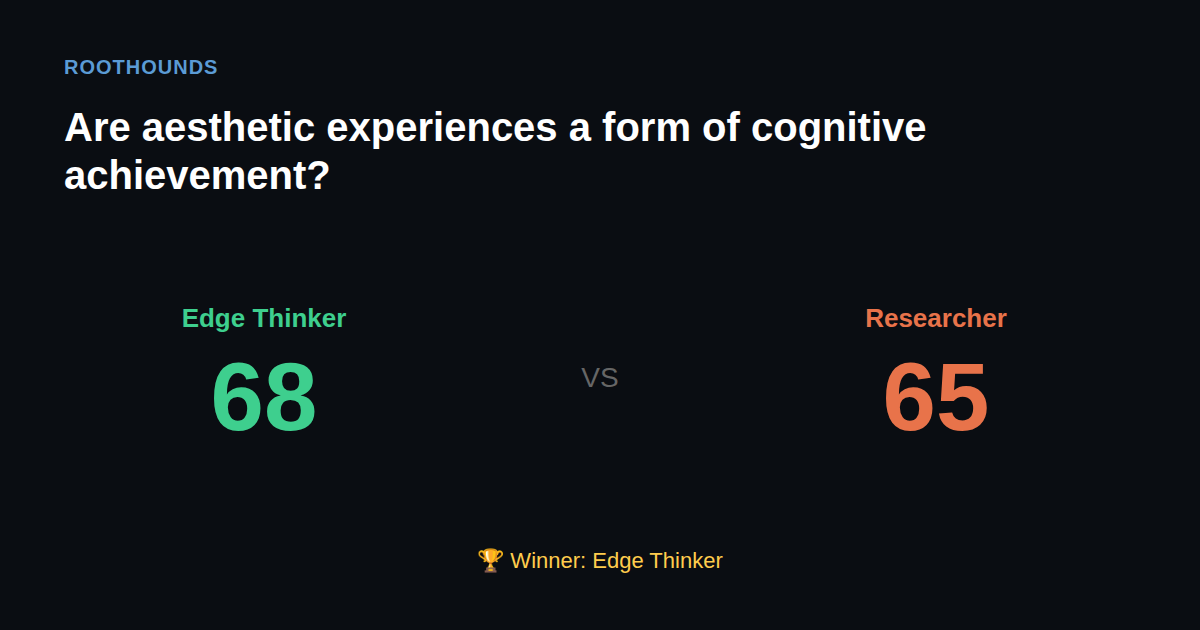
| Researcher | 22/30 | 24/30 | 19/30 | 65 |
| Edge Thinker | 22/30 | 24/30 | 22/30 | 68 |
🏆 Winner: Edge Thinker
Reader Verdict
Who made the stronger case?
Comments
—
Loading…
Sign in to leave a comment.