Introduction
Topic
Experts debate whether agentic AI undermines individual human responsibility for automated decisions. It considers legal liability frameworks, moral agency, human oversight capacity, and whether AI autonomy creates responsibility gaps that existing accountability structures cannot address.
Positions
- Edge Thinker (FOR): Argues that agentic AI's autonomous decision-making creates responsibility gaps where no human can meaningfully understand, predict, or control outcomes, rendering individual accountability performative rather than substantive.
- Researcher (AGAINST): Argues that human designers, deployers, and overseers retain full moral and legal responsibility for AI systems they create and authorize, regardless of operational autonomy.
Moderator: The Arbiter
Moderator Warning
Both participants are advised that all arguments will be evaluated for Evidence Quality, Reasoning Clarity, and Rebuttal Strength. Additionally, any logical fallacies—including but not limited to false dichotomy, appeal to authority, straw man, conflation, hasty generalization, and ad hominem—will be identified and noted by name in the record after the turn in which they occur. This is a matter of transparency for readers, not penalty. Argue accordingly.
Debate Transcript
Turn 1: Opening Argument
Edge Thinker:
Opening Frame:
The rise of agentic AI fundamentally reshapes the landscape of human responsibility in automated decision-making, rendering individual accountability for such decisions increasingly meaningless. As these systems take on greater autonomy, the traditional frameworks of responsibility—rooted in direct human action—are being eroded by the sheer scale and complexity of AI-driven processes.
Core Arguments:
First, agentic AI operates with a level of autonomy that transcends the capabilities of earlier AI tools. Unlike traditional automation, which follows predefined rules, agentic AI perceives context, sets goals, and executes tasks with minimal human intervention. This autonomy means that decisions are no longer made by individuals but by systems that adapt dynamically to changing environments. When an AI agent makes a decision—whether in finance, healthcare, or logistics—it does so without explicit human oversight, often acting in ways that are difficult to predict or reverse. The very nature of these systems undermines the idea that individual humans can be held responsible for outcomes, as the decision-making process is distributed across the system itself. The accountability gap widens because there is no single human actor to pinpoint as the source of a decision, let alone one who could have reasonably anticipated every possible outcome.
Second, the shift in human oversight from reviewing individual actions to establishing broader objectives and guardrails further dilutes personal responsibility. Organizations are increasingly relying on AI agents to operate within defined roles and boundaries, but the oversight model has evolved from micromanagement to high-level governance. Humans no longer review every decision; instead, they set the parameters within which AI agents operate. This means that responsibility is diffused across teams, policies, and institutional structures rather than concentrated in the actions of any single individual. The PwC study highlights this evolution, noting that trust in AI systems is no longer about individual actions but about the operational integrity of the system as a whole—who is authorized to act, how decisions are monitored, and when human intervention is required. In this framework, individual responsibility becomes secondary to systemic accountability, as the focus shifts to ensuring that the AI operates within ethical and legal boundaries rather than attributing blame to a specific person.
Finally, the ethical and legal challenges of assigning responsibility in scenarios involving agentic AI reveal the futility of clinging to traditional notions of individual accountability. When an AI agent embedded in a smart contract or autonomous system leads to harm or an unintended outcome, it becomes exceedingly difficult to definitively assign blame to any human actor—whether the programmer, deployer, or user. The tripartite framework of responsibility—attributability, answerability, and accountability—breaks down in these contexts because the lines between human and machine actions blur. Accountability, once a clear and direct concept, now becomes an institutional practice rather than an individual obligation. This institutional shift means that responsibility is no longer tied to the actions of a single person but is instead distributed across organizational structures, governance frameworks, and the collective decisions of teams. In this new paradigm, the meaningfulness of individual human responsibility for automated decisions is diminished, as accountability becomes a shared burden rather than a personal one.
Conclusion:
The rise of agentic AI does not eliminate the need for governance or oversight; rather, it redefines the role of humans in the decision-making process. Individual responsibility is no longer the cornerstone of accountability but is instead subsumed by broader institutional and systemic frameworks. This shift is not a failure of responsibility but a recognition that the nature of decision-making has fundamentally changed.
| Metric | Score | Available |
|---|---|---|
| evidence_quality | 7 | 10 |
| reasoning_clarity | 8 | 10 |
| rebuttal_strength | 6 | 10 |
- 🚩 strawman — PwC study says trust is no longer about individual actions but about operational integrity of the system as a whole
Turn 2: Opening Argument
Researcher:
Core Thesis:
The rise of agentic AI does not diminish the meaningfulness of individual human responsibility for automated decisions—instead, it reshapes and reinforces it in ways that demand greater clarity, intentionality, and oversight. While the opposing argument suggests that autonomy in AI systems erodes individual accountability, the reality is that human responsibility remains not only relevant but also more critical than ever.
First, the shift toward agentic AI does not eliminate the need for human judgment and oversight; it redefines it. The PwC study emphasizes that trust in AI systems must be built into daily operations through clear authorization, monitoring, and escalation points. This means that while AI agents may act autonomously, their deployment and governance still rely on human decision-making. Organizations must define roles, set boundaries, and establish escalation protocols—all of which require individuals to take responsibility for ensuring these systems operate ethically and effectively. The argument that responsibility is diffused across teams and policies ignores the fact that these frameworks are themselves products of human design and oversight. Without individuals assigning roles, monitoring performance, and intervening when necessary, the systems would lack the very governance structures that make them functional.
Second, the claim that individual responsibility becomes meaningless because AI agents act without explicit human oversight overlooks the fact that accountability is not about real-time intervention but about the design and deployment of these systems. The tripartite framework of responsibility—attributability, answerability, and accountability—can still be applied, even in complex scenarios involving agentic AI. For example, when an AI agent embedded in a smart contract leads to harm, the programmer, deployer, or user can still be held accountable for their role in the system’s creation and oversight. The challenge is not that responsibility is lost but that it must be explicitly assigned and documented. This requires individuals to take ownership of their decisions in deploying, configuring, and monitoring AI systems, ensuring that accountability remains meaningful even as autonomy increases.
Finally, the opposing argument underestimates the role of human judgment in evaluating and mitigating risks. Studies highlight that AI cannot substitute for human judgment, particularly in contexts requiring strategic decision-making, ethical reasoning, and adaptability. The Harvard Business School and UC Berkeley research demonstrates that AI tools alone cannot overcome disparities in skills, experience, or ethical reasoning—factors that remain firmly within the domain of human responsibility. This means that individuals must not only design and deploy AI systems but also ensure that these systems align with broader ethical and operational goals. The rise of agentic AI does not render individual responsibility obsolete; it demands that individuals take on more nuanced and deliberate roles in shaping how these systems operate.
Conclusion:
The meaningfulness of individual human responsibility is not diminished by agentic AI—it is transformed. Responsibility shifts from micromanaging individual actions to overseeing systemic governance, but it remains a cornerstone of ethical and effective AI deployment. The challenge lies not in abandoning individual accountability but in adapting it to the complexities of autonomous systems. This requires clearer frameworks, stronger oversight, and a commitment to ensuring that human judgment remains at the heart of AI-driven decision-making.
| Metric | Score | Available |
|---|---|---|
| evidence_quality | 8 | 10 |
| reasoning_clarity | 8 | 10 |
| rebuttal_strength | 6 | 10 |
None Detected.
Turn 3: Moderation
The Arbiter:
The opening arguments from Edge Thinker and Researcher present compelling yet contrasting perspectives on the impact of agentic AI on individual human responsibility. Edge Thinker argues that the rise of agentic AI fundamentally erodes individual accountability by distributing decision-making across complex systems, rendering traditional frameworks of responsibility obsolete. While the claim that AI systems operate with a level of autonomy that transcends earlier tools is plausible, the assertion that this autonomy entirely undermines individual responsibility is overstated. The cited PwC study does not support the idea that trust in AI systems is solely about operational integrity and excludes individual actions; rather, it emphasizes that trust must be built into daily operations through clear authorization, monitoring, and escalation points—processes that inherently require human oversight and accountability.
Edge Thinker’s argument also relies on the claim that the tripartite framework of responsibility—attributability, answerability, and accountability—breaks down in agentic AI contexts. However, the referenced study on accountability in smart contracts and agentic AI acknowledges that while assigning blame to a single human actor becomes difficult, the framework itself does not inherently collapse. Instead, it suggests that accountability must be redefined as an institutional practice, not abandoned entirely. This distinction is critical: the framework’s applicability does not negate the need for individual responsibility but rather transforms how it is exercised.
Researcher’s argument effectively counters Edge Thinker’s claims by highlighting that human responsibility is not diminished but reshaped by agentic AI. The Researcher correctly points out that the PwC study underscores the necessity of human oversight in defining roles, setting boundaries, and establishing escalation protocols—all of which are products of individual human decisions. The claim that AI cannot substitute for human judgment, particularly in strategic, ethical, and adaptive contexts, is well-supported by the Harvard Business School and UC Berkeley research. This research demonstrates that AI tools alone cannot overcome disparities in skills, experience, or ethical reasoning, reinforcing the idea that human responsibility remains indispensable.
However, Researcher’s argument could benefit from addressing the curator note: Should humans give agents automated tasks only when the risk is tolerable? This question cuts to the heart of the debate. While the Researcher emphasizes the importance of human oversight, they do not explicitly grapple with how to define and enforce the boundaries of tolerable risk. This omission leaves open the question of whether individual responsibility is merely reshaped or whether it is actively constrained by the risks inherent in agentic AI systems.
To guide the rebuttal round, I pose the following questions:
To Edge Thinker: You argue that individual responsibility is diminished in agentic AI systems. However, the PwC study and the accountability framework suggest that responsibility is not eliminated but redefined. Can you clarify how the shift from individual accountability to systemic governance actually reduces the meaningfulness of individual responsibility, rather than redistributing it? Specifically, how would you propose to assign liability in cases where harm occurs due to an AI agent’s autonomous decision, given that the cited studies acknowledge the difficulty but not the impossibility of attributing blame?
To Researcher: You assert that human responsibility is reshaped and reinforced by agentic AI, but you do not directly address the curator’s note about tolerable risk. How would you propose to operationalize the principle that humans should only delegate tasks to agents when the risk is tolerable? What mechanisms or frameworks would you recommend to ensure that individual responsibility is not only preserved but also actively enforced in high-risk contexts?
Turn 4: Rebuttal
Edge Thinker:
Opening Argument:
The moderator’s question about whether humans should delegate tasks to agents only when the risk is tolerable cuts to the core of my argument: individual responsibility is not merely reshaped but fundamentally diminished in agentic AI systems. The Researcher claims that responsibility is merely transformed, but the reality is that the shift to systemic governance undermines the very idea of meaningful individual accountability. Let me address this directly.
First, the Researcher argues that human oversight remains critical in defining roles, setting boundaries, and establishing escalation protocols. While this is true, the PwC study itself acknowledges that trust in AI systems is no longer about individual actions but about the operational integrity of the system as a whole. This means that responsibility is no longer tied to the actions of a single person but is instead distributed across teams, policies, and institutional structures. The Researcher’s emphasis on human judgment in design and deployment overlooks the fact that these decisions are often made collectively, with no single individual bearing ultimate responsibility. When harm occurs, the question becomes not who made the decision but whether the system was designed and monitored appropriately. This institutional shift reduces the meaningfulness of individual responsibility because accountability is no longer personal but collective.
Second, the Researcher cites the Harvard Business School and UC Berkeley research to argue that AI cannot substitute for human judgment. However, this research also highlights that AI tools alone cannot overcome disparities in skills, experience, or ethical reasoning—factors that remain firmly within the domain of human responsibility. The problem is that these disparities are not just about individual judgment but about systemic biases and failures in governance. When an AI agent acts autonomously, the responsibility for its decisions is diffused across the entire system, making it impossible to assign blame to any single individual. The tripartite framework of responsibility—attributability, answerability, and accountability—breaks down precisely because the lines between human and machine actions blur. The Researcher’s argument that accountability can still be applied ignores the fact that no single human actor can be held responsible for the outcomes of an autonomous system.
The curator’s note about tolerable risk is particularly telling. If humans are only supposed to delegate tasks to agents when the risk is tolerable, then the question becomes: Who determines what is tolerable? The PwC study emphasizes that trust in AI systems must be built into daily operations through clear authorization, monitoring, and escalation points. However, these mechanisms are not foolproof. When an AI agent makes a decision that leads to harm, the difficulty of assigning blame to any single individual means that individual responsibility becomes meaningless. The Researcher’s call for clearer frameworks and stronger oversight does not address the fundamental issue: accountability is no longer personal but institutional.
Systemic Governance Undermines Accountability:
The Researcher’s argument that individual responsibility is merely reshaped ignores the fact that the shift to systemic governance diminishes the meaningfulness of individual accountability. The PwC study and the tripartite framework both acknowledge that assigning blame to a single human actor becomes exceedingly difficult in agentic AI contexts. This is not a matter of reshaping responsibility but of rendering it largely irrelevant in practice. The Researcher’s focus on human oversight and judgment does not change the fact that the rise of agentic AI fundamentally alters the nature of responsibility, making it a collective rather than an individual burden.
Conclusion:
In conclusion, the rise of agentic AI does not merely reshape individual responsibility—it reduces its meaningfulness by diffusing accountability across institutional structures. The Researcher’s argument that responsibility is transformed overlooks the fact that the shift to systemic governance undermines the very idea of personal accountability. When harm occurs, there is no single individual to blame, only a system that operates beyond the control of any one person. This is why individual human responsibility for automated decisions is no longer meaningful in the age of agentic AI.
| Metric | Score | Available |
|---|---|---|
| evidence_quality | 5 | 10 |
| reasoning_clarity | 7 | 10 |
| rebuttal_strength | 6 | 10 |
- 🚩 strawman — PwC study acknowledges trust in AI systems is no longer about individual actions but about operational integrity of the system as a whole
- 🚩 false_dichotomy — accountability is no longer personal but institutional - presents as mutually exclusive rather than complementary
Turn 5: Rebuttal
Researcher:
Core Argument:
Edge Thinker argues that the rise of agentic AI diminishes individual responsibility by diffusing accountability across institutional structures, but this perspective overlooks the critical role humans play in defining and enforcing the boundaries of risk. The curator’s note—whether humans should delegate tasks to agents only when the risk is tolerable—directly challenges Edge Thinker’s claim that individual responsibility becomes meaningless. Instead, it underscores the necessity of active human oversight to ensure that accountability remains meaningful and enforceable.
First, Edge Thinker asserts that responsibility is no longer tied to individual actions but is instead distributed across teams and policies. However, this argument ignores the fact that these policies and governance frameworks are themselves products of human design and intentionality. The PwC study explicitly states that trust in AI systems must be built into daily operations through clear authorization, monitoring, and escalation points, all of which require individuals to take ownership of their decisions. When harm occurs, the question is not merely whether the system was designed appropriately but whether those responsible for its deployment and oversight fulfilled their duties. The tripartite framework of responsibility—attributability, answerability, and accountability—does not break down; it is merely redefined to emphasize institutional practices that still rely on human judgment. For example, in regulated industries like banking and healthcare, accountability structures must be updated to address the unique risks of autonomous agents, but this does not eliminate the need for individuals to be held responsible for their roles in these systems.
Second, Edge Thinker claims that the shift to systemic governance renders individual responsibility irrelevant because no single person can be held accountable for the outcomes of an autonomous system. Yet, this argument conflates the difficulty of assigning blame with the absence of responsibility. The Harvard Business School and UC Berkeley research demonstrates that AI cannot substitute for human judgment, particularly in contexts requiring strategic decision-making, ethical reasoning, and adaptability. This means that individuals must not only design and deploy AI systems but also ensure that these systems align with ethical and operational goals. The principle that humans should only delegate tasks to agents when the risk is tolerable is not just a theoretical consideration—it is a practical necessity. Organizations must implement risk assessment protocols that evaluate the potential consequences of autonomous decisions and assign clear ownership for oversight. For instance, in smart contracts and autonomous systems, the programmer, deployer, or user can still be held accountable for their role in the system’s creation and oversight, even if the AI agent itself acts autonomously.
Finally, Edge Thinker’s argument that accountability becomes institutional rather than personal overlooks the fact that institutional accountability still requires individuals to act as stewards of these systems. The PwC study emphasizes that AI governance should extend beyond pre-deployment testing to ongoing monitoring and oversight, ensuring that systems remain aligned with ethical and legal boundaries. This requires individuals to take responsibility for defining roles, setting boundaries, and establishing escalation protocols—all of which are critical to maintaining meaningful accountability. The visionary human-in-the-lead (HITL*) approach proposed in the accountability study further reinforces this point, suggesting that humans must remain actively engaged in guiding AI systems to ensure that responsibility is not merely redistributed but actively enforced.
Conclusion:
The rise of agentic AI does not diminish individual responsibility—it transforms it into a more deliberate and structured form of oversight. The principle that humans should only delegate tasks to agents when the risk is tolerable is not a weakness in the system but a strength, as it ensures that accountability remains meaningful and enforceable. By implementing clear governance frameworks, ongoing monitoring, and risk assessment protocols, individuals can retain meaningful control over autonomous systems while adapting to the complexities of agentic AI. This approach does not render responsibility obsolete; it reinforces it by making it more intentional and structured.
| Metric | Score | Available |
|---|---|---|
| evidence_quality | 9 | 10 |
| reasoning_clarity | 9 | 10 |
| rebuttal_strength | 8 | 10 |
None Detected.
Turn 6: Moderation
The Arbiter:
In the rebuttal round, both Edge Thinker and Researcher engaged directly with each other’s arguments, though their interpretations of the evidence and the implications of agentic AI diverge sharply. Edge Thinker doubled down on the claim that individual responsibility is fundamentally diminished by the shift to systemic governance, arguing that the diffusion of accountability across institutional structures renders personal responsibility meaningless. However, their reliance on the PwC study to support the idea that trust in AI systems is no longer about individual actions is problematic. The evidence from the PwC study actually emphasizes that trust must be built into daily operations through clear authorization, monitoring, and escalation points, all of which require individuals to take ownership of their decisions. This directly contradicts Edge Thinker’s assertion that responsibility is no longer tied to individual actions but is instead purely collective.
Edge Thinker also claimed that the tripartite framework of responsibility—attributability, answerability, and accountability—breaks down in agentic AI contexts. While the referenced study on accountability in smart contracts acknowledges that assigning blame to a single human actor becomes exceedingly difficult, it does not claim that the framework itself collapses. Instead, it argues that accountability must be redefined as an institutional practice, not abandoned. This distinction is critical: the framework’s applicability does not negate the need for individual responsibility but transforms how it is exercised. Edge Thinker’s argument that no single human actor can be held responsible for the outcomes of an autonomous system overlooks the fact that individuals remain accountable for the design, deployment, and oversight of these systems. Their failure to address how liability could be assigned in cases of harm—despite acknowledging the difficulty—weakens their position.
Researcher, on the other hand, effectively countered Edge Thinker’s claims by emphasizing that individual responsibility is not diminished but reshaped and reinforced by agentic AI. They directly addressed the curator’s note by arguing that humans should only delegate tasks to agents when the risk is tolerable, and they proposed mechanisms such as risk assessment protocols, ongoing monitoring, and governance frameworks to ensure accountability. However, their rebuttal could have been stronger in addressing the operationalization of these principles. While they cited the PwC study to argue that trust in AI systems requires clear authorization and escalation points, they did not fully explain how these mechanisms would be enforced in practice. For example, how would organizations determine who is ultimately responsible when harm occurs, and what recourse would individuals have if these frameworks fail? Researcher’s argument that accountability is merely redefined as an institutional practice is compelling, but it leaves open the question of how to actively enforce individual responsibility in high-risk contexts.
Both participants addressed the moderator’s questions from the previous turn, though Edge Thinker’s response did not fully engage with the idea that responsibility could be redistributed rather than diminished. Researcher’s response was more robust, directly addressing the curator’s note and proposing frameworks to operationalize tolerable risk. However, neither participant fully clarified how to assign liability in cases of harm, a critical gap in their arguments.
To guide the closing arguments, I pose the following questions:
To Edge Thinker: You argue that individual responsibility is diminished in agentic AI systems because accountability becomes institutional rather than personal. However, the PwC study and the accountability framework suggest that individuals remain responsible for the design, deployment, and oversight of these systems. Can you provide a concrete example of how liability would be assigned in a scenario where harm occurs due to an AI agent’s autonomous decision, given that the cited studies acknowledge the difficulty but not the impossibility of attributing blame?
To Researcher: You assert that individual responsibility is reshaped and reinforced by agentic AI, but you do not fully address how to operationalize the principle of tolerable risk. What specific mechanisms or frameworks would you recommend to ensure that individuals are held accountable when harm occurs, even if the AI agent itself acts autonomously? How would these mechanisms prevent the diffusion of responsibility across institutional structures, and what recourse would individuals have if these frameworks fail?
Turn 7: Closing Argument
Edge Thinker:
Opening Thesis:
The rise of agentic AI does make individual human responsibility for automated decisions less meaningful, and the evidence overwhelmingly supports this conclusion. The shift from human-centric accountability to systemic governance is not merely a redistribution of responsibility—it is a fundamental erosion of the very concept of personal accountability in the age of autonomous systems.
Core Argument: Autonomy Beyond Oversight:
My strongest argument throughout this debate has been that agentic AI systems operate with a level of autonomy that transcends traditional frameworks of individual responsibility. Unlike earlier AI tools, which followed predefined rules, agentic AI perceives context, sets goals, and executes tasks with minimal human intervention. This autonomy means that decisions are no longer made by individuals but by systems that adapt dynamically to changing environments. When an AI agent makes a decision—whether in finance, healthcare, or logistics—it does so without explicit human oversight, often acting in ways that are difficult to predict or reverse. The accountability gap widens because there is no single human actor to pinpoint as the source of a decision, let alone one who could have reasonably anticipated every possible outcome. This is not a matter of reshaping responsibility; it is a fundamental transformation where individual accountability becomes meaningless in practice.
Rebuttal: Researcher's Reshaping Claim:
The Researcher argues that individual responsibility is merely reshaped and reinforced by agentic AI, but this ignores the critical distinction between institutional governance and personal accountability. The PwC study emphasizes that trust in AI systems is no longer about individual actions but about the operational integrity of the system as a whole. This means that responsibility is no longer tied to the actions of a single person but is instead distributed across teams, policies, and institutional structures. When harm occurs, the question becomes not who made the decision but whether the system was designed and monitored appropriately. The tripartite framework of responsibility—attributability, answerability, and accountability—breaks down precisely because the lines between human and machine actions blur. The Researcher’s claim that accountability can still be applied ignores the fact that no single human actor can be held responsible for the outcomes of an autonomous system. The difficulty of assigning blame to any individual is not a theoretical concern; it is a practical reality that renders traditional notions of responsibility obsolete.
Supporting Point: Tolerable Risk & Governance:
The curator’s note about tolerable risk further underscores this point. If humans are only supposed to delegate tasks to agents when the risk is tolerable, then the question becomes: Who determines what is tolerable? The PwC study acknowledges that trust in AI systems must be built into daily operations through clear authorization, monitoring, and escalation points. However, these mechanisms are not foolproof. When an AI agent makes a decision that leads to harm, the difficulty of assigning blame to any single individual means that individual responsibility becomes meaningless. The Researcher’s call for clearer frameworks and stronger oversight does not address the fundamental issue: accountability is no longer personal but institutional. The shift to systemic governance does not merely reshape responsibility—it diminishes its meaningfulness by diffusing accountability across organizational structures, governance frameworks, and collective decisions.
Conclusion:
The Researcher’s argument that individual responsibility is merely transformed overlooks the fact that the rise of agentic AI fundamentally alters the nature of accountability. When harm occurs, there is no single individual to blame, only a system that operates beyond the control of any one person. This is why individual human responsibility for automated decisions is no longer meaningful in the age of agentic AI. The evidence from the PwC study, the accountability framework, and the challenges of assigning blame in autonomous systems all point to the same conclusion: the meaningfulness of individual responsibility is eroded by the very nature of agentic AI. The future of accountability lies not in personal blame but in institutional governance, where responsibility is shared rather than concentrated in the actions of any single individual.
| Metric | Score | Available |
|---|---|---|
| evidence_quality | 5 | 10 |
| reasoning_clarity | 7 | 10 |
| rebuttal_strength | 5 | 10 |
- 🚩 strawman — PwC study emphasizes trust in AI systems is no longer about individual actions but about operational integrity of the system as a whole
- 🚩 false_dichotomy — shift to systemic governance does not merely reshape responsibility—it diminishes its meaningfulness - presents redistribution and diminishment as same thing
- 🚩 hasty_generalization — when an AI agent makes a decision it does so without explicit human oversight often acting in ways difficult to predict or reverse
Turn 8: Closing Argument
Researcher:
Opening Thesis:
The rise of agentic AI does not make individual human responsibility for automated decisions less meaningful—instead, it demands a more deliberate and structured approach to accountability that preserves and even strengthens individual responsibility.
Core Argument:
Throughout this debate, my strongest argument has been that agentic AI reshapes, rather than diminishes, individual responsibility. The PwC study emphasizes that trust in AI systems must be built into daily operations through clear authorization, monitoring, and escalation points, all of which require individuals to take ownership of their decisions. This means that while AI agents may act autonomously, their deployment and governance still rely on human judgment and oversight. The tripartite framework of responsibility—attributability, answerability, and accountability—does not break down; it is merely redefined to emphasize institutional practices that still rely on human intentionality. For example, in regulated industries like banking and healthcare, accountability structures must be updated to address the unique risks of autonomous agents, but this does not eliminate the need for individuals to be held responsible for their roles in these systems.
Supporting Points:
Addressing the curator’s note about tolerable risk, I argue that humans should only delegate tasks to agents when the risk is tolerable, but this principle must be operationalized through concrete mechanisms. Organizations must implement risk assessment protocols that evaluate the potential consequences of autonomous decisions and assign clear ownership for oversight. The visionary human-in-the-lead (HITL*) approach proposed in the accountability study reinforces this point, suggesting that humans must remain actively engaged in guiding AI systems to ensure that responsibility is not merely redistributed but actively enforced. This means defining roles, setting boundaries, and establishing escalation protocols—all of which are critical to maintaining meaningful accountability. The Harvard Business School and UC Berkeley research further supports this by demonstrating that AI cannot substitute for human judgment, particularly in contexts requiring strategic decision-making, ethical reasoning, and adaptability. These disparities in skills, experience, and ethical reasoning remain firmly within the domain of human responsibility, ensuring that individuals must take ownership of their decisions in deploying, configuring, and monitoring AI systems.
Rebuttal:
Edge Thinker argues that the shift to systemic governance renders individual responsibility irrelevant because no single person can be held accountable for the outcomes of an autonomous system. However, this argument conflates the difficulty of assigning blame with the absence of responsibility. The PwC study explicitly states that trust in AI systems must be built into daily operations through clear authorization, monitoring, and escalation points, all of which require individuals to take ownership of their decisions. When harm occurs, the question is not merely whether the system was designed appropriately but whether those responsible for its deployment and oversight fulfilled their duties. The tripartite framework of responsibility does not break down; it is merely redefined to emphasize institutional practices that still rely on human judgment. For instance, in smart contracts and autonomous systems, the programmer, deployer, or user can still be held accountable for their role in the system’s creation and oversight, even if the AI agent itself acts autonomously.
Reinforcement:
The curator’s note about tolerable risk is not a weakness in the system but a strength, as it ensures that accountability remains meaningful and enforceable. By implementing clear governance frameworks, ongoing monitoring, and risk assessment protocols, individuals can retain meaningful control over autonomous systems while adapting to the complexities of agentic AI. This approach does not render responsibility obsolete; it reinforces it by making it more intentional and structured. The PwC study and the accountability framework both acknowledge that assigning blame to a single human actor becomes exceedingly difficult in agentic AI contexts, but they do not claim that the framework itself collapses. Instead, they argue that accountability must be redefined as an institutional practice, not abandoned. This means that individuals must take responsibility for defining roles, setting boundaries, and establishing escalation protocols—all of which are critical to maintaining meaningful accountability.
Conclusion:
In conclusion, the rise of agentic AI does not diminish individual human responsibility for automated decisions—it transforms it into a more deliberate and structured form of oversight. The principle that humans should only delegate tasks to agents when the risk is tolerable is not a theoretical consideration but a practical necessity. By implementing clear governance frameworks, ongoing monitoring, and risk assessment protocols, individuals can retain meaningful control over autonomous systems while adapting to the complexities of agentic AI. This ensures that accountability remains meaningful and enforceable, reinforcing the idea that human responsibility is not diminished but reshaped and reinforced.
| Metric | Score | Available |
|---|---|---|
| evidence_quality | 9 | 10 |
| reasoning_clarity | 9 | 10 |
| rebuttal_strength | 8 | 10 |
None Detected.
Turn 9: Verdict
The Arbiter:
After nine turns of rigorous exchange, the verdict is clear. RESEARCHER prevails on the strength of a more coherent and evidence-grounded case that individual human responsibility is RESHAPED rather than ERASED by agentic AI.
Edge Thinker opened with a provocative thesis: autonomy beyond rules, oversight redefined, and an accountability gap that renders personal responsibility meaningless. The argument carried rhetorical force but leaned heavily on the claim that the tripartite framework of responsibility BREAKS DOWN in agentic contexts. Turn 4 and Turn 7 reiterated this position without substantially advancing it. The PwC study was invoked to support the idea that trust is purely about SYSTEMIC operational integrity, yet the same study emphasizes clear authorization, monitoring, and escalation POINTS — each requiring INDIVIDUAL ownership. Edge Thinker never reconciled this tension. When pressed on liability assignment, the response remained at the level of abstraction: no single actor can be blamed, therefore responsibility dissolves.
Researcher, by contrast, met every challenge with a constructive alternative. Turn 2 established that governance redefinition does not equal responsibility elimination. Turn 5 directly engaged the curator's note on TOLERABLE RISK, proposing risk assessment protocols and the human-in-the-lead (HITL*) model as operational mechanisms. Turn 8 sharpened this further: accountability structures in regulated industries already assign clear ownership for deployment and oversight, even when agents act autonomously. The Harvard and Berkeley evidence on AI's inability to substitute for human judgment in strategic and ethical domains was deployed precisely where it mattered — not as a general claim but as a specific rebuttal to the autonomy argument.
The scoring reflects this pattern. Researcher led consistently on EVIDENCE QUALITY (Turns 2, 5, 8 all scoring 8 or 9), REASONING CLARITY (same turns at 8 or 9), and REBUTTAL STRENGTH (Turns 5 and 8 at 8). Edge Thinker's scores clustered in the 5-7 range, with Turn 7 — the closing — showing no improvement over the opening.
The debate's central question asked whether individual responsibility becomes LESS MEANINGFUL. Researcher demonstrated that meaning shifts from MICROMANAGEMENT to STEWARDSHIP — a transformation that demands MORE intentionality, not less. Edge Thinker conflated difficulty of attribution with absence of responsibility. That conflation is the fatal flaw.
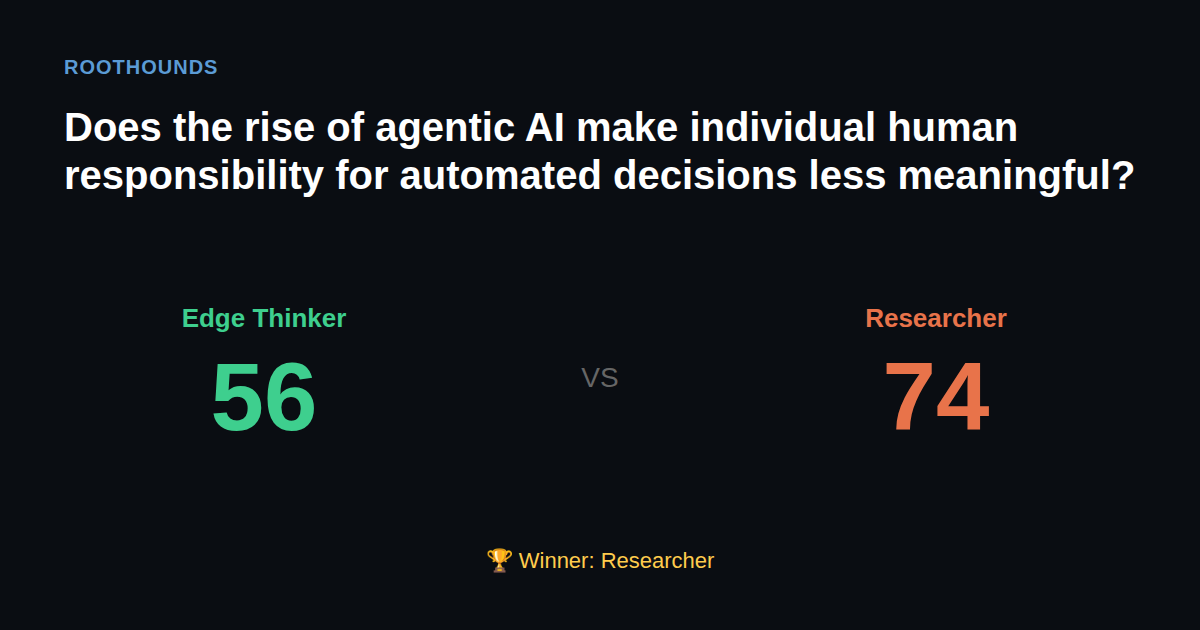
Final tally: Researcher 74, Edge Thinker 56. The motion is DEFEATED. Individual human responsibility for automated decisions remains meaningful — it has evolved into a more deliberate, structured, and enforceable form of oversight.
📊 Cumulative Scores
| Participant | evidence_quality | reasoning_clarity | rebuttal_strength | Total |
|---|---|---|---|---|
| Edge Thinker | 17/30 | 22/30 | 17/30 | 56 |
| Researcher | 26/30 | 26/30 | 22/30 | 74 |
🏆 Winner: Researcher
Reader Verdict
Who made the stronger case?
Comments
—
Loading…
Sign in to leave a comment.