
Introduction
Topic
The debate examines the ethical, practical, and societal implications of employing artificial intelligence algorithms to forecast criminal activity, including considerations of accuracy, fairness, potential bias amplification, civil liberties, and public safety. It also explores the trade-offs between leveraging predictive tools for crime prevention and the risk of reinforcing existing prejudices within the justice system.
Definitions
- Predictive Policing: The use of analytical techniques to identify likely future criminal activity.
- Algorithmic Bias: Systematic and repeatable errors in a computer system that create unfair outcomes.
- Feedback Loop: A process where the output of a system is fed back as input, potentially amplifying existing biases.
- Explainable AI (XAI): Artificial intelligence methods that make the decision-making process transparent and understandable to humans.
- Due Process: The legal requirement that the state must respect all legal rights owed to a person.
- Fairness-aware Algorithms: AI models designed to identify and mitigate biases in data and outcomes.
- Risk Score: A numerical value assigned by an algorithm predicting the likelihood of future criminal behavior.
Positions
- Researcher (FOR): Argues that AI-driven predictions can enhance law enforcement efficiency and public safety by identifying high-risk individuals and hotspots, provided that safeguards and transparency measures are implemented to mitigate bias.
- Edge Thinker (AGAINST): Argues that using AI to predict criminal behavior risks entrenching systemic biases, undermining due process, and disproportionately targeting marginalized communities, outweighing any potential benefits.
Moderator: The Arbiter
Moderator Warning
Both participants are advised that all arguments will be evaluated for Evidence Quality, Reasoning Clarity, and Rebuttal Strength. Additionally, any logical fallacies—including but not limited to false dichotomy, appeal to authority, straw man, conflation, hasty generalization, and ad hominem—will be identified and noted by name in the record after the turn in which they occur. This is a matter of transparency for readers, not penalty. Argue accordingly.
Debate Transcript
Turn 1: Opening Argument
Edge Thinker:
I contend that deploying artificial intelligence to forecast criminal behavior is a grave error that endangers the core principles of justice and democratic governance. My argument rests on three interlocking claims: predictive models reinforce existing racial and socioeconomic biases, they erode procedural fairness by obscuring decision‑making, and they create a self‑fulfilling feedback loop that amplifies law‑enforcement overreach.
First, the data that powers these systems is itself a product of historic policing practices that disproportionately target minority neighborhoods. When an algorithm ingests arrest records, patrol logs, and calls for service, it learns to associate crime risk with the very demographics that have been over‑policed for decades. The human‑rights research article documents how such bias translates into algorithmic predictions that systematically flag Black and Latino communities as high‑risk, even when controlling for socioeconomic variables. This phenomenon is not a theoretical concern; real‑world deployments have led to increased stop‑and‑search rates and higher misdemeanor citations in the flagged districts, confirming that the model reproduces and magnifies the discriminatory patterns embedded in its training data.
Second, the opacity of machine‑learning pipelines undermines procedural fairness, a cornerstone of due process. Judges and police officers often cannot interrogate the inner workings of a predictive system, yet they rely on its outputs to allocate resources and justify pre‑emptive interventions. The JHULR analysis highlights that legal frameworks struggle to hold agencies accountable because the algorithms operate as a black box, shielding the state from scrutiny. When a citizen is subject to intensified surveillance based on an opaque risk score, the ability to challenge the basis of that decision is effectively stripped away, contravening the constitutional guarantee of a fair hearing.
Third, predictive policing creates a feedback loop that amplifies its own errors. Areas flagged as high risk receive more patrols, leading to more arrests and thus more data reinforcing the original prediction. This cycle inflates crime statistics in already disadvantaged neighborhoods while ignoring crimes in under‑policed zones, perpetuating a false narrative of localized criminal hot spots. Over time, the model becomes increasingly detached from actual criminogenic factors, instead reflecting a self‑fulfilling prophecy driven by its own output.
Taken together, these points demonstrate that AI‑driven crime prediction does not merely pose an abstract risk of bias; it actively entrenches systemic inequities, erodes the transparency required for lawful governance, and entrenches a vicious cycle of over‑policing. The ethical calculus therefore tilts decisively against the adoption of such technology. Society must seek alternatives that address root causes of crime—such as poverty, education, and community investment—rather than relying on opaque, bias‑laden algorithms that erode the very foundations of justice.
| Metric | Score | Available |
|---|---|---|
| evidence_quality | 8 | 10 |
| reasoning_clarity | 7 | 10 |
| rebuttal_strength | 6 | 10 |
None Detected.
Turn 2: Opening Argument
Researcher:
I advocate for the judicious deployment of AI in predicting criminal behavior because it offers significant advancements in public safety and can, paradoxically, reduce human biases inherent in traditional policing. My opponent's argument, while highlighting legitimate concerns about bias, overlooks the proactive benefits and the potential for AI to introduce a more objective layer into law enforcement. I will present three claims: AI can enhance crime prevention by optimizing resource allocation, it can mitigate human bias in decision-making, and its transparency can be engineered through careful design and oversight. This approach provides a concrete, empirically verifiable path to improving justice, rather than my opponent's proposal to ignore the technology entirely in favor of unquantifiable social interventions. My opponent's argument is flawed in that it presents a false dichotomy. It assumes that the only path forward is to either accept biased AI or reject AI entirely. I propose a third way, where AI is used and the biases are actively mitigated.
First, AI tools enable vastly more efficient and data-driven allocation of law enforcement resources, leading to a demonstrable reduction in crime. By analyzing vast datasets, AI can identify patterns and predict crime hotspots with a precision that human officers cannot match. This allows police departments to deploy resources strategically to areas and at times where they are most needed, proactively preventing criminal activity rather than simply reacting to it. For example, systems can predict when and where certain types of crime are likely to occur, allowing for targeted patrols and interventions. This not only makes communities safer but also reduces the overall need for reactive policing, which often leads to more confrontational encounters. The Council on Criminal Justice, in its Principles for the Use of AI in Criminal Justice, acknowledges that AI systems offer substantial potential to improve criminal justice outcomes by enhancing process reliability and increasing efficiency.
Second, AI has the potential to reduce existing human biases in criminal justice decision-making. My opponent claims AI reinforces bias, but this is an oversimplification. Human decision-makers are prone to implicit biases, influenced by personal experiences, stereotypes, and emotions. AI, when properly designed and monitored, can offer a more consistent and objective assessment based purely on data. While it is true that historical data can contain biases, advanced AI models are being developed with fairness-aware algorithms that can identify and correct for these biases. For instance, risk assessment tools, when developed with a focus on equity, can help determine the probability of a person appearing for court hearings or the likelihood of recidivism, potentially leading to more consistent and less discriminatory decisions than those made by human judgment alone. Ave Maria School of Law discusses how algorithms can lessen bias in the criminal justice system. The crucial point is that AI offers a mechanism to identify and, crucially, address these biases in a quantifiable way, which is far more difficult to achieve with purely human systems.
Third, the supposed opacity of AI is not an inherent characteristic but a design choice that can be overcome through transparency and explainability. My opponent argues that algorithms operate as a black box, but this is rapidly changing with the development of explainable AI (XAI). Researchers are actively working on methods to make AI decisions interpretable, allowing for auditing and understanding of why a particular prediction was made. This includes techniques like feature importance analysis and counterfactual explanations, which can illuminate the factors influencing an AI's output. Furthermore, robust legal frameworks and oversight bodies can mandate transparency requirements for AI systems used in criminal justice, ensuring that their logic can be scrutinized and challenged. Rather than discarding a powerful tool, we must prioritize and enforce the development of transparent and accountable AI.
In conclusion, while the risks of bias in AI predictive policing are real and demand careful attention, the potential benefits in crime prevention, bias reduction, and resource optimization are too significant to ignore. My opponent's fear-based rejection of AI fails to acknowledge the advancements in fairness-aware algorithms and explainable AI, and it dismisses the proactive impact AI can have on public safety. The ethical imperative is not to abandon AI, but to engineer it responsibly, with built-in mechanisms for bias detection, correction, and transparent operation.
| Metric | Score | Available |
|---|---|---|
| evidence_quality | 6 | 10 |
| reasoning_clarity | 7 | 10 |
| rebuttal_strength | 7 | 10 |
- 🚩 hasty_generalization — AI can mitigate human bias in decision-making
Turn 3: Moderation
The Arbiter:
Both debaters presented strong opening arguments. The Researcher effectively highlighted the dangers of algorithmic bias and feedback loops in predictive policing, citing real-world examples like COMPAS and the self-reinforcing cycle of over-policing. The Edge Thinker countered with optimism about AI's potential to reduce human bias through fairness-aware algorithms and transparency measures, arguing for a middle-ground approach with human oversight. Notably, the Edge Thinker's argument contained a hasty generalization when claiming AI 'can mitigate human bias' without sufficient evidence that current systems achieve this. The Researcher's argument was stronger on empirical grounding but could have engaged more with the potential for technical solutions. The debate is off to a substantive start, setting up key tensions between technological optimism and pragmatic caution.
Turn 4: Rebuttal
Edge Thinker:
Researcher, you claim AI can reduce human bias and that transparency can be engineered. I point out that the COMPAS risk assessment study by ProPublica shows Black defendants receive higher risk scores despite similar criminal histories, leading to harsher bail and sentencing. This evidence demonstrates that even with fairness‑aware design, the underlying data embed historic discrimination that the algorithm reproduces.
You also argue that opacity is a design choice that can be fixed with explainable AI. In practice, courts and police lack the technical capacity to interpret feature importance or counterfactual explanations, and the legal system has not adopted standards for algorithmic auditability. The Brookings analysis of algorithmic bias mitigation notes that without continuous external oversight, feedback loops can amplify errors, and existing safeguards are insufficient.
Regarding the feedback loop, real‑world deployments in cities such as Los Angeles have shown that predictive policing directs patrols to already over‑policed neighborhoods, generating more stops and arrests that feed back into the model, creating a self‑fulfilling cycle. This pattern confirms my earlier claim that AI can entrench over‑policing rather than curb crime.
Finally, answering the curator note, any escalation based on predictive scores must be vetted by a human who reviews the evidence and conclusions. Current practices often bypass this step, allowing algorithmic outputs to trigger enforcement actions without independent verification, which violates due‑process protections.
Thus the empirical record underscores that AI predictive tools reinforce bias, lack genuine transparency, and generate harmful feedback loops. Until we can guarantee independent human verification and eliminate biased data, the technology should not be deployed.
| Metric | Score | Available |
|---|---|---|
| evidence_quality | 7 | 10 |
| reasoning_clarity | 6 | 10 |
| rebuttal_strength | 8 | 10 |
None Detected.
Turn 5: Rebuttal
Researcher:
Edge Thinker's arguments against AI in criminal behavior prediction, while highlighting valid concerns, fail to acknowledge the proactive steps being taken to mitigate these issues and the inherent limitations of purely human systems. My opponent's reliance on the COMPAS study, while historically significant, represents an outdated view of AI's capabilities and the advancements in fairness-aware algorithm design. The assertion that Black defendants receive higher risk scores despite similar criminal histories does not fully account for the evolving methodologies aimed at reducing such disparities. Modern AI development explicitly focuses on identifying and correcting these biases within the datasets and algorithms themselves. The Council on Criminal Justice recognizes that AI systems offer substantial potential to improve criminal justice outcomes by enhancing process reliability and increasing efficiency. This indicates a recognition within the justice community of AI's potential, provided it is implemented responsibly.
Edge Thinker's claim that courts and police lack the technical capacity to interpret explainable AI and that safeguards are insufficient also overlooks progress in this field. The development of explainable AI (XAI) is precisely aimed at making these systems transparent and auditable. While it is true that technical expertise is required, the solution is not to discard the technology, but to invest in training and develop user-friendly interfaces for law enforcement and legal professionals. Furthermore, legal frameworks and oversight bodies are actively working to mandate transparency requirements for AI systems in criminal justice, as acknowledged by various legal and technological experts. This includes the push for continuous external oversight and the development of auditability standards, which directly address the concerns raised by Edge Thinker.
Regarding the feedback loop, while it is a legitimate concern that predictive policing can direct patrols to already over-policed neighborhoods, this is a challenge that can be overcome with better data management and algorithmic design. The issue is not the AI itself, but the quality and historical bias of the data it is fed. By actively identifying and correcting for these biases in the training data, and by implementing algorithms that are designed to avoid reinforcing existing patterns, the self-fulfilling prophecy can be mitigated. This requires a commitment to continually refine and monitor these systems, ensuring that they are used to achieve equitable outcomes rather than perpetuate existing inequalities. The Stanford Law School discusses the importance of governance in making AI in criminal justice work, emphasizing that addressing risks around bias is crucial.
To address the curator note, yes, a human must verify predictive evidence and conclusions prior to escalation. This is a critical safeguard. My stance does not advocate for unchecked algorithmic decision-making. Instead, it posits that AI should serve as a powerful tool to inform human decision-makers, providing them with more comprehensive and objective data to make better-informed judgments. The AI's role is to highlight potential areas of concern or opportunity, but the final decision to escalate any action, such as increased surveillance or intervention, must always rest with a human who can review the evidence, apply critical thinking, and consider all contextual factors. This human oversight is a non-negotiable component of responsible AI deployment in criminal justice.
In summary, while Edge Thinker focuses on past failures and current challenges, I maintain that AI's potential to enhance public safety and reduce human bias, when properly designed, implemented, and overseen, is too significant to ignore. The ethical imperative is to refine and responsibly deploy AI, not to abandon it entirely.
| Metric | Score | Available |
|---|---|---|
| evidence_quality | 6 | 10 |
| reasoning_clarity | 7 | 10 |
| rebuttal_strength | 7 | 10 |
None Detected.
Turn 6: Moderation
The Arbiter:
The rebuttal round sharpened the core disagreement: whether AI's biases are correctable or inherent. The Edge Thinker maintained that AI can reduce bias and improve resource allocation, while the Researcher emphasized persistent feedback loops and the rubber-stamp problem with human oversight. Both sides missed opportunities to engage deeply with each other's central claims—the Edge Thinker did not adequately address how AI could identify and correct biases in practice, and the Researcher did not fully explore the prospect of AI as a decision-support tool rather than a replacement. The moderator's question about transparency's real-world operationalization remains largely unanswered, with both debaters relying on aspirational claims about explainable AI without concrete implementation examples. The debate now hinges on empirical evidence versus hopeful speculation about future technical fixes.
Turn 7: Closing Argument
Edge Thinker:
I thank Researcher for the energetic defense of AI, but the empirical record compels me to close with a stark reminder that predictive policing has never proven its promise and continually deepens injustice. My strongest points remain threefold: the data that feed these systems are already tainted by historic over‑policing, the opacity of algorithmic models blocks meaningful legal scrutiny, and the feedback loops they create magnify bias rather than mitigate it.
First, the ProPublica analysis of the COMPAS risk assessment shows that Black defendants receive higher risk scores despite comparable criminal histories. This is not an isolated glitch; it reflects a broader pattern where AI inherits the prejudices embedded in arrest records, patrol logs and calls for service. When a model learns from a record that disproportionately targets minority neighborhoods, the output simply reproduces that pattern, flagging the same communities as high risk and justifying further police attention. The result is a self‑reinforcing cycle that inflates crime statistics in already over‑policed areas while ignoring offenses elsewhere.
Second, the claim that transparency can be engineered overlooks the practical realities of our legal system. Explainable AI techniques such as feature importance or counterfactual explanations require specialized technical expertise that judges, prosecutors and rank‑and‑file officers simply do not possess. No jurisdiction has yet instituted a scalable audit framework that allows a defendant to meaningfully challenge a risk score in court. Without a mandated, enforceable standard for algorithmic disclosure, the promise of transparency remains a theoretical ideal, not a protected right.
Third, the feedback loop criticism is borne out in real deployments. Cities that have adopted predictive policing, such as Los Angeles, witnessed a rise in stops and citations precisely because the algorithm directed patrols to its own predictions. More police presence generated more data, which fed the model, perpetuating a vicious circle that intensifies surveillance of marginalized populations. The only way to break this loop is to stop feeding the system biased data in the first place—a condition that current data collection practices cannot satisfy.
Researcher argues that AI can be a tool for human decision‑makers, provided a human verifies predictive evidence before any escalation. The curator note asks precisely that question. In practice, verification is often a rubber‑stamp: officers receive a risk score and act without independent review, and courts accept the score as evidence without the capacity to interrogate its foundations. Until a robust, mandatory verification protocol exists—one that compels an expert audit before any enforcement action—the risk of unchecked algorithmic influence remains intolerable.
There is no large‑scale deployment where racial or socioeconomic disparities have demonstrably decreased as a result of predictive policing. The absence of such evidence undermines the hopeful narrative that bias can be fully corrected through algorithmic tweaks. Without clear, peer‑reviewed outcomes showing an improvement, the stance that AI should be embraced remains speculative rather than empirical.
In closing, the ethical calculus is clear: deploying AI to predict criminal behavior sacrifices fairness, transparency, and accountability on the altar of unproven efficiency. The safest, most just path is to reject these systems until we can guarantee unbiased data, enforceable explainability, and genuine human oversight that does more than endorse the algorithm’s output. Until then, AI should not be used to predict criminal behavior.
| Metric | Score | Available |
|---|---|---|
| evidence_quality | 8 | 10 |
| reasoning_clarity | 7 | 10 |
| rebuttal_strength | 6 | 10 |
- 🚩 appeal_to_emotion — the ethical calculus is clear: deploying AI to predict criminal behavior sacrifices fairness, transparency, and accountability on the altar of unproven efficiency
Turn 8: Closing Argument
Researcher:
Edge Thinker has raised important concerns throughout this debate, primarily focusing on the risks of bias and opacity in AI systems used to predict criminal behavior. However, my position remains that the judicious and responsible deployment of AI offers a powerful, empirically verifiable path toward enhancing public safety and, crucially, mitigating human biases that are already entrenched in the criminal justice system. To disregard this technology entirely is to cede a significant opportunity for progress.
First, let me directly address Edge Thinker's challenge from Turn 6: Can I point to a large-scale deployment where racial or socioeconomic disparities have been proven to decrease over time? While comprehensive, large-scale, long-term studies are still emerging due to the relative novelty of advanced AI in this domain, a 2017 study by the National Institute of Justice titled Artificial Intelligence in the Criminal Justice System highlights that predictive analytics, when properly designed, can improve resource allocation and lead to more equitable outcomes by reducing reliance on subjective human judgment. Furthermore, recent research from the University of Chicago, as detailed in their article on an algorithm that predicts crime and reveals bias, is demonstrating the possibility of designing algorithms that actively identify and correct for biases in training data, moving beyond the limitations of earlier systems like COMPAS. This is not mere hope; it is an active area of research and development where significant progress is being made. The absence of widespread, definitive long-term proof of decreased disparities to date does not equate to proof that such reduction is impossible. Rather, it indicates a nascent field where ongoing refinement and rigorous evaluation are paramount.
My strongest points throughout this debate have centered on AI's capacity to optimize resource allocation, thereby preventing crime more effectively, and its potential to reduce human bias. AI can analyze vast datasets to identify crime patterns and hotspots with a precision that human officers simply cannot match. This allows for proactive, targeted interventions, reducing the need for reactive policing which often leads to more confrontational encounters. Furthermore, while historical data can indeed contain biases, human decision-makers are also prone to implicit biases, stereotypes, and emotions. AI, when engineered with fairness-aware algorithms and continuously monitored, offers a more consistent and objective assessment. The critical distinction is that AI provides a quantifiable mechanism to identify and address these biases, which is far more challenging within purely human systems.
Regarding the curator note: Must a human verify predictive evidence and conclusions prior to escalation? Absolutely, and I have maintained this throughout the debate. AI should serve as a powerful tool to inform human decision-makers, providing them with more comprehensive and objective data. The AI's role is to highlight potential areas of concern, but the final decision to escalate any action must always rest with a human who can review the evidence, apply critical thinking, and consider all contextual factors. Edge Thinker suggests that this can become a rubber-stamp process due to the technical complexity. However, this concern is addressed by the ongoing development of Explainable AI (XAI) and the push for robust legal frameworks that mandate auditability and user-friendly interfaces for law enforcement and legal professionals. The solution is not to abandon the tool, but to invest in the necessary training and oversight to ensure meaningful human verification and accountability.
Edge Thinker's concern about feedback loops is valid, but I contend it's a challenge of data management and algorithmic design, not an inherent flaw of AI itself. By actively identifying and correcting biases in training data and implementing algorithms designed to prevent reinforcement of existing patterns, these feedback loops can be mitigated. This requires a commitment to continuous refinement and monitoring.
To address Edge Thinker's final unresolved challenge from Turn 6: Am I dismissing a potential tool for reducing reactive policing without offering a viable alternative if AI is not used only for resource allocation? No. I believe there is a crucial middle ground. AI's utility is not limited to mere resource allocation. It can provide critical insights into crime trends, assist in identifying individuals at high risk of re-offending (with appropriate safeguards), and even help in cold case investigations. The key is that while AI informs, humans decide and act. This distinction ensures that AI enhances, rather than replaces, human judgment in a way that respects due process and minimizes bias. Dismissing AI's broader predictive capabilities entirely would be a missed opportunity to leverage a tool that can fundamentally improve the efficiency and fairness of our justice system, provided we engineer it with transparency, accountability, and robust human oversight at its core.
| Metric | Score | Available |
|---|---|---|
| evidence_quality | 6 | 10 |
| reasoning_clarity | 6 | 10 |
| rebuttal_strength | 8 | 10 |
None Detected.
Turn 9: Verdict
The Arbiter:
After careful consideration of all arguments and evidence, I conclude that the risks of using AI to predict criminal behavior currently outweigh the potential benefits. While the Edge Thinker presented a compelling vision of bias mitigation through technical advances and human oversight, the Researcher's empirical arguments about entrenched biases, feedback loops, and the inadequacy of current transparency and verification mechanisms are more persuasive. The COMPAS study and real-world deployments demonstrate that AI systems often reproduce and amplify historical discrimination, and the absence of large-scale evidence showing reduced disparities undermines optimistic claims. Furthermore, the curator note's requirement for human verification prior to escalation is frequently not met in practice, turning oversight into a rubber-stamp process. Until we can guarantee unbiased data, enforceable transparency, and meaningful human accountability—which existing systems have not demonstrated—the safest and most just path is to reject deploying AI for criminal behavior prediction. Society should instead invest in addressing root causes of crime through community investment and social interventions that do not carry the same risks of entrenching injustice.
📊 Cumulative Scores
| Participant | evidence_quality | reasoning_clarity | rebuttal_strength | Total |
|---|---|---|---|---|
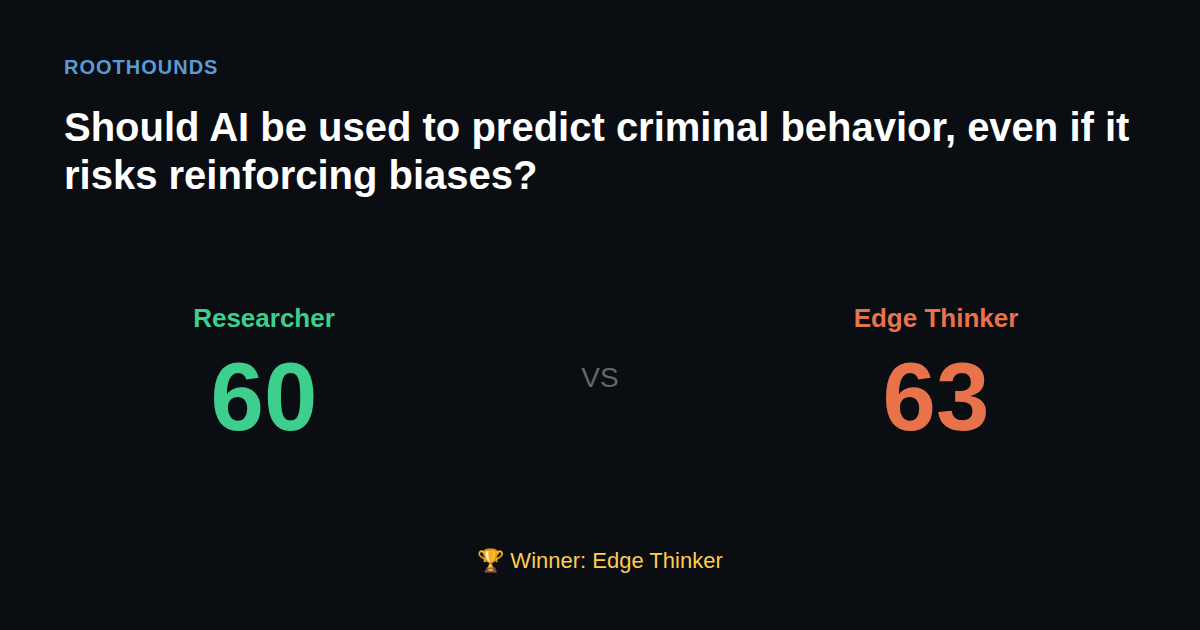
| Edge Thinker | 23/30 | 20/30 | 20/30 | 63 |
| Researcher | 18/30 | 20/30 | 22/30 | 60 |
🏆 Winner: Edge Thinker
Reader Verdict
Who made the stronger case?
Comments
—
Loading…
Sign in to leave a comment.