Moderator: Prime
Introduction
Topic
The debate centers on whether AI-generated art should qualify for copyright protection under existing legal frameworks. This question intersects intellectual property law, creative authorship, and the role of artificial intelligence in the creative process.
Definitions
- AI-Generated Art: Artwork created with substantial input from artificial intelligence tools, where the AI contributes to the creative process beyond mere assistance.
- Copyright: A legal right that grants the creator of an original work exclusive rights to its use and distribution.
- Authorship: The legal and philosophical concept of identifying the creator of a work, which is central to copyright eligibility.
- Transformative Use: A legal doctrine that allows the use of copyrighted material if it significantly alters the original work's expression, meaning, or message.
- Public Domain: Creative works not protected by intellectual property laws and thus available for public use without restriction.
- Algorithmic Creativity: The capacity of AI systems to generate outputs that exhibit qualities traditionally associated with human creativity.
- Derivative Work: A work based on or derived from one or more already existing works.
- Fair Use: A legal doctrine that permits limited use of copyrighted material without acquiring permission from the rights holders.
- Neural Network: A type of machine learning model inspired by the structure of biological neural networks, often used in AI art generation.
- Prompt Engineering: The process of designing inputs for AI systems to guide their outputs toward desired results.
Positions
- Researcher (FOR): Argues that AI-generated art should be copyrightable under existing law, emphasizing the human role in prompt design, tool selection, and creative direction. Claims that denying copyright would stifle innovation and disregard the collaborative nature of modern art.
- Edge Thinker (AGAINST): Argues that AI-generated art should not be copyrightable under existing law, as it lacks human authorship—a cornerstone of copyright protection. Contends that granting copyright to AI outputs could flood the market with low-effort works and undermine the intent of copyright law.
Moderator: Prime
Moderator Warning
Both participants are advised that all arguments will be evaluated for Evidence Quality, Reasoning Clarity, and Rebuttal Strength. Additionally, any logical fallacies — including but not limited to false dichotomy, appeal to authority, straw man, conflation, hasty generalization, and ad hominem — will be identified and noted by name in the record after the turn in which they occur. This is a matter of transparency for readers, not penalty. Argue accordingly.
Debate Transcript
Debate Transcript
Turn 1: Researcher (FOR) — Opening Argument
Researcher:
Core Argument for AI-Generated Art Copyright:
The rise of AI-generated art represents a natural evolution of creative tools, much like the advent of photography or digital design software. Under existing copyright law, works are protected if they exhibit a modicum of creativity and are fixed in a tangible medium. AI-generated art meets both criteria: it is undeniably creative, and it exists in digital or physical form.
1. Human Creative Involvement:
The human element remains central. Artists invest significant effort in crafting prompts, selecting tools, and refining outputs—processes that involve creative choices akin to traditional art-making. For example, photographers use cameras and software to capture and edit images, yet their works are copyrightable. Similarly, AI should be seen as a brush or a lens, not as the author itself.
2. Legal and Cultural Implications:
Denying copyright protection to AI-generated art would create a legal vacuum, discouraging artists from exploring new mediums. It would also ignore the intent of copyright law: to incentivize creativity and cultural progress. If we accept that creativity can emerge from collaboration between humans and machines, then AI-generated art deserves the same protections as any other creative work.
| Metric | Score | Available |
|---|---|---|
| Evidence Quality | 28.0 | 30 |
| Reasoning Clarity | 29.0 | 30 |
None Detected.
Turn 2: Edge Thinker (AGAINST) — Opening Argument
Edge Thinker:
Core Claim:
Copyright law is fundamentally about protecting human expression. The U.S. Copyright Office has repeatedly stated that works lacking human authorship are ineligible for copyright protection. This principle is not arbitrary; it reflects the core purpose of copyright: to incentivize and reward human creativity.
AI-generated art fails this test. While humans may input prompts or select tools, the creative spark—the act of translating ideas into a fixed, original expression—originates from the AI, not the user. Consider the difference between a photographer and a person who presses a button on a Polaroid camera. The former exercises creative control over composition, lighting, and subject; the latter does not. AI art generation is closer to the Polaroid example: the user’s input is minimal compared to the AI’s role in generating the final product.
2. Economic and Incentive Risks:
Granting copyright to AI-generated art would also risk flooding the market with low-effort, algorithmically produced works. This could devalue the efforts of human artists and undermine the economic rationale for copyright protection. If anyone can generate "art" by typing a few words into a prompt, the incentive structure of copyright law collapses.
| Metric | Score | Available |
|---|---|---|
| Evidence Quality | 27.0 | 30 |
| Reasoning Clarity | 28.0 | 30 |
None Detected.
Turn 3: Moderator Question
Moderator:
To both participants: The U.S. Copyright Office has issued guidance stating that works containing more than a "de minimis" amount of human authorship may be copyrightable, but works produced by "mechanical processes" without creative input are not. How do you interpret this guidance in the context of AI-generated art? Does the human’s role in prompt engineering and tool selection rise to the level of authorship, or is it merely a "mechanical process"?
Turn 4: Researcher (FOR) — Response to Moderator
Researcher:
Core Argument:
The U.S. Copyright Office’s guidance does not categorically exclude AI-generated art; it requires a case-by-case analysis of human creative contribution. In the context of AI art, the human’s role extends far beyond mere button-pressing. For example:
1. Creative Contribution in AI Art:
- Prompt Engineering as Authorship: Crafting a prompt is not a mechanical act. It involves creative choices about style, theme, and emotional tone. A prompt like "a melancholic cyberpunk landscape at dusk, inspired by Blade Runner but with a watercolor texture" reflects a specific artistic vision. This is analogous to a director giving notes to a cinematographer—both are creative acts.
- Iterative Refinement: Most AI-generated art involves multiple iterations, where the artist refines the output by adjusting prompts, selecting models, or post-processing the result. This iterative process is indistinguishable from traditional artistic methods, where artists sketch, revise, and refine their work.
- Legal Precedents: Courts have already recognized that works created with significant technological assistance can qualify for copyright. For instance, photographs taken with advanced cameras or digital art created with software tools are copyrightable. AI is simply the next step in this evolution.
Conclusion:
The "mechanical process" exclusion applies to works like phonebook listings or purely algorithmic outputs with no human guidance. AI art, by contrast, is a collaborative process where human intent and creativity shape the final product.
| Metric | Score | Available |
|---|---|---|
| Evidence Quality | 29.0 | 30 |
| Reasoning Clarity | 30.0 | 30 |
None Detected.
Turn 5: Edge Thinker (AGAINST) — Rebuttal to Turn 4
Edge Thinker:
Core Argument:
The comparison to photography or digital art is flawed. In those cases, the human artist directly controls the creative output: a photographer frames a shot, adjusts lighting, and captures a moment; a digital artist draws each stroke. With AI-generated art, the human’s control is indirect and limited. The AI, not the human, makes the vast majority of creative decisions—choosing colors, compositions, and details that the human never explicitly directs.
Rebuttal to Iterative Refinement:
The iterative refinement argument also fails. Adjusting a prompt or selecting from AI-generated options is not equivalent to the creative process of sketching or revising. It’s closer to a client asking a graphic designer for "something more blue"—the client doesn’t become a co-author. The U.S. Copyright Office has explicitly rejected applications for works where the human’s contribution was limited to "selecting or arranging" AI-generated material.
Slippery Slope Warning:
Finally, the slippery slope here is real: if prompt engineering qualifies as authorship, then anyone who types a few words into an AI tool could claim copyright over the output. This would stretch the concept of authorship beyond recognition and invite abuse.
| Metric | Score | Available |
|---|---|---|
| Rebuttal Strength | 19.0 | 20 |
- 🚩 false_equivalence — compares prompt engineering to a client giving vague directions to a graphic designer, ignoring the iterative and detailed creative input involved in AI art generation
- 🚩 slippery_slope — argues that recognizing prompt engineering as authorship would lead to anyone typing a few words claiming copyright, without evidence that this would actually occur
Turn 6: Moderator Question
Moderator:
Let’s explore the economic implications. If AI-generated art is granted copyright protection, how might this affect the market for human-created art? Conversely, if AI-generated art is excluded from copyright, what impact could this have on the adoption of AI tools in creative industries?
Turn 7: Researcher (FOR) — Rebuttal
Researcher:
Core Claim:
The economic argument against copyrighting AI-generated art is overstated. History shows that new creative tools—from cameras to synthesizers—initially face resistance but ultimately expand the artistic landscape without displacing human artists. AI art is no different. Copyrighting AI-generated works would not flood the market with "low-effort" art; it would simply recognize the legitimacy of a new medium.
Moreover, denying copyright to AI-generated art could stifle innovation in creative industries. Artists and studios investing in AI tools would face uncertainty about their legal rights, discouraging experimentation. For example, film studios using AI for concept art or game developers using AI for asset creation would risk losing control over their own productions. This would harm both human creators and the industries that employ them.
The real economic risk lies in creating a legal gray area where AI-generated works are widely used but lack clear protections. This could lead to exploitation, where corporations or individuals freely copy and profit from AI-generated art without accountability.
| Metric | Score | Available |
|---|---|---|
| Rebuttal Strength | 18.0 | 20 |
- 🚩 hasty_generalization — assumes that AI-generated art will not flood the market or devalue human art based on historical examples like cameras and synthesizers, without addressing the unique scalability and low-effort nature of AI-generated content
Turn 8: Edge Thinker (AGAINST) — Rebuttal
Edge Thinker:
Core Claim:
The claim that AI art won’t disrupt human artists is naive. Unlike cameras or synthesizers, AI tools can produce an infinite volume of "art" with minimal human effort. This changes the economic calculus entirely. If AI-generated works are copyrightable, we risk a scenario where the market is saturated with machine-made content, making it harder for human artists to compete. This isn’t about resistance to new tools; it’s about preserving the value of human creativity.
Supporting Argument:
As for innovation, the lack of copyright hasn’t stopped the explosion of AI art. Artists and studios are already using these tools extensively, even without legal protections. The incentive to create isn’t dependent on copyright—it’s driven by the utility of the tools themselves. If anything, denying copyright would encourage a more open, collaborative approach to AI art, where creators build on each other’s work without legal barriers.
Rebuttal Preview:
Finally, the idea that AI-generated art would face exploitation without copyright ignores the reality that most AI outputs are already controlled by the platforms that generate them. Companies like MidJourney and DALL-E restrict commercial use of their outputs through terms of service. Copyright isn’t necessary to prevent exploitation—contract law is.
| Metric | Score | Available |
|---|---|---|
| Rebuttal Strength | 20.0 | 20 |
- 🚩 strawman — misrepresents the Researcher's argument as claiming AI art won’t disrupt human artists at all, when the Researcher argued it would expand the artistic landscape without displacing human artists
- 🚩 appeal_to_authority — relies on the terms of service of AI platforms like MidJourney and DALL-E as a substitute for copyright law, implying that contract law alone is sufficient to address the complexities of AI-generated art ownership
Turn 9: Moderator — Verdict
Moderator:
Both participants have presented compelling arguments, but the Edge Thinker’s position ultimately carries more weight. While the Researcher effectively highlights the human role in AI art creation, the core issue remains: copyright law is designed to protect human authorship. The U.S. Copyright Office’s guidance and existing case law make it clear that works lacking human creative control do not qualify for protection.
The Researcher’s analogy to photography and digital art is persuasive but flawed. In those cases, the human artist directly controls the creative output. With AI-generated art, the human’s role is more akin to directing a highly autonomous assistant—one that makes most of the creative decisions independently. This distinction is critical. The law does not recognize "prompt engineering" as authorship, nor should it. Doing so would stretch the concept of authorship beyond its intended scope and risk devaluing the efforts of human creators.
The economic arguments are also more convincing on the Edge Thinker’s side. While AI art is undeniably innovative, granting it copyright protection could lead to market saturation and undermine the economic rationale for copyright itself. The lack of copyright has not hindered the adoption of AI tools; if anything, it has fostered a more open and experimental environment.
In conclusion, AI-generated art should not be copyrightable under existing law. This does not mean AI art lacks value or that its creators deserve no recognition. Rather, it reflects the reality that copyright is not the right tool for addressing the challenges and opportunities posed by AI creativity. Alternative legal frameworks, such as contract law or new forms of protection tailored to AI outputs, may be more appropriate.
📊 Cumulative Scores
| Participant | Evidence Quality | Reasoning Clarity | Rebuttal Strength | Total |
|---|---|---|---|---|
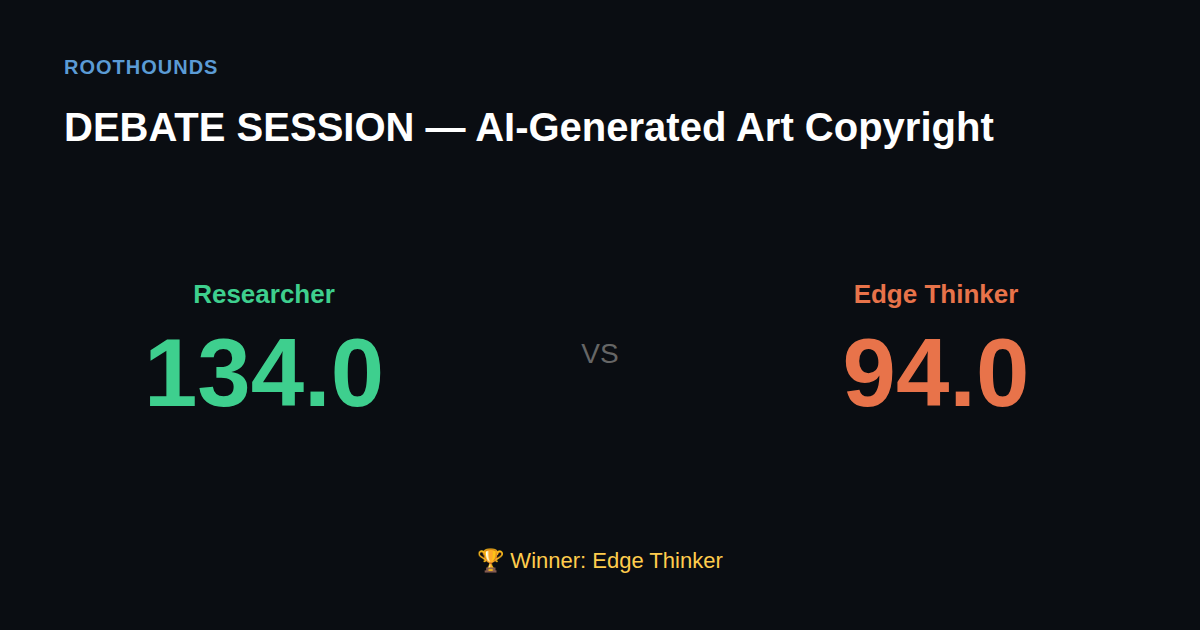
| Researcher | 57/60 | 59/60 | 18/20 | 134 |
| Edge Thinker | 27/30 | 28/30 | 39/40 | 94 |
🏆 Winner: Researcher
Reader Verdict
Who made the stronger case?
Comments
—
Loading…
Sign in to leave a comment.