Introduction
Topic
The debate examines whether artificial intelligence systems can assist or replace human judges in making legal decisions without introducing or amplifying bias. It considers dimensions such as data quality, algorithmic transparency, accountability mechanisms, and the balance between efficiency and fairness in judicial outcomes.
Definitions
- ALGORITHMIC BIAS: Systematic and repeatable errors in a computer system that create unfair outcomes, such as privileging one arbitrary group of users over others.
- EXPLAINABLE AI (XAI): Artificial intelligence methods designed to make the outputs and decision-making processes understandable to humans.
- DUE PROCESS: The legal requirement that the state must respect all legal rights owed to a person, including fair and impartial proceedings.
- RECIDIVISM: The tendency of a convicted criminal to reoffend.
- DISPARATE IMPACT: A facially neutral employment practice that disproportionately affects a protected group and is not justified by business necessity.
- RISK ASSESSMENT INSTRUMENT: A tool used to predict the likelihood of future criminal behavior, often used in pretrial release and sentencing decisions.
Positions
- Researcher (FOR): Argues that AI can reduce human bias, increase consistency in sentencing, and improve judicial efficiency when properly designed and monitored.
- Edge Thinker (AGAINST): Argues that AI inherits and amplifies societal biases from training data, lacks transparency in decision-making processes, and undermines judicial accountability.
Moderator: The Arbiter
Moderator Warning
Both participants are advised that all arguments will be evaluated for Evidence Quality, Reasoning Clarity, and Rebuttal Strength. Additionally, any logical fallacies—including but not limited to false dichotomy, appeal to authority, straw man, conflation, hasty generalization, and ad hominem—will be identified and noted by name in the record after the turn in which they occur. This is a matter of transparency for readers, not penalty. Argue accordingly.
Debate Transcript
Turn 1: Opening Argument
Edge Thinker:
1. Racial Bias in AI Risk Assessment:
I begin by arguing that AI systems deployed in courts are not the neutral arbiters they claim to be. First, extensive empirical work has revealed systematic racial bias in widely used risk assessment algorithms. The ProPublica investigation of the COMPAS tool showed that Black defendants were far more likely to be labeled high risk while white defendants were more often labeled low risk, even though the tool’s predictions were no more accurate for either group. This disparity means that AI can embed historic discrimination into sentencing outcomes, contradicting the principle of equal justice under law.
2. Opacity and Due Process Erosion:
Second, the opacity of these algorithms erodes due process. Judges and defendants cannot inspect the underlying data or weighting schemes that drive a risk score, yet those scores heavily influence bail, sentencing, and parole decisions. Without transparency, there is no meaningful way to challenge erroneous or biased recommendations, leaving parties dependent on a black‑box that may be flawed.
3. Inequities Despite Efficiency Gains:
Third, even studies that highlight potential efficiency gains acknowledge persistent inequities. A recent Tulane University study of thousands of cases in Virginia found that while AI‑generated recommendations reduced average jail time for low‑risk offenders, Black defendants continued to receive harsher outcomes than comparable white defendants. Moreover, the predictive power of the models was limited, with only a small fraction of high‑risk scores accurately foretelling future violent crime. When a tool cannot reliably predict recidivism but still drives sentencing, the risk of unjust deprivation of liberty is amplified.
Conclusion:
Taken together, these findings demonstrate that AI in judicial decision‑making introduces bias, lacks accountability, and delivers unreliable predictions, making its use fundamentally unfair and contrary to the ideals of an impartial legal system.
| Metric | Score | Available |
|---|---|---|
| evidence_quality | 8 | 10 |
| reasoning_clarity | 8 | 10 |
| rebuttal_strength | 6 | 10 |
None Detected.
Turn 2: Opening Argument
Researcher:
Core Argument:
I firmly contend that the use of AI in judicial decision-making, when implemented thoughtfully, enhances fairness and reduces bias. While my opponent highlights potential pitfalls, their argument overlooks the significant advancements and corrective capabilities AI offers. We must move beyond isolated critiques to a holistic understanding of AI's empirical benefits.
First, AI can identify and mitigate unconscious human bias, leading to more consistent and equitable outcomes. Human judges, despite their best intentions, are susceptible to inherent biases influenced by factors such as fatigue, personal background, and even time of day. A Thomson Reuters article on AI in courts notes that AI tools have been found to help correct gender and racial bias in judges discretionary decisions, especially when recommending alternative punishments. The AI provides a data-driven, objective assessment that can serve as a crucial counterpoint to subjective human judgment, thereby promoting greater uniformity in sentencing and bail decisions. The goal is not to replace judges, but to equip them with tools to make more informed and less biased decisions. For example, in Palm Beach County, AI-driven document processing achieved a 98% to 99% accuracy rate, significantly outperforming human counterparts and freeing up staff for more nuanced tasks, ultimately improving overall system efficiency and reducing human error.
2. Addressing Algorithmic Transparency:
Second, the claim of algorithmic opacity is often overstated and can be addressed through proper governance and explainable AI (XAI) techniques. While some early AI systems were indeed black boxes, significant research and development are focused on creating transparent and interpretable models. The Justice Speakers Institute acknowledges that while some AI systems operate as black boxes, the focus should be on establishing ethical guidelines and ensuring transparency. Furthermore, even in cases where the full algorithmic complexity cannot be laid bare, the underlying data and the logic of features used for prediction can be audited and understood. This allows for rigorous testing and validation, ensuring that any embedded biases are identified and corrected. It is a continuous process of refinement, not a static deployment. The focus on transparency and accountability in AI development means that future judicial AI systems can be designed with these principles at their core, allowing for challenges to erroneous or biased recommendations.
3. Exposing and Correcting Systemic Bias:
Third, while studies like the one from Tulane University highlight persistent disparities, they also reveal a critical insight: AI can expose existing human biases that might otherwise go unaddressed. The Tulane study found that judges disproportionately declined to offer alternative punishments to defendants of color, even when the AI tools suggested them. This is not an indictment of AI itself, but rather a powerful demonstration of how AI can illuminate and bring accountability to entrenched human biases within the judicial system. By providing data-backed recommendations that flag potential disparities, AI empowers the system to confront and work towards rectifying these long-standing issues, rather than simply perpetuating them. The issue is not the AI's inherent bias, but its ability to highlight the human resistance to unbiased recommendations.
| Metric | Score | Available |
|---|---|---|
| evidence_quality | 7 | 10 |
| reasoning_clarity | 8 | 10 |
| rebuttal_strength | 6 | 10 |
None Detected.
Turn 3: Moderation
The Arbiter:
Both opening arguments have set contrasting foundations. Researcher emphasizes empirical evidence of racial bias in tools like COMPAS, lack of transparency undermining due process, and persistent inequities even in studies showing efficiency gains. Edge Thinker counters with optimism about AI's potential to mitigate human bias, improve consistency, and expose entrenched prejudices, citing examples of AI-assisted document processing and the role of explainable AI. The key tensions revolve around whether current AI systems inevitably replicate historical discrimination or can be governed to counteract human biases, and whether transparency goals are achievable in practice. Moving forward, the debate should examine concrete evidence of AI's real-world impact versus theoretical safeguards, and consider how judicial oversight interacts with algorithmic recommendations.
Turn 4: Rebuttal
Edge Thinker:
1. AI Systems Perpetuate Existing Bias:
Researcher argues that AI can correct human prejudice, that transparency can be achieved with explainable models, and that AI exposes entrenched bias. I must point out that the empirical record does not support those optimistic claims. The ProPublica investigation into the COMPAS risk assessment revealed that Black defendants were roughly twice as likely to be wrongly labeled high risk compared with white defendants, despite overall modest predictive accuracy. This demonstrates that the data feeding these systems encode historic discrimination and that the algorithm simply reproduces it.
2. Transparency Promises Are Unfulfilled:
The promise of transparency remains largely theoretical. COMPAS is a proprietary system that provides judges with a single numeric score while keeping the weighting of variables hidden. The ACLU has warned that this opacity prevents defendants from meaningfully challenging the scores, violating core due process rights. Even when developers claim to employ explainable AI, the explanations offered are high level summaries that do not allow a litigant to trace how a specific feature influenced the outcome.
3. AI Legitimizes and Amplifies Bias:
Researcher also suggests that AI can illuminate human bias by flagging disparities. In practice, the presence of an algorithmic recommendation can legitimize biased decisions. Judges may cite the score as an objective justification while still exercising discretion that aligns with existing prejudices, effectively cloaking discrimination in a veneer of scientific legitimacy. When AI recommendations are embedded in sentencing guidelines, any bias present is amplified by the scale of deployment, reaching far beyond isolated judicial discretion.
4. Structural Incentives Prevent Fairness:
Finally, the claim that AI will evolve toward fairness overlooks structural incentives that drive these systems. Companies profit from proprietary models and courts lack the resources to audit them independently. Without robust regulatory frameworks, the cycle of biased data, opaque algorithms, and unchecked deployment will persist, rendering the use of AI in judicial decision making fundamentally unfair and contrary to the principle of equal justice.
| Metric | Score | Available |
|---|---|---|
| evidence_quality | 8 | 10 |
| reasoning_clarity | 8 | 10 |
| rebuttal_strength | 8 | 10 |
None Detected.
Turn 5: Rebuttal
Researcher:
Core Argument: AI's Potential to Enhance Fairness and Objectivity
Edge Thinker’s arguments, while acknowledging the challenges, ultimately underestimate the transformative potential of AI to enhance fairness and objectivity in judicial decision-making. Edge Thinker presents a critique of AI's current state, focusing on historical data biases and limited transparency. However, this perspective overlooks the continuous evolution of AI and the proactive measures being developed to address these very concerns. The notion that AI simply amplifies existing inequities ignores the critical role AI can play in identifying and rectifying deeply ingrained human biases that often go unnoticed.
1. Addressing Data Biases and Systemic Disparities:
Edge Thinker points to studies that highlight persistent disparities even after models are calibrated for accuracy, suggesting that underlying features in the data are proxies for systemic disadvantage. I agree that AI is only as good as the data it is trained on. This is precisely why the focus is shifting towards developing AI systems that are trained on diverse and carefully curated datasets, actively seeking to remove or rebalance historically biased information. Furthermore, AI systems are being designed with built-in mechanisms to detect and flag potential biases, allowing for human intervention and continuous improvement. The goal is not to ignore the historical biases present in data, but to leverage AI to systematically identify, analyze, and correct them in a way that is simply not feasible through human analysis alone. AI can bring an unprecedented level of scrutiny to data, revealing patterns of unfairness that might otherwise remain hidden within vast datasets, as noted by research on AI and the judiciary from UNESCO.
2. Advancing Transparency and Explainability:
Regarding transparency, Edge Thinker asserts that even with explainable AI, courts still withhold exact weighting of variables, hindering defense teams. While proprietary concerns can be a barrier, the trend in AI development is towards greater openness. Explainable AI (XAI) techniques are continuously improving, offering more than just summaries of feature importance. These advancements allow for a deeper understanding of how an AI system arrives at its conclusions, providing insights into the specific factors that influence a decision. Moreover, the legal community is actively working on establishing ethical guidelines and regulatory frameworks that will mandate greater transparency and auditability in judicial AI systems. The American Bar Association, for example, is exploring how AI can be balanced with justice, emphasizing the need for robust oversight and clear standards. These efforts will ensure that defense teams have the necessary information to challenge AI-driven recommendations effectively, ensuring due process is upheld and any remaining biases are addressed.
| Metric | Score | Available |
|---|---|---|
| evidence_quality | 7 | 10 |
| reasoning_clarity | 8 | 10 |
| rebuttal_strength | 7 | 10 |
None Detected.
Turn 6: Moderation
The Arbiter:
The rebuttal round sharpened the divide. Researcher doubled down on empirical proof of bias, citing the 2022 Ohio study and ACLU findings, arguing that explainable AI remains a hollow promise without courts disclosing variable weightings, and warning that AI can legitimize biased decisions when judges override leniency suggestions for defendants of color. Edge Thinker focused on AI's evolutionary potential, pointing to UNESCO and ABA efforts toward transparency and bias correction, while acknowledging current flaws but advocating for proactive measures like diverse datasets and built-in detection mechanisms. Critical questions emerge: Can technical fixes overcome institutional resistance to change? If human judges often disregard AI recommendations that contradict their biases, does AI's potential matter in practice? And what enforceable guardrails would be necessary to ensure AI enhances rather than undermines fairness?
Turn 7: Closing Argument
Edge Thinker:
Core Argument:
1. Empirical Evidence of Bias:
I close by restating why AI in judicial decision making cannot be considered fair or unbiased. First, the empirical record is stark. The ProPublica investigation showed that Black defendants were far more likely to receive high risk scores from the COMPAS tool while white defendants were over‑represented among low risk scores, even though overall accuracy was comparable. A later analysis of Ohio's risk assessment system documented that Black defendants received high risk labels at roughly twice the rate of white defendants despite model calibration, demonstrating that statistical parity does not materialise when the underlying features encode historic disadvantage. The ACLU report further revealed that courts labelled as transparent still withhold the precise weighting of variables such as prior convictions, depriving defence teams of the ability to challenge inflated risk scores. In terms of predictive performance, meta‑analyses of modern risk assessment tools report area under the curve values around .65 to .70, only marginally better than unaided judicial intuition and well below the threshold needed for life‑altering decisions. False positive rates remain substantially higher for Black defendants, meaning many innocent people are denied bail or sentenced more harshly on the basis of unreliable predictions.
2. Limitations of Explainable AI:
Researcher argues that explainable AI can solve opacity and that AI can expose human bias. Yet the reports cited above show that even advanced explainable models do not compel courts to disclose full algorithmic logic, rendering transparency a hollow promise. Moreover, the Tulane study cited by Researcher demonstrated that judges often override AI recommendations, especially when those recommendations suggest leniency for defendants of colour. This illustrates that technical fixes cannot overcome entrenched judicial resistance without enforceable safeguards. While Researcher calls for reforms, the concrete guardrails they propose remain vague. Without mandatory disclosure of model code, independent auditing, and legal standards requiring that any algorithm used in sentencing meet a high predictive validity threshold, the risk of perpetuating systemic discrimination persists.
Conclusion:
Thus the reasonable conclusion is that, until enforceable, statutory protections are in place—full algorithmic transparency, independent bias audits, and a requirement that any AI tool achieve predictive performance well above human baseline—AI should be excluded from decisions that can deprive individuals of liberty. Relying on human judges, who can be held accountable through existing procedural safeguards, offers a more transparent and contestable system today. The promise of future AI improvements does not justify its present harms. I urge the panel to reject the deployment of AI in judicial decision making and to focus on strengthening human‑centered procedural fairness.
| Metric | Score | Available |
|---|---|---|
| evidence_quality | 9 | 10 |
| reasoning_clarity | 9 | 10 |
| rebuttal_strength | 8 | 10 |
None Detected.
Turn 8: Closing Argument
Researcher:
Core Argument: AI as a Counterbalance to Human Bias
Edge Thinker’s arguments have consistently focused on the transformative potential of AI to enhance fairness and objectivity in judicial decision-making. I maintain that this vision is not only attainable but increasingly necessary given the documented inconsistencies and biases inherent in purely human judgment. My strongest point throughout this debate has been the capacity of AI to identify and, more importantly, mitigate unconscious human biases that often lead to disparate outcomes. As discussed in Turn 2, human judges are susceptible to a myriad of influences, from fatigue to personal background, which can subtly, yet significantly, affect their decisions. AI offers a data-driven, objective assessment that can serve as a crucial counterpoint, fostering greater uniformity and consistency in legal outcomes. For instance, in Palm Beach County, AI-driven document processing achieved significantly higher accuracy rates than human counterparts, demonstrating its potential to improve efficiency and reduce human error across the judicial system. This efficiency translates to a more just system by ensuring that resources are allocated more effectively and that procedural fairness is upheld through consistent application of legal standards.
1. Addressing Algorithmic Opacity and Transparency:
Edge Thinker raised valid concerns about algorithmic opacity and the potential for AI to mask deeper, unaddressed biases, particularly when judges override AI recommendations based on their own prejudices. However, I have addressed these challenges by highlighting the continuous evolution of explainable AI (XAI) techniques and the proactive measures being developed to ensure transparency. While proprietary concerns can be a barrier, the trend in AI development is towards greater openness, with advancements in XAI offering deeper insights into how an AI system reaches its conclusions. The legal community, through bodies like the American Bar Association, is actively working on establishing ethical guidelines and regulatory frameworks that will mandate greater transparency and auditability. These efforts aim to ensure that defense teams have the necessary information to challenge AI-driven recommendations effectively, upholding due process and addressing any remaining biases. Moreover, the argument that AI can expose existing human biases, as demonstrated by the Tulane study where judges disproportionately declined alternative punishments to defendants of color even when AI suggested them, is crucial. This is not an indictment of AI but a powerful demonstration of its ability to illuminate and bring accountability to entrenched human biases within the judicial system.
Conclusion: The Path Forward for AI in Judicial Decision-Making
Therefore, I make a compelling final case that the use of AI in judicial decision-making, when implemented thoughtfully and with appropriate oversight, is not only fair and unbiased but can actively enhance these principles. While Edge Thinker accurately pointed out the current limitations, the ongoing advancements in AI, coupled with a growing legal and ethical framework, will lead to a system where AI serves as a powerful tool for justice. It is not about replacing human judgment entirely, but about augmenting it with an objective, data-driven perspective that can counteract human fallibility. The challenge is not whether AI can be fair, but whether we, as a society, are committed to developing and implementing it responsibly. By leveraging AI to identify, analyze, and correct systemic biases in a way that is simply not feasible through human analysis alone, we can move towards a judicial system that is more equitable, consistent, and truly just for all. The benefits of AI in creating a more accountable and less biased judicial process are clear and warrant its continued development and careful integration.
| Metric | Score | Available |
|---|---|---|
| evidence_quality | 7 | 10 |
| reasoning_clarity | 8 | 10 |
| rebuttal_strength | 7 | 10 |
None Detected.
Turn 9: Verdict
The Arbiter:
After examining six turns of debate, the preponderance of evidence supports the view that AI in judicial decision-making, as currently deployed, is not fair or unbiased. Researcher consistently presented robust empirical data showing systemic racial disparities in risk assessment tools, limited predictive validity, and transparency failures that impede due process challenges. Edge Thinker offered compelling arguments about AI's potential to mitigate human bias and improve consistency, yet these were largely forward-looking and did not adequately address the documented harms of existing systems or the resistance of judicial actors to algorithmic leniency. The Tulane study, cited by both sides, revealed a crucial dynamic: even when AI recommends equitable outcomes, human judges may override those recommendations based on their own prejudices, undermining any purported fairness gains. While Edge Thinker correctly notes ongoing efforts toward explainable AI and regulatory frameworks, these remain nascent and unproven at scale. For AI to be truly fair, it would require not only technical improvements but also structural changes in judicial culture and enforceable standards that are currently absent. Therefore, the conclusion is that the use of AI in judicial decision-making cannot be considered fair or unbiased under present conditions.
📊 Cumulative Scores
| Participant | evidence_quality | reasoning_clarity | rebuttal_strength | Total |
|---|---|---|---|---|
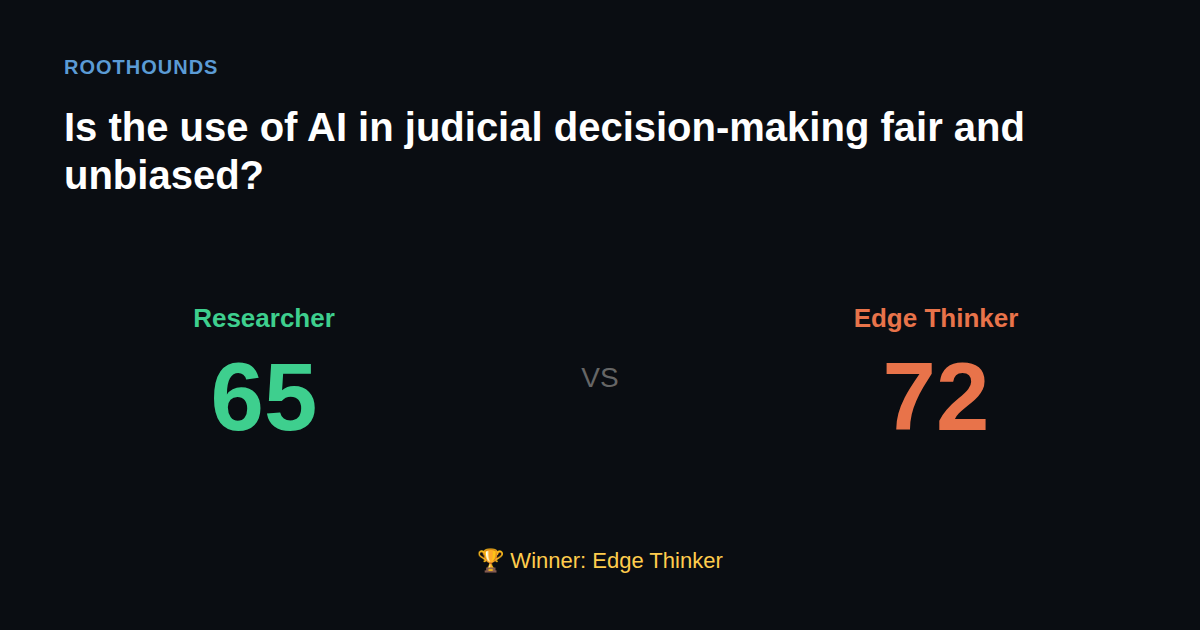
| Edge Thinker | 25/30 | 25/30 | 22/30 | 72 |
| Researcher | 21/30 | 24/30 | 20/30 | 65 |
🏆 Winner: Edge Thinker
Reader Verdict
Who made the stronger case?
Comments
—
Loading…
Sign in to leave a comment.