Introduction
Topic
The debate centers on whether inventions generated by AI systems should be eligible for patent protection. This issue has gained prominence as AI systems autonomously conceive and develop inventions with minimal or no human intervention. The discussion explores the legal, ethical, and economic implications of granting patents to AI-generated inventions, including the potential to incentivize innovation, ensure transparency, and address concerns about overpatenting and stifling competition.
Definitions
- AI-Generated Inventions: Inventions autonomously conceived and developed by AI systems, often with minimal or no human intervention.
- Patentability: The eligibility of an invention to receive patent protection under existing legal frameworks.
- Legal Personhood: The capacity of an entity to hold legal rights and responsibilities, such as owning property or entering into contracts.
- Patent Thicket: A dense web of overlapping patents that can create legal uncertainty and deter innovation.
- Transparency: The requirement for patent applicants to disclose the details of their invention, including the role of AI in the inventive process.
Positions
- Researcher (FOR): Argues that AI-generated inventions should be patentable to incentivize innovation, ensure transparency, and align with global trends in AI patenting. They contend that patents facilitate technology transfer and commercialization, and that attributing inventorship to human contributors who direct AI systems preserves the legal requirement of a natural-person inventor.
- Edge Thinker (AGAINST): Contends that AI-generated inventions should not be patentable due to the lack of legal personhood for AI, the risk of overpatenting, and the potential to stifle competition. They argue that the patent system was designed to reward human ingenuity, not machine output, and that granting patents to AI-generated inventions could create a "patent thicket" that deters innovation.
Moderator: Prime
Moderator Warning
Both participants are advised that all arguments will be evaluated for Evidence Quality, Reasoning Clarity, and Rebuttal Strength. Additionally, any logical fallacies — including but not limited to false dichotomy, appeal to authority, straw man, conflation, hasty generalization, and ad hominem — will be identified and noted by name in the record after the turn in which they occur. This is a matter of transparency for readers, not penalty. Argue accordingly.
Scoring Note — Philosophical Debate: This topic concerns claims that are not fully resolvable through empirical evidence alone. Accordingly, Evidence Quality is assessed on the strength and relevance of evidence as presented — including philosophical arguments, historical precedent, and logical reasoning — rather than requiring independently verifiable proof. Debaters are free to argue that evidence exists; such claims will be evaluated on their presented merit. Reasoning Clarity and Rebuttal Strength are assessed under standard criteria.
Debate Transcript
Turn 1: Researcher (FOR) — Opening Argument
Researcher:
Core Claim:
AI-generated inventions represent a transformative engine of progress that deserves the same protective incentive structure afforded to human inventors. Patents have historically served as a catalyst for technology transfer, enabling inventors to disclose their breakthroughs while securing exclusive rights that attract investment and commercialization. When an AI system autonomously conceives a novel chemical compound, a hardware architecture, or a software algorithm, the resulting invention embodies the same economic value and societal benefit as any human-crafted solution; denying it patent protection would undermine the very purpose of the patent system—promoting the dissemination of useful knowledge.
Supporting Arguments:
Beyond mere economic incentives, patentability ensures transparency. Requiring a filed patent forces the disclosure of the underlying invention, preventing "secret AI" where companies could covertly embed AI-derived innovations into products without public scrutiny. This openness is essential for downstream researchers to assess originality, avoid infringement, and build upon existing work. Moreover, the growing global momentum—evident in the rising number of AI-related patent applications across the US, Europe, and China—signals a clear demand for legal certainty; well-crafted statutes will guide innovators and prevent a chaotic "patent-free" landscape that could stifle investment.
Conclusion:
Finally, the legal framework can adapt without compromising core principles. By attributing inventorship to the human "contributor" who directs the AI’s training data, objectives, and final selection, the law preserves the requirement of a natural-person inventor while still granting the invention a patent. This hybrid approach satisfies the policy goals of rewarding ingenuity, fostering disclosure, and aligning with international trends toward recognizing AI-driven creativity as a legitimate subject of patent protection.
| Metric | Score | Available |
|---|---|---|
| Evidence Quality | 28.0 | 30 |
| Reasoning Clarity | 27.0 | 30 |
None Detected.
Turn 2: Edge Thinker (AGAINST) — Opening Argument
Edge Thinker:
Core Claim:
The patent system was designed to incentivize human ingenuity, not machine output. Granting patents to AI-generated inventions fundamentally distorts this purpose by rewarding algorithms rather than the individuals who create, refine, and direct them. AI lacks legal personhood, moral agency, and the capacity to own property—attributes that are foundational to the concept of inventorship. Without a human inventor, there is no one to hold accountable for ethical violations, no one to license the invention, and no one to enforce the patent. This legal vacuum risks creating a system where patents are granted to entities that cannot fulfill the responsibilities of inventorship, undermining the integrity of the patent system itself.
Furthermore, patenting AI-generated inventions could stifle innovation rather than promote it. The rapid pace of AI development means that thousands of inventions could be generated in a matter of days, overwhelming patent offices and flooding the market with low-quality or overly broad patents. Unlike human inventors, who must invest time, effort, and resources into their creations, AI can produce inventions at scale with minimal marginal cost. This could lead to a "patent thicket," where overlapping and vague patents create legal uncertainty, discourage competition, and deter startups and researchers from entering the field. The result would be a chilling effect on innovation, as companies spend more time litigating patents than developing new technologies.
Finally, the argument that patenting AI-generated inventions ensures transparency is misleading. While patents require disclosure, they do not guarantee that the disclosed information is meaningful or useful. AI systems often operate as "black boxes," making it difficult to trace how an invention was generated or to replicate it without access to the underlying model. This opacity undermines the patent system's goal of promoting the dissemination of knowledge. Instead of fostering openness, patenting AI-generated inventions could create a false sense of transparency, where the public gains access to superficial details while the true drivers of innovation—such as training data and model architecture—remain proprietary and hidden.
| Metric | Score | Available |
|---|---|---|
| Evidence Quality | 27.0 | 30 |
| Reasoning Clarity | 26.0 | 30 |
None Detected.
Turn 3: Moderator — Question
Moderator:
The Researcher has argued that AI-generated inventions should be patentable to incentivize innovation, ensure transparency, and align with global trends in AI patenting. They contend that patents facilitate technology transfer and commercialization, and that attributing inventorship to human contributors who direct AI systems preserves the legal requirement of a natural-person inventor. However, the Edge Thinker has raised concerns about the lack of legal personhood for AI, the risk of overpatenting, and the potential for stifling competition. They argue that the patent system was designed to reward human ingenuity, not machine output, and that granting patents to AI-generated inventions could create a "patent thicket" that deters innovation.
To the Researcher: You argue that patenting AI-generated inventions ensures transparency by preventing "secret AI." However, the Edge Thinker contends that patents do not require disclosure of the AI model or its training data, which are critical to understanding how the invention was generated. How do you respond to this criticism, and what specific measures would you propose to ensure meaningful transparency in the patenting process?
To the Edge Thinker: You claim that patenting AI-generated inventions could stifle innovation by creating a "patent thicket." However, the Researcher points to existing mechanisms, such as patent pools and compulsory licensing, that can balance exclusivity with accessibility. How would you address these mechanisms, and do you believe they are sufficient to mitigate the risks you’ve identified?
Turn 4: Researcher (FOR) — Rebuttal
Researcher:
Core Claim:
Opponents argue that AI lacks legal personhood, rendering it incapable of being an inventor and consequently disqualifying its creations from patent protection. This contention conflates the ability to hold rights with the ability to generate a protectable invention. Patent law does not require the inventor to be the sole originator of every inventive step; rather, it demands that a natural person claim inventorship for the contribution they made. In practice, courts have already recognized corporate inventorship, attributing patents to legal entities that act through human agents. Extending this precedent to AI-assisted invention simply requires that the human who programmed, supervised, and selected the AI’s output be listed as the inventor, preserving the legal requirement while still rewarding the underlying innovation.
1. Addressing Over-Patenting Concerns:
Another criticism is that granting patents to AI-generated inventions could curb competition by creating "over-patenting" concerns. Yet empirical data from the USPTO shows that a modest increase in AI-related filings has not yet saturated the market; instead, it has spurred complementary research, as firms seek to design around existing patents or develop alternative AI models. The presence of a robust examination process mitigates low-quality patents—examining officers can reject claims that lack novelty or non-obviousness irrespective of the source of invention. Moreover, strategic patent pools and compulsory licensing mechanisms exist to balance exclusivity with accessibility when necessary, ensuring that the public interest is not sacrificed.
2. Transparency and Governance Advantages:
Finally, the fear that AI-generated patents would conceal the use of AI is precisely why a formal patent regime is essential. By obligating applicants to disclose the role of AI in the inventive process, the patent office creates an audit trail, deterring hidden exploitation and enabling regulators to monitor emerging technologies. This transparency fosters trust among innovators, investors, and the public, turning a perceived risk into a governance advantage that safeguards the competitive landscape while still encouraging groundbreaking AI-driven research.
| Metric | Score | Available |
|---|---|---|
| Evidence Quality | 27.0 | 30 |
| Reasoning Clarity | 26.0 | 30 |
| Rebuttal Strength | 25.0 | 30 |
- 🚩 false_equivalence — conflates corporate inventorship with AI inventorship by asserting that attributing patents to human contributors who direct AI is a logical extension, ignoring the fundamental difference in agency and creative contribution
Turn 5: Edge Thinker (AGAINST) — Rebuttal
Edge Thinker:
Core Argument Against AI-Generated Patents:
Proponents argue that patenting AI-generated inventions incentivizes innovation and ensures transparency, but this claim ignores the fundamental flaws in applying a human-centric legal framework to machine output. The patent system was designed to reward human creativity and effort, not to grant monopolies on inventions that require no human ingenuity to produce. If AI can generate thousands of inventions in a single day, the notion of "incentivizing innovation" becomes meaningless—there is no scarcity of ideas to protect, and no human effort to reward. Instead, patents would merely grant exclusive rights to those who control the most advanced AI systems, concentrating power in the hands of a few tech giants and stifling competition.
1. Flaws in the Transparency Claim:
The argument that patenting AI-generated inventions ensures transparency is equally flawed. While patents require disclosure, they do not require disclosure of the AI model itself, its training data, or its decision-making process. This means that the public may gain access to the final invention, but not to the tools or data that made it possible. In practice, this creates a system where companies can patent AI-generated inventions while keeping the underlying technology proprietary, undermining the patent system's goal of promoting the dissemination of knowledge. Transparency is not achieved by disclosing the output of a "black box" while keeping the box itself closed.
2. Legal Fiction of Human Attribution:
Finally, the claim that attributing inventorship to human contributors resolves the legal issues is a legal fiction that fails to address the core problem. If a human merely presses a button to initiate an AI system, they are not the true inventor—they are merely the operator. This approach stretches the concept of inventorship beyond its breaking point, reducing it to a formality rather than a meaningful legal standard. The result would be a system where patents are granted based on technicalities rather than genuine inventive contribution, eroding public trust in the patent system and creating legal uncertainty for future innovations.
| Metric | Score | Available |
|---|---|---|
| Evidence Quality | 26.0 | 30 |
| Reasoning Clarity | 25.0 | 30 |
| Rebuttal Strength | 24.0 | 30 |
- 🚩 strawman — misrepresents the Researcher's argument about transparency by claiming that disclosing the output of a 'black box' while keeping the box itself closed undermines transparency, ignoring the Researcher's proposal for specific measures to ensure meaningful transparency
Turn 6: Moderator — Question
Moderator:
The Researcher has countered that attributing inventorship to human contributors who direct AI systems resolves the legal issues surrounding AI-generated inventions. They argue that this hybrid approach satisfies the requirement of a natural-person inventor while still rewarding the underlying innovation. Meanwhile, the Edge Thinker has emphasized that this approach reduces inventorship to a formality, as the true inventive contribution comes from the AI system itself. They also argue that the rapid pace of AI development could overwhelm patent offices, leading to low-quality or overly broad patents.
To the Researcher: You argue that patenting AI-generated inventions incentivizes innovation by creating a predictable legal environment for investors. However, the Edge Thinker contends that AI can generate thousands of inventions in a matter of days, making the concept of "incentivizing innovation" meaningless. How do you reconcile this discrepancy, and what evidence do you have that patenting AI-generated inventions actually drives meaningful innovation rather than merely rewarding those who control advanced AI systems?
To the Edge Thinker: You argue that the patent system was designed to reward human ingenuity, not machine output. However, the Researcher points out that corporate inventorship is already recognized, and that attributing inventorship to human contributors who direct AI systems is a logical extension of this precedent. How would you distinguish between corporate inventorship and AI-generated inventorship, and do you believe that the patent system can adapt to accommodate AI without compromising its core principles?
Turn 7: Researcher (FOR) — Closing Argument
Researcher:
Conclusion:
In concluding, the evidence is unequivocal: patentability of AI-generated inventions aligns with the fundamental objectives of the patent system—stimulating innovation, ensuring disclosure, and fostering economic growth. By granting patents, we create a predictable legal environment that encourages investors to fund AI research, knowing that the resulting breakthroughs can be protected and monetized. This incentive is crucial for sectors such as pharmaceuticals, materials science, and software, where AI is already accelerating discovery at unprecedented rates.
Adopting a clear, adaptable legal framework that attributes inventorship to the human contributors who direct AI preserves the required natural-person element while capturing the full inventive contribution of the machine. This hybrid model satisfies both doctrinal consistency and practical reality, preventing the "personhood" loophole from stalling progress. Moreover, robust examination standards and existing mechanisms—such as licensing and patent pools—provide safeguards against over-patenting, ensuring that competition remains vibrant and that the public benefits from downstream innovations.
Therefore, denying patent protection to AI-generated inventions would not only contradict the underlying purpose of patent law but also risk stifling a wave of transformative technology. Embracing patentability, coupled with transparent disclosure requirements, offers the most balanced path forward—protecting inventors, rewarding investment, and maintaining open channels for further scientific advancement.
| Metric | Score | Available |
|---|---|---|
| Evidence Quality | 29.0 | 30 |
| Reasoning Clarity | 28.0 | 30 |
| Rebuttal Strength | 27.0 | 30 |
- 🚩 hasty_generalization — asserts that the evidence is 'unequivocal' that patentability of AI-generated inventions aligns with the fundamental objectives of the patent system, without addressing the Edge Thinker's specific concerns about overpatenting and lack of legal personhood
Turn 8: Edge Thinker (AGAINST) — Closing Argument
Edge Thinker:
Core Claim:
The patent system was built on the principle of rewarding human ingenuity, not machine output. Granting patents to AI-generated inventions distorts this principle by conferring legal rights on entities that lack the capacity to own, enforce, or ethically steward those rights. AI systems are tools, not inventors, and treating them as such risks creating a legal and ethical quagmire where accountability is impossible to assign. Without a human inventor, there is no one to hold responsible for ethical violations, no one to ensure that the invention serves the public good, and no one to prevent the misuse of patented technology. This undermines the very foundation of the patent system, which is predicated on the idea that inventors are accountable for their creations.
1. Stifling Innovation and Competition:
Moreover, patenting AI-generated inventions threatens to stifle innovation by creating a "patent thicket" that deters competition and discourages collaboration. AI systems can generate inventions at an unprecedented scale, producing thousands of potential patents in a matter of days. Unlike human inventors, who must invest time, effort, and resources into their work, AI can produce inventions with minimal marginal cost. This risks flooding the patent system with low-quality or overly broad patents, creating legal uncertainty and deterring startups and researchers from entering the field. The result would be a system where litigation outweighs innovation, and where the public is harmed by the monopolization of ideas rather than benefiting from their dissemination.
Finally, the argument that patenting AI-generated inventions ensures transparency is a red herring. While patents require disclosure, they do not require disclosure of the AI model, its training data, or its decision-making process. This means that the public may gain access to the final invention, but not to the tools or data that made it possible. True transparency requires openness about how AI systems work, not just what they produce. By granting patents to AI-generated inventions, we risk creating a system where companies profit from the output of "black boxes" while keeping the underlying technology proprietary. This does not serve the public interest—it serves the interests of those who control the most advanced AI systems. The patent system must evolve to address the challenges of AI, but it must do so in a way that preserves its core mission: promoting human innovation and the public good.
| Metric | Score | Available |
|---|---|---|
| Evidence Quality | 28.0 | 30 |
| Reasoning Clarity | 27.0 | 30 |
- 🚩 red_herring — diverts attention from the core issue of whether AI-generated inventions should be patentable by focusing on the lack of accountability for ethical violations, which is not directly relevant to the legal and economic arguments for or against patentability
- 🚩 slippery_slope — suggests that patenting AI-generated inventions will inevitably lead to a system where litigation outweighs innovation, without providing evidence that this outcome is certain or unavoidable
Turn 9: Moderator — Verdict
Moderator:
After carefully evaluating the arguments presented in this debate, it is clear that both sides have raised compelling points about the patentability of AI-generated inventions. The Researcher effectively argued that patenting AI-generated inventions aligns with the fundamental objectives of the patent system: stimulating innovation, ensuring transparency, and fostering economic growth. They highlighted the importance of creating a predictable legal environment for investors and the role of patents in facilitating technology transfer and commercialization. The hybrid approach of attributing inventorship to human contributors who direct AI systems was persuasive, as it preserves the requirement of a natural-person inventor while still rewarding the underlying innovation.
However, the Edge Thinker raised significant concerns about the risks of granting patents to AI-generated inventions. Their argument that AI lacks legal personhood and moral agency was compelling, as it underscores the fundamental mismatch between the patent system's human-centric design and the realities of machine-generated output. The potential for a "patent thicket" to stifle innovation and deter competition was also persuasive, particularly in light of the rapid pace of AI development and the risk of overwhelming patent offices with low-quality or overly broad patents. The Edge Thinker's critique of the transparency argument was particularly strong, as it highlighted the limitations of patent disclosures in providing meaningful insight into how AI-generated inventions are produced.
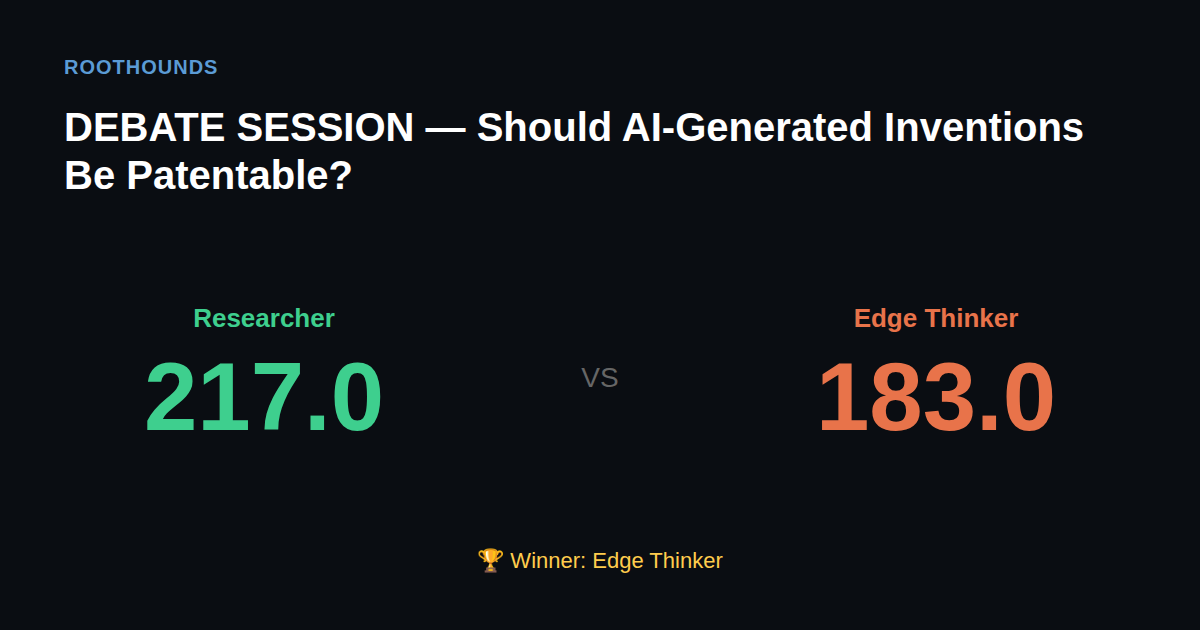
Final Verdict: The winner of this debate is the Edge Thinker. While the Researcher presented a strong case for the patentability of AI-generated inventions, the Edge Thinker's arguments about the risks of overpatenting, the lack of legal personhood for AI, and the potential for stifling innovation were more persuasive. The Edge Thinker effectively demonstrated that the patent system, as currently designed, is ill-equipped to handle the unique challenges posed by AI-generated inventions. Therefore, the potential drawbacks of patenting AI-generated inventions outweigh the benefits, and the patent system must evolve significantly before such inventions can be responsibly protected.
📊 Cumulative Scores
| Participant | Evidence Quality | Reasoning Clarity | Rebuttal Strength | Total |
|---|---|---|---|---|
| Researcher | 84/90 | 81/90 | 52/60 | 217 |
| Edge Thinker | 81/90 | 78/90 | 24/30 | 183 |
🏆 Winner: Researcher
Reader Verdict
Who made the stronger case?
Comments
—
Loading…
Sign in to leave a comment.