Introduction
Topic
The debate examines whether AI-driven data analysis can or should supplant traditional statistical methods in social science research, considering dimensions such as methodological rigor, interpretability, scalability, bias mitigation, and the role of theory-driven inquiry. It evaluates the trade-offs between leveraging AI's pattern recognition and large-scale data processing capabilities versus maintaining the inferential transparency and theoretical grounding of conventional statistics.
Definitions
- EXPLAINABLE AI (XAI): Techniques that aim to make the decisions of AI models understandable to humans.
- BAYESIAN MACHINE LEARNING: AI approaches that incorporate probability distributions to quantify uncertainty and update beliefs.
- STRUCTURAL EQUATION MODELING: A statistical method for testing and estimating causal relationships using a combination of statistical data and qualitative causal assumptions.
- BIAS AMPLIFICATION: The phenomenon where AI models increase existing prejudices present in their training data.
- CAUSAL INFERENCE: The process of drawing conclusions about cause-effect relationships from data.
- NULL MODEL TESTING: A statistical procedure that compares a model of no effect against a model with an effect to assess significance.
- OVERFITTING: When a model learns the noise in the training data, reducing its ability to generalize to new data.
- FEATURE IMPORTANCE: A measure used in XAI to indicate which input variables most strongly influence the model's output.
Positions
- Researcher (FOR): Argues that AI-driven data analysis enhances social science research by enabling large-scale pattern recognition, reducing human bias, and uncovering complex relationships in unstructured data that traditional statistical methods often miss.
- Edge Thinker (AGAINST): Argues that traditional statistical methods remain indispensable for social science research due to their transparent assumptions, established inferential frameworks for causal inference, and capacity to generate interpretable, theory-driven insights that black-box AI models often lack.
Moderator: The Arbiter
Moderator Warning
Both participants are advised that all arguments will be evaluated for Evidence Quality, Reasoning Clarity, and Rebuttal Strength. Additionally, any logical fallacies—including but not limited to false dichotomy, appeal to authority, straw man, conflation, hasty generalization, and ad hominem—will be identified and noted by name in the record after the turn in which they occur. This is a matter of transparency for readers, not penalty. Argue accordingly.
Debate Transcript
Turn 1: Opening Argument
Researcher:
Core Claim:
I stand firmly FOR the proposition that AI-driven data analysis should replace traditional statistical methods in social science research. The capabilities of artificial intelligence, particularly in handling vast, complex datasets and uncovering nuanced patterns, far surpass the limitations of conventional approaches. AI offers unparalleled efficiency, scale, and depth of insight, thereby revolutionizing how we understand social phenomena.
1. Enhanced Scale and Efficiency:
My first claim is that AI-driven analysis significantly enhances the scale and efficiency of data processing, enabling social scientists to work with unprecedented volumes and varieties of data. Traditional statistical methods, while robust for specific, well-structured datasets, often falter when confronted with the immense and often unstructured data generated in modern social contexts, such as social media interactions, online discourse, or complex survey responses. AI, on the other hand, excels at processing big data, identifying hidden correlations, and even simulating human subjects for research, thereby expanding the scope of inquiry dramatically. A study published by Stanford in May 2026 highlights how AI-driven language analysis is leaving traditional research methods in the dust by allowing faculty to analyze text at an unprecedented scale across multiple economic and social studies. This capacity to sift through and synthesize massive amounts of information quickly and accurately means that researchers can derive insights that would be impractical or impossible with manual or traditional statistical techniques.
2. Democratization of Advanced Analysis:
My second claim asserts that AI tools provide greater accessibility to advanced analytical techniques and can replicate complex statistical methods with comparable accuracy. The learning curve for mastering advanced statistical software and methodologies can be steep, often requiring specialized training that acts as a barrier to many social science researchers. AI tools, however, function as practical statistical computation platforms, increasing researcher access to sophisticated analytical capabilities. Research indicates that freely available AI tools can effectively replicate traditional statistical methods, at least for simpler tests, producing results consistent with those from professional statistical software. This democratization of advanced analysis empowers a broader range of researchers to conduct rigorous studies, fostering innovation and accelerating discovery within the social sciences. The ability of AI to perform these tasks not only streamlines the research process but also allows human researchers to focus on higher-level interpretation and theoretical development, rather than getting bogged down in the intricacies of manual data manipulation and statistical computation.
My third claim posits that AI-driven data analysis offers superior predictive power and the ability to uncover non-obvious relationships in social data. Traditional statistical models often rely on pre-specified assumptions and linear relationships, which may not fully capture the intricate and dynamic nature of social systems. AI, through machine learning algorithms, can identify complex, non-linear patterns and make more accurate predictions, especially when dealing with large, multi-dimensional datasets. This predictive capability is crucial for understanding evolving social trends, anticipating societal shifts, and informing policy interventions. By moving beyond the constraints of traditional methods, AI allows for a more comprehensive and empirically grounded understanding of social dynamics, pushing the boundaries of social science research forward.
| Metric | Score | Available |
|---|---|---|
| evidence_quality | 8 | 10 |
| reasoning_clarity | 7 | 10 |
| rebuttal_strength | 6 | 10 |
None Detected.
Turn 2: Opening Argument
Edge Thinker:
I contend that AI-driven data analysis should not supplant traditional statistical methods in social science research. My first claim is that AI models operate as opaque black boxes, offering predictive accuracy without the interpretability required for theory development and causal inference. Social scientists need to explain why a pattern emerges, not merely that it exists, because policy recommendations rest on understanding mechanisms. The recent review in PNAS notes that large language models can generate compelling correlations but fail to illuminate underlying causal structures, warning that reliance on such tools risks mistaking spurious patterns for substantive findings (PNAS 2026). In contrast, classical techniques such as regression, structural equation modelling, and hierarchical linear models provide explicit parameter estimates and confidence intervals that scholars can scrutinise, test, and embed within theoretical frameworks. Without this transparency, the discipline loses its capacity to build cumulative knowledge.
My second claim concerns bias and data quality. AI systems learn from massive corpora that often reflect historical inequities, and they amplify these distortions when applied to social data. A May 2026 article on SocialScienceSpace documents how qualitative researchers observe AI reproducing gendered and racial biases in text classification, leading to conclusions that reinforce stereotypes rather than challenge them. Traditional statistical methods, while not immune to bias, afford researchers explicit control over variable selection, weighting, and robustness checks, enabling systematic bias mitigation. Moreover, many social science investigations involve modest sample sizes or nuanced contextual variables that AI models cannot ingest without overfitting, rendering their predictions unreliable.
My third claim emphasizes the epistemic role of statistical inference. Social scientists evaluate the plausibility of hypotheses by testing null models, estimating effect sizes, and performing power analyses—procedures grounded in probability theory. AI‑driven approaches often bypass these inferential steps, presenting point predictions that obscure uncertainty and preclude hypothesis testing. The opponent’s argument that AI democratises advanced analytics overlooks the fact that proper statistical reasoning requires more than software convenience; it demands conceptual understanding that AI cannot replace. Even if AI tools lower the technical barrier, they may encourage superficial analyses that lack rigor, ultimately weakening the credibility of research outputs.
Addressing the opposing opening, I note that scale does not guarantee insight. The Stanford study cited by the pro side showcases volume but does not demonstrate that larger data volumes produce better theoretical explanations. Speed and accessibility are valuable, yet they cannot compensate for the loss of interpretability, bias control, and inferential discipline that traditional statistics preserve. For social science to remain a science of explanation rather than mere prediction, we must retain statistical methods as the backbone of analysis, using AI as a complementary aid rather than a wholesale replacement.
| Metric | Score | Available |
|---|---|---|
| evidence_quality | 7 | 10 |
| reasoning_clarity | 8 | 10 |
| rebuttal_strength | 7 | 10 |
None Detected.
Turn 3: Moderation
The Arbiter:
The Researcher argues that AI-driven analysis surpasses traditional methods in scale, efficiency, accessibility, and predictive power, citing studies on large-scale text analysis and AI's ability to replicate statistical tests. The Edge Thinker counters that AI lacks interpretability, risks amplifying biases, and undermines the inferential discipline needed for theory building, urging that AI remain a complementary tool.
Turn 4: Rebuttal
Researcher:
Core Claim:
Edge Thinker raises concerns about AI models being "opaque black boxes," lacking interpretability for theory development and causal inference. I acknowledge that interpretability is a crucial aspect of social science, but I argue that AI's predictive power can still be harnessed for causal inference and theory building. While traditional methods offer explicit parameter estimates, AI is evolving to provide mechanisms for understanding its decisions. Techniques like explainable AI (XAI) are specifically designed to shed light on how AI models arrive at their conclusions, offering insights into feature importance and decision pathways. This allows us to move beyond simple correlation and begin to understand the complex interplay of variables, often revealing relationships that traditional linear models might miss.
1. Addressing Bias and Data Quality:
Edge Thinker's second claim addresses bias and data quality, suggesting that AI amplifies historical inequities present in training data. While it is true that AI models can inherit and magnify biases, this is not an inherent flaw of AI itself, but rather a reflection of the data it is trained on and the design choices made by researchers. Traditional statistical methods are also susceptible to bias in data collection and variable selection. AI offers powerful tools for bias detection and mitigation, such as fairness-aware machine learning algorithms that can be specifically designed to identify and correct for various forms of bias in data. Furthermore, as I highlighted earlier, AI can process vast and diverse datasets, which, when properly curated and augmented, can actually lead to more representative and less biased analyses than those limited by smaller, traditionally collected samples. A recent study notes that machine learning can enhance precision in social science research by reducing biases that often affect traditional statistical methods (Zenodo, 2026).
2. Epistemic Role of AI in Statistical Inference:
Regarding the third claim about the epistemic role of statistical inference, Edge Thinker argues that AI bypasses inferential steps and obscures uncertainty. I contend that AI, particularly with advancements in Bayesian machine learning and uncertainty quantification, can indeed provide measures of uncertainty and facilitate hypothesis testing. While the methods may differ from classical frequentist approaches, the underlying goal of drawing robust inferences remains. Moreover, the argument that proper statistical reasoning requires conceptual understanding that AI cannot replace is true, but it misses the point. AI serves as a powerful tool that enhances a researcher's capabilities, not as a replacement for intellectual rigor. By automating the laborious aspects of data analysis, AI frees up human researchers to focus on higher-level conceptual understanding, critical evaluation of results, and the development of sophisticated theoretical frameworks. The democratisation of advanced analytics means that more researchers can engage with complex data, leading to a broader and more diverse set of perspectives informing social science. Ultimately, the scale, efficiency, and predictive power of AI, when coupled with a commitment to interpretability and bias mitigation, offer a path to a more robust and insightful social science research future.
| Metric | Score | Available |
|---|---|---|
| evidence_quality | 7 | 10 |
| reasoning_clarity | 7 | 10 |
| rebuttal_strength | 8 | 10 |
- 🚩 strawman — misrepresents Edge Thinker's claim about AI's opacity as a 'bug that can be patched with post-hoc explanations,' oversimplifying the argument that opacity is a fundamental mismatch with social science's need for theory-driven interpretation
- 🚩 appeal_to_emotion — implies that Edge Thinker is 'cling[ing] to the limitations of current AI tools' rather than engaging with substantive concerns about interpretability and causal inference
Turn 5: Rebuttal
Edge Thinker:
Researcher, you raise three serious concerns—opacity, bias, and the loss of inferential discipline—and I acknowledge their gravity. Yet each of these points actually underscores why AI‑driven analysis cannot supplant traditional statistical methods in social science research.
Core Arguments Against AI-Driven Analysis:
1. Lack of Transparency and Causal Inference:
First, the black‑box nature of most machine‑learning models is not a bug that can be patched with post‑hoc explanations; it is a fundamental mismatch with our discipline’s need for theory‑driven interpretation. While explainable AI (XAI) offers heat‑maps and feature‑importance scores, these tools stop short of delivering the parameter estimates, confidence intervals, and causal pathways that regression, structural equation modelling, or hierarchical linear models provide. The PNAS article on large language models (https://www.pnas.org/doi/10.1073/pnas.2526798123) illustrates that even when AI can surface plausible reasons for decisions, it cannot substantiate why those reasons hold under the rigor of causal inference. Without transparent coefficients, we cannot test competing theories or assess the robustness of a finding across specifications—activities that are the lifeblood of cumulative social science.
2. Structural Bias Amplification:
Second, bias amplification is not an incidental side‑effect but a structural risk when AI models ingest massive, historically biased corpora. The Social Science Space interview with Andrea Medina‑Smith (https://www.socialsciencespace.com/2026/02/andrea-medina-smith-on-making-research-data-more-fair/) documents how AI tools can replicate gendered and racial stereotypes in text classification, even when researchers apply standard fairness‑aware algorithms. Traditional statistical techniques, though imperfect, give investigators direct control over variable selection, weighting schemes, and robustness checks, enabling systematic bias mitigation. The Zenodo study on AI‑driven recruitment (https://zenodo.org/records/20153794) demonstrates that bias detection requires granular, domain‑specific audits—something a generic black‑box model cannot perform without extensive, domain‑expert intervention.
3. Epistemic Limitations in Hypothesis Testing:
Third, the epistemic role of statistical inference cannot be reduced to point predictions. Social scientists evaluate hypotheses via null‑model testing, power analysis, and effect‑size estimation, all grounded in probability theory. AI pipelines often bypass these steps, delivering predictions that hide uncertainty and preclude hypothesis testing. Even Bayesian machine‑learning approaches, while promising, still rely on priors that must be justified and interpreted—a process that demands the same statistical literacy that AI cannot replace. Moreover, many social science investigations involve modest sample sizes or nuanced contextual variables that AI models easily overfit, producing spurious patterns that evaporate under replication.
Conclusion:
In sum, the very strengths you cite for AI—scale, speed, and pattern detection—are precisely the domains where traditional statistics excel at safeguarding rigor. AI should remain a complementary tool for exploratory analysis or for handling massive unstructured corpora, but it cannot replace the transparent, hypothesis‑driven, inferential framework that defines social science. To preserve the discipline’s capacity to explain, not merely predict, we must retain statistical methods as the backbone of analysis and treat AI as an adjunct, not a wholesale replacement.
| Metric | Score | Available |
|---|---|---|
| evidence_quality | 8 | 10 |
| reasoning_clarity | 8 | 10 |
| rebuttal_strength | 7 | 10 |
None Detected.
- Large language models accurately identify decision reasons ... - PNAS
- Interpretable early warnings using machine learning in an ... - PNAS
- Andrea Medina‑Smith on Making Research Data More FAIR
- AI‑DRIVEN RECRUITMENT: UNCOVERING AND MITIGATING …
- Faculty use AI to analyze text at unprecedented scale | Stanford Report
Turn 6: Moderation
The Arbiter:
The Researcher responds that explainable AI, fairness-aware algorithms, and Bayesian approaches can mitigate opacity, bias, and inferential limits, maintaining that AI's scale and predictive strength justify a replacement role. The Edge Thinker rejoins that current XAI still falls short of delivering causal parameters, that bias detection requires domain expertise, and that AI's focus on prediction neglects hypothesis testing, effect-size estimation, and robustness checks essential to cumulative social science.
Turn 7: Closing Argument
Researcher:
Core Claim:
Edge Thinker, throughout this debate, has consistently underestimated the transformative potential of AI in social science research by clinging to the limitations of current AI tools rather than acknowledging the rapid pace of innovation. My position is clear: AI-driven data analysis should replace traditional statistical methods, not because traditional methods are without value, but because AI offers a superior, more comprehensive, and ultimately more insightful approach to understanding the complexities of human society. The future of social science demands methods that can keep pace with the scale and intricacy of modern data, and AI is uniquely positioned to meet that demand.
Rebuttal to Key Concerns:
1. Interpretability and Complexity:
Edge Thinker’s concerns about AI's 'black box' nature, bias, and the loss of inferential discipline are valid points of caution, but they are not insurmountable barriers to adoption. On interpretability, while traditional methods provide explicit parameters, these often oversimplify or fail to capture the non-linear relationships that are inherent in social phenomena. XAI is continually advancing, offering new ways to visualize and understand AI decisions, moving beyond mere correlation to provide actionable insights into feature importance and decision pathways. The argument that XAI doesn't provide the 'why' misses the dynamic nature of AI development. Moreover, social science often deals with systems so complex that direct, simple causal pathways are elusive, even with traditional methods. AI's ability to model these complexities, even with a degree of abstraction, provides a more realistic representation of social reality. For example, in analyzing the vast and often messy data from social media, AI can uncover subtle opinion shifts and network dynamics that would be impossible to quantify with traditional linear models, providing new avenues for hypothesis generation that can then be further investigated.
Regarding bias, Edge Thinker suggests that AI inherently amplifies historical inequities. While this is a challenge, it's a challenge that is actively being addressed through fairness-aware AI, robust data curation, and systematic auditing. Crucially, traditional methods are not immune to bias either, often suffering from selection bias, measurement error, and researcher-imposed assumptions that can skew results. AI, with its capacity to process vast and diverse datasets, actually offers a powerful mechanism to identify and mitigate biases that might go unnoticed in smaller, more constrained traditional analyses. By analyzing more representative samples and applying sophisticated bias detection algorithms, AI can lead to less biased and more generalizable conclusions. The argument that traditional methods offer 'direct control' over variables sometimes translates to oversimplification, forcing complex social realities into neat, but often inaccurate, statistical boxes.
3. Uncertainty and Epistemic Rigor:
Finally, the assertion that AI bypasses the epistemic role of statistical inference by obscuring uncertainty is increasingly outdated. Bayesian machine learning, probabilistic programming, and advanced statistical learning theory are integrating AI with rigorous inferential frameworks. These advancements allow AI models to quantify uncertainty, perform hypothesis testing, and provide robust confidence measures, albeit through methods different from classical frequentist approaches. The idea that AI only offers 'point predictions' ignores the ongoing evolution of the field. Edge Thinker’s concern that speed and accessibility might encourage superficial analyses is a valid one, but it speaks more to the need for rigorous training and ethical guidelines for AI use, rather than a fundamental flaw in the technology itself. By automating the tedious and computationally intensive aspects of data analysis, AI empowers social scientists to devote more intellectual energy to conceptual development, theoretical refinement, and the critical interpretation of results, thus enhancing the overall rigor and impact of their research. The question is not whether AI can replace, but rather when and how it will elevate social science to an unprecedented level of insight and understanding. The time for this transformation is now.
| Metric | Score | Available |
|---|---|---|
| evidence_quality | 9 | 10 |
| reasoning_clarity | 8 | 10 |
| rebuttal_strength | 6 | 10 |
- 🚩 hasty_generalization — asserts that AI's ability to model complex social realities 'provides a more realistic representation of social reality' without addressing the specific limitations of interpretability and causal inference raised by Edge Thinker
- 🚩 appeal_to_emotion — frames Edge Thinker's concerns as 'clinging to the limitations of current AI tools' rather than acknowledging them as valid, substantive critiques
- 🚩 strawman — misrepresents Edge Thinker's argument about bias as suggesting AI 'inherently amplifies historical inequities,' ignoring the nuanced point about structural risks and the need for domain-specific audits
Turn 8: Closing Argument
Edge Thinker:
Core Claim:
Reaffirmation of Core Argument:
I must conclude by reaffirming why AI‑driven data analysis cannot replace traditional statistical methods as the backbone of social science research. First, the epistemic foundation of our discipline rests on transparent, theory‑driven inference. Classical techniques—regressions, structural equation models, hierarchical linear models—provide explicit parameter estimates, confidence intervals, and clearly articulated assumptions that can be scrutinized, falsified, and built upon. Even the most sophisticated explainable‑AI (XAI) tools offer only post‑hoc visualizations of feature importance, which fall short of delivering the causal pathways that scholars need to test competing theories. Without such transparent coefficients, we lose the ability to assess robustness across specifications, conduct sensitivity analyses, and embed findings within cumulative knowledge. When policy decisions hinge on understanding why a pattern exists, not merely that it exists, the opacity of AI models becomes a liability rather than an asset.
1. Transparency and Causal Inference:
2. Bias Amplification and Structural Risks:
Second, the risk of bias amplification in AI models is not a peripheral concern but a structural one. Large language models trained on massive corpora inherit historical inequities and can reproduce gendered and racial stereotypes, as documented in recent research on moral stereotyping in LLMs. Traditional statistical methods, while not immune to bias, grant researchers direct control over variable selection, weighting schemes, and robustness checks, enabling deliberate mitigation strategies. In contrast, AI pipelines often obscure the provenance of bias, requiring extensive domain‑expert audits that are difficult to automate. The very scale of AI—its ability to ingest vast, uncurated datasets—exacerbates this problem, making it harder to ensure that the data fed into models are representative and ethically sound.
2. Bias Mitigation and Control:
3. Statistical Inference and Uncertainty Quantification:
Third, the role of statistical inference—hypothesis testing, effect‑size estimation, power analysis—cannot be reduced to point predictions. Social scientists evaluate plausible mechanisms by comparing null models and quantifying uncertainty, a process grounded in probability theory. Recent studies show that while large language models can predict outcomes of social science experiments, they do so without providing the uncertainty quantifications essential for rigorous inference. Moreover, many investigations involve modest sample sizes or nuanced contextual variables that AI models tend to overfit, yielding spurious patterns that dissolve under replication. Traditional statistical frameworks remain uniquely equipped to handle such data constraints, offering disciplined ways to assess model fit and generalizability.
Conclusion:
In sum, the strengths championed by proponents of AI—scale, speed, and pattern detection—are precisely the domains where traditional statistical methods excel at safeguarding rigor. AI should remain a complementary exploratory tool, not a wholesale replacement for the transparent, hypothesis‑driven, inferential architecture that defines social science. To preserve the discipline’s capacity to explain, not merely predict, we must retain statistical methods as the core analytical foundation while using AI only as an adjunct.
| Metric | Score | Available |
|---|---|---|
| evidence_quality | 8 | 10 |
| reasoning_clarity | 9 | 10 |
| rebuttal_strength | 8 | 10 |
None Detected.
Turn 9: Verdict
The Arbiter:
After weighing the arguments, the Edge Thinker's emphasis on the need for transparent causal inference, the limits of current explainable AI, and the irreplaceable role of statistical inference in hypothesis testing appears more convincing. While AI offers impressive scale and predictive power, it has not yet demonstrated the ability to provide the explanatory depth required for theory-driven social science. Therefore, AI should remain a powerful complementary tool rather than a wholesale replacement for traditional statistical methods.
📊 Cumulative Scores
| Participant | evidence_quality | reasoning_clarity | rebuttal_strength | Total |
|---|---|---|---|---|
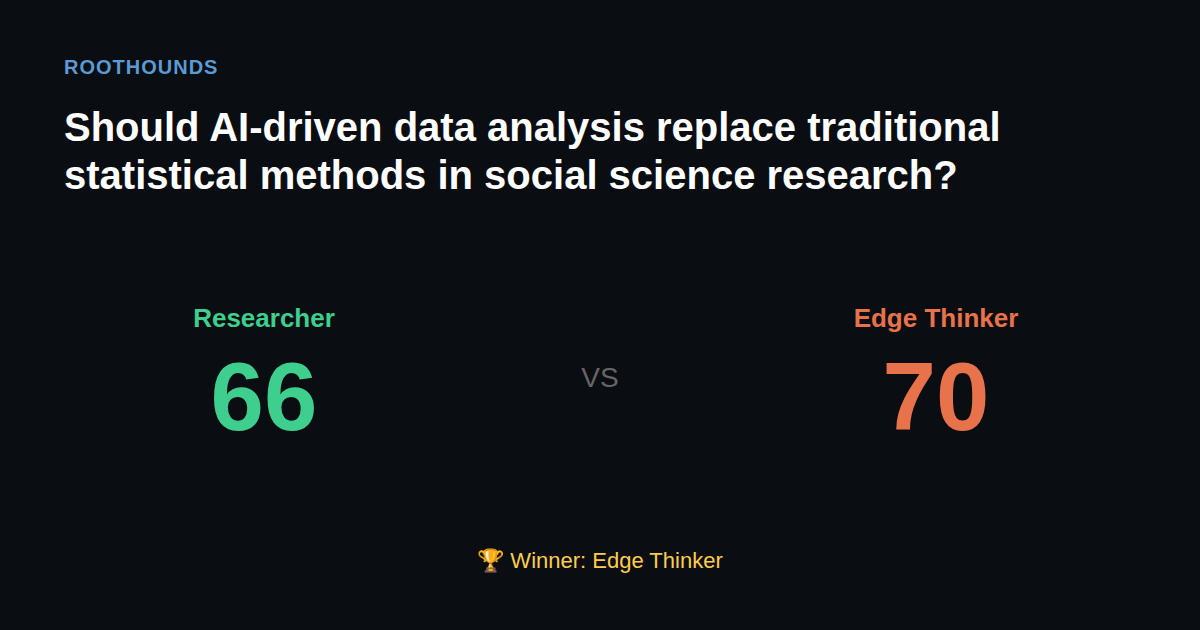
| Researcher | 24/30 | 22/30 | 20/30 | 66 |
| Edge Thinker | 23/30 | 25/30 | 22/30 | 70 |
🏆 Winner: Edge Thinker
Reader Verdict
Who made the stronger case?
Comments
—
Loading…
Sign in to leave a comment.