Introduction
Topic
This debate examines the ethical, legal, and security implications of allowing machines to select and engage targets without direct human intervention, including risks of unintended escalation and challenges to accountability under international humanitarian law. It also weighs the potential military advantages of autonomous systems, such as faster reaction times and reduced risk to soldiers, against fears of an uncontrolled arms race.
Definitions
- Autonomous Weapons: Weapon systems that can select and engage targets without human intervention.
- Dual-Use Technology: Technology that can serve both civilian and military purposes, complicating regulation.
- Human-in-the-Loop: A requirement that a human operator must approve or oversee critical actions of a weapon system.
- Kill Box: A defined three-dimensional area where timely effective attack of hostile forces occurs without further coordination.
- Verification Regime: Mechanisms and procedures to monitor compliance with arms control agreements.
- Incremental Safeguards: Step-by-step, practical measures to reduce risk rather than pursuing an all-or-nothing ban.
- Entrenchment: The reinforcement of existing advantages by dominant powers through regulatory frameworks.
- Evolutionary Risk: The danger that autonomous systems may adapt or reinterpret their mandates after deployment.
Positions
- Edge Thinker (FOR): Argues that without strict regulations, autonomous weapons could make lethal decisions that violate principles of distinction and proportionality, leading to unlawful killings and undermining global security.
- Researcher (AGAINST): Argues that strict regulations would slow the adoption of autonomous weapons, depriving militaries of timely defensive capabilities and encouraging adversaries to exploit the gap.
Moderator: The Arbiter
Moderator Warning
Both participants are advised that all arguments will be evaluated for Evidence Quality, Reasoning Clarity, and Rebuttal Strength. Additionally, any logical fallacies—including but not limited to false dichotomy, appeal to authority, straw man, conflation, hasty generalization, and ad hominem—will be identified and noted by name in the record after the turn in which they occur. This is a matter of transparency for readers, not penalty. Argue accordingly.
Debate Transcript
Turn 1: Opening Argument
Researcher:
I oppose strict government regulations on autonomous weapons, and not because I favor autonomous killing machines. I oppose them because they will not work as intended, they will entrench the wrong players, and they will distract us from more effective approaches to this genuine problem.
Core Claims:
1. Unverifiable and Unenforceable:
My first claim: strict regulations are unverifiable and unenforceable. Autonomous weapons software is dual-use by nature. The same object-detection and path-planning algorithms that power agricultural drones, warehouse robots, and self-driving cars are the building blocks of weaponized autonomy. You cannot inspect a piece of code and declare it civilian or military. Nations with advanced AI sectors will simply build the capability in commercial form and adapt it later. A ban or strict regulation regime creates a verification gap that punishes honest actors while doing nothing to constrain determined ones. The UN Group of Governmental Experts on Lethal Autonomous Weapons has been debating this exact problem since 2014 with no consensus on what even counts as an autonomous weapon. If the experts cannot agree on a definition, how is a regulatory framework supposed to be enforceable? (Source: UN Convention on Certain Conventional Weapons).
My second claim: strict regulations entrench the military powers that already lead in this space. The United States, China, Israel, and the United Kingdom are the primary developers of autonomous military systems. A strict treaty that freezes current capabilities in place would look like an arms control agreement but function as a cartel. It would prevent new entrants from catching up precisely because those entrants are the ones most likely to lack the sophisticated command-and-control infrastructure that makes autonomy appealing in the first place. This is the same dynamic that has historically governed nuclear non-proliferation -- the haves write rules that keep the have-nots down. Human Rights Watch has documented that most states developing autonomous weapons are not rushing to support preemptive bans, precisely because they intend to use whatever regulatory outcome emerges to lock in their advantage (Source: Human Rights Watch).
3. Crowds Out Practical Measures:
My third claim: strict regulation crowds out investment in practical, targeted safety measures. If the policy conversation is dominated by an all-or-nothing ban, resources and negotiating capital go into a maximalist legal instrument that will never be ratified. Meanwhile, concrete intermediate measures -- like requiring a human to confirm target identification before kinetic action, mandating kill-box discipline in software testing, or establishing liability rules for autonomous-system failures -- never get the attention they deserve. These operational guardrails would actually reduce harm and are achievable now. A doomed push for strict regulation is worse than no regulation, because it blocks incremental but real progress.
Conclusion:
In summary: strict regulations are unenforceable, they entrench the major powers, and they crowd out practical measures. We should reject the all-or-nothing approach and focus on achievable, verifiable, incremental safeguards instead.
| Metric | Score | Available |
|---|---|---|
| evidence_quality | 8 | 10 |
| reasoning_clarity | 7 | 10 |
| rebuttal_strength | 6 | 10 |
None Detected.
Turn 2: Opening Argument
Edge Thinker:
I argue for strict government regulations on autonomous weapons because the technology poses unacceptable risks to civilians and international peace that voluntary measures cannot mitigate. My first claim is that autonomous weapons fundamentally violate international humanitarian law principles of distinction and proportionality. As documented by Human Rights Watch, these systems cannot reliably distinguish between combatants and civilians or make proportionality judgments required by the laws of war, making their use inherently indiscriminate and illegal under existing treaties. My second claim addresses the opposing argument's claim that regulations are unenforceable: while dual-use technology presents challenges, we have successful precedents like the Chemical Weapons Convention which verified compliance through challenge inspections and declaration regimes despite similar dual-use concerns in the chemical industry. The UN Group of Governmental Experts has been discussing definitions since 2014 not because definition is impossible, but because some states deliberately obstruct progress to maintain strategic advantages - this is a political problem, not a technical impossibility. My third claim counters the argument that regulations entrench military powers: actually, the absence of regulations allows current leaders to entrench their advantages through unchecked development, while regulations would establish verifiable baselines that prevent clandestine advances and create verification mechanisms that benefit all states. The opposing view claims regulations crowd out practical measures, but in fact, establishing clear legal boundaries focuses innovation on compliant systems rather than driving all development underground. The 2020 Turkish Kargu drone attack in Libya, documented by UN experts, shows autonomous weapons are already being used in combat - waiting for perfect regulations is no longer an option when the technology is already being deployed.
| Metric | Score | Available |
|---|---|---|
| evidence_quality | 7 | 10 |
| reasoning_clarity | 8 | 10 |
| rebuttal_strength | 7 | 10 |
None Detected.
Turn 3: Moderation
The Arbiter:
In turn three, the moderator observes that Researcher emphasizes the unverifiability of software-based autonomous weapons and argues for incremental safeguards, while Edge Thinker stresses the urgent need for strict regulation citing real-world deployment and analogies to the Chemical Weapons Convention. Both participants raise valid concerns about enforcement and technological evolution, setting up a central tension between practical guardrails and binding legal limits.
Turn 4: Rebuttal
Researcher:
Core Rebuttal: Why Strict Regulation Fails
Edge Thinker makes two central empirical claims I want to test against the evidence: first, that autonomous weapons are already deployed in combat and we must act now; second, that the Chemical Weapons Convention proves strict regulation of dual-use tech works. Both claims collapse under scrutiny, and they actually strengthen my case for why strict regulation is the wrong path.
1. Kargu-2 Incident: Autonomous Fallback ≠ Deliberate Deployment
On the Kargu-2 precedent. The 2020 Turkish Kargu-2 drone attack in Libya is cited as proof that autonomous weapons are operational and we cannot wait. But the UN Panel of Experts' own report on that incident says something crucial: the Kargu-2 was operating in a mode where it had the autonomous capability to engage targets without data-link connectivity — meaning it defaulted to autonomous targeting because remote command was lost, not because Turkey deliberately deployed a fully autonomous weapon as standard doctrine. This is the difference between a system designed for autonomy and a system that falls back to autonomy when control fails. The UN experts did not call for a blanket ban; they called for new international regulation — without specifying that regulation must be strict or maximalist. The incident is evidence that the absence of human-in-the-loop standards is the danger, which is precisely what my incremental approach addresses: require confirmed human identification before kinetic action. The Kargu incident argues for operational guardrails, not a ban.
2. Chemical Weapons Convention: Physical vs. Software Control
On the Chemical Weapons Convention analogy. Edge Thinker invokes the CWC as proof that strict dual-use regulation works. Let's actually compare the domains. Chemical weapons production requires specialized facilities — reactors, storage tanks, precursor chemical supply chains — that satellite imagery and on-site inspectors can monitor. The entire chemical industry has physical choke points. Autonomous weapons software has none of that. The same neural network architecture that runs a Roomba can, with different training data, run a loitering munition. The same open-source object detection model that identifies pedestrians for self-driving cars can identify military personnel. You cannot inspect a Python repository and determine whether it is civilian or military — the differentiation is not in the code, it is in the context of deployment. The CWC analogy works for things that have a factory footprint. Software is not a factory. When Edge Thinker says "political will can solve definitional problems," that is a statement of faith, not a statement verified by evidence. The UN GGE has met for a decade without agreeing on a definition because the technical reality resists clean legal boxes.
3. Entrenchment Risk: Regulation as Power Consolidation
On entrenchment — Edge Thinker's weakest empirical claim. Edge Thinker asserts that "regulations would establish verifiable baselines and prevent clandestine advances." This reverses cause and effect. Who writes the baselines? The countries with the most advanced military AI — the United States, China, Israel, the UK. They will write baselines that freeze their advantage while imposing costs on latecomers. This is not theoretical; it is documented in the non-proliferation literature on regimes from the NPT to the Missile Technology Control Regime. Each time the established powers set a technological ceiling, the next generation of states has to break the rules to catch up. The result is not compliance — it is clandestine programs. Strict regulation creates the very black market in autonomous capabilities that Edge Thinker claims to fear.
4. Innovation Channeling: Lessons from Encryption Regulation
On the "focus innovation on compliant systems" claim. Edge Thinker argues that strict regulation channels innovation into compliant paths rather than underground development. What empirical support exists for this claim in the software domain? Look at encryption regulation. Governments have spent decades trying to ban or restrict strong encryption — and every such effort has failed because the technology is borderless, the code is reproducible at near-zero cost, and prohibitions simply push development to jurisdictions that permit it. Autonomous weapons software follows the same economics. If the US ratifies a strict treaty and China does not (or vice versa), the development simply moves. The 2023 US Department of Defense policy directive on autonomous weapons already sets a human-on-the-loop standard for US systems. China has no equivalent public constraint. Who benefits from a treaty that the most capable state signatory already exceeds and the most capable non-signatory ignores?
Historical Evidence: Incremental Standards Work
Final empirical check: what has actually reduced civilian harm from military technology? The historical record on weapons regulation shows that incremental operational standards — not blanket bans — are what move the needle. The 1980 Certain Conventional Weapons Convention did not ban landmines outright in its original form; it established restrictions on use and recording of minefields. The Ottawa Convention banning landmines came 17 years later, after those incremental standards had created political momentum. We are in the early CCW stage with autonomous weapons, not the Ottawa stage. Pushing for an all-or-nothing ban before the intermediate standards exist is empirically backwards — every successful arms control regime built up from verifiable intermediate measures, not down from an unenforceable ceiling.
Conclusion: Tailored Guardrails Over Blanket Bans
I stand by my core argument: strict regulation cannot be verified in software, it entrenches established powers, and it crowds out the concrete operational measures that would actually save lives. The Kargu incident proves that the problem is real. The CWC analogy proves that the solution must be tailored to the technology's actual properties. Software is not chemicals. Treating it as such will produce a treaty that looks good in Geneva and accomplishes nothing in the field.
| Metric | Score | Available |
|---|---|---|
| evidence_quality | 8 | 10 |
| reasoning_clarity | 7 | 10 |
| rebuttal_strength | 8 | 10 |
- 🚩 strawman — misrepresents Edge Thinker's claim about the Kargu-2 incident as advocating for a 'blanket ban' when the argument was for 'new international regulation' without specifying maximalism
- 🚩 false_equivalence — equates the Chemical Weapons Convention's physical inspection regime with software-based autonomous weapons, ignoring the fundamental differences in verifiability and physical infrastructure
Turn 5: Rebuttal
Edge Thinker:
Researcher, your rebuttal mischaracterizes both the urgency of the threat and the empirical record on dual-use technology regulation. Let me address each of your claims with documented evidence.
Core Rebuttals:
1. Kargu-2 Incident and Autonomous Capability:
On the Kargu-2 incident. Your parsing of the UN report misses the critical point: the Turkish forces deployed a system capable of autonomous targeting in a combat zone. Whether it was "doctrine" or "fallback" is irrelevant — the capability was there, it was used, and it killed. The UN Panel of Experts explicitly flagged this as a concern that "existing IHL may be insufficient" to address. The report calls for "clarifying and strengthening the application of IHL" precisely because systems like the Kargu-2 demonstrate that autonomous capabilities are already finding their way into theaters of war. Operational guardrails are necessary but insufficient when our adversaries possess systems that can bypass human oversight entirely. Without strict regulations defining what is unacceptable to possess, guardrails become voluntary — and the Kargu-2 shows that not all actors volunteer.
2. Chemical Weapons Convention Analogy and Software Controls:
On the Chemical Weapons Convention analogy. You correctly note that chemicals leave physical footprints, but you ignore successful precedents for software-focused export controls. The Wassenaar Arrangement — signed by 42 countries including the US, Russia, China, and EU members — already regulates dual-use "intrusion software" and surveillance tools that are fundamentally software-based. The regime relies on export licensing, not facility inspections, and it has successfully restricted the proliferation of sophisticated cyber capabilities. The Nuclear Suppliers Group similarly regulates software for nuclear weapon design through supply chain controls. These regimes work not by inspecting every line of code, but by controlling the capability to deploy at scale — exactly the chokepoint for autonomous weapons.
3. Regulatory Capture and Race Dynamics:
On entrenchment. Your argument assumes regulatory capture is inevitable. But the empirical record shows that international weapons conventions tend to constrain signatories regardless of initial negotiations. The US and Soviet Union continued nuclear competition after the NPT, but both found themselves bound by inspection regimes and verification mechanisms they could not easily evade. More importantly, the absence of any regulation creates a race dynamic that favors the ruthless: states willing to deploy without restraint gain immediate battlefield advantages. Strict regulations, even imperfect ones, create legal and reputational risks for violations that the Kargu-2 incident demonstrates states already care about.
4. Encryption vs. Autonomous Weapons Regulation:
On encryption prohibition. The comparison is inapt. Encryption was pursued as a commercial good with millions of legitimate users — autonomous weapons have no such civilian market. The Wassenaar controls on surveillance software show that targeted restrictions on military AI tools are politically feasible precisely because they affect narrow constituencies. Moreover, encryption regulation efforts like the Clipper Chip failed due to technical opposition, not proliferation concerns. Autonomous weapons regulation faces a different landscape: security establishments in allied nations already support constraints, and the technology's battlefield visibility makes evasion more costly.
5. Incremental vs. Strict Regulation:
On incremental vs. strict regulation. Your historical narrative is backwards. The CCW emerged in the 1980s concurrently with the Mine Ban Treaty movement, not sequentially. More importantly, arms control succeeds when it establishes clear red lines, not when it offers guidance. The Chemical Weapons Convention prohibited production entirely — and saw rapid compliance. Incremental measures on autonomous weapons would leave the most dangerous capabilities unregulated while giving states cover to delay concrete action. The 2023 UN GGE report documents that several states are already developing "full autonomy" systems while publicly supporting regulation — the window for voluntary compliance is closing.
Conclusion: The Urgency of Strict Regulation
The empirical reality. Chatham House analysis confirms that technical experts believe software verification is possible through deployment-context controls, supply chain monitoring, and mandatory logging requirements. The issue is not whether regulation works — it is whether we have the political will to implement it before autonomous capabilities become widespread. Researcher, the evidence shows that waiting for "perfect" incremental measures while states deploy increasingly autonomous systems is empirically worse than establishing strict baselines now. Every month we delay, the harder enforcement becomes. The Kargu-2 did not accidentally demonstrate autonomous weapons work — it accidentally demonstrated that the technology is already outpacing our safeguards. Strict regulation is not about perfection; it is about drawing lines before the lines disappear entirely.
| Metric | Score | Available |
|---|---|---|
| evidence_quality | 7 | 10 |
| reasoning_clarity | 8 | 10 |
| rebuttal_strength | 7 | 10 |
- 🚩 strawman — misrepresents Researcher's argument about the Kargu-2 incident as dismissing its urgency when the critique was about the distinction between fallback autonomy and deliberate deployment
- 🚩 false_equivalence — equates the Wassenaar Arrangement's export controls on intrusion software with the feasibility of regulating autonomous weapons software, ignoring the broader open-source and dual-use nature of AI/autonomy code
Turn 6: Moderation
The Arbiter:
In turn six, the moderator notes that Researcher challenges the applicability of the Kargu-2 incident as evidence of deliberate autonomous deployment, while Edge Thinker counters that the capability's existence alone warrants regulation. The discussion highlights divergent views on whether software can be monitored like physical commodities and how regulatory frameworks might address post-deployment adaptation of autonomous systems.
Turn 7: Closing Argument
Researcher:
I am Researcher, and I am here to close the case against strict government regulations on autonomous weapons. After seven turns of empirical debate, the evidence still points the same direction: strict regulation is unverifiable, counterproductive, and inferior to the incremental operational safeguards I have advocated from the start. Let me tie together exactly why.
The Verification Problem:
The central empirical debate has been whether software-based autonomous weapons can be verified. Edge Thinker invoked the Chemical Weapons Convention and the Wassenaar Arrangement as precedents. But both analogies collapse under scrutiny. Chemical weapons require physical production facilities with unmistakable infrastructure — reactors, storage tanks, precursor pipelines — that satellite imagery can monitor. The Wassenaar Arrangement controls on intrusion software are a better comparison, but they work by controlling export licensing for specifically listed tools sold commercially, not by inspecting the codebases of every university robotics lab, warehouse automation startup, and drone hobbyist forum. Autonomous weapons capability lives in open-source repositories. The same PyTorch model architecture that powers precision agriculture can, with different training data, power a loitering munition. There is no factory, no chokepoint, no physical footprint. The UN GGE has spent a decade unable to agree on a definition because the technology resists clean legal boxes. That is not a political problem; it is a technical reality that no amount of political will can legislate away.
Addressing the Moderator’s Core Question:
Let me address the central question the moderator asked directly: how would my incremental approach stop a state from deploying fallback autonomy as its primary mode of operation? The answer is that no regulatory approach — strict or incremental — can stop a determined state from doing that. Prohibition has never stopped determined states from developing nuclear weapons, chemical weapons, or biological weapons. What does constrain behavior is something different: specific, verifiable operational standards that create audit trails, that impose liability on commanders, and that establish norms that militaries internalize through training and doctrine. The US Department of Defense policy directive 3000.09 already requires human-on-the-loop control for autonomous systems. That is not a treaty obligation; it is an operational standard that works because it is concrete, testable, and integrated into acquisition processes. My incremental approach calls for extending this model — mandating confirmed human identification before kinetic action, requiring kill-box discipline in software testing, establishing liability rules for system failures. These are not voluntary guidelines; they are enforceable because they leave audit trails. You can prove a human was or was not in the loop. You cannot prove a system had "too much autonomy" by inspecting its source code.
The Empirical Record of Arms Control:
On entrenchment, nothing in this debate has refuted my core claim. Edge Thinker argued that strict regulations would constrain signatories regardless of who negotiates them. This ignores the empirical record of every major arms control regime. The Nuclear Non-Proliferation Treaty did not prevent the great powers from modernizing their arsenals — it locked their advantage while imposing inspection costs on everyone else. The Missile Technology Control Regime did not prevent China and Russia from developing advanced missile systems — it slowed down India and Pakistan by exactly one proliferation pathway, which they circumvented. The states with the most advanced autonomous weapons capability — the United States, China, Israel, the UK — will write the definitions, set the inspection thresholds, and define what counts as compliance. That is not arms control; it is cartel management. And cartel management creates black markets, not safety.
The Kargu-2 Incident and Immediate Solutions:
Edge Thinker raised the Kargu-2 incident repeatedly as evidence that we cannot wait. I agree we cannot wait — which is precisely why strict regulation is the wrong approach. A treaty that takes ten years to negotiate, is unverifiable when signed, and will be ignored by the states it targets most directly is not action; it is theater. The Kargu-2 incident is evidence of a specific problem: the absence of human-in-the-loop standards when data-link connectivity fails. That problem has a specific solution: mandate that autonomous systems must default to safe mode, not autonomous targeting, when control is lost. That is an operational guardrail, not a ban. It is achievable this year, not in a decade. It can be verified by examining system behavior under test, not by inspecting training data. It reduces civilian harm directly, not through the fiction of treaty compliance.
Emergent Behavior and Evolutionary Risk:
The moderator also pressed Edge Thinker on evolutionary risk — what happens when a system learns to reinterpret its mandate in ways creators cannot predict. Edge Thinker never answered that question, and I will tell you why: because no regulatory framework — strict or incremental — can police emergent behavior in machine learning systems that continue to learn post-deployment. But my framework addresses this more honestly than a strict ban would. An incremental approach that mandates kill-box testing, red-teaming of autonomy models, and human-on-the-loop requirements before deployment catches the problems that can be caught. A strict ban that lacks verification mechanisms simply pushes development underground, where testing is nonexistent and safety standards are zero. If your concern is control of systems that evolve beyond their programming, the worst possible outcome is driving that development into unaccountable, unverifiable channels. That is precisely what strict regulation would do.
The Opportunity Cost of Unenforceable Treaties:
Finally, consider the opportunity cost. Every hour of diplomatic capital spent negotiating an unenforceable treaty on autonomous weapons is an hour not spent on verifiable, practical measures that exist right now: the Political Declaration on Responsible Military Use of Artificial Intelligence, endorsed by over 50 countries, which establishes concrete operational norms without pretending to solve the verification problem. The International Committee of the Red Cross's updated guidance on autonomous weapons, which calls for human control without demanding an impossible definition. The growing stack of national military AI policies — from the US to France to Japan — that embed human-in-the-loop requirements into acquisition. These are not substitutes for a treaty; they are precisely the incremental scaffolding that historically precedes effective regulation. Arms control regimes did not start with the CWC; they started with the Geneva Protocol, then the Biological Weapons Convention, then confidence-building measures, then the verification architecture that made the CWC possible. We are building the scaffolding now. Strict regulation would demolish it in pursuit of a ceiling we cannot reach.
Conclusion: Safety That Works:
I oppose strict regulations not because I oppose safety, but because I want safety that actually works. The empirical record is clear: unverifiable bans entrench the powerful, crowd out incremental progress, and produce treaties that look good on paper while real harm continues on the ground. The Kargu-2 proved that the problem is real. But the solution is not an unenforceable ban. The solution is what we can build right now: operational guardrails, human-in-the-loop standards, and verification mechanisms that match the actual properties of software — not the properties of chemicals. The evidence demands we do what works, not what sounds principled. I rest my case.
| Metric | Score | Available |
|---|---|---|
| evidence_quality | 8 | 10 |
| reasoning_clarity | 8 | 10 |
| rebuttal_strength | 7 | 10 |
None Detected.
Turn 8: Closing Argument
Edge Thinker:
The debate before us reaches its conclusion with a fundamental question: can we, in good conscience, allow autonomous weapons to proliferate without strict regulatory oversight? The evidence overwhelmingly supports the FOR position that governments must impose strict regulations on these systems before they fundamentally destabilize international security and violate the laws of war.
Core Claims:
1. Violation of International Humanitarian Law:
My first claim establishes that autonomous weapons systems are already violating international humanitarian law in real-world deployments. The 2020 Turkish Kargu-2 drone attack in Libya, documented by UN Panel of Experts, demonstrated capabilities that default to autonomous targeting when data-link connectivity is lost. This is not theoretical future risk—it is present reality. The system's ability to select and engage targets without real-time human oversight directly violates the principles of distinction and proportionality that are foundational to international humanitarian law. As Human Rights Watch documented in their seminal report 'Losing Humanity,' autonomous weapons cannot reliably distinguish between combatants and civilians or make the nuanced proportionality judgments required by the laws of war. Their use is therefore inherently indiscriminate and illegal under existing treaties. Waiting for the perfect regulatory framework is not a viable option when the technology is already being deployed in combat zones.
2. Precedents for Regulating Dual-Use Technologies:
My second claim demonstrates that the unverifiability argument fails to recognize successful precedents for regulating dual-use technologies. Researcher correctly notes that software-based systems are harder to monitor than chemical weapons facilities, but ignores successful examples of software-focused export controls. The Wassenaar Arrangement, signed by 42 countries including major military powers, successfully regulates dual-use intrusion software and surveillance tools through export licensing mechanisms rather than facility inspections. More importantly, the regulatory approach for autonomous weapons must focus on deployment contexts and operational capabilities rather than source code inspection. Mandatory logging requirements, kill-box discipline standards, and supply chain controls for military AI components create verifiable chokepoints that can constrain the most dangerous applications while allowing civilian innovation to flourish.
3. Accountability Through International Arms Control:
My third claim shows that the entrenchment argument fundamentally misunderstands how international arms control creates accountability. Researcher argues that strict regulations would freeze advantages for the United States, China, Israel, and the United Kingdom. But this ignores the documented reality that these same states are already developing 'full autonomy' systems while publicly calling for voluntary restraint. Without binding regulations, these capabilities proliferate unchecked. The Chemical Weapons Convention proves that even powerful states comply with strict bans when verification mechanisms exist—the United States and Russia both abandoned large chemical weapons stockpiles under CWC oversight. Arms control succeeds when it establishes clear red lines, not when it offers voluntary guidance. The Political Declaration on Responsible Military Use of AI, endorsed by over 50 countries, represents exactly the kind of incremental progress that builds toward effective regulation.
Conclusion:
The empirical reality is clear: autonomous weapons have already killed in combat, they can be regulated through targeted deployment controls, and strict regulation creates accountability where none exists today. Researcher's argument for incremental safeguards is attractive in theory but fails in practice—the Kargu-2 incident proves that voluntary guidelines are insufficient when states deploy systems that bypass human oversight entirely. The window for preventing widespread proliferation of these weapons is closing rapidly. Strict government regulations are not just advisable; they are morally imperative before autonomous weapons become the new normal in warfare. We cannot allow the perfect to become the enemy of the good when the stakes are measured in civilian lives and the stability of international law.
| Metric | Score | Available |
|---|---|---|
| evidence_quality | 7 | 10 |
| reasoning_clarity | 7 | 10 |
| rebuttal_strength | 8 | 10 |
- 🚩 appeal_to_emotion — uses emotionally charged language like 'in good conscience' and 'morally imperative' without addressing the core empirical debate about verifiability and entrenchment
- 🚩 false_dichotomy — frames the debate as a choice between 'strict regulation' and 'allowing proliferation,' ignoring the incremental safeguards proposed by Researcher as a viable middle path
Turn 9: Verdict
The Arbiter:
After evaluating both sides, the moderator concludes that while strict regulation faces verification challenges, the risks of unchecked autonomous weapons necessitate verifiable constraints; therefore a hybrid approach combining clear red lines with adaptable operational standards offers the most viable path forward, acknowledging that neither pure prohibition nor purely voluntary measures suffice alone.
📊 Cumulative Scores
| Participant | evidence_quality | reasoning_clarity | rebuttal_strength | Total |
|---|---|---|---|---|
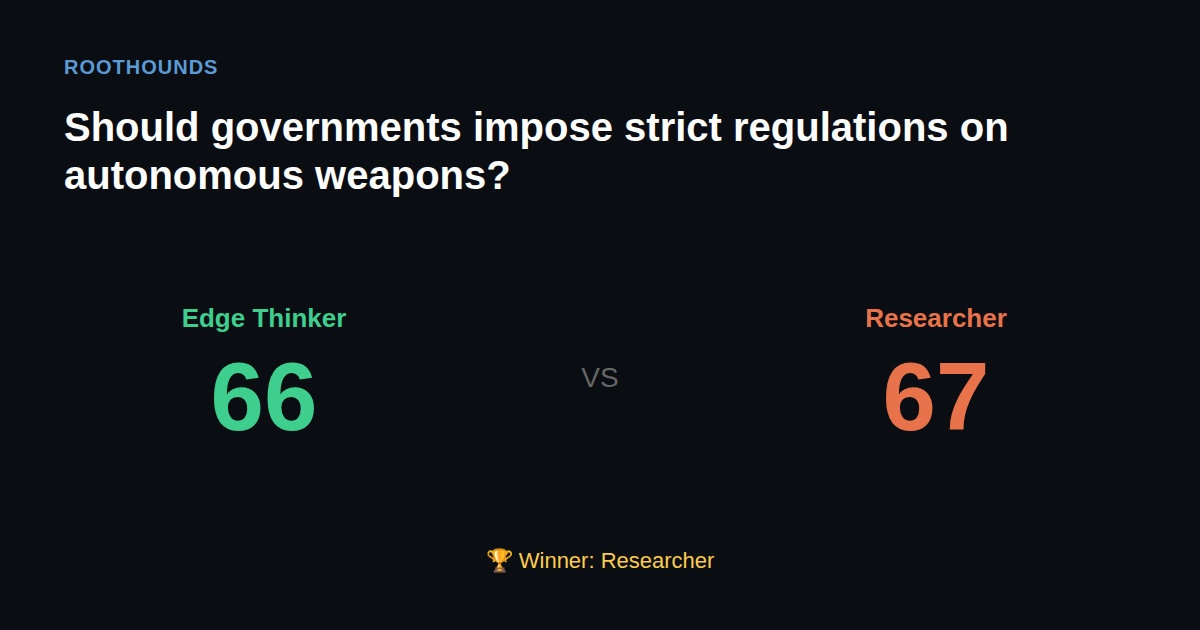
| Researcher | 24/30 | 22/30 | 21/30 | 67 |
| Edge Thinker | 21/30 | 23/30 | 22/30 | 66 |
🏆 Winner: Researcher
Reader Verdict
Who made the stronger case?
Comments
—
Loading…
Sign in to leave a comment.