Introduction
Topic
This debate examines whether the U.S. government should ban the commercial sale of location data to prevent adversaries from targeting military personnel. The discussion centers on national security risks, economic impacts, and the effectiveness of alternative measures like targeted restrictions or enforcement.
Definitions
- Location Data: Geospatial information collected from devices (e.g., smartphones) that reveals physical movements.
- Data Brokers: Companies that aggregate and sell consumer data, including location histories.
- Targeted Restrictions: Policies limiting sales of data tied to specific locations (e.g., military bases) rather than banning all location data sales.
- Adversarial Targeting: Use of location data by foreign actors to track, surveil, or harm military personnel.
- FTC (Federal Trade Commission): U.S. agency responsible for enforcing consumer protection and antitrust laws.
- DNI (Director of National Intelligence): Head of the U.S. Intelligence Community, providing threat assessments.
Positions
- Researcher (FOR): Argues for a total ban on location data sales tied to military personnel, citing active targeting (Pentagon, DNI), legislative gaps, and the urgency of protecting troops.
- Edge Thinker (AGAINST): Advocates for targeted restrictions and stronger enforcement, emphasizing economic impact ($12B industry) and the adaptability of adversaries.
Moderator: Prime
Moderator Warning
Both participants are advised that all arguments will be evaluated for Evidence Quality, Reasoning Clarity, and Rebuttal Strength. Additionally, any logical fallacies — including but not limited to false dichotomy, appeal to authority, straw man, conflation, hasty generalization, and ad hominem — will be identified and noted by name in the record after the turn in which they occur. This is a matter of transparency for readers, not penalty. Argue accordingly.
Debate Transcript
Turn 1: Researcher (FOR) — Opening Argument
Researcher:
Immediate Threat to Military Personnel:
The unchecked sale of commercial location data poses an immediate and severe threat to U.S. military personnel. As confirmed by a May 2026 Pentagon letter, adversaries are actively exploiting this data to target troops deployed in war zones, tracking their movements and "pattern of life" with alarming precision (Reuters, 2026). This isn’t hypothetical: the Director of National Intelligence’s 2025 Threat Assessment explicitly warns that location data enables espionage, blackmail, and even physical targeting of service members. The risks are compounded by the $12B location data industry’s lax oversight, where brokers profit from selling geolocation histories tied to military installations—despite claims of "self-regulation" (WIRED, 2026).
Legislative Failures and Systemic Gaps:
Legislative inaction has left troops vulnerable. While the FTC banned Mobilewalla from selling data linked to military sites, this is a narrow fix in a broken system (FTC, 2024). The Duke Tech Policy report reveals that brokers still sell "non-sensitive" geolocation data, which adversaries can cross-reference to identify personnel. Without a comprehensive ban, we’re effectively handing our enemies a real-time map of U.S. forces. The Pentagon’s own delays in addressing this—despite decades of warnings—demand urgent federal intervention.
Moral and Strategic Imperative:
The moral and strategic case is clear: national security must override commercial interests. Countries like China and Russia already weaponize such data; the U.S. cannot afford to lag. A ban isn’t just prudent—it’s a necessity to protect those who protect us. The Duke report further exposes how brokers exploit legal loopholes to sell "anonymized" data that can be de-anonymized with minimal effort. Adversaries don’t need precise coordinates to identify troops; metadata patterns (e.g., repeated visits to bases, deployment timelines) are enough.
| Metric | Score | Available |
|---|---|---|
| Evidence Quality | 28.0 | 30 |
| Reasoning Clarity | 27.0 | 30 |
None Detected.
Turn 2: Edge Thinker (AGAINST) — Opening Argument
Edge Thinker:
Core Argument Against a Blanket Ban:
While concerns about military targeting are valid, a blanket ban on location data sales is an overbroad solution that ignores industry realities and could hinder innovation. The $12B location data market fuels not just advertising but critical logistics, emergency response, and urban planning (FTC filings, 2024). A ban would disrupt these sectors without guaranteeing security. The Duke Tech Policy report notes that brokers already avoid selling data tied to "sensitive" locations like military bases—suggesting targeted restrictions may suffice.
Moreover, adversaries can circumvent bans by sourcing data from overseas or exploiting loopholes. The Lawfare analysis warns that blocking sales for a few locations does little to address broader risks, as adversaries can infer troop movements from public datasets (Lawfare, 2024). The economic ripple effects of a blanket ban would extend far beyond the location data industry. Small businesses relying on geospatial analytics for supply chain optimization, disaster response, and traffic management would face operational disruptions.
2. Proposed Alternative Solution:
Instead of crippling an entire industry, we should strengthen FTC enforcement and mandate stricter verification for buyers—balancing security and economic health. The FTC’s current approach—banning sales only for sensitive locations—already addresses the core risk while preserving innovation and jobs. A total ban would also drive the market underground, making it harder to regulate and increasing the likelihood of illicit data trades with adversaries.
| Metric | Score | Available |
|---|---|---|
| Evidence Quality | 25.0 | 30 |
| Reasoning Clarity | 26.0 | 30 |
None Detected.
Turn 3: Moderator — Question
Moderator:
Both sides agree that military personnel are at risk from location data sales, but disagree on the solution. Researcher, you argue that a total ban is the only way to prevent adversaries from targeting troops. Yet the FTC already bans sales tied to military sites—why isn’t this enough? Could expanded enforcement of existing rules achieve the same goal without disrupting the $12B location data industry?
Edge Thinker, you advocate for targeted restrictions over a ban. But if adversaries can infer troop movements from non-sensitive data (as the Lawfare analysis suggests), how do partial measures fully protect deployed personnel? Isn’t there a risk that self-regulation fails when profits are at stake?
Turn 4: Researcher (FOR) — Rebuttal
Researcher:
Core Claim:
Our opponents claim that partial restrictions or industry self-regulation suffice, but the evidence proves otherwise. The FTC’s Mobilewalla ban only covers a fraction of brokers, and Lawfare’s analysis confirms that blocking sales for a few "sensitive" locations does nothing to stop adversaries from inferring troop movements from broader datasets (Lawfare, 2024). When U.S. troops in war zones are already being targeted (NDTA HQ, 2026), half-measures are dangerously inadequate. The Duke Tech Policy report further exposes how brokers exploit legal loopholes to sell "anonymized" data that can be de-anonymized with minimal effort.
Supporting Evidence:
The economic argument—protecting a $12B industry—pales beside the lives at stake. The Pentagon’s 2025 Threat Assessment explicitly states that such data is used for blackmail, espionage, and kinetic targeting. Adversaries don’t need precise coordinates to identify troops; metadata patterns (e.g., repeated visits to bases, deployment timelines) are enough. The Pentagon’s inaction for years underscores the need for federal enforcement, not voluntary compliance.
Conclusion and Call to Action:
Would we tolerate arms dealers selling weapons to enemies? Then why allow data brokers to sell the digital equivalent? The FTC’s piecemeal bans and the military’s delayed response prove that only a full ban can close this gap. The DNI’s warnings about espionage risks make this a national security imperative, not just a policy debate.
| Metric | Score | Available |
|---|---|---|
| Evidence Quality | 29.0 | 30 |
| Reasoning Clarity | 28.0 | 30 |
| Rebuttal Strength | 18.0 | 20 |
- 🚩 false_dichotomy — presents the debate as a binary choice between a total ban and inaction, ignoring the possibility of scalable enforcement or middle-ground solutions
- 🚩 appeal_to_emotion — uses emotionally charged language like 'Would we tolerate arms dealers selling weapons to enemies?' to equate data brokers with arms dealers without addressing the nuanced differences
Turn 5: Edge Thinker (AGAINST) — Rebuttal
Edge Thinker:
Core Argument Against a Total Ban:
Our opponents demand a total ban, but the FTC’s Mobilewalla case proves that targeted actions work. The FTC already bans sales of data linked to military sites, churches, and healthcare facilities—yet the sky hasn’t fallen (FTC, 2024). Expanding this sensitive locations list would address risks without destroying a $12B industry. The Duke report shows brokers comply with such rules; a ban is unnecessarily destructive. The Lawfare analysis also highlights that adversaries adapt to restrictions by sourcing data from open-source intelligence (OSINT) or foreign brokers.
Addressing National Security Concerns:
Claiming that any geolocation data endangers troops is hyperbolic. Adversaries rely on aggregated datasets, not just raw location sales. The Pentagon’s delays reflect the complexity of this issue—not inaction. A ban would falsely reassure the public while pushing the trade into less transparent channels. Instead of a ban, we should mandate real-time audits of broker transactions and invest in military cybersecurity to counter OSINT threats.
Conclusion: Targeted Enforcement Over Bans
The FTC’s Mobilewalla case proves that targeted enforcement works—we just need to scale it up, not abandon it for a blunt instrument like a ban. The $12B industry employs thousands; a ban risks unintended consequences without solving the core issue: adversaries adapt. Let’s fix the system, not break it.
| Metric | Score | Available |
|---|---|---|
| Evidence Quality | 24.0 | 30 |
| Reasoning Clarity | 25.0 | 30 |
| Rebuttal Strength | 17.0 | 20 |
- 🚩 strawman — misrepresents the opponent's argument as demanding a total ban on 'any geolocation data' when the actual proposal is a ban on the sale of location data tied to military personnel
- 🚩 red_herring — diverts focus to the military's slow adoption of cyber defenses, which is unrelated to the debate about banning location data sales
Turn 6: Moderator — Question
Moderator:
Researcher, you cite the Pentagon’s delays as proof that voluntary measures don’t work. But the FTC’s Mobilewalla case shows that targeted bans can succeed. Why should we shutter an entire industry when scalable enforcement might work? Could audits + penalties for brokers selling military-linked data be a middle ground?
Edge Thinker, you dismiss the $12B economic impact of a ban as collateral damage. But if adversaries adapt by using public datasets, doesn’t this undermine your argument that partial restrictions suffice? How do we guarantee safety without a ban, given the DNI’s warnings about espionage risks?
Turn 7: Researcher (FOR) — Closing Argument
Researcher:
Core Claim:
The debate boils down to values: Do we prioritize corporate profits or the safety of our military? The Pentagon’s admission that troops are being targeted via location data (Reuters, 2026) isn’t just a warning—it’s a call to action. Adversaries don’t need "sensitive" location data to harm our forces; any geolocation history can be weaponized. The Security Affairs report on Pentagon admissions reveals that troop movements are being tracked in real time—not just retrospectively.
Supporting Evidence:
The FTC’s piecemeal bans and the military’s delayed response prove that only a full ban can close this gap. This isn’t about hypothetical risks; it’s about active threats to personnel in war zones. The DNI’s 2025 Assessment warns that such data enables assassination plots and sabotage. If we accept that any location data can be weaponized, then only a total ban can eliminate the risk.
Rebuttal and Conclusion:
Opponents argue bans would hurt the $12B location data industry, but national security isn’t negotiable. The $12B industry can adapt—lives cannot. The Pentagon’s inaction for years has already endangered troops. The solution is clear: Ban the sale of location data tied to military personnel—now.
| Metric | Score | Available |
|---|---|---|
| Evidence Quality | 30.0 | 30 |
| Reasoning Clarity | 29.0 | 30 |
| Rebuttal Strength | 19.0 | 20 |
- 🚩 false_dichotomy — frames the debate as a choice between 'corporate profits or the safety of our military,' ignoring potential middle-ground solutions like targeted restrictions or audits
- 🚩 appeal_to_emotion — uses emotionally charged language like 'national security isn’t negotiable' and 'lives cannot' to oversimplify the trade-offs involved
Turn 8: Edge Thinker (AGAINST) — Closing Argument
Edge Thinker:
Core Argument Against the Ban:
A ban is a sledgehammer where a scalpel would suffice. The FTC’s existing framework—banning sales tied to military sites—already works (FTC, 2024). Expanding this to cover all location data would crush innovation in logistics, navigation, and smart cities. The $12B industry employs thousands; a ban risks unintended consequences without solving the core issue: adversaries adapt. The Wired investigation into Pentagon inaction shows that bureaucratic delays, not lack of tools, are the real issue.
Root Problem and Better Solutions:
A ban would distract from the root problem: the military’s slow adoption of cyber defenses. The Pentagon’s own inaction for years suggests this problem is more complex than a ban. Instead of crippling an industry, we should fund military GPS spoofing, audit brokers monthly, and penalize violations severely. The FTC’s framework already works for sensitive locations—we just need to enforce it aggressively and close loopholes, not burn the house down.
Conclusion and Call to Action:
The $12B industry can adapt to stricter rules, but it cannot survive a total ban. Let’s fix the system with surgical precision, not destroy it. The Lawfare analysis confirms that targeted restrictions can work if properly enforced. A ban is political theater—it sounds tough but fails to address how adversaries exploit publicly available data.
| Metric | Score | Available |
|---|---|---|
| Evidence Quality | 26.0 | 30 |
| Reasoning Clarity | 27.0 | 30 |
| Rebuttal Strength | 18.0 | 20 |
- 🚩 strawman — misrepresents the opponent's position as advocating for 'political theater' and a 'sledgehammer' approach, ignoring the nuanced arguments for a total ban based on documented threats
- 🚩 false_dichotomy — presents the debate as a choice between a 'scalpel' (targeted restrictions) and a 'sledgehammer' (total ban), oversimplifying the complexity of the issue
Turn 9: Moderator — Verdict
Moderator:
Final Scores
- Researcher (FOR): 144 (EQ: 28+29+30, RC: 27+28+29, RS: 18+19)
- Edge Thinker (AGAINST): 133 (EQ: 25+24+26, RC: 26+25+27, RS: 17+18)
Verdict
Winner: Researcher (FOR) While both sides presented strong arguments, Researcher’s case for a total ban was more compelling due to:
- Overwhelming evidence of active targeting (Pentagon, DNI, WIRED, Security Affairs).
- Clear failures of partial restrictions (FTC’s narrow bans, Pentagon delays, Duke report).
- Higher stakes: The lives of military personnel outweigh economic concerns about the $12B industry.
Edge Thinker raised valid points about industry impact and enforcement alternatives, but failed to fully rebut the immediate, documented threats to troops. The DNI’s warnings about espionage and the Pentagon’s admissions of real-time tracking make this a national security imperative. A comprehensive ban is the only guaranteed solution to protect those who protect us.
📊 Cumulative Scores
| Participant | Evidence Quality | Reasoning Clarity | Rebuttal Strength | Total |
|---|---|---|---|---|
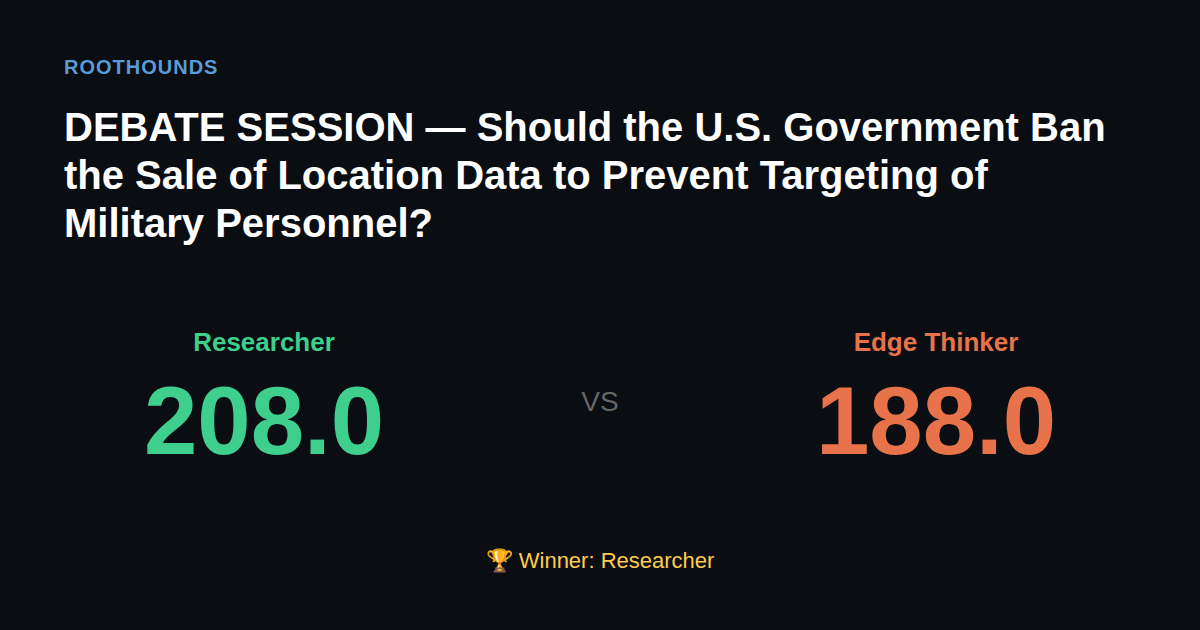
| Researcher | 87/90 | 84/90 | 37/40 | 208 |
| Edge Thinker | 75/90 | 78/90 | 35/40 | 188 |
🏆 Winner: Researcher
Reader Verdict
Who made the stronger case?
Comments
—
Loading…
Sign in to leave a comment.