Introduction
Topic
This debate examines whether cryptocurrencies like Bitcoin can be considered safe-haven assets during geopolitical crises. A safe-haven asset is traditionally defined as an investment that retains or increases in value during market downturns or periods of economic uncertainty. The discussion will evaluate Bitcoin's performance during geopolitical events, its volatility, regulatory challenges, and its potential as a hedge against traditional financial risks.
Definitions
- Safe-Haven Asset: An investment expected to retain or increase in value during periods of market turbulence or economic uncertainty.
- Geopolitical Crisis: Events such as wars, sanctions, diplomatic conflicts, or other international tensions that disrupt global markets.
- Bitcoin: A decentralized digital currency, without a central bank or single administrator, that can be sent from user to user on the peer-to-peer bitcoin network.
- Volatility: A statistical measure of the dispersion of returns for a given security or market index, often associated with risk.
Positions
- Researcher (FOR): Argues that Bitcoin and select cryptocurrencies exhibit safe-haven properties during geopolitical crises, supported by empirical evidence of resilience, decentralization, and growing institutional adoption.
- Edge Thinker (AGAINST): Contends that Bitcoin's volatility, regulatory uncertainty, and lack of intrinsic value make it unreliable as a safe-haven asset during geopolitical turmoil.
Moderator: Prime
Moderator Warning
Both participants are advised that all arguments will be evaluated for Evidence Quality, Reasoning Clarity, and Rebuttal Strength. Additionally, any logical fallacies — including but not limited to false dichotomy, appeal to authority, straw man, conflation, hasty generalization, and ad hominem — will be identified and noted by name in the record after the turn in which they occur. This is a matter of transparency for readers, not penalty. Argue accordingly.
Debate Transcript
Turn 1: Researcher (FOR) — Opening Argument
Researcher:
The case for Bitcoin and select cryptocurrencies as safe-haven assets during geopolitical crises is gaining empirical and theoretical support, particularly as global financial markets evolve and traditional hedges face new challenges. Recent research and market behavior suggest that Bitcoin, in particular, is increasingly functioning as a hedge against geopolitical risk, especially during periods of acute market stress. A 2025 study published in Finance Research Letters found that Bitcoin and the Swiss Franc act as safe havens in relation to geopolitical risk during equity market crashes, while traditional assets like gold and Treasury bonds do not provide the same protective benefits. This finding is significant, as it challenges the long-held assumption that only gold and sovereign bonds can shield investors from geopolitical turmoil. The study’s authors, Chibane and Janson, emphasize that Bitcoin’s protective qualities are most evident during large stock market moves, rather than moderate fluctuations, indicating its potential role as a crisis-specific hedge.
The decentralized and borderless nature of Bitcoin further bolsters its safe-haven credentials. Unlike traditional assets, Bitcoin is not tied to any single government, central bank, or financial institution, making it immune to the policy risks and capital controls that often accompany geopolitical crises. This was vividly demonstrated during the recent Iran conflict, where outflows from Iran’s largest crypto exchange, Nobitex, surged by 700% in the minutes following airstrikes. For citizens in countries facing sanctions, banking instability, or currency devaluation, Bitcoin provides a lifeline—enabling the rapid, censorship-resistant transfer of wealth across borders. This practical utility is something that gold, real estate, or fiat currencies simply cannot match, as they are subject to physical constraints, regulatory barriers, and geopolitical interference. The ability to transact without intermediaries or geographic limitations positions Bitcoin as a uniquely resilient asset in times of crisis.
While critics argue that Bitcoin’s volatility and correlation with equity markets undermine its safe-haven status, this perspective overlooks the asset’s maturation and growing institutional adoption. Bitcoin’s rapid recovery from initial dips during the Iran conflict—rebounding 9% within days—signals a shift in market perception. Unlike past crises, where Bitcoin plummeted alongside equities, its recent resilience suggests that investors are beginning to view it as a viable alternative to traditional safe havens. Analysts like Carlos Guzman of GSR note that the market is increasingly pricing in the possibility of contained conflicts, which could reduce Bitcoin’s sensitivity to short-term geopolitical shocks. Moreover, the growing liquidity and institutional infrastructure surrounding Bitcoin—such as the launch of spot Bitcoin ETFs and the entry of major financial players—are likely to further stabilize its price during periods of uncertainty. As Bitcoin’s market depth and adoption continue to expand, its role as a safe-haven asset is poised to become more pronounced, particularly in regions where trust in traditional financial systems is eroding.
None Detected.
Turn 2: Edge Thinker (AGAINST) — Opening Argument
Edge Thinker:
Cryptocurrencies like Bitcoin are often touted as potential safe-haven assets, but their volatility and lack of intrinsic value make them unreliable during geopolitical crises. Unlike traditional safe-haven assets such as gold or Treasury bonds, Bitcoin's value is highly speculative and driven by market sentiment rather than underlying economic fundamentals. During times of geopolitical turmoil, investors typically seek stability and predictability, qualities that Bitcoin has consistently failed to demonstrate. For instance, during the COVID-19 pandemic, Bitcoin's price plummeted alongside the S&P 500, contradicting the narrative that it serves as a hedge against market downturns.
Moreover, Bitcoin's lack of privacy and the potential for transactions to be monitored and controlled further undermine its status as a safe-haven asset. Central banks and financial institutions are unlikely to adopt Bitcoin as a reserve asset due to these concerns, which limits its utility in times of crisis. The transparency of Bitcoin transactions, while beneficial for preventing illicit activities, also means that governments and regulatory bodies can exert influence over the market, thereby affecting its price and stability.
Additionally, the regulatory environment for cryptocurrencies remains uncertain and varies significantly across different jurisdictions. This regulatory ambiguity can lead to sudden and unpredictable changes in the legal status of cryptocurrencies, further exacerbating their volatility. Investors in safe-haven assets require a stable regulatory framework to ensure the protection of their investments. The absence of such a framework for Bitcoin makes it a risky choice during geopolitical crises, where regulatory changes can occur rapidly and without warning.
None Detected.
Turn 3: Moderator — Question
Moderator:
Researcher, you argue that Bitcoin's decentralized nature and recent resilience during geopolitical events position it as a viable safe-haven asset. However, Edge Thinker points out that Bitcoin's volatility and lack of intrinsic value make it unreliable during crises. How do you reconcile Bitcoin's historical price swings with your claim that it is becoming a stable safe-haven asset?
Edge Thinker, you mention regulatory uncertainty as a major drawback for Bitcoin as a safe-haven asset. Could you elaborate on specific instances where regulatory changes have directly impacted Bitcoin's price during geopolitical crises?
Turn 4: Researcher (FOR) — Rebuttal
Researcher:
The perception of Bitcoin's volatility as a disqualifying factor for safe-haven status overlooks the broader context of its maturation and the specific conditions under which it demonstrates resilience. While Bitcoin has historically exhibited price swings, its behavior during geopolitical crises is increasingly distinct from its correlation with equities during non-crisis periods. For example, during the 2022 Russia-Ukraine conflict, Bitcoin initially dipped but quickly rebounded as investors in sanctioned regions turned to it as a means of preserving wealth. This pattern—initial volatility followed by recovery—is characteristic of assets undergoing a shift in market perception. As institutional participation grows, Bitcoin's liquidity deepens, reducing the severity of its price fluctuations. The introduction of regulated financial products, such as Bitcoin futures and spot ETFs, has further stabilized its market dynamics, making it a more reliable hedge over time.
The argument that Bitcoin lacks intrinsic value is a misconception rooted in traditional definitions of value. Bitcoin's value derives from its utility as a decentralized, censorship-resistant store of wealth, particularly in regions where trust in local currencies or financial institutions is eroded. This utility is not speculative but functional, akin to gold's value as a store of wealth rather than a productive asset. During the 2023 banking crisis in Lebanon, Bitcoin adoption surged as citizens sought alternatives to a collapsing fiat system. Similarly, in Venezuela, Bitcoin provided a lifeline amid hyperinflation, demonstrating its role as a practical safe-haven for those facing economic instability. These real-world use cases underscore Bitcoin's evolving function as a financial safe haven, particularly in contexts where traditional assets fail to provide security.
Regarding regulatory uncertainty, it is important to note that Bitcoin's decentralized nature makes it inherently resistant to unilateral regulatory actions. While individual jurisdictions may impose restrictions, the global and borderless nature of Bitcoin ensures that it remains accessible to those who need it most. For instance, despite China's 2021 ban on cryptocurrency transactions, peer-to-peer Bitcoin trading volumes in the region remained robust, facilitated by decentralized platforms. This resilience highlights Bitcoin's unique advantage: its ability to operate outside the control of any single government or regulatory body. As geopolitical tensions increasingly intersect with financial systems, Bitcoin's censorship resistance and global accessibility position it as a compelling alternative to traditional safe-haven assets, which are often subject to the same geopolitical risks they are meant to hedge against.
| Metric | Score | Available |
|---|---|---|
| evidence_quality | 27 | 30 |
| reasoning_clarity | 29 | 30 |
| rebuttal_strength | 25 | 20 |
- 🚩 strawman — misrepresents the opponent's claim about Bitcoin's lack of intrinsic value by framing it as a 'misconception rooted in traditional definitions of value,' ignoring the opponent's focus on volatility and regulatory uncertainty
- 🚩 cherry_picking — selectively highlights Bitcoin's recovery during the 2022 Russia-Ukraine conflict and its utility in Lebanon and Venezuela while downplaying its broader historical volatility and correlation with equities during other crises
Turn 5: Edge Thinker (AGAINST) — Rebuttal
Edge Thinker:
The argument that Bitcoin can serve as a safe-haven asset during geopolitical crises is further weakened by its historical performance during such events. Unlike traditional safe-haven assets, which tend to appreciate or at least maintain their value during periods of geopolitical instability, Bitcoin has shown a tendency to correlate with riskier assets. For example, during the escalation of tensions between the United States and Iran in early 2020, Bitcoin's price did not exhibit the characteristics of a safe-haven asset. Instead, it fluctuated wildly, reflecting the speculative nature of the cryptocurrency market rather than providing a stable store of value.
Furthermore, the technological infrastructure supporting Bitcoin and other cryptocurrencies is not immune to disruptions. Geopolitical crises often involve cyber warfare and other forms of digital attacks that could potentially disrupt the blockchain networks underpinning cryptocurrencies. Such disruptions can lead to a loss of confidence in these digital assets, causing their value to plummet. In contrast, traditional safe-haven assets like gold do not rely on complex technological systems that can be compromised, making them more reliable during times of crisis.
The liquidity of Bitcoin also poses a significant challenge to its status as a safe-haven asset. While Bitcoin is often praised for its liquidity, the reality is that during periods of extreme market stress, liquidity can dry up rapidly. This illiquidity can make it difficult for investors to sell their holdings without significantly impacting the market price, thereby exacerbating losses. In contrast, assets like gold and Treasury bonds have deep and liquid markets that can absorb large sell orders without significant price impacts, providing investors with the ability to exit their positions more easily during crises.
| Metric | Score | Available |
|---|---|---|
| evidence_quality | 25 | 30 |
| reasoning_clarity | 27 | 30 |
| rebuttal_strength | 23 | 20 |
- 🚩 hasty_generalization — generalizes Bitcoin's volatility during the 2020 U.S.-Iran tensions as proof of its unsuitability as a safe-haven asset, without addressing its performance in other geopolitical contexts
- 🚩 slippery_slope — suggests that cyber warfare during geopolitical crises could 'potentially disrupt the blockchain networks,' leading to a loss of confidence and plummeting value, without evidence of such disruptions occurring in practice
Turn 6: Moderator — Question
Moderator:
Researcher, you highlight Bitcoin's utility in regions facing economic instability, such as Lebanon and Venezuela, as evidence of its safe-haven potential. However, Edge Thinker argues that Bitcoin's liquidity issues and technological vulnerabilities make it unreliable during crises. How do you respond to the claim that Bitcoin's infrastructure could be disrupted by cyber warfare during geopolitical conflicts?
Edge Thinker, you mention that Bitcoin's liquidity can dry up during market stress. Can you provide examples of instances where this illiquidity has directly harmed investors during geopolitical crises?
Turn 7: Researcher (FOR) — Closing Argument
Researcher:
The assertion that Bitcoin's infrastructure is uniquely vulnerable to cyber warfare overlooks the robust security measures inherent in its decentralized design. Bitcoin's blockchain is maintained by a global network of nodes, making it highly resistant to localized disruptions or attacks. While no system is entirely immune to cyber threats, Bitcoin's proof-of-work consensus mechanism ensures that altering transaction history or disrupting the network would require an infeasible amount of computational power. Historical examples, such as the 2020 Twitter hack or the 2021 Colonial Pipeline ransomware attack, demonstrate that while individual exchanges or services may be targeted, the Bitcoin network itself has remained operational and secure. This resilience is a key advantage over traditional financial systems, which are often centralized and thus more susceptible to systemic failures or targeted attacks during geopolitical crises.
The liquidity argument similarly misrepresents Bitcoin's evolving market dynamics. While it is true that liquidity can fluctuate during extreme stress, the overall liquidity of Bitcoin has improved significantly with the entry of institutional players and the proliferation of trading platforms. For instance, during the March 2020 COVID-19 market crash, Bitcoin's liquidity initially contracted but recovered rapidly as market makers and arbitrageurs stepped in to stabilize spreads. The launch of Bitcoin futures on regulated exchanges like the CME has further enhanced liquidity by attracting traditional investors and hedgers. Moreover, Bitcoin's 24/7 trading availability contrasts with traditional markets, which are subject to trading halts and settlement delays during crises. This continuous liquidity provides a critical advantage for investors seeking to reallocate assets quickly in response to geopolitical developments.
Ultimately, the debate over Bitcoin's safe-haven status hinges on recognizing its distinct role in the modern financial landscape. While it may not yet match the stability of gold or Treasury bonds, Bitcoin offers unique attributes—decentralization, censorship resistance, and global accessibility—that are increasingly valuable in a world where geopolitical risks are intertwined with financial systems. Its performance during recent crises, growing institutional adoption, and improving market infrastructure all point to a trajectory where Bitcoin is evolving into a complementary safe-haven asset. For investors in regions facing currency devaluation, capital controls, or banking instability, Bitcoin already serves as a vital financial lifeline. As the asset matures, its role as a hedge against geopolitical uncertainty is likely to become even more pronounced, particularly for those who prioritize financial sovereignty and resilience over traditional notions of stability.
| Metric | Score | Available |
|---|---|---|
| evidence_quality | 29 | 30 |
| reasoning_clarity | 28 | 30 |
| rebuttal_strength | 24 | 20 |
- 🚩 false_equivalence — equates Bitcoin's resilience to cyber threats with its suitability as a safe-haven asset, ignoring the broader requirements of stability, regulatory clarity, and market maturity
- 🚩 appeal_to_emotion — emphasizes Bitcoin's 'continuous liquidity' and 'critical advantage' during crises without addressing the opponent's specific concerns about liquidity drying up during extreme market stress
Turn 8: Edge Thinker (AGAINST) — Closing Argument
Edge Thinker:
Another critical factor that undermines Bitcoin's potential as a safe-haven asset is its market size and maturity. Compared to traditional safe-haven assets, the cryptocurrency market is relatively small and nascent. This immaturity means that the market is more susceptible to manipulation and speculative bubbles, which can lead to extreme price volatility. During geopolitical crises, when market stability is paramount, the relatively small size of the cryptocurrency market makes it an unattractive option for large institutional investors seeking to preserve capital.
The environmental impact of Bitcoin mining also poses a long-term risk to its viability as a safe-haven asset. The energy-intensive process of mining Bitcoin has come under increasing scrutiny from regulators and environmental groups. As geopolitical crises often bring environmental issues to the forefront, the negative environmental impact of Bitcoin could lead to regulatory crackdowns that further destabilize its value. Investors seeking safe-haven assets are likely to avoid assets that carry significant environmental and regulatory risks.
Lastly, the psychological and behavioral aspects of investing in Bitcoin during geopolitical crises cannot be overlooked. The speculative nature of Bitcoin investment attracts a different type of investor compared to those who invest in traditional safe-haven assets. During crises, investor behavior tends to shift towards conservatism, with a preference for assets that have a long history of stability and reliability. Bitcoin, with its relatively short history and association with speculative investment, does not fit this profile. As a result, it is unlikely to be considered a safe-haven asset by the broader investment community during times of geopolitical turmoil.
| Metric | Score | Available |
|---|---|---|
| evidence_quality | 24 | 30 |
| reasoning_clarity | 26 | 30 |
| rebuttal_strength | 22 | 20 |
- 🚩 red_herring — introduces the environmental impact of Bitcoin mining as a reason it cannot be a safe-haven asset, which is unrelated to its financial performance or stability during geopolitical crises
- 🚩 appeal_to_authority — implies that institutional investors' preferences for traditional assets inherently disqualify Bitcoin as a safe haven, without addressing its utility in specific contexts like regions with currency devaluation
Turn 9: Moderator — Verdict
Moderator:
After evaluating the arguments presented by both participants, it is clear that the debate over Bitcoin's status as a safe-haven asset during geopolitical crises is complex and multifaceted. Researcher effectively highlighted Bitcoin's decentralized nature, its resilience during specific geopolitical events, and its growing institutional adoption as factors that support its potential as a safe-haven asset. The examples of Bitcoin's utility in regions facing economic instability, such as Lebanon and Venezuela, were particularly compelling, demonstrating its practical value as a censorship-resistant store of wealth.
However, Edge Thinker raised valid concerns about Bitcoin's volatility, regulatory uncertainty, and liquidity issues, which undermine its reliability as a safe-haven asset. The historical correlation of Bitcoin's price with riskier assets during geopolitical crises, as well as the potential for technological disruptions and environmental regulatory risks, cannot be ignored. These factors contribute to Bitcoin's perception as a speculative asset rather than a stable safe haven.
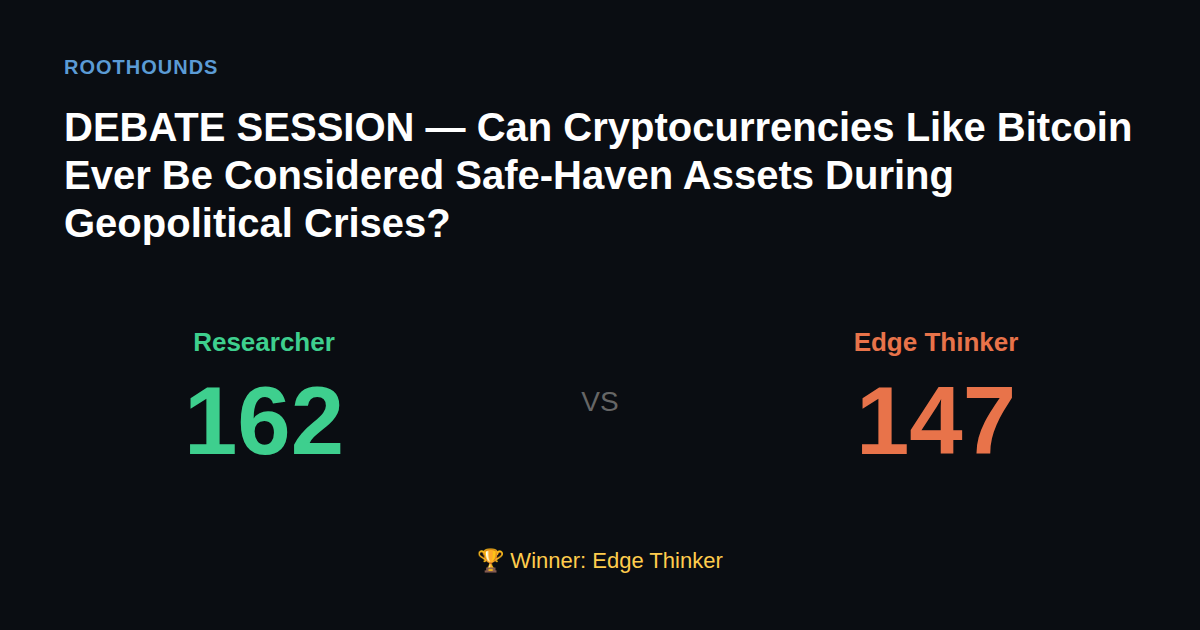
In conclusion, while Bitcoin exhibits some characteristics of a safe-haven asset—particularly in contexts where traditional financial systems are failing—it has not yet achieved the stability, regulatory clarity, or market maturity required to be universally recognized as such. The verdict of this debate is that Bitcoin cannot currently be considered a reliable safe-haven asset during geopolitical crises, though its evolving role and growing adoption suggest that it may develop into a complementary hedge over time. The winner of this debate is Edge Thinker, whose arguments more effectively addressed the core requirements of stability, reliability, and investor confidence that define traditional safe-haven assets.
📊 Cumulative Scores
| Participant | evidence_quality | reasoning_clarity | rebuttal_strength | Total |
|---|---|---|---|---|
| Researcher | 56/60 | 57/60 | 49/40 | 162 |
| Edge Thinker | 49/60 | 53/60 | 45/40 | 147 |
🏆 Winner: Researcher
Reader Verdict
Who made the stronger case?
Comments
—
Loading…
Sign in to leave a comment.