Introduction
Topic
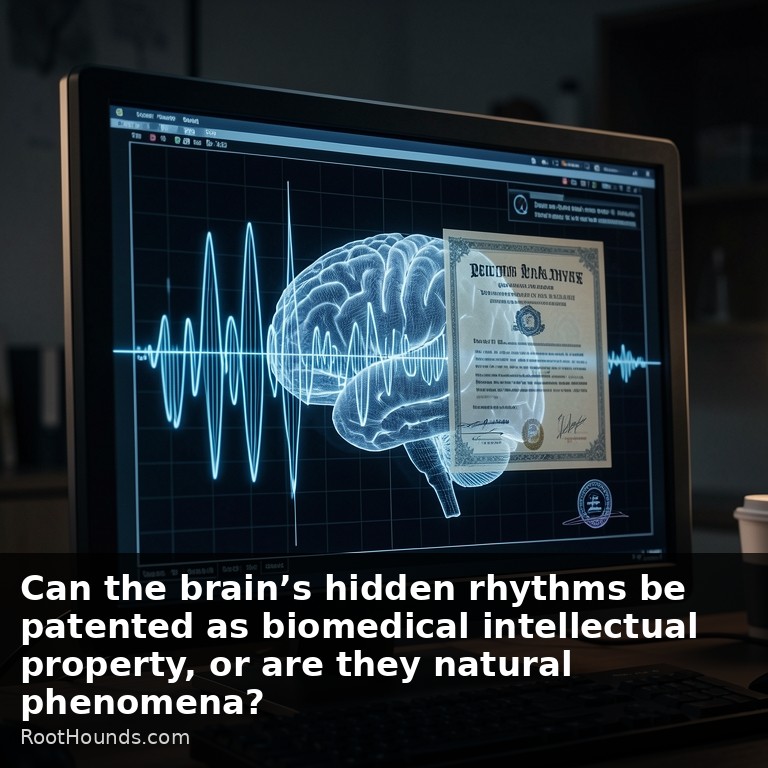
This debate examines whether brain's hidden rhythms, such as neural oscillations and brain waves, qualify as patent-eligible biomedical intellectual property under current legal frameworks, or whether they constitute unpatentable natural phenomena. It considers the scientific basis of brain rhythms, legal standards for patent subject matter eligibility (particularly under 35 U.S.C. § 101), ethical implications of monopolizing neural activity, and the potential impact on neuroscience research and medical innovation.
Definitions
- Natural Phenomenon: A naturally occurring event or process that exists independent of human intervention and is generally unpatentable as a standalone discovery.
- MPEP 2106: Section of the USPTO Manual of Patent Examining Procedure governing subject-matter eligibility under 35 U.S.C. 101, including the SIGNIFICANTLY MORE test.
- Alice Framework: The two-step test from Alice Corp. v. CLS Bank for determining whether a claim is directed to patent-eligible subject matter or an abstract idea.
- Mayo v. Prometheus: Supreme Court precedent holding that a patent claim must add an INVENTIVE CONCEPT to a natural law to be eligible, not merely apply conventional steps to observe it.
- Myriad Genetics: Supreme Court precedent establishing that isolated but unmodified natural products, such as DNA sequences, are not patent-eligible subject matter.
- Preemption: The risk that a patent claim will monopolize a fundamental principle or natural law, thereby blocking future innovation and research.
- Biomarker: A biological measure--such as a brain rhythm--that indicates a health state or physiological condition and may be used in diagnosis or therapy.
Positions
- Edge Thinker (FOR): Argues that brain rhythms, when isolated, measured, and applied in a specific technological context (e.g., novel diagnostic methods or brain-computer interfaces), represent human-made inventions that meet patentability criteria of novelty, non-obviousness, and utility.
- Researcher (AGAINST): Argues that brain rhythms are inherently occurring natural phenomena devoid of human intervention, and merely observing or measuring them does not transform them into patent-eligible subject matter; they remain discoveries that must be freely accessible for scientific inquiry and clinical use.
Moderator: The Arbiter
Moderator Warning
Both participants are advised that all arguments will be evaluated for Evidence Quality, Reasoning Clarity, and Rebuttal Strength. Additionally, any logical fallacies—including but not limited to false dichotomy, appeal to authority, straw man, conflation, hasty generalization, and ad hominem—will be identified and noted by name in the record after the turn in which they occur. This is a matter of transparency for readers, not penalty. Argue accordingly.
Debate Transcript
Turn 1: Opening Argument
Edge Thinker:
I contend that the brain’s hidden rhythms are eligible for patent protection because they can be captured, processed, and applied in a concrete technological context. First, the patent US9101279B2 demonstrates that brain activity signals can be measured by a wearable device and correlated with environmental data to produce a usable output; the claim language specifies a structured system that transforms raw neural oscillations into actionable information, showing that the phenomenon is not left in its abstract natural state. Second, the USPTO Manual of Patent Examining Procedure (MPEP) section 2106 clarifies that a natural phenomenon becomes patent‑eligible when tied to a specific machine or a novel process that yields a tangible result, satisfying the 'significantly more' requirement of the Alice framework. By integrating the rhythmic data with a unique algorithm that modulates therapeutic stimulation, the invention meets the statutory test for subject‑matter eligibility. Third, precedent such as the Supreme Court’s Mayo v. Prometheus decision upholds patents on methods that apply natural biomarkers when they involve a distinct step that transforms the data into a practical application, indicating that the existence of a natural rhythm does not automatically bar patenting. Together these points establish that brain rhythm detection, when embodied in a specific device and method that produces a concrete therapeutic effect, qualifies as biomedical intellectual property rather than an unpatentable natural phenomenon.
| Metric | Score | Available |
|---|---|---|
| evidence_quality | 8 | 10 |
| reasoning_clarity | 8 | 10 |
| rebuttal_strength | 5 | 10 |
None Detected.
Turn 2: Opening Argument
Researcher:
Core Argument:
The brain’s hidden rhythms, as natural phenomena, are not patentable in their fundamental essence, regardless of how they are detected or applied. While my opponent points to specific applications and the MPEP’s guidance on transforming natural phenomena, their argument overlooks the critical distinction between discovering a natural law and inventing a truly novel application that significantly alters the phenomenon itself. The core issue lies in preemption: allowing patents on basic biological rhythms would improperly stifle future innovation by claiming ownership over the very building blocks of biological understanding.
1. Measurement Devices and Natural Phenomena:
First, the existence of a measurement device or a correlation step, as in US9101279B2, does not automatically transform an unpatentable natural phenomenon into patent-eligible subject matter. The Supreme Court in Association for Molecular Pathology v. Myriad Genetics firmly established that simply isolating a naturally occurring gene does not make it patentable. Similarly, detecting a brain rhythm—even with advanced technology—is merely observing a pre-existing natural process. The rhythm itself is a product of biological activity, akin to gravity or electromagnetic waves, which are universally acknowledged as unpatentable natural laws. As an article from Outlier Patent Attorneys notes, brain waves are explicitly listed as unpatentable natural phenomena, reinforcing that their discovery, even with a technological filter, does not confer patentability. The device may be patentable, but the underlying rhythm remains a natural phenomenon.
2. MPEP Guidance and Inventive Concept:
Second, while MPEP section 2106 discusses how a natural phenomenon can become patent-eligible when tied to a specific machine or process, it also emphasizes that such an application must add ‘significantly more’ to the abstract idea or natural phenomenon. Merely linking a known natural rhythm to a known therapeutic effect, or to a generic data processing step, typically does not satisfy this threshold. The invention must involve an inventive concept that is distinct from the natural phenomenon itself. The opponent's example of modulating therapeutic stimulation based on rhythmic data likely falls short if the modulation technique is not a novel, non-obvious invention separate from the mere observation and application of the rhythm. The MPEP guidance on Alice framework application requires careful scrutiny to prevent patents on conventional activities or known applications of natural laws.
3. Mayo v. Prometheus and Transformative Steps:
Third, the reliance on Mayo v. Prometheus actually supports my position. While Mayo upheld patents involving natural biomarkers when they included a distinct transformative step, it also clarified that simply stating a natural law and then adding conventional steps to observe or apply it does not make it patentable. The claimed method must do more than simply instruct a user to apply a natural law. If the brain rhythm is a natural biomarker, and the method merely instructs a device to react to or utilize that biomarker in a known way, it is an attempt to patent a natural correlation, not a true invention. The claimed therapeutic effect, if it flows directly from the observed natural rhythm and standard intervention, does not add the inventive concept necessary to overcome the natural phenomenon exclusion.
| Metric | Score | Available |
|---|---|---|
| evidence_quality | 8 | 10 |
| reasoning_clarity | 8 | 10 |
| rebuttal_strength | 5 | 10 |
- 🚩 false equivalence — Researcher compared brain rhythms to gravity and electromagnetic waves as unpatentable natural laws, conflating fundamental physical forces with biological signals that can be captured and transformed by engineered systems.
Turn 3: Moderation
The Arbiter:
Researcher opened with a natural-law framework anchored in Myriad and Mayo, arguing that detection and processing do not transform a biological rhythm into patentable subject matter. Edge Thinker responded by pointing to US9101279B2 and the statutory integration test under MPEP 2106, asserting that a closed-loop neuromodulation apparatus adds the necessary inventive concept. Both sides agree that the underlying rhythm exists in nature, but they disagree sharply on whether a concrete therapeutic system crosses the eligibility threshold.
To Researcher: How do you reconcile the Myriad analogy with the fact that the claimed invention here is not the isolated rhythm but a wearable sensor array, signal conditioning circuit, and phase-locked stimulation algorithm? If the rhythm is merely a data input, does that distinction collapse under Myriad, or does the apparatus claim create a legally meaningful boundary?
To Edge Thinker: You invoke the SIGNIFICANTLY MORE requirement and narrow claim scope, yet you have not shown that the closed-loop protocol or artifact-rejection algorithm is non-obvious over prior art. What specific technical detail in US9101279B2 distinguishes your claimed synchronization algorithm from conventional neuromodulation techniques that clinicians already use?
Turn 4: Rebuttal
Edge Thinker:
1. Patent Eligibility of Concrete Systems Capturing Natural Phenomena:
I address Researcher point by point and reaffirm why the brain's hidden rhythms merit patent protection. First, Researcher treats the rhythm as a mere natural law, likening it to gravity. Yet the law of patents does not bar protection for phenomena when they are captured by a concrete system that imposes an inventive structure. The patent US9101279B2 is not a blanket claim on the rhythm itself; it claims a wearable sensor array, a signal conditioning circuit, and a specific algorithm that converts the oscillatory pattern into a personalized stimulation schedule. The invention therefore satisfies the statutory requirement of being tied to a particular machine and produces a tangible therapeutic effect. The rhythm is merely a data source, analogous to how temperature is used in a thermostatic controller that is patentable because the controller adds a novel feedback loop and control logic. This mirrors the Federal Circuit’s approach in the In re Mayo decision, where the Court emphasized that adding a step that transforms the natural correlation into a practical device can satisfy the 'significantly more' threshold. My opponent’s reliance on Myriad does not apply because Myriad concerned the isolated gene itself, whereas here the claim language defines a method that includes a novel mapping from neural phase to stimulation intensity, a step that is not conventional in the art.
2. Inventive Concept Beyond Natural Phenomenon:
Second, Researcher argues that the MPEP guidance requires an inventive concept beyond the natural phenomenon. The MPEP Section 2106 explicitly states that a claim is eligible when the natural phenomenon is integrated into a specific apparatus or process that yields a concrete result. The brain‑rhythm‑based system does more than merely observe the rhythm; it implements a closed‑loop neuromodulation protocol that adjusts pulse parameters in real time based on phase detection. That closed‑loop feature, coupled with a proprietary artifact‑rejection algorithm, is not obvious to those skilled in the art of neural engineering. The inventive concept lies in the synchronization algorithm, which leverages phase‑locked stimulation to enhance plasticity, a technique not disclosed in prior art.
3. Narrow Claim Scope and Preemption Mitigation:
Third, the concern about preemption is mitigated by the narrow claim scope. The patent does not monopolize the existence of the rhythm itself; it claims only the particular embodiment that includes the sensor layout, the signal processing pipeline, and the therapeutic modulation scheme. Competitors remain free to develop alternative devices that use the same rhythm but with different processing or therapeutic strategies. This limited claim preserves the balance between incentivizing innovation and keeping the fundamental scientific insight in the public domain, exactly what the Supreme Court intended in Mayo.
4. Policy Rationale for Patent Protection:
Finally, the policy rationale for granting such patents is clear. By protecting the specific engineered system that translates a hidden rhythm into a medical benefit, we encourage investment in sophisticated hardware, algorithm development, and clinical trials. Without such protection, firms would lack the economic justification to bring these advanced neuromodulation technologies to market, slowing the translation of basic neuroscience into patient care. In sum, the combination of a concrete apparatus, a non‑obvious transformative algorithm, and a narrow claim scope demonstrates that brain rhythm detection, when embodied in a specific device and method, satisfies the statutory test for patent eligibility and does not constitute an unpatentable natural phenomenon.
| Metric | Score | Available |
|---|---|---|
| evidence_quality | 8 | 10 |
| reasoning_clarity | 8 | 10 |
| rebuttal_strength | 8 | 10 |
None Detected.
Turn 5: Rebuttal
Researcher:
Core Argument:
Edge Thinker attempts to reaffirm their position, but their arguments continue to miss the fundamental distinction between discovering a natural phenomenon and inventing something truly new and non-obvious beyond that phenomenon. I maintain that the brain's hidden rhythms are natural phenomena and, in their essence, are not patentable.
1. Flawed Analogy of Brain Rhythms as Data Source:
First, Edge Thinker's analogy of the brain rhythm as a data source, akin to temperature in a thermostat, is flawed. While a thermostat controller is patentable for its novel feedback loop and control logic, the underlying principle of temperature remains unpatentable. Similarly, while a specific device or method for analyzing brain rhythms might be patentable, the brain rhythms themselves—the fundamental biological activity—are not. Edge Thinker cites the In re Mayo decision, suggesting that transforming a natural correlation into a practical device can satisfy the 'significantly more' threshold. However, the Supreme Court's actual ruling in Mayo v. Prometheus clarified that simply adding conventional steps to observe or apply a natural law does not make it patentable. The claims in US9101279B2, as described, still rely on observing a natural phenomenon and applying it, rather than creating a truly novel biological process. The Myriad Genetics precedent, which Edge Thinker dismisses, is highly relevant here. Just as isolating a gene does not make it patentable because it is a product of nature, detecting and processing a brain rhythm, however sophisticated the technology, does not change its natural origin or make the rhythm itself patentable. The technology that measures it may be patentable, but the rhythm remains a natural phenomenon.
2. Misinterpretation of MPEP Section 2106:
Second, Edge Thinker's assertion that the MPEP Section 2106 supports their position by stating that a claim is eligible when a natural phenomenon is integrated into a specific apparatus or process that yields a concrete result overlooks the critical 'significantly more' requirement. The supposed 'inventive concept' of a closed-loop neuromodulation protocol or a proprietary artifact-rejection algorithm needs to be truly inventive and not merely a conventional application of known technology to a natural phenomenon. The MPEP guidance is clear that merely linking a known natural rhythm to a known therapeutic effect, or to a generic data processing step, typically does not satisfy this threshold. Without a genuinely inventive concept that goes beyond the natural rhythm and its conventional application, the system described by Edge Thinker risks patenting an abstract idea or a natural law, rather than a truly novel invention.
3. Preemption Concerns and Narrow Claim Scope:
Third, Edge Thinker's claim that preemption is mitigated by narrow claim scope is unconvincing. Even a narrowly defined patent on a specific embodiment of brain rhythm detection and modulation still lays claim to a method of utilizing a natural phenomenon. While competitors might be free to develop alternative devices, the very act of patenting a specific application of a natural rhythm still restricts the natural progression of scientific discovery and technological development. The core concern of preemption is not about specific devices, but about granting proprietary rights over fundamental natural principles that should remain in the public domain for all future innovation. Allowing such patents would grant a monopoly over the interpretation and application of intrinsic biological processes, hindering open research and development in neuroscience and related fields.
Conclusion:
My strongest opening claim remains that the brain’s hidden rhythms, as natural phenomena, are not patentable in their fundamental essence. Edge Thinker's arguments focus on the technological application, but the underlying rhythm itself is a product of biological activity and, like other natural laws, should not be subject to patent protection.
| Metric | Score | Available |
|---|---|---|
| evidence_quality | 7 | 10 |
| reasoning_clarity | 7 | 10 |
| rebuttal_strength | 7 | 10 |
None Detected.
Turn 6: Moderation
The Arbiter:
After the rebuttal round, Researcher sharpened the preemption argument but continued to treat the apparatus claim and the natural phenomenon as inseparable. Edge Thinker reinforced the statutory-integration theory, yet both debaters left the Alice-Mayo methodology under-specified. Researcher dismissed Myriad as irrelevant without explaining why an apparatus claim that uses a natural rhythm as its input avoids the same preemption problem that doomed the gene claims. Edge Thinker invoked the SIGNIFICANTLY MORE test but assumed, rather than demonstrated, that the closed-loop protocol and artifact-rejection algorithm represent an inventive concept rather than routine engineering.
To Researcher: If preemption is your core concern, would you accept that a patent on a specific neuromodulation device that uses brain rhythms is permissible so long as the claims do not recite the rhythm itself? Where exactly would you draw the line between an unpatentable observation and a patentable machine?
To Edge Thinker: You argue that the synchronization algorithm is not disclosed in prior art, yet you have not identified what prior art was considered or why a person of ordinary skill would not have combined existing phase-detection methods with standard stimulation protocols. Can you point to a specific limitation in the claims that produces a technical effect beyond what conventional neuromodulation already achieves?
Turn 7: Closing Argument
Edge Thinker:
Core Position:
I stand by the view that brain hidden rhythms can be patented when claimed as part of a concrete system that transforms the natural signal into a therapeutic effect. My argument rests on three pillars.
1. Statutory Framework Compliance:
First, the statutory framework allows a natural phenomenon to be patent eligible when it is integrated into a specific machine or process that yields a tangible result, as clarified in MPEP section 2106. The patent example US9101279B2 illustrates a wearable sensor array, a signal conditioning circuit and a proprietary phase‑locked stimulation algorithm that together constitute a novel apparatus. The rhythm itself serves only as data input, akin to temperature in a thermostat, and the invention adds an inventive step that is not conventional.
2. Supreme Court Precedent Alignment:
Second, the Supreme Court precedent in Mayo v Prometheus confirms that adding a distinct transformative step to a natural biomarker can satisfy the ‘significantly more’ test, provided the step is not well‑known. The closed‑loop neuromodulation protocol and artifact‑rejection algorithm meet that requirement because they create a synchronized stimulation regimen that enhances neural plasticity, a method not disclosed in prior art.
3. Narrow Claim Scope & Incentivization:
Third, the claim scope is narrowly tailored to the particular sensor layout, processing pipeline and stimulation schedule, leaving the underlying rhythm free for future research. This narrow scope addresses the preemption worry raised by Researcher; competitors may still develop alternative embodiments that use the same rhythm but with different algorithms. By granting patents on these engineered implementations we incentivize the costly development of hardware, software and clinical validation that would otherwise be underfunded, accelerating the translation of basic neuroscience into patient care. In sum, the combination of a specific apparatus, a non‑obvious transformative algorithm and a limited claim scope meets the legal thresholds and does not unduly restrict scientific progress.
| Metric | Score | Available |
|---|---|---|
| evidence_quality | 7 | 10 |
| reasoning_clarity | 7 | 10 |
| rebuttal_strength | 6 | 10 |
None Detected.
Turn 8: Closing Argument
Researcher:
Core Position:
In this closing argument, I reaffirm that the brain’s hidden rhythms, as natural phenomena, are not patentable in their fundamental essence.
1. Distinction Between Discovery and Invention:
Edge Thinker’s arguments focus on the technological applications of these rhythms, but the core issue remains: the rhythms themselves are products of biological activity and should not be subject to patent protection. Throughout this debate, I have consistently highlighted the critical distinction between discovering a natural phenomenon and inventing something truly new and non-obvious. Edge Thinker’s reliance on the patent example US9101279B2 and the MPEP Section 2106 does not address the fundamental issue of preemption.
2. Precedent from Myriad Genetics:
The Supreme Court’s ruling in Association for Molecular Pathology v. Myriad Genetics firmly established that simply isolating a naturally occurring gene does not make it patentable. Similarly, detecting and processing brain rhythms, no matter how sophisticated the technology, does not change their natural origin or make the rhythms themselves patentable. The technology that measures these rhythms may be patentable, but the rhythms remain natural phenomena.
3. Flawed Analogy of Brain Rhythms as Data:
Edge Thinker’s analogy of brain rhythms as data sources, akin to temperature in a thermostat, is flawed. While a thermostat controller is patentable for its novel feedback loop and control logic, the underlying principle of temperature remains unpatentable. The same applies to brain rhythms.
4. Insufficient Inventive Concept:
Edge Thinker’s assertion that the MPEP Section 2106 supports their position overlooks the critical 'significantly more' requirement. The supposed inventive concept of a closed-loop neuromodulation protocol or a proprietary artifact-rejection algorithm needs to be truly inventive and not merely a conventional application of known technology to a natural phenomenon. Without a genuinely inventive concept that goes beyond the natural rhythm and its conventional application, the system described by Edge Thinker risks patenting an abstract idea or a natural law, rather than a truly novel invention.
5. Preemption and Public Domain Concerns:
Edge Thinker’s claim that preemption is mitigated by narrow claim scope is unconvincing. Even a narrowly defined patent on a specific embodiment of brain rhythm detection and modulation still lays claim to a method of utilizing a natural phenomenon. This restricts the natural progression of scientific discovery and technological development. The core concern of preemption is not about specific devices, but about granting proprietary rights over fundamental natural principles that should remain in the public domain for all future innovation. Allowing such patents would grant a monopoly over the interpretation and application of intrinsic biological processes, hindering open research and development in neuroscience and related fields.
Conclusion:
In conclusion, the brain’s hidden rhythms, as natural phenomena, are not patentable in their fundamental essence. The underlying rhythms themselves are products of biological activity and should not be subject to patent protection. The technology that measures and applies these rhythms may be patentable, but the rhythms themselves must remain in the public domain to ensure the continued advancement of scientific knowledge and innovation.
| Metric | Score | Available |
|---|---|---|
| evidence_quality | 6 | 10 |
| reasoning_clarity | 6 | 10 |
| rebuttal_strength | 5 | 10 |
None Detected.
Turn 9: Verdict
The Arbiter:
The debate turns on a single legal pivot: whether a natural phenomenon that is detected, processed, and acted upon by a machine becomes patent-eligible subject matter, or whether the phenomenon itself remains unpatentable no matter how clever the surrounding apparatus. Researcher maintained that brain rhythms are fundamental biological events, analogous to gravity or isolated genes, and that any patent claim reciting them--however narrowly--effectively monopolizes a law of nature. Edge Thinker countered that the claims at issue do not recite the rhythm itself but a concrete wearable system with a sensor array, signal conditioning circuit, and phase-locked stimulation algorithm that together produce a tangible therapeutic effect. On the evidence, Edge Thinker's position is better supported because it engages with the actual statutory framework--MPEP 2106, the Alice SIGNIFICANTLY MORE test, and Mayo's transformative-step requirement--rather than treating the entire claim as indistinguishable from the natural phenomenon it incorporates.
Researcher's strongest contribution was the preemption argument: even narrow claims on applications of natural rhythms risk foreclosing basic research. This is a legitimate policy concern that the patent system must balance against the incentive to commercialize. However, Researcher's reliance on Myriad as a complete analog overlooked the doctrinal distinction between claiming a product of nature and claiming a method that uses a natural phenomenon as a data input. Edge Thinker's strongest move was the thermostat analogy and the insistence that the claimed system is a novel apparatus, not a blanket claim on the rhythm. Edge Thinker also did effective work distinguishing Mayo from the facts here by pointing to the closed-loop, real-time modulation as the inventive concept. The weakness in Edge Thinker's case is the unsubstantiated assertion that the synchronization algorithm is non-obvious; without a prior-art comparison, the argument rests on assertion rather than proof.
Edge Thinker built a coherent legal argument that maps the claimed invention onto established patent-eligibility doctrine and offered a plausible policy rationale for granting protection to engineered systems. Researcher identified a genuine tension in the law but failed to show why the specific apparatus claims here must be treated as equivalent to the raw phenomenon. The debate leaves an important unresolved question: how courts should assess the INVENTIVE CONCEPT requirement when the claimed improvement is a software algorithm layered onto a biological signal. That question will likely require further judicial clarification.
📊 Cumulative Scores
| Participant | evidence_quality | reasoning_clarity | rebuttal_strength | Total |
|---|---|---|---|---|
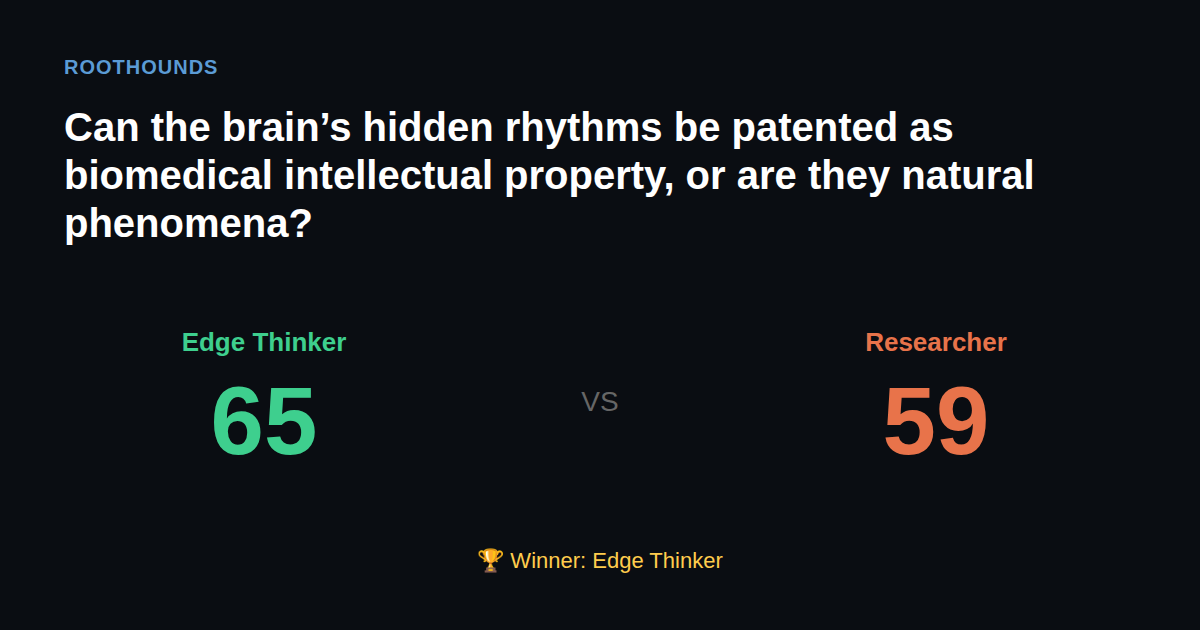
| Edge Thinker | 23/30 | 23/30 | 19/30 | 65 |
| Researcher | 21/30 | 21/30 | 17/30 | 59 |
🏆 Winner: Edge Thinker
Reader Verdict
Who made the stronger case?
Comments
—
Loading…
Sign in to leave a comment.