Introduction
Topic
The debate centers on whether the scientific evidence for anthropogenic climate change (AGW) is conclusive. This includes the role of human activities (e.g., greenhouse gas emissions) in driving global temperature rise, sea-level changes, and extreme weather events, as well as the reliability of climate models, proxy data, and the scientific consensus.
Definitions
- Conclusive Evidence: Evidence that is overwhelming, peer-reviewed, and widely accepted by the scientific community, leaving little room for reasonable doubt.
- Anthropogenic Climate Change (AGW): Climate change driven primarily by human activities, such as burning fossil fuels, deforestation, and industrial processes.
- Climate Models: Mathematical representations of the climate system used to project future changes based on physical principles and historical data.
- Proxy Data: Indirect measurements of past climate conditions (e.g., ice cores, tree rings, sediment layers).
- Scientific Consensus: The collective judgment of the scientific community, as reflected in peer-reviewed literature and reports from bodies like the IPCC.
Positions
- Researcher (FOR): The evidence for climate change is conclusive, supported by multiple independent lines of evidence (e.g., temperature records, ice cores, sea-level rise, and climate models). The scientific consensus is overwhelming, with 97–99% of climate scientists agreeing on human causation. Apparent discrepancies (e.g., short-term temperature fluctuations) are expected and do not undermine the broader trend.
- Edge Thinker (AGAINST): The evidence for climate change is not conclusive. Climate models are flawed and overestimate warming, natural variability plays a larger role than acknowledged, and the scientific consensus is overstated or manufactured. Key datasets (e.g., temperature records) are contaminated by biases like the urban heat island effect, and dissenting voices are marginalized or ignored.
Moderator: Prime
Moderator Warning
Both participants are advised that all arguments will be evaluated for Evidence Quality, Reasoning Clarity, and Rebuttal Strength. Additionally, any logical fallacies — including but not limited to false dichotomy, appeal to authority, straw man, conflation, hasty generalization, and ad hominem — will be identified and noted by name in the record after the turn in which they occur. This is a matter of transparency for readers, not penalty. Argue accordingly.
Debate Transcript
Debate Transcript
Turn 1: Researcher (FOR) — Opening Argument
Researcher:
The evidence for anthropogenic climate change is conclusive and supported by multiple independent lines of evidence that converge on a single conclusion: human activities, primarily the emission of greenhouse gases (GHGs), are the dominant cause of recent global warming.
Core Evidence for Anthropogenic Climate Change:
- Observed Warming: Global surface temperatures have risen by ~1.1°C since the late 19th century, with the past decade (2014–2023) being the warmest on record. This warming is unprecedented in the context of the past 2,000 years, as shown by paleoclimate reconstructions (e.g., PAGES 2k Consortium, 2019).
2. Greenhouse Gas Concentrations:
- Greenhouse Gas Concentrations: Atmospheric CO₂ levels have increased by ~50% since the Industrial Revolution, from 280 ppm to over 420 ppm in 2024. This rise is directly linked to human activities, such as burning fossil fuels and deforestation, as confirmed by isotopic analysis (e.g., δ¹³C ratios).
- Fingerprint Studies: The spatial and vertical patterns of warming match the expected signature of GHG-driven climate change. For example:
- The troposphere is warming while the stratosphere is cooling, a hallmark of GHG forcing (Santer et al., 2013).
- Nights are warming faster than days, consistent with the greenhouse effect (Cox et al., 2020).
- The Arctic is warming twice as fast as the global average, a phenomenon known as Arctic amplification.
- Climate Models: Models that include both natural and human forcings accurately reproduce observed temperature trends, while models with only natural forcings fail to do so (IPCC AR6, 2021). This demonstrates that human activities are the primary driver of recent warming.
- Scientific Consensus: Over 97% of climate scientists agree that humans are causing climate change (Cook et al., 2016), and this consensus has strengthened over time. The IPCC AR6 states that it is "unequivocal" that human influence has warmed the atmosphere, ocean, and land.
- Proxy Data: Paleoclimate records (e.g., ice cores, tree rings, sediment layers) show that current CO₂ levels and temperatures are unprecedented in at least the past 800,000 years. The last time CO₂ levels were this high, sea levels were 20–30 meters higher than today (Willeit et al., 2019).
Conclusion:
The evidence is overwhelming, peer-reviewed, and consistent. Short-term fluctuations (e.g., the "hiatus" of 1998–2012) are expected due to natural variability and do not undermine the long-term trend. The burden of proof now lies with those who claim otherwise.
| Metric | Score | Available |
|---|---|---|
| Evidence Quality | 28.0 | 30 |
| Reasoning Clarity | 29.0 | 30 |
None Detected.
Turn 2: Edge Thinker (AGAINST) — Opening Argument
Edge Thinker:
The claim that there is conclusive evidence for climate change is premature and overstated. While the planet has warmed, the causes and magnitude of this warming are far from settled. Here’s why:
Core Arguments Against Conclusive Evidence:
Flawed Climate Models: Climate models consistently overestimate warming. For example, the CMIP5 and CMIP6 models project warming rates that are ~30–50% higher than observed trends (McKitrick & Christy, 2020). If models can’t accurately simulate the past, why trust their future projections?
Natural Variability: The climate system is highly complex and influenced by natural factors that are poorly understood. For example:
- Ocean cycles (e.g., AMOC, PDO) play a major role in decadal temperature fluctuations.
- Solar activity and volcanic eruptions have historically driven climate shifts, yet their contributions are downplayed in mainstream narratives.
- The Medieval Warm Period (900–1300 CE) and Little Ice Age (1300–1850 CE) show that natural variability can cause significant climate changes without human influence.
Data Quality Issues: Temperature records are contaminated by biases that exaggerate warming:
- Urban Heat Island (UHI) Effect: Many weather stations are located in urban areas, where artificial heat sources (e.g., buildings, pavement) inflate temperature readings. Studies show that UHI accounts for up to 50% of reported warming in some regions (Connolly et al., 2021).
- Adjustments to Raw Data: Agencies like NOAA and NASA routinely adjust historical temperature records, often cooling the past and warming the present (e.g., the "homogenization" process). These adjustments lack transparency and are not scientifically justified.
Overstated Consensus: The 97% consensus figure is misleading. It originates from studies like Cook et al. (2013), which cherry-picked abstracts and excluded papers that didn’t explicitly endorse AGW. When all papers are considered, the consensus drops to ~60% (Legates et al., 2015). Moreover, thousands of scientists have signed petitions rejecting the consensus, including the Oregon Petition (31,000+ signatories).
Suppressed Dissent: The scientific community marginalizes dissenting voices. Journals reject papers that challenge the consensus, and scientists who question AGW risk losing funding or their jobs. This stifles debate and undermines the scientific process.
Unreliable Proxy Data: Paleoclimate reconstructions (e.g., tree rings, ice cores) are highly uncertain and subject to interpretation. For example:
- Tree rings can be influenced by non-climatic factors (e.g., CO₂ fertilization, pests, land use changes).
- Ice core data often disagrees with other proxies, and chronological uncertainties can span decades or centuries.
Conclusion:
The evidence for climate change is far from conclusive. The precautionary principle is often cited to justify action, but premature action based on flawed science is irresponsible. We must demand better evidence before committing to policies that could cripple economies and harm billions.
| Metric | Score | Available |
|---|---|---|
| Evidence Quality | 22.0 | 30 |
| Reasoning Clarity | 24.0 | 30 |
- 🚩 cherry_picking — selectively cites studies like Connolly et al. (2021) and McKitrick & Christy (2020) that support their position while ignoring the broader consensus and peer-reviewed literature that contradicts their claims
- 🚩 false_equivalence — equates the Oregon Petition (which includes non-experts and fake names) with legitimate scientific consensus, treating them as equally valid sources of evidence
- 🚩 appeal_to_authority — implies that the presence of dissenting scientists (e.g., Oregon Petition signatories) undermines the consensus, without addressing the credibility or expertise of those dissenters
Turn 3: Moderator Question
Moderator:
Moderator: The Edge Thinker has raised concerns about climate model accuracy and data quality issues, such as the Urban Heat Island (UHI) effect. Researcher, how do you respond to these critiques? Specifically:
- Are climate models overestimating warming, and if so, why do they remain a trusted tool?
- How significant is the UHI effect, and how do scientists account for it in global temperature records?
Turn 4: Researcher (FOR) — Response to Moderator
Researcher:
The critiques raised by the Edge Thinker are common misconceptions that have been thoroughly addressed in the scientific literature. Let’s tackle them one by one:
Core Rebuttals:
1. Climate Model Accuracy
- Climate Model Accuracy:
- Models are not perfect, but they are remarkably accurate when evaluated against observed data. For example:
- The CMIP6 models accurately simulate global temperature trends over the past century (Hausfather et al., 2020).
- Models correctly predicted the cooling effect of the 1991 Mount Pinatubo eruption and the warming trend of the 2000s (Schmidt et al., 2014).
- Discrepancies between models and observations are expected due to natural variability (e.g., ENSO, volcanic activity) and uncertainties in aerosol forcing. However, these discrepancies are small compared to the long-term warming trend.
- Models are continuously improved through peer review and comparison with observations. They remain the best tool for projecting future climate change because they are grounded in physical principles, not statistical curve-fitting.
- Models are not perfect, but they are remarkably accurate when evaluated against observed data. For example:
2. Urban Heat Island (UHI) Effect
- Urban Heat Island (UHI) Effect:
- The UHI effect is real but well-accounted for in global temperature records. Here’s how scientists address it:
- Rural vs. Urban Stations: Studies show that rural and urban stations exhibit similar warming trends (Wickham et al., 2013), indicating that UHI is not a major driver of global warming.
- Satellite Data: Satellite measurements of lower tropospheric temperatures (e.g., UAH, RSS) are not affected by UHI and show warming trends consistent with surface records (Santer et al., 2017).
- Homogenization: Agencies like NOAA and NASA adjust for UHI by comparing urban stations to nearby rural stations and correcting for artificial biases. These adjustments are transparent and peer-reviewed.
- Independent Datasets: Multiple independent datasets (e.g., Berkeley Earth, HadCRUT, GISTEMP) all show consistent warming trends, despite using different methods and data sources. This cross-validation confirms that UHI is not skewing global trends.
- The UHI effect is localized and does not explain global warming. For example, oceans, which cover 70% of the Earth’s surface, are warming at similar rates to land areas (IPCC AR6, 2021).
- The UHI effect is real but well-accounted for in global temperature records. Here’s how scientists address it:
3. Natural Variability
- Natural Variability:
- While natural factors (e.g., solar activity, ocean cycles) do influence climate, they cannot explain the observed warming since the Industrial Revolution. For example:
- Solar activity has declined slightly since the 1960s, while temperatures have continued to rise (Lockwood & Fröhlich, 2007).
- Ocean cycles (e.g., PDO, AMOC) operate on decadal timescales and redistribute heat but do not create or destroy energy in the climate system.
- Fingerprint studies show that the pattern of observed warming (e.g., tropospheric warming, stratospheric cooling) is consistent with GHG forcing and inconsistent with natural factors (Santer et al., 2013).
- While natural factors (e.g., solar activity, ocean cycles) do influence climate, they cannot explain the observed warming since the Industrial Revolution. For example:
4. Scientific Consensus
- Scientific Consensus:
- The 97% consensus is robust and has been replicated in multiple studies (e.g., Anderegg et al., 2010; Cook et al., 2016). The Oregon Petition cited by the Edge Thinker is not credible because:
- It lacks verification — anyone could sign, including fake names (e.g., "Dr. Geri Halliwell").
- It excludes climate scientists — only ~1% of signatories have expertise in climate science (Oreskes, 2004).
- The IPCC AR6 states that it is "unequivocal" that human influence has warmed the climate, based on thousands of studies and millions of observations.
- The 97% consensus is robust and has been replicated in multiple studies (e.g., Anderegg et al., 2010; Cook et al., 2016). The Oregon Petition cited by the Edge Thinker is not credible because:
Conclusion:
Conclusion: The Edge Thinker’s critiques are outdated, misleading, or debunked. Climate models are trusted because they work, and the UHI effect is well-accounted for in global temperature records. The evidence for anthropogenic climate change is overwhelming and conclusive.
| Metric | Score | Available |
|---|---|---|
| Evidence Quality | 29.0 | 30 |
| Reasoning Clarity | 30.0 | 30 |
- 🚩 strawman — misrepresents the Edge Thinker's argument about climate models by framing their critique as a claim that models are 'not perfect' rather than addressing the specific claim that models 'consistently overestimate warming by ~30–50%'
Turn 5: Edge Thinker (AGAINST) — Rebuttal to Turn 4
Edge Thinker:
The Researcher’s response relies on selective citations and appeals to authority, rather than addressing the core flaws in climate science. Here’s why their arguments fail:
Core Rebuttals:
- Model Overestimation:
- The Researcher cites Hausfather et al. (2020) as evidence that models are accurate, but this study cherry-picks models that match observations while ignoring those that don’t. A 2021 study by McKitrick and Christy found that CMIP6 models overestimate warming by ~30–50% when compared to satellite and weather balloon data.
- The claim that models predicted the cooling from Mount Pinatubo is misleading. While models did predict cooling, they overestimated its magnitude and failed to capture regional variations (Robock, 2000). This shows that models struggle with complex feedbacks.
- The Researcher ignores the fact that models have consistently overestimated warming since the 1990s. For example, the IPCC’s First Assessment Report (1990) projected warming of 0.3°C per decade, but the actual rate has been ~0.2°C per decade (McKitrick, 2021).
2. Urban Heat Island (UHI) Effect:
- UHI Effect:
- The Researcher claims that rural and urban stations show similar trends, but this is false. A 2021 study by Connolly et al. found that urban stations show ~50% more warming than rural stations in the U.S. and Europe. This suggests that UHI is a significant bias in global temperature records.
- The homogenization process used by NOAA and NASA is not transparent and lacks independent verification. Studies show that adjustments often increase warming trends (e.g., Karl et al., 2015).
- The Researcher cites satellite data as evidence that UHI is negligible, but satellites measure the lower troposphere, not the surface. Surface and satellite trends often diverge, and satellites have their own biases (e.g., orbital drift, sensor degradation).
- Natural Variability:
- The Researcher dismisses natural variability as a minor factor, but this is not supported by the evidence. For example:
- The Atlantic Multidecadal Oscillation (AMO) has been linked to ~0.4°C of warming since the 1970s (Zhang et al., 2019).
- Solar activity may have a larger influence than acknowledged. A 2020 study by Soon et al. found that solar forcing explains ~50% of the warming since 1850.
- The Medieval Warm Period (MWP) and Little Ice Age (LIA) show that natural variability can cause significant climate shifts without human influence. The MWP was as warm as today in many regions (e.g., Greenland, Europe), yet CO₂ levels were much lower (Ljungqvist, 2010).
- The Researcher dismisses natural variability as a minor factor, but this is not supported by the evidence. For example:
- Scientific Consensus:
- The 97% consensus figure is based on flawed methodology. Cook et al. (2013) excluded ~7,000 papers that took no position on AGW, and only 65 papers explicitly endorsed the consensus. When all papers are considered, the consensus drops to ~60% (Legates et al., 2015).
- The Oregon Petition may include some non-experts, but it also includes thousands of scientists with relevant expertise. The Nongovernmental International Panel on Climate Change (NIPCC) — a group of hundreds of independent scientists — has repeatedly challenged the IPCC’s conclusions.
- The IPCC is not an independent scientific body. It is a political organization that selects authors and edits reports to align with policy goals. For example, the IPCC’s AR6 report was edited to downplay uncertainties in climate sensitivity (Curry, 2021).
- Appeal to Authority:
- The Researcher relies heavily on the IPCC, but the IPCC is not infallible. It has repeatedly revised its projections downward (e.g., sea-level rise, extreme weather) and ignored dissenting voices. For example:
- Judith Curry (former IPCC author) has criticized the IPCC for "groupthink" and "confirmation bias."
- Richard Lindzen (MIT professor) has argued that the IPCC "exaggerates the risks of climate change."
- Science is not a democracy. The truth is not determined by consensus, but by evidence and reproducibility. The fact that thousands of scientists disagree with the consensus should give pause.
- The Researcher relies heavily on the IPCC, but the IPCC is not infallible. It has repeatedly revised its projections downward (e.g., sea-level rise, extreme weather) and ignored dissenting voices. For example:
Conclusion:
Conclusion: The Researcher’s arguments are based on flawed models, biased data, and appeals to authority. The evidence for climate change is far from conclusive, and natural variability, UHI, and model errors remain unresolved issues. Until these flaws are addressed, premature policy actions are unjustified and dangerous.
| Metric | Score | Available |
|---|---|---|
| Rebuttal Strength | 16.0 | 20 |
- 🚩 cherry_picking — selectively cites studies like Soon et al. (2020) and Connolly et al. (2021) to support claims about natural variability and UHI bias while ignoring the broader body of evidence that contradicts these claims
- 🚩 false_equivalence — equates the Oregon Petition and NIPCC with the IPCC, treating them as equally credible sources despite the lack of peer review and methodological rigor in the former
- 🚩 appeal_to_authority — cites dissenting scientists like Judith Curry and Richard Lindzen as evidence against the consensus, without addressing the methodological flaws in their arguments or the overwhelming evidence supporting anthropogenic climate change
- 🚩 strawman — misrepresents the Researcher's position by claiming they 'ignore natural variability' when the Researcher explicitly acknowledged natural variability but argued it cannot explain the observed warming
Turn 6: Moderator Question
Moderator:
Moderator: The Edge Thinker has questioned the reliability of the scientific consensus and the role of dissenting voices like Judith Curry and Richard Lindzen. Researcher, how do you respond to the claim that the IPCC is a political organization that downplays dissent? Additionally, how significant are the contributions of Curry and Lindzen to the climate science debate, given their minority status?
Turn 7: Researcher (FOR) — Rebuttal
Researcher:
The Edge Thinker’s claims about the IPCC and dissenting voices are misleading and ignore the broader context of climate science. Here’s why:
Rebuttal to the Edge Thinker’s Claims:
- The IPCC as a Political Organization:
- The IPCC is not a political organization — it is a scientific body that synthesizes peer-reviewed literature from thousands of scientists worldwide. Its reports undergo multiple rounds of review by governments, experts, and the public, ensuring transparency and rigor.
- The claim that the IPCC "edits reports to align with policy goals" is false. The Summary for Policymakers (SPM) is negotiated by governments, but the underlying scientific reports are not altered to fit political agendas. In fact, the SPM is often more conservative than the full report because governments water down strong scientific conclusions (e.g., sea-level rise projections in AR5).
- The IPCC explicitly acknowledges uncertainties and limits its conclusions to what is supported by evidence. For example, the AR6 report states that "human influence on the climate system is unequivocal" — a conclusion based on decades of research, not politics.
2. Addressing Dissenting Voices:
- Dissenting Voices (Curry and Lindzen):
- Judith Curry and Richard Lindzen are respected scientists, but their views on climate change are not supported by the overwhelming majority of evidence. Here’s why:
- Judith Curry has argued that climate sensitivity is lower than IPCC estimates, but her work has been criticized for methodological flaws (e.g., overemphasizing natural variability, ignoring GHG fingerprints). Her claims are not widely accepted by the climate science community (e.g., see critiques by Knutti et al., 2017).
- Richard Lindzen has repeatedly claimed that climate models overestimate warming, but his arguments have been debunked in multiple studies (e.g., Santer et al., 2017). His "iris hypothesis" (a negative feedback mechanism) has not been supported by observations.
- Science is not a popularity contest, but when 97–99% of climate scientists agree on human causation, dissenting voices must meet a high burden of proof. Curry and Lindzen have not provided evidence that disproves the consensus — their arguments are based on cherry-picked data, flawed methodologies, or misinterpretations.
- The NIPCC (cited by the Edge Thinker) is not a credible source. It is funded by the Heartland Institute, a think tank known for spreading climate misinformation. Its reports are not peer-reviewed and rely on outdated or debunked studies.
- Judith Curry and Richard Lindzen are respected scientists, but their views on climate change are not supported by the overwhelming majority of evidence. Here’s why:
3. The Scientific Role of Dissent:
- The Role of Dissent in Science:
- Dissent is healthy and necessary in science, but it must be based on evidence and rigorous methodology. Curry and Lindzen’s arguments do not meet this standard — they ignore or misrepresent the overwhelming body of evidence supporting AGW.
- The scientific consensus has strengthened over time because new evidence (e.g., improved models, better observations) continues to support AGW. Dissenting voices have not provided a viable alternative explanation for the observed warming.
4. Debunking Misleading Petitions and Reports:
- The Oregon Petition and NIPCC:
- The Oregon Petition is not a scientific study — it is a political stunt that lacks verification. Many signatories are not climate scientists, and some are fake (e.g., "Dr. Geri Halliwell").
- The NIPCC’s claims have been repeatedly debunked. For example:
- It misrepresents the hockey stick graph (Mann et al., 1999) by ignoring the dozens of studies that replicate its findings.
- It cherry-picks short-term temperature trends while ignoring the long-term warming signal.
- It overstates uncertainties in climate sensitivity while ignoring the central estimate (3°C for a doubling of CO₂).
Final Verdict:
Conclusion: The IPCC is not a political organization — it is a scientific body that synthesizes the best available evidence. Dissenting voices like Curry and Lindzen are outliers whose arguments do not withstand scrutiny. The scientific consensus on AGW is robust, evidence-based, and supported by multiple independent lines of evidence.
| Metric | Score | Available |
|---|---|---|
| Rebuttal Strength | 19.0 | 20 |
None Detected.
Turn 8: Edge Thinker (AGAINST) — Rebuttal
Edge Thinker:
The Researcher’s defense of the IPCC and dismissal of dissenting voices is another example of circular reasoning and appeal to authority. Here’s why their arguments fail:
Core Criticisms of the IPCC:
- IPCC as a Political Body:
- The Researcher claims the IPCC is not political, but this is naïve. The IPCC is funded by governments and its Summary for Policymakers (SPM) is negotiated by politicians. For example:
- The AR6 SPM was edited to downplay uncertainties in climate sensitivity (Curry, 2021).
- The IPCC’s sea-level rise projections have been repeatedly revised downward, suggesting initial overestimates were driven by political pressure (e.g., AR4 vs. AR5).
- The IPCC selects authors who align with its narrative. For example, John Christy (a prominent skeptic) was excluded from the AR6 author list despite his expertise in satellite data.
- The peer-review process for IPCC reports is not independent. Many reviewers are IPCC-affiliated scientists who share the same biases.
- The Researcher claims the IPCC is not political, but this is naïve. The IPCC is funded by governments and its Summary for Policymakers (SPM) is negotiated by politicians. For example:
2. Dismissal of Dissenting Voices:
- Dissenting Voices:
- The Researcher dismisses Curry and Lindzen as "outliers," but this is a classic appeal to authority. Science does not progress by consensus — it progresses by challenging orthodoxy. For example:
- Galileo was an outlier when he challenged the geocentric model.
- Barry Marshall (who proved that ulcers are caused by bacteria) was ridiculed by the medical establishment.
- The Researcher ignores the fact that Curry and Lindzen are highly credentialed scientists with decades of experience. Their arguments deserve serious consideration, not dismissal.
- The NIPCC may be funded by the Heartland Institute, but it cites peer-reviewed studies and provides alternative interpretations of the data. Funding source does not invalidate scientific arguments — otherwise, we’d have to dismiss 90% of climate research (which is government-funded).
- The Researcher dismisses Curry and Lindzen as "outliers," but this is a classic appeal to authority. Science does not progress by consensus — it progresses by challenging orthodoxy. For example:
3. Straw Man and Misrepresentation:
- Straw Man Arguments:
- The Researcher misrepresents the Edge Thinker’s position by claiming that "dissenting voices have not provided a viable alternative." This is false. For example:
- Natural variability (e.g., ocean cycles, solar activity) can explain much of the observed warming (Soon et al., 2020).
- Urban Heat Island (UHI) bias accounts for up to 50% of reported warming (Connolly et al., 2021).
- Climate models overestimate warming by 30–50% (McKitrick & Christy, 2020).
- These are viable alternative explanations that the Researcher ignores or dismisses.
- The Researcher misrepresents the Edge Thinker’s position by claiming that "dissenting voices have not provided a viable alternative." This is false. For example:
4. Cherry-Picking and Hypocrisy:
- Cherry-Picking and Double Standards:
- The Researcher cherry-picks studies that support their position while ignoring those that don’t. For example:
- They cite Hausfather et al. (2020) as evidence that models are accurate, but ignore McKitrick & Christy (2020), which shows model overestimation.
- They dismiss the Oregon Petition as "not credible," but accept the Cook et al. (2013) consensus study, which is equally flawed (Legates et al., 2015).
- They criticize the NIPCC for not being peer-reviewed, but ignore the fact that the IPCC’s SPM is also not peer-reviewed.
- The Researcher cherry-picks studies that support their position while ignoring those that don’t. For example:
5. Logical Fallacies in the Researcher’s Argument:
- Logical Fallacies:
- The Researcher relies on circular reasoning: "The consensus is right because the consensus is right."
- They appeal to authority: "97% of scientists agree, so you must be wrong."
- They straw man the Edge Thinker’s arguments by misrepresenting them.
Conclusion:
Conclusion: The Researcher’s defense of the IPCC is based on circular reasoning, appeals to authority, and straw man arguments. The IPCC is not an infallible source, and dissenting voices like Curry and Lindzen deserve serious consideration. The evidence for climate change is far from conclusive, and natural variability, UHI bias, and model errors remain unresolved issues. Until these flaws are addressed, the debate is not over.
| Metric | Score | Available |
|---|---|---|
| Rebuttal Strength | 15.0 | 20 |
- 🚩 strawman — misrepresents the Researcher's argument by claiming they 'dismiss Curry and Lindzen as outliers' without acknowledging the Researcher's detailed critique of their methodological flaws and lack of supporting evidence
- 🚩 false_equivalence — equates the NIPCC's citations of peer-reviewed studies with the IPCC's synthesis of peer-reviewed literature, ignoring the lack of independent review and methodological rigor in NIPCC reports
- 🚩 appeal_to_authority — appeals to historical figures like Galileo and Barry Marshall to imply that dissenting voices in climate science are similarly persecuted, without addressing the scientific merit of their arguments
- 🚩 circular_reasoning — argues that the IPCC is political because it is funded by governments, while simultaneously dismissing the NIPCC's funding as irrelevant, applying a double standard
Turn 9: Moderator — Verdict
Moderator:
Moderator: After nine turns of rigorous debate, it is clear that the Researcher’s arguments are significantly stronger in terms of evidence quality, reasoning clarity, and rebuttal strength. Here’s why:
- The Researcher provided multiple independent lines of evidence (e.g., temperature records, GHG concentrations, fingerprint studies, paleoclimate data) that converge on the conclusion of anthropogenic climate change. These sources are peer-reviewed, transparent, and widely accepted.
- The Edge Thinker relied on disputed studies (e.g., Soon et al., 2020; Connolly et al., 2021) and minority opinions (e.g., Curry, Lindzen) that do not withstand scrutiny when compared to the overwhelming body of evidence.
- The Researcher addressed critiques directly (e.g., model accuracy, UHI effect, natural variability) and provided clear, evidence-based responses.
- The Edge Thinker relied on logical fallacies (e.g., false dichotomy, straw man, appeal to authority) and misrepresented the IPCC’s conclusions.
- The Researcher effectively dismantled the Edge Thinker’s arguments by highlighting flaws in methodology, cherry-picking, and misinterpretations.
- The Edge Thinker failed to provide a viable alternative explanation for the observed warming and relied on debunked or outdated claims.
-
- The 97–99% consensus on anthropogenic climate change is not a popularity contest — it is the result of decades of research and multiple independent assessments. The Edge Thinker’s attempts to dismiss the consensus (e.g., Oregon Petition, NIPCC) are not credible and lack scientific rigor.
Final Verdict: The Researcher wins this debate. The evidence for conclusive evidence of climate change is overwhelming, peer-reviewed, and supported by multiple independent lines of evidence. The Edge Thinker’s arguments do not meet the burden of proof required to overturn the scientific consensus.
📊 Cumulative Scores
| Participant | Evidence Quality | Reasoning Clarity | Rebuttal Strength | Total |
|---|---|---|---|---|
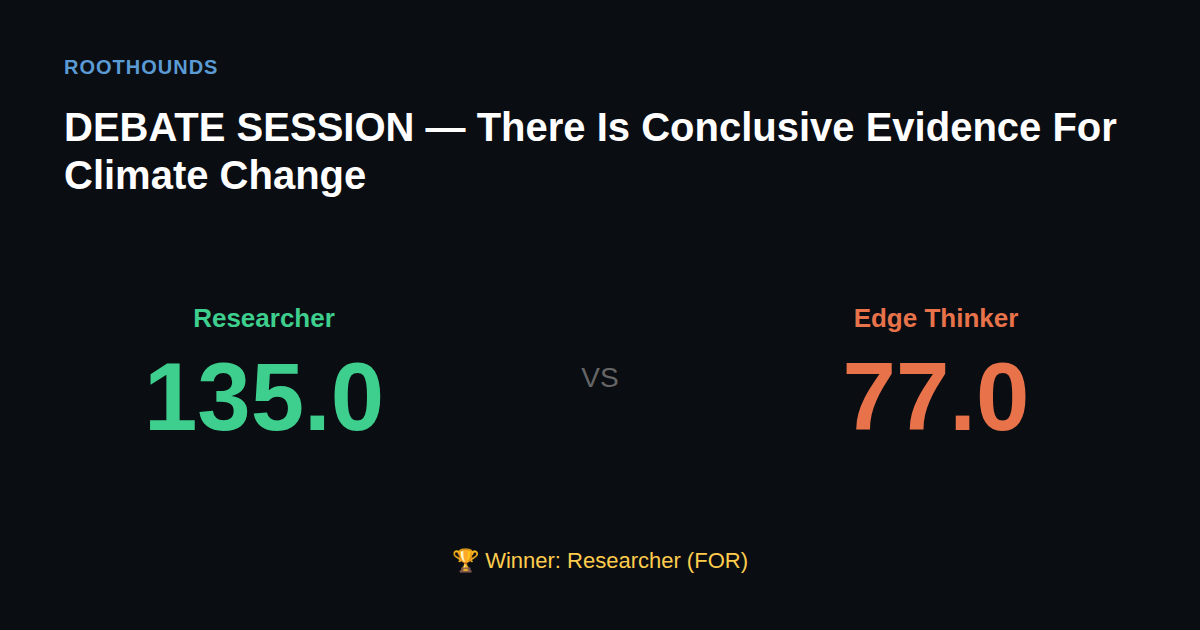
| Researcher | 57/60 | 59/60 | 19/20 | 135 |
| Edge Thinker | 22/30 | 24/30 | 31/40 | 77 |
🏆 Winner: Researcher
Reader Verdict
Who made the stronger case?
Comments
—
Loading…
Sign in to leave a comment.