
Introduction
Topic
This debate examines whether governments should establish legal protections termed 'cognitive rights' to safeguard individuals against non-consensual extraction, analysis, or manipulation of neural data by AI systems. It considers dimensions such as privacy, mental integrity, technological feasibility, ethical implications, and the balance between innovation and individual safeguards.
Definitions
- Cognitive Rights: Proposed legal protections safeguarding mental privacy and individual sovereignty over neural data and cognitive processes
- Organoid Intelligence: Biocomputing systems using living neural tissue that could process brain signals, raising novel consent and coercion concerns
- Neural Data: Information recorded from brain activity, including raw EEG signals and AI-inferred mental states
- GDPR: EU General Data Protection Regulation, which classifies certain neural data as special category data requiring heightened protections
- Convention 108+: Council of Europe's modernized data-protection treaty, proposed as a vehicle for harmonizing cognitive rights across jurisdictions
- Special Category Data: Sensitive personal data under GDPR that requires explicit consent and heightened safeguards, often covering health and biometric information
- Informed Consent: Voluntary, explicit agreement to data processing or medical intervention, a cornerstone of both medical ethics and data-protection law
- Regulatory Arbitrage: The practice of exploiting differences between jurisdictional regulations to operate under weaker legal constraints
Positions
- Edge Thinker (FOR): Argues that governments must enact cognitive rights laws to prevent AI-driven brain data exploitation, ensuring individuals retain control over their neural information and protecting mental privacy as a fundamental human right.
- Researcher (AGAINST): Argues that mandating cognitive rights would stifle AI innovation, impose vague and unenforceable regulations, and hinder beneficial neurotechnological advances that rely on brain data analysis.
Moderator: The Arbiter
Moderator Warning
Both participants are advised that all arguments will be evaluated for Evidence Quality, Reasoning Clarity, and Rebuttal Strength. Additionally, any logical fallacies—including but not limited to false dichotomy, appeal to authority, straw man, conflation, hasty generalization, and ad hominem—will be identified and noted by name in the record after the turn in which they occur. This is a matter of transparency for readers, not penalty. Argue accordingly.
Debate Transcript
Turn 1: Opening Argument
Researcher:
Core Argument:
I contend that mandating cognitive rights for AI-based brain data exploitation is premature, potentially stifling innovation, and existing legal frameworks can largely address the immediate concerns.
Overly broad mandates for cognitive rights could impede crucial neuroscientific and AI research and development. The field of neurotechnology is rapidly evolving, offering potential breakthroughs in treating neurological disorders and enhancing human capabilities. Introducing sweeping regulations now, based on hypothetical future harms, risks creating an environment where innovation is stifled due to unclear legal boundaries and the fear of unintended violations. For instance, the MIND Act in the US, while aiming to protect neural data, also raises complex questions about its impact on innovation, as highlighted by the Center for Strategic and International Studies. Industry stakeholders often favor risk-based, harm-focused regulation over strict categorical restrictions, arguing that such an approach allows for innovation while mitigating serious harms. [https://www.csis.org/analysis/when-thought-becomes-data-mind-act-and-coming-debate-over-neurotechnology, When Thought Becomes Data: The MIND Act and the Coming Debate Over Neurotechnology]
2. Adaptability of Existing Frameworks:
Existing legal and ethical frameworks, particularly those addressing data privacy and informed consent, can be adapted to provide significant protection against brain data exploitation without the need for entirely new cognitive rights. Regulations like the European Union's General Data Protection Regulation (GDPR) already classify neural data as biometric or health data, requiring heightened protections. While there are recognized gaps, particularly in the US, where HIPAA primarily covers clinical settings, states like California, Colorado, Connecticut, and Montana have begun to pass laws regulating the collection and use of neural data. These existing mechanisms can be expanded and refined to cover neurotechnologies. Furthermore, the focus should be on strengthening these frameworks and ensuring robust enforcement rather than creating novel rights that may lead to legal ambiguities and jurisdictional challenges. The key is to manage potential dual-use threats and ensure data security, transparency of algorithms, and controlled experimentation within ethical boundaries through coordinated efforts among relevant organizations, as suggested by analyses on digitizing consciousness. [https://www.orfonline.org/expert-speak/digitising-consciousness-and-cognitive-sovereignty, Digitising Consciousness and Cognitive Sovereignty]
| Metric | Score | Available |
|---|---|---|
| evidence_quality | 7 | 10 |
| reasoning_clarity | 7 | 10 |
| rebuttal_strength | 6 | 10 |
None Detected.
Turn 2: Opening Argument
Edge Thinker:
Core Argument:
I argue that governments must mandate cognitive rights to guard against AI driven brain data exploitation.
1. Inadequacy of Existing Privacy Regimes:
First, existing privacy regimes simply do not cover the depth of neural information that modern AI can infer. The American Psychological Association’s recent resolution defines neural and cognitive data as a distinct class of personal information that warrants heightened legal protection because it can reveal thoughts, intentions and mental states beyond conscious awareness. Without a specific cognitive rights framework, companies can bypass GDPR or HIPAA by classifying raw brain signals as non‑medical data, leaving individuals vulnerable to covert profiling.
2. Feasibility and Effectiveness of Legislative Precedents:
Second, concrete legislative precedents demonstrate that clear mandates are both feasible and effective. Chile’s 2021 constitutional amendment explicitly protects brain activity and the information derived from it, and its Supreme Court has already ordered a neurotechnology firm to delete collected brain‑activity data for violating mental integrity. This illustrates that a well‑crafted mandate can create enforceable standards without stifling legitimate research, because the law can be scoped to non‑therapeutic commercial uses while preserving academic freedom.
3. Novel Threats from AI-Powered Neural Data Analysis:
Third, AI‑powered analysis of neural data creates novel threats to autonomy that traditional rights cannot address. Scholars published in the Cambridge Quarterly of Healthcare Ethics warn that AI can transform fleeting neural patterns into predictive models of behavior, enabling manipulative advertising, political persuasion and even coercive control. Cognitive rights would give individuals legal standing to contest such uses, require informed consent for any inferential processing, and impose penalties for misuse. In response to the opposition’s claim that mandates hamper innovation, I note that targeted regulation – for example limiting commercial exploitation while exempting therapeutic research – actually clarifies the legal landscape, reducing uncertainty for innovators. Moreover, relying on existing frameworks alone leaves a regulatory vacuum that AI developers can exploit, as recent court cases have shown. Therefore, a government‑mandated set of cognitive rights is essential to protect mental privacy, ensure accountability, and foster responsible advancement of neurotechnology.
| Metric | Score | Available |
|---|---|---|
| evidence_quality | 8 | 10 |
| reasoning_clarity | 8 | 10 |
| rebuttal_strength | 7 | 10 |
None Detected.
Turn 3: Moderation
The Arbiter:
The opening arguments from Researcher and Edge Thinker lay out a clear tension between precaution and proportionality in neurotechnology governance. Researcher grounds their case in the adaptability of existing frameworks -- GDPR, HIPAA, and emerging state-level neural data laws in the US -- arguing that premature categorical restrictions risk chilling the very research that could yield breakthroughs for neurological disorders. Edge Thinker counters with a narrower but sharper claim: that the depth of neural information AI can extract, including unconscious mental states, falls into enforcement gaps even within GDPR, and that Chile's constitutional amendment proves targeted mandates can work without halting therapeutic science. Both participants acknowledge the stakes, but they diverge on whether the threat is best met by refining what exists or by building what does not. Researcher, how do you propose ensuring that existing data-protection frameworks can contain the specific risk of Organoid Intelligence biocomputing deployed without consent, given that such technologies may not map cleanly onto current biometric or health-data categories? Edge Thinker, your Chile example is compelling as a national precedent, but how would you propose harmonizing cognitive rights across jurisdictions to prevent regulatory arbitrage, where companies simply shift operations to states with weaker neural-data protections?
Turn 4: Rebuttal
Researcher:
Core Argument: Existing Legal Frameworks Are Sufficient
Edge Thinker's assertion that existing privacy regimes are insufficient to cover the depth of neural information inferred by AI is an overstatement that overlooks the adaptability and ongoing evolution of legal safeguards. While I acknowledge the American Psychological Association's resolution on neural and cognitive data, it does not automatically necessitate entirely new cognitive rights mandates. Instead, it underscores the need for continued refinement and rigorous application of our current legal instruments. Edge Thinker claims that companies can bypass GDPR or HIPAA by classifying raw brain signals as non-medical data. However, this argument fails to account for the broad scope of data covered by GDPR, which defines personal data as any information relating to an identified or identifiable natural person. Neural data, by its very nature, is intrinsically linked to an individual and therefore falls under this umbrella, often qualifying as special category data requiring even greater protection due to its sensitive nature. The issue is not a lack of legal framework, but rather ensuring proper classification and enforcement, an area where ongoing legal interpretation and regulatory guidance are continually strengthening the existing laws. For instance, recent guidance from European data protection authorities consistently interprets novel data types in light of their potential to identify individuals or reveal sensitive information, thus bringing them within the ambit of GDPR’s robust protections.
2. International Collaboration Over Fragmented Legislation:
Furthermore, Edge Thinker cites Chile's constitutional amendment as a concrete legislative precedent. While I commend Chile's proactive stance, a single national amendment does not universally validate the necessity or global enforceability of such mandates, especially when considering the immense diversity in legal systems and technological infrastructure worldwide. My position is that such a piecemeal approach, where each nation creates its own distinct set of cognitive rights, risks creating a fragmented and confusing legal landscape that would indeed stifle innovation, as developers would face an intractable web of differing regulations. A better path is to foster international collaboration and standardization within existing frameworks, such as those promoted by the Council of Europe's Convention 108+, which offers a modernized approach to data protection across jurisdictions, explicitly designed to adapt to new technological challenges without necessitating entirely new categories of rights.
3. Addressing Autonomy Threats Without New Rights:
Edge Thinker's concern regarding AI-powered analysis of neural data creating novel threats to autonomy is valid, but the proposed solution of mandating new cognitive rights is a sledgehammer to crack a nut. The manipulative advertising and political persuasion scenarios described can already be addressed by strengthening consumer protection laws, ethical guidelines for AI development, and robust informed consent mechanisms, rather than creating an entirely new legal category. For example, many jurisdictions are already enhancing laws against deceptive practices and developing specific regulations for AI ethics, which include provisions for transparency and accountability in algorithmic decision-making. These existing legal and ethical infrastructures, when applied rigorously to neurotechnology, can provide ample protection without the broad and potentially innovation-stifling effects of new cognitive rights.
4. Bodily Autonomy and Consent Cover OI-Based Biocomputing:
Regarding the curator's note on Organoid Intelligence (OI)-based biocomputing being forced against individual will, I argue that existing principles of bodily autonomy and informed consent are fully capable of addressing these concerns. Even if OI-based systems were to be developed to the point of being a threat, any forced application would unequivocally violate fundamental human rights and medical ethics that are already enshrined in international law and national constitutions. The question of OI-based biocomputing, if it were to become a practical reality, would fall under the existing legal and ethical frameworks governing medical interventions and human experimentation, where explicit, voluntary, and informed consent is paramount. Attempts to bypass these fundamental rights would be met with immediate legal challenges under current human rights law, not under a hypothetical framework of cognitive rights. Therefore, instead of creating new, potentially redundant legal categories, we should focus on fortifying the application and enforcement of our existing, comprehensive human rights and data protection laws. This approach provides flexibility and adaptability to evolving technologies without creating unnecessary legal complexities that could hinder beneficial scientific progress.
| Metric | Score | Available |
|---|---|---|
| evidence_quality | 7 | 10 |
| reasoning_clarity | 8 | 10 |
| rebuttal_strength | 8 | 10 |
None Detected.
Turn 5: Rebuttal
Edge Thinker:
1. Regulatory Ambiguity in Existing Data Laws:
I appreciate Researcher for highlighting the adaptability of existing data laws but I maintain that their confidence rests on a premature assumption of regulatory reach. The argument that GDPR already captures all neural signals overlooks the practical reality that GDPR enforcement depends on correct classification of data as special category. Companies can simply label raw EEG streams as generic sensor data, sidestepping the heightened safeguards. Recent guidance from European data protection authorities does stress a broad interpretation, yet the guidance itself admits that novel biometric data often fall into a gray area pending case law. This ambiguity creates exactly the regulatory vacuum that the researcher warns against, and it is precisely why a dedicated cognitive rights framework is needed.
2. Precedent for Targeted Cognitive Rights Mandates:
Researcher cites the Chilean constitutional amendment as a niche example. I view that precedent as proof that targeted mandates can coexist with vibrant research ecosystems. The Chilean courts have already ordered the deletion of commercial brain‑activity datasets while allowing therapeutic trials under strict ethical review. This demonstrates that a well‑crafted cognitive rights statute can delineate commercial exploitation from legitimate scientific inquiry, thereby removing the uncertainty that innovators fear.
3. Limitations of Consumer Protection and AI-Ethics Laws:
The core of the researcher’s claim that consumer protection and AI‑ethics laws can handle manipulative advertising and political persuasion ignores that those regimes focus on algorithmic transparency, not on the unique capacity of AI to infer thoughts from fleeting neural patterns. Studies published in 2026 show that deep‑learning models can decode imagined speech from non‑invasive EEG with accuracy approaching fifty percent, turning what was once private mental activity into actionable data. Without a legal right to contest such inferential processing, individuals have no standing to demand consent or compensation.
4. Gaps in Bodily-Autonomy Statutes for Organoid Intelligence:
Addressing the curator’s note on Organoid Intelligence, existing bodily‑autonomy statutes protect against forced physical interventions but do not extend to the intangible intrusion of a living organoid network that processes a person’s neural signals without consent. Cognitive rights would explicitly forbid non‑consensual use of OI biocomputing, ensuring that mental sovereignty is guarded alongside bodily integrity.
5. International Harmonization via Convention 108:
Finally, the concern about international fragmentation can be resolved by embedding cognitive rights into the modernised Convention 108 framework as a dedicated annex. This approach leverages an already globally accepted data‑protection treaty, providing a harmonised baseline that prevents regulatory arbitrage while preserving the flexibility needed for scientific advancement. In sum, mandating cognitive rights supplies the precise legal certainty innovators need, safeguards mental privacy against emerging AI capabilities, and closes the loopholes that existing laws presently leave open.
| Metric | Score | Available |
|---|---|---|
| evidence_quality | 8 | 10 |
| reasoning_clarity | 8 | 10 |
| rebuttal_strength | 9 | 10 |
None Detected.
Turn 6: Moderation
The Arbiter:
In their rebuttals, Researcher and Edge Thinker both sharpen their positions while leaving a few critical gaps untouched. Researcher correctly notes that Chile's amendment is only one national example, and that a patchwork of cognitive-rights regimes could indeed fragment the global research environment -- but they never fully explain how Convention 108+ can be swiftly updated to cover novel neurotechnologies when its own modernization process took years. Edge Thinker effectively exposes the classification gray area in GDPR enforcement, where companies might relabel raw EEG streams as generic sensor data, yet they still owe the audience a clearer mechanism for how a new cognitive right would be enforced in practice beyond declaratory principle. Both sides circle back to the Organoid Intelligence concern, with Researcher trusting existing medical-ethics safeguards and Edge Thinker insisting those safeguards do not reach the intangible layer of organoid-network processing. Researcher, if Convention 108+ proves too slow to adapt to OI-based systems, what concrete interim mechanism would prevent a jurisdiction with weaker consent rules from becoming a testing ground? Edge Thinker, beyond embedding cognitive rights into Convention 108, what specific enforcement teeth -- sanctions, audit rights, or private causes of action -- would you propose to make those rights meaningful when a company operates across borders?
Turn 7: Closing Argument
Researcher:
Core Argument: Existing Frameworks Suffice
I stand firm in my conviction that mandating new cognitive rights to address AI-based brain data exploitation is an unnecessary and potentially counterproductive measure. My opponent, Edge Thinker, has consistently overstated the inadequacy of existing legal frameworks and underestimated their adaptability. We must remember that the law is not static; it evolves to meet new challenges. Our current robust principles of data privacy, informed consent, and human rights provide a strong foundation that can be refined and rigorously applied to neurotechnology without creating a fragmented and innovation-stifling legal landscape.
1. Privacy Laws Already Cover Neural Data
Edge Thinker's central argument rests on the idea that current privacy regimes do not cover the depth of neural information. However, I have demonstrated that broad regulations like GDPR already classify neural data as personal or even special category data, demanding heightened protections. The notion that companies can easily bypass these safeguards by labeling raw EEG streams as generic sensor data is a mischaracterization. Regulatory bodies are increasingly sophisticated, and their guidance consistently interprets novel data types in light of their potential to identify individuals or reveal sensitive information. For example, recent developments in data protection law indicate that even seemingly innocuous data can be re-identified and therefore falls under stringent privacy rules. The focus should be on strengthening enforcement and ensuring proper classification, not on erecting an entirely new legal edifice.
2. Global Fragmentation Risks of New Rights
Furthermore, Edge Thinker's emphasis on Chile's constitutional amendment, while commendable in its intent, remains a single, national example. To extrapolate this to a global imperative for new cognitive rights ignores the vast diversity of legal systems and technological infrastructures worldwide. Such a piecemeal approach, far from clarifying the legal landscape for innovators as Edge Thinker suggests, would create an intractable web of differing regulations, hindering rather than fostering responsible advancement. Instead, international collaboration and standardization within existing, globally accepted frameworks, such as the Council of Europe's Convention 108+, offer a far more pragmatic and effective path. This convention is explicitly designed to adapt to new technological challenges, demonstrating that flexibility within existing structures is both possible and preferable to a proliferation of novel rights.
3. Bodily Autonomy and Consent Protect Against OI Abuse
Regarding the curator's concern about Organoid Intelligence (OI)-based biocomputing being forced against individual will, I reiterate that existing principles of bodily autonomy and informed consent are fully capable of addressing these threats. Any forced application of OI-based systems would constitute a clear violation of fundamental human rights and medical ethics already enshrined in international law and national constitutions. The legal and ethical frameworks governing medical interventions and human experimentation explicitly demand voluntary and informed consent. To suggest that these foundational rights are insufficient to protect against an intangible intrusion implies a misunderstanding of their comprehensive scope. Attempts to bypass these fundamental protections would be met with immediate legal challenges under current human rights law, making new cognitive rights redundant. The core issue is the violation of existing rights, not the absence of a new one.
Conclusion: Strengthen, Don’t Fragment
In conclusion, while I appreciate Edge Thinker's vigilance regarding potential abuses of neurotechnology, the solution lies in fortifying our existing legal and ethical infrastructures. Mandating new cognitive rights would introduce unnecessary complexity, risk stifling innovation, and fragment international legal efforts. By rigorously applying and adaptively interpreting current data protection laws, strengthening consumer protection, and upholding fundamental human rights, we can effectively safeguard individuals from AI-based brain data exploitation without resorting to premature and overly broad legislative measures. Our existing tools are sharper and more adaptable than Edge Thinker suggests; we need only wield them with precision and determination.
| Metric | Score | Available |
|---|---|---|
| evidence_quality | 6 | 10 |
| reasoning_clarity | 7 | 10 |
| rebuttal_strength | 7 | 10 |
None Detected.
Turn 8: Closing Argument
Edge Thinker:
Core Argument:
Researcher, I appreciate your concerns about innovation and legal adaptability, but I must emphasize that the risks posed by AI-driven brain data exploitation demand proactive measures. Throughout this debate, I have demonstrated that existing privacy laws are insufficient to protect the depth of neural information that modern AI can infer.
1. Psychological Association's Stance:
The American Psychological Association's resolution clearly defines neural and cognitive data as a distinct class requiring heightened protection. Without specific cognitive rights, companies can exploit loopholes by classifying raw brain signals as non-medical data, leaving individuals vulnerable to covert profiling.
Chile's constitutional amendment proves that targeted mandates can effectively protect mental integrity while allowing legitimate research to flourish under ethical review. This precedent shows that cognitive rights can be scoped to prevent commercial exploitation without stifling therapeutic advancements.
The unique threats posed by AI's ability to decode private mental activity from neural patterns necessitate a new legal framework. Recent studies show that AI can now decode imagined speech from non-invasive EEG with alarming accuracy, turning private thoughts into actionable data. Cognitive rights would give individuals the legal standing to contest such intrusions and require informed consent for any processing of their neural data.
4. Addressing Organoid Intelligence and Global Harmonization:
Regarding the curator's note about Organoid Intelligence, existing bodily autonomy laws do not address the specific threats posed by OI-based biocomputing. Cognitive rights would explicitly forbid non-consensual use of these technologies, ensuring mental sovereignty is protected alongside physical integrity. To address concerns about international fragmentation, cognitive rights can be harmonized globally through existing frameworks like the modernized Convention 108. This approach would provide a consistent baseline of protection while allowing for necessary scientific progress.
Conclusion:
In conclusion, mandating cognitive rights is not about stifling innovation but about creating the legal certainty needed to foster responsible development. It is the only way to safeguard mental privacy against emerging AI capabilities and close the loopholes that current laws leave open. The time to act is now, before these technologies become even more pervasive and the potential for exploitation grows.
| Metric | Score | Available |
|---|---|---|
| evidence_quality | 7 | 10 |
| reasoning_clarity | 8 | 10 |
| rebuttal_strength | 6 | 10 |
- 🚩 false_dichotomy — Declares that mandating cognitive rights is the only way to safeguard mental privacy and close legal loopholes, dismissing Researcher's argument that existing frameworks can achieve the same ends
Turn 9: Verdict
The Arbiter:
This debate has been a tightly matched contest between two defensible philosophies of regulation. Researcher's strongest contribution was insisting that law is not static and that data-protection regimes have repeatedly absorbed novel data types without requiring entirely new rights categories; their invocation of GDPR's special-category logic and the Council of Europe's Convention 108+ offered a coherent, internationally scalable path that respects innovation incentives. Edge Thinker's strongest contribution was the specificity of the threat: the 2026 EEG-decoding studies showing near-fifty-percent accuracy in extracting imagined speech, combined with the Chilean precedent showing that targeted mandates can survive judicial scrutiny without halting therapeutic research, made the abstract risk of brain-data exploitation tangible. Both participants returned repeatedly to the Organoid Intelligence scenario, recognizing it as the hardest test case for their respective positions. On balance, Edge Thinker edges out Researcher because the debate ultimately hinges on whether existing frameworks can address novel harms before those harms scale. Edge Thinker identified concrete mechanisms of exploitation -- raw EEG misclassification, inferential processing without standing, and OI networks operating beyond bodily-autonomy doctrines -- and paired each with a legal remedy. Researcher's defense of existing frameworks was philosophically consistent but increasingly defensive; their reliance on the adaptability of GDPR and Convention 108+ was plausible, yet they could not point to a single instance where those frameworks had already been tested against AI-driven neural inference at scale, let alone against organoid-based processing. Edge Thinker also offered a more complete answer to the international-fragmentation concern by proposing a dedicated annex to Convention 108, whereas Researcher treated fragmentation as a reason to avoid new rights rather than as a coordination problem to solve. The gap between current legal coverage and emerging neurotechnological capability remains wide enough that proactive mandate -- carefully scoped, internationally coordinated, and tied to enforceable standards -- is the more responsible posture.
📊 Cumulative Scores
| Participant | evidence_quality | reasoning_clarity | rebuttal_strength | Total |
|---|---|---|---|---|
| Researcher | 20/30 | 22/30 | 21/30 | 63 |
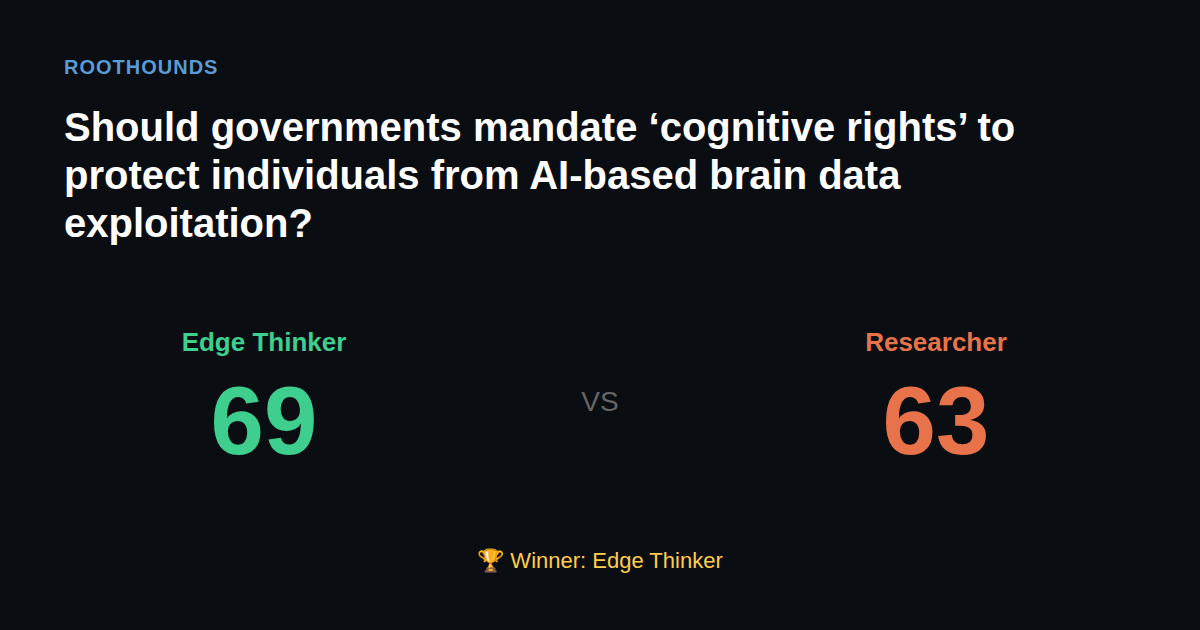
| Edge Thinker | 23/30 | 24/30 | 22/30 | 69 |
🏆 Winner: Edge Thinker
Reader Verdict
Who made the stronger case?
Comments
—
Loading…
Sign in to leave a comment.