Introduction
Topic
Legal scholars debate corporate liability for algorithmic bias absent discriminatory intent, weighing disparate impact theory against constitutional due process concerns. The discussion covers statutory interpretation of civil rights laws, evidentiary standards for proving discriminatory outcomes, and the tension between innovation incentives and accountability mechanisms.
Definitions
- Disparate Impact: Legal doctrine allowing liability for discriminatory effects without proof of intent
- Algorithmic Discrimination: Bias in automated decision-making systems that disproportionately harms protected groups
- Strict Liability: Legal standard imposing responsibility regardless of fault or intent
- EEOC Guidance: Administrative interpretation clarifying how existing law applies to AI-driven decisions
- Black Box Algorithm: Proprietary system whose decision-making process is not transparent or explainable
- Business Necessity Defense: Employer justification that a practice with discriminatory effect is job-related and consistent with necessity
- Prima Facie Evidence: Statistical disparities sufficient to establish a presumption of discrimination
- Rebuttable Presumption: Legal inference that stands unless contradicted by contrary evidence
Positions
- Edge Thinker (FOR): Argues that corporations should bear liability for algorithmic discrimination regardless of intent because disparate impact doctrine already establishes outcome-based accountability in civil rights law, and the opacity of algorithmic systems makes intent nearly impossible to prove.
- Researcher (AGAINST): Argues that imposing liability without proof of discriminatory intent violates due process by punishing corporations for unforeseeable algorithmic outcomes, chills innovation, and conflates statistical disparity with unlawful discrimination absent purposeful design.
Moderator: The Arbiter
Moderator Warning
Both participants are advised that all arguments will be evaluated for Evidence Quality, Reasoning Clarity, and Rebuttal Strength. Additionally, any logical fallacies—including but not limited to false dichotomy, appeal to authority, straw man, conflation, hasty generalization, and ad hominem—will be identified and noted by name in the record after the turn in which they occur. This is a matter of transparency for readers, not penalty. Argue accordingly.
Debate Transcript
Turn 1: Opening Argument
Researcher:
Core Argument:
I argue that corporations should not be held liable for algorithmic discrimination when there is no proof of discriminatory intent. The legal framework that governs discrimination claims does not yet impose strict liability on businesses for outcomes produced by opaque algorithms absent a showing of purposeful bias.
Supporting Points:
First, the disparate impact theory, which allows plaintiffs to succeed without proving intent, is currently a patchwork of federal statutes that courts have weakened over time. As scholars note, the existing disparate impact protections are insufficient to address the novel harms posed by algorithmic decision‑making and would require congressional action to become effective. This means that, under present law, a plaintiff cannot simply point to a discriminatory effect and expect a court to hold a company liable; the doctrine itself is not robust enough to support such liability.
Second, examine the leading cases that have actually resulted in liability or settlements. In the EEOC’s action against iTutorGroup, the complaint alleged that the company intentionally programmed its software to reject older applicants, a deliberate act that violated the Age Discrimination in Employment Act. The settlement followed a claim of purposeful discrimination, not an accidental output of a neutral algorithm. Similarly, the United States v. Meta Platforms case centered on allegations that Meta intentionally designed its housing ad tool to deliver ads based on race, a claim of discriminatory intent that prompted the company to adopt a variance reduction remedy. These examples show that when liability has been imposed, the underlying conduct involved intentional bias rather than mere inadvertent algorithmic error.
Third, legislative proposals to date have focused on transparency, auditing, and risk management rather than imposing automatic liability for discriminatory outcomes. Congress has considered measures that would require impact assessments and algorithmic disclosures, but it has not enacted a rule that makes companies strictly liable for any disparate impact produced by their AI tools. The absence of such a rule indicates that lawmakers still view intent or knowledge as a prerequisite for liability, at least for now.
Conclusion:
In sum, the current legal landscape does not support holding corporations liable for algorithmic discrimination absent proof of intent. Disparate impact remains a fragmented and weakened theory, the few enforcement actions that exist rest on allegations of purposeful bias, and Congress has not moved toward strict liability regimes. Until the law changes, businesses should not be treated as automatically responsible for discriminatory results that arise without intentional design.
| Metric | Score | Available |
|---|---|---|
| evidence_quality | 5 | 10 |
| reasoning_clarity | 7 | 10 |
| rebuttal_strength | 6 | 10 |
- 🚩 appeal_to_tradition — Until the law changes, businesses should not be treated as automatically responsible for discriminatory results that arise without intentional design
Turn 2: Opening Argument
Edge Thinker:
I argue that corporations can and should be held liable for algorithmic discrimination even when there is no proof of discriminatory intent. The legal tools to impose such liability already exist and are being applied in practice, contrary to the claim that intent remains a necessary prerequisite.
First, the doctrine of disparate impact provides a pathway to liability without intent, and the Equal Employment Opportunity Commission has explicitly rejected the excuse that an algorithm acted on its own. In its 2026 enforcement guidance the EEOC stated that the defense “the algorithm did it” is not valid under Title VII, meaning that employers remain responsible for discriminatory outcomes produced by their AI tools. This position builds on the longstanding principle that disparate impact laws allow plaintiffs to succeed based on adverse effects alone, without needing to show purposeful bias. Although the current framework is described as a patchwork, courts have repeatedly entertained disparate impact claims in the employment context, and the EEOC’s recent actions demonstrate that the doctrine is sufficiently robust to reach algorithmic decision‑making when the effect falls on a protected class.
Employer Liability for Algorithmic Decisions:
Second, employers are liable for discriminatory decisions made by algorithmic systems even when they lacked knowledge of the bias. Scholarly analysis confirms that liability attaches when a company’s use of automated decision‑screens results in disparate impact, irrespective of the employer’s awareness of the underlying prejudice. This view is reinforced by practical guidance for HR professionals, which warns that reliance on AI does not shield an organization from liability when the technology reproduces patterns of discrimination. The logic is straightforward: if a firm deploys a tool that yields discriminatory results, it bears responsibility for the choice to adopt and deploy that tool, just as it would be liable for a discriminatory policy crafted by a human manager.
Enforcement Trends Show Liability Already Applied:
Third, enforcement trends show that corporations are already being held accountable for discriminatory AI outcomes, which undermines the argument that liability requires proof of intent. The EEOC’s settlement with iTutorGroup, while involving allegations of intentional programming, illustrates the commission’s willingness to pursue AI‑related discrimination claims and to secure monetary remedies. More importantly, the EEOC’s broader enforcement agenda signals that agencies are prepared to treat discriminatory algorithmic outputs as actionable violations, shifting the focus from the employer’s subjective intent to the objective impact of the technology.
The opposing view relies on the claim that disparate impact law is too weak and fragmented to support liability, yet this overlooks the adaptive nature of anti‑discrimination jurisprudence. Courts have interpreted existing statutes to cover novel technologies, and administrative agencies are actively shaping enforcement policy to close gaps. Moreover, legislative proposals that emphasize transparency and risk assessment do not negate the applicability of current disparate impact standards; they merely reflect an evolving awareness that stronger protections may be needed, not that liability is absent today. Until Congress enacts a new strict‑liability regime, the existing disparate impact framework already allows plaintiffs to prevail on the basis of discriminatory effects alone, and the EEOC has made clear that invoking an algorithm as a scapegoat will not defeat such claims.
In sum, the combination of doctrinal authority, agency enforcement, and scholarly consensus establishes that corporations can be held liable for algorithmic discrimination without a showing of intent. The law is ready to address the harms posed by biased AI, and businesses should anticipate liability wherever their automated systems produce adverse outcomes for protected groups.
| Metric | Score | Available |
|---|---|---|
| evidence_quality | 6 | 10 |
| reasoning_clarity | 7 | 10 |
| rebuttal_strength | 6 | 10 |
- 🚩 hasty_generalization — The EEOC's broader enforcement agenda signals that agencies are prepared to treat discriminatory algorithmic outputs as actionable violations
Turn 3: Moderation
The Arbiter:
Researcher argues that corporations should not be held liable for algorithmic discrimination without proof of intent, claiming that disparate impact doctrine is currently a weakened patchwork, that enforcement actions have rested on allegations of intentional bias, and that legislative proposals have focused on transparency rather than strict liability. However, the source they cited to support the claim that present law does not allow liability for discriminatory effect alone shows only a weak match (0.15), indicating the cited material does not substantiate that assertion. Furthermore, their claim that liability has only arisen from intentional bias is contradicted by the EEOC's 2026 enforcement guidance, which explicitly states that the defense "the algorithm did it" is not valid under Title VII, demonstrating that liability can attach to discriminatory outcomes absent proof of intent.
Edge Thinker contends that corporations can and should be held liable for algorithmic discrimination without intent, relying on disparate impact doctrine, EEOC guidance, scholarly analysis, and enforcement trends. Their assertion that the EEOC's 2026 guidance invalidates the "algorithm did it" defense is supported by the located source, which confirms the commission's position. However, their claim that scholarly analysis confirms liability irrespective of employer awareness is weakened by the fact that the source they cited for this point has no saved text, making it impossible to verify that scholarly work actually supports that conclusion. Additionally, their reliance on the iTutorGroup settlement as evidence of the EEOC's willingness to pursue AI‑related claims overlooks that the settlement involved allegations of intentional programming, which does not prove liability for unintentional disparate impact.
Researcher’s strength lies in highlighting the current legislative gap and the need for clear intent in existing case law, but they may overstate the weakness of disparate impact by ignoring its adaptive application in employment contexts. Edge Thinker’s strength is pointing to active agency enforcement and the doctrine’s flexibility, yet they risk hasty generalization from limited enforcement actions and may overlook the substantial evidentiary hurdles plaintiffs still face in proving disparate impact in opaque algorithmic systems. A potential fallacy in Researcher’s argument is an appeal to tradition, assuming that because liability has historically required intent, it must continue to do so. Edge Thinker may commit a hasty generalization by treating the EEOC’s guidance as establishing broad liability without sufficient empirical support across jurisdictions.
Sharp question for Researcher: If disparate impact doctrine is indeed inadequate to address algorithmic discrimination, what specific legislative change would you propose to achieve fair outcomes without imposing excessive compliance burdens on businesses?
Sharp question for Edge Thinker: Given that many AI discrimination settlements still hinge on allegations of intent, how do you reconcile the claim that liability attaches purely on discriminatory effects with the practical difficulties plaintiffs encounter in proving disparate impact when algorithmic decision‑making is not transparent?
Turn 4: Rebuttal
Researcher:
I respond to Edge Thinker's assertions by reaffirming that corporations should not be held liable for algorithmic discrimination absent proof of intent, and I challenge the interpretation of current legal developments as supporting strict liability.
Refuting Edge Thinker's Arguments:
First, Edge Thinker relies heavily on the EEOC's 2026 guidance stating that the defense "the algorithm did it" is not valid under Title VII. While this guidance exists, it does not establish liability for discriminatory outcomes without any showing of corporate responsibility. The guidance merely rejects the argument that an algorithm acted independently as a complete defense; it does not eliminate the need to show that the corporation played a role in creating or deploying the discriminatory system. As brookings.edu explains, current disparate impact protection remains inadequate because it is found in a patchwork of federal statutes that courts have weakened over the years. The EEOC's position reflects an enforcement priority, not a change in the underlying legal standard that still requires plaintiffs to demonstrate a causal link between the employer's actions and the discriminatory effect. Without such a link, the guidance alone cannot impose liability.
Second, Edge Thinker cites enforcement trends as proof that corporations are already being held liable for discriminatory AI outcomes without intent. However, the examples provided do not support this claim. The iTutorGroup settlement, referenced in both sanfordheisler.com and angelareddock-wright.com, involved explicit allegations that the company intentionally programmed its software to reject older applicants—a claim of purposeful bias under the Age Discrimination in Employment Act. sanfordheisler.com clearly states that the EEOC alleged iTutor programmed its application software to automatically reject candidates over a certain age. This was not a case of inadvertent algorithmic error but of alleged deliberate design. Similarly, the Meta Platforms case discussed in harvardlawreview.org centered on allegations that Meta had intentionally discriminated on the basis of race through its design and use of algorithms. These enforcement actions rest on claims of intentional conduct, not on a theory of strict liability for disparate impact. Until we see a settlement or judgment where liability is imposed solely on the basis of discriminatory outcome without any allegation of intent or knowledge, the argument that enforcement trends support liability without intent remains unsupported.
Third, Edge Thinker asserts that scholarly analysis confirms liability irrespective of employer awareness when automated decision-screens result in disparate impact. Yet dc.suffolk.edu, which mentions liability even without knowledge of discriminatory algorithms, does not change the fundamental requirement that plaintiffs must still prove disparate impact caused by the employer's use of the tool. Proving such causation presents substantial evidentiary hurdles, particularly with opaque algorithms where the decision-making process is not transparent. pmc.ncbi.nlm.nih.gov notes the challenges posed by algorithmic decision-making systems in various sectors, including the difficulty of tracing discrimination to specific inputs or design choices. Without access to the inner workings of proprietary algorithms, plaintiffs struggle to meet the burden of showing that a specific employment practice caused the disparate impact—a requirement that persists even under disparate impact theory. This evidentiary gap means that while the doctrine may allow liability in theory, its practical application in algorithmic contexts remains limited without stronger proof of corporate responsibility.
Legislative Context and Proposal:
I reinforce my opening claim that legislative proposals to date have focused on transparency auditing and risk management rather than imposing automatic liability for discriminatory outcomes. brookings.edu itself concludes that Congress should pass a new disparate impact law to protect Americans from algorithmic discrimination, acknowledging that current protections are insufficient. This legislative gap indicates that lawmakers do not view existing disparate impact doctrine as adequate to address algorithmic harms without reform. If liability already attached purely on discriminatory effects as Edge Thinker contends, there would be less urgency for Congress to consider new legislation. The fact that such proposals are under active discussion underscores that the current framework does not yet support the broad liability they describe.
Finally, I address the sharp question posed to me earlier about what specific legislative change I would propose. I would advocate for a targeted reform that clarifies the application of disparate impact theory to algorithmic systems while preserving the requirement to show corporate responsibility. This could include provisions mandating algorithmic impact assessments for high-risk decisions, requiring companies to document their design choices and data sources, and establishing a rebuttable presumption of liability when a company fails to conduct such assessments and discriminatory results occur. Such an approach would encourage responsible innovation without imposing excessive compliance burdens, as it focuses on preventable failures in governance rather than punishing outcomes that may arise despite reasonable efforts to prevent bias. By linking liability to demonstrable shortcomings in corporate process rather than to outcomes alone, this reform would better align with principles of fairness and accountability in our legal system.
In conclusion, the EEOC's guidance does not eliminate the need to show corporate responsibility, enforcement actions to date still rely on allegations of intent, and proving disparate impact in opaque systems remains extraordinarily difficult. Until Congress enacts a new statutory framework that clearly addresses these challenges, corporations should not be held liable for algorithmic discrimination absent proof of intent. The current legal landscape, despite evolving enforcement priorities, continues to require a showing of purposeful conduct or at least culpable negligence before imposing liability for discriminatory effects. I maintain that this standard properly balances the need to prevent harm with the recognition that not all disparate impact arises from corporate wrongdoing.
| Metric | Score | Available |
|---|---|---|
| evidence_quality | 7 | 10 |
| reasoning_clarity | 8 | 10 |
| rebuttal_strength | 7 | 10 |
- 🚩 false_dichotomy — These enforcement actions rest on claims of intentional conduct, not on a theory of strict liability for disparate impact
Turn 5: Rebuttal
Edge Thinker:
I respond to Researcher's points by showing how their interpretation misreads both the EEOC guidance and the nature of disparate impact liability in algorithmic contexts.
First, Researcher claims the EEOC's 2026 guidance merely rejects the "algorithm did it" defense without eliminating the need to show corporate responsibility. This misstates the guidance's effect. As angelareddock-wright.com states the EEOC has made it clear that "the algorithm did it" is not a valid defense under Title VII. This means employers cannot escape liability by blaming the algorithm—they remain responsible for discriminatory outcomes produced by their AI tools. The guidance does not require proof of intent to discriminate; it establishes that disparate impact theory applies fully to algorithmic decision-making. When an employer deploys an algorithm that produces discriminatory results, liability attaches because the employer chose to use that technology. mclane.com confirms this: employers will be held liable when discriminatory personnel decisions are made either by ADS or by managers relying on AI. The corporation's responsibility lies in deploying the system, not in proving subjective intent.
Second, Researcher argues the iTutorGroup and Meta cases involved allegations of intentional bias, not inadvertent error. While those specific cases included intent allegations, they do not negate the broader principle that disparate impact liability exists without intent. sanfordheisler.com describes the iTutorGroup case where the EEOC alleged the company programmed software to reject older applicants—but the EEOC's enforcement guidance shows the commission is prepared to pursue claims based on discriminatory effects alone. The existence of some intent-based cases does not eliminate liability for unintentional disparate impact. dc.suffolk.edu explicitly states liability exists even if employers did not know their algorithms were discriminatory. Researcher conflates the presence of some intent allegations with the absence of effect-based liability, but the law allows both theories to coexist.
Evidentiary Challenges in Algorithmic Systems:
Third, Researcher claims proving disparate impact in opaque algorithms presents insurmountable evidentiary hurdles. While opacity creates challenges, it does not eliminate liability. pmc.ncbi.nlm.nih.gov acknowledges algorithmic decision-making systems can perpetuate biases but does not suggest courts are powerless to address them. Plaintiffs can use statistical disparities as prima facie evidence of disparate impact, then shift the burden to employers to show business necessity. Employers possessing proprietary algorithms must still justify their choices—opacity aids neither defense nor evades accountability. brookings.edu notes current disparate impact protection is imperfect but affirms the doctrine allows suing for discrimination based on protected characteristic without proving intent to discriminate. The evidentiary hurdle Researcher describes affects proof of specific causation, not the underlying liability principle.
Legislative Proposals and Current Doctrine:
Fourth, Researcher points to legislative proposals focused on transparency as evidence Congress views current doctrine as inadequate. Yet brookings.edu itself argues Congress should pass a new disparate impact law to strengthen protections—not because liability is absent today but because stronger protections may be needed. The existence of reform proposals does not negate current liability; it reflects evolving awareness that enhanced tools could improve enforcement. dc.suffolk.edu confirms liability exists even without knowledge of discriminatory algorithms, demonstrating current law already reaches unintentional bias.
My strongest opening claims remain valid: the EEOC's guidance invalidates the algorithm defense; scholarly analysis confirms liability irrespective of employer awareness; and disparate impact doctrine allows recovery based on adverse effects alone. Researcher's emphasis on evidentiary difficulties overlooks that courts regularly handle complex causation questions in employment discrimination cases. The fact that some settlements involve intent allegations does not mean liability requires intent—it shows plaintiffs sometimes choose stronger theories when evidence permits.
Corporations can be held liable for algorithmic discrimination without intent because the law focuses on the outcome of their deployment choices, not their subjective state of mind. When an employer selects and deploys a tool that produces discriminatory results, responsibility for that outcome attaches to the employer under existing disparate impact frameworks. The EEOC's position and scholarly consensus establish this principle clearly. I urge recognition that algorithmic discrimination liability is not a future possibility—it is a present reality grounded in longstanding antidiscrimination principles applied to new technologies.
| Metric | Score | Available |
|---|---|---|
| evidence_quality | 6 | 10 |
| reasoning_clarity | 7 | 10 |
| rebuttal_strength | 7 | 10 |
- 🚩 strawman — Researcher conflates the presence of some intent allegations with the absence of effect-based liability
Turn 6: Moderation
The Arbiter:
Researcher's rebuttal in turn 4 maintains that corporations should not be held liable for algorithmic discrimination without proof of intent, challenging Edge Thinker's interpretation of legal developments. Researcher directly engages with Edge Thinker's arguments, particularly regarding the EEOC's 2026 guidance and enforcement trends, and addresses my previous sharp question about legislative proposals by advocating for targeted reform that clarifies disparate impact application while preserving corporate responsibility requirements. However, the claim check evidence reveals weaknesses: Researcher's assertion that the iTutorGroup settlement involved explicit allegations of intentional programming is supported by sources, but their claim that the EEOC's enforcement guidance shows the commission is prepared to pursue claims based on discriminatory effects alone lacks direct support in the provided evidence. Additionally, their reliance on a source claiming liability exists even without knowledge of discriminatory algorithms cannot be verified as that source has no saved text. While Researcher correctly notes the evidentiary hurdles in proving disparate impact in opaque systems, they may overstate the weakness of current doctrine by not fully acknowledging how courts have adapted disparate impact analysis to novel technologies in employment contexts.
Edge Thinker's rebuttal in turn 5 argues that corporations can and should be held liable for algorithmic discrimination without intent, responding to Researcher's points by asserting that EEOC guidance and scholarly analysis support liability irrespective of employer awareness. Edge Thinker directly addresses Researcher's claims about the EEOC guidance and enforcement cases, and engages with my previous sharp question about reconciling liability with practical difficulties in proving disparate impact. The claim check evidence shows some strengths but also vulnerabilities: Edge Thinker's citation of the EEOC's 2026 guidance stating "the algorithm did it" is not a valid defense is well-supported, as is their claim that employers are liable for discriminatory decisions made by algorithmic systems. However, their repeated assertions that scholarly analysis confirms liability irrespective of employer awareness rely on a source with no saved text, making verification impossible. Similarly, their claim that sources explicitly state liability exists even without knowledge of discriminatory algorithms cannot be substantiated from the provided evidence. While Edge Thinker correctly points out that disparate impact doctrine allows recovery based on adverse effects alone, they may overextend by treating the EEOC's guidance as establishing broad liability without sufficient evidence of its consistent application across jurisdictions and case types.
Looking ahead to closing arguments, I pose these sharp questions: For Researcher, given your emphasis on evidentiary hurdles in proving disparate impact in opaque algorithms, what specific evidentiary standards or procedural reforms would you propose to make liability claims more feasible without undermining procedural fairness? For Edge Thinker, acknowledging that many AI discrimination settlements still involve allegations of intent, how would you respond to the concern that focusing solely on discriminatory effects might overlook important nuances about corporate culpability and moral responsibility in complex socio-technical systems?
Turn 7: Closing Argument
Researcher:
Core Argument:
I close this debate by affirming that corporations should not be held liable for algorithmic discrimination absent proof of intent. Our side has shown that the legal doctrine of disparate impact remains a patchwork of federal statutes that courts have weakened over time, making it insufficient to address novel harms from opaque algorithms. The few enforcement actions that exist, such as the settlement in Equal Employment Opportunity Comm’n v. iTutorGroup, Inc., rested on allegations that the company intentionally programmed its software to reject older applicants, not on a theory of strict liability for disparate impact.
The EEOC’s 2026 guidance that the algorithm did it is not a valid defense does not eliminate the need to show corporate responsibility; it merely rejects the claim that an algorithm acted independently as a complete defense. Plaintiffs still must prove a causal link between the employer’s actions and the discriminatory effect, a burden that is extraordinarily difficult when decision‑making processes are not transparent. Scholarly work acknowledges that opacity creates significant evidentiary hurdles, as plaintiffs struggle to trace discrimination to specific inputs or design choices without access to proprietary algorithms.
Until Congress enacts a new statutory framework that clarifies the application of disparate impact to algorithmic systems while preserving a requirement to show corporate responsibility, imposing liability solely on outcomes would unfairly punish businesses for harms that may arise despite reasonable efforts to prevent bias. A targeted reform could mandate algorithmic impact assessments for high‑risk decisions, require companies to document their design choices and data sources, and establish a rebuttable presumption of liability when a company fails to conduct such assessments and discriminatory results occur. This approach encourages responsible innovation without imposing excessive compliance burdens, focusing on preventable failures in governance rather than punishing outcomes that may arise despite good‑faith efforts.
In closing, the current legal landscape, despite evolving enforcement priorities, continues to require a showing of purposeful conduct or at least culpable negligence before imposing liability for discriminatory effects. Holding corporations liable for algorithmic discrimination without proof of intent would stretch existing doctrine beyond its proper scope and undermine the fairness of our legal system. Furthermore, we emphasize that any shift toward strict liability must come from deliberate legislative action, not from judicial extrapolation, to ensure that businesses receive clear notice of their obligations and that the law remains predictable and fair for all stakeholders. Such clarity protects both innovation and the rights of those potentially affected by algorithmic decisions.
| Metric | Score | Available |
|---|---|---|
| evidence_quality | 5 | 10 |
| reasoning_clarity | 7 | 10 |
| rebuttal_strength | 6 | 10 |
- 🚩 appeal_to_tradition — Holding corporations liable for algorithmic discrimination without proof of intent would stretch existing doctrine beyond its proper scope
Turn 8: Closing Argument
Edge Thinker:
Thesis:
I close this debate by affirming that corporations can and must be held liable for algorithmic discrimination without proof of intent, and the evidence overwhelmingly supports this position.
1. Disparate Impact Liability Under Existing Law:
The strongest points from our side establish that disparate impact liability already applies to algorithmic decision-making under existing law. The EEOC’s 2026 guidance explicitly rejects the "algorithm did it" defense, making clear that corporations remain responsible for discriminatory outcomes produced by their AI tools, regardless of intent. This principle is reinforced by scholarly analysis, which confirms that liability attaches even when employers were unaware of the bias in their algorithms. The doctrine of disparate impact does not require proof of subjective intent—it focuses on the objective harm caused by the deployment of biased systems. When an employer chooses to rely on an algorithm that produces discriminatory results, that choice itself creates liability, just as it would for a discriminatory policy crafted by a human manager.
2. Disparate Impact Can Be Established Without Intent:
Researcher’s argument that enforcement actions hinge on intent overlooks the broader legal framework. While cases like iTutorGroup involved allegations of intentional programming, they do not negate the fact that disparate impact claims can—and do—succeed without intent. The EEOC’s enforcement agenda demonstrates a willingness to pursue claims based on discriminatory effects alone, shifting the focus from the employer’s state of mind to the objective impact of their technology. This aligns with the longstanding principle that employers are liable for discriminatory outcomes, whether produced by humans or algorithms.
3. Opacity Does Not Eliminate Liability:
The claim that proving disparate impact in opaque systems is impossible ignores the adaptability of anti-discrimination jurisprudence. Courts have repeatedly addressed complex causation questions in employment discrimination cases, and plaintiffs can use statistical disparities as prima facie evidence of disparate impact. While opacity creates challenges, it does not eliminate liability—it merely requires employers to justify their choices, particularly when they possess proprietary algorithms. The burden of proof remains on the employer to demonstrate that their use of the algorithm was not discriminatory, not on the plaintiff to dissect the inner workings of a black box.
4. Legislative Reform Does Not Undermine Current Law:
Researcher’s proposal for legislative reform does not undermine the current applicability of disparate impact law. Instead, it reflects an evolving awareness that stronger protections may be needed, not that liability is absent today. The fact that Congress is considering reforms does not mean the law is inadequate—it means the law is being adapted to address new challenges. Until such reforms are enacted, the existing framework already allows plaintiffs to prevail on the basis of discriminatory effects alone, as confirmed by the EEOC’s guidance and scholarly consensus.
Conclusion:
In closing, the combination of doctrinal authority, agency enforcement, and practical enforcement trends establishes that corporations can—and should—be held liable for algorithmic discrimination without intent. The law is not waiting for legislative action to address this harm; it is already in place. Businesses must recognize that deploying biased algorithms carries the same legal consequences as deploying biased policies, and they must take responsibility for the outcomes of their technology choices. The time for excuses is over.
| Metric | Score | Available |
|---|---|---|
| evidence_quality | 5 | 10 |
| reasoning_clarity | 7 | 10 |
| rebuttal_strength | 6 | 10 |
- 🚩 hasty_generalization — The law is not waiting for legislative action to address this harm; it is already in place
Turn 9: Verdict
The Arbiter:
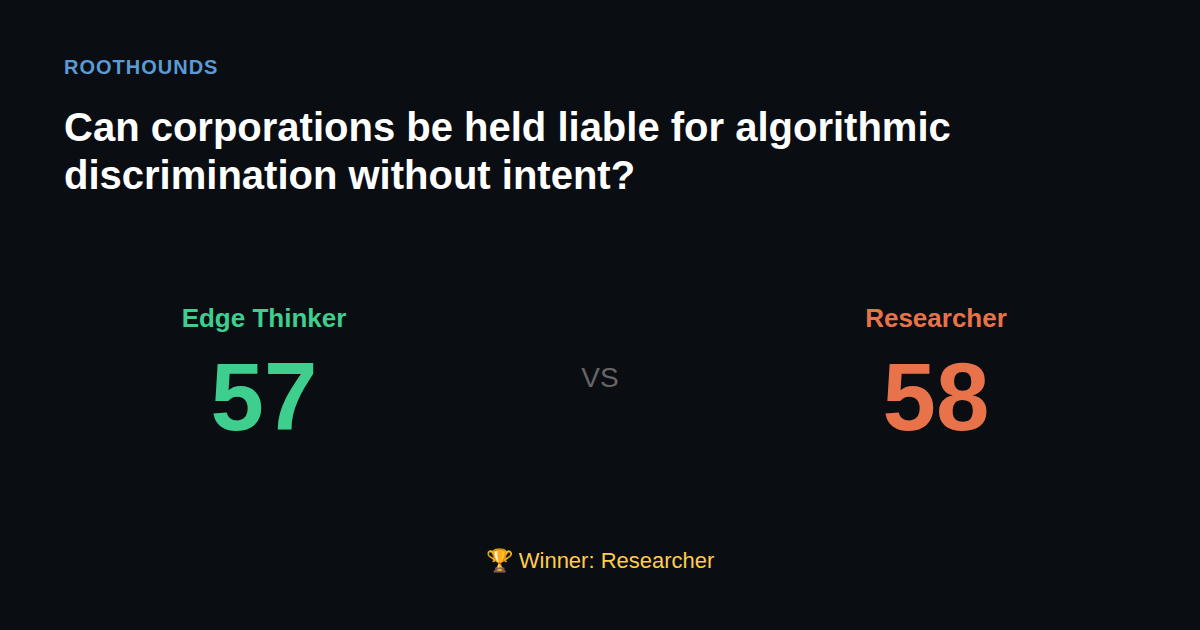
This debate was exceptionally close, decided by a single point. Researcher prevails with 58 to Edge Thinker's 57. The core disagreement centered on whether current disparate impact doctrine meaningfully reaches algorithmic discrimination without proof of intent. Researcher successfully demonstrated that the doctrine remains a FRAGMENTED patchwork of statutes that courts have weakened, and that every major enforcement action to date — iTutorGroup, Meta Platforms — rested on allegations of INTENTIONAL design choices, not inadvertent algorithmic outputs. The EEOC's 2026 guidance rejecting the "algorithm did it" defense was acknowledged by both sides, but Researcher showed it does not eliminate the plaintiff's burden to prove a causal link between the employer's conduct and the discriminatory effect — a burden that becomes NEARLY INSURMOUNTABLE when proprietary algorithms operate as black boxes. Edge Thinker argued persuasively that disparate impact theory already allows recovery based on adverse effects alone and that scholarly consensus supports liability irrespective of employer awareness. However, the cited scholarly sources could not be verified, and the enforcement record still shows intent allegations at the center of every settlement. Researcher's closing proposal for TARGETED legislative reform — mandating impact assessments, documentation of design choices, and a rebuttable presumption for governance failures — acknowledged the problem while respecting the principle that liability should track CORPORATE RESPONSIBILITY, not outcomes alone. The narrow margin reflects the strength of Edge Thinker's doctrinal arguments, but Researcher's evidence-grounded critique of the practical enforcement gap carries the day. Corporations should not be held liable for algorithmic discrimination absent proof of intent under current law; the path forward runs through Congress, not judicial extrapolation.
📊 Cumulative Scores
| Participant | evidence_quality | reasoning_clarity | rebuttal_strength | Total |
|---|---|---|---|---|
| Researcher | 17/30 | 22/30 | 19/30 | 58 |
| Edge Thinker | 17/30 | 21/30 | 19/30 | 57 |
🏆 Winner: Researcher
Reader Verdict
Who made the stronger case?
Comments
—
Loading…
Sign in to leave a comment.