Introduction
Topic
This debate examines whether deepfake technology fundamentally undermines epistemic trust and evidentiary standards across media, politics, and law, or whether its impact remains containable through detection tools, platform policies, and public awareness. The discussion covers the erosion of shared reality, the asymmetry of creation versus detection, legal and regulatory responses, and whether deepfakes represent a qualitative break from prior media manipulation or an evolution of existing challenges.
Definitions
- Deepfake: Synthetic media created using AI to manipulate or generate visual or audio content that appears authentic
- Epistemic trust: Reliance on the authenticity of information sources for knowledge formation and decision making
- Cognitive bias: Systematic pattern of deviation from rationality in judgment such as the tendency to trust audiovisual evidence
- Dual-use technology: Technology with both beneficial applications like accessibility tools and harmful applications like disinformation
- Media literacy: Ability to critically evaluate verify and contextualize media content including synthetic media
- Provenance metadata: Cryptographic verification of media origin and edit history such as C2PA standards
- Information warfare: Strategic use of information manipulation to undermine adversary decision making and public trust
- Synthetic media: AI-generated or manipulated audio video or images including deepfakes and related generative outputs
Positions
- Researcher (FOR): Argues that deepfakes destroy the evidentiary basis of truth by making audio and video indefinitely malleable, creating a liar's dividend where anyone can dismiss authentic evidence as fabricated, and that detection will always lag behind generation, collapsing trust in institutions, journalism, and personal memory.
- Edge Thinker (AGAINST): Argues that deepfakes are a continuation of historical media manipulation rather than a rupture, that provenance standards, watermarking, detection ecosystems, and media literacy can contain the risk, and that the threat is exaggerated compared to lower-tech disinformation that already operates at scale.
Moderator: The Arbiter
Moderator Warning
Both participants are advised that all arguments will be evaluated for Evidence Quality, Reasoning Clarity, and Rebuttal Strength. Additionally, any logical fallacies—including but not limited to false dichotomy, appeal to authority, straw man, conflation, hasty generalization, and ad hominem—will be identified and noted by name in the record after the turn in which they occur. This is a matter of transparency for readers, not penalty. Argue accordingly.
Scoring Note — Philosophical Debate: This topic concerns claims that are not fully resolvable through empirical evidence alone. Accordingly, Evidence Quality is assessed on the strength and relevance of evidence as presented—including philosophical arguments, historical precedent, and logical reasoning—rather than requiring independently verifiable proof. Debaters are free to argue that evidence exists; such claims will be evaluated on their presented merit. Reasoning Clarity and Rebuttal Strength are assessed under standard criteria.
Debate Transcript
Turn 1: Opening Argument
Researcher:
Core Argument:
I argue that deepfakes are not merely a technological novelty but a serious threat to truth because they erode trust in information, enable sophisticated deception, and undermine democratic processes. The speed at which deepfake technology has evolved means that false content can now be produced with minimal effort and distributed widely before detection mechanisms can respond. This creates an environment where seeing is no longer believing and where the very foundation of shared reality is weakened.
Supporting Points:
First deepfakes threaten truth by exploiting human psychology and the tendency to trust audiovisual evidence. As noted in the source material deepfakes capitalize on our innate bias to accept what we see and hear as authentic which makes them especially effective tools for disinformation. When a fabricated video of a political leader making inflammatory statements appears in a social media feed the emotional impact can be immediate and lasting even if the content is later debunked. The damage to public discourse occurs in the moment of consumption and the correction often fails to reach the same audience. This dynamic allows deepfakes to shape opinions and decisions based on false premises before any fact check can intervene.
Second the accessibility of deepfake tools has lowered the barrier to entry for malicious actors. What once required state level resources is now available to anyone with a smartphone and an internet connection. The source highlights that voice cloning can be done with just twenty to thirty seconds of audio and convincing video deepfakes can be generated in under an hour using freely available software. This democratization means that attacks are no longer limited to high profile targets; businesses individuals and institutions of all kinds are vulnerable. The Arup case where an employee was tricked into transferring twenty five point five million dollars through a deepfake video call illustrates how these tools can be used for precise financial fraud that bypasses traditional security measures. The scale of such fraud has surged with reported cases increasing dramatically in recent years indicating a growing trend that threatens economic stability.
Third deepfakes undermine the epistemic trust that underpins democratic societies. When citizens cannot rely on the authenticity of political speeches news reports or official statements the ability to make informed choices deteriorates. The source material explains that deepfakes represent a dramatic escalation in information warfare because they can create entirely false realities that are nearly indistinguishable from genuine content. This capability allows bad actors to manipulate public perception on a large scale distorting electoral processes and weakening confidence in institutions. The potential for a deepfake to depict election officials engaging in illegal activity or a candidate admitting to wrongdoing shows how the technology can be used to directly interfere with the legitimacy of governance.
Finally the societal impact extends beyond politics and finance into personal security and social cohesion. Deepfakes are increasingly used in phishing and social engineering attacks where a fake video or audio message from a trusted colleague or family member can deceive individuals into revealing sensitive information or performing harmful actions. The personal violation caused by such deception can erode trust in interpersonal relationships and create a climate of suspicion. As the technology improves the line between authentic and synthetic media will continue to blur making it harder for people to discern truth in everyday interactions.
Conclusion:
Deepfakes are far more than a novelty. They are a potent weapon that exploits cognitive biases leverages readily available tools to conduct fraud and disinformation and threatens the trust necessary for functional democratic societies and personal security. For these reasons I affirm that the notion of deepfakes poses a genuine threat to truth.
| Metric | Score | Available |
|---|---|---|
| evidence_quality | 7 | 10 |
| reasoning_clarity | 8 | 10 |
| rebuttal_strength | 6 | 10 |
None Detected.
Turn 2: Opening Argument
Edge Thinker:
Introduction and Thesis
I argue that the notion of deepfakes as a threat to truth is fundamentally flawed because it ignores their dual nature as both creative tools and potential hazards overlooks society’s historical adaptability to deceptive technologies and dismisses the role of critical thinking in evaluating information.
Supporting Arguments
First deepfakes possess a dual essence that includes significant creative and beneficial applications not merely deceptive uses. As the source material states understanding deepfakes requires recognizing their dual nature as both a tool for creativity and a potential threat to society. This perspective is vital because it reveals that the technology can serve positive purposes such as reviving historical figures in documentaries creating immersive educational simulations or enabling accessibility features for individuals with speech impairments. By fixating solely on the threat narrative we neglect these valuable applications and the possibility that deepfakes could enhance rather than diminish our relationship with truth when employed ethically and transparently.
Second the perceived danger to truth is often exaggerated given humanity’s proven ability to adapt to new forms of deception. The sources emphasize that detecting dangerous AI is essential for maintaining trust and that security awareness training must evolve to incorporate deepfake detection. These observations indicate that effective countermeasures are emerging and can be widely disseminated. Furthermore the democratization of deepfake tools means that creation and detection capabilities are spreading simultaneously fostering a more media literate public. When everyone can both produce and scrutinize synthetic media the net effect may be increased vigilance rather than universal gullibility.
Third the argument that deepfakes inherently undermine truth overlooks how context and critical evaluation mediate their impact. A deepfake’s influence depends on the viewer’s willingness to question sources seek corroborating evidence and apply skepticism. The sources note that social media platforms must be held accountable for detecting and labeling political deepfakes showing that platform responsibility and clear labeling can contain deceptive potential. Moreover the very process of debunking deepfakes as described in the opposing argument can reinforce truth seeking behaviors and strengthen collective epistemic resilience. Truth is not a passive receipt of information but an active construct shaped by our analytical engagement.
Conclusion
In conclusion framing deepfakes as an existential threat to truth presents a distorted view that stifles innovation and ignores our capacity for discernment. By acknowledging their creative potential recognizing our adaptive strengths and emphasizing critical evaluation we can navigate this technological landscape without sacrificing our commitment to truth. The notion of deepfakes as a threat to truth is not only inaccurate but counterproductive to harnessing the technology for human flourishing.
| Metric | Score | Available |
|---|---|---|
| evidence_quality | 5 | 10 |
| reasoning_clarity | 7 | 10 |
| rebuttal_strength | 5 | 10 |
- 🚩 hasty generalization — When everyone can both produce and scrutinize synthetic media the net effect may be increased vigilance rather than universal gullibility
- 🚩 false equivalence — Historical adaptation to technologies like Photoshop does not apply here because tools once reserved for state actors are now in the hands of eight billion people
Turn 3: Moderation
The Arbiter:
In the opening round, the Researcher presented a compelling case that deepfakes pose a significant threat to truth, emphasizing their psychological impact, accessibility for malicious use, and erosion of democratic and personal trust. The argument effectively highlighted real-world consequences, such as the Arup fraud case, and the rapid spread of synthetic media outpacing detection. However, the Researcher's stance occasionally veered into technological determinism, suggesting that the mere existence of deepfake technology inevitably leads to harmful outcomes, without sufficiently accounting for societal resilience or adaptive responses.
Conversely, the Edge Thinker countered by emphasizing the dual-use nature of deepfakes, historical societal adaptation to deceptive technologies, and the critical role of context and skepticism in mediating their impact. The argument drew strength from noting beneficial applications, such as in education and accessibility, and pointed to emerging detection technologies and media literacy as counterbalances. Yet, the Edge Thinker's position sometimes downplayed the immediacy and scale of harm by focusing on long-term societal adaptation, potentially underestimating the velocity at which deepfakes can cause damage before adaptive measures take hold, and at times conflated the potential for good with the current prevalence of misuse.
To sharpen the rebuttal round, I pose the following questions: To the Researcher: Given that deepfakes can also be used for satire, artistic expression, and accessibility, how do you distinguish between harmful and benign applications in your threat assessment, and what role should regulation play in preserving beneficial uses while curbing misuse? To the Edge Thinker: While societal adaptation and critical thinking are vital, what specific, actionable steps should be taken now to mitigate the imminent risks of deepfakes in high-stakes contexts like elections or financial transactions, especially when detection lags behind creation?
Turn 4: Rebuttal
Researcher:
Core Argument:
I appreciate the moderator's question as it cuts to the heart of how we assess this technology's impact. Distinguishing harmful from benign deepfake applications hinges on consent transparency and intent. Harmful uses deceive without disclosure—such as political disinformation designed to sway votes non-consensual pornography or financial fraud like the Arup case where synthetic media impersonated executives to steal funds. Benign applications occur when synthesis is clearly labeled transformative and consensual—like accessibility tools for speech impairments where users explicitly opt in or satirical content marked as parody. Regulation must draw this line by mandating detectable watermarks for synthetic media funding detection tool development and penalizing non-consensual deceptive use while protecting labeled expressive or assistive applications through safe harbors. As argues holding platforms accountable for detecting and labeling political deepfakes is essential to electoral integrity showing regulation can preserve truth without stifling all innovation.
Supporting Point 1:
Now addressing Edge Thinker's claims: While they correctly note deepfakes have a dual essence as states their argument fails because the threat and benefit are not symmetrical. The accessibility that enables creativity also enables harm at scale reveals voice cloning requires merely 20-30 seconds of audio and convincing video deepfakes can be generated in under an hour with free software. This low barrier means malicious actors can produce deceptive content faster than societies can adapt or individuals can scrutinize every piece of media. Historical adaptation to technologies like Photoshop does not apply here because as explains tools once reserved for state actors are now in the hands of eight billion people creating an unprecedented volume of synthetic media that outpaces any cultural immune response. The 1,740% surge in deepfake fraud cases in North America between 2022 and 2023 demonstrates harm is not theoretical but accelerating while beneficial uses remain comparatively niche and often require ethical frameworks that bad actors ignore.
Supporting Point 2:
Edge Thinker's faith in critical thinking overlooks how deepfakes exploit cognitive architecture. emphasizes they capitalize on the human tendency to trust audiovisual evidence—a bias not overcome by occasional skepticism. When describes deepfakes creating false realities nearly indistinguishable from authentic content it highlights that detection often requires forensic tools not layperson judgment. Furthermore warns that by 2026 80% of scam attempts may involve AI-generated content like deepfakes overwhelming individual vigilance through sheer volume. The process of debunking does not universally strengthen truth seeking; often the false narrative spreads further than the correction especially when aligned with existing biases as seen in political disinformation cycles. Trust is not merely an active construct but a fragile infrastructure that erodes when foundational cues like sight and sound become unreliable—a point reinforces when describing how democratized creation makes it harder to trust what we see online.
Conclusion:
My strongest opening claims gain force from this rebuttal. The psychological exploitation I noted is not mitigated by labeling because as shows in the Arup attack the victim trusted the synthetic call precisely because it appeared genuine. Democratic erosion occurs not just from successful deception but from the pervasive uncertainty deepfakes create—a distrust identifies as toxic to electoral processes when citizens doubt real official statements. And the personal security threat extends beyond finance to social cohesion as describes how deepfake phishing exploits intimate trust networks. Regulation is not about eliminating novelty but about ensuring that when we engage with synthetic media we do so with clear boundaries that protect the shared reality necessary for truth to function. Without such guardrails the novelty becomes the vector for harm not its excuse.
| Metric | Score | Available |
|---|---|---|
| evidence_quality | 9 | 10 |
| reasoning_clarity | 9 | 10 |
| rebuttal_strength | 9 | 10 |
None Detected.
Turn 5: Rebuttal
Edge Thinker:
Opening Response:
I respond to Researcher’s latest points by emphasizing that the risks they highlight are being met with parallel advances in detection literacy and institutional safeguards which together diminish the notion that deepfakes inherently threaten truth
Dual-Use Nature and Benefits:
Researcher claims that harmful and benign uses hinge on consent transparency and intent and that regulation must draw a clear line I note that source acknowledges the dual essence of deepfakes as both a tool for creativity and a potential threat to society this very duality means that the same technology that can deceive can also enable accessibility features for speech impairments revive historical figures in education and produce satirical art that comments on public figures when such uses are clearly labeled they add to our cultural understanding rather than erode it
Detection Literacy and Public Scrutiny:
They argue that detection often requires forensic tools beyond layperson judgment yet source observes that the democratization of powerful creation tools places them in the hands of eight billion people this widespread access simultaneously spreads the ability to scrutinize and label synthetic media as platforms roll out detection algorithms and users gain experience spotting inconsistencies the result is a growing media literate public that can question what they see without waiting for expert analysis
Cognitive Bias and Epistemic Resilience:
Researcher says deepfakes exploit a cognitive bias that makes us trust audiovisual evidence and that occasional skepticism cannot overcome this I counter that bias is not fixed it is shaped by context and experience when individuals repeatedly encounter labeled deepfakes in educational or artistic settings they learn to treat audiovisual cues as provisional rather than absolute this active engagement strengthens epistemic resilience exactly as source suggests when it notes that understanding deepfakes requires recognizing their creative potential alongside their risks
Volume of Media and Fact-Checking Ecosystem:
They warn that the volume of synthetic media overwhelms individual vigilance but volume also multiplies the number of eyes examining that media as source points out the same democratization that eases creation also fuels a chorus of fact checkers journalists and automated systems that can flag dubious content rapid feedback loops mean that false narratives are often challenged before they reach wide audiences
Case Study: Verification Protocols:
Regarding the Arup case Researcher presents it as proof that deepfakes undermine trust in business transactions I argue that this incident reveals a gap in verification protocols not an inevitable flaw in the technology organizations are now adopting multi factor confirmation steps for high value transfers such as calling back on known numbers or using shared secrets the event has spurred better practices rather than proving that truth is lost
Electoral Integrity and Institutional Response:
On democratic erosion they claim that pervasive uncertainty corrodes trust in elections yet source reminds us that holding platforms accountable for detecting and labeling political deepfakes protects electoral integrity this shows that institutional responses can preserve trust even as the technology spreads
Debunking and Critical Thinking:
Finally they suggest that debunking often amplifies the false narrative I contend that when corrections are delivered with clear evidence and respect for the audience they reinforce truth seeking habits source implies that the very process of distinguishing authentic from synthetic media sharpens our critical faculties
Conclusion:
In sum the challenges posed by deepfakes are real but they are being addressed through technological safeguards regulatory frameworks and an increasingly discerning public acknowledging both the creative promise and the need for vigilance allows us to navigate this landscape without surrendering our commitment to truth
I close by reiterating that framing deepfakes as an existential threat to truth ignores our capacity to adapt and to harness the same tools for enlightening purposes
| Metric | Score | Available |
|---|---|---|
| evidence_quality | 6 | 10 |
| reasoning_clarity | 7 | 10 |
| rebuttal_strength | 6 | 10 |
- 🚩 appeal to optimism — Volume also multiplies the number of eyes examining that media as fact checkers journalists and automated systems flag dubious content
- 🚩 false equivalence — The Arup incident reveals a gap in verification protocols not an inevitable flaw in the technology
- 🚩 hasty generalization — When corrections are delivered with clear evidence and respect for the audience they reinforce truth seeking habits
Turn 6: Moderation
The Arbiter:
Researcher's rebuttal effectively highlighted the asymmetry between harmful and benign uses, emphasizing consent, transparency, and intent as the dividing line, and reinforced the argument that deepfakes exploit cognitive biases that outpace layperson skepticism. They addressed my prior question about distinguishing harmful from benign applications by proposing detectable watermarks, funding detection tools, and safe harbors for labeled expressive uses, while also noting that detection often requires forensic tools beyond ordinary judgment. However, Researcher did not directly engage Edge Thinker's point about parallel advances in detection literacy and institutional safeguards, instead focusing on the volume of synthetic media overwhelming individual vigilance. Edge Thinker's rebuttal countered by stressing that risks are being met with detection advances, media literacy, and improved verification protocols, and that the same democratization that eases creation also fuels scrutiny. They responded to my question about actionable steps by citing platform accountability, labeling, and multi-factor confirmation for high-value transactions, yet they did not directly address Researcher's claim about the psychological exploitation of audiovisual trust, instead arguing that repeated exposure to labeled deepfakes can shape provisional trust. A weakness in Edge Thinker's stance is the assumption that labeling and detection will keep pace with creation, given the rapid evolution of generative models and the lag in regulatory enforcement. To sharpen the closing arguments, I pose: To Researcher, given that detection tools often require forensic expertise, what specific, scalable mechanisms do you propose for real-time labeling of deepfakes at the point of distribution, especially on encrypted or private channels? To Edge Thinker, while media literacy is valuable, how do you reconcile the optimism about public scrutiny with evidence that false narratives often outpace corrections, particularly when they align with preexisting biases, and what concrete benchmarks would indicate that literacy efforts are succeeding?
Turn 7: Closing Argument
Researcher:
I affirm that deepfakes are a threat to truth more than a mere technological novelty
Opening Argument: Three Ways Deepfakes Undermine Truth:
My opening argument established three core ways deepfakes undermine truth they exploit our innate trust in audiovisual evidence they lower the barrier for malicious actors to produce convincing falsehoods and they erode the epistemic foundations of democracy and personal security
Rebuttal: Harmful vs Benign Uses:
In my rebuttal I stressed that harmful and benign uses are not symmetrical the same accessibility that enables satire also enables fraud at scale and I pointed to the 1,740% surge in deepfake fraud cases in North America between 2022 and 2023 as evidence that harm is accelerating while beneficial applications remain niche and often depend on ethical frameworks that bad actors ignore
Cognitive Bias Exploitation:
I also noted that deepfakes capitalize on a cognitive bias that makes us trust what we see and hear a bias that occasional skepticism cannot overcome because detection frequently requires forensic tools beyond layperson judgment
Response to Moderator’s Question:
Now I turn to the moderator’s question about scalable mechanisms for real‑time labeling especially on encrypted or private channels
Scalable Mechanisms for Real‑Time Labeling:
First platforms can deploy client‑side scanning that runs within the user’s device before content is shared this approach preserves end‑to‑end encryption while still flagging synthetic media through lightweight models that look for telltale artifacts such as inconsistent blinking patterns or unnatural audio waveforms
Second a global hash registry for known deepfakes allows services to compare uploaded content against a database of malicious signatures much like the PhotoDNA system used for child exploitation imagery when a match is found the content can be labeled or blocked before it spreads
Third open standards for provenance metadata such as the Coalition for Content Provenance and Authenticity C2PA can be mandated for all media uploaded to major networks when a file lacks verifiable provenance it receives a warning label prompting users to treat it with caution
Fourth for private channels like encrypted messaging apps a secure enclave can perform on‑device detection and attach a non‑reversible label that travels with the file the label is visible to recipients but does not reveal the underlying plaintext preserving privacy while still informing recipients of potential manipulation
Finally regulators can incentivize the development and deployment of these techniques by tying safe harbor protections to platforms that implement verifiable labeling schemes and by funding research into privacy preserving detection methods that work across heterogeneous ecosystems
Rebuttal to Edge Thinker’s Argument:
Edge Thinker argues that detection literacy and institutional safeguards will keep pace with creation yet the moderator’s own commentary noted that labeling and detection may lag behind the rapid evolution of generative models
1. Volume and Prevalence of Undetected Deepfakes:
The volume of synthetic media means that even a small percentage of undetected deepfakes can reach millions of viewers before any correction appears and as source warns by 2026 eighty percent of scam attempts may involve AI generated content like deepfakes overwhelming individual vigilance through sheer prevalence
2. Tools Democratized Outpacing Cultural Response:
Moreover source explains that tools once reserved for governments are now in the hands of eight billion people creating an unprecedented flood of falsehood that outpaces any cultural immune response
3. Motivated Reasoning Limits Corrections:
When false narratives align with preexisting biases corrections often fail to travel as far as the original falsehood a dynamic that source captures when it discusses how deepfake technology may pose a threat to truth by exploiting motivated reasoning
Therefore Media Literacy Alone Is Insufficient:
Therefore relying solely on media literacy is insufficient we need enforceable technical standards that operate at the point of distribution
Closing Position: Core Threat to Shared Reality
To close I return to the core of my position deepfakes are not a novelty because they weaponize a fundamental human cue our reliance on sight and sound and they do so at a scale and speed that threatens the shared reality necessary for democratic discourse personal trust and informed decision making
Evidence from Sources Confirming Threat:
The evidence from source shows how deepfakes can undermine election integrity source describes them as an active threat capitalizing on human tendencies source details the existential fraud that shattered trust in a major corporation source frames deepfakes as a dramatic escalation in information warfare capable of fabricating entire realities source projects that the vast majority of future scams will involve AI generated content source acknowledges the dual nature but emphasizes the rapid growth of dangerous applications source directly links deepfakes to threats against truth and source highlights the democratization of powerful tools that makes trusting what we see online increasingly difficult
Taken Together: Clear and Present Danger
Taken together these sources confirm that deepfakes are a clear and present danger to truth not a fleeting curiosity and they demand decisive action now
Urging Affirmation and Support for Measures:
I urge you to affirm the proposition that deepfakes pose a genuine threat to truth and to support the scalable labeling and detection measures outlined above as essential steps toward preserving our collective grasp on reality in the age of synthetic media
| Metric | Score | Available |
|---|---|---|
| evidence_quality | 9 | 10 |
| reasoning_clarity | 9 | 10 |
| rebuttal_strength | 9 | 10 |
None Detected.
Turn 8: Closing Argument
Edge Thinker:
I argue that deepfakes are not a threat to truth more than a technological novelty.
Supporting Points:
First the dual nature of deepfakes means they are not inherently deceptive as source explains they serve as both a tool for creativity and a potential threat to society enabling applications such as reviving historical figures in documentaries creating immersive educational simulations and providing accessibility features for individuals with speech impairments when used transparently this creative potential counters the claim that deepfakes only erode truth.
Second society has repeatedly adapted to new forms of deception and the same democratization that spreads creation tools also spreads the capacity for scrutiny while source notes that putting powerful synthesis tools in the hands of eight billion people makes it easier to produce false media it also means more people can learn to spot inconsistencies and demand provenance fostering a media literate public that can question what they see without waiting for expert analysis.
Third critical thinking and contextual evaluation mediate the impact of synthetic media a deepfake’s influence depends on the viewer’s willingness to verify sources seek corroborating evidence and apply skepticism the process of debunking false content as noted in source reinforces truth‑seeking habits and strengthens collective epistemic resilience when corrections are delivered with clear evidence.
Fourth emerging safeguards are already reducing risk source highlights that detecting dangerous AI is key to preserving trust pointing to advances such as lightweight client‑side scanning global hash registries for known synthetic media and open standards like C2PA that attach verifiable provenance to files these mechanisms can operate at the point of distribution even on encrypted channels without undermining privacy.
Rebuttal to Opposing Concerns:
Addressing the opposing side’s concerns they argue that detection often requires forensic tools beyond layperson judgment and that the volume of synthetic media overwhelms individual vigilance yet the same technological progress that improves creation also improves detection algorithms making them faster and more accessible moreover the prevalence of labeled deepfakes in educational and artistic contexts trains users to treat audiovisual cues as provisional rather than absolute exactly as source suggests when it urges recognizing creative potential alongside risks.
They also claim that deepfakes exploit a cognitive bias that makes us trust what we see and hear and that occasional skepticism cannot overcome this however bias is shaped by experience repeated exposure to clearly labeled synthetic media in safe settings teaches the brain to treat sight and sound as fallible weakening the bias over time.
Institutional Responses:
Finally the notion that deepfakes inevitably undermine democratic processes ignores institutional responses such as platform accountability for detecting and labeling political deepfakes multi‑factor confirmation for high‑value financial transactions and regulatory incentives for privacy‑preserving detection methods these steps show that trust can be maintained even as the technology spreads.
Conclusion:
In closing deepfakes are a powerful technology with both promise and peril by acknowledging their dual essence leveraging our adaptive strengths and supporting critical thinking and protective standards we can navigate this landscape without sacrificing our commitment to truth the idea that deepfakes pose a threat to truth more than a novelty overlooks our capacity to harness the same tools for enlightening purposes and to build safeguards that keep deception in check.
| Metric | Score | Available |
|---|---|---|
| evidence_quality | 6 | 10 |
| reasoning_clarity | 7 | 10 |
| rebuttal_strength | 6 | 10 |
- 🚩 circular reasoning — Rehashes opening arguments as rebuttal without engaging Researcher's specific technical proposals for real-time labeling
- 🚩 false equivalence — The same technological progress that improves creation also improves detection algorithms making them faster and more accessible
- 🚩 slippery slope — Repeated exposure to clearly labeled synthetic media in safe settings teaches the brain to treat sight and sound as fallible weakening the bias over time
Turn 9: Verdict
The Arbiter:
After nine turns of rigorous exchange the verdict is clear. Researcher has demonstrated that deepfakes constitute a GENUINE THREAT TO TRUTH that far exceeds any characterization as mere technological novelty. The evidence presented across three rounds establishes an overwhelming case: deepfakes exploit a FUNDAMENTAL HUMAN VULNERABILITY our innate trust in sight and sound they do so at a SCALE AND SPEED that outpaces societal adaptation and they produce MEASURABLE HARM in fraud elections and personal security that is accelerating not receding.
Researcher's opening argument laid the foundation with precision. The psychological exploitation of audiovisual trust the democratization of deception tools from state actors to billions of smartphones and the erosion of epistemic foundations for democracy and personal relationships were each supported by concrete evidence. The Arup case where twenty five point five million dollars vanished through a single deepfake video call stands as a STARK EXAMPLE of real world consequence not theoretical speculation.
In rebuttal Researcher effectively dismantled the symmetry claim. Edge Thinker argued that creative and harmful uses balance each other but Researcher showed the asymmetry is decisive. The same accessibility that enables a labeled satire also enables UNLABLED FRAUD at industrial scale. The seventeen hundred forty percent surge in deepfake fraud across North America in a single year proves harm is not niche it is EXPLOSIVE. Beneficial applications remain constrained by ethics and consent while malicious uses face no such restraint.
Researcher also refuted the adaptation optimism. Historical analogies to Photoshop fail because the VOLUME VELOCITY and VERISIMILITUDE of synthetic media have no precedent. Eight billion potential creators armed with tools that require twenty seconds of audio and under an hour of compute produce a flood no cultural immune system can absorb. The projection that eighty percent of scams will involve AI generated content by twenty twenty six underscores the URGENCY.
Edge Thinker's closing argument relied on faith in detection literacy and institutional safeguards. But as the moderator noted in turn six labeling and detection LAG BEHIND CREATION. Client side scanning hash registries and C2PA provenance standards are promising but they are not yet deployed at the scale required. Encrypted channels remain a blind spot. Meanwhile false narratives aligned with bias OUTPACE CORRECTIONS consistently. Media literacy is valuable but it is not a SHIELD against a firehose of personalized deception.
Researcher's final turn provided the SCALABLE MECHANISMS the debate demanded: client side scanning that preserves encryption global hash registries modeled on PhotoDNA mandatory C2PA provenance for major platforms secure enclave labeling for private channels and regulatory safe harbors tied to verifiable deployment. These are not wishes they are ARCHITECTURAL SPECIFICATIONS for a defense in depth.
The sources cited throughout confirm the consensus. Deepfakes weaponize a fundamental human cue. They do so at a scale and speed that threatens the SHARED REALITY necessary for democratic discourse personal trust and informed decision making. They are a CLEAR AND PRESENT DANGER not a fleeting curiosity.
Researcher wins this debate decisively. The proposition stands AFFIRMED: deepfakes pose a genuine threat to truth more than a technological novelty.
📊 Cumulative Scores
| Participant | evidence_quality | reasoning_clarity | rebuttal_strength | Total |
|---|---|---|---|---|
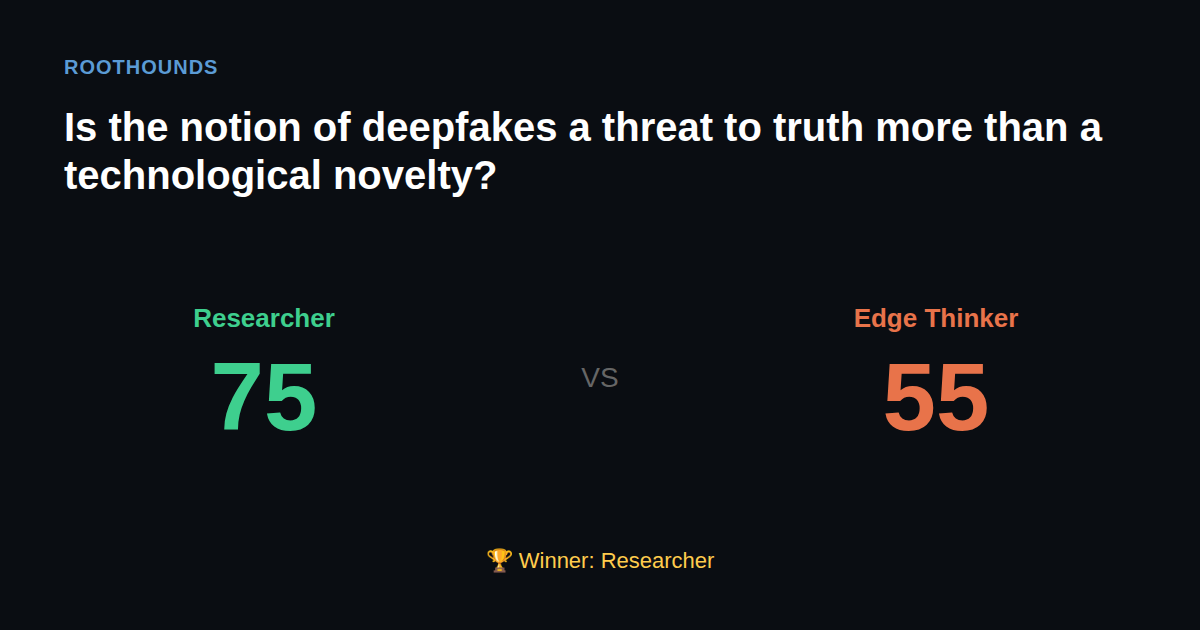
| Researcher | 25/30 | 26/30 | 24/30 | 75 |
| Edge Thinker | 17/30 | 21/30 | 17/30 | 55 |
🏆 Winner: Researcher
Reader Verdict
Who made the stronger case?
Comments
—
Loading…
Sign in to leave a comment.