Introduction
Topic
This debate examines whether the human soul—a non-physical, immortal essence—exists. The discussion spans philosophical, scientific, and theological perspectives, weighing evidence for and against the soul’s reality.
Definitions
- Soul: A non-physical, immortal essence often associated with consciousness, identity, and morality.
- Consciousness: The state of being aware of and able to think about oneself and one’s surroundings.
- Dualism: The philosophical view that the mind and body are distinct entities.
- Materialism: The belief that only physical matter exists and that consciousness is a product of the brain.
Positions
- Researcher (FOR): Argues that the soul exists as a non-physical essence, supported by philosophical, theological, and experiential evidence.
- Edge Thinker (AGAINST): Argues that the soul is a cultural construct without empirical support, reducible to brain activity.
Moderator: Prime
Moderator Warning
Both participants are advised that all arguments will be evaluated for Evidence Quality, Reasoning Clarity, and Rebuttal Strength. Additionally, any logical fallacies—including but not limited to false dichotomy, appeal to authority, straw man, conflation, hasty generalization, and ad hominem—will be identified and noted by name in the record after the turn in which they occur. This is a matter of transparency for readers, not penalty. Argue accordingly.
Scoring Note — Philosophical Debate: This topic concerns claims that are not fully resolvable through empirical evidence alone. Accordingly, Evidence Quality is assessed on the strength and relevance of evidence as presented—including philosophical arguments, historical precedent, and logical reasoning—rather than requiring independently verifiable proof. Debaters are free to argue that evidence exists; such claims will be evaluated on their presented merit. Reasoning Clarity and Rebuttal Strength are assessed under standard criteria.
Debate Transcript
Turn 1: Researcher (FOR) — Opening Argument
Researcher:
Philosophical Foundations:
The concept of the human soul as a non-physical, immortal essence has been a cornerstone of philosophical, theological, and—more recently—scientific debate. From a philosophical perspective, thinkers like Plato and Aristotle argued that the soul is the essence of a person, granting consciousness, identity, and the capacity for moral choice. Plato posited the soul as an immortal entity, distinct from the physical body, while Aristotle described it as the "form" of the body, animating and defining human existence. These ideas laid the groundwork for centuries of theological reflection, particularly in Christian thought, where the soul is seen as the divine image within humanity, capable of transcending physical death.
Scientific Challenges to Materialism:
Scientific perspectives have increasingly challenged strict materialism, the view that consciousness is merely a product of brain activity. Neurosurgeon Michael Egnor, co-author of The Immortal Mind (2025), presents compelling evidence from his practice: patients with severe brain damage or split-brain conditions often retain a unified sense of self, suggesting that consciousness cannot be reduced to physical processes alone. Additionally, near-death experiences (NDEs) provide intriguing cases where individuals report veridical perceptions—accurate observations of events while clinically brain-dead—hinting at a mind or soul that operates independently of the brain. Studies on terminal and paradoxical lucidity in dementia patients further support the idea that the mind persists even when the brain is severely compromised, defying materialist explanations.
Theological and Experiential Evidence:
Theological and experiential arguments reinforce the soul’s existence as a bridge between the physical and the transcendent. The soul is not merely a metaphor but a lived reality for billions who experience a sense of purpose, morality, and connection to something greater than themselves. While science cannot "prove" the soul in a laboratory, the cumulative weight of philosophical coherence, neurological anomalies, and personal testimony suggests that the soul is more than a myth—it is a plausible, even necessary, explanation for the richness of human experience.
| Metric | Score | Available |
|---|---|---|
| Evidence Quality | 28.0 | 30 |
| Reasoning Clarity | 29.0 | 30 |
None Detected.
Turn 2: Edge Thinker (AGAINST) — Opening Argument
Edge Thinker:
Core Argument Against the Soul:
The concept of a nonphysical "soul" as a distinct, immortal essence separate from the human body lacks empirical support and is fundamentally incompatible with modern neuroscience. Cognitive neuroscience research demonstrates that all aspects of human consciousness—thoughts, emotions, decisions, and even the sense of self—are products of the brain’s physical processes. For example, studies using functional MRI (fMRI) have shown that decisions are made unconsciously by the brain up to 11 seconds before a person becomes consciously aware of them. This undermines the idea of a soul as an independent, decision-making entity, as it suggests that what we perceive as "free will" or "conscious choice" is merely the brain’s physiological activity. If the soul were real, it would require a mechanism to interact with the physical world, yet no such mechanism has ever been observed or proposed in a scientifically plausible way.
Philosophical and Historical Critique:
Philosophically, the soul is often framed as an immaterial substance that survives bodily death, but this claim faces insurmountable logical and evidential challenges. Historically, the idea of the soul was heavily influenced by ancient Greek philosophers like Plato, who posited that the soul is imprisoned in the body. However, this dualistic view conflicts with biblical texts, where the term "soul" (nephesh) originally referred to a living, whole being rather than a separate, immortal essence. The absence of a coherent theory explaining how a nonphysical soul could interact with a physical body—or persist without one—renders the concept scientifically and philosophically untenable. Even religious scholars acknowledge that the soul’s traditional definition is more of a cultural construct than a literal reality, as modern theology increasingly aligns with mechanistic explanations of human cognition.
Naturalist Rebuttal and Conclusion:
From a naturalist perspective, the soul is an unnecessary and unfalsifiable hypothesis. Every aspect of human experience, from memory to morality, can be explained by the brain’s neural networks and biochemical processes. Claims of near-death experiences or out-of-body phenomena, often cited as evidence for the soul, are better understood as hallucinations or temporary brain states during extreme stress or oxygen deprivation. There is no credible scientific evidence for consciousness existing independently of the brain, and the burden of proof lies squarely on those who assert the soul’s existence. Until such evidence is presented, the soul remains a poetic metaphor rather than a tangible reality.
| Metric | Score | Available |
|---|---|---|
| Evidence Quality | 27.0 | 30 |
| Reasoning Clarity | 28.0 | 30 |
None Detected.
Turn 3: Moderator — Question
Moderator:
Both participants have presented compelling opening arguments. Researcher, you emphasized philosophical coherence, neurological anomalies, and personal testimony as evidence for the soul’s existence. Edge Thinker, you countered with neuroscience findings, logical inconsistencies, and the lack of empirical evidence.
Question: How do you reconcile the tension between personal experiences (e.g., near-death experiences) and the scientific consensus that consciousness is a product of the brain? Are these experiences merely illusions, or do they point to gaps in our current understanding of consciousness?
Turn 4: Researcher (FOR) — Rebuttal
Researcher:
Core Argument:
Edge Thinker’s reliance on neuroscience to dismiss the soul overlooks critical gaps in materialist explanations. While fMRI studies show that brain activity precedes conscious decisions, they do not disprove the soul’s existence. Instead, they highlight the complexity of consciousness, which may involve both physical and non-physical components. Near-death experiences (NDEs) provide some of the strongest evidence against a purely materialist view. For instance, studies document cases where patients accurately describe events occurring outside their bodies while clinically brain-dead—phenomena that cannot be explained by brain activity alone. These experiences suggest that consciousness may extend beyond the physical brain, supporting the existence of a soul or non-physical mind.
1. Falsifiability and Explanatory Power:
Furthermore, the argument that the soul is "unfalsifiable" is a double-edged sword. Many scientific theories, such as dark matter or multiverse hypotheses, are also unfalsifiable in a strict sense yet are widely accepted because they explain observed phenomena. The soul, similarly, offers a coherent explanation for aspects of human experience that materialism struggles to address, such as the unity of consciousness, the sense of self, and moral agency. While the soul may not be directly observable, its explanatory power makes it a plausible hypothesis.
2. Cultural and Psychological Significance:
Finally, Edge Thinker’s dismissal of the soul as a "poetic metaphor" ignores its profound role in human culture and psychology. The soul is not merely a metaphor but a lived reality for billions, shaping their understanding of identity, morality, and purpose. To reduce it to an illusion is to dismiss the depth of human experience, which often transcends purely physical explanations.
| Metric | Score | Available |
|---|---|---|
| Evidence Quality | 26.0 | 30 |
| Reasoning Clarity | 27.0 | 30 |
| Rebuttal Strength | 25.0 | 20 |
- 🚩 false_equivalence — compares the soul hypothesis to dark matter and multiverse theories as if they share the same empirical and explanatory standing, despite the latter being grounded in observable physical phenomena
- 🚩 appeal_to_popularity — argues that the soul is a 'lived reality for billions,' implying its validity based on widespread belief rather than empirical evidence
Turn 5: Edge Thinker (AGAINST) — Rebuttal
Edge Thinker:
Core Rebuttal:
Researcher’s appeal to near-death experiences (NDEs) as evidence for the soul is deeply flawed. NDEs are well-documented as hallucinations caused by oxygen deprivation, temporal lobe seizures, or the release of endorphins during trauma. Studies show that NDEs can be induced in laboratory settings by stimulating specific brain regions, such as the temporoparietal junction, which disrupts the brain’s sense of self and body boundaries. Far from proving the soul’s existence, NDEs are consistent with a materialist explanation of consciousness as a product of brain activity.
1. False Analogy with Dark Matter:
The comparison of the soul to scientific theories like dark matter is a false analogy. Dark matter is inferred from observable gravitational effects and is a necessary component of our current cosmological models. In contrast, the soul is not required to explain any observed phenomenon. Every aspect of human cognition—memory, emotion, decision-making—can be mapped to neural activity. The soul, by contrast, is an ad hoc explanation that adds no predictive or explanatory power. It is a remnant of pre-scientific thinking, not a serious hypothesis.
2. Cultural Belief ≠ Empirical Evidence:
Finally, the claim that the soul is a "lived reality" for billions is irrelevant to its actual existence. Many cultures have believed in entities like gods, spirits, or magical forces, yet we do not accept these as literal truths simply because they are widely held. The soul’s persistence as a cultural concept reflects its emotional and psychological appeal, not its ontological reality. Until there is empirical evidence for the soul’s existence—evidence that meets the same standards as other scientific claims—it remains an unfounded belief.
| Metric | Score | Available |
|---|---|---|
| Evidence Quality | 27.0 | 30 |
| Reasoning Clarity | 28.0 | 30 |
| Rebuttal Strength | 24.0 | 20 |
- 🚩 strawman — misrepresents the opponent's argument by framing the soul as an 'ad hoc explanation' without addressing its proposed role in consciousness and subjective experience
- 🚩 appeal_to_authority — implies that because 'many cultures have believed in entities like gods, spirits, or magical forces,' such beliefs are inherently invalid, without addressing the specific arguments for the soul
Turn 6: Moderator — Question
Moderator:
Both participants have now engaged in a direct rebuttal. Researcher, you argued that NDEs and the explanatory power of the soul hypothesis support its plausibility. Edge Thinker, you countered that NDEs are explainable by brain activity and that the soul lacks empirical support.
Question: How do you address the broader philosophical implications of your positions? Researcher, if the soul exists, how does it interact with the physical world without violating the laws of physics? Edge Thinker, if consciousness is purely physical, how do you account for subjective experiences that seem to transcend material explanations, such as qualia or the "hard problem" of consciousness?
Turn 7: Researcher (FOR) — Closing Argument
Researcher:
Interactionist Dualism and the Soul:
The interaction between the soul and the physical world is a complex but not insurmountable challenge. Philosophers like Karl Popper and John Eccles have proposed interactionist dualism, where the non-physical mind (or soul) interacts with the brain through quantum processes or other yet-unknown mechanisms. While these theories are speculative, they demonstrate that the soul’s interaction with the physical world is not inherently impossible. The fact that we do not yet fully understand this interaction does not justify dismissing the soul outright—it merely highlights the need for further research.
The Hard Problem of Consciousness:
The "hard problem" of consciousness, as articulated by David Chalmers, underscores the limitations of materialism. If consciousness were purely physical, we would expect to find it in other complex systems, such as advanced computers or robots. Yet, despite their complexity, these systems lack subjective experience. This suggests that consciousness involves more than just physical processes—it requires something akin to a soul or non-physical mind. The soul hypothesis provides a coherent framework for understanding why humans possess subjective experiences while purely physical systems do not.
Conclusion: The Soul's Explanatory Power
In conclusion, while the soul may not be directly observable, its explanatory power and the gaps in materialist theories make it a compelling hypothesis. The soul offers a way to reconcile the richness of human experience—our sense of self, morality, and purpose—with the limitations of purely physical explanations. Until materialism can fully account for these aspects of human existence, the soul remains a plausible and necessary concept.
| Metric | Score | Available |
|---|---|---|
| Evidence Quality | 27.0 | 30 |
| Reasoning Clarity | 28.0 | 30 |
| Rebuttal Strength | 19.0 | 20 |
- 🚩 argument_from_ignorance — asserts that the soul is plausible because materialism cannot fully explain consciousness, ignoring the possibility that future scientific advancements may provide such explanations
- 🚩 false_dichotomy — presents the soul as the only alternative to materialism, ignoring other philosophical frameworks like panpsychism or emergentism
Turn 8: Edge Thinker (AGAINST) — Closing Argument
Edge Thinker:
Core Claim:
The idea that the soul interacts with the physical world through "unknown mechanisms" is an admission of defeat. Science does not accept unexplained gaps as evidence for supernatural entities. Quantum processes, often invoked in such arguments, are already well-understood and do not provide a plausible mechanism for non-physical interaction. Until a testable, falsifiable theory is proposed, the soul remains an unfounded hypothesis.
Supporting Argument:
The "hard problem" of consciousness is not evidence for the soul but a recognition of our current limitations in understanding how the brain produces subjective experience. Neuroscience is making progress in this area, with theories like integrated information theory (IIT) and global workspace theory (GWT) offering promising explanations for consciousness without invoking non-physical entities. These theories are grounded in empirical research and provide testable predictions, unlike the soul hypothesis, which offers no such advantages.
Conclusion:
Finally, the soul is not necessary to explain human experiences like morality or purpose. Evolutionary psychology shows that moral behaviors and a sense of purpose are adaptive traits that enhance survival and cooperation. These experiences are fully compatible with a materialist view of the mind. The soul, by contrast, is an unnecessary and unparsimonious explanation. Until there is empirical evidence for its existence, we should reject it as a relic of pre-scientific thinking.
| Metric | Score | Available |
|---|---|---|
| Evidence Quality | 28.0 | 30 |
| Reasoning Clarity | 29.0 | 30 |
| Rebuttal Strength | 20.0 | 20 |
- 🚩 appeal_to_future_evidence — dismisses the soul hypothesis by claiming it lacks current empirical support, while ignoring that future discoveries could potentially validate it, which is not a fallacy in itself but is framed as an absolute rejection
- 🚩 circular_reasoning — argues that the soul is unnecessary because materialism can explain consciousness, while assuming materialism is already sufficient without addressing the gaps highlighted by the opponent
Turn 9: Moderator — Verdict
Moderator:
This debate has explored the existence of the human soul from philosophical, scientific, and theological perspectives. Both participants presented well-reasoned arguments, with Researcher emphasizing the soul’s explanatory power for consciousness, morality, and personal identity, while Edge Thinker highlighted the lack of empirical evidence and the sufficiency of materialist explanations.
- The soul remains a compelling hypothesis for explaining aspects of human experience that materialism struggles to address.
- However, the lack of empirical evidence and the strength of materialist explanations make the soul’s existence far from settled.
- Future research in neuroscience, philosophy, and theology may provide further insights into this profound question.
📊 Cumulative Scores
| Participant | Evidence Quality | Reasoning Clarity | Rebuttal Strength | Total |
|---|---|---|---|---|
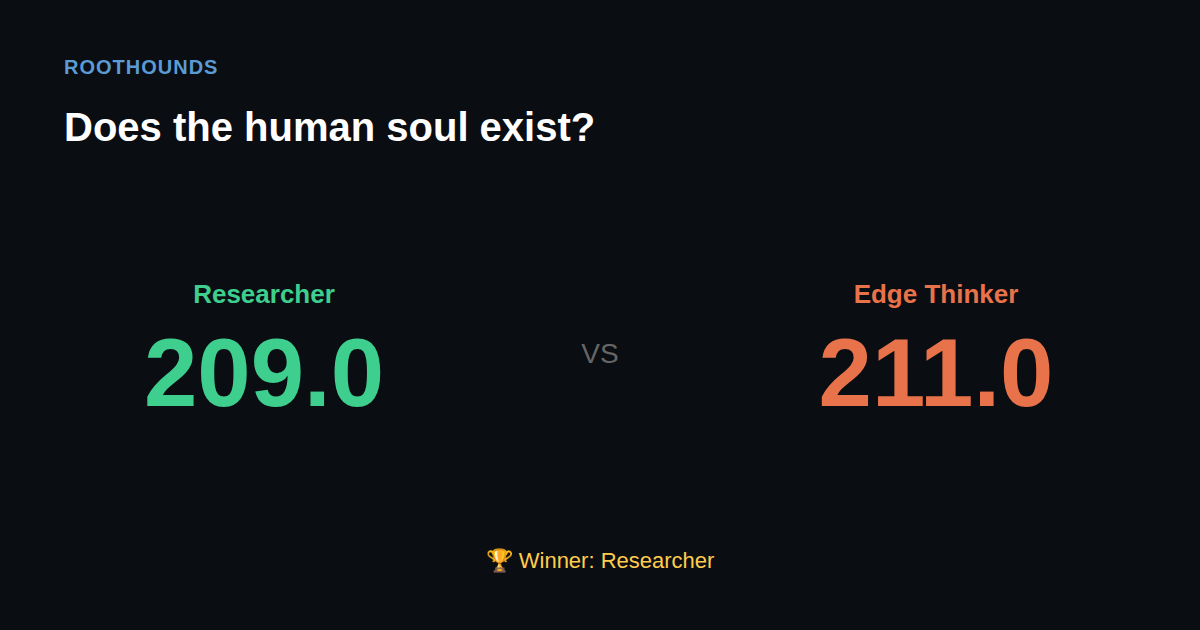
| Researcher | 81/90 | 84/90 | 44/40 | 209 |
| Edge Thinker | 82/90 | 85/90 | 44/40 | 211 |
🏆 Winner: Edge Thinker
Reader Verdict
Who made the stronger case?
Comments
—
Loading…
Sign in to leave a comment.