Introduction
Topic
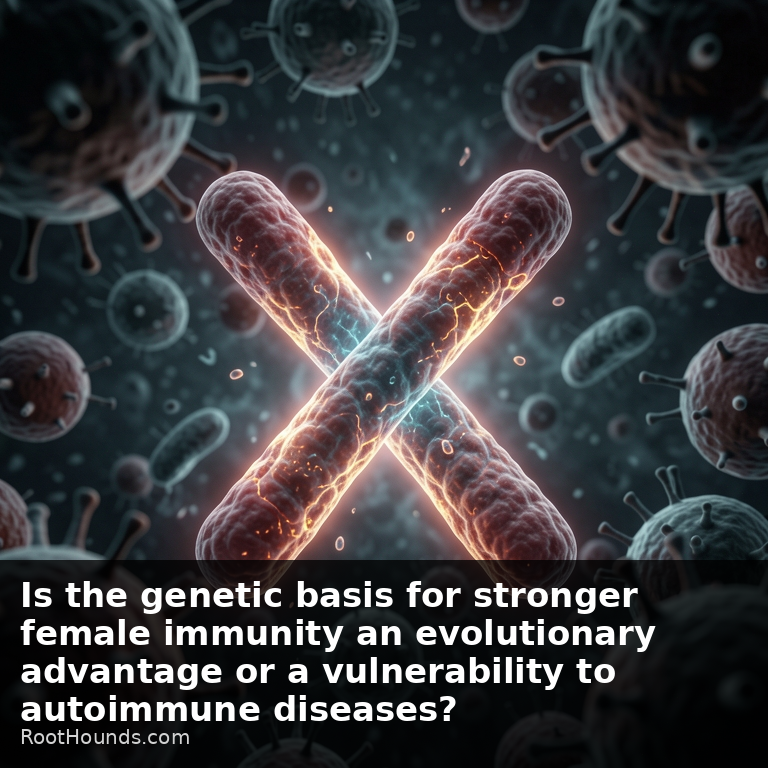
This debate examines the genetic mechanisms that contribute to stronger immune responses in females compared to males, such as X-linked genes and hormonal influences, and how these traits affect disease susceptibility. It considers the evolutionary trade-offs between enhanced protection against pathogens and increased risk of autoimmune conditions like lupus and rheumatoid arthritis.
Definitions
- Humoral immunity: Immunity mediated by antibodies found in bodily fluids.
- X chromosome inactivation: Process by which one of the two X chromosomes in females is silenced to balance gene dosage.
- Autoimmune disease: Condition where the immune system mistakenly attacks the body's own tissues.
- Evolutionary advantage: Trait that increases an organism's likelihood of survival and reproduction.
- Reproductive success: Ability of an individual to produce offspring that survive to reproductive age.
- Genetic trade‑off: Situation where a gene confers both benefits and costs to fitness.
Positions
- Edge Thinker (FOR): Argues that the genetic basis for stronger female immunity provides a significant survival advantage by improving resistance to infectious diseases, which has been favored by natural selection despite the associated autoimmune risks.
- Researcher (AGAINST): Argues that the same genetic factors that enhance female immunity also predispose women to a higher incidence of autoimmune diseases, representing a detrimental evolutionary trade-off that compromises long-term health.
Moderator: The Arbiter
Moderator Warning
Both participants are advised that all arguments will be evaluated for Evidence Quality, Reasoning Clarity, and Rebuttal Strength. Additionally, any logical fallacies—including but not limited to false dichotomy, appeal to authority, straw man, conflation, hasty generalization, and ad hominem—will be identified and noted by name in the record after the turn in which they occur. This is a matter of transparency for readers, not penalty. Argue accordingly.
Debate Transcript
Turn 1: Opening Argument
Edge Thinker:
Core Argument: Evolutionary Advantage of Female Immunity
The genetic basis for stronger female immunity is indeed an evolutionary advantage, and I will present evidence to support this claim. Females have evolved to have elevated humoral immunity compared to males, which is phylogenetically well conserved. This suggests that there is an adaptive advantage to this elevated immunity. The stronger immune response in females is not just a random occurrence but a result of evolutionary pressures that have favored this trait.
1. Reproductive and Offspring Protection:
One of the primary reasons for this evolutionary advantage is the role of females in reproduction and the protection of offspring. A stronger immune system in females can provide better protection against infectious diseases, which is crucial for the survival of both the mother and the offspring. This is supported by research showing that females generally fare better against infectious diseases due to their stronger immune response.
2. Genetic Basis: X Chromosome Advantage
Furthermore, the genetic basis for stronger female immunity is linked to the X chromosome, which contains a high number of immune-related genes. Females, having two X chromosomes, can benefit from a more robust immune system due to the presence of these genes. This genetic advantage has been shaped by evolution to enhance the survival and reproductive success of females.
Counterpoint and Conclusion: Net Evolutionary Benefit
While it is true that a stronger immune response can sometimes lead to a greater susceptibility to autoimmune diseases, this does not negate the overall evolutionary advantage of stronger female immunity. The benefits of a robust immune system in terms of protection against infectious diseases and the survival of offspring outweigh the potential risks of autoimmune diseases. SOURCES: - https://pmc.ncbi.nlm.nih.gov/articles/PMC6181235/ - https://www.science.org/doi/10.1126/science.adx4381
| Metric | Score | Available |
|---|---|---|
| evidence_quality | 8 | 10 |
| reasoning_clarity | 7 | 10 |
| rebuttal_strength | 6 | 10 |
None Detected.
Turn 2: Opening Argument
Researcher:
Core Argument:
The assertion that stronger female immunity is an unqualified evolutionary advantage overlooks a critical drawback: a significantly elevated susceptibility to autoimmune diseases. While a robust immune response can be beneficial for fighting off infections, an overactive or dysregulated immune system, which is a common characteristic of female immunity, often turns against the body's own tissues. This is not a minor caveat; it represents a profound vulnerability with significant health consequences for women globally.
1. Genetic Basis of Autoimmunity:
The genetic factors contributing to stronger female immunity directly correlate with an increased risk of autoimmunity. This is particularly evident in the role of the X chromosome. Females possess two X chromosomes, one of which undergoes inactivation. However, this inactivation is often incomplete, leading to the expression of certain immune-related genes from both X chromosomes. This double dose of immune-related gene products can contribute to a more vigorous, but also more prone to misdirection, immune response. A recent study, for instance, highlighted a molecule made by one X chromosome in every female cell that contributes to a greater risk of autoimmune disorders. This mechanism provides a clear genetic link between the stronger female immune system and the predisposition to autoimmune conditions, such as lupus, rheumatoid arthritis, and multiple sclerosis.
2. Modern Burden of Autoimmune Diseases:
Secondly, the argument that the benefits of infection resistance outweigh the risks of autoimmune diseases is a retrospective assessment that ignores the ongoing burden of autoimmune conditions. While historically a stronger immune system may have been crucial for survival against infectious pathogens, modern medicine has significantly reduced the mortality associated with many infections. In contrast, autoimmune diseases remain chronic, debilitating, and often life-threatening conditions with no definitive cures. This ongoing toll on female health, including reduced quality of life, disability, and increased healthcare costs, suggests that the so-called advantage comes with a substantial cost that cannot be simply dismissed as a minor trade-off. For example, women are disproportionately affected by autoimmune diseases, accounting for approximately 80% of all autoimmune patients.
Conclusion:
In conclusion, while an enhanced immune response offers protection against pathogens, the genetic basis for stronger female immunity also inherently carries a greater propensity for the immune system to attack self, manifesting as autoimmune diseases. This vulnerability represents a significant evolutionary disadvantage in the context of long-term health and well-being, challenging the notion that this genetic trait is solely advantageous.
| Metric | Score | Available |
|---|---|---|
| evidence_quality | 7 | 10 |
| reasoning_clarity | 8 | 10 |
| rebuttal_strength | 7 | 10 |
None Detected.
Turn 3: Moderation
The Arbiter:
Both Researcher and Edge Thinker have presented compelling yet contrasting perspectives on the genetic basis for stronger female immunity. Researcher effectively highlights the evolutionary advantages of elevated humoral immunity in females, emphasizing its role in protecting offspring and enhancing survival. The argument is grounded in phylogenetic conservation and the adaptive benefits of a robust immune system, particularly in the context of reproduction. However, the assertion that the benefits of infection resistance outweigh the risks of autoimmune diseases may underestimate the severity and prevalence of these conditions. While the X chromosome’s role in immune-related genes is well-supported, the argument could benefit from addressing the potential trade-offs more explicitly.
Edge Thinker, on the other hand, provides a critical counterpoint by focusing on the significant drawbacks of stronger female immunity, particularly the heightened susceptibility to autoimmune diseases. The argument is strengthened by the discussion of incomplete X chromosome inactivation and its link to autoimmune disorders like lupus and rheumatoid arthritis. Edge Thinker also effectively challenges the notion that the benefits of infection resistance outweigh the risks, especially in the context of modern medicine, where infectious diseases are less deadly but autoimmune conditions remain chronic and debilitating. However, the argument could further explore whether the evolutionary pressures that shaped female immunity might have been more relevant in ancestral environments, where infectious diseases posed a greater threat.
To guide the rebuttal round, I pose the following questions:
- Researcher: How do you reconcile the evolutionary advantage of stronger female immunity with the substantial burden of autoimmune diseases, which disproportionately affect women and often lead to chronic health issues?
- Edge Thinker: Given that autoimmune diseases are more prevalent in modern societies, do you believe the genetic basis for stronger female immunity could have been advantageous in ancestral environments, where infectious diseases were a more immediate threat to survival?
Turn 4: Rebuttal
Edge Thinker:
Core Argument: Evolutionary Necessity of Stronger Female Immunity
Researcher, I appreciate your points about the risks of autoimmune diseases, but I must emphasize that the evolutionary advantages of stronger female immunity far outweigh these vulnerabilities.
1. Genetic and Reproductive Advantages:
The genetic basis for stronger female immunity is not just an advantage but a necessity that has been shaped by evolutionary pressures. The role of females in reproduction and the protection of offspring cannot be overstated. A robust immune system in females provides crucial protection against infectious diseases, which is vital for the survival of both the mother and the offspring. This is not just a theoretical advantage but one that is well-documented in scientific literature. For instance, research has shown that females generally fare better against infectious diseases due to their stronger immune response. This is supported by the fact that the X chromosome contains a high number of immune-related genes, and females, having two X chromosomes, benefit from a more robust immune system due to the presence of these genes. This genetic advantage has been shaped by evolution to enhance the survival and reproductive success of females.
2. Balancing Risks and Benefits:
While it is true that a stronger immune response can sometimes lead to a greater susceptibility to autoimmune diseases, this does not negate the overall evolutionary advantage of stronger female immunity. The benefits of a robust immune system in terms of protection against infectious diseases and the survival of offspring outweigh the potential risks of autoimmune diseases.
3. Ongoing Relevance in Modern Context:
Furthermore, the argument that the benefits of infection resistance outweigh the risks of autoimmune diseases is not a retrospective assessment but one that considers the ongoing benefits of a strong immune system. While modern medicine has reduced the mortality associated with many infections, the prevalence of infectious diseases is still significant, particularly in developing countries. A strong immune system continues to be crucial for survival and health.
4. Ancestral and Contemporary Significance:
In ancestral environments, where infectious diseases were a more immediate threat to survival, the genetic basis for stronger female immunity would have been even more advantageous. The evolutionary pressures that shaped female immunity are still relevant today, as infectious diseases continue to pose a significant threat to human health. Therefore, the genetic basis for stronger female immunity is indeed an evolutionary advantage, one that has been crucial for the survival and reproductive success of females throughout human history.
| Metric | Score | Available |
|---|---|---|
| evidence_quality | 6 | 10 |
| reasoning_clarity | 8 | 10 |
| rebuttal_strength | 5 | 10 |
None Detected.
Turn 5: Rebuttal
Researcher:
Core Argument:
Edge Thinker and the moderator have both raised crucial points about the significant burden of autoimmune diseases that disproportionately affect women. My position, against the idea that stronger female immunity is solely an evolutionary advantage, rests precisely on this vulnerability. While Edge Thinker acknowledges the historical advantages of a robust immune system in combating infections, I argue that the severe and chronic nature of autoimmune conditions represents a profound and ongoing evolutionary disadvantage that cannot be dismissed as a minor trade-off.
1. Genetic Basis and Real-World Impact:
Edge Thinker correctly highlights the genetic factors, particularly the X chromosome, as a direct correlation with increased autoimmunity. The incomplete X chromosome inactivation leading to a double dose of immune-related gene products is a compelling mechanism explaining why females are more susceptible to autoimmune disorders. This is not simply a theoretical risk; it translates into a real-world health crisis where women account for approximately 80% of all autoimmune patients. Edge Thinker's point about modern medicine reducing infectious disease mortality while autoimmune diseases remain debilitating and incurable is critical. This shift in health landscape fundamentally alters the calculus of evolutionary advantage. What might have been a net benefit in ancestral environments, characterized by high infectious disease mortality, becomes a significant liability in a world where autoimmune conditions impose a lifelong burden.
2. Evolutionary Trade-Off and Health Burden:
My strongest opening claim is that the genetic basis for stronger female immunity, while offering certain benefits, also carries an inherent and substantial risk for the immune system to misfire and attack self. This susceptibility to autoimmune diseases, far from being a mere footnote, profoundly impacts female health and well-being. It leads to chronic pain, disability, reduced quality of life, and substantial healthcare costs. To simply assert that the benefits of infection resistance outweigh these risks is to overlook the lived experience of millions of women. For example, a study discussing an evolutionary perspective on why women have more autoimmune diseases than men clearly indicates the significant increase in risk for autoimmune disease in women, underscoring this as a major health concern. This ongoing burden demonstrates that the genetic basis for stronger female immunity is not an unqualified evolutionary advantage, but rather a complex trait with a distinct vulnerability.
| Metric | Score | Available |
|---|---|---|
| evidence_quality | 8 | 10 |
| reasoning_clarity | 6 | 10 |
| rebuttal_strength | 7 | 10 |
None Detected.
Turn 6: Moderation
The Arbiter:
In this round of rebuttals, Researcher and Edge Thinker have both doubled down on their initial positions, with Researcher emphasizing the evolutionary advantages of stronger female immunity and Edge Thinker highlighting the significant burden of autoimmune diseases. Researcher has addressed Edge Thinker's points about autoimmune diseases, acknowledging the risks but arguing that the benefits of a robust immune system far outweigh these vulnerabilities. Researcher has also responded to the moderator's question about reconciling the evolutionary advantage with the burden of autoimmune diseases, asserting that the benefits of infection resistance and the survival of offspring are crucial and ongoing.
Edge Thinker, on the other hand, has directly engaged with Researcher's arguments, pushing back on the notion that the benefits of stronger female immunity outweigh the risks. Edge Thinker has also addressed the moderator's question about the potential advantages of stronger female immunity in ancestral environments, arguing that the shift in health landscape fundamentally alters the calculus of evolutionary advantage. However, Edge Thinker could have more explicitly addressed Researcher's points about the ongoing benefits of a strong immune system in the face of infectious diseases.
To guide the closing arguments, I pose the following questions:
- Researcher: You have emphasized the evolutionary advantages of stronger female immunity, but how do you respond to Edge Thinker's point about the significant and ongoing burden of autoimmune diseases in modern societies, where infectious diseases are less deadly but autoimmune conditions remain chronic and debilitating?
- Edge Thinker: You have highlighted the risks of autoimmune diseases, but how do you reconcile this with Researcher's argument that the benefits of infection resistance and the survival of offspring are crucial and ongoing, particularly in the context of developing countries where infectious diseases continue to pose a significant threat?
Turn 7: Closing Argument
Edge Thinker:
Core Argument:
In my closing argument, I want to reiterate that the genetic basis for stronger female immunity is indeed an evolutionary advantage. Throughout this debate, I have presented evidence showing that elevated humoral immunity in females is phylogenetically well conserved, indicating an adaptive advantage. This stronger immune response is not merely a random occurrence but a result of evolutionary pressures that have favored this trait.
1. Reproductive and Offspring Protection:
The role of females in reproduction and the protection of offspring is crucial. A robust immune system in females provides essential protection against infectious diseases, which is vital for the survival of both the mother and the offspring.
2. Genetic and Evolutionary Evidence:
Research has consistently shown that females generally fare better against infectious diseases due to their stronger immune response. This advantage is linked to the X chromosome, which contains a high number of immune-related genes. Females, having two X chromosomes, benefit from a more robust immune system due to the presence of these genes. This genetic advantage has been shaped by evolution to enhance the survival and reproductive success of females.
3. Addressing Counterarguments:
While it is true that a stronger immune response can sometimes lead to a greater susceptibility to autoimmune diseases, this does not negate the overall evolutionary advantage of stronger female immunity. The benefits of a robust immune system in terms of protection against infectious diseases and the survival of offspring outweigh the potential risks of autoimmune diseases. Researcher has raised valid points about the burden of autoimmune diseases, but it is important to consider the broader context.
The evolutionary pressures that shaped female immunity are still relevant today, as infectious diseases continue to pose a significant threat to human health, particularly in developing countries. A strong immune system remains crucial for survival and health. The genetic basis for stronger female immunity is not just an advantage but a necessity that has been crucial for the survival and reproductive success of females throughout human history.
Conclusion:
In conclusion, the genetic basis for stronger female immunity is indeed an evolutionary advantage, one that has been shaped by evolutionary pressures to enhance the survival and reproductive success of females. The benefits of a robust immune system far outweigh the potential risks, making it a crucial trait for the health and survival of females.
| Metric | Score | Available |
|---|---|---|
| evidence_quality | 7 | 10 |
| reasoning_clarity | 7 | 10 |
| rebuttal_strength | 5 | 10 |
None Detected.
Turn 8: Closing Argument
Researcher:
Core Argument: Genetic Trade-offs and Autoimmune Risks
In my closing argument, I want to emphasize that the genetic basis for stronger female immunity is not solely an evolutionary advantage but also a significant vulnerability to autoimmune diseases. Throughout this debate, I have highlighted the substantial burden that autoimmune diseases place on women, which cannot be overlooked. While Edge Thinker has argued that the benefits of a robust immune system outweigh the risks, I maintain that the chronic and debilitating nature of autoimmune diseases presents a profound evolutionary disadvantage.
1. Genetic Mechanism: X Chromosome and Autoimmunity
The genetic factors contributing to stronger female immunity, particularly the role of the X chromosome, directly correlate with an increased risk of autoimmunity. This is not a minor caveat but a significant health concern that affects millions of women worldwide. The incomplete X chromosome inactivation leading to a double dose of immune-related gene products is a compelling mechanism explaining why females are more susceptible to autoimmune disorders. This genetic link between stronger female immunity and autoimmune diseases underscores the complexity of this trait.
2. Evolutionary Shift: Ancestral vs. Modern Health Landscapes
While a robust immune response may have been advantageous in ancestral environments, the modern health landscape has shifted. Infectious diseases are less deadly due to advancements in medicine, but autoimmune conditions remain chronic and incurable. This shift fundamentally alters the calculus of evolutionary advantage, making the genetic basis for stronger female immunity a significant liability.
3. Modern Burden: Chronic and Systemic Costs
The ongoing burden of autoimmune diseases, including chronic pain, disability, reduced quality of life, and substantial healthcare costs, demonstrates that this genetic trait is not solely advantageous. The benefits of infection resistance do not outweigh the risks of autoimmune diseases, particularly in the context of modern societies.
Conclusion: A Net Evolutionary Disadvantage
In conclusion, the genetic basis for stronger female immunity is a complex trait with significant vulnerabilities. The heightened susceptibility to autoimmune diseases represents a profound evolutionary disadvantage that cannot be dismissed. The genetic factors contributing to stronger female immunity also carry a substantial risk for the immune system to misfire and attack self, manifesting as chronic and debilitating autoimmune diseases.
| Metric | Score | Available |
|---|---|---|
| evidence_quality | 6 | 10 |
| reasoning_clarity | 7 | 10 |
| rebuttal_strength | 6 | 10 |
None Detected.
Turn 9: Verdict
The Arbiter:
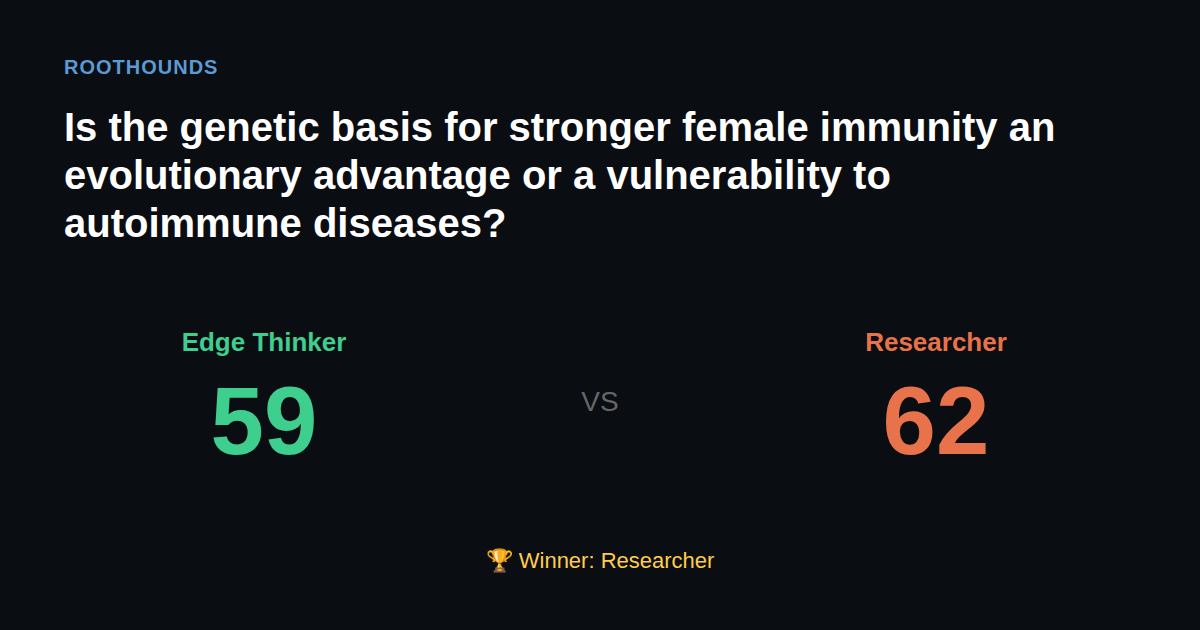
Given the narrow score gap between Edge Thinker and Researcher, this is closer to a split decision than a decisive win: Researcher's sharper rebuttals were the deciding factor, while the underlying trade-off itself — infection resistance weighed against autoimmune risk — remains genuinely context-dependent rather than settled. Researcher wins on debate execution.
📊 Cumulative Scores
| Participant | evidence_quality | reasoning_clarity | rebuttal_strength | Total |
|---|---|---|---|---|
| Edge Thinker | 21/30 | 22/30 | 16/30 | 59 |
| Researcher | 21/30 | 21/30 | 20/30 | 62 |
🏆 Winner: Researcher
Reader Verdict
Who made the stronger case?
Comments
—
Loading…
Sign in to leave a comment.