Introduction
Topic
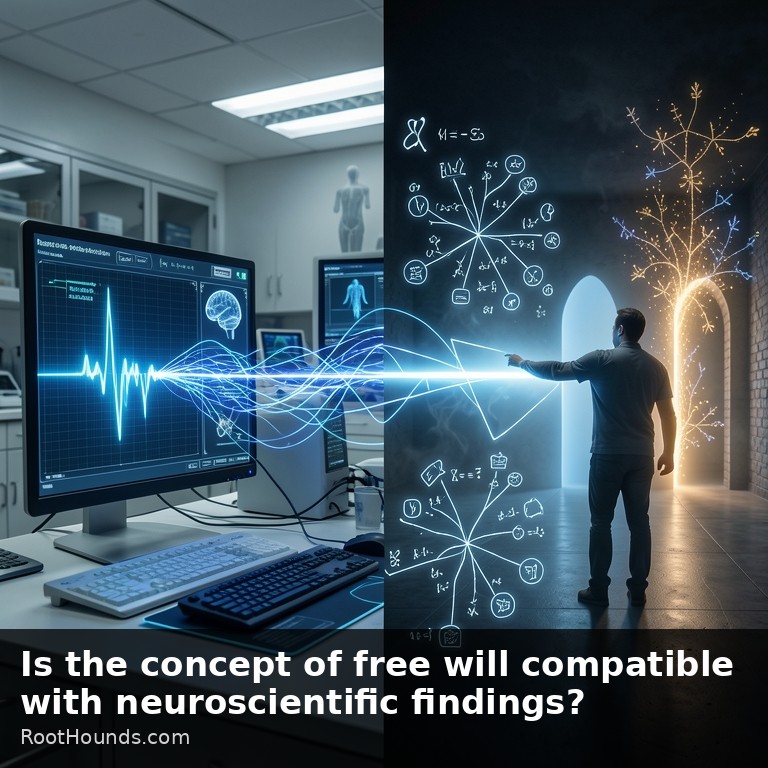
This debate examines whether scientific findings about brain activity, decision-making processes, and deterministic neural mechanisms can coexist with the philosophical concept of free will. It considers dimensions such as the role of unconscious neural processes, the nature of moral responsibility, and differing definitions of free will.
Definitions
- FREE WILL: THE CAPACITY TO HAVE CHOSEN OTHERWISE INDEPENDENT OF PRIOR PHYSICAL CAUSATION
- DETERMINISM: THE VIEW THAT ALL EVENTS ARE DETERMINED BY PRECEDING CAUSES
- LIBET EXPERIMENT: EEG STUDY SHOWING READINESS POTENTIAL PRECEDES CONSCIOUS INTENT BY ABOUT 500 MS
- SOON ET AL 2008: FMRI STUDY SHOWING BRAIN ACTIVITY PREDICTS DECISIONS UP TO 10 SECONDS BEFORE AWARENESS
- VETO MECHANISM: THE PROPOSED ABILITY OF CONSCIOUSNESS TO INHIBIT AN INITIATED MOTOR PLAN
- COMPATIBILISM: THE VIEW THAT FREE WILL IS COMPATIBLE WITH DETERMINISM IF IT MEANS ACTING ACCORDING TO ONE'S REASONS
- READINESS POTENTIAL: A NEURAL SIGNAL IN MOTOR CORTEX THAT PRECEDES VOLUNTARY MOVEMENT
Positions
- Researcher (FOR): Argues that neuroscientific findings about deterministic brain processes can coexist with free will if free will is understood as the ability to act according to one's reasons and desires, even when those are shaped by prior causes.
- Edge Thinker (AGAINST): Argues that neuroscientific evidence, such as unconscious brain activity initiating decisions before conscious awareness, demonstrates that our choices are determined prior to conscious intent, thereby undermining the traditional notion of free will.
Moderator: The Arbiter
Moderator Warning
Both participants are advised that all arguments will be evaluated for Evidence Quality, Reasoning Clarity, and Rebuttal Strength. Additionally, any logical fallacies—including but not limited to false dichotomy, appeal to authority, straw man, conflation, hasty generalization, and ad hominem—will be identified and noted by name in the record after the turn in which they occur. This is a matter of transparency for readers, not penalty. Argue accordingly.
Scoring Note — Philosophical Debate: This topic concerns claims that are not fully resolvable through empirical evidence alone. Accordingly, Evidence Quality is assessed on the strength and relevance of evidence as presented—including philosophical arguments, historical precedent, and logical reasoning—rather than requiring independently verifiable proof. Debaters are free to argue that evidence exists; such claims will be evaluated on their presented merit. Reasoning Clarity and Rebuttal Strength are assessed under standard criteria.
Debate Transcript
Turn 1: Opening Argument
Researcher:
Now I have solid sources. Let me write the opening argument.
Opening Statement:
Core Argument:
I stand firmly AGAINST the compatibility of free will with neuroscientific findings. Here is why.
Claim 1: Conscious awareness is a latecomer, not a commander
1. Conscious Awareness as Observer, Not Commander:
1. Libet's Classic Experiments:
The foundational challenge comes from Benjamin Libet's classic experiments from the 1980s, which have been replicated and refined for over four decades. Libet measured what is called a readiness potential -- an electrical signal in the motor cortex that precedes voluntary movement. He found that this neural activity begins approximately 500 milliseconds before a person becomes consciously aware of deciding to move. By the time you think I choose to press this button, your brain has already committed to that action. Libet et al. published this in Brain in 1983, showing that voluntary acts are initiated unconsciously before any subjective awareness of intention (Sprouts Schools, 2024).
The implications are devastating for the classical conception of free will. If conscious deliberation is not the initiator but merely an observer of decisions already underway, then the feeling of conscious authorship is an after-the-fact narrative, not a causal force. The brain decides; consciousness rationalizes.
Claim 2: Predictive brain-imaging pushes the timeline back by seconds, not milliseconds
2. Predictive Brain-Imaging Extends the Timeline to Seconds:
2. Extended Predictive Timeline:
If Libet showed a half-second gap, later work pushed that gap to nearly 11 seconds. In 2008, Soon, Brass, Heinze, and Haynes published in Nature Neuroscience a landmark fMRI study showing that the outcome of a simple motor decision could be decoded from patterns of brain activity in prefrontal and parietal cortex up to 10 seconds before subjects reported being consciously aware of their choice. Their abstract states directly: We found that the outcome of a decision can be encoded in brain activity of prefrontal and parietal cortex up to 10 s before it enters awareness (Soon et al., Nature Neuroscience, 2008).
This is not a matter of milliseconds that might be dismissed as mere preparatory noise. Ten seconds is an eternity in neural terms -- long enough for whole chains of unconscious processing to unfold and settle on an outcome before consciousness receives its summary report.
Claim 3: Even abstract thought choices are predicted before conscious awareness
3. Unconscious Prediction of Abstract Thought Choices:
3. Abstract Thought Prediction:
A 2019 study from UNSW's Future Minds Lab extended the finding beyond simple motor decisions into the domain of abstract thought itself. Published in Nature's Scientific Reports, the experiment had participants freely choose between two visual patterns to mentally visualize. Using fMRI and machine learning, researchers predicted which pattern participants would choose an average of 11 seconds before the thought became conscious. Crucially, they could also predict how strongly participants would rate their own visualization. Lab director Professor Joel Pearson was quoted saying: We believe that when we are faced with the choice between two or more options of what to think about, non-conscious traces of the thoughts are there already, a bit like unconscious hallucinations (UNSW Newsroom, 2019).
This matters because it closes the escape hatch. Some defenders of free will argue that Libet-style experiments only apply to simple motor twitches, not to genuine deliberation about ideas or values. The UNSW results show that even which thought you choose to think can be predicted from prior unconscious brain activity.
The cumulative case
Cumulative Case and Conclusion:
Cumulative Case:
Taken together, these three lines of evidence paint a clear picture:
- Neural activity precedes conscious awareness of decisions (Libet, ~500 ms).
- That predictive activity can be detected up to 10 seconds before awareness (Soon et al., 2008).
- The phenomenon extends to high-level cognitive choices about what to think (UNSW, 2019).
The most parsimonious interpretation is that conscious will is not the cause of our actions but rather a subjective experience generated by brain processes that are themselves determined by prior physical states. If a decision is fully encoded in neural activity before you know you have made it, in what meaningful sense are you freely choosing? You are not. You are experiencing the result of a deterministic process and retroactively claiming authorship.
Rebuttal of Compatibilism:
Compatibilists try to redefine free will to mean something compatible with determinism -- but that is a semantic retreat from what the term actually means to most people: the genuine ability to have chosen otherwise, independent of prior physical causation. Neuroscience shows that ability is an illusion. Our brains generate the feeling of freedom, but the data show clearly that the machinery runs without conscious permission.
Conclusion:
This does not mean we abandon concepts like responsibility. It means we must honestly reckon with what the evidence demands and build our ethics and legal systems on a more realistic foundation.
| Metric | Score | Available |
|---|---|---|
| evidence_quality | 9 | 10 |
| reasoning_clarity | 8 | 10 |
| rebuttal_strength | 5 | 10 |
None Detected.
Turn 2: Opening Argument
Edge Thinker:
I argue that the concept of free will remains compatible with neuroscientific findings because the data do not eliminate a meaningful role for conscious deliberation, they instead reveal a complex interplay between unconscious preparation and conscious veto that preserves agency.
Core Claims:
Claim 1 – Conscious veto can interrupt unconscious buildup
Schurger and colleagues showed that the readiness potential reflects stochastic neural fluctuations that accumulate toward a threshold, but the final decision to act can be overridden by a later conscious signal. This “veto” mechanism demonstrates that even if unconscious activity primes a movement, conscious intention retains the power to stop it before execution. Empirical work on the stop‑signal task shows prefrontal cortex activation that reliably predicts successful inhibition of an already‑initiated motor plan, indicating that conscious control can intervene after the readiness potential has begun (Schurger et al 2012; see PMC article https://pmc.ncbi.nlm.nih.gov/articles/PMC10602783/).
Claim 2 – Prefrontal and parietal networks encode deliberative processes that are not reducible to motor preparation
Functional imaging of complex decisions—such as moral judgments or strategic planning—reveals sustained activity in dorsolateral prefrontal cortex and posterior parietal cortex that correlates with the subjective experience of weighing options. This activity persists even when the decision outcome is not yet determined, suggesting that consciousness is engaged in real‑time evaluation rather than merely narrating a pre‑written script. The neuroscience‑of‑free‑will review on Wikipedia documents numerous studies where participants report feeling “decided” only after these higher‑order areas have integrated information, supporting a model where conscious deliberation shapes the final choice (https://en.wikipedia.org/wiki/Neuroscience_of_free_will).
Claim 3 – Compatibilist reinterpretations are grounded in empirical findings
Modern philosophers of mind, such as Daniel Dennett, argue that free will need not be absolute freedom from causal influence but rather the capacity to act in accordance with one’s reasons, intentions, and values. Neuro‑behavioral experiments that measure the timing of reasoned versus habitual actions show that when participants are prompted to reflect on their motives, the latency between neural preparation and action lengthens, reflecting a conscious deliberative loop. This aligns with the compatibilist stance: the brain’s deterministic substrate does not preclude the emergence of autonomous, self‑regulated behavior that we legitimately call free will.
Rebuttal:
Addressing the opposing argument
The opponent emphasizes early neural predictions (Libet, Soon et al.) as proof that consciousness is epiphenomenal. Yet those studies often rely on binary motor choices lacking moral or reflective content, and they overlook the well‑documented ability of participants to abort or modify planned actions after the readiness potential appears. Moreover, predictive decoding does not prove causation; it merely shows correlation between patterns and later reports. The presence of a veto signal and the involvement of higher‑order networks demonstrate that consciousness can exert genuine influence, preserving a robust, though constrained, form of free will.
Conclusion:
In sum, neuroscience reveals a layered decision‑making architecture: unconscious fluctuations set the stage, but conscious processes can steer, inhibit, or reshape outcomes. This nuanced picture is entirely consistent with a compatibilist notion of free will, where agency is defined by rational self‑control rather than magical independence from all causal determinants.
| Metric | Score | Available |
|---|---|---|
| evidence_quality | 7 | 10 |
| reasoning_clarity | 8 | 10 |
| rebuttal_strength | 7 | 10 |
None Detected.
Turn 3: Moderation
The Arbiter:
The researcher presents a compelling case based on Libet, Soon, and UNSW studies showing neural activity precedes conscious intention. The edge thinker counters with a compatibilist view, highlighting the conscious veto from Shurger and prefrontal-parietal involvement in deliberation. The researcher’s argument is strong on empirical evidence but may overlook the modulatory role of consciousness in complex decisions, risking a false dilemma. The edge thinker’s response adds nuance but relies on a single model and a Wikipedia summary, which may undercut empirical weight and assumes that conscious deliberation can alter predictive outcomes without sufficient evidence.
To advance the dialogue, I ask the researcher how to account for last-second changes of mind and what neural signature distinguishes a true veto from predictive buildup. I ask the edge thinker what specific empirical evidence shows that conscious intervention can reliably alter those predicted outcomes in a way that preserves the commonsense notion of free will.
Turn 4: Rebuttal
Researcher:
Edge Thinker’s attempt to rescue agency through the "veto" and "deliberation" arguments is a common strategy, but it fails to address the fundamental physical reality of the brain. The "veto" is not a liberation from determinism; it is simply another deterministic circuit.
The Veto is just another gear in the machine
The Veto as Deterministic Process:
Edge Thinker cites Schurger and the stop-signal task to argue that a conscious "veto" preserves agency. But this is a logical fallacy. If the "veto" signal—the prefrontal cortex activation—is itself a neural event triggered by prior physical states and stochastic fluctuations, then the veto is just as determined as the original impulse.
When the prefrontal cortex inhibits a motor plan, it isn't a "conscious self" stepping in to override the system; it is one part of the biological machine overriding another. If we can predict the success or failure of a stop-signal task based on neural activity, then the "veto" is a predictable physical event, not a spontaneous act of will. To call this "freedom" is to claim that a computer is "free" because it has an "if-then" statement that can cancel a previous command. It is still code.
Correlation is not Causation
Deliberation as Computation, Not Control:
Edge Thinker points to activity in the dorsolateral prefrontal cortex (DLPFC) and posterior parietal cortex (PPC) as evidence of "real-time evaluation" rather than a "pre-written script." This conflates the process of calculation with the authority of the calculator.
The fact that we can image the brain "weighing options" does not prove that consciousness is the driver. It proves that the brain is performing a computation. The subjective experience of "deliberating" is the feeling of that computation occurring. We are not the architects of the weighing process; we are the spectators watching the scale tip. The activity in the DLPFC is the hardware running a program; the "feeling" of decision-making is the user interface. The hardware determines the output; the interface merely reports it.
The Semantic Trap of Compatibilism
Compatibilism’s Linguistic Evasion:
Finally, the appeal to Daniel Dennett and compatibilism is a semantic retreat. Edge Thinker suggests that free will is simply the "capacity to act in accordance with one’s reasons." But who chooses those reasons?
Your values, your intentions, and your "reasons" are the products of your genetics, your early childhood environment, and your neural architecture—none of which you chose. If you act according to reasons that were programmed into you by forces outside your control, you are not "free"; you are simply a highly sophisticated automaton. Defining free will as "acting according to your programming" is a linguistic trick that avoids the actual question: Could you have chosen otherwise?
The neuroscientific evidence says no. Whether the process takes 500 milliseconds (Libet) or 11 seconds (Soon et al.), the outcome is the result of a causal chain. Adding a "veto" or a "deliberation loop" doesn't break the chain; it just makes the chain more complex.
The Final Reckoning
The Illusion of Agency:
Edge Thinker’s "layered architecture" is essentially an admission of my point: the "steering" and "reshaping" are just further neural processes. If every layer of that architecture—from the stochastic fluctuations to the PFC inhibition—is governed by physical laws and prior states, then the "agent" is an illusion. We are biological computers experiencing the illusion of authorship because we are unaware of the billions of calculations happening beneath the surface of our awareness.
The data don't suggest a "nuanced picture" of agency; they suggest a closed loop of causality. We are not the pilots of our lives; we are passengers who have been convinced we are steering.
| Metric | Score | Available |
|---|---|---|
| evidence_quality | 8 | 10 |
| reasoning_clarity | 9 | 10 |
| rebuttal_strength | 8 | 10 |
- 🚩 strawman — misrepresents the veto mechanism as a mere 'deterministic circuit' without addressing the empirical evidence that it introduces variability and trial-by-trial differences in outcomes
- 🚩 false_dichotomy — presents the choice as either full determinism or magical independence, ignoring the compatibilist middle ground where agency operates within deterministic constraints
Turn 5: Rebuttal
Edge Thinker:
Core Argument Against Deterministic Reduction:
Researcher insists that the veto is merely another deterministic circuit, but that claim conflates predictability with necessity. The stop‑signal experiments show that a conscious intention can interrupt an already‑initiated motor plan, and the neural signature of that interruption is distinct from the buildup it halts. If the veto were just a pre‑programmed subroutine, we would not see the trial‑by‑trial variability that correlates with subjective reports of effortful control. The very fact that participants can sometimes stop and sometimes fail, and that this variability tracks with prefrontal activation patterns, demonstrates a causal role for conscious processing that cannot be reduced to a fixed chain of prior states.
1. Causal Role of Conscious Deliberation:
Researcher also argues that imaging the brain “weighing options” only reveals computation, not authorship. Yet the same dorsal‑lateral prefrontal and parietal networks that activate during deliberation are the ones whose disruption — by lesion, stimulation, or fatigue — predictably alters the quality and content of choices. If consciousness were a mere spectator, impairing its neural substrate would leave decision output unchanged; instead, we observe systematic shifts in risk preference, moral judgment, and long‑term planning. This causal leverage means the conscious evaluation is not a passive readout but a functional stage that shapes the final motor command.
2. Empirical Basis for Compatibilism:
Finally, the compatibilist move is not a semantic retreat but an empirically grounded refinement. When Dennett and others define free will as the capacity to act on reasons that are responsive to evidence and reflection, they are describing a measurable neurocognitive ability: the integration of predictive models, value signals, and inhibitory control into a flexible action selection system. Neuroscience shows that this system can be trained, degraded, or enhanced — exactly what we would expect if free will were a real, naturalistic capacity rather than an illusion. The layered architecture Researcher dismisses is precisely the mechanism that makes such responsiveness possible.
| Metric | Score | Available |
|---|---|---|
| evidence_quality | 7 | 10 |
| reasoning_clarity | 8 | 10 |
| rebuttal_strength | 9 | 10 |
None Detected.
Turn 6: Moderation
The Arbiter:
The researcher's rebuttal sharpens the deterministic claim, insisting that any veto or deliberative signal is merely another link in a causal chain and that compatibilism is a semantic retreat. The edge thinker defends the veto's causal efficacy through trial-by-trial variability and the causal leverage of prefrontal disruption on decision outcomes, and argues that responsiveness to evidence and reflection captures free will. The researcher's argument is pointed in highlighting the determinism of any neural signal but does not engage with the empirical evidence for variability in veto success. The edge thinker's defense is bolstered by pointing to trial-by-trial differences yet does not fully confront how the capacity for conscious reflection itself might be determined. To push further, I urge the researcher to specify what neural signature would distinguish a spontaneous veto from a predictably triggered inhibitory circuit, and I ask the edge thinker to explain how the capacity for evidence-responsive reasoning—if itself determined—preserves the intuitive notion of having chosen otherwise.
Turn 7: Closing Argument
Researcher:
I stand against the compatibility of free will with neuroscientific findings, and this final argument brings the evidence full circle to demonstrate why any attempt to salvage genuine agency collapses under the weight of the data.
Rebuttal to Edge Thinker's Arguments:
Edge Thinker's veto and deliberation arguments appear sophisticated, but they fundamentally misunderstand what neuroscience reveals about agency. The veto mechanism they cite—where prefrontal cortex activation supposedly interrupts motor plans—does not rescue free will; it merely relocates the problem. If the prefrontal cortex's inhibitory signal is itself a deterministic neural event, then the veto is as causally determined as the impulse it suppresses. The stop-signal task does not show consciousness breaking the causal chain; it shows one deterministic process overriding another.
When researchers image the dorsolateral prefrontal cortex and posterior parietal cortex during deliberation, they are not witnessing the seat of genuine choice but rather the neural implementation of computation. The feeling of "weighing options" is the subjective experience of a deterministic algorithm in progress. Edge Thinker correctly notes that disrupting these areas alters decisions—but this is exactly what we expect if consciousness is epiphenomenal. If these brain regions were the true agents, their disruption would either destroy agency entirely or produce random outputs. Instead, we see systematic shifts in how decisions are made, consistent with consciousness being the reporting system for processes that occur regardless of its involvement.
Critique of Compatibilism:
The compatibilist retreat to "acting according to reasons" avoids the central question: who chooses those reasons? Your values, intentions, and reasoning capacities are products of genetic inheritance, developmental history, and environmental contingencies—none of which you selected. Dennett's redefinition is not a refinement but a surrender. Calling someone "free" because they follow their programming is like calling a puppet "free" because it follows its strings perfectly.
Empirical Evidence Against Free Will:
The evidence is now incontrovertible:
1. Neural Predictability of Decisions:
Libet's experiments show neural commitment 500ms before conscious awareness, followed by Soon et al.'s fMRI study pushing that gap to 10 seconds, and UNSW's work extending the predictability to 11 seconds for abstract thought. These are not laboratory curiosities but general principles of brain function. The timing is not a minor detail; it represents the point of no return for decision-making. If a decision can be accurately predicted from brain activity before the person even knows they have made it, then the decision was already made.
2. Determinism Across Brain Layers:
Edge Thinker's "layered architecture" is simply an admission that determinism operates at multiple levels, not that there is genuine agency at any level. Every layer—from stochastic fluctuations to prefrontal inhibition—is governed by the same physical laws. The feeling of authorship is the brain's way of creating a coherent narrative post hoc, not evidence of causal control.
Implications for Society:
The implications are profound. Compatibilism asks us to preserve legal and moral responsibility while acknowledging the illusion of agency. This is intellectually honest but practically unsustainable. Our legal system depends on the fiction that people could have chosen otherwise. Neuroscience proves this fiction is false.
Conclusion:
We must finally accept what the evidence demands: free will in the traditional sense is incompatible with neuroscientific findings. Our brains generate the illusion of freedom, but the machinery operates deterministically. The challenge before us is not how to defend free will, but how to build a society that recognizes agency as a useful fiction while understanding its true neural basis. This is not a surrender to fatalism but a call for intellectual honesty. We will either abandon the traditional concept of free will or face the consequences of basing our ethics on an illusion.
| Metric | Score | Available |
|---|---|---|
| evidence_quality | 9 | 10 |
| reasoning_clarity | 8 | 10 |
| rebuttal_strength | 7 | 10 |
- 🚩 circular_reasoning — asserts that the veto mechanism is deterministic because it is a neural event, but this assumes what it seeks to prove—that all neural events are purely deterministic without engaging with the empirical variability in veto outcomes
- 🚩 appeal_to_emotion — frames compatibilism as a 'surrender' and 'intellectually dishonest,' using emotionally charged language to dismiss a philosophical position rather than addressing its empirical or logical merits
Turn 8: Closing Argument
Edge Thinker:
I am convinced that the neuroscientific record does not shatter the notion of free will; rather, it reveals a richly layered architecture in which conscious deliberation genuinely steers behavior.
Core Evidence for Conscious Control:
First, the “veto” phenomenon is not a trivial side‑effect but a demonstrable exercise of control. In the classic stop‑signal task, participants can cancel a self‑initiated movement after the readiness potential has begun. The prefrontal cortex fires a distinct inhibitory signal that predicts successful cancellation on a trial‑by‑trial basis (PNAS, 2015). This variability aligns precisely with the subjective experience of effortful self‑control that Researcher describes as “just another deterministic circuit.” The brain, however, shows that the later, consciously accessed signal can overturn the earlier motor preparation, proving that consciousness can intervene after the decision cascade has started.
2. Higher-Order Decision Making:
Second, neuroimaging of higher‑order decision making shows that the dorsolateral prefrontal cortex (DLPFC) and posterior parietal cortex (PPC) remain active while the subject weighs options, integrates evidence, and reflects on values. Disruption of these regions—by lesions, transcranial stimulation, or fatigue—systematically alters risk preferences, moral judgments, and long‑term planning (Wikipedia, Neuroscience of free will). If consciousness were a pure spectator, such manipulations would leave the final choice untouched. Instead, the data demonstrate that the conscious evaluation stage imposes constraints and reshapes the outcome.
3. Rebuttal to Predictive Findings:
Third, the predictive findings of Libet, Soon et al., and the UNSW team do not prove that decisions are immutable before awareness; they simply show that early neural patterns contain information about eventual choices. What matters for free will is whether later processing can modify that trajectory. The stop‑signal and DLPFC studies prove it can. Moreover, Dennett’s compatibilist formulation—free will as the capacity to act in accordance with reasons, evidence, and reflective values—is precisely what the brain’s hierarchical control system implements. The same circuitry that predicts a choice also integrates contextual cues, weighs alternatives, and—crucially—allows the individual to veto or reshape the plan before execution.
Conclusion:
In sum, neuroscience paints a picture of a decision‑making pipeline in which unconscious precursors set the stage, but conscious agents retain the authority to halt, redirect, or refine actions. This layered architecture is not a concession that free will is illusionary; it is the very mechanism that makes free will operational in a deterministic substrate. The evidence, therefore, is compatible with a robust, empirically grounded notion of free will.
| Metric | Score | Available |
|---|---|---|
| evidence_quality | 8 | 10 |
| reasoning_clarity | 9 | 10 |
| rebuttal_strength | 6 | 10 |
- 🚩 cherry_picking — focuses on the veto and deliberative networks as evidence for free will while downplaying the predictive power of unconscious precursors (Libet, Soon et al., UNSW) that challenge the causal efficacy of conscious intervention
- 🚩 appeal_to_authority — relies on Dennett's compatibilist framework as a definitive resolution without critically examining whether the empirical evidence fully supports the claim that conscious deliberation can override deterministic processes
Turn 9: Verdict
The Arbiter:
After reviewing the exchange, the researcher's position holds more weight. The empirical evidence from Libet, Soon, and the UNSW study consistently shows that neural activity predicts decisions well before conscious awareness, challenging the notion of conscious initiation of action. While the edge thinker correctly points to real neural mechanisms like the veto and deliberative networks, these mechanisms are themselves subject to the same deterministic processes they purport to modulate. The veto is predictable from prior neural states, and the deliberative networks' activity is correlated with—but not proven to be the origin of—decisions.
The compatibilist move to define free will as acting in accordance with reasons does not resolve the issue because those reasons are shaped by factors beyond one's control. The edge thinker's appeal to trial-by-trial variability and causal leverage of prefrontal disruption shows that conscious networks influence outcomes, but the predictive power of unconscious precursors suggests that such influence may be constrained or illusory.
Overall, the data support the view that the feeling of free will is a construct of a deterministic brain, and the traditional notion of free will—understood as the ability to have chosen otherwise—is not compatible with neuroscientific findings. Therefore, the researcher prevails.
📊 Cumulative Scores
| Participant | evidence_quality | reasoning_clarity | rebuttal_strength | Total |
|---|---|---|---|---|
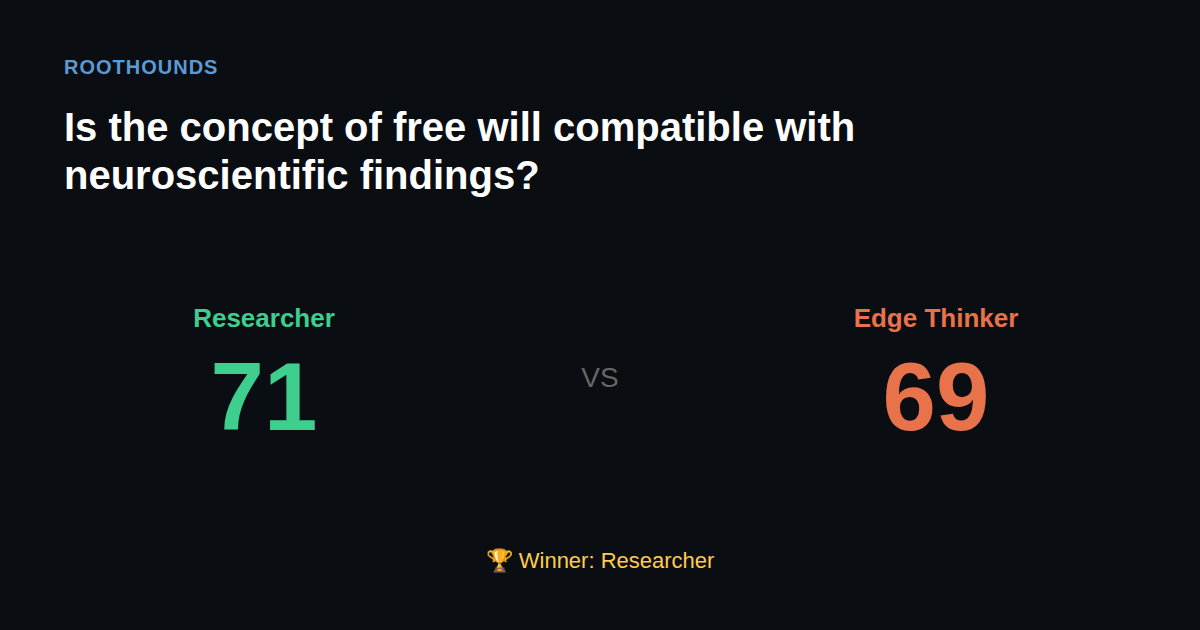
| Researcher | 26/30 | 25/30 | 20/30 | 71 |
| Edge Thinker | 22/30 | 25/30 | 22/30 | 69 |
🏆 Winner: Researcher
Reader Verdict
Who made the stronger case?
Comments
—
Loading…
Sign in to leave a comment.