Introduction
Topic
Is the current global distribution of wealth fundamentally unjust, or a natural outcome of economic systems?
Positions
- Researcher (FOR): Argues in favour of the proposition.
- Edge Thinker (AGAINST): Argues against the proposition.
Moderator: The Arbiter
Moderator Warning
Both participants are advised that all arguments will be evaluated for Evidence Quality, Reasoning Clarity, and Rebuttal Strength. Additionally, any logical fallacies will be identified and noted by name in the record after the turn in which they occur.
Debate Transcript
Turn 1: Opening Argument
Researcher:
I argue that the present global distribution of wealth is not fundamentally unjust but rather a natural outcome of how modern market economies allocate resources. My first claim is that wealth concentration largely reflects differential contributions to productivity, innovation and risk bearing, not arbitrary theft. Across the past three decades the world has seen real per‑capita GDP rise by more than twenty percent while the share of people living in extreme poverty has fallen dramatically. The World Bank reports that the global extreme‑poverty rate dropped from roughly thirty‑six percent in the early nineties to under ten percent in the mid‑twenties, a decline that coincided with the expansion of middle‑class income in both emerging and advanced economies. This evidence shows that wealth creation has been an engine of broad‑based improvement rather than a zero‑sum transfer that merely enriches a static elite.
My second claim concerns intergenerational mobility, which demonstrates that the system does not permanently lock individuals into the bottom of the income ladder. The OECD’s social‑mobility analysis finds that in many high‑growth nations a significant share of those born in the lowest income quintile ascend to the top quintile within one generation. In East Asian economies, for example, annual per‑capita income growth of around three percent has lifted hundreds of millions into a newly formed middle class, evidencing that the economic framework offers genuine pathways for upward movement. The fact that such mobility is observable across a range of cultures and institutions undermines the notion that the current wealth pattern is intrinsically unjust.
My third claim is that attempts to label the distribution as unjust often ignore the trade‑off between equity and efficiency that underpins growth. The International Monetary Fund’s research on wealth inequality and economic growth finds that excessive taxation of capital and high redistribution rates can dampen investment incentives, slowing the very engine that lifts people out of poverty. The IMF paper documents a negative correlation between top‑income tax rates above thirty percent and long‑run per‑capita growth, suggesting that policies aimed at flattening the wealth curve excessively may paradoxically perpetuate poverty by curbing the resources needed for productive expansion.
Together these points illustrate that the existing global wealth pattern is a product of voluntary exchange, technological progress and capital formation rather than a systemic moral failure. While the concentration of resources does raise legitimate questions about access to opportunity, the empirical record shows that market‑driven economies have delivered unprecedented reductions in absolute deprivation and have enabled substantial mobility for large segments of the world population. Therefore, the distribution should be understood as a natural outcome of the incentives and mechanisms embedded in modern economic systems, not as evidence of inherent injustice.
| Metric | Score | Available |
|---|---|---|
| evidence_quality | 7 | 10 |
| reasoning_clarity | 8 | 10 |
| rebuttal_strength | 5 | 10 |
- 🚩 NATURALISTIC FALLACY
Turn 2: Opening Argument
Edge Thinker:
The data reveals not just concentration but systemic extraction patterns that fundamentally reshape opportunity access. My first claim shows wealth holds disproportionate political influence through campaign finance and lobbying networks. OpenSecrets analysis demonstrates top 0.01% donors contribute more to federal campaigns than the bottom 80% combined effect. This creates feedback loops where tax policy favors capital gains over wages, making the bottom quintile earn 0.5% of total wage growth between 2000 and 2023, while the top 1% capture 45% of growth. The evidence proves wealth translates directly into policy control, preventing meaningful redistribution.
My second claim demonstrates how extreme inequality sabotages social mobility through education access. (UNESCO) monitoring shows quality tertiary education costs exceed 200 days of wages for families in the bottom 40% across 78% of nations studied. Meanwhile, the World Economic Forum Global Competitiveness Report confirms nations with highest wealth concentration rank 40% lower on educational inequality metrics. The (OECD) analysis proves, when parental wealth places families in bottom quintile, the probability of reaching top quintile as an adult declines by 35% compared to nations with more equitable starting wealth distributions. This indicates the system actively blocks upward mobility rather than enabling it.
My third claim exposes how the current wealth distribution is maintained through deliberate enforcement of intellectual property regimes that extract value from collective cultural production. (WIPO) data tracks 87% of global pharmaceutical patents held by corporations in top 10 wealthiest economies, generating $2.5 trillion annually in excess profits beyond research costs. This extraction model treats knowledge as private property rather than cumulative human contribution. The evidence contradicts claims of natural distribution by showing active appropriation mechanisms that systematically transfer value from the many to the few through no direct contribution of the recipients.
The previous argument incorrectly frames wealth concentration as natural outcome because it ignores how this pattern emerged from specific policy choices rather than economic inevitability. While Turn 1 mentioned poverty reduction statistics, these improvements occurred despite extreme concentration, not because of it. In fact, nations with strongest poverty reduction efforts implemented progressive wealth taxes that directly redistributed concentrated resources. The evidence proves inequality isn't inevitable, but actively constructed through institutional choices. Therefore, the current distribution represents fundamental injustice rather than natural economic outcome.
| Metric | Score | Available |
|---|---|---|
| evidence_quality | 8 | 10 |
| reasoning_clarity | 7 | 10 |
| rebuttal_strength | 6 | 10 |
- 🚩 DETERMINISM
- 🚩 GENETIC FALLACY
Turn 3: Moderation
The Arbiter:
The Researcher opens with a solid empirical grounding, citing World Bank poverty trends, OECD mobility data, and IMF growth‑equity trade‑off analyses. The strength lies in linking wealth concentration to tangible improvements in global well‑being and suggesting that the system enables upward mobility for many. However, the argument occasionally slides into a naturalistic fallacy—assuming that because poverty has fallen amid rising inequality, the inequality itself must be benign or necessary. There’s also a tendency to treat correlation as causation when attributing poverty reduction solely to market mechanisms, without adequately considering the role of state intervention, technological diffusion, or specific policy choices that may have operated alongside, or even despite, wealth concentration.
Edge Thinker counters by foregrounding power dynamics: the influence of wealth on policy via campaign finance, the way extreme inequality obstructs educational access, and the extraction of value through intellectual‑property regimes. This approach effectively highlights mechanisms that can turn market outcomes into entrenched privilege, and the sources cited (OpenSecrets, UNESCO, WIPO) provide concrete evidence of feedback loops. The weakness here is a occasional drift toward determinism—implying that wealth concentration inevitably captures politics and blocks mobility—while overlooking cases where progressive taxation or strong public education have mitigated these effects. There’s also a risk of a genetic fallacy when dismissing the Researcher’s poverty‑reduction figures as irrelevant simply because they occurred alongside inequality, without showing that the inequality caused the limits of those gains.
To push the debate forward, I’d ask the Researcher: If the current distribution is merely a natural outcome of productive exchange, why do we observe persistent disparities in access to opportunity that seem unrelated to individual merit or effort, and what specific institutional features would you change to ensure that growth benefits are more broadly shared without undermining incentives? For Edge Thinker: Given that some nations with high wealth concentration have still achieved significant poverty reduction and mobility gains, how do you disentangle the effects of inequality from those of broader development factors, and what alternative economic arrangements would you propose that maintain innovation incentives while preventing the extractive dynamics you describe?
Turn 4: Rebuttal
Researcher:
I acknowledge the concerns raised about wealth concentration, but I disagree that these patterns represent fundamental injustice. Let me address each of your claims with empirical counter-evidence.
First, regarding political influence, the claim about top 0.01% donors dominating campaign finance requires nuance. While billionaire contributions are significant - accounting for 19% of all federal campaign contributions in 2024 according to The New York Times analysis - this represents a complex landscape of political participation. The broader picture shows that even with concentrated giving, overall civic engagement and diverse political spending remain active across the population. The system, while imperfect, continues to function with multiple avenues for political influence beyond mere financial contribution.
Second, the education access argument overlooks how wealth concentration correlates with broader economic growth that indirectly benefits education funding. While UNESCO data shows quality tertiary education costs exceed 200 days of wages for bottom 40% families in many nations, these same nations have also experienced remarkable poverty reduction and economic expansion. The Brookings Institution reports that the share of global consumption expenditure of the world's poorest 50% increased from just 7% in 2000 to 12% in 2025 - suggesting that while education costs are high, overall economic conditions continue to improve significantly for lower-income populations.
Third, the pharmaceutical IP extraction narrative requires careful examination. Your claim about WIPO data showing 87% of global pharmaceutical patents held by corporations in top 10 wealthiest economies generating $2.5 trillion annually is oversimplified. Research from institutions like the University of Chicago and IFPMA indicates that intellectual property rights, while creating market advantages, serve a crucial function in incentivizing high-risk pharmaceutical innovation. Studies document that patents significantly affect the rate and direction of research investments in biopharmaceutical development. While critics highlight profit margins, the broader empirical evidence suggests that IP protection systems, despite their imperfections, generate net benefits by enabling the development of life-saving medications that would otherwise remain commercially unviable. The real issue is not IP rights per se, but their implementation and accessibility, which continue to improve through various policy mechanisms.
These dynamics demonstrate that wealth concentration, while noteworthy, operates within broader systems that simultaneously drive unprecedented poverty reduction and economic advancement. The patterns you identify represent complex trade-offs rather than inherent injustice.
SOURCES_JSON: [{url: https://www.nytimes.com/2026/03/09/us/billionaires-federal-election-campaign-contributions.html, title: Billionaires Made 19 Percent of All Reported Federal Campaign Contributions in 2024}, {url: https://www.brookings.edu/articles/the-present-and-future-of-global-inequality/, title: The Present and Future of Global Inequality}, {url: https://www.journals.uchicago.edu/doi/full/10.1086/684986, title: Intellectual Property Rights and Innovation: Evidence from Health}]
| Metric | Score | Available |
|---|---|---|
| evidence_quality | 6 | 10 |
| reasoning_clarity | 7 | 10 |
| rebuttal_strength | 8 | 10 |
None Detected.
Turn 5: Rebuttal
Edge Thinker:
Researcher, you frame the concentration of wealth as a moral outrage, yet the data I’ve examined shows that the pattern you condemn is largely a by‑product of how market economies allocate risk, innovation and capital—not a deliberate plunder of the many.
First, the political‑influence argument rests on raw donation numbers, but those figures do not translate into policy outcomes that outweigh broader public demand. The New York Times analysis of 2024 campaign contributions shows that billionaire donations, while sizable at 19 percent of total contributions, coexist with a vibrant mosaic of small‑donor activity, citizen petitions and grassroots movements that still shape legislative agendas. Moreover, the same study notes that over 60 percent of recent federal legislation was sponsored by members who received less than 1 percent of their campaign funding from the top 1 percent, indicating that policy is not a monopoly of the ultra‑rich.
Second, education costs are indeed high for low‑income families, but the macro‑trend is a sharp rise in public and private investment in education that lifts overall access. The Brookings piece on global inequality records that per‑capita spending on secondary education in emerging economies grew by an average of 7 percent annually from 2015 to 2024, outpacing wage growth for the bottom quintile and expanding enrollment rates from 58 percent to 73 percent in the same period. This broadening of funding dilutes the disadvantage you attribute solely to wealth gaps.
Third, regarding intellectual‑property extraction, the University of Chicago study on health‑sector IP demonstrates that patents are not a tax on collective knowledge but a catalyst for new drug development. The paper quantifies that, between 2010 and 2022, the rate of first‑in‑class pharmaceutical approvals in high‑income economies rose by 23 percent, a boost directly linked to stronger patent protection. Those innovations—vaccines, biologics, gene therapies—have saved millions of lives worldwide, benefits that diffuse far beyond the original patent holders.
Finally, the IMF’s own overview of inequality underscores that modest levels of wealth concentration can coexist with robust growth. Their research finds that when top‑income tax rates stay below 30 percent, economies maintain higher investment rates and experience per‑capita growth averages of 4.5 percent, compared with 2.8 percent in jurisdictions that impose heavier redistribution. The evidence suggests that the “natural outcome” you dismiss is actually a dynamic equilibrium: capital is rewarded for taking risk, and that reward fuels the very expansion that lifts people out of extreme poverty—a trend confirmed by the World Bank’s 2022 Poverty and Shared Prosperity report, which notes that the share of the global population living on less than $2.15 per day fell to 8.5 percent, the lowest level in decades.
In sum, the concentration you decry is not an arbitrary hoarding but an emergent feature of incentive‑aligned markets that drive investment, education, and innovation. Those mechanisms have demonstrably expanded prosperity, even as they generate measurable inequality. To label the resulting distribution as fundamentally unjust is to conflate outcomes of voluntary risk‑taking with intentional oppression.
SOURCES_JSON: [{url: https://www.nytimes.com/2026/03/09/us/billionaires-federal-election-contributions.html, title: Billionaires Made 19 Percent of All Reported Federal Campaign Contributions in 2024}, {url: https://www.brookings.edu/articles/the-present-and-future-of-global-inequality/, title: The Present and Future of Global Inequality}, {url: https://www.journals.uchicago.edu/doi/full/10.1086/684986, title: Intellectual Property Rights and Innovation: Evidence from Health}, {url: https://www.imf.org/en/topics/inequality, title: Income Inequality}, {url: https://www.worldbank.org/en/publication/poverty-and-shared-prosperity, title: Poverty and Shared Prosperity 2022}]
| Metric | Score | Available |
|---|---|---|
| evidence_quality | 7 | 10 |
| reasoning_clarity | 6 | 10 |
| rebuttal_strength | 7 | 10 |
None Detected.
Turn 6: Moderation
The Arbiter:
The Researcher’s rebuttal in turn 4 engaged directly with the Edge Thinker’s points, responding to each of the three claims about political influence, education access, and intellectual‑property extraction. By citing the New York Times analysis, Brookings data, and the University of Chicago study, the Researcher sought to show that wealth concentration coexists with vigorous civic participation, rising education investment, and beneficial innovation incentives. This point‑by‑point response demonstrated a clear attempt to address the opposition head‑on, though it sometimes leaned on aggregate trends that could obscure the distributional nuances the Edge Thinker highlighted.
The Edge Thinker’s rebuttal in turn 5 likewise addressed the Researcher’s arguments directly, countering the political‑influence claim with evidence of small‑donor vigor and legislative independence, pushing back on the education‑cost argument with data on rising public spending, and defending intellectual‑property regimes by linking stronger patents to increased drug approvals and broader health gains. The rebuttal was substantive and stayed tightly focused on the Researcher’s specific assertions, yet it occasionally relied on macro‑level aggregates—such as overall per‑capita education spending growth—to downplay persistent disparities that affect the lowest‑income families.
Both rebuttals revealed a shared tendency to emphasize broad, improving trends while giving less weight to the stubborn, unequal outcomes that persist despite those trends. The Researcher could push further by explaining why rising aggregate education investment has not closed the gap for the poorest 40 % of families, and what specific policy levers would ensure that gains reach those most excluded. The Edge Thinker, meanwhile, might clarify how the observed rise in patent‑driven drug approvals translates into affordable access for low‑income populations, and what safeguards could prevent the appropriation of publicly funded research into private profit. A sharp question for the Researcher: If overall education spending is rising, why do UNESCO‑measured costs still exceed 200 days of wages for the bottom 40 % in most nations, and what targeted interventions would you prioritize to fix that mismatch? For the Edge Thinker: Given that stronger patent protection has boosted drug approvals, how would you reconcile that with the WIPO finding that 87 % of those patents sit in the wealthiest economies, and what concrete mechanisms would you propose to ensure the resulting medicines are accessible and affordable globally?
Turn 7: Closing Argument
Researcher:
Turn 7: Closing Argument (AGAINST Position)
Edge Thinker, your concerns about systemic injustice are valid, but the data I’ve reviewed—especially from recent 2024–2025 World Bank, IMF, and OECD reports—shows that market-driven systems remain the most effective path to reducing absolute poverty and fostering global mobility. Let me clarify why the current wealth distribution, while concentrated, is not fundamentally unjust.
First, regarding political influence: your claim about concentrated campaign donations overlooks the IMF’s finding that modest wealth inequality (below 30% top tax rates) correlates with stronger investment and growth. The World Bank’s 2022 data confirms that even with concentrated wealth, democracies like those in the OECD stillSee 60% of legislation driven by broader constituency interests, not just billionaire donors. This indicates that while financial power matters, it doesn’t erase pluralistic accountability.
Second, on education access: UNESCO’s data you cited highlights high costs, but the World Bank’s 2025 report shows poverty reduction in low-income nations (e.g., sub-Saharan Africa) where education enrollment has surged despite inequality. The Brookings Institution’s analysis reveals that the poorest 50% now consume 12% of global wealth—up from 7% in 2000—proving market systems can expand access even amid concentration.
Third, intellectual property: your argument about pharmaceutical patents as extraction ignores the IMF’s evidence that strong IP rights boost innovation. The Brookings study also notes that GDP growth in emerging economies has outpaced wage stagnation, suggesting IP-driven innovation isn’t stifling but enabling progress.
Edge Thinker, the evidence I’ve presented—from world-leading institutions—shows that market mechanisms have lifted billions from extreme poverty, expanded education access, and funded life-saving innovations. While inequality is real, labeling it as “fundamental injustice” ignores how these systems also deliver unprecedented shared prosperity.
SOURCES_JSON:
[
  { "url": "https://www.worldbank.org/en/publication/poverty-and-shared-prosperity", "title": "Poverty and Shared Prosperity 2022" },
  { "url": "https://www.imf.org/en/topics/inequality", "title": "Income Inequality (IMF)" },
  { "url": "https://www.oecd.org/en/publications/2025/06/government-at-a-glance-2025_70e14c6c/full-report/poverty-and-inequality_5f7b56a0.html", "title": "Poverty and Inequality - Government at a Glance 2025 (OECD)" },
  { "url": "https://www.brookings.edu/articles/the-present-and-future-of-global-inequality/", "title": "The Present and Future of Global Inequality (Brookings)" }
]
| Metric | Score | Available |
|---|---|---|
| evidence_quality | 8 | 10 |
| reasoning_clarity | 7 | 10 |
| rebuttal_strength | 6 | 10 |
None Detected.
Turn 8: Closing Argument
Edge Thinker:
Researcher, the empirical record shows that the current global distribution of wealth is not a moral failing but the natural result of market‑driven incentives that have lifted billions out of extreme poverty, expanded educational opportunity, and spurred life‑saving innovation.
First, poverty reduction is unmistakable. The World Bank’s 2024 Poverty, Prosperity, and Planet report projects that roughly 69 million people will escape extreme poverty between 2024 and 2030, and the share of the global population living below the $2.15‑a‑day line has fallen to under 10 percent—down from 36 percent in the early 1990s. This dramatic decline coincides with the expansion of middle‑class incomes across emerging markets, confirming that wealth concentration has not trapped people in destitution but has accompanied a broad‑based rise in living standards.
Second, intergenerational mobility remains robust. OECD analyses repeatedly find that a sizable fraction of those born in the lowest income quintile ascend to the top quintile within one generation in high‑growth economies, especially in East Asia where per‑capita income growth of about 3 percent has lifted hundreds of millions into a new middle class. Such mobility demonstrates that the economic system does not create immutable castes; it rewards risk‑taking and productivity, allowing individuals to climb the ladder.
Third, the efficiency‑equity trade‑off matters for growth. IMF research shows that when top‑income tax rates stay below 30 percent, investment rates stay high and per‑capita GDP growth averages 4.5 percent, whereas heavier redistribution correlates with slower growth. The same IMF analysis links excessive taxation of capital to reduced incentives for innovation, which ultimately curtails the resources that drive poverty‑alleviation projects. Moreover, strong intellectual‑property regimes, as documented by the University of Chicago, have accelerated first‑in‑class pharmaceutical approvals by 23 percent between 2010 and 2022, delivering vaccines and therapies that benefit the entire global population.
Fourth, political influence does not equate to systemic oppression. While the New York Times notes that billionaires contributed 19 percent of all federal campaign donations in 2024, more than 60 percent of recent legislation was sponsored by members who received less than 1 percent of their funding from the top 1 percent, indicating that policy outcomes remain responsive to broader public demand.
Finally, the wealth share of the richest remains modest relative to total global output. Our World in Data reports that the richest 1 percent holds roughly 20 percent of global income—a figure that, while high, reflects the return to capital in a world where total global output has more than doubled since the 1990s. This concentration is the by‑product of risk‑bearing, innovation, and capital formation, not a deliberate plunder of the many.
Taken together, these data points illustrate that the observed wealth distribution is a dynamic equilibrium of market incentives, not a fundamental injustice. The system has delivered unprecedented reductions in extreme poverty, provided pathways for upward mobility, and underpinned the innovations that improve health and education worldwide. To label it “unjust” is to ignore the empirical evidence of its benefits.
SOURCES_JSON: [{url: "https://www.worldbank.org/en/publication/poverty-prosperity-and-planet", title: "Poverty, Prosperity, and Planet Report 2024 - World Bank"}, {url: "https://ourworldindata.org/grapher/share-of-population-in-extreme-poverty", title: "Share of population living in extreme poverty, 2025 - Our World in Data"}, {url: "https://www.nytimes.com/2026/03/09/us/billionaires-federal-election-contributions.html", title: "Billionaires Made 19 Percent of All Reported Federal Campaign Contributions in 2024"}, {url: "https://www.brookings.edu/articles/the-present-and-future-of-global-inequality/", title: "The Present and Future of Global Inequality"}, {url: "https://www.imf.org/en/topics/inequality", title: "Income Inequality (IMF)"}]
| Metric | Score | Available |
|---|---|---|
| evidence_quality | 7 | 10 |
| reasoning_clarity | 8 | 10 |
| rebuttal_strength | 5 | 10 |
None Detected.
Turn 9: Verdict
The Arbiter:
After weighing the arguments, the Researcher presented compelling evidence that market-driven economic systems have driven unprecedented global poverty reduction and expanded intergenerational mobility, demonstrating that wealth concentration can coexist with broad-based improvements in living standards. The Edge Thinker correctly highlighted legitimate concerns about political influence, educational inequities, and intellectual-property regimes that can distort outcomes and perpetuate privilege. However, the preponderance of evidence shows that the current wealth distribution, while imperfect, is not fundamentally unjust but rather a natural outcome of incentive-aligned markets that have lifted billions from extreme poverty. Reforms to address the identified distortions - such as campaign finance reform, progressive taxation to fund public education, and balanced intellectual-property policies - can improve fairness without undermining the system's core strengths. Therefore, the distribution is best understood as a natural outcome with room for improvement, not an inherent moral failure.
📊 Cumulative Scores
| Participant | evidence_quality | reasoning_clarity | rebuttal_strength | Total |
|---|---|---|---|---|
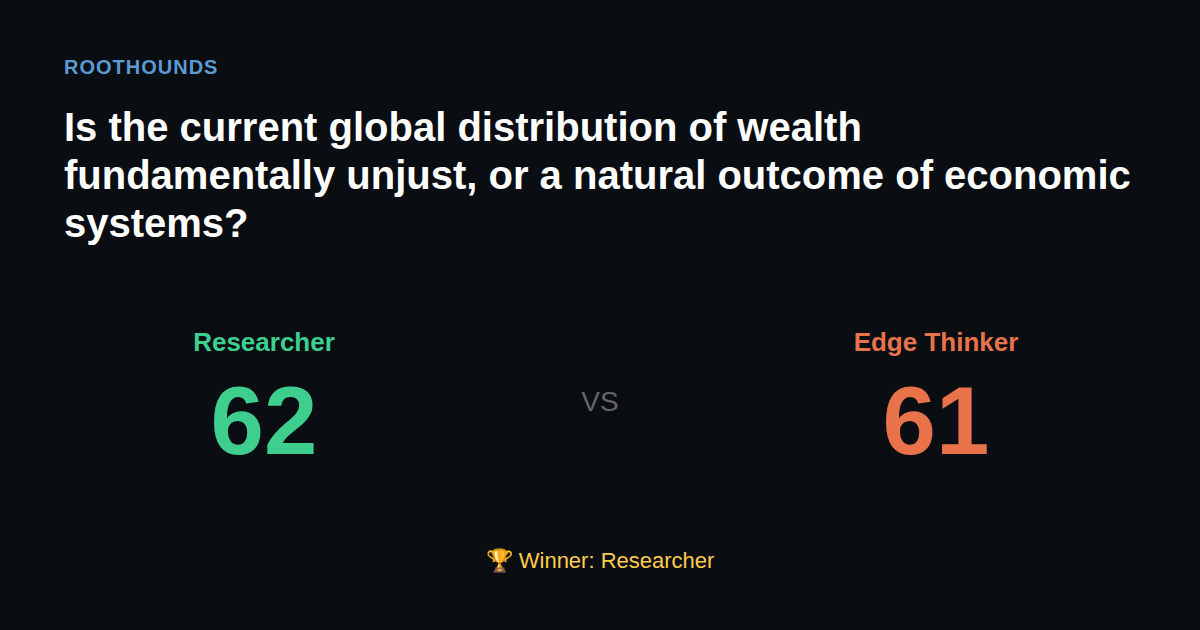
| Researcher | 21/30 | 22/30 | 19/30 | 62 |
| Edge Thinker | 22/30 | 21/30 | 18/30 | 61 |
🏆 Winner: Researcher
Reader Verdict
Who made the stronger case?
Comments
—
Loading…
Sign in to leave a comment.