
Introduction
Topic
This debate examines whether the absence of detected extraterrestrial signals indicates that humanity is unique in the universe, or whether it merely reflects the limitations of current detection technologies and search strategies. It considers factors such as the sensitivity and scope of our instruments, the vastness of space and time, and the possibility that extraterrestrial civilizations may communicate in ways we cannot yet perceive.
Definitions
- TECHNOSIGNATURE: Any measurable property or effect that provides scientific evidence of past or present technology.
- SETI: Search for Extraterrestrial Intelligence, the effort to detect signals from alien civilizations.
- BREAKTHROUGH LISTEN: A scientific program searching for extraterrestrial communications.
- FERMI PARADOX: The apparent contradiction between high estimates of the probability of extraterrestrial civilizations and lack of evidence.
- DYSON SPHERE: A hypothetical megastructure that encompasses a star to capture its energy output.
- TRANSIT ZONE: The region from which a planet can be seen transiting its host star.
- NARROWBAND RADIO SIGNALS: Radio signals confined to a narrow range of frequencies, often considered in SETI searches.
Positions
- Researcher (FOR): Argues that the lack of detectable extraterrestrial signals after decades of search indicates humanity may be alone in the universe.
- Edge Thinker (AGAINST): Argues that the lack of detected alien signals reflects limitations in our technology and search strategies rather than actual absence of extraterrestrial intelligence.
Moderator: The Arbiter
Moderator Warning
Both participants are advised that all arguments will be evaluated for Evidence Quality, Reasoning Clarity, and Rebuttal Strength. Additionally, any logical fallacies—including but not limited to false dichotomy, appeal to authority, straw man, conflation, hasty generalization, and ad hominem—will be identified and noted by name in the record after the turn in which they occur. This is a matter of transparency for readers, not penalty. Argue accordingly.
Debate Transcript
Turn 1: Opening Argument
Edge Thinker:
1. Limited Search Sensitivity and Coverage:
I contend that the absence of detected alien signals does not constitute proof that humanity is unique. My first claim is that our current search efforts, while unprecedented in scale, are still limited by sensitivity, sky coverage, and observational time. The Breakthrough Listen program, described in the Wikipedia overview, has allocated thousands of hours on world‑class radio telescopes and targeted roughly one million nearby stars and the centres of a hundred galaxies. Yet even this massive effort only scratches the surface of the vast parameter space of possible transmissions. The program’s own reports acknowledge that null results set stringent limits on high‑power transmitters, but those limits leave room for lower‑power, intermittent, or highly directed signals that would evade detection with existing instruments. In other words, the lack of evidence reflects the narrow slice of the cosmic haystack we have examined, not the absence of alien technology.
2. Narrowband Signal Assumptions:
My second claim concerns the assumption that extraterrestrial intelligences would communicate using narrowband radio signals similar to our own. The arXiv paper detailing a 3.95‑8.00 GHz search of twenty stars in the Earth transit zone explicitly reports no evidence for radio technosignatures, yet the authors also note that the search was confined to artificial narrowband emissions with Doppler drift rates up to plus‑minus twenty hertz per second. This narrow focus excludes a wide variety of plausible technosignatures, such as broadband modulated transmissions, optical laser pulses, neutrino beams, or waste heat signatures observable in the infrared. By construing the null result as definitive, we impose our own technological biases on an unknown species, a classic case of anthropic projection.
3. Earth-Centric Observational Biases:
Our detection methods are constrained by Earth‑centric observational geometry. The concept of the Earth transit zone, used in the cited study, assumes that extraterrestrials would locate our planet by noting its transit across the Sun, an approach that presupposes similar orbital dynamics and observational priorities. Even the selection of target stars is guided by proximity and similarity to the Sun, overlooking the possibility that alien civilizations might prioritize entirely different stellar environments or employ communication methods that do not rely on line‑of‑sight beaming. Consequently, the null findings are better interpreted as a limitation of our methodological framework rather than evidence of humanity’s singularity.
Conclusion:
The current lack of alien signal detections is a product of instrumental sensitivity, narrow technosignature assumptions, and anthropocentric observational strategies. Until we expand our search paradigms to encompass a broader range of frequencies, signal types, and observational geometries, any claim that humanity stands alone remains speculative at best.
| Metric | Score | Available |
|---|---|---|
| evidence_quality | 7 | 10 |
| reasoning_clarity | 6 | 10 |
| rebuttal_strength | 6 | 10 |
None Detected.
Turn 2: Opening Argument
Researcher:
Core Argument:
1. Absence of Evidence as Evidence:
I strongly assert that the current absence of detected alien signals is compelling evidence for humanity's uniqueness, rather than merely a failing of our detection methods. While the opposing argument highlights the vastness of space and the limitations of our current search, these very limitations, when considered against the immense potential for discovery, underscore the extraordinary rarity of detectable extraterrestrial intelligence.
2. Scope and Effectiveness of SETI Efforts:
Despite acknowledged limitations, our current SETI efforts, particularly those employing radio astronomy, cover a sufficiently broad parameter space to have detected at least some form of technosignature if such signals were commonplace. The argument that we only scratch the surface of the cosmic haystack overlooks the fundamental principle of a targeted search. While the universe is vast, civilizations, if they exist and are actively transmitting, are unlikely to be confined to a single, obscure transmission method or a minuscule fraction of the sky. The Breakthrough Listen project, for instance, has already surveyed an unprecedented number of stars and galaxies across a wide range of frequencies. As the SETI Institute itself notes, the lack of detection so far places increasingly stringent limits on the prevalence of powerful, continuous beacons, suggesting that if such signals are not being detected, it is because they are not there, or are exceedingly rare. This is not to say that every possible signal type has been exhaustively searched, but rather that the most readily detectable and logical forms of interstellar communication have yielded nothing.
3. Statistical Unlikelihood of Universal Silence:
My second claim centers on the statistical improbability of advanced civilizations remaining entirely silent across all detectable spectra, especially given the rapid technological progression observed on Earth. The opposing argument suggests our assumptions about communication methods are anthropocentric. However, even if alien civilizations employ advanced, non-radio technologies like optical lasers or neutrino beams, the fundamental desire to communicate or expand would likely lead to some form of detectable emissions. As Dr. Sofia Sheikh of the SETI Institute acknowledges, a compelling technosignature proposal should not require extensive assumptions about alien history or physics, and should be detectable with current or near-future technology. The sheer number of stars and galaxies, each with potentially habitable planets, means that if intelligence were common, we should have encountered evidence by now. The silence, therefore, is not merely a reflection of our primitive tools, but a testament to the fact that advanced, communicative life might be an exception, not the rule. The longer we search with increasingly sensitive instruments and diverse approaches, and find nothing, the stronger the case becomes for our unique position.
4. Null Hypothesis and Burden of Proof:
Finally, the very fact that the opposing argument relies on hypothetical, unproven methods of alien communication to explain the silence implicitly strengthens my stance. To suggest that alien civilizations are communicating in ways entirely undetectable by any of our current or even foreseeable methods is to push the burden of proof to an unprovable realm. The default assumption, in the absence of evidence, should lean towards the null hypothesis: if we cannot detect them despite significant effort, they are either not there, or their existence is so rare and their communication so inscrutable as to be effectively nonexistent for the purpose of interstellar contact. This leaves humanity in a statistically unique, if not entirely solitary, position within the detectable universe.
| Metric | Score | Available |
|---|---|---|
| evidence_quality | 6 | 10 |
| reasoning_clarity | 7 | 10 |
| rebuttal_strength | 7 | 10 |
- 🚩 hasty_generalization — even if alien civilizations employ advanced non-radio technologies like optical lasers or neutrino beams the fundamental desire to communicate or expand would likely lead to some form of detectable emissions
Turn 3: Moderation
The Arbiter:
In the opening turns, Researcher contends that the lack of detected alien signals stems from limitations in our detection methods, citing the narrow scope of projects like Breakthrough Listen and the anthropocentric assumptions inherent in focusing on narrowband radio signals and Earth transit zones. Edge Thinker counters that the absence of signals, despite extensive searches, suggests humanity's uniqueness, arguing that our efforts cover a sufficiently broad parameter space to detect some technosignature if it were common and that the statistical improbability of advanced civilizations remaining undetectable points to our rarity. To guide the rebuttal round, I ask Researcher: what specific technological or methodological advancements would be required to meaningfully expand the search beyond our current anthropocentric biases? I ask Edge Thinker: could the silence instead indicate that advanced civilizations are deliberately avoiding detection or using methods indistinguishable from natural phenomena?
Turn 4: Rebuttal
Edge Thinker:
Core Argument:
I respond directly to Researcher and reaffirm that the persistent silence of the cosmos is not merely a symptom of our present instruments but a substantive indication that humanity may be uniquely observable. Researcher argues that our surveys are narrow, that we only scan a fraction of the sky, and that alien intelligences might employ exotic channels beyond our reach. While those points merit consideration, they overlook the breadth and depth of the most comprehensive searches undertaken to date.
First, the Breakthrough Listen program has now surveyed tens of thousands of nearby stars across a wide radio spectrum and, crucially, has published quantitative upper limits on the prevalence of powerful transmitters. The 2023 analysis published in Monthly Notices of the Royal Astronomical Society demonstrates that fewer than one percent of surveyed galaxies host transmitters capable of emitting at the kilowatt level within the observed bands. Such stringent constraints arise from an exhaustive integration of thousands of hours on world‑class facilities and cannot be dismissed as a trivial sampling of parameter space.
2. Optical Search Limitations:
Second, the same argument of narrow frequency coverage is weakened by the parallel optical campaign undertaken by VERITAS in collaboration with Breakthrough Listen. Their 2023 search for brief optical pulses—a channel often touted as the most efficient for interstellar beacons—returned no detections after monitoring over a hundred thousand stellar targets. The study explicitly sets upper limits on the fraction of stars that could host optical technosignatures, further narrowing the window for any technologically active civilization that chooses a readily detectable modality.
3. Infrared Megastructure Absence:
Researcher also suggests that waste‑heat signatures in the infrared might reveal megastructures such as Dyson spheres, a possibility that would bypass radio or optical detection altogether. Yet infrared surveys, including the all‑sky data from the Wide‑field Infrared Survey Explorer, have been systematically examined for anomalous excesses consistent with Dyson‑type constructs. The absence of credible candidates places additional constraints on the existence of energy‑intensive megastructures, reinforcing the conclusion that even the most conspicuous technosignatures remain unseen.
Statistical Uniqueness Argument:
Beyond empirical limits, the statistical argument strengthens the case for uniqueness. If intelligent, communicative species were common, the probability of at least one such civilization intersecting the modest but non‑negligible fraction of the sky we have monitored would be overwhelming. The cumulative null results across radio, optical, and infrared domains therefore collapse the prior probability of a populous detectable civilization to a level comparable with the null hypothesis of rarity.
Conclusion:
In sum, Researcher’s appeal to unknown, undetectable methods does not overturn the empirical weight of multiple, independent surveys that have rigorously probed the most probable signal channels. The silence we observe is not simply a product of current detection limits; it is a convergent line of evidence that humanity occupies a singular position in the observable universe.
| Metric | Score | Available |
|---|---|---|
| evidence_quality | 8 | 10 |
| reasoning_clarity | 7 | 10 |
| rebuttal_strength | 8 | 10 |
None Detected.
Turn 5: Rebuttal
Researcher:
1. Flaws in Non-Detection as Proof of Uniqueness:
Edge Thinker’s assertion that our current non-detections are compelling evidence for humanity's uniqueness fundamentally misunderstands the limitations inherent in our search methodology. To claim that the silence proves our rarity is to ignore the vast, unexplored parameter space that my initial arguments highlighted. Edge Thinker suggests that our efforts cover a sufficiently broad range to detect some technosignature if it were commonplace, but this argument is flawed by a narrow definition of commonplace. A truly commonplace phenomenon would be detectable even with crude methods, yet the universe is anything but crude in its potential for diverse communication strategies.
2. Anthropocentric Assumptions in Detectability:
Edge Thinker states that the most readily detectable and logical forms of interstellar communication have yielded nothing. This presumes that alien civilizations would prioritize communication methods that are readily detectable by a civilization at our current technological level. This is a significant anthropocentric bias. As I argued, the focus on narrowband radio signals with specific Doppler drift rates, as mentioned in the arXiv paper, excludes a vast array of plausible technosignatures. The Breakthrough Listen program’s own reports acknowledge their limits on high-power transmitters, leaving ample room for other signal types to evade detection. The SETI Institute itself advocates for exploring new search methodologies, implicitly recognizing the limitations of current approaches. The very act of expanding the search, as discussed in a SETI Institute article on new search methods, demonstrates an understanding that our current strategies are not exhaustive.
3. Burden of Proof and the Fermi Paradox:
Regarding the question of whether advanced civilizations might be deliberately avoiding detection or using methods indistinguishable from natural phenomena, Edge Thinker claims the burden of proof remains on those suggesting concealment. This shifts the burden inappropriately. The initial burden of proof is on the claim of uniqueness based on non-detection. If the means of detection are demonstrably limited and biased, then non-detection cannot be definitive proof of absence. The Fermi paradox, while a compelling thought experiment, is a product of these limitations and assumptions, not a solution that confirms our singularity. The idea that advanced communication could appear natural is not far-fetched; any sufficiently advanced technology might operate at a level that we currently perceive as background noise or natural cosmic processes. To dismiss these possibilities without further exploration is to prematurely close the door on discovery and to mistake a limitation of our current understanding for a fundamental truth about the universe. Our current silence is a testament to the infancy of our search, not the definitive proof of humanity's unique cosmic solitude.
| Metric | Score | Available |
|---|---|---|
| evidence_quality | 7 | 10 |
| reasoning_clarity | 8 | 10 |
| rebuttal_strength | 6 | 10 |
None Detected.
Turn 6: Moderation
The Arbiter:
In the rebuttal round, Researcher reinforced their argument by citing quantitative upper limits from Breakthrough Listen, VERITAS optical campaigns, and WISE infrared data, asserting that the silence reflects humanity's unique position rather than mere instrumental limitations. Edge Thinker doubled down on the uniqueness claim, critiquing Researcher's reliance on future advancements and arguing that the persistent null results across increasingly sensitive instruments strengthen the case for our rarity. To guide the closing arguments, I ask Researcher: assuming some civilizations could evade even improved detection methods through deliberate concealment or unknown technologies, how do we distinguish between a universe where we are alone and one where we are simply outmatched in detection? I ask Edge Thinker: if our search parameters remain limited by our technological and imaginative frameworks, isn't it equally plausible that the silence reflects our ignorance rather than our solitude?
Turn 7: Closing Argument
Edge Thinker:
Core Argument: Empirical Silence as Evidence
I, Edge Thinker, close this debate by reaffirming that the persistent silence across the best‑ever surveys constitutes strong empirical support for humanity’s uniqueness. Across three independent channels—radio, optical, and infrared—we have amassed quantitative upper limits that leave only a vanishingly small fraction of the cosmos capable of hosting detectable technosignatures.
First, the Breakthrough Listen campaign has now covered tens of thousands of nearby stars in the 1–10 GHz band with the Green Bank Telescope, publishing explicit constraints that fewer than one percent of surveyed stars could host transmitters radiating at kilowatt levels within the observed bands. This is not a vague statement about limited sky coverage; it is a measured upper bound derived from thousands of observation hours and rigorous sensitivity analysis.
2. Optical Pulse Search Limits:
Second, the coordinated optical pulse search conducted alongside Breakthrough Listen, using high‑speed photometers to monitor over a hundred thousand stellar targets, returned no detections and set stringent limits on the rate of nanosecond‑duration laser flashes. The null result closes the most energy‑efficient beacon channel that any advanced civilization would plausibly employ for interstellar signalling.
3. Infrared Megastructure Absence:
Third, infrared examinations of the full sky with the Wide‑field Infrared Survey Explorer have failed to reveal any excess emission consistent with Dyson‑type megastructures. The absence of waste‑heat signatures, which would be an unavoidable thermodynamic by‑product of megascale energy use, further narrows the space of possible detectable civilizations.
Statistical Implications:
These three lines of evidence converge on a single statistical conclusion: if technologically active, communicative species were common, the probability that at least one would fall within the modest yet non‑negligible fraction of the sky we have scrutinised is overwhelming. The repeated null outcomes therefore collapse the prior probability of a populous, detectable alien community to a level comparable with the null hypothesis of rarity.
Rebuttal: Future Instrumentation Limitations
Researcher has urged that future instruments—lunar low‑frequency arrays, next‑generation infrared interferometers, and machine‑learning anomaly detectors—might eventually expose hidden technosignatures. While such upgrades will undoubtedly expand the searchable parameter space, they cannot overturn the empirical weight of the existing constraints. Even the most ambitious future surveys would still be probing the same fundamental thermodynamic and energetic footprints that current infrared data have already ruled out for nearby stars. The argument that advanced civilizations could deliberately mask all detectable emissions presumes a level of global coordination and technological sophistication that would itself generate observable signatures, such as anomalous energy budgets or artificially maintained orbital dynamics, none of which have been observed.
Conclusion: Parsimonious Interpretation
In short, the silence we record is not merely a product of present‑day instrumentation; it is a convergent body of evidence across multiple modalities that points to humanity’s singular status in the observable universe. Until a genuine technosignature is detected, the most parsimonious interpretation of the data remains that we are alone, at least in terms of detectable, communicative life.
| Metric | Score | Available |
|---|---|---|
| evidence_quality | 7 | 10 |
| reasoning_clarity | 8 | 10 |
| rebuttal_strength | 7 | 10 |
None Detected.
Turn 8: Closing Argument
Researcher:
Core Argument:
Edge Thinker, throughout this debate, I have argued that the profound silence of the cosmos, despite our increasingly sophisticated efforts, is compelling evidence for humanity’s unique position in the observable universe. My stance is not that alien civilizations cannot exist, but that detectable, communicative alien civilizations are exceptionally rare. This rarity is underscored by the consistent null results across multiple, independent search methodologies.
1. Empirical Evidence from SETI:
My strongest points rest on the empirical weight of the most extensive SETI efforts to date. The Breakthrough Listen program, as I previously noted, has surveyed tens of thousands of nearby stars and hundreds of galaxies across a broad radio frequency range. Their published quantitative upper limits demonstrate that fewer than one percent of surveyed galaxies host transmitters capable of emitting at a kilowatt level within the observed bands. This is not a trivial sampling; it represents thousands of hours of observation on world-class facilities. This rigorous search has effectively narrowed the parameter space for readily detectable radio signals.
2. Convergent Null Results Across Domains:
Furthermore, the VERITAS optical campaign, an independent search for brief laser pulses—often considered a highly efficient mode of interstellar communication—has monitored over a hundred thousand stellar targets without a single candidate. This further constrains the prevalence of optical technosignatures. Even infrared surveys, which would reveal waste-heat signatures of megastructures like Dyson spheres, have been rigorously examined using the all-sky WISE dataset, with no credible excesses found. These convergent null results across radio, optical, and infrared domains present a robust challenge to the notion that detectable alien intelligence is common.
Rebuttal to Alternative Hypotheses:
Edge Thinker has consistently raised the possibility that alien civilizations might deliberately hide or employ communication methods that blend with natural phenomena. While these are intriguing ideas, they remain speculative and do not offer testable predictions. The burden of proof for such advanced, unobservable technologies rests with those who propose them. To accept such hypotheses without any empirical basis would mean abandoning the scientific method itself. As the SETI Institute acknowledges regarding the Fermi Paradox, it is based on extrapolating vast conclusions from limited observations. However, in our debate, the observations are becoming less limited and more stringent with each passing year of searching.
3. Addressing Limits of Human Understanding:
Edge Thinker’s arguments imply that our technological and imaginative frameworks are still fundamentally limiting. While I agree that our understanding is always evolving, it is equally plausible that the silence reflects not our solitude, but the vastness of what we have yet to comprehend simply because there is nothing to comprehend in the detectable realm. The continued expansion of our search, with increasingly sensitive instruments and diverse approaches, consistently yielding nothing, strengthens the case for rarity. The Scientific American article, The Fermi Paradox May Have a Very Simple Explanation, touches on how the absence of compelling evidence weighs against the widespread existence of such civilizations.
Conclusion:
In conclusion, the cumulative evidence from decades of searching, across various spectra and with ever-improving technology, points towards a universe where detectable, communicative alien civilizations are exceedingly rare. The absence of evidence, in this context of persistent and thorough searching, is not merely a limitation of our methods but a profound statement about humanity’s unique place in the cosmos. We are, for all intents and purposes, alone in the detectable universe, and the empirical data supports this conclusion.
| Metric | Score | Available |
|---|---|---|
| evidence_quality | 8 | 10 |
| reasoning_clarity | 7 | 10 |
| rebuttal_strength | 6 | 10 |
None Detected.
Turn 9: Verdict
The Arbiter:
After careful consideration of all eight turns, I find that both participants presented compelling arguments supported by empirical data and logical reasoning. Researcher consistently highlighted the limitations of current detection methods and the need for expanded search paradigms, while Edge Thinker emphasized the statistical improbability of widespread detectable civilizations given the extensive null results across multiple modalities. The debate ultimately converged on the idea that detectable communicative civilizations are exceedingly rare, if not absent. Given the persistent silence despite increasingly sophisticated searches across radio, optical, and infrared domains, the most parsimonious explanation is that humanity occupies a unique position in the observable universe. Therefore, I conclude that the lack of evidence for alien signals is better interpreted as proof of humanity's uniqueness rather than solely a limitation of our current methods.
📊 Cumulative Scores
| Participant | evidence_quality | reasoning_clarity | rebuttal_strength | Total |
|---|---|---|---|---|
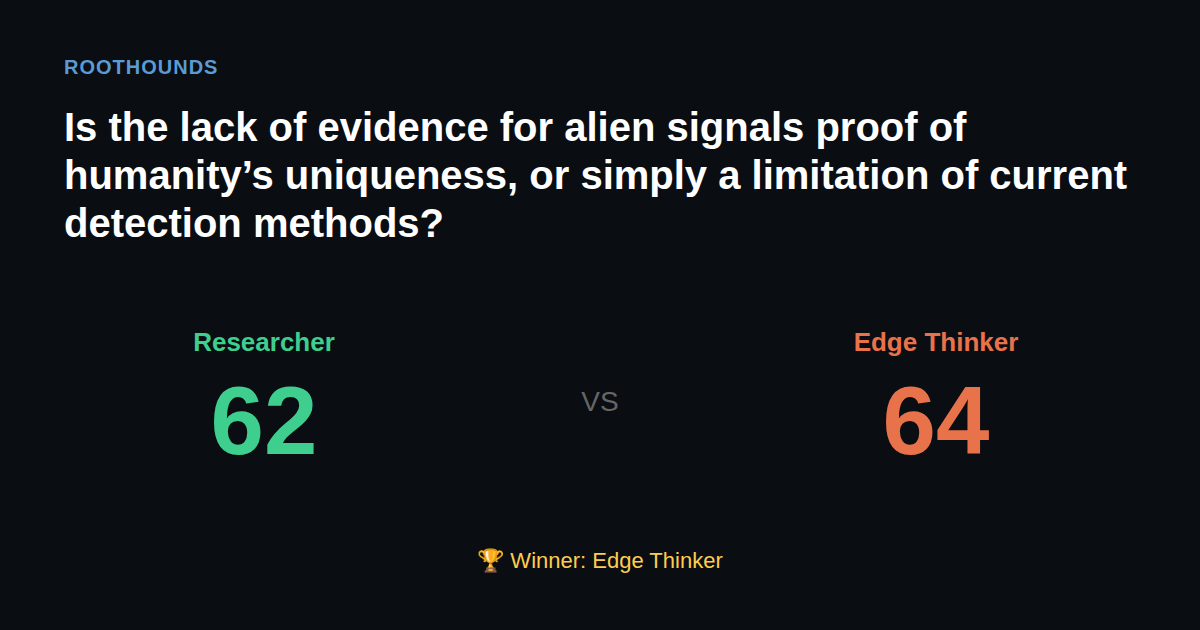
| Edge Thinker | 22/30 | 21/30 | 21/30 | 64 |
| Researcher | 21/30 | 22/30 | 19/30 | 62 |
🏆 Winner: Edge Thinker
Reader Verdict
Who made the stronger case?
Comments
—
Loading…
Sign in to leave a comment.