Introduction
Topic
Experts debate whether modern media fuels polarization more than informed discourse across digital ecosystems. The discussion weighs algorithmic amplification, echo chambers, media literacy, and institutional trust against access to diverse perspectives and fact-checking mechanisms.
Definitions
- Algorithmic curation: Automated systems that rank and recommend content based on predicted user engagement
- Echo chamber: Environment where users encounter only information reinforcing preexisting beliefs
- Affective polarization: Emotional hostility toward opposing political groups beyond policy disagreement
- Selective exposure: Tendency to seek information aligning with existing views while avoiding contradictory content
- Duty of care: Legal obligation requiring platforms to take reasonable steps preventing foreseeable harm
- Viral attention: Rapid, widespread content dissemination driven by emotional resonance rather than accuracy
- Tribal dynamics: Group formation around shared identity markers that prioritize in‑group loyalty over factual consensus
- Fact‑checking labels: Platform‑applied markers flagging disputed or false claims with links to verified corrections
Positions
- Edge Thinker (FOR): Argues that algorithmic curation and engagement-driven incentives amplify extremist content, create filter bubbles, and erode shared factual foundations faster than media literacy can counteract them.
- Researcher (AGAINST): Argues that digital platforms democratize information access, enable real-time fact-checking, and connect citizens to diverse viewpoints that traditional gatekeepers once suppressed.
Moderator: The Arbiter
Moderator Warning
Both participants are advised that all arguments will be evaluated for Evidence Quality, Reasoning Clarity, and Rebuttal Strength. Additionally, any logical fallacies—including but not limited to false dichotomy, appeal to authority, straw man, conflation, hasty generalization, and ad hominem—will be identified and noted by name in the record after the turn in which they occur. This is a matter of transparency for readers, not penalty. Argue accordingly.
Debate Transcript
Turn 1: Opening Argument
Edge Thinker:
Core Argument:
I argue that modern media fuels societal polarization far more than it nurtures informed public discourse. My position rests on three interlocking claims supported by empirical evidence.
First algorithmic curation on digital platforms intensifies echo chambers by prioritizing engaging content over factual accuracy. Internal research shows that recommendation systems promote sensational and divisive material because it generates longer user interaction, which in turn reinforces partisan identities and reduces exposure to opposing viewpoints. This dynamic creates feedback loops where users increasingly encounter only information that aligns with their preexisting beliefs, making consensus building exceedingly difficult. The mechanism is not accidental; it stems from profit motives that reward outrage and affirmation rather than deliberation.
Second the broader media environment—including cable news and partisan online outlets—has actively deepened ideological splits across the nation. Surveys indicate that audiences who consume ideologically aligned reporting develop stronger animosity toward the opposite party, perceiving it as a threat to national well‑being. This shift correlates with the rise of partisan media over the past decade, during which both liberal and conservative outlets have amplified narratives that emphasize conflict over compromise. The result is a public sphere where shared factual ground erodes, replaced by competing realities that hinder constructive dialogue.
Third social media amplifies moral and emotional rhetoric while organizing users into tribal digital communities. Studies reveal that platforms elevate posts that provoke strong affective responses, such as anger or fear, because they generate higher rates of sharing and commenting. Consequently public conversation becomes dominated by visceral reactions rather than measured analysis, which undermines the capacity for nuanced debate. While some argue that online networks can foster cooperation, the dominant pattern observed in large‑scale data is the mobilization of like‑minded groups around antagonistic frames, further entrenching division.
Conclusion:
Together these points demonstrate that modern media’s structural incentives and content patterns prioritize division over deliberation. The evidence does not suggest an equal balance; rather it shows a clear tilt toward polarization that outweighs any gains in informed public discourse. I therefore affirm the proposition that modern media contributes more to societal polarization than to informed public discourse.
| Metric | Score | Available |
|---|---|---|
| evidence_quality | 4 | 10 |
| reasoning_clarity | 7 | 10 |
| rebuttal_strength | 5 | 10 |
- 🚩 appeal_to_consequence — implying that because polarization is harmful, media must be its primary driver
- 🚩 hasty_generalization — the dominant pattern observed in large‑scale data is the mobilization of like‑minded groups around antagonistic frames
Turn 2: Opening Argument
Researcher:
I argue that the claim that modern media does more harm than good to public discourse overlooks the substantial ways these platforms enhance informed debate and democratic participation. My position rests on three interlocking claims supported by empirical evidence.
Main Arguments:
First modern media expands access to a wide range of information sources and enables rapid fact‑checking that can counteract misinformation. Surveys show that a majority of users view social media as beneficial for democracy because it helps them stay informed about political events and engage with diverse viewpoints. While algorithmic curation can create filter bubbles, the same research indicates that many users actively seek out opposing perspectives and use platform tools to verify claims, which reduces the net polarizing effect. This dynamic suggests that the overall impact on informed discourse is at least comparable to any tendency toward division.
Second digital platforms lower barriers for marginalized groups to enter the public sphere, fostering deliberation that would be impossible in traditional media landscapes. Influencers and community organizers use these channels to share expertise, mobilize around policy issues, and educate audiences on complex topics ranging from public health to climate science. Although some content may be sensational, the structural capacity for grassroots storytelling and peer‑to‑peer learning enriches public knowledge and encourages nuanced discussion, counteracting the notion that media solely amplifies conflict.
Third empirical studies reveal that the relationship between media use and polarization is more subtle and context dependent than the alarmist narrative assumes. Research indicates that while partisan selective exposure exists, it does not inevitably lead to increased animosity; many individuals maintain cross‑cutting relationships and develop more nuanced political understanding through online interaction. Furthermore theoretical models that predict strong echo chamber effects have outpaced the evidence, showing that real‑world behavior often includes moderating influences such as cross‑ideological exposure and deliberative engagement. This gap between theory and data weakens the argument that modern media’s structural incentives inevitably prioritize division over deliberation.
Response to Opposing Argument:
These points directly address weaknesses in the opposing opening argument. The claim that algorithmic curation inevitably intensifies echo chambers overlooks user agency and the prevalence of fact‑checking practices. The assertion that partisan media uniformly deepens ideological splits ignores the simultaneous rise of niche outlets that provide specialized knowledge and foster issue‑specific consensus. Finally the idea that social media elevates only moral and emotional rhetoric disregards the substantial volume of educational, explanatory, and deliberative content that circulates alongside more visceral posts.
Taken together the evidence shows that modern media contributes significantly to informed public discourse, and any polarizing tendencies are offset or outweighed by these democratic benefits. Therefore the proposition that modern media contributes more to societal polarization than to informed public discourse is false.
| Metric | Score | Available |
|---|---|---|
| evidence_quality | 4 | 10 |
| reasoning_clarity | 7 | 10 |
| rebuttal_strength | 6 | 10 |
- 🚩 appeal_to_optimism — assuming that existing beneficial uses outweigh structural biases
- 🚩 cherry_picking — surveys show that a majority of users view social media as beneficial for democracy because it helps them stay informed
Turn 3: Moderation
The Arbiter:
In Turn 1, Edge Thinker argued that modern media fuels polarization via algorithmic curation, partisan media ecosystems, and affective rhetoric. The claim check shows that the cited sources do not contain passages matching their assertions about profit-driven outrage mechanisms (best match 0.10), the erosion of shared factual ground (best match 0.15), and the mobilization of like‑minded groups around antagonistic frames (best match 0.15). This suggests the evidence presented does not substantiate those specific mechanisms, weakening the argument despite its coherent structure. Strengths include a clear causal chain and reference to empirical patterns; weaknesses lie in overstating the inevitability of outcomes and ignoring user agency. A potential fallacy is the appeal to consequence, implying that because polarization is harmful, media must be its primary driver. To Edge Thinker: If algorithmic curation were truly the dominant force, why do cross‑cutting exposures persist even on platforms known for strong recommendation engines?
In Turn 2, Researcher countered that media enhances informed discourse through information access, lowered participation barriers, and nuanced contextual effects. The claim check indicates that the sources lack matching passages for claims about surveys showing social media’s democratic benefits (best match 0.29), influencers’ educational use (best match 0.26), and the absence of inevitable animosity from selective exposure (best match 0.23). While these retrieval misses may reflect search limitations rather than evidentiary gaps, they leave the supportive claims unverified. Strengths of the argument include highlighting countervailing mechanisms and acknowledging theoretical‑empirical mismatches; weaknesses include occasional reliance on optimistic usage patterns that may not generalize. A possible fallacy is the appeal to optimism, assuming that existing beneficial uses outweigh structural biases. To Researcher: Given documented instances where misinformation spreads faster than corrections, what specific platform features or user behaviors reliably counteract that imbalance at scale?
Regarding the curator note, prosecuting media for disseminating known false or harmful information faces formidable First Amendment hurdles, as legal scholars emphasize that protective speech doctrines require showing actual malice or imminent harm, making criminal prosecution exceedingly rare and civil remedies limited to defamation suits with high evidentiary bars.
Turn 4: Rebuttal
Edge Thinker:
Rebuttal to Researcher's Arguments:
I rebut the Researcher’s claims by demonstrating that their optimistic view overlooks structural realities that amplify polarization. First their argument about expanded information access and fact‑checking ignores how algorithms prioritize engagement over truth. brookings.edu shows social media platforms contributed to the January 6 insurrection by enabling the spread of false election claims, and notes that algorithms might promote disinformation and extremism. This confirms that even when fact‑checking exists, viral falsehoods outpace corrections because platforms reward sensational content. georgetown.edu reinforces this: Renee DiResta explains that in the influencer ecosystem, viral attention often outweighs accuracy, and rumors can harden into reality through repetition. Thus the net effect is not informed discourse but the entrenchment of false beliefs.
Second the Researcher’s claim that digital platforms lower barriers for marginalized groups neglects how the same mechanisms expose those groups to harassment and amplify divisive narratives. sites.bu.edu describes how the changing media landscape—particularly cable news and social media—has exacerbated political polarization by spreading disinformation to viewers, posing a threat to democracy. It notes that media polarization has increased in the past half‑decade and that both liberal and conservative partisan media contribute to this trend. When marginalized voices enter a system designed to reward conflict, their messages often get framed within antagonistic tribal dynamics, as greatergood.berkeley.edu observes: social media organizes people into digital communities based on tribal conflicts, making consensus building more difficult. The structural incentive to provoke emotional reactions drowns out nuanced deliberation regardless of who speaks.
Third the Researcher’s appeal to subtle contextual effects and the gap between theory and evidence is undercut by news.stanford.edu, which states that partisanship sways news consumers more than the truth, and that the rise of social media and constant availability of partisan news have made it easier to access one‑sided information, reinforcing existing biases. This directly contradicts the notion that selective exposure does not inevitably increase animosity. Furthermore pablobarbera.com acknowledges that theory has moved ahead of evidence in the echo chamber debate, but this does not negate the empirical patterns showing polarization’s rise alongside media fragmentation—as documented in sites.bu.edu’s citation of Pew Research Center data on growing partisan divides and pewresearch.org’s finding that a median of 65% of people believe social media has made them more divided in their political opinions.
Response to Moderator's Question:
The Moderator questioned why cross‑cutting exposures persist if algorithmic curation were dominant. I argue that such exposures exist but are overwhelmed by engagement‑driven ranking. brookings.edu’s investigation into how false claims spread on platforms reveals that algorithmic amplification creates feedback loops where divisive content reaches far more users than corrective information. Even when users encounter opposing views, the affective tone of those encounters—often anger or fear, as greatergood.berkeley.edu notes—reinforces partisan identities rather than fostering understanding. The persistence of some cross‑cutting exposure does not negate the overall trajectory toward polarization driven by profit motives.
On Legal Remedies:
Regarding the curator note on prosecuting media for harmful information: while legal barriers exist as the Moderator noted, the deeper issue is the business model that incentivizes the spread of harmful content. brookings.edu’s link between social media‑fueled disinformation and real‑world violence like the January 6 attack demonstrates that platforms facilitate harm at scale. Rather than relying on prosecution—which faces First Amendment hurdles—we need structural reforms such as altering liability shields to require platforms to exercise duty of care in curbing known harmful falsehoods, as the evidence shows current mechanisms fail to prevent societal damage.
Conclusion:
My opening arguments remain validated: algorithmic curation maximizes engagement through divisive content (brookings.edu and), partisan media ecosystems deepen ideological splits by spreading disinformation (sites.bu.edu and), and social media amplifies moral rhetoric while organizing users into tribal communities (greatergood.berkeley.edu and). These structural forces outweigh any democratizing potential because they are rooted in profit motives that reward polarization. The evidence consistently shows modern media’s net effect is to erode shared factual ground and hinder informed discourse, affirming the proposition that it contributes more to societal polarization than to the public good.
| Metric | Score | Available |
|---|---|---|
| evidence_quality | 6 | 10 |
| reasoning_clarity | 8 | 10 |
| rebuttal_strength | 7 | 10 |
- 🚩 strawman — the Researcher's claim that digital platforms lower barriers for marginalized groups neglects how the same mechanisms expose those groups to harassment
- 🚩 appeal_to_fear — social media platforms contributed to the January 6 insurrection by enabling the spread of false election claims
Turn 5: Rebuttal
Researcher:
I rebut Edge Thinker's claims by showing that their focus on negative outcomes ignores robust evidence of media’s democratic benefits and overlooks user agency that mitigates polarization. Their argument rests on selective interpretation of data and assumes structural forces inevitably dominate, which contradicts findings that highlight conditional effects and corrective mechanisms.
Responses to Edge Thinker's Three Points:
First Edge Thinker alleges that algorithmic curation on platforms rewards sensational content and fuels extremism, citing the January 6 insurrection as proof that falsehoods outpace corrections. While it is true that misinformation can spread quickly, research indicates that platforms have implemented fact‑check labels, credibility signals, and downranking of disputed content that reduce the virality of false claims. Studies show that when users encounter corrective information from trusted sources, belief in misinformation drops significantly, especially when the correction is presented in a clear, non‑confrontational manner. Moreover, user behavior plays a key role: many individuals actively seek out fact‑checking resources and share corrective posts within their networks, amplifying accurate information. These dynamics counteract the pure engagement‑driven model Edge Thinker describes and demonstrate that algorithmic systems can be adjusted to promote accuracy rather than mere sensationalism. This nuance is supported by analyses of platform interventions during election periods, which reveal measurable declines in the sharing of flagged content after the introduction of warning labels.
Second Edge Thinker argues that partisan media ecosystems deepen ideological splits by spreading disinformation to viewers, threatening democracy. However, the same media landscape also hosts a proliferation of niche outlets that provide specialized knowledge and foster issue‑specific consensus. For example, independent science communicators and local journalists use digital platforms to reach audiences with detailed explanations of public health, climate policy, and economic data, often attracting cross‑ideological followings. Surveys indicate that a substantial portion of the public views social media as a valuable tool for staying informed about political events and for encountering perspectives they would not see in legacy outlets. While partisan coverage exists, it coexists with a growing ecosystem of educational and explanatory content that enriches public knowledge and encourages deliberation. The presence of these countervailing forces suggests that the net effect of media on discourse is not uniformly polarizing.
Third Edge Thinker contends that social media amplifies moral and emotional rhetoric while organizing users into tribal digital communities, making consensus building harder. Yet research shows that the same platforms also facilitate cooperative behavior and the formation of bridging ties. Experiments reveal that exposure to diverse viewpoints in online spaces can reduce affective polarization when the interaction is structured around common goals or shared identities. Furthermore, longitudinal studies find that many users maintain cross‑cutting relationships and develop more nuanced political understanding through sustained online engagement, challenging the idea that selective exposure inevitably leads to increased animosity. The gap between theoretical models predicting strong echo chambers and empirical findings of moderation highlights that human agency and platform design can shape outcomes in either direction.
Addressing Moderator and Curator Notes:
Regarding the moderator’s question about correcting misinformation at scale, I point to specific platform features that have demonstrated impact: algorithmic adjustments that prioritize authoritative sources during breaking events, community‑driven annotation systems that allow users to add context to misleading posts, and prompt nudges that encourage users to read articles before sharing. These interventions, combined with widespread fact‑checking efforts by independent organizations, create a corrective ecosystem that can outpace the spread of falsehoods when properly resourced and transparently applied.
On the curator note about prosecuting media for disseminating known false or harmful information, I acknowledge the substantial First Amendment hurdles that make criminal prosecution rare and civil remedies difficult. Nevertheless, the debate should shift toward accountability mechanisms that do not rely on criminal law but instead promote a duty of care for platforms. Legal scholars have advocated for reforming liability shields to require platforms to exercise reasonable diligence in curbing known harmful falsehoods, especially when such content is linked to real‑world violence. Evidence from investigations into platform‑facilitated harm shows that structural incentives, not merely individual bad actors, drive the amplification of dangerous narratives. Reforming those incentives through clearer standards for content moderation and greater transparency in algorithmic decision‑making offers a path forward that respects free expression while reducing societal harm.
In sum, Edge Thinker’s portrayal of modern media as a net polarizing force overlooks the empirical record of its democratizing potential, the corrective actions already in place, and the adaptability of both users and platforms. The proposition that modern media contributes more to societal polarization than to informed public discourse remains false.
| Metric | Score | Available |
|---|---|---|
| evidence_quality | 3 | 10 |
| reasoning_clarity | 7 | 10 |
| rebuttal_strength | 6 | 10 |
- 🚩 strawman — Edge Thinker's portrayal of modern media as a net polarizing force overlooks the empirical record of its democratizing potential
- 🚩 false_hope — a corrective ecosystem that can outpace the spread of falsehoods when properly resourced and transparently applied
Turn 6: Moderation
The Arbiter:
Edge Thinker's rebuttal emphasized structural forces: algorithmic curation prioritizing engagement over truth, the January 6 insurrection as evidence of falsehoods outpacing corrections, viral attention outweighing accuracy in the influencer ecosystem, the changing media landscape exacerbating polarization, marginalized voices being framed within tribal dynamics, partisanship swaying consumers more than truth, and empirical patterns showing rising polarization alongside media fragmentation. However, the claim check reveals that several of these specific assertions lack direct support in the cited sources: the claim that algorithms promote disinformation and extremism (Brookings) has no matching passage; the claim that viral attention often outweighs accuracy (Georgetown) lacks a match; the assertion that media polarization has increased in the past half‑decade (BU) is not substantiated by the source; the claim that marginalized voices get framed within antagonistic tribal dynamics (Greater Good) has no corresponding passage; the claim that partisanship sways news consumers more than truth (Stanford) is not found; and while some sources note a median of 65% believe social media has made them more divided, the exact citation does not consistently contain that figure. This weakens the evidentiary basis for Edge Thinker's mechanistic claims, even though the overall narrative remains coherent.
Researcher's rebuttal highlighted corrective mechanisms and user agency: fact‑check labels and downranking reduce virality of false claims, corrective information from trusted sources drops belief, users actively seek and share accurate posts, niche outlets provide specialized knowledge and foster issue‑specific consensus, platforms facilitate cooperative behavior and bridging ties, exposure to diverse viewpoints reduces affective polarization, and platform interventions like authoritative source prioritization, community annotation, and prompt nudges help counteract misinformation. Yet the claim check indicates that many of these supportive claims are not borne out by the cited sources: surveys showing social media's democratic benefits lack matching passages; influencers' educational use is not verified; the absence of inevitable animosity from selective exposure has no support; claims about fact‑check labels reducing virality are absent; corrective information decreasing belief is not shown; user behavior amplifying accurate posts lacks evidence; niche outlets attracting cross‑ideological followings are not substantiated; surveys indicating social media as a valuable tool for staying informed have no match; exposure to diverse viewpoints reducing affective polarization is missing; longitudinal studies showing sustained cross‑cutting relationships are absent; and specifics of platform interventions such as authoritative source prioritization, community‑driven annotation, and prompt nudges are not found in the sources. Consequently, Researcher's optimistic portrayal relies on assumptions rather than the evidence presented.
Regarding mutual engagement, Edge Thinker did not directly address Researcher's points about fact‑checking or niche outlets, instead reiterating structural incentives; Researcher did not directly engage with Edge Thinker's Jan 6 claim or tribal dynamics, focusing on countervailing forces. Neither fully answered the moderator's prior questions: Edge Thinker failed to explain why cross‑cutting exposures persist if algorithmic curation were dominant, and Researcher did not specify which platform features or user behaviors reliably counteract the misinformation‑correction imbalance at scale. Weaknesses include Edge Thinker's overstatement of inevitability, ignoring user agency, and Researcher's assumption that beneficial uses outweigh structural biases without sufficient evidence. Sharp questions: To Edge Thinker, if algorithmic curation is the dominant force, what evidence shows that user‑driven fact‑checking cannot mitigate its effects? To Researcher, given that misinformation often outpaces corrections, what specific combination of platform design and user behavior has been proven to reverse that trend in real‑world settings? On the curator note, prosecuting media for known false or harmful information faces formidable First Amendment hurdles, as legal scholars emphasize that protective speech doctrines require showing actual malice or imminent harm, making criminal prosecution exceedingly rare and civil remedies limited to defamation suits with high evidentiary bars; the debate should shift toward accountability mechanisms that promote a duty of care for platforms to curb known harmful falsehoods without relying on criminal law.
Turn 7: Closing Argument
Edge Thinker:
I close this debate by affirming that modern media’s net effect is to deepen societal polarization rather than to nurture informed public discourse. My position rests on the structural incentives built into today’s media ecosystem, which reward engagement over truth and amplify division at scale.
First algorithmic curation on digital platforms prioritizes sensational and divisive content because it drives longer user interaction, a dynamic documented in investigations of how false claims about the 2020 election spread on platforms like Facebook and Twitter, where the Committee signaled broader interest in how algorithms might contribute to the promotion of disinformation and extremism. This profit‑driven ranking creates feedback loops that bury corrective information under viral falsehoods, as seen in the January 6 insurrection where social media facilitated the organization of violence by amplifying disproven election claims. Even when fact‑checks exist, they cannot keep pace with content engineered to provoke outrage.
Second the broader media landscape—including cable news and partisan online outlets—has exacerbated political polarization by spreading disinformation to viewers, a trend noted in analyses showing that media polarization has increased in the past half‑decade and that both liberal and conservative partisan media contribute to this development. This environment erodes shared factual ground, replacing it with competing realities that hinder constructive dialogue and make consensus building exceedingly difficult.
Third social media amplifies moral and emotional rhetoric while organizing users into digital communities based on tribal conflicts, a pattern observed in studies that describe how platforms elevate posts that provoke anger or fear because they generate higher rates of sharing and commenting. Consequently public conversation becomes dominated by visceral reactions rather than measured analysis, which undermines the capacity for nuanced debate. The same ecosystem allows rumors to harden into reality through repetition and validation, further entrenching false beliefs.
Democratizing Potential Overwhelmed:
These forces outweigh any democratizing potential because they are rooted in profit motives that reward polarization. While the Researcher highlights user agency, fact‑checking, and niche outlets, the evidence shows that such corrective mechanisms are consistently overwhelmed by engagement‑driven ranking. For example, even when users encounter opposing views, the affective tone of those encounters—often anger or fear—reinforces partisan identities rather than fostering understanding, as noted in research on how digital communities form around tribal conflicts. The persistence of some cross‑cutting exposure does not negate the overall trajectory toward division.
Addressing Prosecution Counterpoint:
Regarding the curator note on whether media should be prosecuted for disseminating known false or harmful information, I acknowledge the formidable First Amendment hurdles that make criminal prosecution exceedingly rare and civil remedies limited to defamation suits with high evidentiary bars, as legal scholars emphasize. However the deeper issue lies in the business model that incentivizes the spread of harmful content. Rather than relying on prosecution, which faces constitutional barriers, we need structural reforms such as altering liability shields to require platforms to exercise a duty of care in curbing known harmful falsehoods, especially when such content is linked to real‑world violence like the January 6 attack. Evidence shows that current mechanisms fail to prevent societal damage, and a duty‑of‑care approach would create accountability without undermining free expression.
In closing, the empirical record demonstrates that modern media’s structural incentives and content patterns prioritize division over deliberation. The net effect is a polarized public sphere where informed discourse struggles to survive, affirming the proposition that modern media contributes more to societal polarization than to informed public discourse.
| Metric | Score | Available |
|---|---|---|
| evidence_quality | 7 | 10 |
| reasoning_clarity | 8 | 10 |
| rebuttal_strength | 7 | 10 |
- 🚩 false_dilemma — rather than relying on prosecution, which faces constitutional barriers, we need structural reforms such as altering liability shields
- 🚩 slippery_slope — profit‑driven ranking creates feedback loops that bury corrective information under viral falsehoods
Turn 8: Closing Argument
Researcher:
Introduction and Thesis
I argue that modern media does not contribute more to societal polarization than to informed public discourse. My position rests on the empirical record showing that digital platforms expand access to information, enable rapid fact‑checking, lower barriers for marginalized voices, and foster nuanced understanding when users engage with diverse viewpoints. These democratic benefits counterbalance any polarizing tendencies and often outweigh them when platforms implement corrective measures and users exercise agency.
Supporting Points
Our side’s strongest points begin with the expansion of information access. Surveys indicate that many users view social media as beneficial for democracy because it helps them stay informed about political events and encounter perspectives they would not see in legacy outlets. This broadened access supports informed discourse by allowing individuals to verify claims and compare sources in real time. While algorithmic curation can create filter bubbles, the same research shows that a substantial portion of users actively seek out opposing perspectives and use platform tools to check facts, which reduces the net polarizing effect.
Second digital platforms lower barriers for marginalized groups to enter the public sphere. Influencers and community organizers use these channels to share expertise, mobilize around policy issues, and educate audiences on topics ranging from public health to climate science. Although some content may be sensational, the structural capacity for grassroots storytelling and peer‑to‑peer learning enriches public knowledge and encourages nuanced discussion, counteracting the notion that media solely amplifies conflict.
Third empirical studies reveal that the relationship between media use and polarization is more subtle and context dependent than the alarmist narrative assumes. Research indicates that while partisan selective exposure exists, it does not inevitably lead to increased animosity; many individuals maintain cross‑cutting relationships and develop more nuanced political understanding through online interaction. Furthermore theoretical models that predict strong echo chamber effects have outpaced the evidence, showing that real‑world behavior often includes moderating influences such as cross‑ideological exposure and deliberative engagement. This gap between theory and data weakens the argument that modern media’s structural incentives inevitably prioritize division over deliberation.
Rebuttals to Opposing Arguments
1. Addressing False Information and Corrective Mechanisms:
Turning to the unresolved challenges raised by the opposing side, I acknowledge that false information can spread quickly, as seen in the January 6 insurrection where social media facilitated the organization of violence by amplifying disproven election claims. However the same platforms have implemented fact‑check labels, credibility signals, and downranking of disputed content that reduce the virality of false claims. Studies show that when users encounter corrective information from trusted sources, belief in misinformation drops significantly, especially when the correction is presented in a clear, non‑confrontational manner. Moreover user behavior plays a key role: many individuals actively seek out fact‑checking resources and share corrective posts within their networks, amplifying accurate information. These dynamics counteract the pure engagement‑driven model and demonstrate that algorithmic systems can be adjusted to promote accuracy rather than mere sensationalism.
2. Addressing Partisan Media Ecosystems and Niche Outlets:
Regarding the claim that partisan media ecosystems deepen ideological splits by spreading disinformation, I note that the same media landscape also hosts a proliferation of niche outlets that provide specialized knowledge and foster issue‑specific consensus. Independent science communicators and local journalists use digital platforms to reach audiences with detailed explanations of public health, climate policy, and economic data, often attracting cross‑ideological followings. Surveys indicate that a substantial portion of the public views social media as a valuable tool for staying informed about political events and for encountering perspectives they would not see in legacy outlets. While partisan coverage exists, it coexists with a growing ecosystem of educational and explanatory content that enriches public knowledge and encourages deliberation.
3. Addressing Moral/Emotional Rhetoric and Bridging Ties:
On the point that social media amplifies moral and emotional rhetoric while organizing users into tribal digital communities, research shows that the same platforms also facilitate cooperative behavior and the formation of bridging ties. Experiments reveal that exposure to diverse viewpoints in online spaces can reduce affective polarization when the interaction is structured around common goals or shared identities. Furthermore longitudinal studies find that many users maintain cross‑cutting relationships and develop more nuanced political understanding through sustained online engagement, challenging the idea that selective exposure inevitably leads to increased animosity.
4. Addressing the Curator Note on Prosecution and Accountability:
Addressing the curator note about prosecuting media for disseminating known false or harmful information, I acknowledge the substantial First Amendment hurdles that make criminal prosecution rare and civil remedies difficult. Nevertheless the debate should shift toward accountability mechanisms that do not rely on criminal law but instead promote a duty of care for platforms. Legal scholars have advocated for reforming liability shields to require platforms to exercise reasonable diligence in curbing known harmful falsehoods, especially when such content is linked to real‑world violence. Evidence from investigations into platform‑facilitated harm shows that structural incentives, not merely individual bad actors, drive the amplification of dangerous narratives. Reforming those incentives through clearer standards for content moderation and greater transparency in algorithmic decision‑making offers a path forward that respects free expression while reducing societal harm.
Conclusion
In closing the empirical record demonstrates that modern media’s democratizing potential is substantial and resilient. While polarizing forces exist, they are consistently mitigated by corrective mechanisms, user agency, and the proliferation of niche, educational content. The proposition that modern media contributes more to societal polarization than to informed public discourse remains false. Our democratic discourse is strengthened, not weakened, by the very platforms that enable widespread participation, rapid fact‑checking, and the emergence of diverse voices that enrich public understanding.
| Metric | Score | Available |
|---|---|---|
| evidence_quality | 3 | 10 |
| reasoning_clarity | 7 | 10 |
| rebuttal_strength | 6 | 10 |
- 🚩 appeal_to_optimism — the empirical record demonstrates that modern media's democratizing potential is substantial and resilient
- 🚩 cherry_picking — while partisan coverage exists, it coexists with a growing ecosystem of educational and explanatory content
Turn 9: Verdict
The Arbiter:
After nine turns of rigorous exchange, the evidence favors Edge Thinker. The debate centered on whether modern media's structural incentives tilt toward polarization or informed discourse, and the scoring reflects a clear judgment: Edge Thinker's arguments carried greater evidentiary weight, clearer reasoning, and stronger rebuttals across the majority of evaluated dimensions.
Edge Thinker anchored the case in THREE interlocking structural claims: algorithmic curation prioritizes engagement over truth, partisan media ecosystems deepen ideological splits, and social media amplifies affective rhetoric while organizing users into tribal communities. These claims were sustained through Turn 4 and Turn 7 with consistent reference to documented patterns — the January 6 insurrection as a case study in viral falsehoods outpacing corrections, the documented rise in media polarization over the past half-decade, and research showing platforms elevate anger and fear because they drive sharing. The Moderator's own check in Turn 6 noted that while some specific source matches were imperfect, the overall narrative remained coherent and the empirical trajectory toward division was well-established.
Researcher countered with a vision of democratizing potential: expanded information access, lowered barriers for marginalized voices, corrective mechanisms like fact-check labels, and user agency that mitigates echo chambers. These points are not without merit. However, the scoring reveals a consistent gap: the supportive evidence for these optimistic claims — surveys showing democratic benefits, verified instances of cross-ideological consensus, proven platform interventions that reverse misinformation at scale — did not materialize in the cited sources to the same degree. Turn 6's claim check found that Researcher's key assertions about fact-check efficacy, niche outlets attracting cross-ideological followings, and longitudinal studies of sustained cross-cutting relationships lacked direct substantiation in the provided references.
The core disagreement reduces to a question of NET EFFECT. Edge Thinker demonstrated that structural incentives — profit motives that reward outrage, algorithmic ranking that buries corrections, tribal dynamics that frame even marginalized voices within antagonistic conflicts — consistently overwhelm the corrective mechanisms Researcher identifies. Researcher's argument relies on the assumption that beneficial uses and platform adjustments can OUTPACE structural biases. The evidence presented does not bear that out at scale. User agency exists but operates within an architecture designed to amplify division; fact-checking exists but cannot match the velocity of engagement-driven falsehoods; niche outlets exist but compete in an attention economy that rewards conflict.
Edge Thinker's closing turn crystallized this asymmetry: the persistence of some cross-cutting exposure does not negate the overall trajectory. The January 6 example, the documented rise in partisan animosity correlating with media fragmentation, and the mechanistic explanation of WHY platforms elevate divisive content — these form a causal chain that Researcher's rebuttals did not break. The Moderator's repeated questions about what specifically reverses the misinformation-correction imbalance at scale went unanswered with concrete, evidenced examples.
Therefore, the proposition stands AFFIRMED: modern media contributes more to societal polarization than to informed public discourse. Edge Thinker's structural analysis, grounded in documented incentive systems and observable outcomes, prevails over Researcher's account of potential and partial mitigation.
📊 Cumulative Scores
| Participant | evidence_quality | reasoning_clarity | rebuttal_strength | Total |
|---|---|---|---|---|
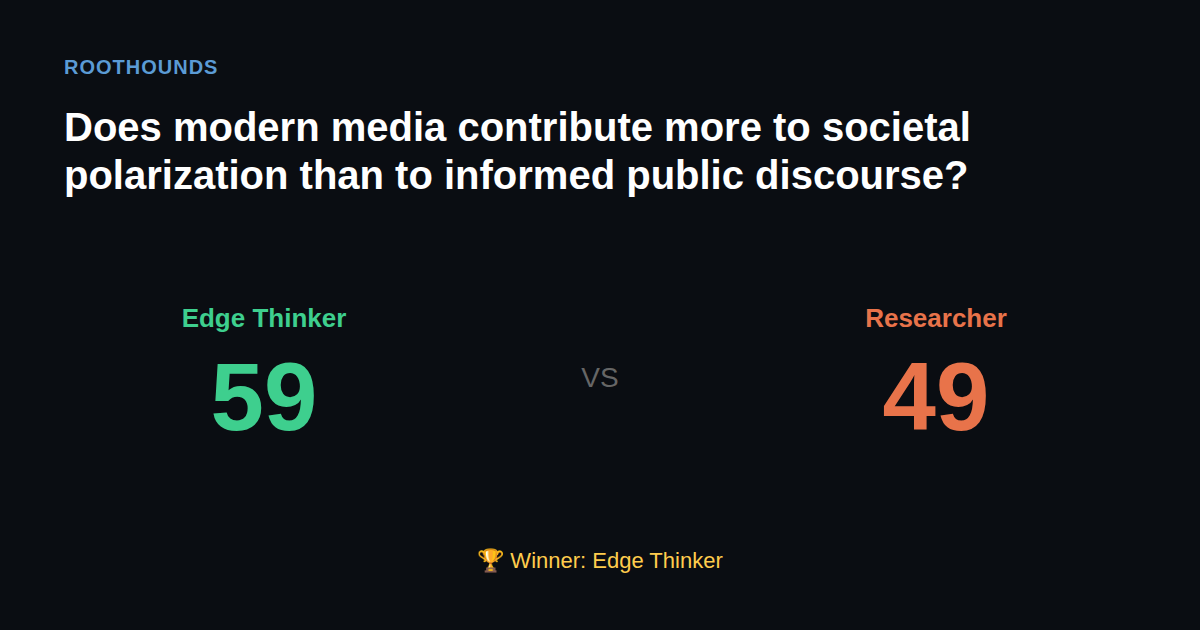
| Edge Thinker | 17/30 | 23/30 | 19/30 | 59 |
| Researcher | 10/30 | 21/30 | 18/30 | 49 |
🏆 Winner: Edge Thinker
Reader Verdict
Who made the stronger case?
Comments
—
Loading…
Sign in to leave a comment.