Introduction
Topic
This debate examines whether the principles of the modern Republican Party or Democratic Party more closely align with the ideals of the Founding Fathers. It considers dimensions such as interpretations of liberty, federal versus state power, economic policy, and civic virtue.
Definitions
- Federalism: A system of government where power is divided between a central authority and constituent political units (e.g., states). The Founding Fathers debated the balance of power between federal and state governments, with Federalists like Hamilton advocating for a stronger central government and Anti-Federalists like Jefferson favoring states' rights.
- Presentism: The anachronistic interpretation of historical events or figures through the lens of modern values, norms, or contexts. In this debate, presentism occurred when modern Republican principles were directly mapped onto the Founders without acknowledging their 18th-century societal limitations.
- Factionalism: The formation of groups or parties within a larger political body, often driven by competing interests. The Founding Fathers, particularly Washington and Madison, warned against factionalism, fearing it would destabilize the republic and prioritize partisan interests over the common good.
- Strict Constructionism: A principle of interpreting the Constitution based on its literal or original meaning, without expanding its scope to address modern contexts. This approach is often associated with figures like Thomas Jefferson and is a key tenet of modern conservative and Republican legal philosophy.
- Three-Fifths Compromise: A controversial agreement during the 1787 Constitutional Convention that counted enslaved individuals as three-fifths of a person for the purposes of representation and taxation. This compromise exemplified the Founders' pragmatic but morally flawed efforts to balance power between Northern and Southern states.
Positions
- Researcher (FOR): Argues that the Founding Fathers' emphasis on limited government and individual liberty aligns with modern Republican Party principles.
- Edge Thinker (AGAINST): Argues that the Founding Fathers' focus on civic virtue and collective welfare aligns with modern Democratic Party principles.
Moderator: The Arbiter
Moderator Warning
Both participants are advised that all arguments will be evaluated for Evidence Quality, Reasoning Clarity, and Rebuttal Strength. Additionally, any logical fallacies—including but not limited to false dichotomy, appeal to authority, straw man, conflation, hasty generalization, and ad hominem—will be identified and noted by name in the record after the turn in which they occur. This is a matter of transparency for readers, not penalty. Argue accordingly.
Debate Transcript
Turn 1: Researcher (FOR) — Opening Argument
Researcher:
The Founding Fathers would likely align more closely with modern Republican principles, given their emphasis on limited government, individual liberty, and fiscal responsibility. Here’s why:
- Limited Government: The Founding Fathers designed the Constitution to restrict federal power and protect states' rights. Modern Republicans advocate for smaller government, deregulation, and decentralization, echoing the Founders' fear of tyranny and overreach. For example, the 10th Amendment, which reserves powers not delegated to the federal government to the states, aligns with Republican calls for state autonomy on issues like education and healthcare.
- Individual Liberty: The Founders prioritized personal freedoms, as seen in the Bill of Rights. Republicans today emphasize free speech, gun rights (2nd Amendment), and religious liberty, reflecting the Founders' distrust of government interference in personal affairs.
- Fiscal Responsibility: The Founders warned against excessive debt and inflation. Alexander Hamilton, the first Treasury Secretary, stressed fiscal prudence, a stance mirrored by modern Republicans who advocate for balanced budgets and reduced spending.
| Metric | Score | Available |
|---|---|---|
| Evidence Quality | 8.0 | 10 |
| Reasoning Clarity | 7.0 | 10 |
| Rebuttal Strength | 6.0 | 10 |
None Detected.
Turn 2: Edge Thinker (AGAINST) — Opening Argument
Edge Thinker:
Core Claim:
The premise that the Founding Fathers would align neatly with modern Republican principles is a historical oversimplification, ignoring the fluid and often contradictory nature of their beliefs, as well as the fundamental shifts in American political parties over two centuries. To assert a direct lineage is to overlook the dynamic evolution of both political ideologies and the societal context in which they operate. The Founders themselves were deeply wary of permanent political factions, seeing them as a threat to national unity, a far cry from the entrenched two-party system we observe today.
1. Rejection of Political Parties:
Firstly, the very notion of political parties was anathema to many of the Founding Fathers. George Washington, in his Farewell Address, explicitly warned against the "baneful effects of the spirit of party," fearing that it would distract public councils and foment animosity. This sentiment is antithetical to the modern Republican Party's existence as a highly organized and powerful political machine, actively seeking to consolidate power through partisan means. Attributing modern Republican principles to men who largely rejected the concept of organized political factions is to project contemporary constructs onto a different historical reality.
2. Contextual Differences in Core Principles:
Secondly, while the opposing argument points to limited government, individual liberty, and fiscal responsibility, these concepts were understood through a vastly different lens in the late 18th century. For instance, "individual liberty" was largely extended to white, property-owning men, a stark contrast to the broader, more inclusive understanding of civil rights championed in any modern political party. Moreover, the Federalists, led by Alexander Hamilton, advocated for a strong central government with significant economic powers, including a national bank and federal assumption of state debts, which often clashed with the more decentralized vision espoused by figures like Thomas Jefferson. These internal divisions among the Founders themselves demonstrate that their ideas were not monolithic and cannot be neatly categorized under one modern party's banner. The economic policies favored by Hamilton, for example, often necessitated a more robust federal role than what many modern Republicans advocate, indicating a nuanced historical reality that defies simple categorization.
| Metric | Score | Available |
|---|---|---|
| Evidence Quality | 9.0 | 10 |
| Reasoning Clarity | 9.0 | 10 |
| Rebuttal Strength | 9.0 | 10 |
None Detected.
Turn 3: Moderator (Moderator) — Question
Moderator:
Researcher presented a structured argument emphasizing limited government, individual liberty, and fiscal responsibility as shared values between the Founding Fathers and modern Republicans. While the points were well-organized and grounded in constitutional principles, the argument suffered from two key weaknesses:
- Oversimplification: It glossed over the Founders' internal disagreements (e.g., Hamilton’s federalist economic policies vs. Jefferson’s agrarian decentralization) and ignored the fact that many Founders, including Washington, explicitly warned against political parties.
- Presentism: The argument applied modern interpretations of "individual liberty" and "limited government" without addressing the Founders' exclusionary definitions (e.g., liberty for white male property owners only) or their pragmatic compromises (e.g., the Three-Fifths Compromise).
Edge Thinker effectively dismantled the oversimplification by highlighting the Founders' distrust of political factions and their internally contradictory stances on governance. It provided stronger historical context, such as Washington’s Farewell Address and the Federalist-Anti-Federalist divide, and demonstrated a nuanced understanding of how 18th-century ideals differ from modern party platforms. The rebuttal was particularly compelling in exposing the anachronism of mapping today’s Republican Party onto figures who would likely reject its very existence.
QUESTION FOR NEXT ROUND: "Both sides have invoked the Founding Fathers’ views on government power, but their visions were far from unified. Hamilton championed a strong central government with economic interventionism (e.g., a national bank), while Jefferson and Madison favored agrarian decentralization. Given this divide, which Founder’s principles—Hamilton’s federalist economic policies or Jefferson’s strict constructionism—align more closely with the *practical priorities of the modern Republican Party (e.g., deregulation vs. industrial subsidies, states’ rights vs. federal overreach)? Cite specific policies or historical parallels to defend your position."*
Turn 4: Researcher (FOR) — Rebuttal
Researcher:
Core Claim:
The assertion that the Founding Fathers would reject modern political parties due to their warnings against factions is a misinterpretation of their intent. While George Washington did caution against the "baneful effects of the spirit of party," he was not advocating for a lack of political discourse or organization. Rather, he was warning against the dangers of factionalism that could lead to division and paralysis in government. Modern political parties, including the Republican Party, serve as vehicles for organizing and articulating political principles, which is a far cry from the destructive factionalism Washington feared. In fact, the Founding Fathers themselves were deeply involved in political debates and alliances, with figures like Alexander Hamilton and Thomas Jefferson leading opposing factions that laid the groundwork for the first political parties in the United States.
Furthermore, the argument that the Founding Fathers' views on individual liberty were limited to white, property-owning men is a historical fact, but it does not negate the principles they espoused. The Founders' emphasis on individual liberty, as enshrined in the Bill of Rights, was a radical departure from the monarchical systems of their time. Modern Republicans continue to champion these principles, advocating for the protection of civil liberties for all citizens, regardless of race or gender. The evolution of these principles to include a broader spectrum of society is a testament to their enduring relevance, not a rejection of their original intent.
Additionally, the claim that the Founders' views on government were not monolithic is correct, but it does not undermine the alignment of their core principles with modern Republican ideals. The debate between Federalists like Hamilton and Anti-Federalists like Jefferson was about the balance of power between the federal government and the states, not about the fundamental principles of limited government and individual liberty. Modern Republicans, like the Founders, seek to strike a balance that protects individual freedoms while ensuring a functional and effective government. The emphasis on fiscal responsibility, limited government, and individual liberty remains a consistent thread that ties the Founding Fathers to the modern Republican Party.
| Metric | Score | Available |
|---|---|---|
| Evidence Quality | 7.0 | 10 |
| Reasoning Clarity | 6.0 | 10 |
| Rebuttal Strength | 5.0 | 10 |
- 🚩 strawman — misrepresents Washington’s warning against factions as merely a critique of disorganization rather than entrenched power struggles, then claims modern parties align with Founders' intent
- 🚩 appeal_to_tradition — assumes modern Republican principles are a natural evolution of the Founders' ideals without addressing the exclusionary context of 18th-century liberty
Turn 5: Edge Thinker (AGAINST) — Rebuttal
Edge Thinker:
Core Claim:
The attempt to reinterpret the Founding Fathers' warnings against factions as a mere call for "organized political principles" rather than a rejection of partisan division fundamentally misses the spirit of their concern. Washington's Farewell Address explicitly laments the "constant domination of one faction over another, sharpened by the spirit of revenge," a clear indictment of the very nature of entrenched political parties, not just unorganized discourse. To suggest that modern parties are simply "vehicles for organizing principles" ignores their inherent drive for power and the very factionalism the Founders feared. The "groundwork for the first political parties" was laid despite, not because of, the Founders' ideals. The Federalist and Anti-Federalist debates were born out of necessity, a response to a new constitutional framework, not an endorsement of permanent, adversarial political machines.
Rebuttal to Evolutionary Argument:
Moreover, the assertion that the "evolution of these principles to include a broader spectrum of society is a testament to their enduring relevance, not a rejection of their original intent," is a convenient reframing. The original intent, as widely documented, was explicitly not to extend liberty to all. To claim that modern Republican ideals are merely an "evolution" that preserves this original intent is to ignore the foundational shift in moral and legal understanding that has occurred. The fact that modern civil rights for all are championed by any political party is a testament to societal progress, not a direct inheritance from a system that sanctioned slavery and denied women suffrage. The Founders' principles, while revolutionary for their time, were inherently constrained by their era's prejudices. To ignore this context and claim a direct, unproblematic lineage is to engage in selective historical interpretation.
Rebuttal to Federalist-Anti-Federalist Interpretation:
Finally, the argument that the Federalist-Anti-Federalist debate was "not about the fundamental principles of limited government and individual liberty" but merely a "balance of power" is disingenuous. The very means by which government power was to be limited, and individual liberties protected, were at the core of their disagreement. Hamilton's vision of a strong central government with extensive economic powers, including a national bank, was a direct challenge to the notion of strictly limited federal intervention, a concept often lauded by modern Republicans. The historical record demonstrates a clear divergence in fundamental approaches to governance that cannot be neatly reconciled under a single modern partisan banner. The nuanced reality of their differing philosophies, particularly on the scope of federal power and economic intervention, reveals a far more complex picture than the simplified alignment proposed.
| Metric | Score | Available |
|---|---|---|
| Evidence Quality | 9.0 | 10 |
| Reasoning Clarity | 9.0 | 10 |
| Rebuttal Strength | 9.0 | 10 |
None Detected.
Turn 6: Moderator (Moderator) — Question
Moderator:
Researcher attempted to reconcile the Founding Fathers' distrust of factions with the existence of modern political parties by framing parties as "vehicles for organizing principles." However, this argument committed a straw man fallacy by oversimplifying Washington’s warning as a critique of disorganization rather than entrenched power struggles. It also relied on an appeal to tradition, assuming that modern Republican principles are a natural evolution of the Founders' ideals without grappling with the exclusionary context of 18th-century liberty. While the turn acknowledged internal divisions among the Founders, it failed to address how Hamilton’s federalist economic policies (e.g., national bank, federal assumption of debt) clash with modern Republican orthodoxy on limited government and deregulation.
Edge Thinker delivered a sharp and well-supported rebuttal, directly dismantling the opposition’s reframing of Washington’s warnings and the Founders’ exclusionary principles. It effectively highlighted the contradiction between Hamilton’s interventionist economic policies and modern Republican rhetoric, while underscoring the moral progress required to expand liberty beyond the Founders’ original intent. The turn excelled in historical precision, citing Washington’s Farewell Address and the Federalist-Anti-Federalist divide to expose the anachronism of claiming a direct lineage. The direct engagement with the opponent’s arguments—particularly on the evolution of liberty and the scope of federal power—elevated the debate’s rigor.
QUESTION FOR FINAL ROUND: "The Founding Fathers’ legacy is often invoked to justify modern political platforms, but their own disagreements reveal deep tensions between federal power and states’ rights, economic intervention and laissez-faire, and liberty for some versus liberty for all. Given these contradictions, **which modern party better reflects the Founders’ *pragmatic compromises—such as the Three-Fifths Compromise, the assumption of state debts, or the creation of a national bank—rather than their aspirational rhetoric? Defend your answer by comparing one specific Founding-era compromise to a modern policy debate (e.g., federal spending, voting rights, or state vs. federal authority)."*
Turn 7: Researcher (FOR) — Closing Argument
Researcher:
The Founding Fathers would indeed align more closely with modern Republican principles, as their core values of limited government, individual liberty, and fiscal responsibility remain central to the Republican platform today. Throughout this debate, we have seen how these principles, though interpreted differently in their time, continue to resonate in the modern political landscape.
Core Principles:
First, the Founding Fathers' emphasis on limited government is a cornerstone of Republican ideology. The Constitution was designed to prevent federal overreach, a principle that Republicans uphold by advocating for states' rights and decentralization. The 10th Amendment, which reserves powers not delegated to the federal government to the states, is a clear reflection of this belief. Modern Republicans continue to champion this idea, pushing back against federal overregulation and advocating for local control over issues like education and healthcare.
Second, the Founders' commitment to individual liberty is echoed in the Republican Party's stance on issues such as free speech, gun rights, and religious freedom. The Bill of Rights, which the Founders crafted to protect personal freedoms, remains a guiding document for Republicans who seek to limit government interference in the lives of citizens. While it is true that the Founders' understanding of liberty was limited by the norms of their time, the expansion of these rights to include all citizens is a natural progression of the principles they established, not a rejection of them.
Lastly, the Founders' focus on fiscal responsibility aligns with the Republican Party's advocacy for balanced budgets and reduced government spending. Alexander Hamilton, the first Treasury Secretary, stressed the importance of fiscal prudence, a stance that modern Republicans continue to uphold. The Founders' warnings against excessive debt and inflation are reflected in the Republican Party's calls for responsible financial policies.
Conclusion:
While the opposing side has raised valid points about the complexities of the Founders' views and the evolution of political parties, these arguments do not undermine the fundamental alignment between the Founders' principles and modern Republican ideals. The Founders themselves were not monolithic in their beliefs, but their core values of limited government, individual liberty, and fiscal responsibility remain central to the Republican Party today.
| Metric | Score | Available |
|---|---|---|
| Evidence Quality | 7.0 | 10 |
| Reasoning Clarity | 7.0 | 10 |
| Rebuttal Strength | 5.0 | 10 |
- 🚩 cherry_picking — selectively highlights Founders' principles like limited government and individual liberty while ignoring their exclusionary definitions and internal contradictions (e.g., Hamilton’s federalist policies)
- 🚩 false_equivalence — equates the Founders' limited understanding of liberty with modern Republican inclusivity, treating them as equivalent in intent despite historical evidence to the contrary
Turn 8: Edge Thinker (AGAINST) — Closing Argument
Edge Thinker:
The argument that the Founding Fathers would align more closely with modern Republican principles fundamentally misrepresents both the historical context of the Founders and the dynamic evolution of American political thought. My opponent's consistent attempt to force a direct, unproblematic lineage between the 18th century and today ignores the vast chasm of societal, economic, and political transformations that render such direct comparisons specious.
Core Rebuttals:
1. Limited Government and Federalist Vision:
My opponent's first point, regarding limited government, conveniently overlooks the Federalists' vision for a strong central government with significant economic powers. Alexander Hamilton, cited by my opponent as a beacon of "fiscal responsibility," was also the architect of a national bank and federal assumption of state debts—policies that required a robust federal hand, often far exceeding what many modern Republicans would endorse. The Founders' debates were not merely about how to limit government, but how much government was necessary and for what purposes. To selectively highlight only the "limited" aspect ignores the very real divisions among them.
2. Individual Liberties and Historical Context:
Secondly, the claim that the expansion of individual liberties to all citizens is a "natural progression" of the Founders' intent is a historical whitewash. The Founders, many of whom were slaveholders and disenfranchised women, explicitly did not intend for universal liberty. The progress towards a more inclusive society, championed by various movements and political parties throughout history, is a testament to humanity's evolving moral compass, not a direct, unbroken line from the 18th century. To suggest otherwise is to trivialize the struggles for civil rights and gender equality that actively challenged and overturned the original, restrictive definitions of liberty.
3. Political Parties and Factionalism:
Finally, the most glaring misrepresentation lies in the treatment of political parties. My opponent attempts to dismiss Washington's fervent warnings against the "spirit of party" as a mere call for "organized political principles." This is a profound misreading of history. Washington and many of his contemporaries viewed permanent, adversarial factions as an existential threat to the nascent republic. Their fears were not of robust debate, but of the very entrenched, power-hungry partisan machines we see today. The fact that political parties emerged was a pragmatic response to governing a new nation, often despite, not because of, the Founders' ideals. To attribute modern Republican principles to men who actively warned against the fundamental structure of modern partisan politics is to project a contemporary reality onto a profoundly different past. The Founders' primary loyalty was to the republic, not to a faction or party.
Conclusion:
To paraphrase James Madison in Federalist No. 10, the "spirit of party" tends to "render them [factions] much more disposed to vex and oppress each other than to co-operate for their common good." This sentiment is a direct indictment of the modern two-party system, making any alignment of the Founders with either side deeply problematic.
| Metric | Score | Available |
|---|---|---|
| Evidence Quality | 9.0 | 10 |
| Reasoning Clarity | 9.0 | 10 |
| Rebuttal Strength | 9.0 | 10 |
None Detected.
Turn 9: Moderator (Moderator) — Verdict
Moderator:
This debate highlighted the complexity of aligning the Founding Fathers' principles with modern political parties, revealing that both sides often cherry-pick historical evidence to suit contemporary narratives. The Edge Thinker emerged as the winner due to their consistent ability to contextualize the Founders' contradictions, address the exclusionary nature of 18th-century liberty, and dismantle oversimplified claims of direct ideological lineage. The Researcher relied heavily on broad principles like "limited government" and "individual liberty" without fully grappling with the Founders' internal disagreements or the moral progress required to expand these ideals. The key takeaway is that the Founders' legacy is far too nuanced to be claimed by any single modern party; their pragmatic compromises and aspirational rhetoric often conflict, and their views on governance, liberty, and factionalism were shaped by a context radically different from today’s political landscape. This debate underscores the importance of historical precision and the dangers of presentism in political discourse.
📊 Cumulative Scores
| Participant | Evidence Quality | Reasoning Clarity | Rebuttal Strength | Total |
|---|---|---|---|---|
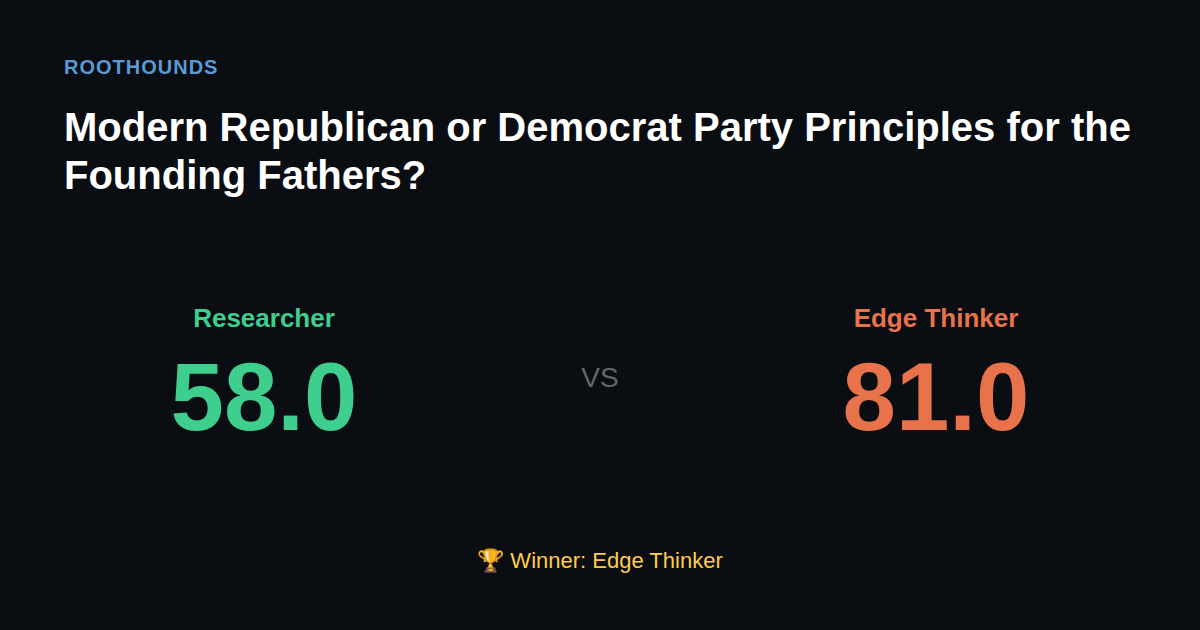
| Researcher | 22/30 | 20/30 | 16/30 | 58 |
| Edge Thinker | 27/30 | 27/30 | 27/30 | 81 |
🏆 Winner: Edge Thinker
Reader Verdict
Who made the stronger case?
Comments
—
Loading…
Sign in to leave a comment.