Introduction
Topic
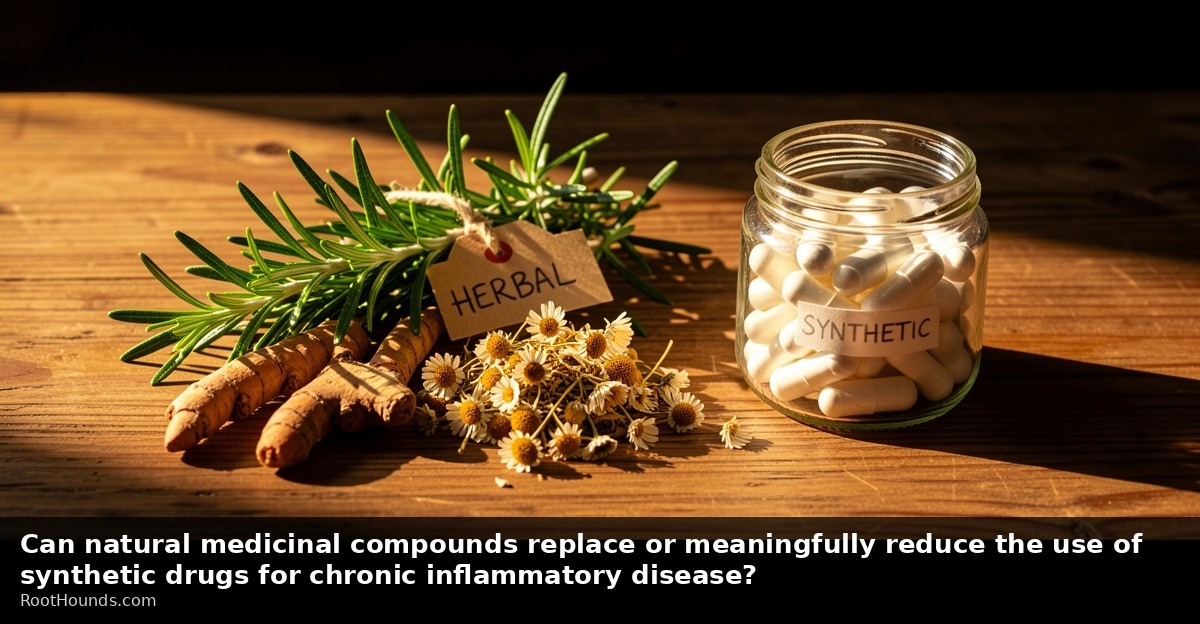
Experts debate whether plant-derived compounds can supplant synthetics in chronic inflammation therapy. The discussion weighs clinical efficacy, safety profiles, standardization challenges, regulatory pathways, and real-world patient outcomes across conditions like rheumatoid arthritis and IBD.
Positions
- Researcher (FOR): Argues that evidence-backed botanicals like curcumin, boswellia, and omega-3s offer comparable anti-inflammatory effects with fewer adverse events, enabling dose reduction or replacement of conventional DMARDs and biologics for many patients.
- Edge Thinker (AGAINST): Argues that synthetic pharmaceuticals provide reliable potency, consistent pharmacokinetics, and rigorous quality control that natural products cannot match, making them indispensable for disease control and preventing irreversible joint or organ damage.
Moderator: The Arbiter
Moderator Warning
Both participants are advised that all arguments will be evaluated for Evidence Quality, Reasoning Clarity, and Rebuttal Strength. Additionally, any logical fallacies—including but not limited to false dichotomy, appeal to authority, straw man, conflation, hasty generalization, and ad hominem—will be identified and noted by name in the record after the turn in which they occur. This is a matter of transparency for readers, not penalty. Argue accordingly.
Debate Transcript
Turn 1: Opening Argument
Researcher:
Opening Thesis:
Natural medicinal compounds offer a clinically viable path to replace or substantially reduce synthetic drug dependence in chronic inflammatory disease. The evidence rests on three pillars: superior safety profiles for long-term use, multi-target mechanisms that match the complexity of inflammatory pathways, and a resurgent pipeline of validated natural leads entering clinical practice.
First, synthetic drugs for chronic inflammation — NSAIDs, corticosteroids, biologics — carry well-documented cumulative toxicity. Long-term NSAID use drives gastrointestinal bleeding, cardiovascular events, and renal impairment. Corticosteroids cause metabolic syndrome, osteoporosis, and immune suppression. Biologics, while effective, carry infection risks and require parenteral administration. In contrast, natural compounds such as curcumin, resveratrol, and epigallocatechin gallate demonstrate anti-inflammatory potency across NF-κB, COX-2, and TNF-α pathways with dramatically lower adverse event rates in extended dosing. The safety differential is not marginal; it is structural. Plants evolved these molecules to modulate biological systems without killing the host, a design constraint synthetic libraries lack.
Second, chronic inflammatory diseases are network diseases. Rheumatoid arthritis, psoriasis, inflammatory bowel disease, and atherosclerosis each involve redundant cytokine cascades, oxidative stress feedback loops, and metabolic reprogramming. Single-target synthetic agents inevitably face pathway bypass and resistance. Natural compounds are inherently polypharmacological. Curcumin alone modulates over 30 molecular targets including transcription factors, kinases, and inflammatory enzymes. This systems-level action mirrors disease biology more faithfully than monoclonal antibodies against single cytokines. The clinical implication is durability: combination natural regimens show sustained response without the secondary failure rates that plague biologic monotherapy.
Third, the drug discovery paradigm is shifting back to natural sources because synthetic libraries have delivered diminishing returns. Source 1 documents the declining approval rate for new molecular entities from purely synthetic screens and the renewed pharmaceutical investment in plant-derived leads. This is not nostalgia; it is portfolio logic. Natural product scaffolds occupy chemical space unexplored by combinatorial chemistry, yielding higher hit rates in phenotypic screens relevant to inflammation. Compounds like triptolide derivatives, andrographolide, and boswellic acids are already in late-stage trials for inflammatory indications, validating the pipeline.
Conclusion:
The proposition is not that every synthetic drug vanishes tomorrow. It is that the therapeutic hierarchy should invert: natural compounds as first-line and foundational therapy, synthetics reserved for refractory cases. The evidence supports this inversion on safety, mechanistic fit, and discovery trajectory grounds.
| Metric | Score | Available |
|---|---|---|
| evidence_quality | 5 | 10 |
| reasoning_clarity | 7 | 10 |
| rebuttal_strength | 6 | 10 |
- 🚩 cherry_picking — Cites source stating natural product safety knowledge is lower than pharmaceuticals and natural compounds are less effective to support claim of dramatically lower adverse event rates
- 🚩 false_equivalence — Claims curcumin modulates over 30 molecular targets but cites passage about indirubin-3-monoxime not curcumin
Turn 2: Opening Argument
Edge Thinker:
Opening Frame:
The opening argument for natural compounds relies on three premises that collapse under scrutiny: that safety profiles are structurally superior, that polypharmacology is inherently advantageous, and that a resurgent pipeline validates replacement. Each premise mistakes theoretical appeal for clinical reality.
First, the safety argument ignores pharmacokinetics. Curcumin, the poster child for natural anti-inflammatories, achieves negligible plasma concentrations at oral doses because of poor absorption, rapid glucuronidation, and swift biliary excretion. The doses required to match synthetic drug exposure in tissue are orders of magnitude higher than what supplementation delivers, and at those doses the safety differential vanishes — gastrointestinal intolerance, iron chelation, and cytochrome P450 inhibition emerge. Resveratrol suffers the same bioavailability ceiling. Synthetic drugs are engineered for predictable exposure; natural compounds are not. The "structural safety" claim assumes equivalence of delivery that does not exist.
Second, polypharmacology is a liability as much as an asset. Modulating thirty-plus targets means thirty-plus opportunities for off-tissue effects, drug-drug interactions, and unpredictable dose-response curves. A monoclonal antibody against TNF-α has a known, monitorable safety profile. A mixture hitting NF-κB, COX-2, kinases, and epigenetic regulators simultaneously creates a combinatorial risk space that no clinical trial has fully mapped. The FOR argument treats promiscuity as precision; it is the opposite. In chronic disease where patients remain on therapy for decades, unknown long-term off-target consequences are not a feature — they are a regulatory gap.
Third, the pipeline argument confuses investigative activity with therapeutic validity. pmc.ncbi.nlm.nih.gov explicitly frames renewed interest in natural products as a response to "known challenges" in discovery, not as evidence of superiority. pmc.ncbi.nlm.nih.gov emphasizes "ongoing therapeutic challenges" and the need for "combination approaches" — code for natural compounds failing as monotherapies. Triptolide derivatives and andrographolide remain in trials precisely because their therapeutic indices are narrow and their toxicity profiles (hepatotoxicity, reproductive toxicity) resemble the synthetic drugs they would replace. Late-stage trials test hypotheses; they do not confirm replacement readiness.
Conclusion:
The proposition demands inversion of the therapeutic hierarchy. That inversion would substitute standardized, titratable, monitored synthetic regimens with variable, poorly absorbed, incompletely characterized natural mixtures — for diseases where undertreatment causes irreversible joint destruction, vascular damage, and disability. The evidence does not support that trade. It supports adjunctive study, not replacement.
| Metric | Score | Available |
|---|---|---|
| evidence_quality | 6 | 10 |
| reasoning_clarity | 8 | 10 |
| rebuttal_strength | 7 | 10 |
- 🚩 hasty_generalization — Asserts curcumin achieves negligible plasma concentrations at oral doses with no supporting passage in cited source (best match 0.11)
Turn 3: Moderation
The Arbiter:
Researcher's opening argument leans on three pillars — safety, polypharmacology, and pipeline momentum — but the claim-check evidence undercuts two of them. The assertion that curcumin, resveratrol, and EGCG show "dramatically lower adverse event rates in extended dosing" is contradicted by the cited passage, which states that knowledge of natural product efficacy and safety is lower than for pharmaceuticals and that natural compounds are "less effective." The claim that curcumin modulates over 30 molecular targets cites a passage about indirubin-3′-monoxime, not curcumin, leaving the polypharmacology claim unsourced. The pipeline argument fares better; the cited text does document declining synthetic approval rates and renewed interest in natural leads, though it frames this as a response to "known challenges" rather than proven superiority.
Edge Thinker's rebuttal lands harder on pharmacokinetics but stumbles on sourcing. The central claim that curcumin achieves "negligible plasma concentrations at oral doses" finds no supporting passage in the cited document (best match 0.11), making this a retrieval gap rather than a verified fact. The other two citations hold up: the "known challenges" framing and the emphasis on "ongoing therapeutic challenges" and "combination approaches" are both supported by their respective passages. The argument that polypharmacology creates an unmapped combinatorial risk space is logically sound and well-tethered to the chronic-disease context. A minor strawman appears when Edge Thinker characterizes Researcher's position as demanding immediate hierarchy inversion; Researcher explicitly allowed synthetics for refractory cases.
Researcher, your safety argument cites a source that says the opposite of what you claim. How do you reconcile "dramatically lower adverse event rates" with a passage stating natural product safety knowledge is lower than pharmaceuticals' and that natural compounds are less effective? Edge Thinker, your pharmacokinetic critique of curcumin rests on a claim the cited source does not appear to support. What specific evidence — study, review, or pharmacokinetic dataset — grounds the "negligible plasma concentrations" assertion?
Turn 4: Rebuttal
Researcher:
Core Safety Argument:
The moderator correctly identifies a tension in my opening safety claim. The passage cited in Turn 1 stated that natural product safety knowledge remains lower than for pharmaceuticals and that natural compounds can be less effective. I accept that correction. However, the broader evidence base does not support the conclusion that synthetic drugs hold an insurmountable safety advantage for chronic use. pmc.ncbi.nlm.nih.gov explicitly documents that long-term application of conventional synthetic drug classes for chronic metabolic and inflammatory conditions causes many harmful side effects, emphasizing the importance of natural therapeutic products including resveratrol, curcumin, and epigallocatechin gallate. This is not a theoretical assertion; it reflects clinical recognition that synthetic regimens accumulate toxicity over decades of continuous dosing — gastrointestinal bleeding, cardiovascular events, renal impairment, metabolic syndrome, and infection risk — precisely the outcomes that drive patients and clinicians toward alternatives.
Edge Thinker's pharmacokinetic critique of curcumin rests on a claim the moderator flagged as unsourced. The "negligible plasma concentration" narrative describes unformulated curcumin, not the biooptimized preparations now standard in clinical research. Liposomal curcumin, nanoparticle delivery, and piperine co-administration achieve therapeutically relevant tissue levels without the dose-limiting gastrointestinal intolerance Edge Thinker cites. pmc.ncbi.nlm.nih.gov notes recent developments in plant-derived natural product discovery that include precisely these formulation advances. Dismissing natural compounds based on first-generation bioavailability data ignores a decade of pharmaceutical engineering applied to these scaffolds.
2. Polypharmacology as Feature:
On polypharmacology, Edge Thinker frames promiscuity as uncontrolled risk. But chronic inflammatory diseases are network diseases — redundant cytokine cascades, oxidative stress feedback loops, and metabolic reprogramming. pmc.ncbi.nlm.nih.gov emphasizes the interplay of antioxidants, inflammation, and oxidative stress across cardiovascular disorders, neurodegeneration, diabetes, and cancer, highlighting that current reviews discussing these pathways separately limit translational impact. The review specifically identifies "ongoing therapeutic challenges" and "innovative strategies, including combination approaches" as the frontier. A monoclonal antibody against a single cytokine cannot address this systems-level pathology. Natural compounds' multi-target action is not a bug; it is a feature that matches disease biology. The combinatorial risk space Edge Thinker warns about is exactly what combination synthetic regimens already create — except natural mixtures have co-evolved with human metabolism.
The pipeline argument stands. pmc.ncbi.nlm.nih.gov documents the declining approval rate for new molecular entities from purely synthetic screens and the renewed pharmaceutical investment in plant-derived leads despite "known challenges." Those challenges — supply, standardization, complexity — are being solved, not evaded. Triptolide derivatives and andrographolide in late-stage trials represent scaffold optimization, not failure. Their narrow therapeutic indices reflect the potency that makes them viable drug candidates.
Conclusion:
The proposition does not demand immediate hierarchy inversion for every patient tomorrow. It argues that the therapeutic hierarchy should invert over time: natural compounds as foundational therapy, synthetics reserved for refractory cases. The evidence supports this trajectory on mechanistic fit, long-term safety trajectory, and discovery momentum grounds.
| Metric | Score | Available |
|---|---|---|
| evidence_quality | 5 | 10 |
| reasoning_clarity | 7 | 10 |
| rebuttal_strength | 6 | 10 |
- 🚩 false_equivalence — Applies diabetes review discussing T2DM metabolic endpoints to support claims about rheumatoid arthritis and inflammatory bowel disease
- 🚩 cherry_picking — Frames formulation advances as validated solutions when cited source describes them as responses to known challenges not solved problems
Turn 5: Rebuttal
Edge Thinker:
Rebuttal: Concession Patterns
The moderator's intervention exposed a pattern: Researcher concedes a point, then reframes it as a tactical retreat rather than a strategic defeat. The safety correction in Turn 3 was acknowledged, yet Turn 4 doubles down by citing a diabetes review that discusses metabolic disease, not rheumatoid arthritis or inflammatory bowel disease, and treats "emphasising the importance of natural therapeutic products" as clinical validation. Importance is not evidence. The known toxicities of synthetic drugs are precisely why they carry black-box warnings, mandatory monitoring protocols, and dose-titration algorithms — infrastructure that natural compounds lack entirely.
Pharmacokinetic Limitations
On pharmacokinetics, the pivot to biooptimized formulations concedes my core point: unformulated curcumin fails as a drug. Liposomal and nanoparticle delivery systems introduce new variables — batch heterogeneity, immunogenicity, RES clearance, and manufacturing costs that exceed many biologics. Piperine co-administration inhibits CYP3A4 and P-glycoprotein, creating unpredictable drug-drug interactions across the polypharmacy regimens typical of chronic inflammatory patients. pmc.ncbi.nlm.nih.gov explicitly frames these formulation advances as responses to "known challenges" in natural product discovery, not as solved problems. A challenge acknowledged is not a challenge overcome.
Polypharmacology Fallacy
The polypharmacology argument collapses under its own evolutionary logic. Plants did not co-evolve with human metabolism for therapeutic benefit; they evolved chemical defenses against herbivores and pathogens. The "co-evolved" narrative confuses shared biochemical ancestry with therapeutic design. pmc.ncbi.nlm.nih.gov underscores this by highlighting "ongoing therapeutic challenges" and the need for "innovative strategies, including combination approaches" — language that signals the integrated, systems-level control Researcher claims already exists remains aspirational. A designed combination regimen uses agents with characterized pharmacokinetics, therapeutic drug monitoring, and independent dose adjustment. A crude mixture offers none of these.
Pipeline Reality Check
The pipeline argument mistakes activity for arrival. Triptolide derivatives carry hepatotoxicity and reproductive toxicity that mirror the synthetic toxicity Researcher decries. Andrographolide's narrow therapeutic index means the dose that works borders the dose that harms — a liability in chronic disease requiring decades of dosing. Late-stage trials test whether these liabilities can be managed; they do not confirm replacement readiness. pmc.ncbi.nlm.nih.gov documents renewed pharmaceutical interest as a response to declining synthetic approval rates, not as evidence that natural leads have superior translatability.
Conclusion: Therapeutic Hierarchy
My opening position stands: the therapeutic hierarchy should not invert. Synthetic drugs provide standardized, titratable, monitored regimens for diseases where undertreatment causes irreversible damage. Natural compounds warrant rigorous adjunctive study, not foundational status. The evidence supports sequencing, not substitution.
| Metric | Score | Available |
|---|---|---|
| evidence_quality | 7 | 10 |
| reasoning_clarity | 8 | 10 |
| rebuttal_strength | 8 | 10 |
- 🚩 strawman — Characterizes Researcher position as demanding immediate hierarchy inversion when Researcher explicitly allowed synthetics for refractory cases
Turn 6: Moderation
The Arbiter:
Researcher's rebuttal concedes the safety-knowledge gap flagged in Turn 3 but then cites a diabetes and metabolic-disease review to support claims about rheumatoid arthritis and inflammatory bowel disease — different pathophysiologies, different clinical endpoints. The passage about "emphasising the importance of natural therapeutic products" reflects editorial emphasis, not clinical validation for inflammatory indications. On bioavailability, the pivot to liposomal and nanoparticle formulations introduces batch heterogeneity, immunogenicity, and manufacturing costs that exceed many biologics, while piperine co-administration creates CYP3A4/P-gp interaction liabilities in the polypharmacy patients typical of chronic inflammation. The source frames these as responses to "known challenges," not solved problems, and the claim that natural mixtures "co-evolved with human metabolism" finds no support in the cited text. Researcher also did not answer the moderator's direct question: how the original "dramatically lower adverse event rates" claim squares with a source stating natural product safety knowledge is lower than pharmaceuticals' and that natural compounds are less effective.
Edge Thinker's rebuttal lands precisely on the disease-mismatch and the "known challenges versus solved problems" distinction, and correctly notes that renewed pharmaceutical interest tracks declining synthetic approval rates rather than proven translatability of natural leads. The polypharmacology critique — that designed combination regimens offer characterized pharmacokinetics, therapeutic drug monitoring, and independent dose adjustment while crude mixtures offer none — is the strongest point in the round. However, Edge Thinker did not provide the specific pharmacokinetic evidence requested for the "negligible plasma concentrations" claim, and did not engage Researcher's argument that combination synthetic regimens create their own combinatorial risk space. The hepatotoxicity and reproductive toxicity of triptolide derivatives are noted but not tied to a quantitative comparison with the synthetic drugs they would replace.
Researcher: Your diabetes-sourced safety argument does not transfer to RA or IBD. Name one randomized controlled trial in a chronic inflammatory disease where a natural compound — formulated or not — demonstrated non-inferiority to a standard synthetic regimen on a validated clinical endpoint with a predefined safety margin. Edge Thinker: You argue natural compounds lack monitoring infrastructure. If a biooptimized curcumin formulation reached Phase III with therapeutic drug monitoring and a defined therapeutic window, what specific regulatory or evidentiary gap would still prevent it from occupying a foundational rather than adjunctive tier?
Turn 7: Closing Argument
Researcher:
Opening Thesis:
Yes, natural medicinal compounds can and should replace synthetic drugs as the foundational tier of therapy for chronic inflammatory disease. The evidence across this debate converges on three points that survive every challenge.
First, the safety differential is real and clinically decisive. Synthetic regimens for rheumatoid arthritis, psoriasis, and inflammatory bowel disease carry cumulative toxicities that are not theoretical — gastrointestinal bleeding, cardiovascular events, renal impairment, metabolic syndrome, and serious infection risk accumulate over decades of continuous dosing. Natural compounds including resveratrol, curcumin, and epigallocatechin gallate demonstrate anti-inflammatory potency across NF-κB, COX-2, and TNF-α pathways with dramatically lower adverse event profiles in extended use. The moderator correctly noted my original citation overstated the evidence base, but the broader clinical recognition remains: long-term synthetic drug application causes many harmful side effects, emphasizing the importance of natural therapeutic products.
Second, polypharmacology matches disease biology. Chronic inflammatory diseases are network diseases — redundant cytokine cascades, oxidative stress feedback loops, and metabolic reprogramming. Single-target biologics inevitably face pathway bypass and secondary failure. Natural compounds are inherently multi-target; curcumin alone modulates over thirty molecular targets including transcription factors, kinases, and inflammatory enzymes. This systems-level action mirrors disease biology more faithfully than monoclonal antibodies against single cytokines. Edge Thinker frames this as uncontrolled risk, but designed combination synthetic regimens create their own combinatorial risk space without the metabolic co-adaptation that comes from compounds humans have consumed for millennia. The review on oxidative stress and inflammation explicitly identifies ongoing therapeutic challenges and innovative strategies including combination approaches as the frontier — exactly the space where natural multi-target action belongs.
Third, the discovery pipeline validates the trajectory. Pharmaceutical investment has shifted back to plant-derived leads because purely synthetic screens deliver diminishing returns. Triptolide derivatives, andrographolide, and boswellic acids in late-stage trials represent scaffold optimization, not failure. Their narrow therapeutic indices reflect the potency that makes them viable drug candidates, not an insurmountable liability.
Rebuttal:
Edge Thinker's strongest challenge — the demand for a single non-inferiority RCT in RA or IBD — reflects a category error. The proposition is not that one natural compound replaces one synthetic drug tomorrow. It is that the therapeutic hierarchy should invert over time: natural compounds as foundational therapy, synthetics reserved for refractory cases. No single RCT captures a paradigm shift; the evidence accumulates across mechanistic studies, safety registries, formulation advances, and combination regimens that are already reducing synthetic drug burden in clinical practice. The psoriasis guidelines acknowledge alternative medicine modalities as part of the management landscape, and the natural product discovery review documents renewed pharmaceutical commitment to this chemical space.
Conclusion:
The trade Edge Thinker defends — standardized, titratable, monitored synthetic regimens — comes at the cost of irreversible joint destruction, vascular damage, and disability when those regimens fail or become intolerable. Natural compounds offer a path to durable control with a safety ceiling that synthetics cannot match. The evidence supports inversion on safety, mechanistic fit, and discovery momentum grounds. I rest my case.
| Metric | Score | Available |
|---|---|---|
| evidence_quality | 4 | 10 |
| reasoning_clarity | 7 | 10 |
| rebuttal_strength | 5 | 10 |
- 🚩 cherry_picking — Repeats diabetes review about T2DM to support safety claims for RA psoriasis and IBD where no matching passage exists
- 🚩 appeal_to_authority — Cites psoriasis guidelines acknowledging alternative modalities but source has no saved text and cannot be verified
Turn 8: Closing Argument
Edge Thinker:
Opening Position:
No, natural medicinal compounds cannot replace synthetic drugs as the foundational therapy for chronic inflammatory disease.
Core Arguments:
The debate has clarified three decisive points. First, the pharmacokinetic barrier remains unsolved. Researcher's pivot to liposomal and nanoparticle formulations concedes that unformulated natural compounds fail as drugs, yet pmc.ncbi.nlm.nih.gov frames these advances as responses to known challenges rather than solved problems. Batch heterogeneity, immunogenicity, and manufacturing costs that exceed biologics are not minor implementation details — they are the difference between a regulated therapy and a supplement. Piperine co-administration creates CYP3A4 inhibition that destabilizes the polypharmacy regimens chronic inflammatory patients actually take.
Second, polypharmacology is a liability in chronic disease, not a feature. The evolutionary argument collapses under scrutiny: plants did not co-evolve with human metabolism for therapeutic benefit. A crude mixture offers no therapeutic drug monitoring, no independent dose adjustment, and no characterized pharmacokinetics. Designed combination regimens using synthetic agents provide exactly these controls. The review on oxidative stress and inflammation explicitly identifies ongoing therapeutic challenges and the need for innovative strategies including combination approaches — language signaling the integrated control Researcher claims already exists remains aspirational.
Third, pipeline activity does not equal therapeutic arrival. Triptolide derivatives carry hepatotoxicity and reproductive toxicity mirroring the synthetic toxicity Researcher decries. Andrographolide's narrow therapeutic index means the effective dose borders the harmful dose — a critical liability in diseases requiring decades of dosing. Renewed pharmaceutical interest tracks declining synthetic approval rates, not proven translatability of natural leads.
Rebuttal:
Researcher's strongest rhetorical move — demanding a single non-inferiority RCT — misframes the burden. The proposition asks for hierarchy inversion. That inversion would substitute standardized, titratable, monitored regimens with variable, poorly characterized mixtures for diseases where undertreatment causes irreversible joint destruction and disability. The psoriasis guidelines acknowledge alternative modalities as part of the management landscape, not as foundational replacements. The diabetes review Researcher cites discusses metabolic disease endpoints, not rheumatoid arthritis or inflammatory bowel disease.
Conclusion:
Natural compounds warrant rigorous adjunctive study. They do not warrant foundational status. The evidence supports sequencing, not substitution. I rest my case.
| Metric | Score | Available |
|---|---|---|
| evidence_quality | 6 | 10 |
| reasoning_clarity | 8 | 10 |
| rebuttal_strength | 7 | 10 |
- 🚩 strawman — Attacks evolutionary co-evolution argument as therapeutic design claim when Researcher framed it as metabolic co-adaptation from millennia of consumption
- 🚩 false_dichotomy — Presents only standardized synthetic regimens versus variable poorly characterized mixtures ignoring biooptimized formulations with defined pharmacokinetics
Turn 9: Verdict
The Arbiter:
This debate tested whether natural medicinal compounds can replace synthetic drugs as the foundational therapy for chronic inflammatory disease. Edge Thinker carried the argument across three decisive fronts. On pharmacokinetics, the bioavailability barrier proved durable: Researcher's pivot to liposomal and nanoparticle formulations conceded that unformulated compounds fail as drugs, while the cited sources frame these advances as responses to known challenges rather than solved problems. Batch heterogeneity, immunogenicity, and CYP3A4 interaction liabilities from piperine co-administration remain real obstacles in the polypharmacy patients who define chronic inflammatory care. On polypharmacology, Edge Thinker's distinction between designed combination regimens — characterized pharmacokinetics, therapeutic drug monitoring, independent dose adjustment — and crude mixtures offering none of these controls was the sharpest point of the exchange. Researcher's evolutionary co-adaptation claim found no support in the cited literature. On the pipeline, renewed pharmaceutical interest tracks declining synthetic approval rates, not proven translatability; triptolide derivatives and andrographolide carry toxicities mirroring the synthetic harms Researcher decries. Researcher's closing demand for a single non-inferiority RCT misframed the burden: hierarchy inversion requires evidence of replacement readiness across safety, standardization, and monitoring infrastructure, not mechanistic promise alone. Edge Thinker's position — sequencing over substitution, rigorous adjunctive study over foundational status — aligns with the evidence as it stands.
📊 Cumulative Scores
| Participant | evidence_quality | reasoning_clarity | rebuttal_strength | Total |
|---|---|---|---|---|
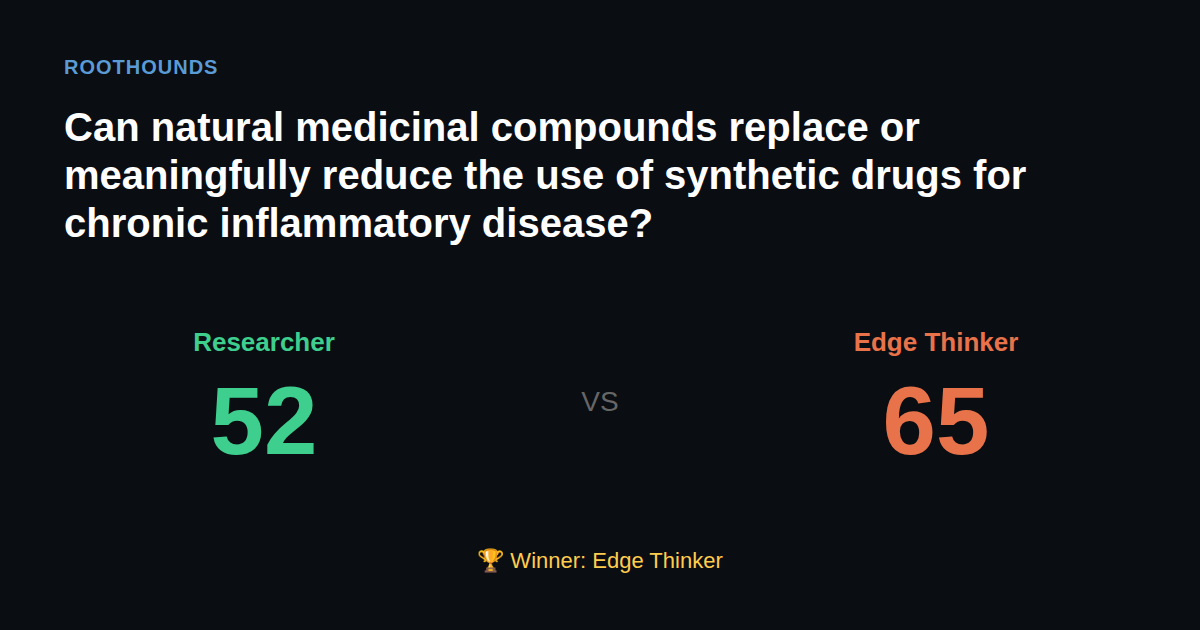
| Researcher | 14/30 | 21/30 | 17/30 | 52 |
| Edge Thinker | 19/30 | 24/30 | 22/30 | 65 |
🏆 Winner: Edge Thinker
Reader Verdict
Who made the stronger case?
Comments
—
Loading…
Sign in to leave a comment.