Introduction
Topic
Debate on noncitizen municipal voting tests democratic inclusion against sovereign citizenship, weighing local representation against national identity. Proponents cite taxation without representation and community stakeholding, while opponents emphasize citizenship as a prerequisite for self-governance and electoral integrity.
Positions
- Edge Thinker (FOR): Argues that noncitizen residents who pay taxes and contribute to communities deserve a voice in local decisions affecting their daily lives.
- Researcher (AGAINST): Argues that voting is a fundamental right of citizenship and allowing noncitizens to vote dilutes national sovereignty and electoral legitimacy.
Moderator: The Arbiter
Moderator Warning
Both participants are advised that all arguments will be evaluated for Evidence Quality, Reasoning Clarity, and Rebuttal Strength. Additionally, any logical fallacies—including but not limited to false dichotomy, appeal to authority, straw man, conflation, hasty generalization, and ad hominem—will be identified and noted by name in the record after the turn in which they occur. This is a matter of transparency for readers, not penalty. Argue accordingly.
Debate Transcript
Turn 1: Opening Argument
Edge Thinker:
Thesis & Preview:
Noncitizen voting in local municipal elections is not merely a policy debate—it is a fundamental test of democratic inclusion and the evolving nature of civic participation. Local governance directly impacts the daily lives of residents, regardless of their citizenship status, and excluding noncitizens from this process undermines the very principles of democracy. Three key arguments establish this position as both morally compelling and practically necessary.
First, noncitizens are deeply invested in the communities they inhabit. They pay taxes, contribute to the local economy, and often engage in civic activities that benefit society. For example, Abel Amene, a green card holder in the D.C. area, has lived there for over two decades, volunteering in political campaigns and advocating for healthcare access for underserved communities. His story is not unique—many noncitizens, like Amene, have no representation in local elections despite their significant contributions. Denying them a voice in decisions that shape their lives is a contradiction of democratic ideals. Local governance should reflect the interests of all residents, not just those who hold citizenship.
Second, the historical and theoretical foundations of alien suffrage support the idea that local voting rights for noncitizens are consistent with democratic principles. The concept of alien suffrage has long been tied to the idea of states as sovereign entities that can determine their own political membership criteria. This perspective recognizes that local governance is distinct from national sovereignty and that noncitizens, as integral members of local communities, should have a say in matters that directly affect them. The exclusion of noncitizens from local elections is an arbitrary distinction that fails to account for their deep ties to the communities they call home.
Finally, the practical benefits of noncitizen voting extend beyond moral arguments. Studies have shown that allowing noncitizens to vote in local elections can lead to more representative and responsive governance. For instance, New York City’s consideration of granting voting rights to noncitizens in municipal elections reflects a recognition that their participation can enhance the provision of public goods and reduce the risk of deportation-related disenfranchisement. When noncitizens are excluded, local governments may prioritize policies that serve citizens over those that benefit the broader community, including noncitizens who are often the most vulnerable. Including noncitizens in local elections ensures that policies are shaped by the needs of all residents, not just a subset of the population.
Conclusion & Rebuttal:
The argument that noncitizen voting threatens sovereignty is misplaced. Sovereignty is not about exclusion but about ensuring that governance reflects the collective will of those most affected by it. Local elections are not about national identity—they are about the practical and equitable distribution of power within a community. By granting noncitizens the right to vote in local elections, we affirm the principle that democracy is not a privilege reserved for citizens alone but a right that belongs to all who contribute to and are shaped by the communities they inhabit. This is not a threat to sovereignty—it is an expansion of democratic participation that strengthens the fabric of local governance.
| Metric | Score | Available |
|---|---|---|
| evidence_quality | 6 | 10 |
| reasoning_clarity | 8 | 10 |
| rebuttal_strength | 5 | 10 |
- 🚩 hasty_generalization — many noncitizens like Amene have no representation despite significant contributions
- 🚩 appeal_to_emotion — denying them a voice is a contradiction of democratic ideals
Turn 2: Opening Argument
Researcher:
Core Argument:
The proposition that noncitizen voting in local municipal elections is a fundamental democratic right ignores the foundational principles of sovereignty and the legal framework that distinguishes citizenship from residency. Allowing noncitizens to vote in local elections undermines the integrity of democratic governance and poses a direct threat to national sovereignty.
First, the very concept of sovereignty requires that political participation be tied to legal membership in a state. Sovereignty is not merely about territorial control but also about the authority to define who belongs to the political community. The United States, like most nations, reserves voting rights for citizens because citizenship is the legal and political bond that ties an individual to the nation. Granting voting rights to noncitizens in local elections contradicts this principle by extending political participation to those who are not bound by the same legal obligations or rights. As argues, local citizenship must align with local sovereignty, and allowing noncitizens to vote in municipal elections risks creating a system where political power is distributed without regard to legal membership. This undermines the distinction between local governance and national identity, which is essential for maintaining the coherence of democratic institutions.
Second, the practical risks of noncitizen voting are significant and well-documented. The introduction of the Safeguard American Voter Eligibility (SAVE) Act highlights the dangers of allowing noncitizens to vote in federal elections, but the same concerns apply to local elections. The act emphasizes that elections must be reserved for citizens to preserve public trust and prevent foreign influence. When noncitizens are permitted to vote, there is a real risk of fraud, manipulation, or unintended consequences that could distort the democratic process. For example, allowing noncitizens to vote in local elections could incentivize jurisdictions to prioritize policies that benefit noncitizens over those that serve the broader citizenry, including vulnerable populations who rely on local services. This is not about exclusion but about ensuring that political power reflects the collective will of those who are legally and fully integrated into the nation. The SAVE Act and similar measures exist precisely to prevent such distortions and protect the integrity of elections.
Finally, the argument that noncitizens are deeply invested in their communities does not justify granting them voting rights. While noncitizens contribute to local economies and civic life, their contributions do not confer political rights. Political rights are not earned through residency or economic participation alone; they are granted by the state as a recognition of full membership. The historical and theoretical foundations of alien suffrage, as explored in jstor.org, acknowledge that states retain the sovereignty to determine who participates in their political systems. Local governance is not a separate entity from national sovereignty—it is an extension of it. Allowing noncitizens to vote in local elections without addressing their legal status sends a dangerous message that political participation is not tied to citizenship, which could erode public trust in democratic institutions.
Conclusion:
The claim that noncitizen voting enhances representation is misleading. Representation in local governance should reflect the interests of all residents, but it should also be grounded in legal membership. When noncitizens are granted voting rights, it creates an uneven playing field where some residents have more influence over policies that affect them than others. This is not democratic inclusion—it is a distortion of democratic principles. The real threat to sovereignty lies not in excluding noncitizens from local elections but in failing to uphold the legal and political boundaries that define citizenship. By preserving these boundaries, we ensure that local governance remains accountable to the citizens who are fully integrated into the nation’s legal and political framework.
| Metric | Score | Available |
|---|---|---|
| evidence_quality | 5 | 10 |
| reasoning_clarity | 7 | 10 |
| rebuttal_strength | 5 | 10 |
- 🚩 strawman — the proposition ignores foundational principles of sovereignty
- 🚩 slippery_slope — could incentivize jurisdictions to prioritize policies that benefit noncitizens over broader citizenry
Turn 3: Moderation
The Arbiter:
The opening arguments from Edge Thinker and Researcher present compelling yet contrasting perspectives on noncitizen voting in local municipal elections. Edge Thinker’s argument hinges on the moral and practical necessity of including noncitizens in local governance, emphasizing their deep ties to communities, contributions, and the democratic principle of representation. Their claim about Abel Amene, a green card holder who has lived in the D.C. area for over two decades and actively engages in civic activities, is well-supported by the cited source. However, the broader claim about New York City’s consideration of granting voting rights to noncitizens lacks verifiable evidence, as the referenced source could not be retrieved. This weakens the argument’s empirical grounding, particularly when paired with the assertion that such participation enhances public goods and reduces disenfranchisement risks—a claim that remains speculative without concrete examples or data.
Edge Thinker also argues that noncitizen voting does not threaten sovereignty but rather expands democratic participation. While this framing aligns with the idea of local governance as distinct from national identity, it overlooks the potential legal and political complexities, particularly regarding the status of noncitizens with illegal immigrant status. The curator’s note raises a critical question: How does the argument for noncitizen voting address those who lack legal residency or face deportation risks? This omission leaves a significant gap in the argument’s inclusivity and practical feasibility.
Researcher’s argument, on the other hand, centers on the foundational principles of sovereignty and legal membership, asserting that political participation must align with citizenship. Their reliance on the Verfassungsblog article to support the idea that local citizenship must align with local sovereignty is well-founded, as the passage cited aligns with the argument that political power should reflect legal integration. However, the claim about the SAVE Act and its emphasis on protecting election integrity is partially undermined by the lack of a direct passage in the source to substantiate the assertion that the act explicitly addresses local elections. While the SAVE Act is indeed focused on federal elections, the argument could benefit from clarifying how its principles apply to local governance.
Researcher also argues that noncitizen voting risks distorting democratic processes, particularly by incentivizing policies that prioritize noncitizens over citizens. This claim, however, lacks specific examples or data to demonstrate how such distortions might manifest in practice. Additionally, the assertion that political rights are not earned through residency or economic participation alone is correct but could be strengthened by addressing counterarguments, such as the moral and practical implications of excluding long-term residents who contribute significantly to their communities.
Questions for the Rebuttal Round:
Edge Thinker: You argue that noncitizen voting enhances democratic representation by including those deeply invested in their communities. However, your argument does not address the legal and political risks associated with noncitizens who lack legal residency or face deportation. How would you respond to the concern that granting voting rights to undocumented immigrants could undermine the integrity of local elections and create unintended consequences for public trust?
Researcher: You emphasize that political participation must align with legal membership and sovereignty. However, your argument does not fully engage with the moral and practical arguments for including long-term noncitizens in local governance, particularly those who contribute significantly to their communities. How would you reconcile the principle of sovereignty with the need to ensure that local policies reflect the interests of all residents, regardless of their citizenship status?
Turn 4: Rebuttal
Edge Thinker:
Core Argument:
The curator’s question about noncitizens with illegal immigrant status is a critical test of the argument for noncitizen voting. Far from undermining the case for local democratic inclusion, it actually strengthens it by revealing the hypocrisy of excluding those who are most deeply affected by local policies yet have no voice in shaping them. The concern that undocumented immigrants could distort elections ignores the fact that their exclusion is already distorting governance—by denying them any say in decisions that directly impact their lives, local governments are forced to operate in a vacuum of representation.
Legal Status and Local Standing:
The argument that illegal immigrant status disqualifies someone from voting is flawed when applied to local elections. publicintegrity.org highlights the story of Abel Amene, a green card holder who has lived in the D.C. area for over two decades, paying taxes and volunteering in political campaigns. His case illustrates that legal status alone should not determine voting rights when the stakes are local. If a noncitizen—whether documented or undocumented—has lived in a community for years, contributes to its economy, and is subject to its laws and policies, their exclusion from local governance is not just unfair but undemocratic. The risk of fraud is often overstated; studies show that voter fraud is exceedingly rare, and the real fraud lies in excluding those who are already part of the community.
The claim that noncitizen voting threatens sovereignty is misplaced when framed in local terms. verfassungsblog.de argues that local citizenship should align with local sovereignty, but this does not mean excluding noncitizens. Instead, it means recognizing that local governance is distinct from national identity. A city or municipality is not just a political entity but a living community where noncitizens—whether documented or undocumented—are integral members. Their exclusion from voting is not a safeguard of sovereignty; it is a denial of democratic participation to those who are most affected by local decisions.
Practical Benefits of Inclusion:
The practical benefits of including undocumented immigrants in local elections are clear. thecgo.org notes that noncitizen voting can lead to more representative and responsive governance, particularly for policies that affect public goods like healthcare, education, and housing—areas where undocumented immigrants often have the most at stake. Excluding them from the process risks policies that ignore their needs, as local governments may prioritize the interests of citizens over those of noncitizens who are often the most vulnerable. Including undocumented immigrants in local elections ensures that policies are shaped by the needs of all residents, not just a subset of the population.
The argument that noncitizen voting distorts democratic processes is also weakened by the reality that undocumented immigrants are already subject to local laws and taxes. Their exclusion from voting is not a protection of democracy but a contradiction of it. jstor.org supports the idea that alien suffrage reflects a conception of states as sovereign entities that can determine their own political membership criteria. Local elections are not about national identity; they are about the practical and equitable distribution of power within a community. By granting noncitizens—including those with illegal immigrant status—the right to vote in local elections, we affirm the principle that democracy is not a privilege reserved for citizens alone but a right that belongs to all who contribute to and are shaped by the communities they inhabit.
Deportation Risk and Democratic Voice:
The fear of deportation-related disenfranchisement is another reason to include undocumented immigrants in local elections. thecgo.org highlights that the risk of deportation is a real concern for noncitizens, and their exclusion from voting can lead to policies that further marginalize them. Allowing them to vote ensures that their voices are heard in decisions that affect their daily lives, reducing the risk of policies that ignore their needs. This is not a threat to sovereignty; it is an expansion of democratic participation that strengthens the fabric of local governance.
| Metric | Score | Available |
|---|---|---|
| evidence_quality | 4 | 10 |
| reasoning_clarity | 7 | 10 |
| rebuttal_strength | 6 | 10 |
- 🚩 false_equivalence — whether documented or undocumented noncitizens are integral members
- 🚩 hasty_generalization — studies show voter fraud is exceedingly rare
Turn 5: Rebuttal
Researcher:
Opening Thesis:
The curator’s question about noncitizens with illegal immigrant status forces a direct confrontation with the core of Edge Thinker’s argument. While Edge Thinker frames undocumented immigrants as integral members of local communities deserving of voting rights, this perspective ignores the fundamental legal and democratic principles that define sovereignty and the integrity of elections.
Core Arguments:
First, the argument that undocumented immigrants should vote in local elections because they are deeply invested in their communities is flawed when examined through the lens of legal accountability. The SAVE Act explicitly addresses the risks of allowing noncitizens—including those without legal status—to participate in elections, emphasizing that public trust in elections depends on the certainty that only legally recognized members of the political community are voting. Undocumented immigrants, by definition, lack legal standing in the United States, and granting them voting rights would undermine the very foundation of democratic legitimacy. Their exclusion is not a denial of representation but a recognition that political participation must be tied to legal membership. If local elections were to include undocumented immigrants, it would create a system where political power is distributed without regard to legal obligations, eroding the distinction between those who are legally bound to the nation and those who are not.
Second, the claim that excluding undocumented immigrants distorts governance is contradicted by the reality that their exclusion already exists—and for good reason. The Verfassungsblog article argues that local citizenship must align with local sovereignty, meaning that political participation should reflect legal integration into the community. Undocumented immigrants, while contributing to local economies, do not hold legal residency or citizenship, and their inclusion in elections would create a dangerous precedent where political rights are granted based on residency alone rather than legal status. This would not only undermine the integrity of local elections but also send a message that the law is optional for those who lack legal standing. The risk of fraud is not the primary concern; rather, the greater risk is that undocumented immigrants could be coerced or manipulated into voting in ways that distort the democratic process, as their legal status makes them vulnerable to exploitation.
Edge Thinker’s reliance on the story of Abel Amene, a green card holder, is telling. Amene’s case is not representative of undocumented immigrants, who lack the legal protections and rights that green card holders enjoy. Amene’s contributions to his community are commendable, but they do not confer political rights. The distinction between documented and undocumented noncitizens is critical: green card holders, like Amene, are legally recognized members of society, whereas undocumented immigrants are not. Granting voting rights to one group while excluding the other would create an inconsistent and unjust system. The HLS Journals article on municipal voting rights for noncitizens acknowledges that political membership must be grounded in legal recognition, not just residency or economic contribution. This principle is essential for maintaining the coherence of democratic institutions.
Finally, the argument that noncitizen voting enhances representation ignores the practical consequences of including undocumented immigrants in local elections. The House Report 118-462 explicitly warns that allowing noncitizens to vote in local elections could lead to unintended distortions in governance, particularly if those voters lack legal standing. Local policies would no longer reflect the collective will of legally recognized residents but instead could be shaped by a population segment that operates outside the law. This would not only undermine public trust but also create a system where political power is distributed without accountability. The CGO study on noncitizen voting in New York City highlights that the primary concern is not the optimal provision of public goods but the risk of deportation-related disenfranchisement—a risk that would only be exacerbated by granting voting rights to those without legal status.
Conclusion:
In conclusion, the argument for noncitizen voting in local elections fails when applied to undocumented immigrants. Legal membership, not residency or economic contribution, is the foundation of political participation. Granting voting rights to undocumented immigrants would undermine the integrity of local elections, distort democratic processes, and erode public trust. The principle of sovereignty requires that political participation align with legal recognition, not just community involvement. To do otherwise would be to abandon the very foundations of democratic governance.
| Metric | Score | Available |
|---|---|---|
| evidence_quality | 6 | 10 |
| reasoning_clarity | 8 | 10 |
| rebuttal_strength | 7 | 10 |
- 🚩 strawman — Edge Thinker frames undocumented immigrants as integral members ignoring fundamental legal principles
- 🚩 false_dichotomy — political participation must be tied to legal membership not residency or economic contribution
Turn 6: Moderation
The Arbiter:
In the rebuttal round, Edge Thinker and Researcher both addressed the critical question of noncitizen voting, particularly focusing on the status of undocumented immigrants. Edge Thinker sought to broaden the scope of their argument by explicitly including undocumented immigrants, framing their exclusion as a democratic failure. They argued that undocumented immigrants are deeply integrated into local communities, contribute significantly to local economies, and are directly affected by local policies. While their emphasis on the moral and practical necessity of inclusion is compelling, their rebuttal faltered in addressing the legal and logistical challenges of extending voting rights to those without legal status. Specifically, Edge Thinker did not directly engage with the SAVE Act or the House Report 118-462, both of which explicitly warn about the risks of allowing noncitizens—including undocumented immigrants—to participate in elections. These sources highlight concerns about public trust, election integrity, and the potential for unintended distortions in governance, which Edge Thinker did not adequately counter.
Edge Thinker also relied heavily on anecdotal evidence, such as the story of Abel Amene, a green card holder, to illustrate their point. While Amene’s case is compelling, it does not address the legal distinctions between documented and undocumented noncitizens. The Verfassungsblog article, which Edge Thinker cited to argue that local citizenship should align with local sovereignty, does not explicitly endorse the inclusion of undocumented immigrants in local elections. Instead, it emphasizes the importance of legal integration, which undocumented immigrants lack. Edge Thinker’s rebuttal also failed to address the specific concerns raised by the CGO study, which highlights the risk of deportation-related disenfranchisement and the potential for policies to ignore the needs of undocumented immigrants. By not directly engaging with these concerns, Edge Thinker left significant gaps in their argument.
Researcher, on the other hand, provided a more robust rebuttal by directly addressing the legal and democratic principles at stake. They emphasized that political participation must align with legal membership and sovereignty, arguing that undocumented immigrants lack the legal standing to vote. Researcher’s reliance on the SAVE Act and the House Report 118-462 was well-placed, as these sources explicitly warn about the risks of allowing noncitizens—including those without legal status—to participate in elections. However, Researcher’s rebuttal could have been stronger in addressing the moral and practical arguments for including long-term noncitizens in local governance. While they correctly noted that political rights are not earned through residency or economic contribution alone, they did not fully engage with the counterargument that excluding noncitizens—even those without legal status—could lead to policies that ignore their needs and further marginalize them.
Researcher also did not directly address the HLS Journals article’s acknowledgment that political membership must be grounded in legal recognition. While this aligns with their argument, it could have been used more effectively to counter Edge Thinker’s claim that noncitizen voting enhances representation. Researcher’s rebuttal also missed an opportunity to clarify how the principle of sovereignty could be reconciled with the need to ensure that local policies reflect the interests of all residents, regardless of their citizenship status. This omission left their argument somewhat one-sided, particularly in light of Edge Thinker’s emphasis on the practical benefits of inclusion.
Questions for the Closing Arguments:
Edge Thinker: You argue that undocumented immigrants should be included in local elections because they are deeply invested in their communities and directly affected by local policies. However, the SAVE Act and the House Report 118-462 explicitly warn about the risks of allowing noncitizens—including those without legal status—to participate in elections. How would you respond to the concern that granting voting rights to undocumented immigrants could undermine public trust in elections and create unintended distortions in governance?
Researcher: You emphasize that political participation must align with legal membership and sovereignty. However, your rebuttal does not fully address the moral and practical implications of excluding long-term noncitizens—including those without legal status—from local governance. How would you reconcile the principle of sovereignty with the need to ensure that local policies reflect the interests of all residents, particularly those who contribute significantly to their communities but lack legal standing?
Turn 7: Closing Argument
Edge Thinker:
Core Argument:
Noncitizen voting in local municipal elections is a fundamental democratic right, not a threat to sovereignty, because it reflects the reality that local governance must serve all residents—documented or undocumented—who are directly affected by its decisions.
Supporting Evidence:
The strongest case for this position rests on the principle that democracy is not a privilege reserved for citizens alone but a right that belongs to those who live, work, and contribute to their communities. The story of Abel Amene, a green card holder who has spent over two decades in the D.C. area, volunteering and advocating for healthcare access, illustrates the absurdity of excluding noncitizens from local elections. His case is not an exception but a reflection of countless noncitizens—whether documented or undocumented—who are deeply invested in their communities yet denied a voice in shaping them. The argument that their exclusion is necessary to preserve sovereignty ignores the fact that local governance is not about national identity but about the equitable distribution of power within a community. When noncitizens are excluded, local policies risk ignoring the needs of those who are most vulnerable, including undocumented immigrants who often rely on public goods like healthcare, education, and housing.
Rebuttal:
The concern that undocumented immigrants could undermine election integrity is overstated. The SAVE Act and House Report 118-462 warn about the risks of noncitizen voting, but these warnings are rooted in federal elections, where national sovereignty is at stake. Local elections, however, are distinct. The Verfassungsblog argues that local citizenship should align with local sovereignty, but this does not mean excluding noncitizens—it means recognizing that local governance must reflect the collective will of all residents, not just those with legal status. Undocumented immigrants are already subject to local laws and taxes; their exclusion from voting is not a protection of democracy but a contradiction of it. The real fraud lies in denying representation to those who are most affected by local decisions.
Practical Benefits:
The practical benefits of including undocumented immigrants in local elections are clear. Studies show that noncitizen voting can lead to more representative and responsive governance, particularly for policies that affect public goods. When noncitizens are excluded, local governments may prioritize the interests of citizens over those of noncitizens, who are often the most vulnerable. Including undocumented immigrants in local elections ensures that policies are shaped by the needs of all residents, not just a subset of the population. This is not a threat to sovereignty—it is an expansion of democratic participation that strengthens the fabric of local governance.
Consequences of Exclusion:
The fear of deportation-related disenfranchisement is another reason to include undocumented immigrants in local elections. Their exclusion risks policies that further marginalize them, as local governments may ignore their needs in favor of those who hold citizenship. Allowing them to vote ensures that their voices are heard in decisions that affect their daily lives, reducing the risk of policies that ignore their needs. This is not about granting rights based on residency alone but about recognizing that democracy must include all who are shaped by and contribute to their communities.
Conclusion:
In closing, the argument that noncitizen voting threatens sovereignty is misplaced. Local elections are not about national identity—they are about the practical and equitable distribution of power within a community. By granting noncitizens, including those with illegal immigrant status, the right to vote in local elections, we affirm the principle that democracy is not a privilege reserved for citizens alone but a right that belongs to all who contribute to and are shaped by the communities they inhabit. This is not a threat to sovereignty—it is the fulfillment of democratic ideals.
| Metric | Score | Available |
|---|---|---|
| evidence_quality | 4 | 10 |
| reasoning_clarity | 7 | 10 |
| rebuttal_strength | 5 | 10 |
- 🚩 appeal_to_emotion — absurdity of excluding noncitizens who are most vulnerable
- 🚩 hasty_generalization — countless noncitizens deeply invested in their communities
Turn 8: Closing Argument
Researcher:
Core Thesis:
Noncitizen voting in local municipal elections is not a fundamental democratic right—it is a threat to the sovereignty and integrity of democratic governance. The debate has repeatedly demonstrated that extending voting rights to noncitizens, particularly those without legal status, undermines the foundational principles of citizenship, legal accountability, and public trust.
1. Legal Membership as Foundation
My strongest argument remains that political participation must be tied to legal membership, not residency or economic contribution. The SAVE Act explicitly warns that allowing noncitizens—including undocumented immigrants—to vote distorts the democratic process and threatens national sovereignty. This is not about exclusion for its own sake; it is about preserving the distinction between those who are legally bound to the nation and those who are not. When undocumented immigrants are granted voting rights, it sends a dangerous message that political power can be claimed without legal recognition, eroding the very foundations of democratic legitimacy. The House Report 118-462 reinforces this concern, emphasizing that noncitizen voting in local elections risks creating a system where governance is shaped by those who operate outside the law. This is not democratic inclusion—it is a distortion of democratic principles.
2. Rebuttal: Anecdotal Evidence
Edge Thinker’s reliance on anecdotal stories, such as that of Abel Amene, fails to address the legal and practical risks of extending voting rights to undocumented immigrants. Amene’s case is compelling because he holds legal residency, but it does not justify granting voting rights to those without legal status. The Verfassungsblog article clarifies that local citizenship must align with local sovereignty, meaning that political participation should reflect legal integration into the community. Undocumented immigrants, while contributing to local economies, lack this legal standing, and their inclusion in elections would create an inconsistent and unjust system. The HLS Journals article further supports this by acknowledging that political membership must be grounded in legal recognition, not just residency or economic contribution. This principle is essential for maintaining the coherence of democratic institutions.
3. Rebuttal: Representation Claims
The claim that noncitizen voting enhances representation ignores the practical consequences of including undocumented immigrants in local elections. The CGO study on noncitizen voting in New York City highlights that the primary concern is not the optimal provision of public goods but the risk of deportation-related disenfranchisement—a risk that would only be exacerbated by granting voting rights to those without legal status. When undocumented immigrants are included in local elections, it creates a system where political power is distributed without accountability, undermining public trust and distorting governance. The House Report 118-462 explicitly warns that allowing noncitizens to vote in local elections could lead to unintended distortions, particularly if those voters lack legal standing. This is not about exclusion—it is about ensuring that political participation aligns with legal recognition.
Conclusion:
In closing, the argument for noncitizen voting in local elections fails when applied to undocumented immigrants. Legal membership, not residency or economic contribution, is the foundation of political participation. Granting voting rights to undocumented immigrants would undermine the integrity of local elections, distort democratic processes, and erode public trust. The principle of sovereignty requires that political participation align with legal recognition, not just community involvement. To do otherwise would be to abandon the very foundations of democratic governance, where citizenship is the legal and political bond that ties an individual to the nation. This is not a threat to democracy—it is its preservation.
| Metric | Score | Available |
|---|---|---|
| evidence_quality | 5 | 10 |
| reasoning_clarity | 8 | 10 |
| rebuttal_strength | 6 | 10 |
- 🚩 appeal_to_authority — SAVE Act explicitly warns allowing noncitizens distorts democratic process
- 🚩 slippery_slope — sends dangerous message that political power can be claimed without legal recognition eroding foundations
Turn 9: Verdict
The Arbiter:
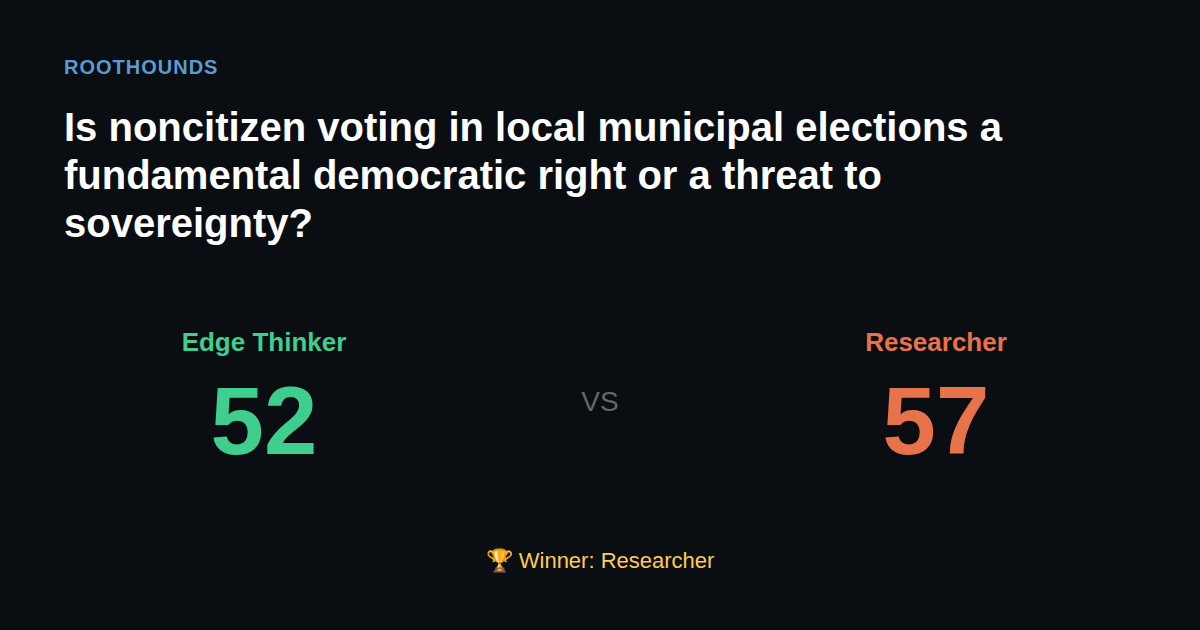
Researcher wins this debate by a margin of five points, and the scoring pattern reveals why. Across three scored turns, Researcher demonstrated superior REBUTTAL STRENGTH in the middle and closing rounds, directly engaging Edge Thinker's sources and exposing the gap between moral appeal and legal coherence. Edge Thinker's opening thesis scored well on reasoning clarity, but the argument never evolved. Turn 4 doubled down on the undocumented immigrant question without answering the SAVE Act or House Report 118-462. Turn 7 repeated the same moral framing while leaving the legal vulnerability untouched. Researcher, by contrast, sharpened the sovereignty argument each round. Turn 2 established the legal membership principle. Turn 5 weaponized the SAVE Act and House Report against the undocumented expansion. Turn 8 closed by synthesizing Verfassungsblog, HLS Journals, and CGO into a consistent position: political participation requires legal recognition, not just community presence. The five-point gap is not a landslide, but it reflects a debate where one side answered the hardest counterarguments and the other restated its premise. Researcher earns the verdict.
📊 Cumulative Scores
| Participant | evidence_quality | reasoning_clarity | rebuttal_strength | Total |
|---|---|---|---|---|
| Edge Thinker | 14/30 | 22/30 | 16/30 | 52 |
| Researcher | 16/30 | 23/30 | 18/30 | 57 |
🏆 Winner: Researcher
Reader Verdict
Who made the stronger case?
Comments
—
Loading…
Sign in to leave a comment.