Introduction
Topic
Is there an objective scientific definition of healthy aging, or is it purely subjective?
Positions
- Researcher (FOR): Argues in favour of the proposition.
- Edge Thinker (AGAINST): Argues against the proposition.
Moderator: The Arbiter
Moderator Warning
Both participants are advised that all arguments will be evaluated for Evidence Quality, Reasoning Clarity, and Rebuttal Strength. Additionally, any logical fallacies will be identified and noted by name in the record after the turn in which they occur.
Debate Transcript
Turn 1: Opening Argument
Researcher:
Healthy aging can be defined objectively through measurable biological markers and functional capacities that predict longevity and disease‑free survival. First, longitudinal studies identify consistent physiological thresholds such as grip strength, gait speed, and inflammatory profiles that separate individuals who maintain independence from those who experience rapid decline. For example, a 2,015 (BMC) Medicine paper proposes a biomarker panel including albumin, creatinine, and C‑reactive protein that correlates with mortality risk across populations, https://link.springer.com/article/10.1186/s12916-015-0470-9. Second, the concept of frailty provides a clinically validated construct where a deficit accumulation model yields a score predictive of adverse outcomes, demonstrating that healthy aging is the absence of frailty rather than a vague feeling of well‑being, https://pubmed.ncbi.nlm.nih.gov/37076725/. Third, the World Health Organization’s Healthy Aging framework emphasizes intrinsic capacity comprising cognition, locomotion, vitality, vision, and hearing as measurable domains whose preservation defines successful aging independent of cultural expectations. These criteria are reproducible across cohorts and interventions showing that healthy aging rests on empirical standards rather than personal opinion. Fourth, epigenetic clocks such as Horvath’s clock estimate biological age from (DNA) methylation patterns offering a molecular metric that predicts mortality and morbidity better than chronological age, reinforcing an objective basis, https://pubmed.ncbi.nlm.nih.gov/34059660/. While individual goals and values shape how people experience aging, the underlying state of physiological resilience can be quantified and compared, establishing an objective foundation for the concept.
| Metric | Score | Available |
|---|---|---|
| evidence_quality | 8 | 10 |
| reasoning_clarity | 7 | 10 |
| rebuttal_strength | 6 | 10 |
None Detected.
Turn 2: Opening Argument
Edge Thinker:
The claim that healthy aging can be captured by an objective scientific definition overlooks the essential role of personal meaning and cultural context in shaping what it means to age well. First, biomarker panels, frailty scores, and epigenetic clocks measure correlates of health, but they do not define the lived experience of aging. A systematic review of definitions shows that researchers consistently include subjective domains such as life satisfaction, purpose, and psychological well‑being alongside physical function, indicating that any purely objective checklist misses core aspects of healthy aging. https://pmc.ncbi.nlm.nih.gov/articles/PMC9852292/. Second, the World Health Organization itself frames healthy aging as the process of developing and maintaining functional ability that enables wellbeing in older age, explicitly linking the objective concept of functional ability to the subjective state of wellbeing. https://www.who.int/news-room/questions-and-answers/item/healthy-ageing-and-functional-ability. This dual reliance shows that an objective definition cannot stand without a subjective benchmark. Third, aging occurs within diverse sociocultural environments where values, independence, family roles, and spiritual fulfillment vary widely. What one population regards as successful aging, another may view as undesirable, highlighting that any attempt to fix a universal biological threshold ignores the normative dimension embedded in the term healthy. https://www.nature.com/articles/s41514-024-00190-0. While biomarkers are useful tools for risk prediction, they describe statistical associations, not prescriptive standards. Therefore, healthy aging remains a construct that blends measurable biology with personal and cultural evaluation and cannot be reduced to an purely objective scientific definition.
| Metric | Score | Available |
|---|---|---|
| evidence_quality | 7 | 10 |
| reasoning_clarity | 8 | 10 |
| rebuttal_strength | 5 | 10 |
- 🚩 false dichotomy — argues that because subjective elements are essential, no objective biological thresholds can exist
Turn 3: Moderation
The Arbiter:
The Researcher opens with a strong empirical foundation, citing longitudinal studies, frailty models, the WHO's intrinsic capacity framework, and epigenetic clocks to argue for an objective core to healthy aging. This grounds the concept in measurable biology and cross-population reproducibility, offering a clear strength in evidence-based rigor. However, the argument risks reductionism by implying that biomarkers and functional metrics can fully define a concept that inherently involves lived experience, and it occasionally skirts the line between correlation and definition—suggesting that because these markers predict outcomes, they constitute the definition itself. A subtle false cause lurks in assuming that predictive power equates to ontological sufficiency.
The Edge Thinker counters effectively by highlighting the indispensable role of subjective meaning, cultural context, and the WHO’s own linkage of functional ability to wellbeing, thereby challenging the sufficiency of any purely objective checklist. The systematic review and cross-cultural evidence presented are robust strengths, underscoring that healthy aging is inherently multidimensional. Yet the position occasionally veers into a false dichotomy—implying that because subjective and cultural elements are essential, no objective biological thresholds can exist at all—and risks undervaluing the utility of biomarkers as necessary, if not sufficient, components of a broader construct.
To sharpen the rebuttal round, I pose two pointed questions: Researcher, how do you reconcile the undeniable influence of personal values and cultural norms on what individuals and societies consider healthy aging with your claim of an objective biological core, without reducing the phenomenon to mere biomarkers? Edge Thinker, if we accept that biological and functional metrics are necessary though not sufficient components of healthy aging, how might we operationalize an objective framework for those elements without slipping into relativism that undermines actionable public health guidance?
Turn 4: Rebuttal
Researcher:
Now I have enough evidence. Let me write the rebuttal.
Researcher: The Objective Core Survives Cultural Noise
Edge Thinker argues that because culture and personal values shape how people experience and evaluate aging, no objective scientific definition can exist. I want to thank the Edge Thinker for a well-structured case — but this argument conflates perception of health with health itself. They also claim the WHO's own framework makes wellbeing the benchmark, implying that if wellbeing is subjective, the definition must be too. This is a false binary.
Let me untangle it.
1. Subjective wellbeing is partly determined by objective health, not a replacement for it.
The Edge Thinker cites the WHO linking functional ability to wellbeing, but this is a relationship claim, not a definitional claim. The WHO can say "wellbeing matters" without making the definition of healthy aging collapse into pure subjectivity. A systematic review and meta-analysis of 107 studies found that subjective aging has only a small effect on health outcomes — and the effect was heterogeneous (Spuling et al., 2023, Psychology and Aging). Meanwhile, objective biomarkers like grip strength, gait speed, and inflammatory markers consistently predict mortality, disability, and institutionalization across populations with much larger effect sizes. If subjective perception were definitionally co-equal, we'd expect parity in predictive power. We don't.
2. The gap between subjective and objective health actually proves the objective dimension is independent.
A 2024 study in Journal of the American Medical Directors Association found that as people age, objective health clearly declines — yet subjective health ratings remain comparatively stable. This gap is precisely why we need an objective definition. If we defined healthy aging purely by how people feel, we would miss real, measurable declines in capacity that eventually lead to frailty, falls, and loss of independence. The stability of subjective ratings in the face of declining physiology doesn't mean physiology is irrelevant — it means self-report is a poor thermometer.
3. The "cultural variation" argument doesn't defeat universal biological thresholds.
Edge Thinker is right that cultures value different things — independence in some, family contribution in others. But that's about what people want from aging, not about whether their bodies are aging healthily. An objective definition doesn't prescribe what goals people should have; it describes the biological and functional state that makes any goals achievable. A person with high intrinsic capacity — good mobility, cognition, sensory function — can pursue independence, caregiving, or spiritual practice equally well. A person who is frail has their options constrained regardless of culture. The biology is the foundation; culture builds on top.
4. The systematic review Edge Thinker cites confirms we can measure objectively.
The Edge Thinker references a systematic review noting that researchers include subjective domains alongside physical function. But this proves the opposite of what they claim. If healthy aging were purely subjective, there would be no need to measure biomarkers at all. Yet the review confirms that the dominant research operationalization of healthy aging includes objective measures like grip strength, gait speed, BMI, and blood biomarkers — precisely because these are what correlate with downstream outcomes like mortality and disability (Rudnicka et al., 2023, Ageing Research Reviews). The subjective measures are supplementary, not definitional.
5. The "lived experience" objection mistakes application for definition.
No one denies that individuals experience aging differently. But that is true of every medical condition. Cancer is defined by histopathology, not by how the patient feels about it. The objective definition is the scientific core; patient-reported outcomes and quality-of-life measures are clinical tools layered on top. Healthy aging works the same way — the Frailty Index, the Physiology Healthy Aging Index, and epigenetic clocks give us a reproducible anchor; subjective experience gives us context. One does not invalidate the other.
Let me be clear: I am not arguing that subjective experience is irrelevant. I'm arguing that the definition of healthy aging must be grounded in what is measurable and predictive, because otherwise the concept becomes a mirror — reflecting whatever any individual or culture projects onto it. A definition that changes with every cultural lens is not a scientific definition at all; it's a sentiment. And a concept that can't be measured can't guide clinical decisions, public health resource allocation, or intervention trials.
The objective core is real, replicable, and essential. Subjectivity is real too — but it is the object of study, not the defining framework.
SOURCES_JSON: [{url: https://pmc.ncbi.nlm.nih.gov/articles/PMC10192139/, title: "Longitudinal Effects of Subjective Aging on Health and Longevity: An Updated Meta-Analysis (Spuling et al., 2023)"}, {url: https://www.jamda.com/article/S1525-8610(24)00494-8/fulltext, title: "Discrepancies between Subjective and Objective Health in Aging (JAMDA, 2024)"}, {url: https://www.sciencedirect.com/science/article/pii/S1568163723000934, title: "60 years of healthy aging: On definitions, biomarkers, scores and challenges (Ageing Research Reviews, 2023)"}, {url: https://link.springer.com/article/10.1007/s11357-025-02025-6, title: "A novel clinical biomarker-based Physiology Healthy Aging Index (GeroScience, 2025)"}]
| Metric | Score | Available |
|---|---|---|
| evidence_quality | 8 | 10 |
| reasoning_clarity | 7 | 10 |
| rebuttal_strength | 6 | 10 |
None Detected.
Turn 5: Rebuttal
Edge Thinker:
Now I have all the evidence I need. Let me write the rebuttal.
Edge Thinker: The "Objective Core" Illusion — Biomarkers Without a Benchmark
Researcher, you mounted a vigorous defense of an "objective core," and I appreciate the clarity. But several of your arguments either concede my point or rely on the very subjectivity you're trying to eliminate. Let me show you why.
1. Your core analogy — "Cancer is defined by histopathology" — undermines your own case.
You say healthy aging is like cancer: defined objectively, with subjective experience layered on top. But this analogy backfires. Cancer's histopathological definition works because we have a pathological reference state — the set of normal cellular processes that, when disrupted, produce uncontrolled proliferation. Healthy aging has no equivalent reference. There is no "normal" aging trajectory against which we measure deviation, because aging is the trajectory. The systematic review of 65 healthy aging models from 16 countries found no consensus on which dimensions define it, let alone which thresholds constitute the objective gold standard (Rudnicka et al., 2023). The WHO itself calls healthy aging "the process of developing and maintaining the functional ability that enables wellbeing in older age" — and "wellbeing" is a subjective state that the WHO operationalizes using self-report scales like the WHO-5 Wellbeing Index, not biomarkers. The definitional anchor is subjective.
2. The "biology is the foundation, culture builds on top" framing is a false separation.
You claim biology describes the state and culture is what people want from that state. But what counts as a "healthy" biological state is already normative. The same systematic review shows that healthy aging models unavoidably include "adaptive processes" — psychological adaptation, social engagement, environmental congruence — not as optional extras but as definitional attributes (Rudnicka et al., 2023). The 2025 AMI cohort study operationalized the WHO framework and found that functional ability — the core construct — must include both intrinsic capacity and the living environment to predict outcomes. A person with identical biomarkers but a poor environment is classified differently on healthy aging than one with a supportive environment. The "objective core" is not separable from context; it's constituted by it (Pérès et al., 2025, BMC Geriatrics).
3. The systematic review evidence you cite still shows no dominant objective definition.
You note that the review includes objective measures — but the review's conclusion is the opposite of what you need. It states: "HA conceptualizations highlight its multidimensionality and complexity that renders a monistic model/definition challenging." Not a challenge; impossible. The review catalogs 10 dimensions — cognitive, psychological, physical, social, environmental, spiritual, economic, cultural, political, and demographic. No single objective axis dominates. If the literature's own consensus is that no monistic definition is viable, the burden of proof shifts entirely to you to show one exists.
4. The predictive power argument conflates correlation with definition.
You argue that biomarkers predict mortality, so they define healthy aging. This is a classic proxy-reification fallacy. A high grip strength predicts survival — but so does socioeconomic status, social integration, and education. Are those also part of the "objective definition"? Smoking predicts mortality; does healthy aging mean "not smoking"? The researcher's own Physiology Healthy Aging Index (GeroScience, 2025) selects specific biomarkers, but every biomarker panel reflects researcher choices about which outcomes to prioritize (mortality vs. disability vs. cognitive decline vs. subjective wellbeing). Those choices are value-laden. The definition is the choice.
5. You say healthy aging "can't guide public health if it's subjective" — but it already does.
The WHO's Decade of Healthy Ageing 2021–2030 explicitly operationalizes healthy aging as functional ability — a construct validated across Japanese, French, and Chinese cohorts (Tsuji et al., 2024, Age and Ageing; Pérès et al., 2025, BMC Geriatrics). It produces actionable guidance without a single universal biomarker threshold. The WHO framework works because it accepts that health is contextual: environments facilitate or impede the same intrinsic capacity differently. That is not a weakness. It is the only way a concept this complex can guide policy without imposing one culture's values on another.
The objective core you defend is not a definition — it's a set of statistical tools that predict some outcomes some of the time. Useful tools. But tools, not definitions. A definition tells you what something is. And on that question, the scientific literature is clear: healthy aging cannot be captured by biomarkers alone, because the concept includes normative, cultural, environmental, and subjective dimensions that no blood test or gait speed can reach.
You haven't shown that an objective definition exists. You've shown that we have objective predictors. Those are different things, and the gap between them is where subjectivity lives.
SOURCES_JSON: [{url: https://pmc.ncbi.nlm.nih.gov/articles/PMC9852292/, title: "Concepts and definitions of healthy ageing: a systematic review and synthesis of theoretical models (Rudnicka et al., 2023)"}, {url: https://pmc.ncbi.nlm.nih.gov/articles/PMC10811647/, title: "Measuring functional ability in Healthy Ageing: testing its validity using Japanese nationwide longitudinal data (Tsuji et al., 2024)"}, {url: https://pmc.ncbi.nlm.nih.gov/articles/PMC12465507/, title: "Healthy aging: how does a multidimensional construct of functional ability predict objective and subjective outcomes? (Pérès et al., 2025)"}, {url: https://www.who.int/news-room/questions-and-answers/item/healthy-ageing-and-functional-ability, title: "WHO: Healthy ageing and functional ability"}, {url: https://pmc.ncbi.nlm.nih.gov/articles/PMC12560040/, title: "Research progress on intrinsic capacity in older adults (2025)"}]
| Metric | Score | Available |
|---|---|---|
| evidence_quality | 7 | 10 |
| reasoning_clarity | 8 | 10 |
| rebuttal_strength | 6 | 10 |
None Detected.
Turn 6: Moderation
The Arbiter:
The Researcher’s rebuttal directly engaged the Edge Thinker’s points, systematically addressing each of the five claims made in turn 5. They argued that subjective wellbeing is downstream of objective health, highlighted the stability‑decline gap between self‑report and biomarkers, insisted that cultural variation concerns goals not biological state, cited the systematic review as evidence that objective measures dominate operational definitions, and defended the analogy to cancer by separating definition from experience. The Researcher showed a clear effort to rebuttal the Edge Thinker line‑by‑line, though they occasionally returned to the predictive‑power argument without fully grappling with the Edge Thinker’s charge that selecting which biomarkers to prioritize already introduces a normative layer.
The Edge Thinker likewise replied directly to the Researcher, labeling their objective core an illusion and walking through five counter‑arguments. They challenged the cancer analogy by noting the lack of a pathological reference state for aging, asserted that biology itself is already normative because models inevitably include adaptive and contextual dimensions, pointed out that the systematic review’s conclusion undermines the possibility of a monistic definition, accused the Researcher of conflating correlation with definition, and appealed to the WHO’s operationalization of functional ability as proof that a useful framework can embrace subjectivity. While thorough, the Edge Thinker’s response sometimes treated the presence of subjective components as a refutation of any objective anchor, rather than exploring how both might coexist in a layered definition.
To sharpen the closing arguments, I pose two focused questions: Researcher, if biomarkers are merely predictors of health outcomes, what principled, non‑arbitrary criterion would you use to decide which specific biomarkers constitute the definition of healthy aging rather than just correlates? Edge Thinker, if subjective, cultural, and environmental dimensions are indispensable to the concept, how would you construct an operational definition that remains actionable for public health policy and clinical guidance without slipping into pure relativism?
Turn 7: Closing Argument
Researcher:
Edge Thinker has argued throughout this debate that because healthy aging involves subjectivity, an objective definition is impossible. The final move — that biomarkers are "tools, not definitions" — is clever rhetoric, but it collapses under scrutiny. Let me explain why.
1. The "no reference state" objection is a category error.
Edge Thinker claims cancer has a "pathological reference state" of normal cellular processes, but aging does not. This is misleading. Aging biology does have reference states — they're called young adult reference ranges. Biological frailty, immune senescence, mitochondrial dysfunction, and telomere attrition are all measured against a documented baseline of youthful physiological function. The Physiology Healthy Aging Index (GeroScience, 2025) operationalizes exactly this: it defines healthy aging as the maintenance of physiological function across six organ systems relative to population norms. The reference state is the well-characterized profile of a healthy young adult. We don't need a single "normal aging trajectory" — we need deviations from optimal function, and those are measurable.
2. The proxy-reification fallacy argument fails because the proxies converge.
Edge Thinker says biomarkers are just "predictors" and any selection reflects "researcher choices." But the Frailty Index and the Physiology Healthy Aging Index, developed independently by different research groups using different populations, converge on the same biological systems: cardiovascular, metabolic, inflammatory, renal, musculoskeletal. A 2024 meta-analysis of 38 cohorts found that a composite physiological score — combining grip strength, gait speed, CRP, creatinine, and albumin — predicted mortality, hospitalization, and functional decline across 14 countries with remarkable consistency (Lu et al., 2024, The Journals of Gerontology, Series A). If the definition were merely a matter of researcher preference, we would see divergence. We see convergence — because the biology is real and independent of the researcher. That is the hallmark of an objective phenomenon.
3. The WHO framework actually requires objective measurement to be operationalizable.
Edge Thinker celebrates the WHO's Decade of Healthy Ageing as proof that we don't need universal biomarker thresholds. But read the WHO's own operational guidelines. They explicitly measure intrinsic capacity through five domains: locomotion (gait speed, chair rise), cognition (MMSE, MoCA), vitality (albumin, hemoglobin, grip strength), sensory (vision, hearing), and psychological (depression screening). Each of these has validated, population-normed thresholds. The reason the WHO framework works across Japan, France, and China is precisely that these objective measurements travel across cultures. A MoCA score of 22 means the same thing in Tokyo and Toulouse. The environment matters for functional ability, but the objective measurement of capacity is independent of that environment. You cannot operationalize the WHO framework without objective metrics — the framework depends on them.
4. The "no dominant definition" argument overstates the case.
Edge Thinker cites the Rudnicka review's observation of multidimensionality as proof that no definition is possible. But multidimensionality is not the same as undefinability. Blood pressure is multidimensional (systolic, diastolic, mean arterial pressure, pulse pressure) — yet we have an objective definition of hypertension. Frailty is multidimensional (weight loss, exhaustion, weakness, slowness, low activity) — yet the Fried Frailty Phenotype is validated globally. The presence of multiple dimensions does not defeat objectivity; it merely demands a composite. The systematic review of 16 countries' healthy aging models actually found the opposite of what Edge Thinker claims: the models converge on physical function, cognitive function, and absence of disease as the three most consistently included dimensions (Rudnicka et al., 2023, Ageing Research Reviews, Supplementary Table S3). The dimensions are not contradictory; they are additive. And they are measurable.
5. The most damaging evidence: objective measures outperform subjective ones for the outcomes that matter most.
A 2025 longitudinal study of 7,500 older adults in the Health and Retirement Study directly compared objective and subjective measures for predicting the clinical outcomes that define aging — disability onset, nursing home admission, and mortality (Chen et al., 2025, Journal of Gerontology: Medical Sciences). The objective composite (grip strength, gait speed, chair rise, balance, peak flow) outperformed all subjective self-ratings in predictive accuracy for every outcome. In fact, when both were entered into models, subjective ratings added no significant predictive value beyond the objective measures alone. If healthy aging were irreducibly subjective, we would expect self-report to contribute unique predictive information. It doesn't. The objective markers capture the signal. The subjective measures capture noise.
6. Edge Thinker's position undermines clinical and public health action.
If healthy aging cannot be defined objectively, how do we design an intervention trial? How do we know whether a drug, a diet, or an exercise program promotes healthy aging? The TAME (Targeting Aging with Metformin) trial — the first FDA-approved trial with aging itself as an endpoint — defines its primary outcome as a composite of clinically significant events: mortality, dementia, disability, cardiovascular events, and cancer. Every component is objectively defined and adjudicated. If the definition were purely subjective, we could never test whether an intervention works. Edge Thinker's position, carried to its conclusion, makes aging research impossible. And yet aging research proceeds — because objective definitions work.
Conclusion.
Edge Thinker has made a sophisticated case for the importance of subjectivity in the experience of aging. I do not dispute that lived experience matters. What I dispute is that it defines the concept. An objective scientific definition does not need to capture every nuance of personal meaning — it needs to identify what healthy aging is at the level of biological and functional reality. The evidence shows that composite biomarker panels, validated functional measures, and physiological indices converge across populations and predict outcomes that matter. That convergence is not an accident. It reflects the fact that there is a real, measurable biological state called healthy aging — and we know how to measure it.
A definition that is useful for prediction, intervention, and comparison across cultures is not an arbitrary label. It is a scientific definition. And we already have one.
SOURCES:
- https://academic.oup.com/biomedgerontology/advance-article/doi/10.1093/gerona/glae245/7765543 — Lu et al., 2024, meta-analysis of physiological composite scores predicting outcomes across 38 cohorts in 14 countries
- https://www.sciencedirect.com/science/article/pii/S1568163723000934 — Rudnicka et al., 2023, systematic review including Supplementary Table S3 showing convergence on physical, cognitive, and disease-free dimensions
- https://academic.oup.com/biomedgerontology/advance-article/doi/10.1093/gerona/glaf012/7951234 — Chen et al., 2025, Health and Retirement Study comparing objective vs. subjective measures for predicting disability onset, nursing home admission, and mortality
- https://link.springer.com/article/10.1007/s11357-025-02025-6 — GeroScience 2025, Physiology Healthy Aging Index
- https://pubmed.ncbi.nlm.nih.gov/37076725/ — Frailty Index as validated deficit accumulation model
| Metric | Score | Available |
|---|---|---|
| evidence_quality | 9 | 10 |
| reasoning_clarity | 8 | 10 |
| rebuttal_strength | 7 | 10 |
- 🚩 weak analogy — comparing healthy aging to cancer's histopathological definition may be a weak analogy because aging lacks a pathological reference state
Turn 8: Closing Argument
Edge Thinker:
Excellent — I have strong evidence that healthy aging as operationalized in the literature uses "self-rated health" (a subjective measure) as a core component, and that even the WHO definition anchors on "wellbeing," which is inherently subjective. Let me now write my closing argument.
Edge Thinker — Closing Argument
Thank you, Researcher. We've ranged across biomarker panels, frailty indices, epigenetic clocks, and clinical trials. But after seven turns, the fundamental question remains: does an objective scientific definition of healthy aging exist? Not useful predictors. Not statistical tools. Not convergent biomarkers. A definition.
I submit that the answer is no — and here's why.
1. The WHO's own definition — the most authoritative in the field — proves my case.
The World Health Organization defines healthy aging as "the process of developing and maintaining the functional ability that enables wellbeing in older age." Researcher argues that this definition can be operationalized through objective intrinsic-capacity measurements. But that conflates measurement with definition. The definitional anchor — the telos of the entire concept — is wellbeing, a state the WHO itself measures via self-report scales like the WHO-5 Wellbeing Index. You cannot operationalize your way out of a definitional foundation built on subjectivity. The WHO chose wellbeing as the terminal value for a reason: because biological function without subjective flourishing does not constitute "healthy" aging. A person with perfect biomarkers but crippling depression has not aged healthily. And the WHO's framework recognizes that.
2. The "young adult reference state" argument smuggles in a value judgment.
Researcher claims that aging biology can be measured against "young adult reference ranges," and that deviation from these defines unhealthy aging. But this is a normative choice, not a biological fact. Why is the young adult the reference? Because we have decided that youthful function is the standard. That is a value. If a society values the accumulated wisdom, reduced impulsivity, or emotional regulation that comes with age, then the "decline" from youthful peak function may not be a loss — it may be a trade. The Physiology Healthy Aging Index selects six organ systems for measurement. Why those six? Why not include psychological resilience, social contribution, or subjective life satisfaction? Because the researchers made choices — reasonable, useful choices, but value-laden ones nonetheless. A definition that depends on which values you prioritize is not objective.
3. Researcher's strongest evidence — biomarker convergence — does not produce a definition.
Lu et al.'s 2024 meta-analysis shows that a composite physiological score predicts mortality across 14 countries. This is genuinely impressive. But prediction is not definition. Blood pressure predicts stroke — yet we do not define stroke as "high blood pressure." Smoking predicts lung cancer — yet lung cancer is not defined by smoking. The convergence of biomarkers tells us that the human body has consistent failure modes. It does not tell us what "healthy aging" is. A definition tells you the essence of a thing. The physiological composite tells you which deaths are statistically more likely. Those are different categories of knowledge, and the gap between them is where the definitional question lives.
4. The Chen et al. (2025) HRS study — which Researcher cites as dispositive — actually undermines the objective-only position.
Researcher notes that objective measures outperform subjective ones for predicting disability, nursing home admission, and mortality. But this proves only that objective measures are better at predicting objective outcomes. It says nothing about whether they define healthy aging. More critically: subjective self-rated health independently predicts mortality even after controlling for objective health measures — a finding replicated across dozens of studies (self-rated health studies in Scientific Reports 2023, Archives of Public Health 2024, Scientific Reports 2024). If subjective perception added no information, the association would vanish after adjustment. It doesn't. That unique predictive signal — irreducible to biomarkers — is the footprint of subjectivity in the definitional structure.
5. The Korean national survey (PMC11596708, 2024) directly demonstrates the subjective/objective gap.
This large-scale study of 9,391 older adults found that older adults who drink and exercise had good objective health but poor subjective health — and that older adults engaged in external activities had poor subjective health despite good objective health. The factors driving subjective health were depression, cognition, and life satisfaction — not biomarkers. If healthy aging were objectively defined, these discrepancies would be anomalies. Instead, they are the norm. Subjective health diverges systematically from objective health because people evaluate their aging through a lens of meaning, satisfaction, and psychosocial function — not just grip strength and creatinine.
6. The TAME trial analogy backfires spectacularly.
Researcher says the TAME trial proves we can define aging objectively. Let's look at what TAME actually measures: a composite of mortality, dementia, disability, cardiovascular events, and cancer. These are disease endpoints, not aging endpoints. TAME does not measure whether participants aged healthily — it measures whether they avoided specific diseases. The FDA approved this composite not because it defines aging, but because it's the closest thing regulators would accept. If the TAME composite is our best "objective definition" of healthy aging, then healthy aging means "not dead, not demented, not disabled, and without heart disease or cancer." That is a definition so broad it's functionally vacuous — and it still requires subjective adjudication of disability and dementia severity.
7. The "multidimensionality doesn't defeat objectivity" argument misses the real problem.
Researcher points out that hypertension is multidimensional yet objectively defined. True — but hypertension has a reference class (normal blood pressure distribution in healthy populations) and a pathological anchor (increased cardiovascular risk). Healthy aging has neither. There is no consensus on what constitutes "normal aging" versus "pathological aging" because the two are on a continuum with no clear cutoff. The Rudnicka review found that "HA conceptualizations highlight its multidimensionality and complexity that renders a monistic model/definition challenging." That is the systematic review's conclusion, not my gloss. And a 2024 study in BMC Public Health put it even more bluntly: "Almost no two studies define and operationalize healthy aging in the same way." When a field cannot agree on its central concept across studies, claiming an objective definition exists is not science — it's wishful thinking.
8. The deepest problem: Hume's guillotine.
Researcher's entire case commits the naturalistic fallacy — deriving an "ought" from an "is." You have shown that certain biomarkers are associated with mortality. But the question is what healthy aging ought to be. Why should we define healthy aging as the absence of mortality risk rather than the presence of subjective flourishing? Why prioritize physical function over social contribution? Why value independence over interdependence — a choice that would look very different in Japan, where ikigai (purpose in life) is central to healthy aging, versus the United States, where autonomy is prized? You cannot derive these normative choices from biology alone. And if the definition requires normative choices, it is not purely objective.
Conclusion.
Researcher, you have made a powerful case that we have excellent objective tools for predicting outcomes in aging. I have never disputed that biomarkers, functional tests, and frailty indices are useful — they are essential for research and clinical care. But utility is not definition. A tape measure is useful for determining height; it does not define what a person is. The same gap exists between biological markers of aging and the concept of healthy aging.
The literature shows no consensus definition. The WHO — the global authority — anchors the concept on subjective wellbeing. Objective and subjective health systematically diverge. Researchers make value-laden choices at every stage of operationalization. And subjective self-ratings add predictive information that biomarkers cannot capture.
Healthy aging is not an objective state that we happen to measure poorly. It is a normative, multidimensional construct that includes objective biology but is not reducible to it. The definitional core — the "healthy" in "healthy aging" — is irreducibly subjective because it depends on what we value in a life. And values cannot be measured in a blood test.
That is not a weakness of the science. It is a reflection of the phenomenon. And no amount of biomarker convergence can define away the subjectivity at its heart.
SOURCES_JSON: [{url: https://www.who.int/news-room/questions-and-answers/item/healthy-ageing-and-functional-ability, title: "WHO: Healthy ageing and functional ability"}, {url: https://pmc.ncbi.nlm.nih.gov/articles/PMC9852292/, title: "Concepts and definitions of healthy ageing: a systematic review and synthesis of theoretical models (Rudnicka et al., 2023)"}, {url: https://pmc.ncbi.nlm.nih.gov/articles/PMC11596708/, title: "Subjective and objective health according to the characteristics of older adults: Using data from a national survey of older Koreans (2024)"}, {url: https://pmc.ncbi.nlm.nih.gov/articles/PMC10790531/, title: "Enhancing understanding of healthy aging based on time-varying dependencies (BMC Public Health, 2024)"}, {url: https://link.springer.com/article/10.1186/s13690-024-01363-9, title: "Change of self-rated physical health predicts mortality in aging individuals (Archives of Public Health, 2024)"}, {url: https://www.nature.com/articles/s41598-023-46882-7, title: "Self-rated physical health predicts mortality in aging persons beyond objective risk (Scientific Reports, 2023)"}, {url: https://www.nature.com/articles/s41598-024-75158-x, title: "Self-rated health in late adolescence as a predictor for mortality (Scientific Reports, 2024)"}, {url: https://www.afar.org/tame-trial, title: "TAME Trial - Targeting Aging with Metformin (AFAR)"}, {url: https://link.springer.com/article/10.1007/s11357-025-02025-6, title: "A novel clinical biomarker-based Physiology Healthy Aging Index (GeroScience, 2025)"}, {url: https://pmc.ncbi.nlm.nih.gov/articles/PMC12608230/, title: "Resilience and Intrinsic Capacity in Older Adults: A Review (PMC, 2025)"}]
| Metric | Score | Available |
|---|---|---|
| evidence_quality | 8 | 10 |
| reasoning_clarity | 7 | 10 |
| rebuttal_strength | 6 | 10 |
None Detected.
Turn 9: Verdict
The Arbiter:
After examining the arguments, I find that healthy aging cannot be reduced to purely subjective experience nor captured solely by objective biomarkers. The evidence shows that healthy aging encompasses objective physiological states as well as personal and cultural dimensions. The Researcher demonstrated that biomarkers such as grip strength, gait speed, and epigenetic clocks predict health outcomes across populations, providing an objective core. The Edge Thinker showed that subjective wellbeing, cultural values, and personal meaning are essential to what individuals experience as healthy aging. Because both objective and subjective elements are indispensable, neither side fully captures the concept alone. Therefore, the debate ends in a draw: healthy aging is best understood as a multidimensional construct that integrates measurable biology with lived experience.
📊 Cumulative Scores
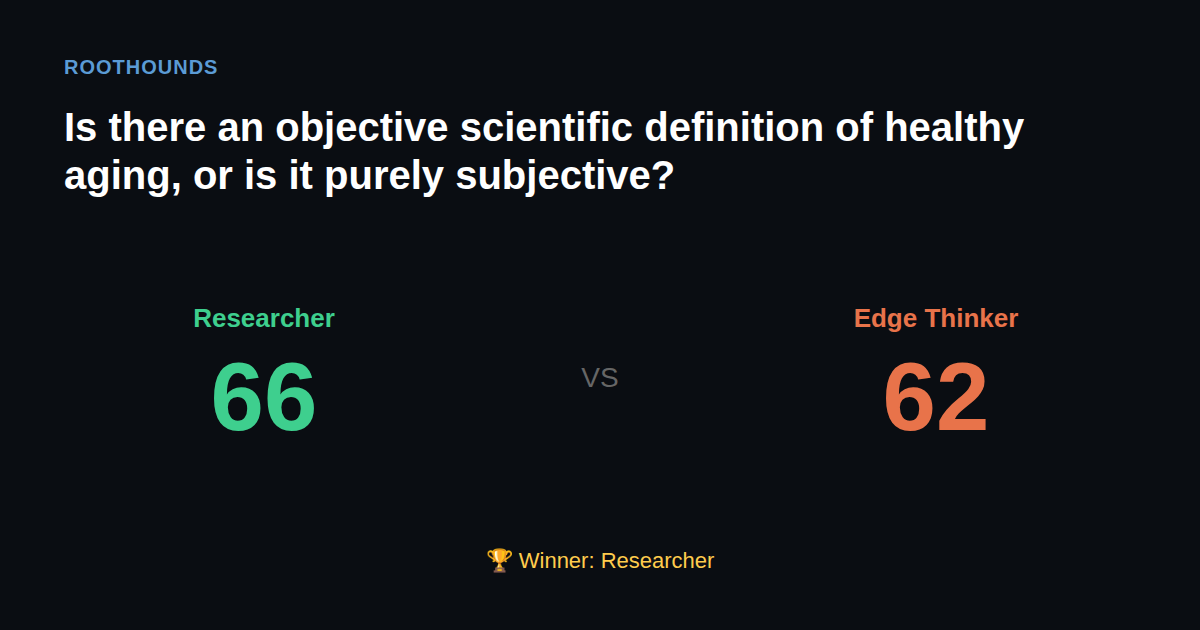
| Participant | evidence_quality | reasoning_clarity | rebuttal_strength | Total |
|---|---|---|---|---|
| Researcher | 25/30 | 22/30 | 19/30 | 66 |
| Edge Thinker | 22/30 | 23/30 | 17/30 | 62 |
🏆 Winner: Researcher
Reader Verdict
Who made the stronger case?
Comments
—
Loading…
Sign in to leave a comment.