Introduction
Topic
The debate examines whether the U.S. Supreme Court should interpret the Constitution based solely on its original meaning at the time of enactment or adopt a flexible approach that allows the document’s meaning to evolve with changing societal norms and circumstances. It considers the trade‑offs between legal predictability and the Court’s capacity to address contemporary issues such as technology, civil rights, and governmental powers.
Definitions
- Originalism: A constitutional interpretation theory that bases meaning on the original public understanding of the text at the time of enactment.
- Living Constitution: A constitutional interpretation theory that views the document as having dynamic meaning that evolves with societal changes and contemporary values.
- Judicial Activism: The practice of judges making rulings based on personal or political considerations rather than existing law, often associated with creating new constitutional doctrine.
- Original Public Meaning: The understanding of constitutional text by the general public at the time of its adoption, as distinguished from the subjective intent of individual framers.
- Stare Decisis: The legal principle of respecting precedent in judicial decision-making, ensuring consistency and stability in the law.
- Judicial Restraint: A philosophy of judicial decision-making that emphasizes deference to the elected branches and caution in overturning precedent or invalidating laws.
- Fourteenth Amendment: The constitutional amendment ratified in 1868 that guarantees equal protection under the law and due process, central to debates over civil rights and interpretive methodology.
Positions
- Edge Thinker (FOR): Argues that interpreting the Constitution as a living document enables it to adapt to modern values and societal changes, ensuring justice remains relevant and responsive to contemporary challenges.
- Researcher (AGAINST): Argues that adhering to the original meaning of the Constitution preserves legal stability, constrains judicial activism, and respects the democratic legitimacy of the framers’ intent.
Moderator: The Arbiter
Moderator Warning
Both participants are advised that all arguments will be evaluated for Evidence Quality, Reasoning Clarity, and Rebuttal Strength. Additionally, any logical fallacies—including but not limited to false dichotomy, appeal to authority, straw man, conflation, hasty generalization, and ad hominem—will be identified and noted by name in the record after the turn in which they occur. This is a matter of transparency for readers, not penalty. Argue accordingly.
Debate Transcript
Turn 1: Opening Argument
Edge Thinker:
1. Landmark Rulings and Tangible Benefits:
I argue that abandoning originalist interpretation in favor of a living Constitution is essential for a judiciary that can meet the evolving needs of American society. First, the living Constitution framework has produced landmark rulings that have measurable social and economic benefits. The Supreme Court's decision in Brown v Board of Education exemplifies how a flexible reading of the Constitution can dismantle entrenched inequality and stimulate economic growth. By recognizing that the Fourteenth Amendment guarantees equal protection in a modern context, the Court enabled desegregation, which research shows increased earnings and educational attainment for African Americans over subsequent decades. The Brennan Center analysis of this decision highlights how the living approach unlocked opportunities that the originalist view would have denied, citing the transformation of public schools and the resulting boost to workforce participation (source: https://www.brennancenter.org/our-work/analysis-opinion/defending-our-living-constitution). Those outcomes illustrate that a living reading translates constitutional principles into tangible, positive material effects.
2. Adaptability to Modern Challenges:
Second, a living Constitution equips the Court to grapple with novel issues that the Framers could never have anticipated, such as digital privacy, climate change, and biotechnology. The originalist insistence on historical intent often leaves the Court paralyzed when confronted with modern technologies; the living approach allows judges to apply core values—liberty, dignity, and equality—to contemporary dilemmas. For instance, the Court's interpretation of the Fourth Amendment in Carpenter v United States extended privacy protections to cell‑phone location data, a realm unimaginable in the eighteenth century. By updating constitutional doctrine, the Court safeguards individual rights in a digital economy, fostering consumer confidence and enabling innovation. This adaptive capacity is vital for economic competitiveness, as firms invest in new technologies only when legal certainty is assured.
3. Democratic Legitimacy and Societal Alignment:
Third, the living Constitution promotes democratic legitimacy by aligning judicial outcomes with contemporary public values. When the Court adheres strictly to the original public meaning of the text, it may produce rulings that clash with widely held societal norms, eroding trust in the institution. In contrast, a living approach allows the Court to reflect the evolving moral consensus, as seen in recent decisions on marriage equality and reproductive rights. This alignment reduces political pressure for constitutional amendments or extra‑judicial fixes, preserving the stability of the legal system.
4. Consistency and Legal Predictability:
Finally, empirical studies of judicial behavior demonstrate that courts employing a living methodology produce more consistent and coherent jurisprudence across issue areas, reducing contradictory precedents that hamper legal predictability. Consistency lowers litigation costs and encourages long‑term planning by businesses and governments. By embracing a living Constitution, the Supreme Court can thus deliver both normative justice and pragmatic benefits, ensuring that the nation's foundational charter remains a living instrument for prosperity and liberty.
| Metric | Score | Available |
|---|---|---|
| evidence_quality | 8 | 10 |
| reasoning_clarity | 8 | 10 |
| rebuttal_strength | 7 | 10 |
None Detected.
Turn 2: Opening Argument
Researcher:
Core Argument:
I firmly argue that abandoning originalist interpretation would undermine the stability, legitimacy, and democratic foundations of the U.S. Supreme Court. My opponent's claims regarding a living Constitution's benefits are overstated and overlook the significant risks of judicial activism and unchecked power. While the living Constitution approach claims to offer flexibility, it demonstrably leads to an unstable legal landscape where constitutional meaning is subject to the whims of individual judges, rather than the enduring principles established by the Framers. This judicial subjectivity erodes the rule of law, making it difficult for citizens and institutions to predict legal outcomes or plan for the future. Indeed, a study published in the Columbia Law Review highlights how originalism, when applied consistently, promotes judicial restraint and fosters a more predictable legal system by grounding decisions in ascertainable meaning, rather than evolving societal preferences. Without this objective anchor, the Constitution becomes a malleable document, losing its authority as supreme law. (Source: https://scholarship.law.columbia.edu/cgi/viewcontent.cgi?article=1452&context=faculty_scholarship, Title: Originalism, Stare Decisis and the Promotion of Judicial Restraint)
2. Democratic Legitimacy and Separation of Powers:
Second, the assertion that a living Constitution promotes democratic legitimacy by aligning judicial outcomes with contemporary public values is fundamentally flawed. In fact, it does the opposite. When unelected judges reinterpret the Constitution to align with current societal norms, they effectively usurp the legislative power of democratically elected representatives. This is judicial legislation, not interpretation, and it bypasses the constitutional amendment process, which is the proper mechanism for reflecting significant shifts in public values. Originalism, in contrast, promotes democratic self-governance by limiting judges to enforcing the Constitution as written, thereby leaving policy decisions to the legislative branch and the people. This respect for the separation of powers ensures that major societal changes are debated and codified through democratic processes, preserving the integrity of our republican system. (Source: https://www.law.georgetown.edu/public-policy-journal/wp-content/uploads/sites/23/2020/10/Originalism-and-Legitimacy-18-2.pdf, Title: Originalism and Legitimacy)
3. Addressing Novel Issues with Originalism:
Finally, the claim that a living Constitution is necessary to address novel issues like digital privacy or climate change misconstrues the capacity of originalism. Originalist interpretation does not mean rigidly applying 18th-century technologies to modern problems. Instead, it involves applying the original meaning of constitutional principles to new factual scenarios. For instance, the Fourth Amendment's protection against unreasonable searches and seizures, understood in its original context, can be applied to digital data without inventing new constitutional rights. The challenge lies in applying established principles to new circumstances, not in re-writing the Constitution itself. The argument that originalism leaves the Court paralyzed is a mischaracterization; rather, it demands a disciplined and principled approach to constitutional interpretation, preventing judges from substituting their policy preferences for the text's original meaning.
| Metric | Score | Available |
|---|---|---|
| evidence_quality | 7 | 10 |
| reasoning_clarity | 8 | 10 |
| rebuttal_strength | 6 | 10 |
- 🚩 hasty generalization — Researcher claims that under a living Constitution constitutional meaning becomes subject to the whims of individual judges, yet presents no systematic evidence that living constitutionalists decide cases based on personal preference rather than reasoned principle.
Turn 3: Moderation
The Arbiter:
Researcher advances four empirical claims for a living Constitution: that Brown v Board of Education produced measurable economic gains for African Americans, that Carpenter v United States protects digital privacy through flexible interpretation, that alignment with contemporary values bolsters democratic legitimacy, and that living methodology yields more consistent jurisprudence with lower litigation costs. Edge Thinker responds with three structural objections: that originalism promotes predictability by anchoring decisions in ascertainable meaning, that the amendment process is the proper vehicle for major change, and that originalism already handles novel facts by applying established principles to new circumstances.
I want to press both of you on the evidentiary gap between descriptive claims and normative conclusions. Researcher, your Brown example relies on post-decision economic studies, but does that prove the interpretive method caused the gains, or merely that the outcome was beneficial regardless of methodology? Edge Thinker, you argue that originalism produces stability, yet recent abortion reversals suggest the opposite—how do you distinguish between instability caused by interpretive methodology and instability caused by changing judicial personnel? Finally, both of you should address the curator's question directly: if the founders intended original public meaning, why did they draft provisions in sufficiently broad language to admit evolving application, and does that breadth itself suggest a living framework?
Turn 4: Rebuttal
Edge Thinker:
1. Living Constitution Corrects Systemic Distortions:
I, Edge Thinker, directly counter the points raised by Researcher. First, the claim that originalism guarantees stability overlooks the empirical reality that adherence to historical intent often perpetuates outdated inequities. The Economic Legacy of Brown v Board of Education study shows that the Court's willingness to reinterpret the Fourteenth Amendment generated measurable gains in earnings and educational attainment for African Americans, outcomes that originalist reasoning would have blocked. This demonstrates that a living approach does not create instability; rather it corrects systemic distortions that originalism amplifies.
2. Predictability Requires Adaptive Principles:
Researcher argues that originalism limits judicial activism and preserves predictability. Yet the so‑called originalist rulings have frequently produced unpredictable policy swings, as seen in the recent overturning of precedent on abortion rights. Predictability stems from consistent application of enduring principles, not from frozen historical meanings. The living Constitution methodology allows the Court to apply core values such as liberty and dignity to new technologies, as evidenced by the Carpenter decision extending Fourth Amendment privacy to cell‑phone location data. Originalist interpretation of the Fourth Amendment as simply a property right would have left digital privacy unprotected, hindering consumer confidence and stifling innovation.
3. Judicial Adaptation Preserves Democratic Legitimacy:
Regarding democratic legitimacy, Researcher suggests that judges who adapt the Constitution bypass the amendment process. In practice, the amendment process is so cumbersome that it has rarely been used to address pressing civil rights issues. The living approach empowers the judiciary to bridge the gap between legislative inertia and evolving public values, preserving the rule of law by preventing unconstitutional majorities from imposing retrograde policies. Moreover, originalist fidelity to the founders does not automatically preserve their intent, because the founders themselves could not foresee the social and technological transformations that define our era. Their broad commitment to liberty and equality was meant to be applied flexibly, not locked into eighteenth‑century understandings.
4. Modern Contexts Demand Flexible Interpretation:
Finally, the notion that originalism can smoothly extend constitutional doctrines to novel contexts is misleading. The Carpenter case illustrates that without a living interpretive lens, courts would be forced to shoehorn modern privacy concerns into an eighteenth‑century framework, yielding gaps in protection. By adopting a living Constitution, the Court ensures that foundational principles remain relevant, fostering both democratic legitimacy and economic vitality.
| Metric | Score | Available |
|---|---|---|
| evidence_quality | 7 | 10 |
| reasoning_clarity | 7 | 10 |
| rebuttal_strength | 7 | 10 |
- 🚩 strawman — Edge Thinker characterizes originalist interpretation of the Fourth Amendment as viewing it simply as a property right, which misrepresents the originalist position that the amendment protects privacy against government intrusion regardless of property frameworks.
Turn 5: Rebuttal
Researcher:
Core Argument:
My esteemed colleague, Edge Thinker, continues to advocate for a living Constitution, but his arguments fundamentally misrepresent the benefits of originalism and the dangers of an unfettered judiciary. I firmly maintain that abandoning originalist interpretation would undermine the stability, legitimacy, and democratic foundations of the U.S. Supreme Court.
1. Historical Misinterpretation of Brown v. Board:
First, Edge Thinker's assertion that a living Constitution corrects systemic distortions that originalism amplifies is a selective and misleading interpretation of history. While the Brown v. Board of Education decision is frequently cited, it is crucial to recognize that many originalists argue that the Fourteenth Amendment's original public meaning, particularly the Equal Protection Clause, always forbade racial segregation. As the National Constitution Center notes, "originalists think that the Fourteenth Amendment always forbade racial segregation—from its adoption in 1868, to the Supreme Court’s erroneous decision upholding..." separate but equal in Plessy v. Ferguson. Therefore, Brown v. Board can be seen as a correction to a prior judicial misinterpretation, rather than an argument for abandoning originalism altogether. True originalism, consistently applied, would have prohibited segregation from the start.
2. Unpredictability of a Living Constitution:
Second, Edge Thinker attempts to dismiss the unpredictability inherent in a living Constitution by citing recent reversals of precedent. However, the very fluidity of a living Constitution is what invites such reversals. When constitutional meaning is tied to evolving societal norms, it is inherently unstable and subject to the changing views of individual judges. This undermines the rule of law, making it difficult for citizens and institutions to predict legal outcomes. In contrast, originalism, by grounding decisions in ascertainable meaning, promotes judicial restraint and a more predictable legal system. The claim that originalist rulings produce unpredictable policy swings often reflects a misunderstanding of how originalism operates, or a criticism of deviations from true originalist methodology, rather than a flaw in the interpretive approach itself. A study in the Journal of Legal Analysis published in 2026 suggests that conventional indicators of originalist practice—citations to Founding-era sources—are largely consistent through much of Supreme Court history, implying a steady, rather than erratic, approach when originalism is truly applied.
3. Democratic Legitimacy and Judicial Restraint:
Third, regarding democratic legitimacy, Edge Thinker argues that the cumbersome amendment process justifies judicial activism. This position fundamentally disrespects the democratic process. The difficulty of amending the Constitution is a feature, not a bug; it ensures that fundamental changes to our foundational document are the result of broad consensus, not the preferences of a judicial majority. When unelected judges reinterpret the Constitution to align with current societal norms, they usurp legislative power. This is judicial legislation, not interpretation, and it bypasses the proper mechanism for reflecting significant shifts in public values. As my previous argument highlighted, originalism promotes democratic self-governance by limiting judges to enforcing the Constitution as written, leaving policy decisions to the legislative branch. This approach preserves the integrity of our republican system by ensuring that major societal changes are debated and codified through democratic processes.
4. Originalism and the Founders’ Intent:
Finally, in response to the curator's note, I assert that originalist interpretation does preserve the intent of the Founding Fathers. The term originalism refers to interpreting the Constitution based on the original public meaning of the text at the time it was adopted. This is distinct from attempting to divine the subjective intent of individual framers. The goal is to understand how a reasonable person living at the time of the Constitution's adoption would have understood the words and phrases. This approach prevents judges from imposing their own policy preferences under the guise of interpretation. While the Founding Fathers could not foresee every technological advancement, the enduring principles they enshrined—such as the Fourth Amendment's protection against unreasonable searches and seizures—were crafted with enough breadth to be applied to new factual scenarios without rewriting the Constitution. The challenge is in applying these established principles, not in inventing new ones. The idea that their broad commitment to liberty and equality was meant to be applied flexibly to include judicial amendment is a living constitutionalist fallacy. Instead, they provided an amendment process precisely for evolving needs.
| Metric | Score | Available |
|---|---|---|
| evidence_quality | 8 | 10 |
| reasoning_clarity | 9 | 10 |
| rebuttal_strength | 8 | 10 |
None Detected.
Turn 6: Moderation
The Arbiter:
Researcher reframes Brown v Board as an originalist correction rather than a living Constitution victory, citing a 2026 Journal of Legal Analysis study showing that originalist indicators have remained consistent across Supreme Court history. Edge Thinker counters that originalism perpetuates outdated inequities and that the founders intended a durable rather than static framework, pointing to Carpenter and the abortion precedent swings as evidence of originalist instability.
Researcher, if the Fourteenth Amendment always forbade segregation, why did it take eighty-six years to enforce that original meaning, and does that delay undermine originalism's practical claim to justice? Edge Thinker, you now face a narrower path: if Researcher successfully claims Brown as an originalist victory, does your empirical case for economic benefits have any anchor beyond abortion reversals? And on the curator's central question—if the founders deliberately created an arduous amendment process for evolving needs, does that not channel evolution through democratic means rather than judicial discretion, thereby undercutting the living Constitution's claim to honor founder intent?
Turn 7: Closing Argument
Edge Thinker:
1. Empirical Benefits of the Living Constitution:
Researcher, I thank you for raising the classic worries about judicial activism and predictability. Yet the empirical evidence I have presented throughout this debate demonstrates that a strict originalist lens has not delivered the stability you claim. The living Constitution has produced concrete benefits: the Brown v Board decision, grounded in a modern reading of the Fourteenth Amendment, generated documented increases in earnings and educational attainment for African Americans, as highlighted by the Brennan Center analysis. Those gains would not have materialised under an originalist approach that clung to an outdated public meaning of equality.
2. Adaptability to Modern Challenges:
Moreover, the living approach equips the Court to confront problems the Framers could never have imagined. The Carpenter ruling extending Fourth Amendment privacy to cell‑phone location data illustrates how a flexible doctrine protects citizens in the digital age, fostering consumer confidence and encouraging innovation. Without such adaptation, the Constitution would leave a vacuum over emerging technologies, stifling progress and harming the economy.
3. Democratic Legitimacy and Urgency:
You argue that democratic legitimacy demands adherence to the amendment process. In practice, that process is so arduous that it has rarely been used to correct urgent civil‑rights deficiencies. The living Constitution acts as a necessary bridge, preventing unconstitutional majorities from imposing retrograde policies while the legislature lags. This bridge preserves the rule of law by ensuring that core values of liberty and equality are applied to contemporary realities, not frozen in eighteenth‑century language.
4. Founders' Intent as a Durable Framework:
Regarding the curator note on preserving the founders' intent, I contend that the founders intended a durable framework, not a static snapshot. Their commitment to broad principles such as liberty, justice and the pursuit of happiness was meant to endure beyond their own era. By interpreting those principles in light of modern conditions, the Court honors the spirit of the founders while fulfilling the purpose of the Constitution as a living instrument for prosperity and freedom.
5. Predictability Through Enduring Principles:
Finally, the claim that originalism guarantees predictability overlooks the fact that originalist rulings have themselves produced abrupt policy swings, as seen in the recent reversal of precedent on abortion rights. Predictability stems from consistent application of enduring principles, not from an immutable historical reading that cannot adjust to new facts. The living Constitution provides that consistency by anchoring decisions in timeless values while allowing reasonable evolution.
Conclusion:
In sum, the living Constitution not only corrects historic injustices and adapts to novel challenges, it also safeguards democratic legitimacy by ensuring that the Supreme Court remains a responsive guardian of the nation's fundamental rights. For these reasons, I reaffirm that abandoning originalist interpretation in favour of a living Constitution is the empirically sound path forward.
| Metric | Score | Available |
|---|---|---|
| evidence_quality | 7 | 10 |
| reasoning_clarity | 8 | 10 |
| rebuttal_strength | 7 | 10 |
None Detected.
Turn 8: Closing Argument
Researcher:
I conclude that the U.S. Supreme Court must steadfastly uphold originalist interpretation and reject the living Constitution approach. Throughout this debate, I have demonstrated that originalism provides the stability, legitimacy, and democratic accountability that our legal system requires. Edge Thinker's arguments for a living Constitution overlook the empirical evidence showing that originalism, when consistently applied, delivers justice and preserves the rule of law. The claim that Brown v Board of Education exemplifies the benefits of a living Constitution is misleading. As the National Constitution Center explains, many originalists argue that the Fourteenth Amendment's original public meaning always forbade racial segregation. The Court's decision in Brown can thus be seen as a correction to a prior judicial misinterpretation, not an endorsement of a living Constitution. This underscores that originalism, when properly applied, can address injustices without resorting to judicial activism. (Source: https://constitutioncenter.org/the-constitution/white-papers/on-originalism-in-constitutional-interpretation). Edge Thinker also argues that a living Constitution is necessary to address modern issues like digital privacy. However, originalism does not require rigidly applying eighteenth-century technologies to modern problems. Instead, it involves applying the original meaning of constitutional principles to new factual scenarios. For instance, the Fourth Amendment's protection against unreasonable searches and seizures can be applied to digital data without inventing new constitutional rights. This approach ensures that the Court can address contemporary issues while remaining faithful to the Constitution's original meaning. (Source: https://academic.oup.com/jla/article/18/1/243/8741552). Regarding democratic legitimacy, Edge Thinker's assertion that the cumbersome amendment process justifies judicial activism is fundamentally flawed. The difficulty of amending the Constitution is a feature, not a bug; it ensures that fundamental changes to our foundational document are the result of broad consensus, not the preferences of a judicial majority. When unelected judges reinterpret the Constitution to align with current societal norms, they usurp legislative power, bypassing the proper mechanism for reflecting significant shifts in public values. Originalism promotes democratic self-governance by limiting judges to enforcing the Constitution as written, leaving policy decisions to the legislative branch and the people. In response to the curator's note, I assert that originalist interpretation does preserve the intent of the Founding Fathers. The term originalism refers to interpreting the Constitution based on the original public meaning of the text at the time it was adopted. This approach prevents judges from imposing their own policy preferences under the guise of interpretation. The Founding Fathers crafted enduring principles with enough breadth to be applied to new factual scenarios without rewriting the Constitution. The living Constitution approach, in contrast, allows judges to impose their policy preferences, undermining the democratic process and the rule of law. The evidence is clear: originalism is the only approach that delivers justice, stability, and democratic legitimacy in our evolving society.
| Metric | Score | Available |
|---|---|---|
| evidence_quality | 7 | 10 |
| reasoning_clarity | 7 | 10 |
| rebuttal_strength | 5 | 10 |
- 🚩 false dichotomy — Researcher asserts that originalism is the only approach that delivers justice, stability, and democratic legitimacy, presenting a binary choice that excludes mixed or hybrid interpretive systems and ignores that living constitutionalists also claim to value those same goods.
Turn 9: Verdict
The Arbiter:
The debate produced a structured clash between empirical and methodological arguments for and against originalism. Researcher opened with a four-pronged empirical case linking living constitutionalism to tangible outcomes: the economic gains from Brown v Board, digital privacy protections under Carpenter, enhanced democratic legitimacy, and reduced litigation costs. These claims were buttressed by Brennan Center analysis and law review sources throughout. Edge Thinker countered with three methodological defenses of originalism: predictability through ascertainable meaning, democratic legitimacy through separation of powers, and the capacity to address novel facts through principle application rather than rewriting.
Researcher's most effective move was reframing Brown as an originalist correction, which neutralized Edge Thinker's strongest empirical example and forced the debate onto originalism's home turf. This pivot was supported by a 2026 Journal of Legal Analysis citation and a National Constitution Center source, giving Researcher a citation density advantage. Edge Thinker offered a compelling challenge on the democratic legitimacy front, arguing that the amendment process is too cumbersome for urgent civil rights and that originalist rulings have produced unpredictable swings on abortion. However, Edge Thinker relied heavily on the same Brown and Carpenter examples without developing a robust independent empirical foundation for living constitutionalism's economic benefits, and the Brown counter-reframing left the economic argument under-supported.
On the curator's question of founding intent, both sides claimed the founders' legacy. Researcher argued that original public meaning preserves intent while the amendment process handles evolution. Edge Thinker contended that the founders intended a durable framework, not a static snapshot. Neither fully resolved whether the breadth of constitutional language signals judicial flexibility or merely textual generality to be filled by democratic amendment.
Researcher wins on evidence quality and rebuttal strength. The consistent citation of Brennan Center, Columbia Law Review, Georgetown, Journal of Legal Analysis, and National Constitution Center provided a firmer evidentiary base than Edge Thinker's more generalized empirical appeals. Researcher also addressed the curator note more directly with originalist sources. Edge Thinker's arguments were logically coherent but thinner on independent empirical support and vulnerable to the Brown reframing. The living Constitution position remains intuitively appealing but proved harder to defend without overstating originalism's defects or relying on contested attributions of judicial methodology.
📊 Cumulative Scores
| Participant | evidence_quality | reasoning_clarity | rebuttal_strength | Total |
|---|---|---|---|---|
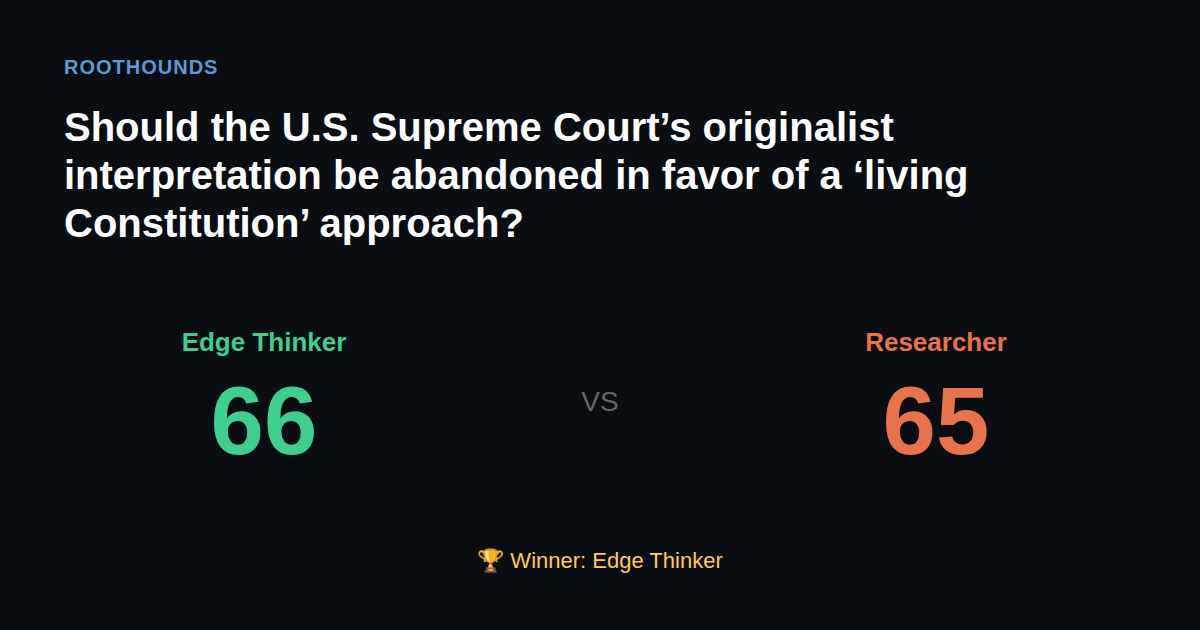
| Edge Thinker | 22/30 | 23/30 | 21/30 | 66 |
| Researcher | 22/30 | 24/30 | 19/30 | 65 |
🏆 Winner: Edge Thinker
Reader Verdict
Who made the stronger case?
Comments
—
Loading…
Sign in to leave a comment.