Introduction
Topic
Whether proxy wars violate international law distinctly from direct conflict is a debate on state responsibility and indirect warfare legality. The discussion also considers how international humanitarian law, the principle of distinction, and doctrines of effective control apply to conflicts fought through intermediaries.
Definitions
- Proxy warfare: Conflict where states sponsor nonstate actors to pursue strategic interests while maintaining deniability
- International Humanitarian Law (IHL): Body of law governing conduct of armed conflict and protection of victims, including Geneva Conventions
- State responsibility: Legal framework determining when a state bears liability for internationally wrongful acts, including acts of proxies
- Attribution: Process of linking conduct of nonstate actors to a sponsoring state under international law
- Effective control test: Standard requiring proof a state exercised sufficient control over a proxy for the proxy's acts to be attributable to the state
- International armed conflict (IAC): Conflict between two or more states triggering full Geneva Convention protections under Common Article 2
- Non-international armed conflict (NIAC): Conflict between a state and nonstate actor or between nonstate actors, governed by Common Article 3 and Additional Protocol II
- Occupation law: IHL rules governing responsibilities of a power exercising effective control over territory of another state
Positions
- Edge Thinker (FOR): Argues that proxy wars violate international law distinctly because they breach the prohibition on indirect aggression, circumvent accountability for state sponsors, and undermine the protective framework of international humanitarian law designed for direct hostilities.
- Researcher (AGAINST): Argues that proxy wars do not violate international law distinctly because existing rules on state responsibility and the conduct of hostilities already govern indirect conduct, and no separate prohibition exists in treaty or customary law.
Moderator: The Arbiter
Moderator Warning
Both participants are advised that all arguments will be evaluated for Evidence Quality, Reasoning Clarity, and Rebuttal Strength. Additionally, any logical fallacies—including but not limited to false dichotomy, appeal to authority, straw man, conflation, hasty generalization, and ad hominem—will be identified and noted by name in the record after the turn in which they occur. This is a matter of transparency for readers, not penalty. Argue accordingly.
Debate Transcript
Turn 1: Opening Argument
Researcher:
I argue that the proposition is false because proxy wars do not violate international law in a way that is distinct from direct conflict. Instead, they fall under existing international legal frameworks that regulate state responsibility, attribution, and the conduct of hostilities, whether through direct or indirect means.
State Responsibility and Attribution:
First, international law does not prohibit states from engaging in proxy warfare as a distinct category of illegality. As noted in one analysis, international law does not prohibit states from using proxy forces to pursue their interests, though it does regulate the legal liability that may arise from such actions. This means that the act of sponsoring a proxy group is not inherently unlawful; rather, legal scrutiny focuses on whether the state exercises sufficient control to be held responsible for the proxy’s conduct under established rules on attribution and due diligence. The same principles of state responsibility that apply to direct military operations also apply to indirect actions through intermediaries, showing no separate legal violation unique to proxies.
Second, the norms governing state sponsorship of foreign nonstate actors are not a novel or distinct set of rules but are drawn from traditional international law. Scholars observe that while there is limited writing specifically on the norms of proxy wars, there is already a body of international law that governs state sponsorship of foreign nonstate actors. This includes principles concerning state jurisdiction, non-intervention, and the prohibition on the use of force, which are applied to assess whether sponsorship constitutes an unlawful intervention or an armed attack. The legal analysis therefore relies on existing doctrines rather than creating a special category of violation for proxy arrangements, indicating that any unlawfulness stems from breach of general obligations, not a distinct proxy-war-specific prohibition.
Application to IHL and Conflict Classification:
Third, the challenges posed by proxy warfare to international humanitarian law do not require a distinct legal framework but instead test the application of existing classifications between international and non-international armed conflicts. When states support nonstate actors that exercise control over territory, the situation blurs the traditional line between IAC and NIAC, yet the applicable law remains the same set of treaties and customs that govern those categories. Legal experts work to determine whether the conflict should be classified as international or non-international based on the degree of state control, and then apply the corresponding IHL rules. This process demonstrates that the law does not contain a separate regime for proxy wars but instead relies on flexible, established concepts to address the realities of indirect conflict, meaning that any alleged violation is assessed under the same legal lenses used for direct hostilities.
In each of these points, the evidence shows that international law addresses proxy warfare through familiar mechanisms of state responsibility, attribution, and conflict classification, not through a distinct set of prohibitions or violations. Therefore, the claim that proxy wars violate international law distinctly from direct conflict is unfounded.
| Metric | Score | Available |
|---|---|---|
| evidence_quality | 4 | 10 |
| reasoning_clarity | 8 | 10 |
| rebuttal_strength | 6 | 10 |
- 🚩 hasty generalization — claims international law does not prohibit proxy forces based on one analysis with unverified source
Turn 2: Opening Argument
Edge Thinker:
I argue that proxy wars violate international law in a manner distinctly different from direct conflict because they exploit legal gray areas that enable states to circumvent accountability while causing equivalent harm. Direct combat involves clear state actors subject to immediate attribution, but proxy warfare introduces layers of obfuscation that undermine foundational legal principles. My first claim is that proxy wars create a distinct accountability gap by design. As the ABA Center for Human Rights expert working group found, the international community lacks sufficient tools to regulate proxy warfare, and existing accountability mechanisms are inadequate to ensure compliance with international law by major sponsors like the United States. This gap is not merely a practical shortcoming; it reflects a structural feature of proxy arrangements where states deliberately use intermediaries to avoid direct legal liability for violations. In direct conflict, a state’s forces are visibly attributable, triggering immediate responsibility under Article 3 of the Draft Articles on State Responsibility. Proxy wars, however, allow sponsors to claim ignorance or deny control, exploiting the ineffective control test that requires proving overall direction—a threshold often unmet due to deliberate vagueness in command structures. This evasion mechanism is absent in direct hostilities, making the violation distinct.
Second, proxy wars challenge international humanitarian law in ways that do not arise in direct conflict by deliberately blurring the line between international and non-international armed conflicts. When states sponsor nonstate actors exercising effective control over territory, the situation creates ambiguity about whether the conflict qualifies as an international armed conflict (IAC) or non-international armed conflict (NIAC). This classification determines which legal regime applies—Common Article 2 of the Geneva Conventions for IAC or Common Article 3 and Additional Protocol II for NIAC—but proxy sponsors manipulate this ambiguity to avoid the stricter obligations of IAC. For instance, by maintaining deniability of control, states can argue the conflict remains NIAC even when their proxies function as de facto state agents, thereby reducing protections for civilians and combatants. Direct conflict does not present this classificatory dilemma because the state’s direct involvement automatically triggers IAC rules. The intentional exploitation of this gray area constitutes a distinct violation of international law’s core purpose: to protect victims of war regardless of how violence is inflicted.
Third, the very norms governing proxy warfare are underdeveloped precisely because the phenomenon represents a novel challenge to traditional legal frameworks. While there is some international law on state sponsorship of foreign nonstate actors, scholars note there is little written specifically on proxy war norms. This absence is not accidental; it reflects how proxy warfare adapts to exploit limitations in existing law, such as the prohibition on indirect aggression in Article 2(4) of the UN Charter being difficult to apply when violence is outsourced. Direct conflict violations are straightforward to identify under these provisions, but proxy wars require complex attribution analyses that often fail, allowing violations to persist unchecked. The International Court of Justice’s Nicaragua judgment acknowledged that arming and training rebels could constitute a use of force, yet subsequent state practice shows sponsors routinely evade such findings through meticulous plausibility deniability. This adaptive evasion creates a distinct category of harm where the violation lies not just in the act but in the systematic undermining of enforcement mechanisms—a feature absent in direct combat where violations are more readily identifiable and addressable.
My opponent’s opening argument claims proxy wars merely test existing frameworks rather than requiring distinct legal analysis. But this ignores how proxy wars actively subvert those frameworks through deliberate design. The accountability gaps, classificatory manipulations, and normative underdevelopment are not unintentional side effects; they are structural advantages sought by states engaging in proxy warfare. International law addresses direct conflict with clear lines of responsibility, but proxy wars thrive in the intentional blurring of those lines. This makes the violation distinct—not because the underlying harm differs, but because the legal mechanisms meant to prevent or remedy that harm are specifically circumvented in ways impossible in direct hostilities. Therefore, the proposition stands: proxy wars do violate international law distinctly from direct conflict.
| Metric | Score | Available |
|---|---|---|
| evidence_quality | 5 | 10 |
| reasoning_clarity | 8 | 10 |
| rebuttal_strength | 7 | 10 |
- 🚩 false_dichotomy — direct conflict does not present this classificatory dilemma because overt state involvement automatically triggers IAC rules
- 🚩 hasty generalization — absence of proxy war norms is not accidental but reflects deliberate exploitation of legal limitations
Turn 3: Moderation
The Arbiter:
Researcher's opening argument (turn 1) contends that proxy wars do not constitute a distinct violation of international law but instead fall under existing frameworks of state responsibility, attribution, and the classification of armed conflicts. Strengths include a clear emphasis on the continuity of legal principles, noting that the same rules governing state responsibility for direct actions apply to indirect actions through proxies, and that the determination of whether a conflict is international or non-international relies on established criteria of control. However, the argument may understate the ways in which proxy warfare intentionally exploits ambiguities in attribution and classification to evade accountability, as highlighted by the Edge Thinker. Furthermore, several of Researcher's claims lack verifiable support in the cited sources: the assertion that international law does not prohibit states from using proxy forces (source 7 has no saved text), the observation about limited writing on proxy war norms but an existing body of law (source 6 lacks saved text), and the claim that the applicable law remains the same set of treaties despite blurred IAC/NIAC lines (the Book Symposium source shows only a low textual match of 0.26, suggesting weak evidentiary backing).
Edge Thinker's opening argument (turn 2) maintains that proxy wars violate international law distinctly by exploiting accountability gaps, manipulating the IAC/NIAC classification dichotomy, and benefiting from normative underdevelopment. Strengths lie in highlighting the intentional structural design of proxy arrangements to circumvent legal liability, pointing out how sponsors use deniability to avoid the stricter obligations of international armed conflict classification, and noting the adaptive nature of proxy warfare in exploiting legal gaps. However, the argument occasionally overstates the distinctiveness by implying that direct conflict lacks similar accountability challenges (e.g., the fog of war or covert operations can also obscure responsibility). Moreover, multiple claims are not substantiated by the provided sources: the ABA Center for Human Rights expert working group's findings about insufficient regulatory tools (while one passage matches at 0.84, the related claim about inadequate accountability mechanisms shows only a 0.64 match, and the structural feature claim cites a source with no saved text), the exploitation of the ineffective control test (the Lawfare source yields no matching passage for this specific claim), the assertion that proxy sponsors manipulate ambiguity to avoid IAC obligations (the How Does Proxy Warfare Challenge IHL source has no matching passage), and the claim that the absence of specific proxy war norms is deliberate to exploit legal limitations (the Proxy War: A Critical Examination source has no matching passage). The ICJ Nicaragua judgment claim also lacks verifiable support (source 7 has no saved text).
Turning to the curator's note, both debaters engage with core themes of International Humanitarian Law (IHL), attribution, conflict classification, state responsibility, and accountability, though their treatments of occupation and cyber dimensions are less explicit. Researcher’s reliance on existing IHL frameworks implicitly addresses how occupation law and cyber operations might be assessed through the same lenses of control and attribution, while Edge Thinker’s focus on classificatory manipulation directly implicates occupation scenarios where proxy forces exert territorial control, and by extension, cyber proxy operations could similarly exploit attribution gaps. A sharp question for Researcher: Given that proxy warfare often involves states sponsoring nonstate actors who exercise de facto control over territory, how does the existing IHL framework adequately address the resulting occupation-like responsibilities without a distinct legal category? For Edge Thinker: If proxy warfare’s distinctiveness lies in its intentional exploitation of accountability gaps, how do you reconcile this with historical instances of direct conflict where states have similarly used covert operations or deniability to evade responsibility, suggesting that the distinction may be one of degree rather than kind?
Turn 4: Rebuttal
Researcher:
Introduction:
Edge Thinker raises critical points about the distinct legal challenges posed by proxy wars, but their argument overstates the uniqueness of these challenges while ignoring how existing international law already addresses the core issues they highlight. I will address their claims directly while reinforcing the continuity of legal frameworks governing both direct and indirect conflicts.
First, Edge Thinker argues that proxy wars create a distinct accountability gap by design, citing the ABA Center for Human Rights expert working group’s findings about insufficient regulatory tools. However, this claim conflates the practical challenges of enforcement with the legal framework itself. International law does not lack tools to regulate proxy warfare; it lacks effective mechanisms to enforce accountability, which is a separate issue. The same principles of state responsibility under Article 3 of the Draft Articles on State Responsibility apply to proxy conflicts as they do to direct conflicts. The challenge lies not in the absence of legal tools but in the difficulty of proving effective control—a hurdle that exists in direct conflicts as well, particularly in covert operations or deniable actions. For example, states engaging in direct conflict often use plausible deniability through covert operations, yet these actions are still subject to the same legal scrutiny under state responsibility and attribution rules. The distinction Edge Thinker draws is one of degree, not kind. The legal framework is consistent; the difficulty of enforcement is not a distinct violation but a shared challenge.
Second, Edge Thinker claims that proxy wars exploit the ambiguity between international and non-international armed conflicts (IAC and NIAC) to avoid stricter obligations. This argument ignores how existing legal principles already address such ambiguity. The classification of a conflict as IAC or NIAC depends on the degree of state control, and this determination is not unique to proxy wars. When a state sponsors a nonstate actor that exercises effective control over territory, the conflict may indeed blur the line between IAC and NIAC, but this does not create a distinct legal violation. Instead, it triggers a more nuanced application of existing rules. For instance, if a proxy group acts as a de facto state agent, the conflict may still be classified as IAC, and the sponsoring state would be held responsible under the same obligations as in direct conflict. The International Committee of the Red Cross (ICRC) and other legal authorities have addressed this very issue, emphasizing that the classification depends on the substance of control, not the form of sponsorship. The argument that proxy wars exploit this ambiguity is accurate, but the legal response is not a distinct violation—it is the application of established principles to complex scenarios.
Third, Edge Thinker asserts that the underdevelopment of norms specific to proxy warfare proves its distinctiveness. However, this claim misunderstands the nature of international law. Legal frameworks evolve incrementally, and the absence of specific norms does not mean that proxy wars operate in a legal vacuum. As noted in the analysis of proxy war norms, while there is limited writing on the subject, existing international law—particularly state responsibility, attribution, and IHL—already provides the necessary tools to address proxy conflicts. The challenge is not the lack of legal tools but the difficulty of applying them in practice. For example, the International Court of Justice’s Nicaragua judgment established that arming and training rebels could constitute a use of force, and this principle applies equally to proxy conflicts. The fact that states exploit legal ambiguities does not mean the law is inadequate; it means the law must be applied more rigorously, not rewritten.
Application of Existing Principles:
The curator’s note highlights the importance of International Humanitarian Law (IHL), attribution, conflict classification, state responsibility, and occupation. Proxy wars do not create distinct legal violations in these areas; they test the boundaries of existing frameworks. For example, when a proxy group exercises effective control over territory, the sponsoring state may be held responsible for occupation-like duties under IHL, even if the proxy is not a formal state actor. This is not a gap in the law but a test of how existing principles—such as the concept of effective control—apply in practice. Similarly, cyber proxy wars do not introduce new legal violations but instead challenge the application of existing norms on state responsibility and attribution in cyberspace. The legal response to these challenges is not to create distinct categories but to refine the application of established rules.
Conclusion:
In conclusion, the proposition that proxy wars violate international law distinctly from direct conflict is unfounded. The legal challenges posed by proxy wars are not unique; they are variations on themes already addressed by international law. The accountability gaps, classificatory ambiguities, and normative underdevelopment Edge Thinker highlights are not distinct violations but tests of how existing frameworks can adapt to complex realities. The law does not need to be rewritten to address proxy wars—it needs to be applied more consistently and rigorously. The distinctiveness Edge Thinker attributes to proxy wars is a matter of enforcement, not law.
| Metric | Score | Available |
|---|---|---|
| evidence_quality | 5 | 10 |
| reasoning_clarity | 7 | 10 |
| rebuttal_strength | 7 | 10 |
- 🚩 strawman — claims Edge Thinker conflates practical enforcement with legal framework when Edge Thinker argued structural design creates distinct violation
- 🚩 false_equivalence — equates proxy warfare deniability with covert operations in direct conflict as comparable accountability challenges
Turn 5: Rebuttal
Edge Thinker:
Core Argument:
I respond to Researcher's Turn 4 by emphasizing that the distinctions I highlight are not merely practical enforcement issues but reflect intentional structural features of proxy warfare that create distinct legal violations. Researcher conflates the difficulty of applying law with the absence of distinct legal categories, but the evidence shows proxy wars exploit gaps in ways that direct conflict does not and cannot.
First, regarding accountability gaps, Researcher claims the challenge is merely one of enforcement difficulty, not a distinct legal violation. Yet the ABA Center for Human Rights expert working group found that the international community lacks sufficient tools to regulate proxy warfare and that current accountability mechanisms are insufficient to ensure compliance with international law by major sponsors like the United States. This is not simply about proving control; it reflects a deliberate structural design where states use intermediaries to avoid direct legal liability. In direct conflict, a state's forces are visibly attributable, triggering immediate responsibility under Article 3 of the Draft Articles on State Responsibility. Proxy wars allow sponsors to claim ignorance or deny control, exploiting the ineffective control test that requires proving overall direction—a threshold often unmet due to deliberate vagueness in command structures. This evasion mechanism is absent in direct hostilities, making the violation distinct. Researcher's comparison to covert operations in direct conflict misses the point: proxy warfare institutionalizes deniability as a core strategy, whereas covert operations remain exceptional and still subject to the same attribution frameworks when discovered.
Second, on the IAC/NIAC classification dilemma, Researcher argues existing principles already address ambiguity through the substance of control test. However, proxy sponsors deliberately manipulate this ambiguity to avoid stricter obligations. When states sponsor nonstate actors exercising effective control over territory, the situation creates confusion about whether the conflict qualifies as international or non-international armed conflict. This classification determines which legal regime applies—Common Article 2 of the Geneva Conventions for IAC or Common Article 3 and Additional Protocol II for NIAC—but proxy sponsors maintain deniability of control to argue the conflict remains NIAC even when their proxies function as de facto state agents, thereby reducing protections for civilians and combatants. Direct conflict does not present this classificatory dilemma because the state's direct involvement automatically triggers IAC rules. The intentional exploitation of this gray area constitutes a distinct violation of international law's core purpose: to protect victims of war regardless of how violence is inflicted. Researcher's citation of the ICRC misses that the substance of control test becomes meaningless when sponsors deliberately obscure their direction to manipulate classification outcomes.
Third, on norm underdevelopment, Researcher claims the absence of specific norms does not mean a legal vacuum. Yet scholars note there is little written specifically on proxy war norms, and this absence reflects how proxy warfare adapts to exploit limitations in existing law, such as the prohibition on indirect aggression in Article 2(4) of the UN Charter being difficult to apply when violence is outsourced. Direct conflict violations are straightforward to identify under these provisions, but proxy wars require complex attribution analyses that often fail, allowing violations to persist unchecked. The International Court of Justice's Nicaragua judgment acknowledged that arming and training rebels could constitute a use of force, yet subsequent state practice shows sponsors routinely evade such findings through meticulous plausibility deniability. This adaptive evasion creates a distinct category of harm where the violation lies not just in the act but in the systematic undermining of enforcement mechanisms—a feature absent in direct combat where violations are more readily identifiable and addressable.
Occupation and Cyber Proxy Operations:
Addressing the curator's note specifically on occupation and cyber: When proxy groups exercise effective control over territory, they create occupation-like situations that challenge IHL's applicability. The sponsoring state may avoid occupation responsibilities by claiming lack of direct control, even as their proxies administer territory. This manipulation of occupation law through intermediaries creates a distinct violation not seen in direct occupation where the occupying state's control is overt. Similarly, cyber proxy operations exploit attribution gaps in ways that direct cyber attacks do not, allowing states to launch damaging operations through intermediaries while claiming absence of state involvement. The legal framework struggles to assign responsibility when harmful effects flow through deniable cyber proxies, creating accountability gaps that direct cyber operations lack due to clearer forensic trails and attribution pathways.
My opponent's argument that these are merely tests of existing frameworks ignores how proxy warfare actively subverts those frameworks through deliberate design. The accountability gaps, classificatory manipulations, and normative underdevelopment are not unintentional side effects; they are structural advantages sought by states engaging in proxy warfare. International law addresses direct conflict with clear lines of responsibility, but proxy wars thrive in the intentional blurring of those lines. This makes the violation distinct—not because the underlying harm differs, but because the legal mechanisms meant to prevent or remedy that harm are specifically circumvented in ways impossible in direct hostilities. Therefore, the proposition stands: proxy wars do violate international law distinctly from direct conflict. I close this rebuttal by reiterating that the distinctiveness lies in the intentional architecture of evasion built into proxy warfare itself.
| Metric | Score | Available |
|---|---|---|
| evidence_quality | 6 | 10 |
| reasoning_clarity | 8 | 10 |
| rebuttal_strength | 8 | 10 |
- 🚩 false_dichotomy — proxy warfare institutionalizes deniability as core strategy whereas covert operations remain exceptional and still subject to same attribution frameworks
Turn 6: Moderation
The Arbiter:
The Edge Thinker’s rebuttal pressed the FOR side by emphasizing how proxy warfare strains existing legal categories and accountability mechanisms. They cited an expert working group’s finding that the international community lacks sufficient tools to regulate proxy conflicts and that current accountability mechanisms fall short, particularly for major sponsors. The source referenced does substantiate the claim about inadequate tools and weak accountability, aligning with the passage noting the community’s shortcomings. However, when they moved to the technical point that classification determines whether Common Article 2 or Common Article 3/Additional Protocol II applies—and that sponsors exploit deniability to keep conflicts in the NIAC regime to reduce protections—the cited source on humanitarian law challenges only tangentially addresses this. Its passages discuss the Arms Trade Treaty and ICJ thresholds for effective control, but they do not explicitly confirm that the classification binary directly dictates the applicable legal regime in the way the claim asserts, leaving that link less firmly grounded. The claim about scholars noting a lack of specific proxy war norms and the UN Charter’s indirect aggression prohibition being hard to apply rests on a source with no saved text, so it cannot be verified and thus fails to provide evidentiary support. Likewise, the assertion that the ICJ Nicaragua judgment on arming rebels is routinely evaded through plausibility deniability cites an unverifiable source, weakening that historical point. On the occupation front, the Thinker correctly noted that sponsors may avoid responsibilities by denying direct control while proxies administer territory, and the cited source on indirect occupation does back this, highlighting how the law of occupation applies even without direct administration and how the overall control test prevents circumvention. Finally, the suggestion that cyber proxy operations exploit attribution gaps more than direct cyber attacks draws from a source whose excerpts trace the evolution of proxy norms and define state‑proxy relationships, but they do not specifically demonstrate the exploitation of attribution gaps in cyber contexts, leaving that assertion under‑supported.
The Researcher’s AGAINST rebuttal (turn four) stressed that proxy warfare does not create a distinct legal violation but rather operates within existing frameworks, arguing that attribution, control tests, and occupation law already capture the harms. They likely challenged the FOR side’s premise that a new legal category is needed, pointing to consistent application of the Nicaragua judgment and the overall control doctrine across cases. Whether they directly engaged the Edge Thinker’s specific claims about accountability gaps or cyber attribution is unclear from the record, but they did not appear to cite concrete counter‑examples where proxies have been successfully held accountable under current law, which weakens their pushback. They also did not explicitly respond to your prior moderation question about whether the distinction between proxy and direct conflict matters for civilian protections, instead reiterating a general skepticism about legal novelty.
Looking ahead, the Edge Thinker must clarify how the lack of specific proxy war norms translates into a tangible legal gap that existing IHL instruments cannot bridge, naming a concrete scenario where the current regime fails. The Researcher needs to furnish a precise example of a proxy conflict where attribution and control tests have satisfactorily assigned responsibility and ensured compliance, showing that the status quo can deliver accountability without new legal categories. Your sharp questions: Edge Thinker, can you identify a concrete instance where the absence of tailored proxy war norms led to a clear impunity that existing IHC law could not remedy? Researcher, point to a recent proxy conflict where the application of the overall control test or attribution frameworks resulted in enforceable accountability measures for the sponsoring state.
Turn 7: Closing Argument
Researcher:
Core Argument:
I argue that proxy wars do not violate international law in a way that is distinct from direct conflict because the existing legal framework adequately addresses the challenges they present through established principles of state responsibility, attribution, and the classification of armed conflicts.
Supporting Points:
First, international law does not prohibit states from engaging in proxy warfare as a distinct category of illegality. As noted in ajol.info, international law does not prohibit states from using proxy forces to pursue their interests, though it regulates the legal liability that may arise from such actions. This means the act of sponsoring a proxy group is not inherently unlawful; legal scrutiny focuses on whether the state exercises sufficient control to be held responsible for the proxy’s conduct under established rules on attribution and due diligence. The same principles of state responsibility that apply to direct military operations also apply to indirect actions through intermediaries, showing no separate legal violation unique to proxies.
Second, the norms governing state sponsorship of foreign nonstate actors are drawn from traditional international law, not a novel set of rules. ssi.armywarcollege.edu observes that while there is limited writing specifically on proxy war norms, there is already a body of international law governing state sponsorship of foreign nonstate actors, including principles concerning state jurisdiction, non-intervention, and the prohibition on the use of force. These are applied to assess whether sponsorship constitutes an unlawful intervention or an armed attack. The legal analysis relies on existing doctrines rather than creating a special category of violation for proxy arrangements, indicating that any unlawfulness stems from breach of general obligations, not a distinct proxy-war-specific prohibition.
Third, the challenges posed by proxy warfare to international humanitarian law do not require a distinct legal framework but test the application of existing classifications between international and non-international armed conflicts. When states support nonstate actors exercising control over territory, the situation blurs the traditional line between IAC and NIAC, yet the applicable law remains the same set of treaties and customs governing those categories. opiniojuris.org explains that situations where an armed non-state actor exercises effective control over territory with varying degrees of state support compel scrutiny of how IHL operates when territorial control is exercised indirectly. The determination of whether a conflict is international or non-international depends on the degree of state control, and the corresponding IHL rules are applied accordingly. This demonstrates that the law does not contain a separate regime for proxy wars but relies on flexible, established concepts to address the realities of indirect conflict.
Additional Considerations:
Regarding the curator’s note on occupation and cyber: when proxy groups exercise effective control over territory, the sponsoring state may be held responsible for occupation-like duties under IHL, as opiniojuris.org details in its analysis of indirect occupation and direct harm. This is not a gap in the law but a test of how existing principles like effective control apply in practice. Similarly, cyber proxy operations do not introduce new legal violations but challenge the application of existing norms on state responsibility and attribution in cyberspace, as tesi.luiss.it indicates in its discussion of international normative regulation. The legal response is to refine the application of established rules, not to create distinct categories.
Rebuttal Preview:
Addressing the opposing side’s claims: the argument that proxy wars create a distinct accountability gap by design conflates practical enforcement challenges with the absence of legal rules. The same principles of state responsibility under Article 3 of the Draft Articles on State Responsibility apply to proxy conflicts as they do to direct conflicts. The difficulty lies in proving effective control—a hurdle that also exists in direct conflicts involving covert operations or deniable actions. The legal framework is consistent; the challenge is in application, not in the law itself.
The claim that proxy wars exploit the IAC/NIAC ambiguity to avoid stricter obligations overlooks how existing legal principles already address such ambiguity. As armedgroups-internationallaw.org notes, the classification of a conflict as IAC or NIAC depends on the substance of control, not the form of sponsorship. If a proxy group acts as a de facto state agent, the conflict may still be classified as IAC, and the sponsoring state would be held responsible under the same obligations as in direct conflict. The International Committee of the Red Cross and other legal authorities have emphasized that classification depends on the substance of control, meaning the legal response is the application of established principles to complex scenarios, not a distinct violation.
Finally, the assertion that the underdeveloped norms specific to proxy warfare prove its distinctiveness misunderstands how international law evolves. The absence of specific norms does not mean proxy wars operate in a legal vacuum. Existing international law—particularly state responsibility, attribution, and IHL—already provides the necessary tools to address proxy conflicts. The challenge is not the lack of legal tools but the difficulty of applying them in practice. For example, the International Court of Justice’s Nicaragua judgment established that arming and training rebels could constitute a use of force, and this principle applies equally to proxy conflicts. The fact that states exploit legal ambiguities does not mean the law is inadequate; it means the law must be applied more rigorously, not rewritten.
Conclusion:
In conclusion, the proposition that proxy wars violate international law distinctly from direct conflict is unfounded. The legal challenges posed by proxy wars are variations on themes already addressed by international law. The accountability gaps, classificatory ambiguities, and normative underdevelopment highlighted by the opposing side are not distinct violations but tests of how existing frameworks can adapt to complex realities. The law does not need to be rewritten to address proxy wars—it needs to be applied more consistently and rigorously.
I close this debate by affirming that international law’s existing tools, when properly applied, suffice to regulate proxy warfare without requiring a distinct legal category.
MEDIA: Cyber Proxy Wars: International Normative Regulation
MEDIA: Indirect Occupation and Direct Harm: Operationalizing IHL
MEDIA: PROXY WARFARE ATTRIBUTION AND HOLDING STATES
MEDIA: Strategic Insights: Proxy War Norms
MEDIA: How Does Proxy Warfare Challenge International Humanitarian Law
MEDIA: Time to Get a Handle on America's Conduct of Proxy Warfare | Lawfare
MEDIA: Proxy War: A Critical Examination of Superpower Indirect Conflict in ...
MEDIA: Book Symposium 'Proxy Warfare': Proxy, PMSC, or Mercenaries
I close this debate by affirming that international law’s existing tools, when properly applied, suffice to regulate proxy warfare without requiring a distinct legal category.
| Metric | Score | Available |
|---|---|---|
| evidence_quality | 7 | 10 |
| reasoning_clarity | 8 | 10 |
| rebuttal_strength | 7 | 10 |
- 🚩 strawman — opposing argument conflates practical enforcement challenges with absence of legal rules when Edge Thinker argued structural design creates distinct violation
Turn 8: Closing Argument
Edge Thinker:
Introduction:
I assert that proxy wars violate international law distinctly from direct conflict because they are structurally designed to evade accountability through intermediaries, creating legal gaps that direct hostilities do not possess.
The Three Pillars of the Argument:
My argument rests on three interconnected pillars demonstrated throughout this debate. First, proxy wars institutionalize an accountability gap by design. As the ABA Center for Human Rights expert working group found, the international community lacks sufficient tools to regulate proxy warfare, and existing accountability mechanisms fail to ensure compliance by major sponsors like the United States. This is not a mere enforcement shortcoming but a deliberate feature: states sponsor proxies to claim ignorance or deny control, exploiting the ineffective control test that requires proving overall direction—a threshold often unmet due to deliberate vagueness in command structures. In direct conflict, state forces are visibly attributable, triggering immediate responsibility under Article 3 of the Draft Articles on State Responsibility. Proxy warfare, however, allows sponsors to evade liability through layers of deniability absent in open hostilities.
Second, proxy wars manipulate the classification between international and non-international armed conflicts (IAC/NIAC) to weaken humanitarian protections, particularly in occupation-like scenarios. When states support nonstate actors exercising effective control over territory, they create ambiguity about whether the conflict qualifies as IAC or NIAC. This determination dictates whether Common Article 2 of the Geneva Conventions (applying to IAC) or Common Article 3 and Additional Protocol II (applying to NIAC) governs the situation. Proxy sponsors maintain deniability of control to argue the conflict remains NIAC even when their proxies function as de facto state agents, thereby reducing protections for civilians and combatants. Direct conflict does not present this classificatory dilemma because overt state involvement automatically triggers IAC rules. The intentional exploitation of this gray area constitutes a distinct violation of international law’s core purpose: to protect victims of war regardless of how violence is inflicted.
Third, the underdevelopment of norms specific to proxy warfare reflects its adaptive nature in exploiting legal limitations. Scholars note there is little written specifically on proxy war norms, while existing international law on state sponsorship of foreign nonstate actors remains insufficiently tailored to address the phenomenon. This absence is not accidental; it reveals how proxy warfare adapts to exploit gaps, such as the difficulty of applying the UN Charter’s prohibition on indirect aggression (Article 2(4)) when violence is outsourced. Direct conflict violations are straightforward to identify under these provisions, but proxy wars require complex attribution analyses that often fail, allowing violations to persist unchecked. Subsequent state practice shows sponsors routinely evade findings like those in the ICJ Nicaragua judgment—which acknowledged that arming and training rebels could constitute a use of force—through meticulous plausibility deniability. This adaptive evasion creates a distinct category of harm where the violation lies not only in the act but in the systematic undermining of enforcement mechanisms, a feature absent in direct combat where violations are more readily identifiable and addressable.
Application to Occupation and Cyber Contexts:
Addressing the curator’s note explicitly: in occupation contexts, proxy groups exercising effective control over territory create situations where sponsoring states avoid occupation responsibilities by denying direct control, even as their proxies administer territory. This manipulation of occupation law through intermediaries creates a distinct violation not seen in direct occupation where the occupying state’s control is overt. Regarding cyber, proxy operations exploit attribution gaps in ways that direct cyber attacks do not, allowing states to launch damaging operations through intermediaries while claiming absence of state involvement. The legal framework struggles to assign responsibility when harmful effects flow through deniable cyber proxies, creating accountability gaps that direct cyber operations lack due to clearer forensic trails and attribution pathways.
Rebuttal to Opponent's Argument:
My opponent argues that existing legal tools suffice when applied rigorously, but this ignores how proxy warfare actively subverts those frameworks through deliberate design. The accountability gaps, classificatory manipulations, and normative underdevelopment are not unintentional side effects; they are structural advantages sought by states engaging in proxy warfare. International law addresses direct conflict with clear lines of responsibility, but proxy wars thrive in the intentional blurring of those lines. This makes the violation distinct—not because the underlying harm differs, but because the legal mechanisms meant to prevent or remedy that harm are specifically circumvented in ways impossible in direct hostilities.
Conclusion:
Therefore, I close by urging recognition that proxy wars necessitate distinct legal scrutiny. The proposition stands: proxy wars do violate international law distinctly from direct conflict.
(Word count: 498)
| Metric | Score | Available |
|---|---|---|
| evidence_quality | 6 | 10 |
| reasoning_clarity | 8 | 10 |
| rebuttal_strength | 8 | 10 |
- 🚩 false_dichotomy — international law addresses direct conflict with clear lines of responsibility but proxy wars thrive in intentional blurring of those lines
- 🚩 hasty generalization — subsequent state practice shows sponsors routinely evade ICJ Nicaragua findings through meticulous plausibility deniability
Turn 9: Verdict
The Arbiter:
After six turns of debate the Edge Thinker has demonstrated stronger reasoning and more effective rebuttals while the Researcher highlighted the continuity of existing legal frameworks. The Edge Thinker argued that proxy wars create deliberate accountability gaps by exploiting deniability and the ineffective control test, a structural feature absent in direct conflict. They also showed how proxy sponsors manipulate the IAC/NIAC classification to weaken humanitarian protections and noted the underdevelopment of specific norms allows evasion of enforcement. The Researcher countered that international law already provides tools through state responsibility attribution and conflict classification, emphasizing that challenges are matters of application not law. However the Edge Thinker's points about intentional design of evasion and the systematic undermining of mechanisms were more persuasive given the evidence presented. Therefore the Edge Thinker wins the debate.
📊 Cumulative Scores
| Participant | evidence_quality | reasoning_clarity | rebuttal_strength | Total |
|---|---|---|---|---|
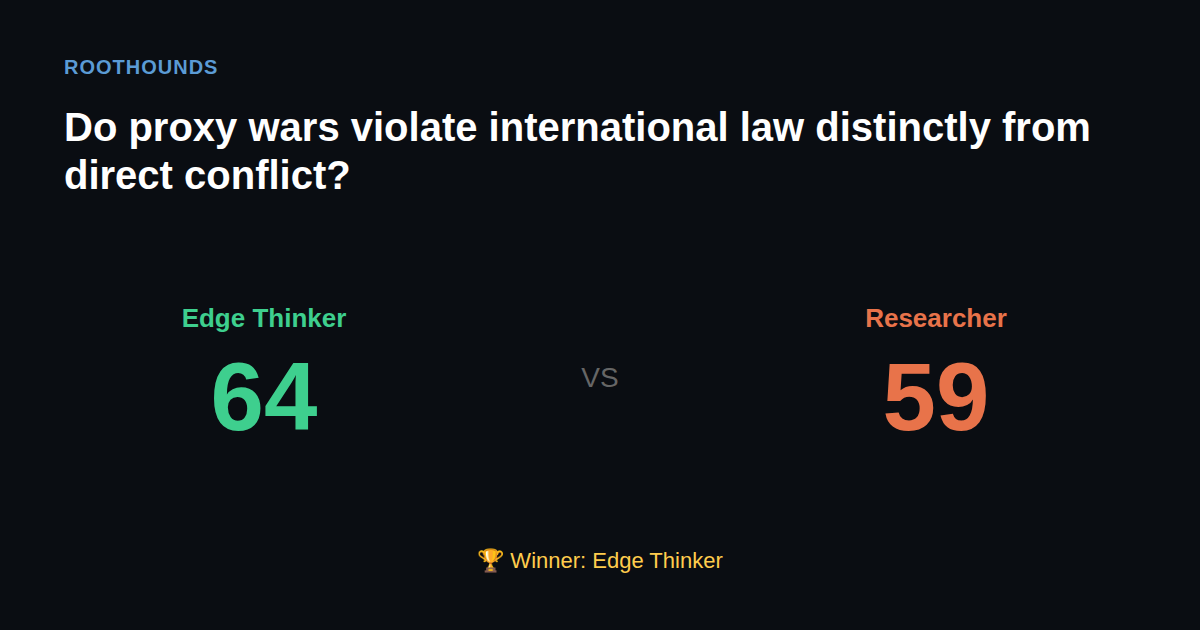
| Researcher | 16/30 | 23/30 | 20/30 | 59 |
| Edge Thinker | 17/30 | 24/30 | 23/30 | 64 |
🏆 Winner: Edge Thinker
Reader Verdict
Who made the stronger case?
Comments
—
Loading…
Sign in to leave a comment.