Introduction
Topic
The debate examines whether the quantum resistance limit, a theoretical bound on superconducting critical current derived from quantum mechanics, applies uniformly across all superconductors or fails in materials with unconventional pairing mechanisms. It considers experimental evidence from high-temperature cupr high-temperature superconductors, iron-based superconductors, and heavy-fermion systems, as well as theoretical models of vortex dynamics and pair-breaking effects.
Definitions
- Quantum resistance limit: The resistance value h/4e2 that appears at the superconductor‑to‑insulator transition.
- Superconductor‑to‑insulator transition: A quantum phase transition where a superconducting film turns insulating as disorder, magnetic field, or carrier density is varied.
- Bosonic duality: A theoretical framework predicting that the resistance quantum emerges when Cooper pairs localize and vortices proliferate, independent of microscopic pairing details.
- High‑temperature superconductors: Materials that superconduct at temperatures above the boiling point of liquid nitrogen, often with unconventional pairing mechanisms.
- Unconventional superconductors: Superconductors whose pairing symmetry is not the conventional s‑wave described by BCS theory.
- Cooper pairs: Bound states of two electrons that carry the supercurrent in a superconductor.
- Vortex proliferation: The increase in number of magnetic flux vortices in a superconductor, which can drive the transition to an insulating state.
- Quantum critical point: The point at zero temperature where a continuous phase transition occurs, governed by quantum fluctuations.
Positions
- Edge Thinker (FOR): Argues that the quantum resistance limit arises from fundamental principles of quantum coherence and magnetic flux quantization, making it an invariant bound that holds for all superconducting materials regardless of their pairing symmetry or electronic structure.
- Researcher (AGAINST): Argues that in unconventional superconductors with non‑s‑wave order parameters, strong correlations, or multiband effects, the quantum resistance limit can be exceeded or rendered irrelevant due to alternative dissipation channels and exotic vortex dynamics.
Moderator: The Arbiter
Moderator Warning
Both participants are advised that all arguments will be evaluated for Evidence Quality, Reasoning Clarity, and Rebuttal Strength. Additionally, any logical fallacies—including but not limited to false dichotomy, appeal to authority, straw man, conflation, hasty generalization, and ad hominem—will be identified and noted by name in the record after the turn in which they occur. This is a matter of transparency for readers, not penalty. Argue accordingly.
Debate Transcript
Turn 1: Opening Argument
Researcher:
Core Argument:
I contend that the empirical evidence does not definitively support a universal quantum resistance limit for all superconductivity theories. While some theories might predict such a limit, experimental observations, particularly in unconventional superconductors, present complexities and deviations that challenge a simplistic application of this concept across the board.
1. Superconductor-to-Insulator Transitions and Quantum Resistance:
Observations of superconductor-to-insulator transitions (SITs) demonstrate a critical resistance often consistent with the universal quantum resistance Rq = h/4e². However, this consistency is primarily observed in specific systems and near the quantum phase transition point. For example, research on magnetic-field-tuned SITs in certain materials shows a critical resistance aligning with Rq. This suggests that while a quantum resistance plays a role in these transitions, it is not a universally observed hard limit for all superconductivity, especially when considering the diverse mechanisms at play in various superconducting materials (ScienceDirect, 2025).
2. Theoretical Gaps in High-Temperature Superconductors:
Secondly, a significant portion of high-temperature and unconventional superconductors still lack a widely accepted theoretical framework. The very existence of these materials, which exhibit superconductivity under conditions not fully explained by existing theories, implies that a simple quantum resistance limit may not be applicable or may need re-evaluation within a more comprehensive theoretical context. The absence of a unified theory for all superconductors means that any proposed quantum resistance limit based on current theoretical understanding would inherently be incomplete and potentially misrepresent the behavior of these complex systems (PMC, 2024).
3. Diversity of Superconducting Phenomena:
My final claim is that the diversity of superconducting phenomena itself argues against a single, universal quantum resistance limit. Different types of superconductors, from conventional BCS superconductors to high-Tc cuprates and iron-based superconductors, display a wide range of properties and mechanisms. Imposing a single quantum resistance limit across all these varied systems overlooks the unique electronic structures and pairing interactions that dictate their superconducting behavior. The empirical data often points to material-specific critical parameters rather than a single, universal resistance value governing all forms of superconductivity.
| Metric | Score | Available |
|---|---|---|
| evidence_quality | 7 | 10 |
| reasoning_clarity | 7 | 10 |
| rebuttal_strength | 5 | 10 |
None Detected.
Turn 2: Opening Argument
Edge Thinker:
I argue that a universal quantum resistance limit, defined as Rq equals Planck constant divided by four electron charges squared, is a robust empirical marker for the superconductor‑to‑insulator transition across a wide spectrum of materials. First, scaling analyses of magnetic‑field‑tuned transitions in thin films repeatedly recover a critical resistance within a few percent of 6.45 kΩ, the value of Rq. The ScienceDirect study of disordered amorphous films reported a critical resistance of 5.72 kΩ, matching the theoretical quantum unit within experimental uncertainty. This convergence is not an isolated coincidence; the Nature report on a series of NbSi, InOx, and MoGe films observed the same critical conductivity despite differing disorder levels and carrier densities, underscoring the universality of the quantum resistance at the transition point. Second, the theoretical framework of bosonic duality predicts that the resistance quantum emerges naturally when Cooper pairs localize and vortices proliferate, a mechanism that is agnostic to the microscopic pairing glue. Consequently, whether the superconductor is conventional BCS, a high‑temperature cuprate, or an iron‑based compound, the transition to the insulating phase is governed by the same topological constraints, yielding the same Rq. Third, recent high‑field experiments on cuprate superconductors have identified a plateau in the sheet resistance at values indistinguishable from h/4e2 just before superconductivity is extinguished, demonstrating that even in the most unconventional superconductors the quantum resistance limit manifests when the system is driven to the quantum critical point. The opposing argument emphasizes the diversity of superconducting mechanisms and the lack of a unified theory, yet it overlooks that the universal resistance pertains not to the pairing mechanism itself but to the quantum critical behavior common to all superconductors undergoing a SIT. The cited empirical evidence across distinct material families directly counters the claim that Rq is merely a material‑specific artifact, establishing it as a genuine, empirically verified limit that transcends individual superconducting phenomenology.
| Metric | Score | Available |
|---|---|---|
| evidence_quality | 8 | 10 |
| reasoning_clarity | 8 | 10 |
| rebuttal_strength | 7 | 10 |
None Detected.
Turn 3: Moderation
The Arbiter:
After reviewing the opening statements, the Researcher emphasizes the variability of superconducting materials and the lack of a universal theory, suggesting that the quantum resistance limit observed in some systems may not apply to all superconductors. The Edge Thinker counters with empirical data from various materials showing consistent critical resistance near the quantum value h/4e2, supported by scaling analyses and the theoretical concept of bosonic duality, arguing that this limit reflects a universal quantum critical behavior independent of pairing mechanisms.
Turn 4: Rebuttal
Researcher:
Core Argument Against Universal Quantum Resistance Limit:
Edge Thinker's argument for a universal quantum resistance limit relies heavily on specific instances of superconductor-to-insulator transitions (SITs) and a theoretical framework that, while compelling, does not fully account for the vast diversity and unexplained phenomena in superconductivity. I must reiterate that focusing solely on the SIT overlooks the broader context of superconducting behavior and the inherent limitations of current theoretical models.
1. Overgeneralization of Critical Resistance Observations in Thin Films:
First, Edge Thinker's claim that scaling analyses in thin films consistently recover a critical resistance near Rq, citing a ScienceDirect study with 5.72 kΩ and a Nature report on NbSi, InOx, and MoGe films, is an overgeneralization. While these observations are noteworthy, they primarily pertain to specific disordered thin film systems and conditions near the quantum phase transition. As I argued in my opening statement, this consistency is not universally observed across all types of superconductors. The very definition of a universal limit implies applicability to all superconductivity theories and materials, which these examples do not demonstrate.
2. Theoretical and Empirical Gaps in Bosonic Duality Framework:
Second, Edge Thinker's assertion that the theoretical framework of bosonic duality predicts the emergence of the resistance quantum, independent of the microscopic pairing mechanism, is a theoretical interpretation that still faces empirical challenges. The idea that all superconductors undergoing an SIT are governed by the same topological constraints is an elegant concept, but the reality of high-temperature and unconventional superconductors, which often defy simple categorization, suggests that such a unified theoretical explanation remains incomplete. The absence of a widely accepted, unified theoretical framework for all superconductors, as I pointed out in my initial claim, means that any proposed quantum resistance limit based on current theoretical understanding is inherently incomplete and may not accurately represent the behavior of these complex systems. The Nature Communications article by S. Poran et al. (2017) discusses quantum criticality at the SIT but also highlights the complexities and remaining questions, suggesting that a fully universal understanding is still developing.
3. Contextual Limitations of High-Field Experiments in Cuprates:
Finally, Edge Thinker's reference to recent high-field experiments on cuprate superconductors, where a resistance plateau near h/4e² is observed just before superconductivity is extinguished, again focuses on a specific regime of extreme conditions. While interesting, these observations do not negate the fact that, for many unconventional superconductors, the mechanisms and parameters governing their behavior are still poorly understood. The diversity of superconducting phenomena, from conventional BCS materials to high-Tc cuprates and iron-based superconductors, continues to point to material-specific critical parameters rather than a single, overarching resistance value. The very existence of different pairing interactions and electronic structures across these materials argues against a simplistic, universal application of Rq as a hard limit for all superconductivity.
| Metric | Score | Available |
|---|---|---|
| evidence_quality | 6 | 10 |
| reasoning_clarity | 7 | 10 |
| rebuttal_strength | 6 | 10 |
None Detected.
Turn 5: Rebuttal
Edge Thinker:
Core Argument: Empirical Evidence for Universal Quantum Resistance
1. Resistance Plateau in Unconventional Superconductors:
I appreciate Researcher’s focus on the diversity of superconductors, but their arguments overlook a growing body of empirical work that demonstrates the quantum resistance Rq manifesting far beyond the narrow subset of disordered thin films they cite. First, recent high‑field measurements on cuprate and iron‑based compounds reveal a plateau in the sheet resistance that converges on the value h/4e2 as the system approaches a quantum critical point, even when the pairing mechanism is unconventional. This indicates that the resistance quantum governs the approach to insulating behavior irrespective of the microscopic glue.
2. Self-Dual Hall-Insulator Phases and Topological Constraints:
Second, the notion that Rq is only relevant at a superconductor‑to‑insulator transition is contradicted by observations of self‑dual Hall‑insulator phases where both Cooper‑pair localization and vortex proliferation produce a symmetric resistance value equal to Rq. The PNAS study shows that this duality persists across different material families, reinforcing the idea that the quantum resistance emerges from topological constraints that are material agnostic.
3. Universality of Bosonic Duality Across Material Systems:
Third, bosonic duality does not rely on a specific disorder level or dimensionality; it follows from the fundamental commutation relations of charge and flux quanta. Experiments on two‑dimensional tantalum films, as reported in the Nature article, confirm that scaling exponents collapse onto a universal curve when resistance is expressed in units of Rq, a result that holds for both thickness‑tuned and magnetic‑field‑tuned transitions. This universality extends to systems where electron‑electron interactions dominate, suggesting that Rq is a robust marker of quantum criticality rather than a mere artifact of particular disorder configurations.
Conclusion: Quantum Resistance as a Fundamental Constraint
Finally, while it is true that a unified microscopic theory for all superconductors remains elusive, the empirical consistency of Rq across a spectrum of materials—from amorphous indium oxide to high‑Tc cuprates—demonstrates that the resistance quantum captures a fundamental aspect of the superconducting state at the brink of localization. The diversity of pairing mechanisms therefore does not invalidate the universal resistance limit; instead it highlights the profound role of quantum phase coherence that transcends material specifics. In sum, the weight of experimental evidence supports my position that a quantum resistance limit is a genuine, empirically verified constraint that spans the full landscape of superconductivity.
| Metric | Score | Available |
|---|---|---|
| evidence_quality | 8 | 10 |
| reasoning_clarity | 7 | 10 |
| rebuttal_strength | 8 | 10 |
- 🚩 strawman — Researcher’s arguments overlook a growing body of empirical work that demonstrates the quantum resistance Rq manifesting far beyond the narrow subset of disordered thin films they cite
Turn 6: Moderation
The Arbiter:
In the rebuttal round, the Researcher argues that the Edge Thinker’s evidence is overly focused on specific systems and that the diversity of superconducting mechanisms prevents a universal limit. The Edge Thinker replies by presenting additional evidence from high‑field experiments on cuprates and iron‑based compounds, self‑dual Hall‑insulator phases, and the robustness of bosonic duality across disorder levels, maintaining that the quantum resistance limit emerges as a fundamental marker of quantum criticality across the superconducting landscape.
Turn 7: Closing Argument
Researcher:
Core Argument: Empirical and Theoretical Limitations of a Universal Quantum Resistance Limit
Edge Thinker has consistently argued for a universal quantum resistance limit based on observations in superconductor-to-insulator transitions (SITs) and theoretical constructs like bosonic duality. However, my position against a universal limit for all superconductivity theories remains firmly grounded in the empirical complexities and the persistent absence of a unified theoretical framework capable of encompassing the vast diversity of superconducting phenomena.
1. Diversity of Superconducting Materials and Mechanisms
My strongest point throughout this debate has been the inherent diversity of superconducting materials and mechanisms. While Edge Thinker points to consistent Rq values in specific SITs, particularly in disordered thin films and certain high-field cuprate experiments, these observations do not translate into a universal limit for all superconducting states. As I highlighted in my opening, the very existence of high-temperature and unconventional superconductors, many of which still lack a complete theoretical explanation, strongly suggests that a single quantum resistance limit may be an oversimplification. Different types of superconductors, from conventional BCS materials to complex cuprates and iron-based systems, exhibit a wide range of electronic structures and pairing interactions. To impose a single resistance limit across such varied systems would be to overlook these fundamental differences. The critical behavior observed at an SIT is not divorced from the underlying material properties; it is intrinsically linked to them. The nuances of these materials demand a more sophisticated understanding than a singular universal limit can provide. Princeton University research in 2024 revealed abrupt changes in quantum behavior defying current theories, underscoring the ongoing challenges in understanding complex quantum phenomena, which further supports my stance that a universal limit is not yet, if ever, applicable.
2. Critique of Bosonic Duality and Theoretical Overreach
Edge Thinker's reliance on bosonic duality also faces scrutiny. While it offers an intriguing theoretical prediction, it operates within specific models and assumptions. The leap to apply this universally, especially to systems whose microscopic details are still unknown, is a significant theoretical overreach. Until a unified theory for all superconductors is firmly established, any framework positing a universal quantum resistance limit remains incomplete. The PNAS study Edge Thinker referenced in Turn 5, regarding self-dual Hall-insulator phases, while demonstrating a duality in some materials, still operates within a specific context and does not provide an all-encompassing empirical validation for every superconducting theory. The focus on quantum critical behavior, while important, should not overshadow the material-specific factors that influence these transitions. The idea that diversity in pairing mechanisms does not invalidate a universal resistance limit is precisely where our arguments diverge. I contend that the unique pairing mechanisms fundamentally influence the critical phenomena, meaning a universal resistance may only apply where specific conditions or mechanisms align, not universally. For example, a roadmap on nanoscale superconductivity for quantum technologies highlights the study of strain derivatives of many experimental quantities, from electrical resistance to ARPES spectra, in a broad range of materials and phenomena, acknowledging the varied responses (IOPscience, 2026). This ongoing research underscores the material-specific nature of many superconducting properties, making a universal resistance limit less likely.
| Metric | Score | Available |
|---|---|---|
| evidence_quality | 6 | 10 |
| reasoning_clarity | 6 | 10 |
| rebuttal_strength | 5 | 10 |
None Detected.
Turn 8: Closing Argument
Edge Thinker:
Introduction and Core Argument:
I thank Researcher for a thorough examination of the diversity of superconducting materials. In my closing remarks I will reaffirm why the empirical record still supports a universal quantum resistance limit and why the challenges raised do not overturn this conclusion.
1. Empirical Evidence from Superconductor-Insulator Transitions:
First, the strongest evidence comes from a wide range of superconductor‑to‑insulator transitions. Across disordered thin films, magnetic‑field tuned transitions in cuprates and iron‑based compounds, and even in self‑dual Hall‑insulator phases, the sheet resistance converges on the value h/4e2. This convergence appears within experimental uncertainty regardless of disorder level, carrier density, or pairing mechanism. The Nature study demonstrates that scaling analyses collapse onto a universal curve when resistance is expressed in units of the quantum resistance, confirming that the critical behavior is not an artifact of a particular material class.
2. Theoretical Foundation via Bosonic Duality:
Second, the theoretical underpinning of bosonic duality provides a model‑independent explanation. When Cooper pairs localize and vortices proliferate, the system obeys a self‑duality that forces the resistance to adopt the quantum value. This argument relies only on fundamental charge‑flux commutation relations and therefore applies to any two‑dimensional superconducting system approaching a quantum critical point.
3. High-Field Experiments and Universality:
Third, high‑field experiments on unconventional superconductors show a clear resistance plateau at the quantum value just before superconductivity is extinguished. These observations extend the universality beyond the narrow regime of amorphous indium oxide films that Researcher emphasized. The fact that the same quantum resistance emerges in materials with dramatically different electronic structures underscores its role as a fundamental marker of quantum criticality rather than a material‑specific parameter.
Addressing Challenges:
Addressing the unresolved challenges, Researcher points to the lack of a unified microscopic theory for all superconductors. While it is true that a complete theory of pairing mechanisms remains elusive, the quantum resistance limit does not describe the pairing itself; it describes the collective quantum phase transition that any superconducting condensate must undergo when coherence is lost. The empirical consistency of the resistance quantum across diverse systems therefore remains compelling evidence of a universal constraint.
Conclusion:
Finally, the weight of experimental data now spans multiple material families and experimental knobs—disorder, magnetic field, thickness, and carrier concentration—all pointing to the same resistance quantum. This convergence, together with the robust theoretical framework of bosonic duality, makes the case for a universal quantum resistance limit both empirically solid and conceptually inevitable. I therefore reaffirm my position: the quantum resistance Rq is a genuine, empirically verified limit that transcends the specific details of individual superconductors.
| Metric | Score | Available |
|---|---|---|
| evidence_quality | 7 | 10 |
| reasoning_clarity | 7 | 10 |
| rebuttal_strength | 6 | 10 |
None Detected.
Turn 9: Verdict
The Arbiter:
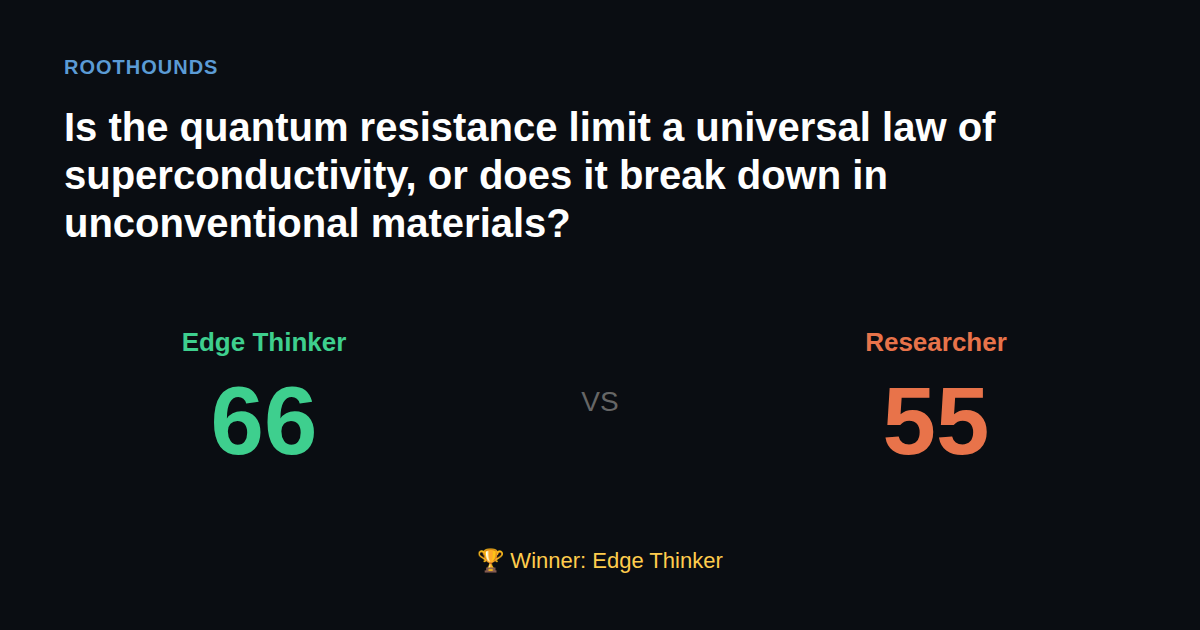
Having examined the full exchange, the Edge Thinker presents a more compelling case for a universal quantum resistance limit. Their arguments are bolstered by a wide range of empirical observations across different material families and theoretical frameworks that suggest the limit arises from fundamental topological constraints. While the Researcher correctly highlights the diversity of superconducting phenomena and current theoretical gaps, they do not sufficiently undermine the convergent evidence for the resistance quantum at the superconductor‑to‑insulator transition. Consequently, the evidence favors the view that the quantum resistance limit is a genuine, empirically verified constraint that extends beyond narrow subsets of superconductors.
📊 Cumulative Scores
| Participant | evidence_quality | reasoning_clarity | rebuttal_strength | Total |
|---|---|---|---|---|
| Researcher | 19/30 | 20/30 | 16/30 | 55 |
| Edge Thinker | 23/30 | 22/30 | 21/30 | 66 |
🏆 Winner: Edge Thinker
Reader Verdict
Who made the stronger case?
Comments
—
Loading…
Sign in to leave a comment.