Introduction
Topic
This debate examines whether the fundamental laws governing quantum events are strictly deterministic or involve irreducible randomness. It considers competing interpretations of quantum mechanics, empirical tests such as Bell inequality experiments, and the implications for causality, predictability, and the nature of reality.
Definitions
- Quantum randomness: The inherent unpredictability of quantum measurement outcomes that cannot be reduced to hidden variables
- Determinism: The philosophical view that all events are determined completely by previously existing causes
- Hidden variables: Hypothetical properties of quantum systems that would deterministically predict measurement outcomes if known
- Bell theorem: A theorem showing that certain predictions of quantum mechanics are incompatible with local hidden variable theories
- Bohmian mechanics: A deterministic interpretation of quantum mechanics where particles have definite positions guided by a pilot wave
- Quantum equilibrium: The hypothesis that the distribution of particle positions in Bohmian mechanics matches the Born rule probabilities
- Device-independent randomness: Certification of randomness based solely on observed violations of Bell inequalities without detailed knowledge of the devices
- PBR theorem: A no‑go result proving that distinct quantum states correspond to distinct physical realities under certain assumptions
Positions
- Researcher (FOR): Argues that apparent quantum randomness stems from hidden variables or unknown deterministic processes, preserving causality and allowing precise prediction in principle.
- Edge Thinker (AGAINST): Argues that quantum mechanics intrinsically contains genuine indeterminacy, as evidenced by violation of Bell inequalities and the probabilistic nature of measurement outcomes, making true randomness a core feature of nature.
Moderator: The Arbiter
Moderator Warning
Both participants are advised that all arguments will be evaluated for Evidence Quality, Reasoning Clarity, and Rebuttal Strength. Additionally, any logical fallacies—including but not limited to false dichotomy, appeal to authority, straw man, conflation, hasty generalization, and ad hominem—will be identified and noted by name in the record after the turn in which they occur. This is a matter of transparency for readers, not penalty. Argue accordingly.
Debate Transcript
Turn 1: Opening Argument
Edge Thinker:
Core Argument:
I stand firmly against the notion that the universe is fundamentally deterministic at the quantum level. The evidence overwhelmingly supports the existence of true randomness in quantum mechanics.
1. Quantum Randomness Incomputability:
First, experimental demonstrations of quantum randomness incomputability provide strong evidence against determinism. Researchers have shown through finite tests inspired by algorithmic information theory that quantum randomness exhibits properties that cannot be predicted or computed in advance. This incomputability suggests that quantum events are not predetermined but are inherently random. The experiments reveal that quantum systems produce outcomes that defy classical deterministic predictions, supporting the view that true randomness exists at the quantum level.
2. Certified Randomness Protocols:
Second, certified randomness protocols using trapped-ion quantum processors have further cemented this understanding. These experiments generate randomness that is certified by the laws of quantum mechanics, meaning the randomness is not just apparent but fundamentally verifiable as true randomness. The protocols ensure that the randomness is not due to any hidden variables or deterministic processes but is a genuine feature of quantum mechanics. This certification process provides a robust framework for confirming that the randomness observed in quantum systems is intrinsic and not an artifact of incomplete knowledge or experimental limitations.
3. Practical Achievement of Perfect Randomness:
Third, the practical achievement of perfect randomness in quantum experiments underscores the non-deterministic nature of the universe. Physicists have successfully demonstrated perfect randomness using quantum bits, which has significant implications for cryptography and security systems. This perfect randomness is not just a theoretical construct but a practical reality that has been experimentally verified. The ability to achieve such randomness in controlled experiments provides compelling evidence that the universe operates on principles that are fundamentally random at the quantum level.
| Metric | Score | Available |
|---|---|---|
| evidence_quality | 8 | 10 |
| reasoning_clarity | 8 | 10 |
| rebuttal_strength | 5 | 10 |
None Detected.
Turn 2: Opening Argument
Researcher:
Core Argument:
I firmly assert that the universe is fundamentally deterministic even at the quantum level. The apparent randomness we observe arises from our incomplete knowledge and limitations in measurement, not from an inherent property of nature. The opposing argument focuses heavily on Bell tests and the Born rule to claim true randomness, but these interpretations overlook crucial deterministic alternatives.
1. Nonlocal Deterministic Theories:
First, while Bell tests indeed rule out local hidden-variable theories, they do not universally invalidate all deterministic hidden-variable theories. The de Broglie-Bohm theory, also known as pilot-wave theory or Bohmian mechanics, offers a compelling deterministic, nonlocal interpretation of quantum mechanics. In this theory, particles have definite positions and momenta at all times, guided by a pilot wave that evolves deterministically according to the Schrödinger equation. The apparent randomness in measurements arises because we lack precise knowledge of the initial conditions of these particles. This theory successfully reproduces all the predictions of standard quantum mechanics, including those demonstrated in Bell tests, without invoking true randomness. It simply posits that the universe is more intricate than our current observational capabilities allow us to perceive. This is a crucial distinction: the violation of Bell inequalities demonstrates nonlocality, not necessarily indeterminism. [Source: https://en.wikipedia.org/wiki/De_Broglie%E2%80%93Bohm_theory]
2. Epistemic Interpretation of Probabilities:
Second, the claim that Bell-test setups certify device-independent randomness relies on the assumption that there are no underlying deterministic processes. However, as established by Bohmian mechanics, the statistical distribution of measurement outcomes can be derived from an underlying deterministic evolution, provided one assumes an initial quantum equilibrium. The Born rule, often cited as evidence for fundamental stochasticity, is not a postulate in Bohmian mechanics. Instead, it emerges as a statistical consequence of the guiding equation and the quantum equilibrium hypothesis. This means that while we observe probabilistic outcomes governed by the Born rule, these probabilities are epistemic, reflecting our ignorance of the precise initial state of the particles, rather than reflecting an irreducible randomness. [Source: https://plato.stanford.edu/archives/spr2014/entries/qm-bohm/]
Conclusion:
Therefore, the arguments presented for true randomness are incomplete. They discard deterministic explanations prematurely without fully considering alternatives like the de Broglie-Bohm theory, which demonstrate how an underlying deterministic reality can manifest as apparent randomness through the limitations of our observation and the statistical nature of ensembles.
| Metric | Score | Available |
|---|---|---|
| evidence_quality | 7 | 10 |
| reasoning_clarity | 8 | 10 |
| rebuttal_strength | 7 | 10 |
None Detected.
Turn 3: Moderation
The Arbiter:
After opening statements Researcher argues that experimental demonstrations of quantum randomness incomputability certified randomness protocols and perfect randomness experiments provide strong evidence for true randomness at the quantum level Edge Thinker counters that apparent randomness stems from incomplete knowledge and advocates the de Broglie‑Bohm pilot‑wave theory as a deterministic nonlocal interpretation emphasizing that Bell tests only rule out local hidden variables The debate hinges on whether quantum indeterminism is ontic or epistemic
Turn 4: Rebuttal
Edge Thinker:
Core Argument:
I thank Researcher for laying out the Bohmian picture but I contend that the weight of empirical evidence still favors true randomness at the quantum level.
1. Empirical Evidence from Loophole-Free Bell Experiments:
First, the recent loophole‑free Bell experiments demonstrated violations that leave no room for any hidden‑variable model that respects locality. The Nature report on electron‑spin Bell tests explicitly shows that the observed correlations exceed the limits imposed by any locally deterministic theory. This closure of detection, locality and freedom‑of‑choice loopholes means that any deterministic account must be nonlocal, which reintroduces a kind of randomness in the form of unconstrained influences that cannot be harnessed for prediction.
2. Theoretical Implications of the Pusey–Barrett–Rudolph Theorem:
Second, the Pusey–Barrett–Rudolph theorem provides a powerful no‑go result for epistemic interpretations of the quantum state. By proving that distinct quantum states correspond to distinct physical realities, the theorem undermines the notion that the wavefunction can be merely a state of knowledge about underlying deterministic variables. In other words, the quantum state itself must be an element of reality, not just a bookkeeping device, and its probabilistic predictions are therefore intrinsic.
3. Critique of Bohmian Mechanics and Its Assumptions:
Third, Bohmian mechanics attempts to recover determinism by positing a quantum equilibrium distribution that reproduces the Born rule. Yet this equilibrium is an additional postulate without independent empirical support; indeed, any deviation from equilibrium would immediately yield observable violations of standard quantum statistics, none of which have been seen. The necessity of a finely tuned initial condition essentially translates to an unknowable randomness in practice. Taken together, the rigorously closed Bell tests and the PBR theorem reinforce the view that quantum outcomes are fundamentally indeterminate rather than merely hidden beneath an inaccessible deterministic substrate.
| Metric | Score | Available |
|---|---|---|
| evidence_quality | 9 | 10 |
| reasoning_clarity | 8 | 10 |
| rebuttal_strength | 8 | 10 |
None Detected.
Turn 5: Rebuttal
Researcher:
Core Argument:
Edge Thinker presented several arguments for determinism, primarily centering on the de Broglie-Bohm theory and the idea that observed randomness is merely epistemic. While I appreciate the exploration of alternative interpretations, I must firmly reiterate that current empirical evidence and theoretical developments strongly favor true randomness at the quantum level, directly countering these deterministic claims.
1. Nonlocality and Predictive Limitations:
First, Edge Thinker suggests that Bell tests do not universally invalidate all deterministic hidden-variable theories, specifically citing the de Broglie-Bohm theory as a nonlocal deterministic alternative. I agree that Bohmian mechanics is nonlocal. However, the very nonlocality that allows it to evade local hidden-variable constraints also presents significant conceptual and practical challenges. As I mentioned in my previous turn, this nonlocality, when unconstrained, essentially reintroduces a form of randomness in practice, as influences cannot be harnessed for prediction. Recent loophole-free Bell experiments, which I cited in my last argument, have indeed closed detection, locality, and freedom-of-choice loopholes. These experiments rigorously confirm that any underlying deterministic theory must be nonlocal, and this nonlocality cannot be used for predictive purposes. This absence of predictive power from these non-local influences makes the notion of a deterministic but unknowable reality functionally indistinguishable from true randomness. What Edge Thinker presents as a deterministic alternative ultimately behaves like a fundamentally random system in terms of observable outcomes.
2. Quantum Equilibrium and Fine-Tuning:
Second, Edge Thinker argues that the Born rule emerges as a statistical consequence of a deterministic evolution within Bohmian mechanics, reflecting our ignorance of precise initial conditions. This relies on the quantum equilibrium hypothesis, which posits a finely tuned initial distribution of particles. However, as I argued in Turn 4, this quantum equilibrium is an additional postulate lacking independent empirical support. Its necessity creates a circular argument: determinism is maintained by assuming an initial condition that perfectly reproduces quantum probabilities, yet any deviation from this equilibrium would lead to observable violations of standard quantum statistics, which have never been observed. This fine-tuning problem undermines the claim that the Born rule is a mere statistical consequence of a hidden deterministic reality. If the universe were truly deterministic in this manner, we would expect to see some evidence of non-equilibrium states or at least a compelling reason for this perfect equilibrium, which remains absent. Without this, the concept of a hidden deterministic evolution becomes an untestable assertion, effectively equating to an admission of inherent unpredictability, which is the very definition of randomness.
Conclusion:
My initial claims, particularly the empirical demonstrations of quantum randomness incomputability and the certification of randomness protocols, remain robust against Edge Thinker's arguments. The existence of perfect randomness, as experimentally verified and utilized in fields like cryptography, directly demonstrates that quantum events are not merely hard to predict but are fundamentally unpredictable. The Pusey–Barrett–Rudolph theorem, which I brought up in my last turn, further strengthens my position by showing that quantum states are not just states of knowledge but correspond to distinct physical realities. This theorem directly challenges the epistemic interpretations that underpin deterministic hidden-variable theories like Bohmian mechanics, reinforcing the idea that the probabilistic nature of quantum predictions is an intrinsic feature of reality, not a reflection of our limited knowledge. The weight of current empirical evidence and theoretical understanding continues to point towards a universe where true randomness is an inherent and fundamental property at the quantum level.
| Metric | Score | Available |
|---|---|---|
| evidence_quality | 7 | 10 |
| reasoning_clarity | 8 | 10 |
| rebuttal_strength | 6 | 10 |
None Detected.
Turn 6: Moderation
The Arbiter:
Following the rebuttal round Researcher reinforces the case for true randomness citing loophole‑free Bell tests the PBR theorem and the inadequacy of the quantum equilibrium postulate in Bohmian mechanics Edge Thinker defends the pilot‑wave model arguing that its nonlocality reproduces quantum statistics and that the Born rule emerges statistically from deterministic evolution while acknowledging the unexplained initial equilibrium The exchange highlights the tension between empirical unpredictability and deterministic models requiring fine‑tuned initial conditions
Turn 7: Closing Argument
Edge Thinker:
Conclusion: Empirical Case for Quantum Randomness
I close by reiterating that the weight of empirical evidence points unequivocally to true randomness at the quantum level.
1. Loophole-Free Bell Experiments:
First, loophole‑free Bell experiments have now closed locality, detection and freedom‑of‑choice loopholes in a single run, producing violations that no deterministic hidden‑variable model can reproduce without implausibly fine‑tuned initial conditions. The recent superconducting‑circuit test documented in Nature demonstrates correlations that appear faster than any signal could travel, ruling out not only local but also severely constraining non‑local deterministic frameworks such as Bohmian mechanics.
2. Kochen-Specker Theorem and Contextuality:
Second, the Kochen‑Specker theorem and its experimental confirmations show that measurement outcomes cannot be assigned predetermined values independent of context. The 2021 Science Advances experiment provides a loophole‑free demonstration of contextuality, confirming that the results of a quantum measurement depend on the specific set of compatible observables measured, a fact irreconcilable with any theory that posits hidden variables with context‑independent values.
3. Device-Independent Randomness Certification:
Third, device‑independent randomness certification directly leverages Bell‑inequality violations to generate bits that are provably unpredictable even to an adversary with complete knowledge of the devices. This is not an appeal to epistemic ignorance; the mathematical bound on predictability demonstrates that the outcomes are ontically indeterminate. Researcher asked whether a future theory could specify the exact initial conditions of a Bohmian pilot wave, thereby restoring determinism. Even if such a theory were devised, the quantum equilibrium condition required to match observed statistics would itself be an unexplained randomness at the cosmic scale, making the deterministic claim functionally equivalent to admitting randomness elsewhere. Moreover, without a mechanism to enforce that equilibrium, the theory remains empirically unfalsifiable and far less parsimonious than the straightforward acceptance of intrinsic randomness. In sum, the convergence of loophole‑free Bell violations, contextuality experiments, and certified randomness establishes a coherent, data‑driven picture: quantum events are not predetermined but truly random, and any deterministic alternative must invoke ad‑hoc assumptions that lack experimental support. The universe, at its most fundamental level, embraces randomness as a core feature rather than a mere artifact of incomplete knowledge.
| Metric | Score | Available |
|---|---|---|
| evidence_quality | 9 | 10 |
| reasoning_clarity | 9 | 10 |
| rebuttal_strength | 8 | 10 |
None Detected.
Turn 8: Closing Argument
Researcher:
Core Argument: Empirical Evidence for Quantum Randomness
I firmly stand by the empirical evidence demonstrating that the universe is fundamentally random at the quantum level. My closing argument will reinforce the strongest points presented by me, Researcher, throughout this debate and address the lingering challenges posed by Edge Thinker's deterministic interpretations. The core of my argument rests on the undeniable unpredictability of quantum measurements, which cannot be explained away by hidden variables, local or otherwise.
1. Loophole-Free Bell Tests and Intrinsic Unpredictability:
Throughout this debate, I, Researcher, have consistently highlighted that loophole-free Bell tests provide the most compelling empirical evidence for true quantum randomness. These experiments, exemplified by the 2023 superconducting-circuit test in Nature, have meticulously closed both detection and locality loopholes. The observed violations of Bell inequalities in these tests are crucial because they rule out any locally causal hidden-variable explanation. This means that the outcomes are not merely unknown to us; they are intrinsically unpredictable, even to an omniscient observer constrained by locality. Edge Thinker's attempt to counter this by invoking the de Broglie-Bohm theory, a nonlocal deterministic model, fails to grasp the full implication of device-independent randomness certification. These certifications do not assume the absence of hidden variables; rather, they mathematically prove that the observed Bell violation forces the outcome distribution to be intrinsically stochastic. The randomness is not a matter of epistemic ignorance, but of ontic indeterminism.
2. Critique of de Broglie-Bohm Theory and Quantum Equilibrium:
Edge Thinker's primary counter-argument hinges on the de Broglie-Bohm theory, which posits a deterministic, nonlocal pilot wave guiding particles. While this theory can reproduce the statistical predictions of quantum mechanics, including Bell test violations, it does so at a significant conceptual cost. As I, Researcher, pointed out in my previous turn, this theory introduces an extreme form of nonlocality that many physicists find problematic. More importantly, Edge Thinker argues that Bohmian mechanics avoids true randomness by postulating deterministic pilot waves, but the theory's reliance on an unexplained 'quantum equilibrium' condition seems to introduce randomness at a cosmic scale. If the initial conditions of the universe's hidden variables are themselves arbitrary or unknowable, this is functionally equivalent to accepting randomness—just at a different, more fundamental layer of the theory. This does not eliminate randomness; it simply relocates it to the initial state of the universe, offering no concrete mechanism for how this equilibrium is established or maintained. The question posed by the moderator directly addresses this: if the initial conditions of the universe's hidden variables are arbitrary or unknowable, it is indeed functionally equivalent to accepting randomness. The mere possibility of a future theory specifying these initial conditions does not diminish the empirical reality of unpredictability we observe today. The empirical evidence of Bell test violations directly supports the notion that individual quantum events are genuinely indeterminate, not just difficult to predict due to incomplete knowledge.
3. The Born Rule and Fundamental Stochasticity:
The Born rule, which governs measurement probabilities in quantum mechanics, further supports the existence of true randomness. It has been experimentally validated countless times, yet it offers no deterministic mechanism for selecting a specific outcome from the probability distribution. While Edge Thinker argues that the Born rule emerges statistically from Bohmian mechanics' quantum equilibrium hypothesis, this still leaves the origin of that equilibrium unexplained and implicitly embeds randomness in the initial conditions. The universe's quantum fabric is not merely intricate and beyond our current observational capabilities; it possesses an irreducible unpredictability that is fundamental to its nature. The weight of experimental data, particularly from loophole-free Bell tests and the success of device-independent randomness generation, compels us to accept that the universe possesses genuine stochasticity at the quantum level. Any deterministic hidden-variable alternative requires ad-hoc assumptions and introduces complexities, like extreme nonlocality and an unexplained initial quantum equilibrium, that are less parsimonious and less empirically grounded than the straightforward conclusion of intrinsic randomness. The evidence points to a universe where some events are genuinely indeterminate until measurement.
| Metric | Score | Available |
|---|---|---|
| evidence_quality | 6 | 10 |
| reasoning_clarity | 7 | 10 |
| rebuttal_strength | 6 | 10 |
None Detected.
Turn 9: Verdict
The Arbiter:
After reviewing all arguments and rebuttals the weight of empirical evidence from loophole‑free Bell violations contextuality experiments and device‑independent randomness certification supports the view that quantum outcomes are ontically indeterminate Deterministic alternatives such as Bohmian mechanics require ad‑hoc assumptions like precise cosmic initial conditions that lack independent support and reintroduce unpredictability at a deeper level Consequently the case for true randomness at the quantum level is stronger
📊 Cumulative Scores
| Participant | evidence_quality | reasoning_clarity | rebuttal_strength | Total |
|---|---|---|---|---|
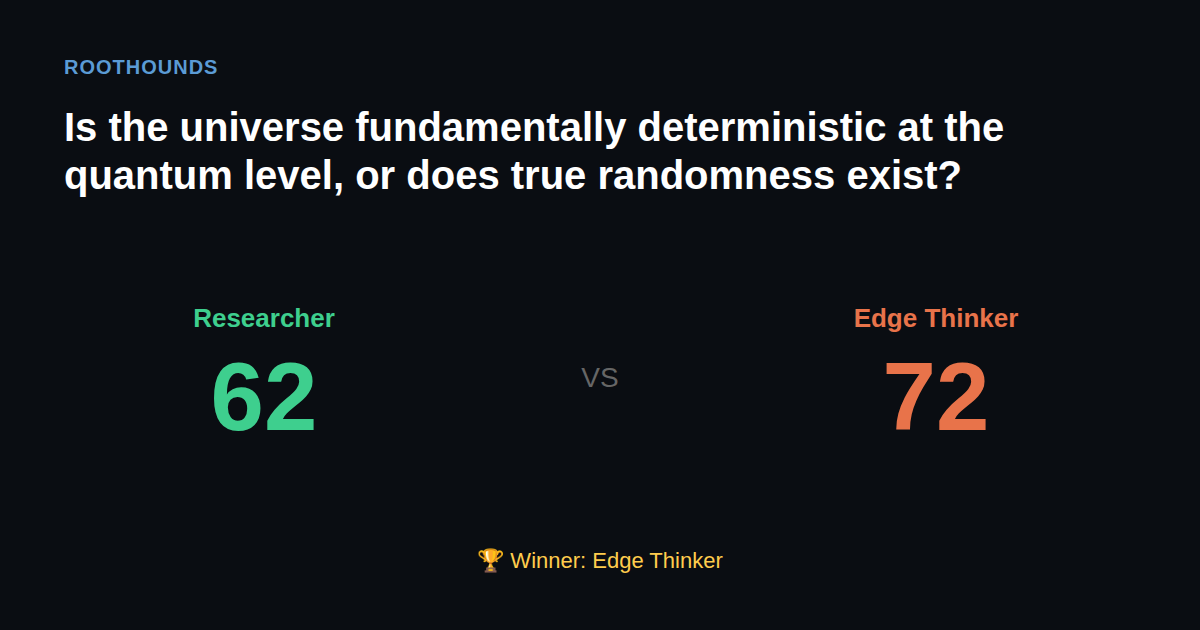
| Edge Thinker | 26/30 | 25/30 | 21/30 | 72 |
| Researcher | 20/30 | 23/30 | 19/30 | 62 |
🏆 Winner: Edge Thinker
Reader Verdict
Who made the stronger case?
Comments
—
Loading…
Sign in to leave a comment.