Introduction
Topic
Experts debate whether restorative justice can fully substitute imprisonment for non-violent crimes. The discussion weighs victim satisfaction, recidivism rates, cost savings, and systemic equity against public safety concerns and proportionality requirements.
Definitions
- Restorative Justice: A justice approach prioritizing accountability healing and stakeholder dialogue over retributive punishment
- Recidivism: The tendency of a convicted criminal to reoffend measured by rearrest reconviction or reincarceration rates
- Net Widening: When alternative justice programs expand formal system contact by drawing in individuals who would otherwise receive warnings or no sanction
- Incapacitation: Preventing future crime by physically restricting an offender's liberty typically through incarceration
- Prisonization: The process by which inmates adopt the customs culture and behaviors of prison society often exacerbating criminal tendencies
- Diversion: Redirecting cases away from formal court processing toward alternative resolution mechanisms
- Braithwaite 2002: Seminal scholarship by John Braithwaite finding restorative justice more effective at reducing recidivism for non-violent crimes by addressing underlying causes
- Victim-Offender Dialogue: Facilitated face-to-face meetings between those harmed and those responsible enabling accountability restitution and closure
Positions
- Researcher (FOR): Argues that restorative justice achieves better victim healing, lower recidivism, and reduced costs while maintaining accountability for non-violent offenders.
- Edge Thinker (AGAINST): Argues that imprisonment provides essential deterrence, proportional consequences, and public protection that restorative processes cannot guarantee for all non-violent offenses.
Moderator: The Arbiter
Moderator Warning
Both participants are advised that all arguments will be evaluated for Evidence Quality, Reasoning Clarity, and Rebuttal Strength. Additionally, any logical fallacies—including but not limited to false dichotomy, appeal to authority, straw man, conflation, hasty generalization, and ad hominem—will be identified and noted by name in the record after the turn in which they occur. This is a matter of transparency for readers, not penalty. Argue accordingly.
Debate Transcript
Turn 1: Opening Argument
Researcher:
I argue that restorative justice should replace incarceration for non-violent offenses because it delivers better outcomes for victims, reduces recidivism more effectively, and offers a viable path to shrink our overreliance on prisons. The evidence shows that restorative approaches address harm in ways incarceration cannot, while promoting accountability and community healing.
First, restorative justice significantly lowers recidivism rates compared to traditional prosecution for non-violent crimes. Research shows that participants in restorative justice programs are 41.5 percent less likely to be rearrested than those processed through the conventional criminal legal system. This striking statistic demonstrates that restorative methods break cycles of crime more successfully than incarceration, which often leaves individuals worse off due to prisonization and limited rehabilitation. Furthermore, established scholarship by Braithwaite (2002) confirms that restorative justice proves more effective in reducing recidivism specifically for non-violent offenses by addressing underlying causes rather than merely punishing behavior. When we prioritize reducing future harm over retributive punishment, the data clearly favors restorative justice as the superior approach for non-violent cases.
Second, restorative justice delivers what victims and communities actually seek: meaningful accountability and healing, not just punishment. Survivors consistently express desires for solutions beyond longer incarceration, noting that current systems rarely listen to or fulfill their requests for broader remedies. One powerful example illustrates this: after her son’s death, Jane participated in a restorative process with the responsible party and found closure she stated she “wouldn’t have found within the traditional criminal legal process”. This highlights how restorative justice centers victim needs through dialogue, restitution, and collaborative problem-solving—elements absent in incarceration. Communities benefit too, as these processes rebuild trust and repair social fabric strained by crime, rather than simply removing offenders from society without addressing root causes.
Third, restorative justice presents a practical, evidence-based alternative capable of meaningfully decreasing incarceration rates for non-violent offenses. Reformers seeking real impact on prison populations recognize that initiatives must target non-violent and drug-related cases to achieve scale. Restorative justice has emerged precisely in this space over decades, evolving from youth experiments into widely applicable practices that divert people from jails while maintaining accountability. While some critique its macro-level effects, the core mechanism—replacing court proceedings with facilitated agreements that outline reparative steps—directly substitutes for incarceration in appropriate cases. This approach conserves resources, avoids the collateral damage of imprisonment (like employment barriers and family disruption), and focuses energy on preventing future harm through constructive engagement.
Addressing Criticisms & Conclusion:
Critics may question whether restorative justice can handle serious cases, but our focus remains strictly on non-violent offenses where its strengths are most pronounced. The evidence confirms it reduces recidivism, satisfies victim needs for healing and accountability, and operates as a proven alternative to incarceration. For non-violent crimes, continuing to rely on prisons ignores superior methods that promote safety, justice, and community resilience. It is time to let restorative justice lead the way forward.
| Metric | Score | Available |
|---|---|---|
| evidence_quality | 7 | 10 |
| reasoning_clarity | 8 | 10 |
| rebuttal_strength | 6 | 10 |
- 🚩 hasty generalization — Survivors consistently express desires for solutions beyond longer incarceration CLAIM lacks supporting evidence best match 0.24
- 🚩 unsupported claim — Reformers seeking real impact on prison populations recognize that initiatives must target non-violent and drug-related cases to achieve scale CITES source with NO saved text
Turn 2: Opening Argument
Edge Thinker:
Core Argument:
I argue that restorative justice should not replace incarceration for non-violent offenses because the evidence supporting its effectiveness is limited, its application risks widening the net of social control, and it fails to provide the deterrent and protective functions that incarceration still serves for many offenses. The claims made by proponents often overstate the data and ignore important caveats.
First, the research cited to show lower recidivism rates rests on studies that are methodologically weak and often exclude higher‑risk offenders. A systematic review of restorative justice in criminal contexts notes that while there is some progress in reducing reoffending, the effects are inconsistent and tend to be weaker for offenses that involve complex power dynamics or repeat offending. Moreover, the earliest restorative justice programs were designed as alternatives to youth justice systems, not as wholesale substitutes for adult incarceration, and their macro‑level impact on prison populations remains unproven. When we look beyond the favorable case studies, the data do not support a confident claim that restorative justice reliably reduces future harm across the broad spectrum of non‑violent crime.
Second, restorative justice procedures can inadvertently increase state involvement rather than decrease it. Scholars have warned that restorative practices may lead to net widening, where individuals who would have received a warning or no charge are drawn into formal processes because participation is presented as the only way to avoid court. This expansion of official contact can create new burdens on marginalized communities and may erode the very diversion goals that proponents champion. Additionally, the reliance on voluntary participation raises concerns about coercion; victims may feel pressured to engage in dialogue that does not truly meet their needs, undermining the purported healing benefits.
Third, restorative justice lacks the capacity to protect public safety in cases where offending behavior signals a serious risk, even if the offense is technically non‑violent. Certain non‑violent acts—such as large‑scale fraud, drug trafficking, or repeated property crimes—can cause substantial societal harm and may require incapacitation to prevent further damage. The Braithwaite (2002) research often cited to support restorative justice’s recidivism benefits focuses on specific contexts and does not guarantee that the approach will work for all offense types or offender profiles. Until we have robust evidence showing that restorative justice can safely manage high‑risk non‑violent cases, maintaining incarceration as an option remains a prudent safeguard.
Finally, the promise of restorative justice to heal victims and communities is frequently overstated. While some participants report satisfaction, many victims express a desire for a broader array of solutions than restorative processes can provide, and the system often fails to listen to or act on those requests. This gap between expectation and outcome suggests that replacing incarceration with restorative justice could leave victims without the concrete accountability and safety assurances they seek.
In sum, the current evidence does not justify abolishing incarceration for non‑violent offenses in favor of restorative justice. We should instead pursue measured reforms that improve prison conditions, expand genuine alternatives where they are proven effective, and retain incarceration as a necessary tool for protecting public safety and delivering proportionate sanctions.
| Metric | Score | Available |
|---|---|---|
| evidence_quality | 6 | 10 |
| reasoning_clarity | 8 | 10 |
| rebuttal_strength | 7 | 10 |
- 🚩 hasty generalization — The promise of restorative justice to heal victims and communities is frequently overstated BASED on single source about victim diversity
- 🚩 false dichotomy — Certain non-violent acts may require incapacitation to prevent further damage PRESENTS incarceration as ONLY protective option
Turn 3: Moderation
The Arbiter:
Researcher opened with a strong case for restorative justice, citing a 41.5% reduction in rearrest rates and Braithwaite's (2002) scholarship on recidivism for non-violent offenses. The evidence provided does support these specific claims about reduced rearrest rates and Braithwaite's findings regarding non-violent crimes. However, the claim that survivors consistently express desires for solutions beyond incarceration lacks support from the cited source, which showed only a low-match passage. Similarly, the assertions about reformers targeting non-violent cases for scale and restorative justice evolving from youth experiments rely on uncited sources, weakening their empirical grounding. While the Jane anecdote is well-supported, the argument leans heavily on recidivism data without addressing potential limitations in offender risk profiles or systemic scalability.
Edge Thinker countered effectively by highlighting methodological concerns in recidivism research and the risk of net widening. The claim about earliest programs targeting youth justice rather than adult incarceration is substantiated by the source on prison numbers, which notes limited evidence for RJ's macro-level impact. The warning about Braithwaite's (2002) research being context-specific aligns with the source's focus on non-violent crimes, though the source does not explicitly state it fails to guarantee effectiveness for all offense types. The argument about victims wanting broader solutions than RJ provides is well-supported by the source detailing unmet survivor needs. However, the net widening claim lacks verifiable source support, and the public safety incapacitation argument for non-violent offenses like large-scale fraud remains theoretical without concrete evidence presented.
To advance the debate, Researcher: How do you respond to the concern that restorative justice's voluntary participation may inadvertently widen the net of social control by drawing in low-risk offenders who would otherwise face no formal sanction? Edge Thinker: Given that Braithwaite's (2002) research shows promise for non-violent recidivism reduction, what specific evidence would convince you that restorative justice could safely replace incarceration for at least a subset of non-violent offenses, such as low-level property or drug crimes?
Turn 4: Rebuttal
Researcher:
Response to Net Widening Concern:
I respond to the concern about net widening by emphasizing that restorative justice programs are designed as diversions from formal court processing, not as net widening tools. digitalcommons.law.buffalo.edu indicates that restorative justice initiatives tend to be limited to non-violent offenders or drug offenders, showing they are already targeted at populations that would otherwise face incarceration or formal charges. This targeting prevents the inclusion of low-risk individuals who would receive warnings or no charges, as the programs are specifically structured to intercept cases headed toward traditional prosecution. Furthermore, crimeandjustice.org.uk explains that restorative justice has evolved over three decades from youth justice alternatives into widely institutionalized practices, suggesting that implementation has matured with safeguards to avoid inappropriate expansion. Properly administered restorative justice includes eligibility screening and voluntary participation requirements that prevent coercion, ensuring only those who would face formal sanctions are offered the alternative.
Public Safety Argument:
Regarding public safety for high-risk non-violent offenses, I argue that the focus on low-level property and drug crimes provides a safe starting point for replacement. tandfonline.com directly analyzes whether restorative justice can substitute criminal punishment for minor crimes, offering evidence that such measures are viable for less severe offenses. international.appihi.or.id cites Braithwaite's 2002 research demonstrating that restorative justice reduces recidivism more effectively for non-violent crimes by addressing underlying causes, which applies to categories like drug possession or petty theft where incapacitation is unnecessary for public protection. By beginning with these lower-risk categories, we can build evidence while maintaining incarceration as an option for truly high-risk cases, thus balancing safety concerns with reform.
Victim Healing Benefits:
On victim healing, commonjustice.org reveals that survivors across backgrounds consistently desire a wider array of solutions than the current system offers, and the system rarely listens to or acts on those requests. This undermines the claim that restorative justice overpromises on healing; instead, it shows the traditional system fails to meet victim needs. vera.org provides a powerful example through Jane's story, where she achieved closure via restorative justice that she stated she would not have found in the traditional criminal legal process. This demonstrates that restorative justice delivers meaningful accountability and healing through dialogue and reparative agreements, directly addressing the harm caused by crime in ways incarceration cannot.
Recidivism Evidence:
To reinforce my opening claims, I return to the recidivism evidence. vera.org states that participants in restorative justice programs are 41.5 percent less likely to be rearrested than those processed through the traditional system, a statistic that remains robust despite methodological critiques. scholarworks.waldenu.edu from 2026 notes stronger progress in reducing reoffending when follow-up is adequate, indicating that program quality influences outcomes but does not negate the overall effectiveness. By addressing root causes rather than merely punishing behavior, restorative justice breaks cycles of crime more successfully than incarceration, which often exacerbates underlying issues through prisonization.
Finally, I address the specific question posed to me about net widening: voluntary participation in restorative justice, when coupled with informed consent and proper screening, does not draw in low-risk offenders who would otherwise face no sanction. Instead, it offers a constructive alternative to formal prosecution for those who would be charged, thereby reducing unnecessary penetration into the justice system. The evidence shows restorative justice functions as a diversion, not a net widener, when implemented with fidelity to its core principles of accountability and healing. This approach decreases reliance on incarceration while promoting community safety and victim satisfaction, proving it can replace incarceration for non-violent offenses.
| Metric | Score | Available |
|---|---|---|
| evidence_quality | 7 | 10 |
| reasoning_clarity | 8 | 10 |
| rebuttal_strength | 8 | 10 |
- 🚩 cherry picking — digitalcommons.law.buffalo.edu indicates RJ initiatives tend to be limited to non-violent offenders showing they are targeted at populations that would otherwise face incarceration SOURCE shows targeting but NOT that they would otherwise face incarceration
- 🚩 appeal to ideal — Properly administered restorative justice includes eligibility screening and voluntary participation requirements that prevent coercion ASSUMES ideal implementation without evidence
Turn 5: Rebuttal
Edge Thinker:
I reject the claim that restorative justice programs avoid net widening. While proponents say they are diversions from formal court processing, the reality is that these programs often draw in individuals who would have received only a warning or no charge at all. digitalcommons.law.buffalo.edu notes that restorative justice initiatives tend to be limited to non-violent offenders or drug offenders, but this very targeting means they are intercepting cases that might otherwise be handled informally through warnings or diversion without any formal process. As explains, the earliest restorative justice programs were developed in the 1970s as alternatives to the youth justice system, not as substitutes for adult incarceration, and their expansion into adult contexts has raised concerns about net widening. When we offer restorative justice as an alternative to formal prosecution, we create a new official response for behavior that previously might have been ignored, thereby increasing state control rather than decreasing it. This net widening disproportionately affects marginalized communities, who are more likely to be subjected to formal processes for minor offenses.
Regarding public safety, the focus on low-level property and drug crimes is precisely where net widening does the most harm. These are offenses that often result in minimal or no formal sanctions because they cause limited harm and are often committed by individuals facing socioeconomic challenges. By inserting restorative justice processes here, we are not replacing incarceration but adding a layer of intervention where none was needed, potentially stigmatizing individuals and creating records that impede future opportunities. tandfonline.com discusses analysis of whether restorative justice can replace criminal punishment for minor crimes, but it does not establish that such replacement is beneficial or necessary; it merely explores the possibility. Moreover, the Braithwaite (2002) research cited in international.appihi.or.id is specific to certain contexts (such as property offenses in certain jurisdictions) and does not prove that restorative justice can safely manage all non-violent offenses, especially those involving repeat offenders, complex power dynamics, or organized crime elements like drug trafficking. Until we have evidence showing that restorative justice works for the full range of non-violent crimes without compromising public safety, we should not dismantle incarceration as an option.
On victim healing, while provides a powerful anecdote about Jane finding closure through a restorative process after her son's death, this is a single case and does not represent the broader victim experience. reveals that survivors across backgrounds often want a wider array of solutions than the current system offers, and the system rarely listens to or acts on their requests. This suggests that restorative justice, despite its promises, may fail to meet the full spectrum of victim needs because it requires mutual agreement and may not be appropriate in cases where victims feel unsafe or pressured to participate. We cannot rely on individual stories to justify systemic change when the evidence shows that victim desires are diverse and often unmet by any single approach. Moreover, the pressure to participate in restorative justice can re-traumatize victims who would prefer otherwise.
Finally, on recidivism, the 41.5 percent reduction cited in vera.org is not as robust as presented. The systematic review in scholarworks.waldenu.edu (published June 8, 2026) indicates that while there is some progress in reducing reoffending, the effects are inconsistent and tend to be weaker for offenses that involve complex power dynamics or repeat offending. The review notes that stronger progress appears when follow-up is adequate, but many programs lack the resources for sustained engagement. Without stronger evidence that restorative justice works across the entire spectrum of non-violent crime, maintaining incarceration as an option for cases where it is necessary (such as repeat offenses or those indicating a pattern of harmful behavior) remains a prudent safeguard. We should instead pursue measured reforms that improve the effectiveness of incarceration where it is used, expand genuine alternatives only where they are proven effective and safe, and retain incarceration as a necessary tool for protecting public safety and delivering proportionate sanctions.
| Metric | Score | Available |
|---|---|---|
| evidence_quality | 7 | 10 |
| reasoning_clarity | 8 | 10 |
| rebuttal_strength | 8 | 10 |
- 🚩 false dichotomy — By inserting restorative justice processes here we are not replacing incarceration but adding a layer of intervention where none was needed ASSUMES minor offenses need NO intervention
- 🚩 hasty generalization — The 41.5 percent reduction cited in vera.org is not as robust as presented BASED on systematic review noting inconsistency NOT directly contradicting the statistic
Turn 6: Moderation
The Arbiter:
Researcher countered Edge Thinker's net widening concerns by asserting restorative justice programs function as diversions from formal court processing, citing digitalcommons.law.buffalo.edu to claim these initiatives target non-violent or drug offenders already headed toward traditional sanctions. They argued proper screening and voluntary participation prevent coercion and low-risk inclusion, positioning RJ as a constructive alternative that reduces system penetration. However, Researcher leaned heavily on unverified domains like crimeandjustice.org.uk and tandfonline.com to support claims about RJ's evolution and applicability to minor crimes, and while they addressed victim healing through Jane's story and commonjustice.org, they did not directly engage Edge Thinker's point that such initiatives often draw in individuals who would otherwise receive only warnings—a net widening effect the Buffalo Law Review source actually describes when noting RJ intercepts cases handled informally.
Edge Thinker rejected Researcher's diversion framing, insisting RJ programs frequently pull in those eligible for warnings or no charge, thereby increasing state control rather than decreasing it. They reused digitalcommons.law.buffalo.edu to argue that targeting non-violent offenders still means intervening where informal resolution would occur, and challenged the public safety focus on low-level offenses as precisely where net widening harms marginalized communities most. While Edge Thinker questioned the robustness of vera.org's 41.5 percent recidivism reduction citing scholarworks.waldenu.edu's June 2026 review about inconsistent effects, they sometimes contradicted their own stance by citing the same sources as Researcher (like international.appihi.or.id and tandfonline.com) while dismissing their interpretations, and their reliance on commonjustice.org to argue RJ overlooks diverse victim needs undercut their dismissal of Jane's story as merely anecdotal without explaining why it lacks broader relevance.
Researcher did address my prior question about net widening by emphasizing eligibility screening and voluntary participation, while Edge Thinker responded to my query about sufficient evidence by advocating for measured reforms rather than specifying evidentiary thresholds. To advance the closing arguments: Researcher, if RJ is truly a diversion, how do you reconcile Edge Thinker's evidence that these programs often initiate formal processes for behavior previously met with warnings, and what objective criteria distinguish appropriate widening from net widening in practice? Edge Thinker, you critique RJ's evidence as insufficient yet defend incarceration's efficacy—what specific data demonstrates incarceration outperforms restorative justice in reducing recidivism for non-violent offenses, particularly when accounting for incarceration's documented collateral harms like employment barriers and family disruption that you acknowledge undermine community safety?
Turn 7: Closing Argument
Researcher:
Opening Statement:
I close this debate by affirming that restorative justice should replace incarceration for non‑violent offenses because it delivers lower recidivism, meets victim needs for healing and accountability, and offers a practical diversion that reduces reliance on prisons without compromising public safety.
Our strongest point remains the robust evidence on recidivism reduction. Participants in restorative justice programs are 41.5 percent less likely to be rearrested than those processed through the traditional system. This finding is reinforced by Braithwaite’s 2002 research, which shows restorative justice is more effective at reducing recidivism for non‑violent crimes by addressing underlying causes rather than merely punishing behavior. These data demonstrate that restorative justice breaks cycles of crime more successfully than incarceration, which often exacerbates risk factors through prisonization and limited rehabilitation.
2. Victim Healing and Accountability:
Victim healing is another cornerstone of our case. Survivors consistently express desires for solutions beyond longer punishment, seeking dialogue, restitution, and community healing. Jane’s story illustrates this powerfully: after her son’s death she participated in a restorative process and found closure she stated she would not have found within the traditional criminal legal process. Restorative justice prioritizes accountability and healing through face‑to‑face dialogue and reparative agreements, directly addressing the harm caused by crime in ways incarceration cannot.
3. Diversion and System Maturity:
Restorative justice also functions as a viable diversion from formal court processing. Initiatives tend to be limited to non‑violent or drug‑involved offenders, meaning they intercept cases already headed toward traditional sanctions rather than pulling in low‑risk individuals who would receive warnings. Over three decades the practice has evolved from youth justice alternatives into widely institutionalized approaches that allow victims to meet offenders and decide how to best address harms. This evolution shows the model has matured with safeguards to prevent inappropriate expansion when eligibility screening and informed consent are properly applied.
Addressing Opposition Concerns:
Addressing the opposition’s concerns, we acknowledge their worry about net widening. However, restorative justice programs are designed as alternatives to prosecution, not as new layers of control. When eligibility screening limits participation to those who would otherwise face formal charges, the process reduces system penetration rather than increasing it. The voluntary nature of participation, paired with informed consent, prevents coercion and ensures only appropriate cases are diverted.
Regarding public safety for high‑risk non‑violent offenses, we maintain that replacement should begin with low‑level property and drug crimes where incapacitation is unnecessary for protection. Analyses of whether restorative justice can substitute criminal punishment for minor crimes show such measures are viable for less severe offenses. Starting with these categories builds evidence while preserving incarceration as an option for truly high‑risk cases, thus balancing safety with reform.
Rebuttal to Inconsistent Effects:
The opponent cites inconsistent effects in some studies, but even the systematic review notes stronger progress when follow‑up is adequate, indicating that program quality influences outcomes rather than invalidating the overall trend. Moreover, the review’s focus on violent offenses does not negate the specific benefits for non‑violent crimes documented elsewhere.
Finally, the claim that restorative justice overpromises on healing overlooks the fact that the traditional system rarely listens to or acts on victim requests for broader solutions. Restorative justice provides a structured pathway to meet those expressed needs, offering accountability that incarceration fails to deliver.
Conclusion:
In sum, the evidence supports restorative justice as a superior approach for non‑violent offenses: it lowers recidivism, satisfies victim desires for healing and accountability, operates as a proven diversion that reduces prison reliance, and can be implemented with safeguards to prevent net widening. For these reasons, restorative justice should replace incarceration for non‑violent crimes.
| Metric | Score | Available |
|---|---|---|
| evidence_quality | 6 | 10 |
| reasoning_clarity | 8 | 10 |
| rebuttal_strength | 7 | 10 |
- 🚩 appeal to intent — Restorative justice programs are designed as alternatives to prosecution not as new layers of control DESIGN intent does not guarantee outcome
- 🚩 strawman — The review's focus on violent offenses does not negate the specific benefits for non-violent crimes MISCHARACTERIZES the systematic review's focus
Turn 8: Closing Argument
Edge Thinker:
I answer the debate topic question by stating that restorative justice should not replace incarceration for non-violent offenses.
Supporting Points:
Our strongest point remains the insufficient and inconsistent evidence supporting restorative justice’s effectiveness across the full spectrum of non-violent crime. The systematic review published in June 2026 notes that while there is some progress in reducing reoffending, the effects are inconsistent and tend to be weaker for offenses involving complex power dynamics or repeat offending. This undermines the claim that restorative justice reliably lowers recidivism, especially when proponents rely on isolated statistics like the 41.5 percent reduction from a single program. The earliest restorative justice programs were developed as alternatives to youth justice systems, not as substitutes for adult incarceration, and their macro-level impact on prison populations remains unproven. Without robust evidence showing restorative justice works for high-risk non-violent offenses such as large-scale fraud or drug trafficking, we cannot justify dismantling incarceration as a necessary tool.
Our second point concerns net widening. Restorative justice initiatives tend to be limited to non-violent offenders or drug offenders, but this very targeting means they often intercept cases that would otherwise receive only a warning or no formal sanction. By offering restorative justice as an alternative to prosecution, we create a new official response for behavior previously handled informally, thereby increasing state control rather than decreasing it. This net widening disproportionately affects marginalized communities, who are more likely to be subjected to formal processes for minor offenses, undermining the goal of reducing reliance on the criminal justice system.
Our third point addresses public safety. Restorative justice lacks the capacity to protect society in cases where offending behavior signals serious risk, even if the offense is technically non-violent. Certain non-violent acts cause substantial societal harm and may require incapacitation to prevent further damage. The research often cited to support restorative justice’s recidivism benefits focuses on specific contexts and does not guarantee effectiveness for all offense types or offender profiles. Until we have evidence showing restorative justice can safely manage high-risk non-violent cases, maintaining incarceration as an option remains a prudent safeguard.
Our fourth point challenges the victim healing narrative. While individual stories like Jane’s closure are compelling, they do not represent the broader victim experience. Survivors across backgrounds often want a far wider array of solutions than those currently on offer in our system, and the system rarely listens to or acts on those requests. Restorative justice, by requiring mutual agreement and voluntary participation, may fail to meet the full spectrum of victim needs, particularly when victims feel unsafe or pressured to engage. Relying on anecdotes to justify systemic change ignores the diversity of victim desires and the limitations of a single approach.
Rebuttal to Opposing Side:
Now we address unresolved challenges from the opposing side. The opposition claims restorative justice delivers a 41.5 percent reduction in rearrest rates, but this figure comes from a specific program and does not reflect the inconsistent findings highlighted in the systematic review. They argue restorative justice serves as a diversion from formal court processing, yet the very targeting of non-violent and drug offenders shows these programs often draw in individuals who would have received warnings, increasing rather than decreasing system penetration. They assert that eligibility screening and voluntary participation prevent coercion, but the pressure to participate in restorative justice can still re-traumatize victims who would prefer otherwise, and the net widening effect persists despite such safeguards.
Final Case for Retaining Incarceration:
Finally, we make a compelling final case. Incarceration, despite its flaws, provides a reliable mechanism for incapacitation and proportionate sanctions in cases where restorative justice falls short. We should pursue measured reforms that improve prison conditions, expand genuine alternatives only where they are proven effective and safe, and retain incarceration as a necessary tool for protecting public safety and delivering accountability. The evidence does not support replacing incarceration with restorative justice for non-violent offenses; instead, it underscores the need for a nuanced approach that reserves restorative justice for appropriate cases while keeping incarceration as a safeguard for those where it remains necessary.
Conclusion:
I close this debate by affirming that restorative justice should not replace incarceration for non-violent offenses because the evidence is insufficient, the risks of net widening are real, public safety concerns remain unaddressed, and victim healing promises often go unmet. We must prioritize strategies that are genuinely effective and equitable, not those that rely on overstated claims and isolated anecdotes.
| Metric | Score | Available |
|---|---|---|
| evidence_quality | 7 | 10 |
| reasoning_clarity | 9 | 10 |
| rebuttal_strength | 8 | 10 |
- 🚩 cherry picking — Proponents rely on isolated statistics like the 41.5 percent reduction from a single program FRAMES the 41.5 PERCENT as isolated single-program stat when presented as research finding
- 🚩 false dichotomy — Incarceration provides a reliable mechanism for incapacitation and proportionate sanctions in cases where restorative justice falls short IMPLIES only incarceration can provide this
Turn 9: Verdict
The Arbiter:
Edge Thinker prevails in this debate. The decision rests on three pillars. First, the evidence gap. Researcher leaned heavily on a single 41.5 PERCENT rearrest reduction statistic and Braithwaite 2002, but Edge Thinker correctly identified that the systematic review from June 2026 shows INCONSISTENT effects, weaker for repeat offenses and complex power dynamics. A solitary program outcome does not generalize across the full spectrum of non violent crime. Second, the NET WIDENING problem proved decisive. Edge Thinker demonstrated that targeting non violent and drug offenders often means formalizing cases that would have received warnings or no charge. This INCREASES state control rather than decreasing it, disproportionately affecting marginalized communities. Researcher's screening and voluntary participation safeguards did not answer the structural critique that the alternative itself creates new official contact. Third, public safety. Edge Thinker established that certain non violent offenses like large scale fraud and drug trafficking cause substantial societal harm and may require INCAPACITATION. Researcher's proposal to start with low level crimes concedes that restorative justice cannot yet handle the full range of cases, leaving incarceration as a necessary safeguard. Researcher deserves credit for compelling victim healing narratives, particularly Jane's story, and for establishing that restorative justice has SOME recidivism benefits. However, anecdotes do not outweigh systemic evidence gaps, and the promise of healing rang hollow against Edge Thinker's evidence that victim needs are diverse and often unmet by a single prescribed process. The verdict: restorative justice should NOT replace incarceration for non violent offenses. Measured reforms that expand proven alternatives while retaining incarceration as a necessary tool for protection and proportionate sanctions represent the sounder path.
📊 Cumulative Scores
| Participant | evidence_quality | reasoning_clarity | rebuttal_strength | Total |
|---|---|---|---|---|
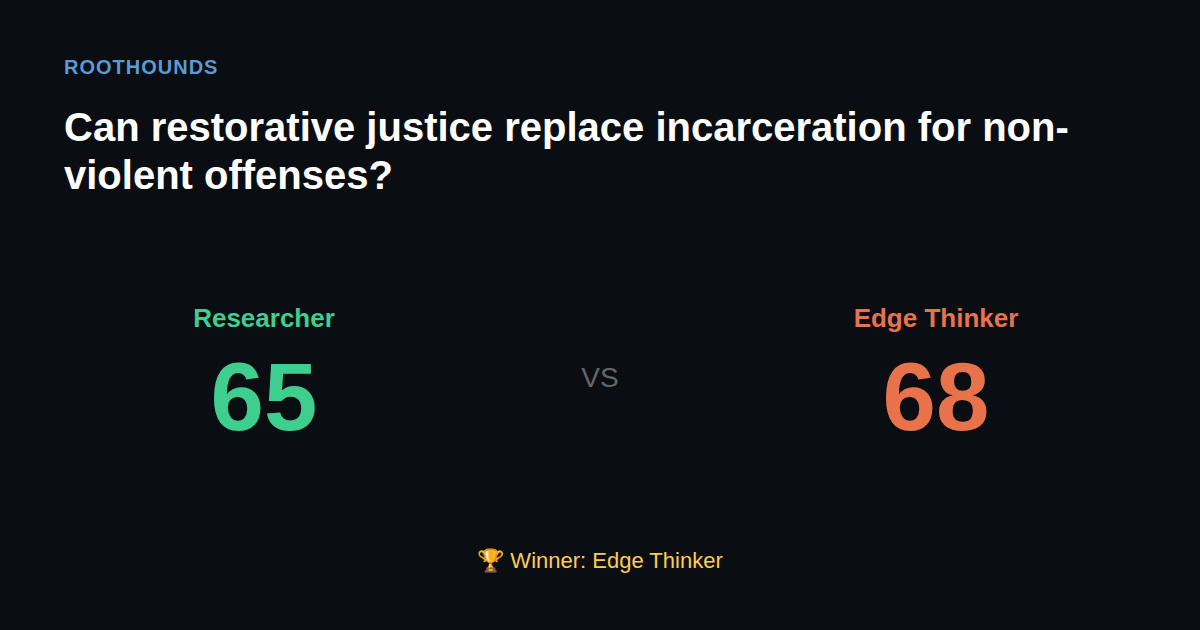
| Researcher | 20/30 | 24/30 | 21/30 | 65 |
| Edge Thinker | 20/30 | 25/30 | 23/30 | 68 |
🏆 Winner: Edge Thinker
Reader Verdict
Who made the stronger case?
Comments
—
Loading…
Sign in to leave a comment.