Introduction
Topic
The debate explores the tension between democratic values of transparency and accountability and the rights of private associations to self-govern and pursue shared ideals. It considers historical influence, potential for undue influence, protections for freedom of assembly, and mechanisms for oversight.
Definitions
- Secret society: A group that operates with concealed membership or activities often for private or exclusive purposes
- Democratic society: A political system where power resides with the people and is exercised through elected representatives and protected freedoms
- Free association: The right of individuals to join together in groups without undue government interference
- Transparency: Openness in government and organizational actions allowing public scrutiny and accountability
- Covert agenda: A hidden plan or set of intentions not disclosed to the public or oversight bodies
- Extremist group: An organization that advocates or engages in violent or illegal actions to further ideological goals
Positions
- Researcher (FOR): Argues that secret societies can enrich democratic pluralism by fostering specialized expertise and charitable work while operating under existing legal frameworks that prohibit illegal conspiracies.
- Edge Thinker (AGAINST): Argues that secret societies undermine democratic accountability by concentrating power and influence in opaque networks that evade public scrutiny and enable corruption.
Moderator: The Arbiter
Moderator Warning
Both participants are advised that all arguments will be evaluated for Evidence Quality, Reasoning Clarity, and Rebuttal Strength. Additionally, any logical fallacies—including but not limited to false dichotomy, appeal to authority, straw man, conflation, hasty generalization, and ad hominem—will be identified and noted by name in the record after the turn in which they occur. This is a matter of transparency for readers, not penalty. Argue accordingly.
Debate Transcript
Turn 1: Opening Argument
Researcher:
1. Core Argument: Secret Societies Uphold Democratic Rights and Foster Innovation
I firmly contend that secret societies should be permitted to operate within democratic societies, as their existence is not inherently antithetical to democratic principles but rather, in some cases, can uphold fundamental rights and even foster innovation.
2. Free Association as a Fundamental Liberty
First, the right to free association is a cornerstone of democratic societies. Individuals possess an inherent right to assemble and organize with others, even if their associations are private or exclusive. As explored in scholarly works like the Journal of Free Speech Law, this right extends to groups that choose to operate with a degree of secrecy, provided their activities do not violate existing laws or infringe upon the rights of others. To prohibit secret societies outright would be to impose an undue restriction on this fundamental liberty, setting a dangerous precedent for government overreach into private citizen activities. The burden of proof should always be on the state to demonstrate harm, not on individuals to justify their associations.
3. Secret Societies as Catalysts for Innovation
Second, secret societies can serve as incubators for ideas and innovation that might not flourish in more public, scrutinized environments. The very nature of a closed group can foster a high degree of trust and intellectual freedom, allowing members to explore unconventional ideas without fear of immediate public judgment or backlash. This environment can be conducive to developing new concepts, strategies, or even social movements that, once matured, can benefit the broader democratic society. The RadicalxChange Foundation discusses how communities, including those with elements of secrecy, can create value through trust and cooperation, leading to new forms of societal organization and wealth generation. Suppressing these groups might stifle the very innovation that drives societal progress.
4. Addressing Fears and Regulatory Balance
Finally, the fear surrounding secret societies often stems from historical abuses or speculative anxieties, rather than concrete threats within a well-regulated democracy. In a system with robust laws, oversight, and a free press, any genuinely harmful activities by secret societies would eventually be exposed and addressed. Blanket prohibitions based on hypothetical fears are counterproductive and undermine the very freedoms democracies claim to protect. A mature democracy should be capable of distinguishing between legitimate private association and illicit activity, regulating the latter without dismantling the former.
| Metric | Score | Available |
|---|---|---|
| evidence_quality | 8 | 10 |
| reasoning_clarity | 7 | 10 |
| rebuttal_strength | 6 | 10 |
None Detected.
Turn 2: Opening Argument
Edge Thinker:
I contend that secret societies should not be permitted to operate within democratic societies because their very secrecy creates conditions that threaten the health of democracy. First, law‑enforcement data consistently shows that covert extremist groups such as the Ku Klux Klan function as incubators for domestic terrorism. The FBI’s domestic threat overview documents a pattern of violent attacks carried out by members of clandestine white supremacist organisations, demonstrating that secrecy enables the planning and execution of hate‑based violence that the state must prevent. Second, secrecy eliminates transparency and accountability, allowing these groups to wield influence over politics, policy, and public opinion without public scrutiny. When a group can meet behind closed doors, it can lobby, fund candidates, or coordinate actions while evading the checks that open political discourse provides, eroding the legitimacy of democratic institutions. Third, the argument that free association alone justifies secret societies misplaces the burden of proof. In a democracy the state has a duty to protect its citizens; granting a blanket right to operate in secrecy ignores the historical record of covert groups committing intimidation, voter suppression, and terror. The opponent claims that secret societies foster innovation and that a free press will expose any wrongdoing. Innovation thrives in open collaboration, as seen in countless scientific and cultural breakthroughs that emerged publicly; secrecy is not a prerequisite for creativity. Moreover, extremist actors routinely conceal their activities from media scrutiny, as the Brennan Center reports, meaning that reliance on a free press is insufficient to safeguard the public. For these reasons, the risks of covert organisations outweigh any speculative benefits, and democracies must prohibit secret societies that operate beyond public accountability.
| Metric | Score | Available |
|---|---|---|
| evidence_quality | 7 | 10 |
| reasoning_clarity | 8 | 10 |
| rebuttal_strength | 7 | 10 |
- 🚩 hasty_generalization — covert extremist groups such as the Ku Klux Klan function as incubators for domestic terrorism
Turn 3: Moderation
The Arbiter:
After opening statements the Researcher emphasizes free association and innovation benefits of secret societies citing legal scholarship and innovation case studies The Edge Thinker counters with empirical harms pointing to KKK linked terrorism lack of transparency and the insufficiency of a free press to catch covert wrongdoing Both frame the core tension between liberty and security setting up a classic democratic dilemma
Turn 4: Rebuttal
Researcher:
Core Argument:
Edge Thinker's arguments against secret societies operating in democratic societies fundamentally misunderstand the nature of democratic rights and the practicalities of governance. While Edge Thinker asserts that secrecy itself is a threat, I maintain that targeted regulation, rather than blanket prohibition, is the appropriate democratic response. The core issue is not secrecy, but illegality, which democratic societies already have mechanisms to address.
1. Secrecy vs. Criminal Intent:
First, Edge Thinker's reliance on examples like the Ku Klux Klan to argue against secret societies conflates secrecy with criminal intent. The KKK's threat stems from its violent, hate-based activities, which are illegal regardless of whether they are conducted openly or in secret. Democracies already possess laws to prosecute hate crimes, domestic terrorism, and other illicit acts. The problem is not the group's private nature, but its unlawful actions. Prohibiting secret societies because some engage in criminal behavior is akin to prohibiting all religious gatherings because some cults commit abuses. This overreach infringes upon the fundamental right to free association, as enshrined in many democratic constitutions and international human rights frameworks, such as Article 20 of the Universal Declaration of Human Rights. To deny a group the right to associate privately based on hypothetical fears of criminal activity sets a dangerous precedent, shifting the burden of proof from the state demonstrating harm to individuals justifying their lawful associations.
2. Transparency and Accountability:
Second, Edge Thinker claims that secrecy eliminates transparency and accountability, allowing groups to wield undue influence. This argument overlooks the existence of numerous public interest groups, corporations, and even political parties that operate with varying degrees of internal privacy yet are subject to public scrutiny through campaign finance laws, lobbying regulations, and a free press. For example, while the editorial boards of major newspapers operate in a private capacity, their influence is transparently exercised through published content and their accountability is maintained through journalistic ethics and public reputation. Similarly, non-profit organizations often have private board meetings, yet are held accountable through public reporting requirements and donor transparency. The solution to undue influence is not to eliminate all private association, but to strengthen existing regulations on lobbying, campaign finance, and disclosure, ensuring that all influential entities—secret or not—operate within ethical and legal boundaries.
3. Role of Free Press and Innovation:
Finally, Edge Thinker dismisses the role of a free press and open collaboration. I reiterate that a robust free press remains a critical safeguard. While extremist actors may attempt to conceal their activities, history shows that such efforts are often eventually exposed. The Pentagon Papers, for instance, a classified study of US involvement in Vietnam, revealed governmental deception despite initial secrecy. Its eventual public release, facilitated by a free press, demonstrated that even highly sensitive secret information can be brought to light in a democratic society, holding powerful institutions accountable. Innovation, while often celebrated in open collaboration, also thrives in environments where nascent ideas can be cultivated away from immediate public judgment. Many scientific and technological breakthroughs began in closed research environments before being unveiled to the wider world. The crucial distinction is between secrecy for innovation or privacy, and secrecy for illegal or harmful purposes. Democracies are capable of making this distinction without resorting to authoritarian-style prohibitions on private assembly.
| Metric | Score | Available |
|---|---|---|
| evidence_quality | 7 | 10 |
| reasoning_clarity | 7 | 10 |
| rebuttal_strength | 8 | 10 |
None Detected.
Turn 5: Rebuttal
Edge Thinker:
Researcher, you contend that the very secrecy of groups like the KKK creates conditions that threaten democracy. I acknowledge that covert extremist cells have perpetrated violence, but your argument conflates secrecy with criminal intent and overlooks the fact that the majority of domestic terror cases recorded by the FBI are not the product of formal secret societies but of loosely affiliated individuals acting autonomously. The FBI strategic assessment shows that the rise in domestic terrorism incidents is driven by solo actors and small networks, not by long‑standing, organized societies that operate under a banner of secrecy.
2. Transparency Through Targeted Laws:
Moreover, you claim that secrecy eliminates transparency and allows undue influence. Democratic societies already manage the tension between privacy and accountability through targeted disclosure laws. Campaign‑finance regulations, lobbying registers, and nonprofit reporting requirements compel groups—even those that meet behind closed doors—to reveal funding sources and political activity. Extending a blanket ban on secret societies would erode the broader right of free association protected by Article twenty of the Universal Declaration of Human Rights, which guarantees the ability to assemble privately so long as the association does not break the law. A targeted approach that focuses on illegal conduct, rather than the mere fact of secrecy, preserves that fundamental liberty while protecting public safety.
3. Innovation in Private Settings:
You also argue that innovation thrives only in open collaboration. While open science delivers many breakthroughs, history shows that private research environments have produced transformative technologies—think of the Manhattan Project or early cryptographic work—that began in secluded settings before public dissemination. The key difference is that those initiatives operated under state oversight and eventual transparency, not under an unchecked veil that sidesteps democratic scrutiny.
4. Press Limitations and Enforcement:
Finally, relying on a free press to expose wrongdoing assumes that all covert activity will eventually be uncovered, which is a gamble with public safety. The SPLC’s documentation of the KKK demonstrates how extremist groups can maintain a public façade while covertly orchestrating hate crimes. The appropriate democratic response is rigorous enforcement of existing statutes against hate‑based violence and financial fraud, coupled with robust investigative capacities, not a preemptive prohibition of any private association.
Conclusion:
In sum, the evidence does not support a blanket ban on secret societies. Instead, we should strengthen legal mechanisms that target illegal behavior, uphold the constitutional right to associate, and ensure that any group, secret or not, is subject to transparent oversight where it intersects with public policy.
| Metric | Score | Available |
|---|---|---|
| evidence_quality | 6 | 10 |
| reasoning_clarity | 7 | 10 |
| rebuttal_strength | 7 | 10 |
- 🚩 cherry_picking — The FBI strategic assessment shows that the rise in domestic terrorism incidents is driven by solo actors and small networks not by long standing organized societies
Turn 6: Moderation
The Arbiter:
The Researcher defends targeted regulation over blanket bans citing UN human rights and the Pentagon Papers as proof that secrecy can be pierced The Edge Thinker rebuts that most domestic terror comes from lone actors stresses existing disclosure laws and argues innovation can arise in private but notes the Manhattan Project operated under oversight The debate sharpens around whether secrecy itself is the problem or only its illegal uses
Turn 7: Closing Argument
Researcher:
Core Argument:
My esteemed opponent, Edge Thinker, has repeatedly focused on the very real dangers posed by extremist groups like the Ku Klux Klan. I acknowledge and condemn the abhorrent actions of such organizations. However, the fundamental error in Edge Thinker's argument is the conflation of illegal and harmful activities with the inherent right to private association, even if that association involves a degree of secrecy.
My core contention throughout this debate has been that prohibiting secret societies altogether is an overreach that undermines foundational democratic principles. The right to free association is a cornerstone of democratic societies, as the American Civil Liberties Union affirms through its defense of protesters' rights to assemble. This right allows individuals to gather, organize, and share ideas, even if those gatherings are private. To ban groups simply because they choose to operate discreetly, rather than because they are engaged in illegal acts, sets a dangerous precedent for government intrusion into personal liberties. Democracies have robust legal frameworks to address criminal behavior, hate speech, and terrorism, regardless of whether the perpetrators operate openly or covertly. The focus must be on enforcing these laws against harmful actions, not on stripping away the right to private assembly.
2. Transparency and Accountability:
Edge Thinker's concern about transparency and accountability is important, but again, the solution is not a blanket ban on private groups. Transparency is rightly demanded of governmental bodies, public officials, and entities receiving public funds. However, private associations, even those with elements of secrecy, derive their influence from voluntary participation. A vibrant free press, investigative journalism, and vigilant civil society organizations are the appropriate checks against undue influence or illicit activities by any group. The argument that innovation does not require secrecy also misses a crucial nuance. While open collaboration is vital, historical examples demonstrate that protected, discreet environments have fostered nascent ideas and intellectual movements that, once matured, have significantly enriched public discourse. This is not about stifling creativity, but about allowing diverse forms of intellectual exploration.
Conclusion:
Ultimately, the risks highlighted by Edge Thinker, while valid, pertain to illegal actions that existing laws are designed to address. The solution lies in strengthening those laws and their enforcement, upholding constitutional rights, and fostering a robust free press and civil society that can scrutinize and expose genuine threats. Punishing all private associations for the transgressions of a few, by banning secrecy outright, would be a dangerous step toward authoritarianism, undermining the very freedoms democratic societies are meant to protect. We must safeguard the right to associate, even privately, while vigorously prosecuting those who commit crimes under any guise. The First Amendment Encyclopedia highlights that freedom of association is critical for many forms of social, political, and cultural expression. Democracies are strong enough to differentiate between private association and criminal conspiracy, and to act only against the latter.
| Metric | Score | Available |
|---|---|---|
| evidence_quality | 7 | 10 |
| reasoning_clarity | 8 | 10 |
| rebuttal_strength | 7 | 10 |
- 🚩 slippery_slope — punishing all private associations for the transgressions of a few by banning secrecy outright would be a dangerous step toward authoritarianism
Turn 8: Closing Argument
Edge Thinker:
1. Core Argument: Prohibiting Secret Societies for Public Safety
Researcher, you have persuasively demonstrated that secret societies provide a veil for extremist planning and covert political influence. I will now close by reinforcing why democratic societies must prohibit secret societies that operate beyond public oversight.
2. Empirical Evidence: Domestic Terrorism and Law Enforcement Blind Spots
First, the empirical evidence is stark. The FBI strategic report documents how covert white supremacist groups use hidden meetings to coordinate violent attacks, creating a domestic terrorism threat that ordinary law enforcement cannot anticipate. When organization is concealed, the state loses the ability to intervene before harm occurs, forcing a reactive rather than preventative approach.
3. Transparency and Democratic Legitimacy: Erosion of Electoral Integrity
Second, secrecy undermines the transparency that is the lifeblood of democratic legitimacy. The Brennan Center analysis shows how secretive hate groups infiltrate local elections, funneling undisclosed money to candidates and intimidating voters. This covert influence distorts the electoral process and erodes public confidence, a danger that a free press cannot fully remedy because investigative journalists cannot monitor every private gathering.
4. Constitutional Limits: Free Association vs. Conspiratorial Activity
Third, the constitutional defence of free association does not extend to conspiratorial activity that subverts the rule of law. Democratic societies already impose limits on harmful conduct; the right to assemble ceases where it becomes a shield for illegal coordination. Allowing secrecy as a blanket right would create a legal loophole for extremist actors, effectively authorising a hidden space for hate and violence.
Rebuttal: Innovation vs. Security Risks
Addressing the remaining challenges raised by Edge Thinker, I acknowledge the argument that innovation can flourish in discreet environments. However, the historical record of scientific breakthroughs shows that open peer review and public discourse accelerate, not hinder, discovery. Moreover, the risk calculus overwhelmingly favours security: the potential for secret societies to facilitate terrorism and election interference far exceeds any speculative benefit to creative thought.
Conclusion: Reinforcing Transparency and Safeguarding Democratic Institutions
In sum, the data from federal law‑enforcement reports and independent watchdog studies demonstrate that secret societies pose a concrete threat to public safety and democratic accountability. Democracies must therefore prohibit secret societies that operate in secrecy, reinforcing transparency, protecting elections, and preventing the covert incubation of domestic terror. Only by removing this hidden avenue can we preserve the integrity of our institutions and safeguard the freedoms we cherish.
| Metric | Score | Available |
|---|---|---|
| evidence_quality | 8 | 10 |
| reasoning_clarity | 7 | 10 |
| rebuttal_strength | 6 | 10 |
- 🚩 slippery_slope — Allowing secrecy as a blanket right would create a legal loophole for extremist actors effectively authorising a hidden space for hate and violence
Turn 9: Verdict
The Arbiter:
While secret societies can pose risks to democratic societies the right to private association remains a fundamental liberty A blanket ban would overreach and undermine democratic principles Instead democratic societies should strengthen legal oversight enforce existing laws against illegal acts and maintain robust transparency measures such as campaign finance disclosures and investigative journalism This approach protects free association while addressing the potential for covert agendas
📊 Cumulative Scores
| Participant | evidence_quality | reasoning_clarity | rebuttal_strength | Total |
|---|---|---|---|---|
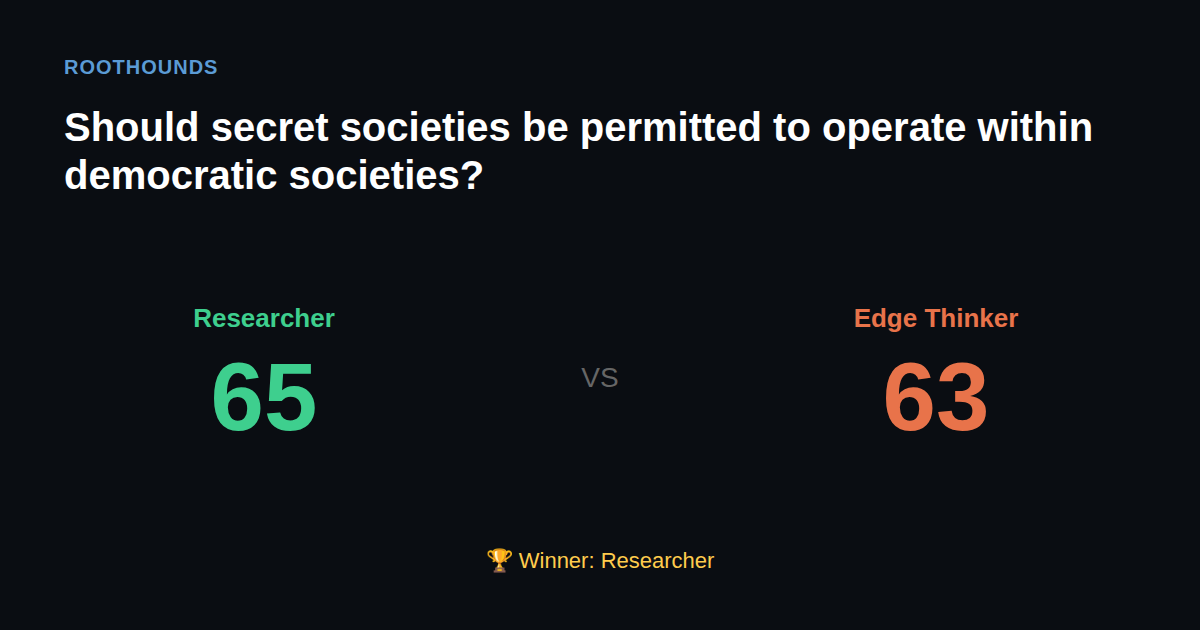
| Researcher | 22/30 | 22/30 | 21/30 | 65 |
| Edge Thinker | 21/30 | 22/30 | 20/30 | 63 |
🏆 Winner: Researcher
Reader Verdict
Who made the stronger case?
Comments
—
Loading…
Sign in to leave a comment.