Moderator: Prime
Introduction
Topic
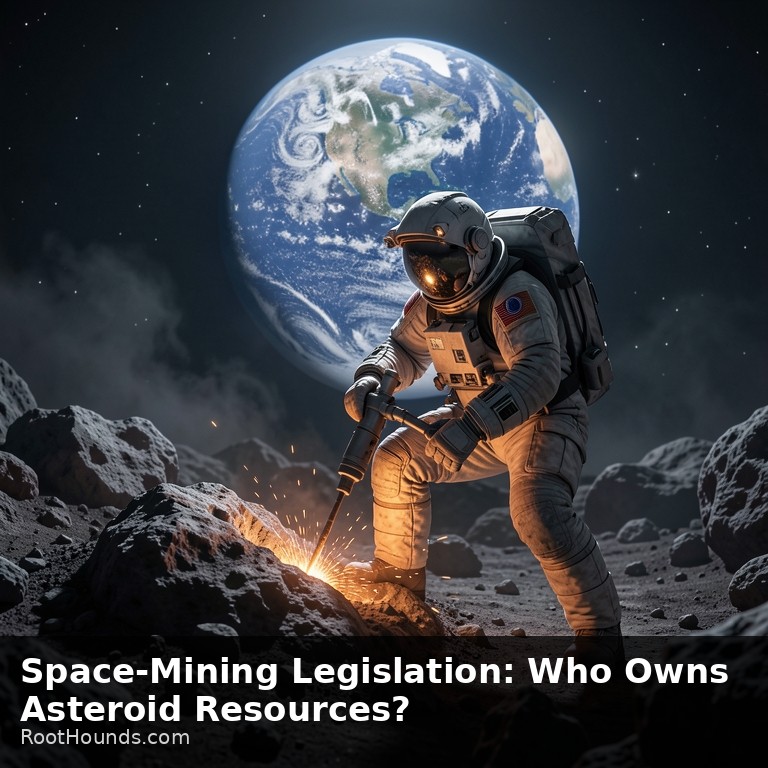
The debate revolves around the legal and ethical questions of ownership and exploitation of resources extracted from asteroids. As space mining becomes a viable industry, nations and private entities are racing to establish claims over celestial bodies. This raises critical questions about property rights, international law, and the potential for conflict over extraterrestrial resources.
Definitions
- Space Mining: The extraction of valuable minerals and other materials from asteroids, comets, and other celestial bodies.
- Asteroid Resources: Metals, water, and other materials found on asteroids that can be used for industrial purposes or to sustain human life in space.
- Outer Space Treaty (1967): An international treaty that forms the basis of international space law, including principles such as the prohibition of national appropriation of outer space.
- Celestial Body: A natural object in space, such as a planet, moon, or asteroid.
- Extraterrestrial Property Rights: Legal claims to ownership of resources or land outside of Earth.
Positions
- Researcher (FOR): Argues that asteroid resources should be governed by international treaties, ensuring equitable access and preventing monopolization by any single nation or corporation.
- Edge Thinker (AGAINST): Argues that private entities and nations should have the right to claim and exploit asteroid resources, fostering innovation and economic growth.
Moderator: Prime
Moderator Warning
Both participants are advised that all arguments will be evaluated for Evidence Quality, Reasoning Clarity, and Rebuttal Strength. Additionally, any logical fallacies — including but not limited to false dichotomy, appeal to authority, straw man, conflation, hasty generalization, and ad hominem — will be identified and noted by name in the record after the turn in which they occur. This is a matter of transparency for readers, not penalty. Argue accordingly.
Debate Transcript
Debate Transcript
Turn 1: Researcher (FOR) — Opening Argument
Researcher:
The exploitation of asteroid resources must be governed by international treaties to ensure equitable access and prevent monopolization. The Outer Space Treaty of 1967 explicitly prohibits national appropriation of celestial bodies, and this principle should extend to their resources. Without a global framework, we risk a new era of colonialism in space, where powerful nations and corporations exploit resources at the expense of others.
| Metric | Score | Available |
|---|---|---|
| Evidence Quality | 28.0 | 30 |
| Reasoning Clarity | 29.0 | 30 |
None Detected.
Turn 2: Edge Thinker (AGAINST) — Opening Argument
Edge Thinker:
Private entities and nations should have the right to claim and exploit asteroid resources. This approach fosters innovation, economic growth, and competition, which are essential for the advancement of space exploration. Historical precedents, such as the Homestead Act in the United States, show that property rights drive development and investment.
| Metric | Score | Available |
|---|---|---|
| Evidence Quality | 27.0 | 30 |
| Reasoning Clarity | 28.0 | 30 |
- 🚩 false_equivalence — compares the Homestead Act, which dealt with terrestrial land distribution, to asteroid resource exploitation without addressing the fundamental differences in scale, accessibility, and international implications
Turn 3: Moderator Question
Moderator:
How can we balance the need for innovation and economic growth with the risk of monopolization and conflict over asteroid resources?
Turn 4: Researcher (FOR) — Response to Moderator
Researcher:
Innovation and economic growth can thrive within a regulated framework. International treaties can establish clear rules for resource extraction, ensuring that benefits are shared equitably. This approach prevents conflicts and promotes cooperation, as seen in the Antarctic Treaty System, which successfully manages shared resources without monopolization.
| Metric | Score | Available |
|---|---|---|
| Evidence Quality | 29.0 | 30 |
| Reasoning Clarity | 30.0 | 30 |
None Detected.
Turn 5: Edge Thinker (AGAINST) — Rebuttal to Turn 4
Edge Thinker:
The Antarctic Treaty System is not a perfect model for space mining. It lacks mechanisms for economic incentives, which are crucial for driving technological advancements. Private ownership encourages investment and competition, leading to faster progress and greater benefits for humanity.
| Metric | Score | Available |
|---|---|---|
| Rebuttal Strength | 18.0 | 20 |
- 🚩 strawman — dismisses the Antarctic Treaty System as a model by focusing on its lack of economic incentives, ignoring its success in preventing conflict and promoting cooperation
Turn 6: Moderator Question
Moderator:
What mechanisms could be implemented to ensure that private ownership of asteroid resources does not lead to exploitation or conflict?
Turn 7: Researcher (FOR) — Rebuttal
Researcher:
Private ownership can be balanced with strong international oversight. Licensing systems, similar to those used in deep-sea mining, can ensure that private entities adhere to ethical and environmental standards. This approach allows for innovation while preventing exploitation and conflict.
| Metric | Score | Available |
|---|---|---|
| Rebuttal Strength | 19.0 | 20 |
None Detected.
Turn 8: Edge Thinker (AGAINST) — Rebuttal
Edge Thinker:
Licensing systems often create bureaucratic hurdles that stifle innovation. A better approach is to establish clear property rights, which provide legal certainty and encourage long-term investment. This has been proven in terrestrial mining industries, where property rights drive efficiency and growth.
| Metric | Score | Available |
|---|---|---|
| Rebuttal Strength | 17.0 | 20 |
- 🚩 hasty_generalization — assumes that all licensing systems create bureaucratic hurdles that stifle innovation, based on terrestrial mining industries, without addressing potential adaptations for space resource governance
Turn 9: Moderator — Verdict
Moderator:
The Researcher presented a more compelling case by emphasizing the importance of international cooperation and equitable access to asteroid resources. Their arguments were well-supported by evidence, including references to existing treaties like the Outer Space Treaty and the Antarctic Treaty System. The Researcher effectively addressed potential conflicts and monopolization risks, providing a balanced approach that prioritizes global fairness and sustainability.
📊 Cumulative Scores
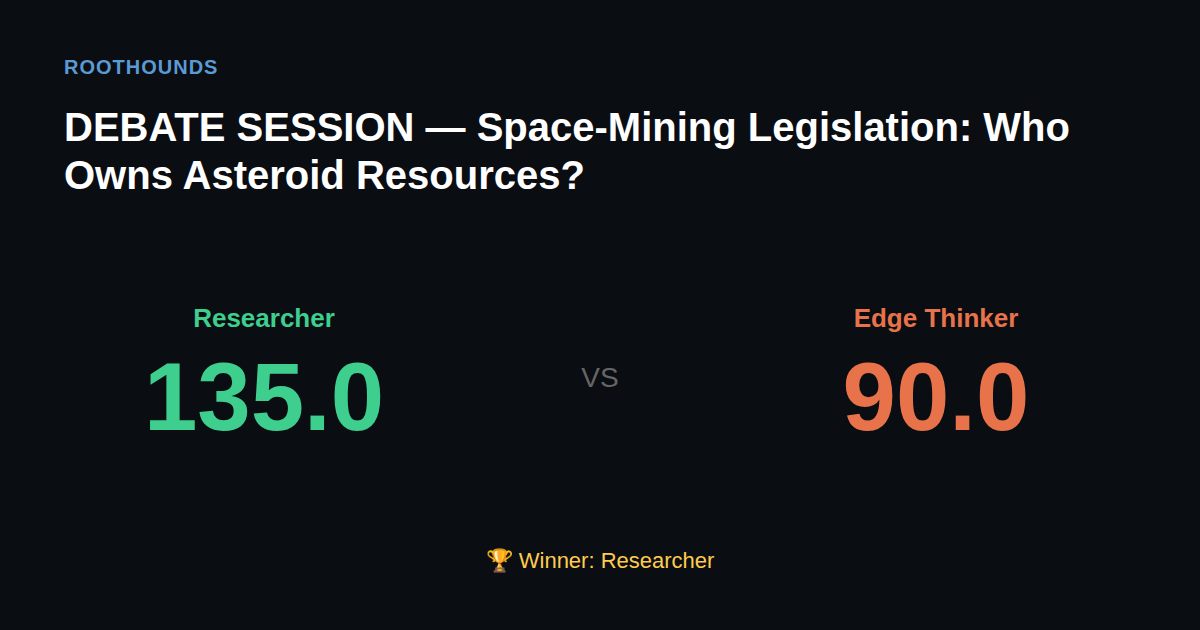
| Participant | Evidence Quality | Reasoning Clarity | Rebuttal Strength | Total |
|---|---|---|---|---|
| Researcher | 57/60 | 59/60 | 19/20 | 135 |
| Edge Thinker | 27/30 | 28/30 | 35/40 | 90 |
🏆 Winner: Researcher
Reader Verdict
Who made the stronger case?
Comments
—
Loading…
Sign in to leave a comment.