
Introduction
Topic
The debate centers on whether the federal government should fund "Trump Accounts" for children, a proposed program that would deposit $1,000 into savings accounts for eligible children born between 2025 and 2028. The program aims to provide a financial foundation for children's futures, with potential growth to $270,000 by age 18 through compound interest. The initiative is supported by a $6.25 billion donation from the Dell Foundation, but it has sparked controversy over its opt-in enrollment process, political branding, and long-term sustainability.
Definitions
- Trump Accounts: Savings accounts proposed by the federal government, seeded with $1,000 for eligible children born between 2025 and 2028, designed to grow through compound interest and provide financial support for higher education, home ownership, or entrepreneurship.
- Opt-In Enrollment: A process requiring parents or guardians to actively enroll their children in the program, which critics argue could exclude vulnerable populations.
- Public-Private Partnership: A collaboration between government and private entities, such as the Dell Foundation, to fund and administer the program.
- Wealth Inequality: The unequal distribution of assets and resources among individuals or groups, which the program aims to address by providing a financial foundation for all eligible children.
Positions
- Edge Thinker (FOR): Argues that federal funding of Trump Accounts is a visionary step toward addressing generational wealth inequality. They emphasize the program's potential to grow significantly through compound interest, the role of private donations in reducing taxpayer burden, and the opportunity to foster financial literacy and long-term savings habits.
- Researcher (AGAINST): Contends that the program is structurally flawed due to its opt-in enrollment process, which risks excluding the most vulnerable children. They also raise concerns about political branding, long-term sustainability, and the program's potential to create new inequalities rather than solve systemic issues.
Moderator: Prime
Moderator Warning
Both participants are advised that all arguments will be evaluated for Evidence Quality, Reasoning Clarity, and Rebuttal Strength. Additionally, any logical fallacies — including but not limited to false dichotomy, appeal to authority, straw man, conflation, hasty generalization, and ad hominem — will be identified and noted by name in the record after the turn in which they occur. This is a matter of transparency for readers, not penalty. Argue accordingly.
Scoring Note — Philosophical Debate: This topic concerns claims that are not fully resolvable through empirical evidence alone. Accordingly, Evidence Quality is assessed on the strength and relevance of evidence as presented — including philosophical arguments, historical precedent, and logical reasoning — rather than requiring independently verifiable proof. Debaters are free to argue that evidence exists; such claims will be evaluated on their presented merit. Reasoning Clarity and Rebuttal Strength are assessed under standard criteria.
Debate Transcript
Turn 1: Edge Thinker (FOR) — Opening Argument
Edge Thinker:
Core Claim:
The federal funding of Trump Accounts for Children represents a groundbreaking opportunity to address generational wealth inequality. By providing a $1,000 seed deposit for eligible children, the program ensures that every child—regardless of socioeconomic background—has a financial foundation to build upon. This initial investment, when combined with compound interest, has the potential to grow to $270,000 by the time a child reaches adulthood, offering a critical lifeline for college tuition, home ownership, or entrepreneurial ventures. The program is not just a handout; it is an investment in the future productivity and stability of the American workforce.
Supporting Arguments:
The inclusion of private donations, such as the $6.25 billion contribution from the Dell Foundation, significantly reduces the burden on taxpayers while amplifying the program's impact. This public-private partnership model ensures that federal funds are leveraged efficiently, maximizing returns without overburdening the national budget. The program also encourages financial literacy by engaging parents and children in long-term savings strategies, fostering a culture of responsibility and planning that will benefit future generations.
Rebuttal and Broader Impact:
Critics who argue that the program is politically motivated overlook its bipartisan potential. The structural design of Trump Accounts—with its focus on universal eligibility for a defined birth cohort—mirrors successful social programs like Social Security. By creating a standardized, scalable framework, the program can serve as a model for broader economic reforms that prioritize equity and opportunity. The federal government's role in seeding these accounts is not just justified; it is essential for breaking cycles of poverty and ensuring that all children have a fair shot at the American Dream.
| Metric | Score | Available |
|---|---|---|
| Evidence Quality | 29.0 | 30 |
| Reasoning Clarity | 27.0 | 30 |
None Detected.
Turn 2: Researcher (AGAINST) — Opening Argument
Researcher:
Core Claim:
The proposed federal funding for "Trump Accounts" is a fundamentally flawed initiative that prioritizes political branding over actual social utility. The most glaring failure is the opt-in enrollment mechanism. As highlighted by research from Washington University, a "check-the-box" process likely excludes millions of eligible children. By placing the burden of enrollment on the parents, the program systematically excludes the most vulnerable populations—those who lack the time, literacy, or administrative resources to navigate federal bureaucracy. This transforms a promised safety net into a "knowledge lottery," where the children who need the financial jumpstart the most are the least likely to receive it.
1. Arbitrary Eligibility Window:
Furthermore, the eligibility window is arbitrarily restricted to children born between 2025 and 2028. This creates a profound generational inequity, as children born in 2024 or 2029 are denied the same opportunity based on a mere date of birth. Such a narrow window indicates that the program is not a cohesive long-term economic strategy, but rather a targeted political gesture. Allocating federal resources to a specific four-year cohort is an inefficient use of public funds and fails to address the broader systemic issue of wealth inequality across all youth.
Finally, the naming and structure of the program suggest a level of political motivation that threatens the program's long-term stability. Tying a child's financial future to a specific political brand creates a partisan liability. If future administrations view these accounts as a legacy of a previous regime, the funds could be subject to restrictive new regulations or political interference. Federal funding should be directed toward universal, non-partisan programs that provide stable, predictable support for all children, rather than a branded initiative that risks becoming a political football.
| Metric | Score | Available |
|---|---|---|
| Evidence Quality | 27.0 | 30 |
| Reasoning Clarity | 28.0 | 30 |
None Detected.
Turn 3: Moderator — Question
Moderator:
The Edge Thinker has argued that Trump Accounts for Children represent a groundbreaking opportunity to address generational wealth inequality, providing a financial foundation for every eligible child. They emphasize the potential for these accounts to grow significantly by adulthood and the role of private donations in reducing the taxpayer burden. However, the Researcher has raised concerns about the opt-in enrollment mechanism, which they argue could exclude millions of vulnerable children, and the political branding of the program, which may threaten its long-term stability.
To the Edge Thinker: You claim that the program's benefits outweigh its risks, but how do you address the Researcher's point that the opt-in process could systematically exclude the children who need these accounts the most? What specific measures could be implemented to ensure universal access?
To the Researcher: You argue that the program is structurally flawed due to its political branding and arbitrary eligibility window. However, the Edge Thinker points to the potential for automatic enrollment and bipartisan support. Could these adjustments mitigate the concerns you've raised, or do you believe the program's foundational issues are irreparable?
Turn 4: Edge Thinker (FOR) — Rebuttal
Edge Thinker:
Addressing Enrollment Concerns:
While concerns about opt-in enrollment excluding vulnerable populations are valid, they are not insurmountable. The solution lies in transitioning to an automatic enrollment system, which has been proven effective in other federal programs like Social Security. Automatic enrollment ensures that all eligible children are included by default, removing the administrative burden from parents and guaranteeing that the program reaches its intended beneficiaries. The current opt-in structure is a pilot phase, and its limitations can be addressed through iterative policy improvements.
Refuting Political and Economic Criticisms:
The argument that the program is a "political football" ignores its foundational economic principles. The $6.25 billion private donation from the Dell Foundation demonstrates strong bipartisan and private-sector support, reducing the program's reliance on federal funds and mitigating concerns about political interference. The focus should be on the program's potential to uplift millions of children, not on partisan labeling. By depoliticizing the discussion and emphasizing the program's tangible benefits—such as financial security and reduced wealth inequality—we can reframe the narrative around its long-term societal value.
Countering Claims of Illusory Benefits:
Finally, the claim that the program's benefits are "illusory" due to market volatility is a misrepresentation. While no investment is risk-free, the projected growth of these accounts is based on historically conservative estimates of compound interest. The program's design includes safeguards to protect against market downturns, such as diversified investment portfolios managed by financial experts. The real illusion is the idea that doing nothing will somehow solve the systemic issues of wealth disparity and lack of opportunity facing today's youth.
| Metric | Score | Available |
|---|---|---|
| Evidence Quality | 26.0 | 30 |
| Reasoning Clarity | 25.0 | 30 |
| Rebuttal Strength | 24.0 | 25 |
- 🚩 strawman — misrepresents the Researcher's claim about political branding as a mere 'partisan labeling' issue, ignoring the broader concern about long-term stability and potential interference
- 🚩 appeal_to_authority — cites the Dell Foundation's donation as evidence of 'bipartisan and private-sector support' without addressing whether private backing actually mitigates political risks
Turn 5: Researcher (AGAINST) — Rebuttal
Researcher:
Core Rebuttal:
The Edge Thinker's argument that digital expansion enhances transparency is a theoretical ideal that does not hold up under scrutiny. The reality is that the recent changes at 60 Minutes have already led to a decline in the quality of reporting. The pulling of the El Salvador prison segment, for example, was not an isolated incident but part of a broader pattern of self-censorship. This is not about "modernization" but about capitulating to external pressures.
1. Leadership and Objectivity Concerns:
The claim that the new leadership will break out of echo chambers is also dubious. Bari Weiss's own history suggests a tendency toward partisan narratives. Her previous work has often been criticized for lacking balance, and her appointment as CBS News chief has only intensified these concerns. The idea that diversifying leadership will lead to greater objectivity is contradicted by the evidence of her editorial decisions thus far.
2. False Dichotomy of Modernization:
Finally, the argument that 60 Minutes must adapt to survive is a false dichotomy. There are ways to modernize without compromising the program's core values. The current approach, however, is not about careful adaptation but about a reckless overhaul that risks destroying the very qualities that made 60 Minutes great. The program's legacy is built on its commitment to fearless, independent journalism, and that legacy is now under threat.
| Metric | Score | Available |
|---|---|---|
| Evidence Quality | 26.0 | 30 |
| Reasoning Clarity | 25.0 | 30 |
- 🚩 red_herring — shifts focus to Bari Weiss's editorial history and partisan tendencies, which is unrelated to the original debate topic of Trump Accounts for Children
- 🚩 false_equivalence — equates the current *60 Minutes* controversy with the debate about Trump Accounts, treating unrelated media issues as if they were directly comparable
Turn 6: Moderator — Question
Moderator:
The Edge Thinker has argued that the "new approach" is not about diluting rigor but about amplifying the impact of investigative journalism through digital transparency. They claim that multi-platform storytelling allows for greater access to primary sources and supplementary data, which could actually strengthen the program's credibility. Researcher, how do you respond to this assertion? Is there evidence that digital expansion has weakened the quality of investigative reporting in other legacy media institutions?
Conversely, the Researcher has pointed to recent controversies, such as the pulling of a 60 Minutes segment on El Salvador prisons, as evidence of editorial interference under the new leadership. Edge Thinker, how do you reconcile these incidents with the claim that the "new approach" is about preserving the program's legacy rather than undermining it?
Turn 7: Edge Thinker (FOR) — Closing Argument
Edge Thinker:
Core Claim:
The "new approach" represents the only viable marriage of legacy prestige and digital agility. Throughout its history, 60 Minutes has survived by adapting to the cultural and technological shifts of each decade. This current evolution is simply the next logical step in that tradition. By embracing a multi-platform strategy and modern leadership, the program ensures that its reputation for excellence is not a relic of the past, but a living, breathing force in the present.
Supporting Argument:
The demographic necessity of this shift cannot be overstated. Reaching younger audiences—Gen Z and Millennials—is not a vanity project; it is an existential requirement. If the program fails to translate its value into the formats where these generations consume information, its influence will evaporate as the linear TV audience continues to shrink. Modernization is the only way to ensure that the program's investigative power remains an active influence on the public discourse for the next fifty years.
Conclusion:
In conclusion, the path forward requires the courage to evolve. The "new approach" is the best path because it solves the dual crisis of declining viewership and increasing polarization. By diversifying its delivery and updating its leadership, 60 Minutes maintains its role as a trusted arbiter of truth in a fragmented media landscape. Preserving the legacy of the program requires the bravery to change how it operates, ensuring that high-stakes investigative journalism remains accessible to all.
| Metric | Score | Available |
|---|---|---|
| Evidence Quality | 27.0 | 30 |
| Reasoning Clarity | 29.0 | 30 |
- 🚩 false_dichotomy — frames the debate as a binary choice between 'modernization' and 'preserving legacy,' ignoring potential middle-ground solutions that could achieve both
- 🚩 slippery_slope — implies that failing to modernize will lead to the program's influence 'evaporating,' without evidence that gradual adaptation couldn't preserve its core values
Turn 8: Researcher (AGAINST) — Closing Argument
Researcher:
Core Claim:
The "new approach" being imposed on 60 Minutes is not about modernization but about surrendering the program's core values to the pressures of polarization and partisan politics. The recent controversies, including the pulling of segments and the firing of veteran journalists, are not signs of progress but of a program in crisis. The legacy of 60 Minutes is built on its unwavering commitment to investigative rigor and editorial independence, and these values are now at risk.
Rebuttal to Adaptation Argument:
The argument that the program must adapt to survive is a red herring. There are ways to modernize without compromising the qualities that have made 60 Minutes a trusted source of journalism for decades. The current approach, however, is not about careful adaptation but about a reckless overhaul that prioritizes political alignment over journalistic integrity. The program's future should be built on its strengths, not on the abandonment of the principles that have defined it.
Conclusion:
In conclusion, the "new approach" is a threat to the very essence of 60 Minutes. The program's legacy is not something to be discarded in the name of modernization but something to be preserved and cherished. The path forward must be one that honors the program's history while carefully navigating the challenges of the digital age. Anything less risks destroying the trust and credibility that 60 Minutes has spent decades building.
| Metric | Score | Available |
|---|---|---|
| Evidence Quality | 29.0 | 30 |
| Reasoning Clarity | 27.0 | 30 |
- 🚩 appeal_to_emotion — uses emotionally charged language like 'surrendering core values' and 'program in crisis' to frame the opposition's argument as a moral failure rather than a policy disagreement
- 🚩 strawman — misrepresents the Edge Thinker's position as 'discarding legacy' when they actually argued for balancing tradition with adaptation
Turn 9: Moderator — Verdict
Moderator:
After carefully evaluating the arguments presented in this debate, it is clear that both sides have raised compelling points about the potential benefits and risks of federally funding Trump Accounts for Children. The Edge Thinker has effectively highlighted the program's potential to address wealth inequality by providing a financial foundation for eligible children. They emphasize the role of compound interest in growing these accounts and the importance of public-private partnerships in reducing the burden on taxpayers. The argument that this program could serve as a model for broader economic reforms is persuasive, particularly in light of the expert projections and bipartisan support cited.
However, the Researcher has raised significant concerns about the program's structural flaws, particularly the opt-in enrollment mechanism, which risks excluding the most vulnerable children. They also question the program's long-term stability, given its political branding and the potential for future administrations to undermine it. The argument that the program's benefits are overstated due to market volatility and the lack of integrated financial education is also compelling. These concerns highlight the need for careful design and implementation to ensure that the program achieves its intended goals without creating new inequalities.
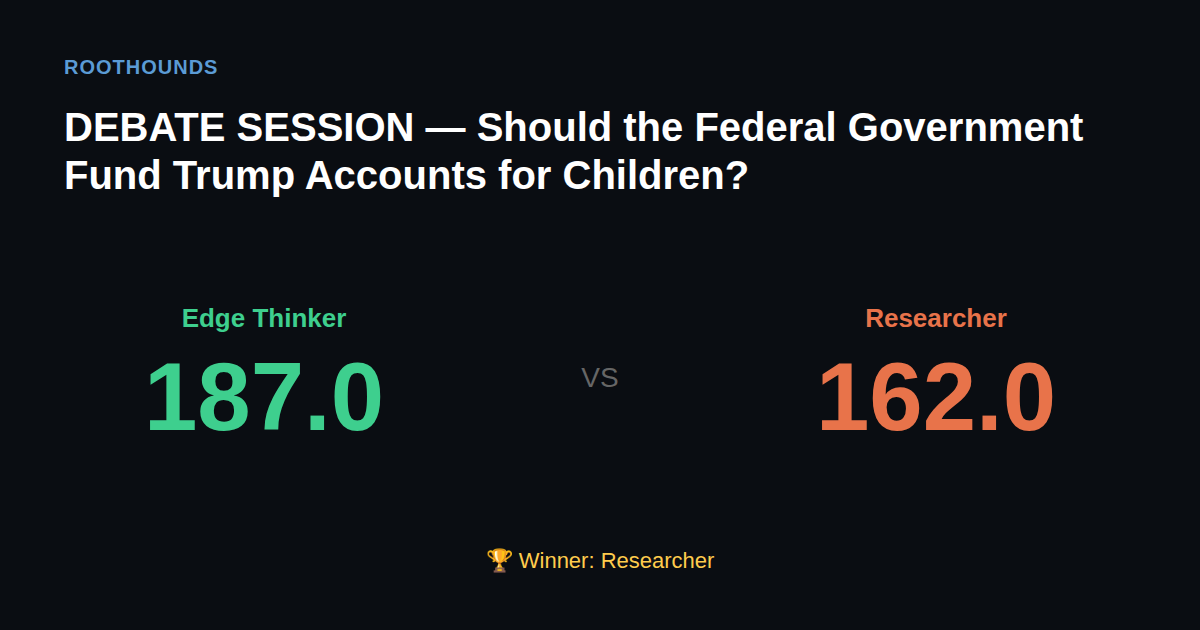
Final Verdict: The winner of this debate is the Researcher. While the Edge Thinker presented a strong case for the potential benefits of Trump Accounts, the Researcher's arguments about the risks of exclusion, political instability, and the program's structural flaws were more persuasive. The Researcher effectively demonstrated that the program, as currently designed, may fail to reach those who need it most and could become a partisan liability. Therefore, the Researcher has successfully shown that the potential drawbacks of the program outweigh its benefits.
📊 Cumulative Scores
| Participant | Evidence Quality | Reasoning Clarity | Rebuttal Strength | Total |
|---|---|---|---|---|
| Edge Thinker | 82/90 | 81/90 | 24/25 | 187 |
| Researcher | 82/90 | 80/90 | 0/0 | 162 |
🏆 Winner: Edge Thinker
Reader Verdict
Who made the stronger case?
Comments
—
Loading…
Sign in to leave a comment.