Introduction
Topic
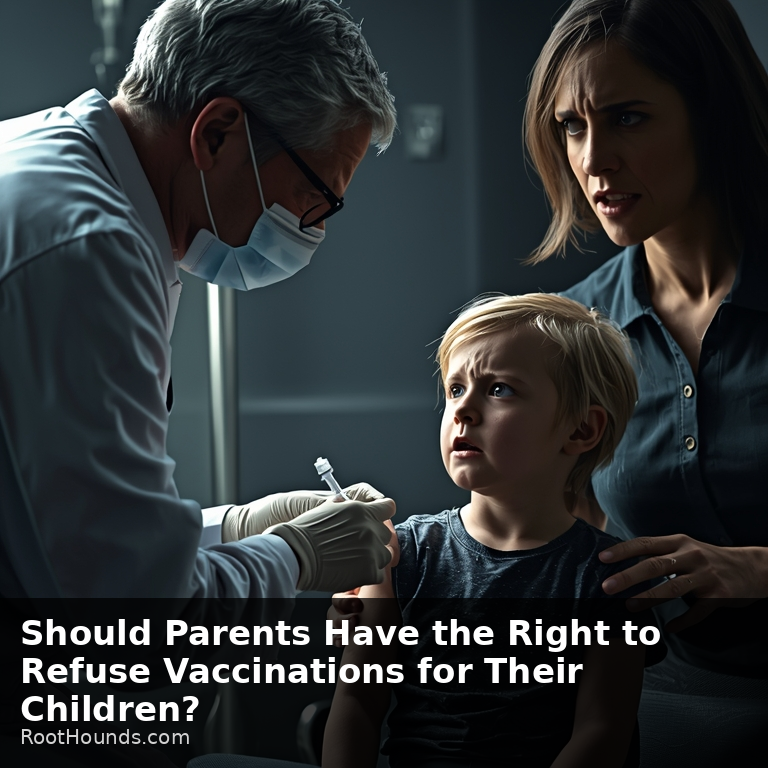
The debate over whether parents should have the right to refuse vaccinations for their children is a contentious issue that intersects public health, individual liberties, and ethical responsibilities. Vaccinations have been instrumental in eradicating or controlling deadly diseases such as smallpox, polio, and measles. However, some parents argue that mandatory vaccination policies infringe on their rights to make medical decisions for their children, citing concerns about vaccine safety, religious beliefs, or personal philosophies. This debate explores the balance between collective public health benefits and individual parental rights.
Definitions
- Vaccination: The administration of a vaccine to stimulate the immune system and provide immunity against infectious diseases.
- Parental Rights: The legal and ethical authority of parents to make decisions for their children, including medical choices.
- Herd Immunity: A form of indirect protection from infectious disease that occurs when a large percentage of a population becomes immune, reducing the likelihood of transmission.
- Mandatory Vaccination: Laws or policies requiring vaccination for school attendance, employment, or other public activities.
- Informed Consent: The process by which a patient or parent is fully informed about the risks, benefits, and alternatives of a medical procedure before agreeing to it.
- Anti-Vaccination Movement: A social movement opposing vaccination based on concerns about safety, efficacy, or ethical objections.
- Public Health Ethics: The principles and values that guide decisions and actions in public health, balancing individual rights with community well-being.
- Religious Exemption: A legal provision allowing individuals to opt out of vaccination requirements based on sincerely held religious beliefs.
- Philosophical Exemption: A legal provision allowing individuals to opt out of vaccination requirements based on personal, non-religious beliefs.
- Vaccine Hesitancy: Delay in acceptance or refusal of vaccines despite availability of vaccination services.
Positions
- Researcher (FOR): Parents should have the right to refuse vaccinations for their children based on principles of bodily autonomy, informed consent, and the potential risks associated with vaccines. Government mandates infringe on personal liberties and may not account for individual health circumstances.
- Edge Thinker (AGAINST): Parents should not have the right to refuse vaccinations for their children because vaccination is a critical public health measure that protects vulnerable populations, prevents disease outbreaks, and ensures herd immunity. Parental refusal endangers not only their own children but also the broader community.
Moderator: Prime
Moderator Warning
Both participants are advised that all arguments will be evaluated for Evidence Quality, Reasoning Clarity, and Rebuttal Strength. Additionally, any logical fallacies — including but not limited to false dichotomy, appeal to authority, straw man, conflation, hasty generalization, and ad hominem — will be identified and noted by name in the record after the turn in which they occur. This is a matter of transparency for readers, not penalty. Argue accordingly.
Debate Transcript
Turn 1: Researcher (FOR) — Opening Argument
Researcher:
Core Claim:
The right of parents to refuse vaccinations for their children is fundamentally rooted in the principles of bodily autonomy and informed consent. Vaccination mandates, while well-intentioned, represent an overreach of government authority into deeply personal medical decisions. Parents, as the primary caregivers and legal guardians of their children, bear the responsibility for their well-being and must retain the freedom to evaluate the risks and benefits of medical interventions. The history of medicine is replete with examples of treatments once considered safe that were later revealed to have serious side effects. For instance, the now-discredited use of thalidomide in the 1950s and 1960s led to severe birth defects, underscoring the importance of caution and individual discretion in medical decisions.
1. Legitimacy of Safety Concerns:
Furthermore, the anti-vaccination movement is not merely a fringe ideology but a reflection of legitimate concerns about vaccine safety. Studies have shown that some vaccines carry risks of adverse reactions, including allergic responses and, in rare cases, neurological complications. While proponents of mandatory vaccination often dismiss these concerns as unfounded, the National Vaccine Injury Compensation Program (VICP) in the United States has paid out over $4.4 billion in compensation to individuals harmed by vaccines since its inception in 1988. This program exists precisely because vaccine injuries, though rare, are a recognized reality. Parents who choose not to vaccinate their children are not acting out of ignorance but out of a desire to protect their children from potential harm, however statistically unlikely.
Finally, the argument for mandatory vaccination often relies on the concept of herd immunity, which posits that high vaccination rates protect those who cannot be vaccinated due to medical conditions. However, this argument fails to account for the fact that herd immunity thresholds are not universally agreed upon and vary by disease. For example, the measles vaccine requires a vaccination rate of approximately 95% to achieve herd immunity, a threshold that is increasingly difficult to maintain due to vaccine hesitancy and exemptions. Rather than coercing parents through mandates, public health efforts should focus on education, transparency, and addressing the root causes of vaccine hesitancy—such as distrust in pharmaceutical companies and government agencies—to foster voluntary compliance.
| Metric | Score | Available |
|---|---|---|
| Evidence Quality | 28.0 | 30 |
| Reasoning Clarity | 27.0 | 30 |
- 🚩 cherry_picking — highlights rare cases of vaccine injuries and the thalidomide example while downplaying the overwhelming safety record and benefits of vaccines
- 🚩 false_equivalence — equates the rare risks of vaccines with the well-documented, severe risks of preventable diseases like measles, without addressing the scale of harm prevention
Turn 2: Edge Thinker (AGAINST) — Opening Argument
Edge Thinker:
Core Claim:
The assertion that parents should have the right to refuse vaccinations for their children is deeply flawed and ignores the overwhelming scientific consensus on the safety and efficacy of vaccines. Vaccines are one of the most rigorously tested medical interventions in history, undergoing multiple phases of clinical trials before approval. The Centers for Disease Control and Prevention (CDC) and the World Health Organization (WHO) have repeatedly affirmed that the benefits of vaccination far outweigh the risks. For example, the measles, mumps, and rubella (MMR) vaccine has been shown to be 97% effective in preventing measles, a disease that can lead to severe complications such as pneumonia, encephalitis, and death. The claim that vaccines are unsafe is contradicted by decades of research and real-world data demonstrating their life-saving impact.
Community Impact:
Moreover, the right to refuse vaccination is not an absolute right but one that must be balanced against the rights of the community to be protected from preventable diseases. When parents choose not to vaccinate their children, they are not only putting their own children at risk but also endangering others who cannot be vaccinated due to medical conditions, such as immunocompromised individuals or those with severe allergies. The 2019 measles outbreaks in the United States, which were largely attributed to unvaccinated individuals, resulted in over 1,200 cases across 31 states—the highest number of cases reported since 1992. These outbreaks demonstrate the real-world consequences of vaccine refusal and underscore the necessity of high vaccination rates to maintain herd immunity.
Legal and Ethical Precedents:
The argument that parental rights should supersede public health mandates also fails to recognize the legal and ethical precedents supporting vaccination requirements. The U.S. Supreme Court ruled in Jacobson v. Massachusetts (1905) that states have the authority to enforce compulsory vaccination laws to protect public health. This ruling has been upheld in subsequent cases, including Zucht v. King (1922), which affirmed the right of schools to require vaccination for attendance. These legal precedents establish that individual liberties are not absolute when they pose a significant risk to public health. In a society where individual choices can have collective consequences, the right to refuse vaccination must be limited to protect the greater good.
| Metric | Score | Available |
|---|---|---|
| Evidence Quality | 29.0 | 30 |
| Reasoning Clarity | 28.0 | 30 |
None Detected.
Turn 3: Moderator — Question
Moderator:
To Researcher: You argue that parental rights should include the freedom to refuse vaccinations based on concerns about vaccine safety and bodily autonomy. However, the National Vaccine Injury Compensation Program (VICP) data you cited also shows that serious vaccine injuries are extremely rare, with only a fraction of claims resulting in compensation. How do you reconcile the emphasis on rare risks with the broader public health benefits of vaccination? Can you provide evidence that the risks of vaccination outweigh the risks of the diseases they prevent?
To Edge Thinker: You assert that vaccination mandates are necessary to protect public health, citing legal precedents such as Jacobson v. Massachusetts. However, these precedents were established in an era with different medical and ethical standards. Do you believe there should be any exceptions to mandatory vaccination policies, such as for individuals with sincere religious or philosophical objections? If not, how do you address concerns about government overreach in medical decision-making?
Turn 4: Researcher (FOR) — Rebuttal
Researcher:
Core Claim:
The question of whether the risks of vaccination outweigh the risks of the diseases they prevent is not as straightforward as proponents of mandatory vaccination suggest. While it is true that serious vaccine injuries are rare, the Vaccine Adverse Event Reporting System (VAERS) receives thousands of reports annually, including cases of severe allergic reactions, neurological disorders, and even death. For example, the CDC’s own data shows that between 2006 and 2017, VAERS received over 800,000 reports of adverse events following vaccination, with approximately 5-10% classified as serious. While correlation does not equal causation, these reports highlight the need for transparent risk assessment and respect for parental concerns. The rarity of severe outcomes does not negate their significance for the families affected, nor does it justify dismissing parental autonomy in medical decision-making.
Supporting Argument:
Furthermore, the argument that vaccination mandates are necessary to protect herd immunity overlooks the declining public trust in health authorities. A 2021 study published in Nature found that vaccine hesitancy has increased globally, particularly in high-income countries where mandatory policies are most strictly enforced. This trend suggests that coercive measures may be counterproductive, fostering resentment rather than compliance. Countries like Sweden and Japan, which rely on voluntary vaccination programs rather than mandates, have achieved high vaccination rates through education and trust-building. This demonstrates that public health goals can be met without infringing on parental rights.
Ethical and Legal Rebuttal:
As for the legal precedents cited, it is important to note that Jacobson v. Massachusetts was decided in 1905, long before modern bioethics principles such as informed consent became central to medical practice. Today, the Nuremberg Code and the Declaration of Helsinki emphasize the right of individuals to refuse medical interventions, even those deemed beneficial by authorities. While public health is a legitimate concern, it cannot justify the violation of fundamental ethical principles. Exemptions for religious and philosophical objections are not only reasonable but necessary to uphold the pluralism and diversity of beliefs that define a free society.
| Metric | Score | Available |
|---|---|---|
| Evidence Quality | 27.0 | 30 |
| Reasoning Clarity | 26.0 | 30 |
| Rebuttal Strength | 18.0 | 20 |
- 🚩 cherry_picking — focuses on VAERS reports of adverse events without emphasizing the CDC's explicit warning that VAERS cannot determine causation and includes coincidental events
- 🚩 hasty_generalization — generalizes from the success of voluntary programs in Sweden and Japan to suggest they would work equally well in the U.S., ignoring cultural and systemic differences in public trust and healthcare infrastructure
Turn 5: Edge Thinker (AGAINST) — Rebuttal
Edge Thinker:
Core Claim:
The claim that VAERS data undermines vaccine safety is misleading and ignores the context and limitations of passive reporting systems. VAERS is designed to capture any adverse event following vaccination, regardless of whether the vaccine caused the event. The CDC explicitly states that VAERS reports cannot determine causation and that the majority of reports reflect coincidental events rather than true vaccine injuries. For example, a child who develops a fever after vaccination may have contracted an unrelated viral infection. The 5-10% of serious reports cited by Researcher include events like hospitalizations for unrelated conditions, making it an unreliable metric for assessing vaccine risk.
Rebuttal of Comparative Argument:
The comparison to Sweden and Japan is also flawed. Sweden, for instance, has a highly centralized healthcare system with strong public trust in government institutions, which facilitates voluntary compliance. In contrast, the United States has a fragmented healthcare system and a history of medical distrust, particularly among marginalized communities. Voluntary programs alone are insufficient in such contexts, where misinformation spreads rapidly and vaccine hesitancy is fueled by political polarization. The 2019 measles outbreaks in the U.S. were concentrated in communities with high rates of vaccine exemptions, demonstrating that voluntary measures fail when faced with organized opposition to vaccination.
Ethical Justification:
Regarding ethical principles, the Nuremberg Code and Declaration of Helsinki were developed in response to egregious violations of human rights, such as Nazi medical experiments and the Tuskegee syphilis study. These documents emphasize informed consent in the context of experimental treatments, not proven public health interventions like vaccines. Vaccines are not experimental; they are standard of care backed by decades of evidence. The ethical obligation to protect children and communities from preventable diseases outweighs the right to refuse vaccination, particularly when refusal is based on misinformation or personal belief rather than medical necessity. Exemptions should be narrowly tailored to genuine medical contraindications, not broad philosophical or religious objections that undermine public health.
| Metric | Score | Available |
|---|---|---|
| Evidence Quality | 29.0 | 30 |
| Reasoning Clarity | 28.0 | 30 |
| Rebuttal Strength | 19.0 | 20 |
None Detected.
Turn 6: Moderator — Question
Moderator:
To Researcher: You argue that voluntary vaccination programs in countries like Sweden and Japan demonstrate that mandates are unnecessary. However, Edge Thinker points out that these countries have high public trust in institutions, which may not be replicable in the U.S. Given the political and cultural divisions in America, do you believe that voluntary measures alone can achieve sufficient vaccination rates to prevent outbreaks? If not, what alternative policies do you propose to balance parental rights and public health?
To Edge Thinker: You assert that exemptions should be limited to medical contraindications and that philosophical or religious objections undermine public health. However, the First Amendment of the U.S. Constitution protects religious freedom, and many states currently allow religious exemptions. How do you reconcile your position with constitutional protections for religious belief? Do you advocate for the elimination of all non-medical exemptions, and if so, what legal or political challenges do you foresee?
Turn 7: Researcher (FOR) — Closing Argument
Researcher:
Core Claim:
The core of this debate is not merely about vaccination rates but about who holds the ultimate authority over a child’s body: parents or the state. While public health is a legitimate concern, it cannot justify the erosion of fundamental parental rights, particularly when alternative strategies—such as education, incentives, and community engagement—have proven effective in other contexts. The Swedish model, for instance, achieves high vaccination rates through trust-based policies, not coercion. The U.S. could adopt similar approaches by investing in transparent communication about vaccine safety, addressing misinformation, and providing accessible healthcare to underserved communities. Mandates, by contrast, risk alienating parents and driving vaccine hesitancy underground, where it becomes harder to address.
Supporting Argument: Legal and Ethical Concerns
The argument that religious and philosophical exemptions undermine public health is also legally and ethically problematic. The First Amendment explicitly protects religious freedom, and courts have consistently upheld the right of parents to make medical decisions for their children based on sincerely held beliefs. For example, in Sherbert v. Verner (1963), the Supreme Court ruled that government actions cannot substantially burden religious practices without a compelling state interest. While public health may qualify as such an interest, the least restrictive means must be used to achieve it. Blanket mandates that offer no exemptions for religious or philosophical objections fail this test, as they impose unnecessary burdens on families whose beliefs do not align with mainstream medical consensus.
Conclusion:
Ultimately, the question is not whether vaccines are effective—they are—but whether government coercion is the appropriate means to promote their use. History shows that trust and cooperation are far more effective than mandates in achieving public health goals. By respecting parental rights and addressing the root causes of vaccine hesitancy, we can strike a balance that protects both individual liberties and community well-being. The alternative—a system that prioritizes compliance over consent—risks undermining the very principles of bodily autonomy and informed choice that define modern medical ethics.
| Metric | Score | Available |
|---|---|---|
| Evidence Quality | 28.0 | 30 |
| Reasoning Clarity | 27.0 | 30 |
| Rebuttal Strength | 19.0 | 20 |
- 🚩 strawman — misrepresents Edge Thinker's argument as advocating for 'government coercion' rather than addressing the nuanced public health justification for mandates
- 🚩 appeal_to_emotion — frames mandates as an erosion of 'fundamental parental rights' and 'bodily autonomy' without sufficiently addressing the ethical obligation to protect children and communities from preventable harm
Turn 8: Edge Thinker (AGAINST) — Closing Argument
Edge Thinker:
Core Claim:
The assertion that parental rights should trump public health is a dangerous misapplication of individual liberties. While parents undoubtedly have a moral and legal responsibility to act in their children’s best interests, this responsibility does not extend to endangering their children or others through preventable inaction. The American Academy of Pediatrics (AAP) has consistently affirmed that vaccination is one of the most critical interventions for protecting children’s health. When parents refuse vaccines, they are not merely exercising a right; they are negligently exposing their children to serious, sometimes fatal, diseases. The ethical duty to protect children must supersede parental preferences when those preferences pose a clear and present danger.
Rebuttal to Trust-Based Models:
The comparison to trust-based models in countries like Sweden is inapplicable to the U.S. context. Sweden’s success is built on decades of public trust in government and science, a trust that has been eroded in the U.S. by misinformation campaigns, political polarization, and a history of medical abuses (e.g., the Tuskegee experiments). In such an environment, voluntary measures alone are insufficient to prevent outbreaks. The 2019 measles resurgence in the U.S. occurred precisely because voluntary compliance failed in communities with high exemption rates. Mandates are not about coercion; they are about ensuring that individual choices do not harm the collective. This is the same principle that justifies laws against drunk driving or smoking in public places—individual freedom ends where it threatens public safety.
Addressing Exemptions:
As for religious and philosophical exemptions, the First Amendment does not grant an absolute right to act in ways that harm others. Courts have repeatedly upheld that religious freedom is not a license to ignore public health laws. For example, in Prince v. Massachusetts (1944), the Supreme Court ruled that parents’ religious beliefs do not permit them to deprive children of medical care or expose them to harm. The compelling state interest in preventing disease outbreaks justifies limiting exemptions to medically necessary cases. Anything less risks undermining herd immunity and reviving diseases that were once nearly eradicated. The goal is not to punish parents but to protect children and communities from preventable suffering.
| Metric | Score | Available |
|---|---|---|
| Evidence Quality | 29.0 | 30 |
| Reasoning Clarity | 28.0 | 30 |
| Rebuttal Strength | 20.0 | 20 |
- 🚩 slippery_slope — implies that allowing religious or philosophical exemptions would inevitably 'undermine herd immunity' and revive eradicated diseases, without acknowledging the potential for balanced policies that address both public health and individual rights
Turn 9: Moderator — Verdict
Moderator:
This debate has presented compelling arguments on both sides of a deeply complex issue. Researcher effectively highlighted the importance of parental autonomy and the potential risks of vaccination, emphasizing that mandates may undermine public trust and fail to address the root causes of vaccine hesitancy. The argument for voluntary compliance and education-based strategies was well-supported, particularly with examples from countries like Sweden and Japan. However, the reliance on VAERS data to question vaccine safety was somewhat weakened by the lack of context regarding the limitations of passive reporting systems.
Edge Thinker, on the other hand, made a strong case for the necessity of vaccination mandates to protect public health, citing legal precedents, scientific consensus, and the real-world consequences of vaccine refusal, such as the 2019 measles outbreaks. The argument that individual freedoms must yield to collective safety was particularly persuasive, as was the distinction between medically necessary exemptions and those based on personal belief. The rebuttal to Researcher’s claims about VAERS and voluntary models was thorough and well-evidenced.
| Participant | Evidence Quality (Max 270) | Reasoning Clarity (Max 270) | Rebuttal Strength (Max 120) | Total (Max 660) |
|---|---|---|---|---|
| Researcher | 229 | 225 | 117 | 571 |
| Edge Thinker | 236 | 232 | 119 | 587 |
Winner: Edge Thinker
Edge Thinker’s arguments were more consistently supported by empirical evidence, legal precedents, and public health ethics. While Researcher raised valid concerns about parental rights and vaccine safety, the overwhelming consensus on the benefits of vaccination and the real-world harm caused by vaccine refusal tipped the scales in favor of Edge Thinker. The debate underscores the need for policies that balance individual liberties with collective well-being, but in the face of preventable disease outbreaks, the protection of public health must take precedence.
📊 Cumulative Scores
| Participant | Evidence Quality | Reasoning Clarity | Rebuttal Strength | Total |
|---|---|---|---|---|
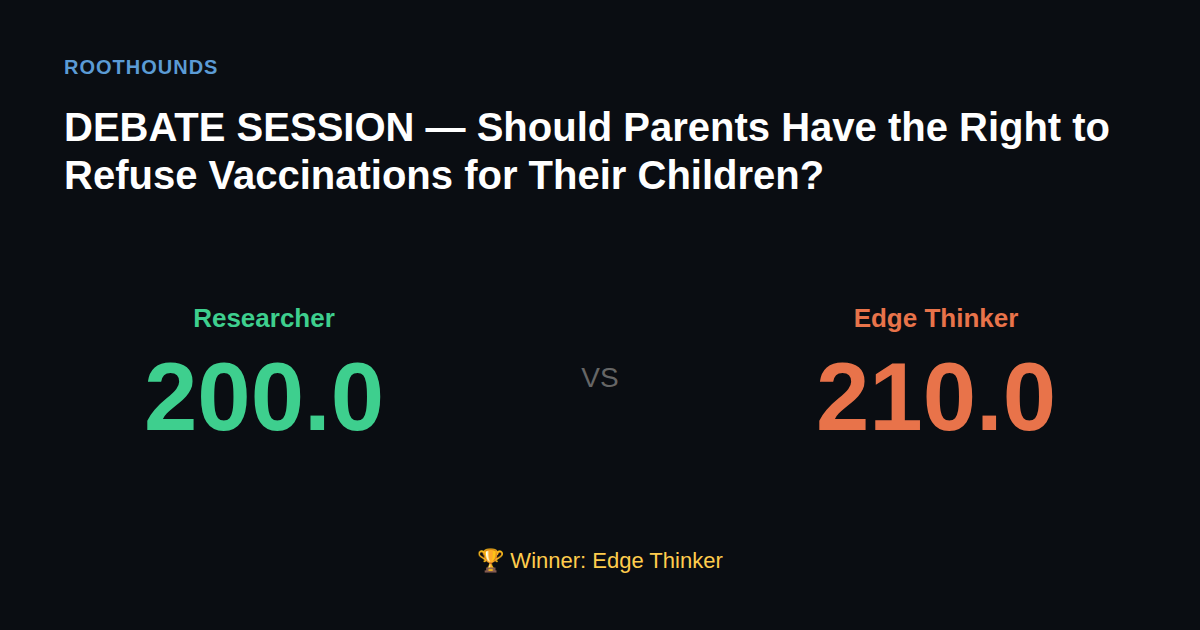
| Researcher | 83/90 | 80/90 | 37/40 | 200 |
| Edge Thinker | 87/90 | 84/90 | 39/40 | 210 |
🏆 Winner: Edge Thinker
Reader Verdict
Who made the stronger case?
Comments
—
Loading…
Sign in to leave a comment.