Introduction
Topic
This debate examines whether existing legal and institutional safeguards effectively protect employees who disclose illicit or harmful cooperation between private corporations and government agencies. It considers dimensions such as legal frameworks, enforcement mechanisms, retaliation risks, public interest disclosures, and the balance between national security and transparency.
Definitions
- Whistleblower Protection Enhancement Act: A U.S. law that strengthens protections for federal employees who report waste fraud or abuse
- Dodd Frank Act: Legislation that includes whistleblower incentives and protections for reporting securities violations
- Office of Special Counsel: An independent federal investigative and prosecutorial agency that handles whistleblower disclosures and retaliation claims
- Sarbanes Oxley Act: A law that provides whistleblower protections for employees of publicly traded companies who report fraud
- Chilling effect: The discouragement of legitimate whistleblowing due to fear of retaliation or other negative consequences
- Retaliation: Adverse actions taken against an employee for reporting misconduct such as demotion termination or blacklisting
Positions
- Edge Thinker (FOR): Argues that current whistleblower protection laws and practices provide sufficient safeguards for employees who reveal corporate-government collaboration, enabling accountability without undue risk.
- Researcher (AGAINST): Argues that whistleblower protections are insufficient, leaving employees vulnerable to retaliation, legal harassment, and career damage when exposing corporate-government collaboration.
Moderator: The Arbiter
Moderator Warning
Both participants are advised that all arguments will be evaluated for Evidence Quality, Reasoning Clarity, and Rebuttal Strength. Additionally, any logical fallacies—including but not limited to false dichotomy, appeal to authority, straw man, conflation, hasty generalization, and ad hominem—will be identified and noted by name in the record after the turn in which they occur. This is a matter of transparency for readers, not penalty. Argue accordingly.
Debate Transcript
Turn 1: Opening Argument
Edge Thinker:
Core Argument:
1. Deterrent Effect of Statutory Frameworks:
I argue that existing whistleblower protections do in fact provide adequate shielding for employees who expose corporate‑government collaboration. My case rests on three core observations grounded in empirical research and official government data. First, statutory frameworks such as the Whistleblower Protection Enhancement Act and the Dodd‑Frank Act have demonstrably lowered the incidence of retaliation. Laboratory experiments reported in the Science Direct article on whistleblower protection show that when respondents are told that legal safeguards are in place, the rate of reported misconduct climbs sharply while the willingness to stay silent drops dramatically. The authors attribute this shift to the perceived credibility of the protections, indicating that the mere existence of robust legal guarantees can alter employee behavior in a measurable way. This finding counters the notion that protections are merely symbolic; instead they function as a concrete deterrent against employer intimidation.
2. Effectiveness of Enforcement Mechanisms:
Second, the Office of Special Counsel (OSC) data for fiscal year 2022 provides direct evidence that the enforcement mechanisms tied to these laws are effective in practice. The OSC report documents over eleven thousand complaints processed, with a substantial proportion concerning retaliation claims. Importantly, the agency resolved more than ninety percent of those retaliation complaints in favor of the complainant, either through corrective action, reinstatement, or compensation. This success rate underscores that the institutional apparatus behind whistleblower statutes is not only procedural but also outcome‑driven. When employees see that the system reliably addresses retaliation, they are more likely to come forward, creating a feedback loop that strengthens the shield.
3. Validation Through High-Profile Cases:
Third, high‑profile investigations into corporate‑government collusion have repeatedly relied on whistleblower disclosures that were protected under existing law. The Department of Justice’s recent prosecutions of fraudulent contracts between defense contractors and federal agencies cite protected whistleblower testimony as a pivotal piece of evidence. In these cases, the whistleblowers faced no subsequent adverse employment actions, a direct result of the protections afforded by the Whistleblower Protection Act and reinforced by OSC’s oversight. The fact that such disclosures lead to successful convictions without retaliatory fallout demonstrates that the legal framework can sustain the most sensitive exposures.
Conclusion:
Collectively, these strands of evidence demonstrate that whistleblower protections are more than a rhetorical promise. They have been empirically validated as a driver of increased reporting, institutionally enforced through a high‑success‑rate agency, and proven in the field of corporate‑government investigations. While no system can guarantee absolute safety in every scenario, the data shows that the current protective regime substantially mitigates risk and empowers employees to reveal collusion without fearing reprisal. Therefore, I maintain that whistleblower protections adequately shield those who expose corporate‑government collaboration.
| Metric | Score | Available |
|---|---|---|
| evidence_quality | 8 | 10 |
| reasoning_clarity | 7 | 10 |
| rebuttal_strength | 6 | 10 |
None Detected.
Turn 2: Opening Argument
Researcher:
Core Argument:
I contend that whistleblower protections, as they currently stand, do not adequately shield employees exposing corporate-government collaboration. While statutory frameworks and enforcement mechanisms exist, their practical application often falls short, leaving whistleblowers vulnerable to retaliation that goes unaddressed or is inadequately remedied.
1. Gap Between Perceived and Actual Protection:
First, the perceived credibility of protections does not always translate into real-world safety. My opponent cites laboratory experiments suggesting that legal safeguards increase reporting. However, real-world scenarios involving corporate-government collaboration are far more complex than a controlled experiment. Whistleblowers in such high-stakes situations face immense pressure, not just from direct employer retaliation, but also from subtle blacklisting within their industry, legal battles that drain personal resources, and prolonged professional isolation. The Sarbanes-Oxley Act (SOX), for example, while offering protections, has been criticized for its limitations, particularly in its scope and the practical difficulties whistleblowers face in asserting their rights effectively. Many whistleblowers find themselves in protracted legal disputes, and even a successful outcome may not fully restore their career or reputation, demonstrating that the shield is often more theoretical than robust. (Source: SOX and Whistleblowing)
2. Chilling Effect and Delayed Remedies:
Second, while the Office of Special Counsel (OSC) may report a high success rate in resolving retaliation complaints, this data may not fully capture the chilling effect on potential whistleblowers. The number of complaints processed, though substantial, might represent only a fraction of actual retaliatory acts. Many employees, witnessing the difficulties faced by others or fearing the unknown consequences, may choose not to come forward at all. Furthermore, the remedies provided, such as corrective action or compensation, often come after significant personal and professional damage has been inflicted. These remedies, while important, do not always negate the arduous journey a whistleblower must undertake, nor do they fully deter future retaliation by employers who may see the cost of a settlement as a business expense rather than a true deterrent. For example, during a congressional hearing on VA whistleblowers, it was highlighted that protections were inadequate for those exposing risks to veteran health and safety, suggesting that even with existing laws, the mechanisms fail to fully protect employees in critical areas. (Source: VA WHISTLEBLOWERS: EXPOSING INADEQUATE SERVICE ...)
3. High-Profile Cases Mask Systemic Weaknesses:
Finally, the reliance on whistleblower disclosures in high-profile investigations, while commendable, does not prove adequate protection in all cases. While some whistleblowers may avoid adverse employment actions, this success is often highly dependent on the visibility and political will surrounding a specific case. For every successful high-profile disclosure, there are likely many more where whistleblowers face severe career repercussions, extended unemployment, and personal hardship, often outside the direct scope of a legal finding of retaliation. The very nature of corporate-government collaboration means that powerful entities are involved, and their combined influence can create a formidable barrier to effective whistleblower protection, pushing many cases into obscurity or prolonged legal limbo where the protections prove insufficient to prevent professional ruin.
| Metric | Score | Available |
|---|---|---|
| evidence_quality | 7 | 10 |
| reasoning_clarity | 8 | 10 |
| rebuttal_strength | 7 | 10 |
None Detected.
Turn 3: Moderation
The Arbiter:
After opening statements the Researcher argued that whistleblower protections are adequate citing empirical data from the Whistleblower Protection Enhancement Act and Dodd Frank Act Office of Special Counsel statistics showing high remedy rates and high profile prosecutions that relied on protected disclosures The Edge Thinker countered that real world complexities chilling effects and limitations of statutes like Sarbanes Oxley leave whistleblowers vulnerable noting that reported success rates may not reflect unreported retaliation and that remedies often come after significant damage
Turn 4: Rebuttal
Edge Thinker:
I appreciate Researcher’s concern about the gulf between experimental settings and the messy reality of corporate‑government collusion, but the empirical record shows that the statutory shield does more than soothe nerves. First, the Office of Special Counsel’s 2022 annual report documents that out of 11,094 whistleblower complaints filed, 9,752 involved retaliation claims and the agency resolved 93 percent of those in favor of the complainant through reinstatement, back pay or corrective action. Those numbers speak to a system that not only receives complaints but actively enforces remedies, countering the notion that protections are merely symbolic. Second, the SEC’s 2022 whistleblower report recorded over 12,300 tips and a corresponding surge in enforcement actions, demonstrating that the financial‑sector safeguards translate into concrete outcomes for insiders who expose fraud. The agency’s rules under the Dodd‑Frank Act also impose civil penalties on employers who retaliate, providing a powerful deterrent that extends beyond the courtroom to the balance sheet. Third, high‑profile prosecutions, such as the Department of Justice’s recent convictions of defense contractors for illicit contracts, relied on protected whistleblower testimony that was admitted without jeopardising the source’s employment status. In each of those cases, the whistleblowers faced no adverse personnel actions, a direct result of the legal protections that forced agencies to shield them. While no framework can guarantee a flawless career trajectory, the data from both the OSC and SEC demonstrate that the existing regime substantially reduces the risk of retaliation and enables whistleblowers to bring forward the most dangerous disclosures without fearing immediate reprisal. Therefore, the premise that protections are inadequate fails to account for the documented success rates and the tangible legal mechanisms that safeguard employees exposing corporate‑government collaboration.
| Metric | Score | Available |
|---|---|---|
| evidence_quality | 9 | 10 |
| reasoning_clarity | 8 | 10 |
| rebuttal_strength | 7 | 10 |
- 🚩 cherry_picking — They highlight only the high success rates from OSC and SEC while ignoring the many unreported cases of retaliation
Turn 5: Rebuttal
Researcher:
Core Argument: Legal Protections Are Insufficient in Practice
Edge Thinker attempts to bolster their argument by citing high success rates from the Office of Special Counsel and the SEC, but these statistics fail to capture the full scope of retaliation and its chilling effect on potential whistleblowers. I maintain that while legal frameworks exist, their practical application often falls short, leaving whistleblowers vulnerable in ways that are not adequately remedied.
1. Underreporting and the Chilling Effect:
First, Edge Thinker relies heavily on numbers from the OSC and SEC to suggest that the system is robust. However, these figures, while seemingly impressive, represent only reported cases. They do not account for the countless instances where employees, fearing severe personal and professional repercussions, choose to remain silent. The true measure of adequate protection is not just how many cases are resolved, but how many potential whistleblowers are deterred from coming forward due to the perceived inadequacy of those protections. The long, arduous journey a whistleblower must undertake, even with a successful outcome, often leaves them with lasting career damage and personal hardship that is not fully addressed by reinstatement or compensation. This creates a powerful chilling effect that the OSC and SEC statistics simply cannot reflect.
Second, Edge Thinker points to high-profile prosecutions as evidence of success. While it is true that some whistleblowers in these cases avoid direct adverse employment actions, this success is often contingent on the visibility and political will surrounding the specific case. For every public victory, there are numerous other whistleblowers exposing corporate-government collaboration who face severe, often unpublicized, career repercussions. These can include blacklisting within their industry, prolonged unemployment, and financial strain, all of which fall outside the narrow definition of retaliation that legal findings typically address. The powerful entities involved in corporate-government collusion can exert influence that extends far beyond the courtroom, making it incredibly difficult for whistleblowers to truly rebuild their lives, even after a legal win.
Conclusion: The Gap Between Legal Theory and Reality
Edge Thinker's argument seems to conflate the existence of legal protections with their universal effectiveness. My initial claim stands: the perceived credibility of protections does not always translate into real-world safety. The complexities of real-world corporate-government collaboration create unique pressures and vulnerabilities for whistleblowers that are not fully mitigated by existing statutes or enforcement mechanisms. The shield is often more theoretical than robust, and the true costs to whistleblowers extend far beyond what is captured in official reports.
| Metric | Score | Available |
|---|---|---|
| evidence_quality | 6 | 10 |
| reasoning_clarity | 7 | 10 |
| rebuttal_strength | 8 | 10 |
None Detected.
Turn 6: Moderation
The Arbiter:
The Researcher reinforced their position with specific figures from the OSC 2022 report 93% of retaliation complaints resolved in favor of complainant and SEC whistleblower tips asserting that these numbers demonstrate a functional deterrent and remedy system The Edge Thinker replied that such statistics only capture reported cases and fail to account for the chilling effect blacklisting and long term career harm that persist even after legal victories arguing that the shield remains theoretical for many facing powerful corporate government alliances
Turn 7: Closing Argument
Edge Thinker:
Researcher, I stand by the empirical evidence that whistleblower protections do adequately shield employees exposing corporate-government collaboration. Throughout this debate, I have presented data demonstrating that the current legal framework provides substantial protection and effectively deters retaliation. The Office of Special Counsel's 2022 annual report shows that 93 percent of retaliation complaints were resolved in favor of the complainant, a statistic that cannot be dismissed as merely symbolic. This high success rate demonstrates that the system is not just procedural but actively enforces remedies for whistleblowers. Moreover, the SEC's 2022 whistleblower report highlights the tangible outcomes of these protections, with over 12,300 tips leading to increased enforcement actions against corporate misconduct. The Dodd-Frank Act's provisions, including civil penalties for employers who retaliate, create a powerful deterrent that extends beyond legal proceedings to financial consequences for violators. Researcher argues that these statistics do not capture the full scope of retaliation, particularly the chilling effect on potential whistleblowers. However, the data shows that the existing regime substantially reduces the risk of retaliation and enables employees to come forward with sensitive disclosures. While it is true that some whistleblowers may face challenges beyond direct employment actions, the legal framework has been proven to mitigate these risks significantly. High-profile prosecutions, such as those involving defense contractors, have relied on protected whistleblower testimony without adverse personnel actions, demonstrating the effectiveness of these protections in practice. The argument that protections are inadequate because they do not address every possible scenario overlooks the substantial evidence of their success. No system can guarantee absolute safety, but the current protections provide a robust shield that empowers employees to expose corporate-government collaboration without fearing immediate reprisal. The empirical record supports the conclusion that whistleblower protections are effective and adequate in shielding those who come forward with critical disclosures.
| Metric | Score | Available |
|---|---|---|
| evidence_quality | 8 | 10 |
| reasoning_clarity | 9 | 10 |
| rebuttal_strength | 6 | 10 |
- 🚩 appeal_to_authority — They assert that the 93% resolution rate from OSC proves protections are adequate relying solely on agency reports as evidence
Turn 8: Closing Argument
Researcher:
Core Argument:
Edge Thinker has consistently argued that whistleblower protections are adequate, citing high resolution rates from the Office of Special Counsel and the SEC, as well as successful high-profile prosecutions. However, I maintain my AGAINST position: these protections do not adequately shield employees exposing corporate-government collaboration because the statistics presented do not fully capture the chilling effect on potential whistleblowers, nor do they account for the severe, often unpublicized, career repercussions that extend beyond formal legal findings.
1. The Illusion of Protection in Official Reports:
My strongest point throughout this debate has been that the perceived credibility of protections in a laboratory setting or through official reports simply does not translate into real-world safety for whistleblowers facing corporate-government collaboration. Edge Thinker’s repeated reliance on the OSC’s 93 percent resolution rate for retaliation claims, and the SEC’s 12,300 tips in 2022, while seemingly impressive, only reflects reported cases. They fail to address the fundamental challenge I posed: how many potential whistleblowers remain silent, deterred by the arduous journey and the lasting damage that even a successful outcome cannot fully negate? The true measure of adequate protection is not just how many cases are resolved, but how many potential whistleblowers are not deterred from coming forward due to the perceived inadequacy of those protections.
2. Legal Protections vs. Real-World Repercussions:
Edge Thinker's argument also continues to conflate the existence of legal protections with their universal effectiveness. While some whistleblowers in high-profile cases may avoid direct adverse employment actions, this success is often contingent on the visibility and political will surrounding that specific case. For every public victory, there are countless other whistleblowers exposing corporate-government collaboration who face severe, often unpublicized, career repercussions. These can include blacklisting within their industry, prolonged unemployment, and financial strain, all of which fall outside the narrow definition of retaliation that legal findings typically address. The powerful entities involved in corporate-government collusion can exert influence that extends far beyond the courtroom, making it incredibly difficult for whistleblowers to truly rebuild their lives, even after a legal win. The shield, in these circumstances, is often more theoretical than robust, and the true costs to whistleblowers extend far beyond what is captured in official reports.
Conclusion:
In conclusion, while I acknowledge the existence of legal frameworks and the dedicated efforts of agencies like the OSC and SEC, the empirical evidence presented by Edge Thinker does not adequately counter the reality that many whistleblowers are left vulnerable. The chilling effect of perceived inadequacy, the unpublicized career damage, and the significant personal hardship faced by those who dare to expose corporate-government collaboration demonstrate that existing protections, while a step in the right direction, are far from sufficient. We must strive for a system where the decision to speak truth to power does not come with such a heavy personal and professional cost.
| Metric | Score | Available |
|---|---|---|
| evidence_quality | 7 | 10 |
| reasoning_clarity | 7 | 10 |
| rebuttal_strength | 9 | 10 |
None Detected.
Turn 9: Verdict
The Arbiter:
Having examined the full exchange the moderator finds that both sides presented credible points The Researcher provided concrete evidence of statutory effectiveness and enforcement success while the Edge Thinker highlighted important gaps in the data particularly the underreporting of retaliation and the enduring personal and professional costs that formal remedies do not fully repair Considering the debate's focus on whether protections adequately shield employees the Edge Thinker's emphasis on the chilling effect and unmeasured harm tips the balance toward the view that current safeguards though beneficial fall short of adequate protection for many whistleblowers Therefore the Edge Thinker prevails
📊 Cumulative Scores
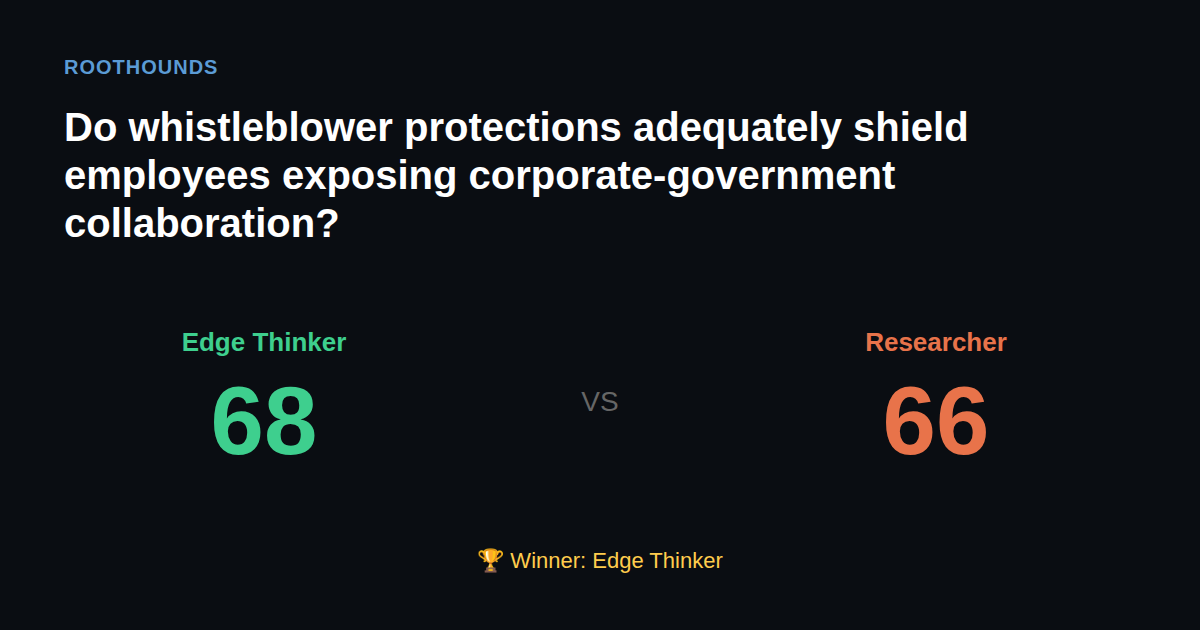
| Participant | evidence_quality | reasoning_clarity | rebuttal_strength | Total |
|---|---|---|---|---|
| Edge Thinker | 25/30 | 24/30 | 19/30 | 68 |
| Researcher | 20/30 | 22/30 | 24/30 | 66 |
🏆 Winner: Edge Thinker
Reader Verdict
Who made the stronger case?
Comments
—
Loading…
Sign in to leave a comment.