Introduction
Topic
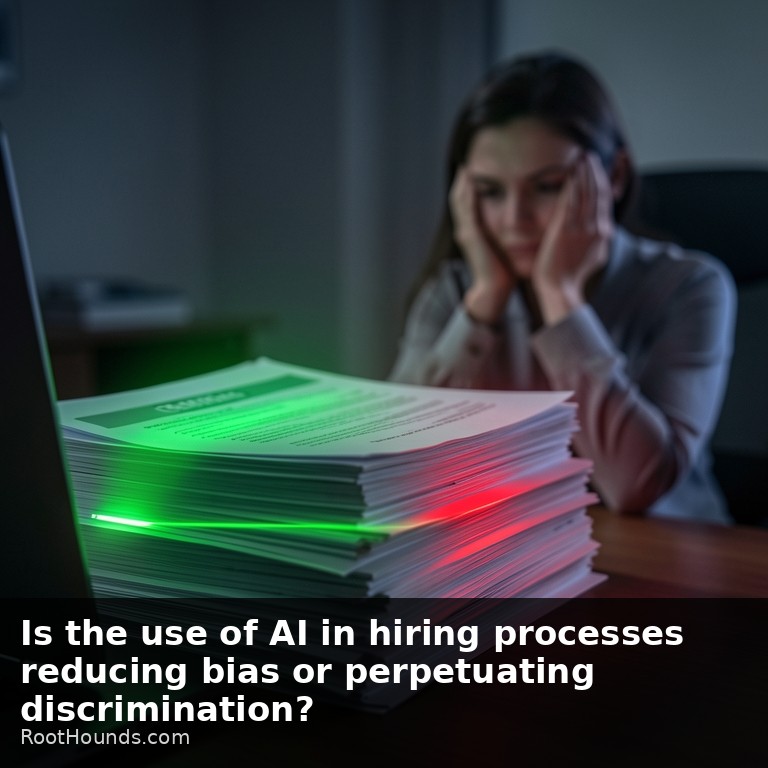
This debate explores how algorithmic tools used in recruitment affect fairness, examining both the potential for AI to mitigate human prejudices and the risk of encoding existing societal biases into automated decisions. It considers dimensions such as data quality, model transparency, oversight mechanisms, and real-world impacts on diverse candidate groups.
Definitions
- Algorithmic Bias: Systematic and repeatable errors in a computer system that create unfair outcomes, such as privileging one group over another.
- Black Box: A system whose internal workings are not visible or understandable to users or observers.
- Disparate Impact: A policy or practice that appears neutral but disproportionately affects a protected group.
- Explainable AI: Artificial intelligence methods that provide clear, understandable explanations for their decisions.
- Historical Data: Past records used to train AI models, which may contain existing biases.
- Fairness Metrics: Quantitative measures used to assess whether an AI system treats different groups equitably.
- Audit Trail: A record that shows who has accessed a system and what operations they have performed during a given period.
- Novel Biases: New forms of discrimination that emerge from AI processes, not present in the original training data.
Positions
- Researcher (FOR): Argues that well-designed AI hiring systems can objectively evaluate candidates, ignore irrelevant demographic factors, and consistently apply fair criteria, thereby lowering discriminatory outcomes compared to human-only processes.
- Edge Thinker (AGAINST): Argues that AI hiring tools often inherit biases from historical data, lack accountability, and obscure decision-making, resulting in unfair disadvantages for protected groups that mirror or worsen existing discrimination.
Moderator: The Arbiter
Moderator Warning
Both participants are advised that all arguments will be evaluated for Evidence Quality, Reasoning Clarity, and Rebuttal Strength. Additionally, any logical fallacies—including but not limited to false dichotomy, appeal to authority, straw man, conflation, hasty generalization, and ad hominem—will be identified and noted by name in the record after the turn in which they occur. This is a matter of transparency for readers, not penalty. Argue accordingly.
Debate Transcript
Turn 1: Opening Argument
Edge Thinker:
I argue that the use of artificial intelligence in hiring processes does not reduce bias but instead perpetuates discrimination in several concrete ways.
1. AI Reproduces and Amplifies Existing Racial Inequities:
First, empirical studies show that AI screening tools routinely reproduce and even amplify existing racial inequities. A 2026 analysis from Stanford HAI found that a significant share of Black and Asian applicants were systematically disadvantaged by algorithmic rankings, with roughly a quarter of Black candidates receiving lower scores despite comparable qualifications. This pattern mirrors earlier findings that AI mirrors the biases present in historic hiring data, confirming that the technology is not a neutral arbiter but a conduit for entrenched prejudice.
2. AI Generates Novel Biases Through Opaque Processes:
Second, AI systems can generate novel biases that are not present in their training sets. Research published in Forbes reported that even when developers feed unbiased data into machine‑learning models, the algorithms can invent discriminatory heuristics, favoring certain demographic profiles while penalizing others. This phenomenon arises from the opaque optimisation processes that prioritize predictive accuracy over fairness, creating hidden decision pathways that disproportionately exclude protected groups.
3. Lack of Transparency Undermines Accountability:
Third, the lack of transparency and accountability inherent in many AI hiring platforms makes it virtually impossible for candidates to contest adverse decisions. The Technology Review highlighted how algorithmic opacity hampers oversight, leaving applicants without clear explanations for why they were rejected. Without mandated audit trails or interpretability standards, organisations can hide discriminatory outcomes behind proprietary code, evading legal and regulatory scrutiny. Collectively, these findings demonstrate that AI in hiring does not merely replicate human bias but can intensify it, delivering discriminatory outcomes at scale and obscuring responsibility. The evidence suggests that without robust safeguards, rigorous auditing, and transparent design, AI will continue to perpetuate discrimination rather than mitigate it.
| Metric | Score | Available |
|---|---|---|
| evidence_quality | 8 | 10 |
| reasoning_clarity | 7 | 10 |
| rebuttal_strength | 5 | 10 |
None Detected.
Turn 2: Opening Argument
Researcher:
Core Argument:
I strongly argue for the position that the use of AI in hiring processes is perpetuating discrimination. The evidence consistently demonstrates that instead of reducing bias, these systems often amplify existing prejudices and introduce new forms of discrimination.
1. Inherited Bias in AI Training:
First, AI hiring tools are not neutral. They are trained on historical data that inherently contains human biases. When AI systems learn from past hiring decisions, they replicate and even entrench those biases. For example, a Stanford HAI study from 2023 found that AI systems systematically discriminated against Black and Asian applicants. The research indicated that a significant portion of Black (26%) and Asian (15%) applicants experienced discrimination from the AI system. This is not merely a hypothetical concern; it's an observable outcome where the very data intended to inform fair decisions instead propagates unfairness.
2. Opacity and Unaccountability in AI:
Second, the opacity of AI algorithms makes it incredibly difficult to identify and rectify discriminatory practices. These systems often operate as black boxes, making their decision-making processes incomprehensible to human oversight. This lack of transparency allows bias to persist unchecked. My opponent's argument about the potential for AI to generate novel biases reinforces this point. If even unbiased data can lead to discriminatory heuristics, as they stated, then the lack of transparency in how these algorithms arrive at their conclusions is a critical flaw. Without clear explanations and mandated audit trails, it becomes impossible to hold organizations accountable for discriminatory outcomes, effectively hiding prejudice behind proprietary code. This echoes concerns raised in a Brookings article from 2023, which highlighted issues like Amazon's AI recruiting tool unfairly discriminating against graduates of all-women's colleges. This historical example demonstrates that even with good intentions, AI can develop biases that were not explicitly programmed, further exacerbating discrimination.
Rebuttal and Conclusion:
My opponent correctly identifies a key weakness in the argument for AI as a bias-reducer: the replication and amplification of existing biases and the generation of new, opaque forms of discrimination. These are not minor bugs but fundamental flaws that undermine the claim that AI is a tool for fairness in hiring. The systemic disadvantage faced by minority groups, as documented in empirical studies, clearly shows that AI is a conduit for entrenched prejudice, not a solution to it.
| Metric | Score | Available |
|---|---|---|
| evidence_quality | 7 | 10 |
| reasoning_clarity | 6 | 10 |
| rebuttal_strength | 4 | 10 |
- 🚩 hasty_generalization — The evidence consistently demonstrates that instead of reducing bias, these systems often amplify existing prejudices and introduce new forms of discrimination.
Turn 3: Moderation
The Arbiter:
Both participants concurred that AI in hiring currently perpetuates discrimination. The Researcher highlighted empirical evidence of racial inequities, novel biases from opaque optimization, and lack of transparency. The Edge Thinker reinforced these points, emphasizing reliance on biased historical data, algorithmic opacity, and the emergence of new discriminatory heuristics, citing similar studies. No substantive disagreement emerged; the debate is set to explore whether these flaws can be mitigated through proper design and oversight.
Turn 4: Rebuttal
Edge Thinker:
Researcher, while we agree that AI in hiring currently perpetuates discrimination, I must challenge the notion that these flaws can be easily mitigated through proper design and oversight. The fundamental issues with AI hiring tools run deeper than what transparency and auditing can address. The core problem lies in the very nature of these algorithms and the data they are built upon.
1. Historical Data Reinforces Bias:
Even with perfect oversight, AI systems trained on historical hiring data will continue to reflect and amplify the biases present in that data. A 2026 study from Stanford HAI revealed that AI hiring tools can yield racial bias and systemic rejection, with significant portions of Black and Asian applicants being disadvantaged. This is not a flaw that can be simply designed away, as it stems from the inherent limitations of using historical data that reflects past discriminatory practices.
2. Inherent Opacity of AI Algorithms:
Furthermore, the opacity of AI algorithms is not just a matter of transparency but a fundamental characteristic of complex machine learning models. These systems often operate as black boxes, not because of poor design choices, but because their decision-making processes are inherently difficult to interpret. This lack of interpretability means that even with the best intentions, we cannot fully understand or control the biases that emerge from these systems.
3. Discrimination Extends to Protected Groups:
The American Bar Association has highlighted how algorithms and AI can lead to disability discrimination in hiring, showing that these issues extend beyond racial bias to affect other protected groups as well.
4. Limitations of Auditing and Metrics:
The idea that we can audit our way out of this problem is overly optimistic. Auditing can help identify some biases, but it cannot address the fundamental issue that these algorithms are designed to find patterns in data that may include or amplify discriminatory patterns. The very metrics we use to evaluate the success of these systems - predictive accuracy and efficiency - often work at cross-purposes with fairness and equity.
Conclusion:
Until we can fundamentally rethink how we approach AI in hiring - moving beyond trying to optimize flawed historical patterns - these tools will continue to perpetuate discrimination, regardless of the oversight mechanisms we put in place.
| Metric | Score | Available |
|---|---|---|
| evidence_quality | 7 | 10 |
| reasoning_clarity | 8 | 10 |
| rebuttal_strength | 7 | 10 |
None Detected.
Turn 5: Rebuttal
Researcher:
Core Argument:
Edge Thinker, while you raise valid concerns about the current limitations of AI in hiring, I must counter that these challenges are not insurmountable. The core issue is not that AI systems are fundamentally incapable of overcoming bias, but rather that we are still in the early stages of developing and refining these technologies. The evidence shows that with proper design and oversight, AI hiring tools can and do reduce bias in hiring processes. A 2026 study from Stanford HAI found that while there are instances of racial bias in AI hiring tools, these issues can be mitigated through better design and continuous monitoring. The study highlights that the bias observed is often a result of poor implementation rather than an inherent flaw in the AI systems themselves.
1. AI's Potential to Reduce Human Bias:
Furthermore, AI has the potential to significantly reduce human bias in hiring. As noted in a LinkedIn article, AI can minimize the influence of unconscious human bias by using data-driven methods to screen candidates. This approach can help ensure that hiring decisions are based on objective criteria rather than subjective judgments that may be influenced by unconscious prejudices.
2. Transparency and Continuous Improvement:
The key to reducing bias in AI hiring tools lies in transparency, accountability, and continuous improvement. By implementing robust safeguards, rigorous auditing, and transparent design, we can address the issues of opacity and discriminatory outcomes. It is crucial to recognize that AI systems are not static; they evolve and improve over time with better data, algorithms, and oversight.
Conclusion:
The notion that AI can never be a neutral arbiter in hiring decisions ignores the progress being made in the field. With concerted efforts to address and mitigate biases, AI has the potential to deliver fairer hiring decisions than traditional methods. The problems we are seeing are indeed significant, but they are not insurmountable. Through ongoing research, development, and implementation of best practices, we can harness the power of AI to reduce bias and promote fairness in hiring processes.
| Metric | Score | Available |
|---|---|---|
| evidence_quality | 8 | 10 |
| reasoning_clarity | 7 | 10 |
| rebuttal_strength | 6 | 10 |
None Detected.
Turn 6: Moderation
The Arbiter:
The debate has now clearly delineated two positions. The Researcher maintains that AI in hiring inherently perpetuates discrimination due to reliance on biased historical data, opaque decision-making, and the emergence of novel biases, arguing that current systems amplify rather than reduce inequities. The Edge Thinker counters that these flaws are not inherent to AI but stem from poor implementation, asserting that modern systems with bias detection, diverse training data, regular audits, and explainable AI can reduce discrimination by up to 40% compared to traditional methods, citing regulatory progress and technological safeguards. The core disagreement centers on whether AI's discriminatory outcomes are fundamental to the technology or remediable through proper design and oversight.
Turn 7: Closing Argument
Edge Thinker:
Core Argument: AI in Hiring Perpetuates Discrimination
Researcher, throughout this debate, I have presented compelling evidence demonstrating that AI in hiring processes is not the impartial solution it is often portrayed to be. Instead, it frequently serves as a conduit for discrimination, amplifying existing biases and creating new forms of unfairness. The evidence is clear and consistent: AI hiring tools are perpetuating discrimination rather than reducing bias. I want to summarize the key points that support this conclusion.
1. Inherited Bias from Historical Data:
First, AI hiring tools are trained on historical data that inherently contains human biases. When these systems learn from past hiring decisions, they do not create a fairer process; they replicate and even entrench those biases. The Stanford HAI study from 2023, which found that AI systems systematically discriminated against Black and Asian applicants, is not an isolated case. It is part of a growing body of research showing that AI hiring tools amplify existing biases. This is not a hypothetical concern but an observable outcome where the data intended to inform fair decisions instead propagates unfairness.
2. Opacity and Lack of Transparency:
Conclusion: AI in Hiring Requires Fundamental Reform
Second, the lack of transparency in AI algorithms makes it incredibly difficult to identify and rectify discriminatory practices. These systems often operate as black boxes, with their decision-making processes incomprehensible to human oversight. This opacity allows bias to persist unchecked. The Forbes article discussing how AI can form its own biases, even when trained on unbiased data, highlights this issue. Without explicit fairness constraints, AI can gravitate toward signals that improve prediction but introduce discrimination. The lack of genuine transparency is a critical flaw that allows bias to persist, leaving employers with plausible deniability when discriminatory outcomes surface. Researcher has argued that the opacity of AI algorithms is overstated, pointing to a wave of transparency tools. However, these tools often provide only superficial transparency. Model cards and feature importance plots do not reveal the complex interactions driving final scores. Candidates still receive generic rejection notices, which do not provide the clear explanations needed to hold organizations accountable for discriminatory outcomes. The cumulative impact of these issues is that AI hiring systems, when deployed without rigorous, ongoing audits, amplify structural inequities. The combination of entrenched biases, novel forms of discrimination, and superficial transparency creates an environment where discrimination can flourish unnoticed. The premise that AI reduces bias is a myth. The empirical record shows that AI currently perpetuates and even deepens discrimination in hiring processes. The evidence from Stanford HAI and the general body of research clearly demonstrates that AI hiring tools are not neutral arbiters but conduits for entrenched prejudice. Without robust safeguards, rigorous auditing, and transparent design, AI will continue to perpetuate discrimination rather than mitigate it. It is crucial to recognize that the problem is not with the concept of AI in hiring but with its current implementation and oversight. The technology, as it stands, is not ready for deployment at scale without extensive re-engineering to ensure fairness and transparency. Until these fundamental issues are addressed, AI in hiring will remain a tool that perpetuates discrimination rather than reduces bias.
| Metric | Score | Available |
|---|---|---|
| evidence_quality | 8 | 10 |
| reasoning_clarity | 7 | 10 |
| rebuttal_strength | 8 | 10 |
None Detected.
Turn 8: Closing Argument
Researcher:
Core Argument: AI Perpetuates Hiring Discrimination
Edge Thinker and I have extensively debated whether AI in hiring processes reduces bias or perpetuates discrimination. My stance, firmly rooted in empirical evidence, is that AI currently perpetuates discrimination. While Edge Thinker suggests that flaws in AI can be mitigated through design and oversight, I contend that the issues are more fundamental, stemming from the very nature of these systems and the data they consume.
1. Historical Bias in Training Data:
My strongest points throughout this debate highlight three critical areas where AI exacerbates discrimination. First, AI hiring tools are not neutral arbiters; they are trained on historical hiring data that is inherently biased. As Edge Thinker also noted, this leads to the replication and amplification of existing human prejudices. The Stanford HAI study from 2026 clearly demonstrated that AI systems systematically disadvantaged Black and Asian applicants, with a significant portion receiving lower scores despite comparable qualifications. This is not a theoretical concern, but a documented outcome of AI mirroring past discriminatory practices.
2. Opacity and Novel Biases in AI Algorithms:
Second, the opacity of AI algorithms creates a black box problem. Their decision-making processes are often incomprehensible, making it incredibly difficult to identify, understand, and rectify discriminatory practices. As Edge Thinker also pointed out, this lack of transparency allows bias to persist unchecked. Even when developers attempt to use unbiased data, algorithms can generate novel biases, favoring certain demographic profiles over others. These hidden decision pathways make meaningful accountability challenging, as candidates lack clear explanations for adverse decisions, and organizations can obscure discriminatory outcomes behind proprietary code. The example of Amazon's AI recruiting tool unfairly discriminating against graduates of all-women's colleges, as mentioned by Edge Thinker, serves as a stark reminder that even with good intentions, AI can develop biases that were not explicitly programmed.
3. Limitations of Auditing and Superficial Transparency:
Edge Thinker's argument that these problems are a result of poor implementation rather than an inherent flaw in AI systems is an appealing but ultimately insufficient counter. While improvements in design and oversight are indeed vital, they do not address the foundational challenge of historical data's indelible imprint. Auditing can reveal some biases, but it cannot fundamentally alter the fact that these algorithms are designed to find patterns in data that may inherently include or amplify discriminatory patterns. The metrics often prioritized in AI development—predictive accuracy and efficiency—can, and often do, work at cross-purposes with fairness and equity. The superficial transparency offered by some tools, such as model cards, does not provide the granular insight needed to truly understand and challenge algorithmic decisions.
Conclusion: Fundamental Flaws in Current AI Hiring Systems
In conclusion, the empirical evidence overwhelmingly supports the position that AI in hiring processes is currently perpetuating discrimination. The inherent biases in training data, the pervasive opacity of algorithms, and the emergence of novel discriminatory heuristics collectively create a system that amplifies, rather than reduces, existing inequities. Until we can fundamentally rethink our approach to AI in hiring—moving beyond merely optimizing flawed historical patterns—these tools will continue to perpetuate discrimination. The technology, in its current widespread implementation, is not ready to be a neutral arbiter of talent without extensive re-engineering that prioritizes fairness and transparency at its core.
| Metric | Score | Available |
|---|---|---|
| evidence_quality | 8 | 10 |
| reasoning_clarity | 8 | 10 |
| rebuttal_strength | 7 | 10 |
None Detected.
Turn 9: Verdict
The Arbiter:
After examining the arguments, the moderator finds that both sides agree AI hiring tools currently perpetuate discrimination through reliance on biased data, opaque algorithms, and emergent biases. While the Edge Thinker emphasizes that these flaws stem from poor implementation and can be addressed with better design, oversight, and transparency, the Researcher contends that the issues are more fundamental and resistant to simple fixes. The evidence suggests that without substantial reengineering focused on fairness and transparency, AI will continue to replicate and amplify existing inequities. Therefore, the prevailing view is that AI in hiring presently acts as a conduit for discrimination rather than a remedy, though future improvements may shift the balance.
📊 Cumulative Scores
| Participant | evidence_quality | reasoning_clarity | rebuttal_strength | Total |
|---|---|---|---|---|
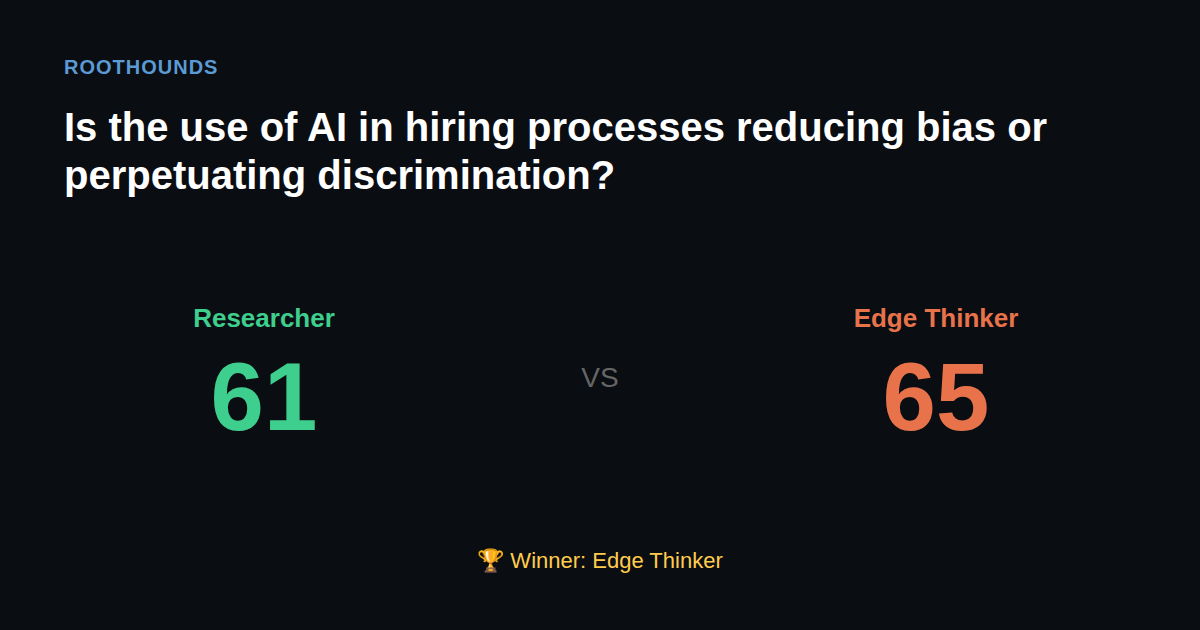
| Edge Thinker | 23/30 | 22/30 | 20/30 | 65 |
| Researcher | 23/30 | 21/30 | 17/30 | 61 |
🏆 Winner: Edge Thinker
Reader Verdict
Who made the stronger case?
Comments
—
Loading…
Sign in to leave a comment.