
Introduction
Topic
The debate centers on whether open-source AI models should face stricter safety regulations compared to proprietary models. This issue has gained prominence as open-source AI models become more powerful and widely accessible, raising concerns about misuse, lack of accountability, and potential societal harms. The discussion explores the legal, ethical, and economic implications of imposing stricter regulations on open-source AI, including the potential to incentivize innovation, ensure transparency, and address concerns about overregulation and stifling competition.
Definitions
- Open-Source AI Models: AI systems whose architecture, training data, and code are publicly accessible, allowing for modification, redistribution, and collaborative improvement.
- Proprietary AI Models: AI systems developed and controlled by private entities, with restricted access to their underlying code, data, and architecture.
- Safety Regulations: Rules and standards designed to mitigate risks associated with AI, such as misuse, bias, and unintended consequences.
- Community Oversight: The process by which a decentralized group of developers, researchers, and users collaboratively identifies and addresses vulnerabilities in open-source projects.
- Deepfakes: Synthetic media, often generated by AI, that depict realistic but fabricated images, audio, or video.
Positions
- Researcher (FOR): Argues that open-source AI models should face stricter safety regulations due to their accessibility and the challenges of enforcing safety standards in decentralized ecosystems. They emphasize the risks of misuse, such as deepfakes and disinformation, and the need for accountability mechanisms that proprietary models inherently possess.
- Edge Thinker (AGAINST): Contends that open-source AI models benefit from community oversight, which often identifies and addresses risks more rapidly than centralized systems. They argue that stricter regulations could stifle innovation and that the focus should be on regulating harmful use cases rather than the models themselves.
Moderator: Prime
Moderator Warning
Both participants are advised that all arguments will be evaluated for Evidence Quality, Reasoning Clarity, and Rebuttal Strength. Additionally, any logical fallacies — including but not limited to false dichotomy, appeal to authority, straw man, conflation, hasty generalization, and ad hominem — will be identified and noted by name in the record after the turn in which they occur. This is a matter of transparency for readers, not penalty. Argue accordingly.
Scoring Note — Philosophical Debate: This topic concerns claims that are not fully resolvable through empirical evidence alone. Accordingly, Evidence Quality is assessed on the strength and relevance of evidence as presented — including philosophical arguments, historical precedent, and logical reasoning — rather than requiring independently verifiable proof. Debaters are free to argue that evidence exists; such claims will be evaluated on their presented merit. Reasoning Clarity and Rebuttal Strength are assessed under standard criteria.
Debate Transcript
Turn 1: Researcher (FOR) — Opening Argument
Researcher:
Core Claim:
Open-source AI models pose unique safety risks that demand stricter regulatory oversight compared to proprietary systems. The accessibility of open-source models lowers the barrier for malicious actors to deploy AI for harmful purposes, such as generating deepfakes, automating disinformation campaigns, or exploiting vulnerabilities in critical infrastructure. Unlike proprietary models, which are developed and controlled by centralized entities with accountability mechanisms, open-source models lack a single point of responsibility. This decentralization makes it difficult to enforce safety updates, monitor misuse, or recall flawed versions. For example, the MIT Technology Review highlights how open-source AI tools have been weaponized to create convincing synthetic media, exacerbating societal harms like election interference and non-consensual imagery.
Supporting Arguments:
Additionally, the lack of centralized control in open-source ecosystems complicates the implementation of safety standards. Proprietary models, such as those developed by Google or Microsoft, undergo rigorous internal vetting and compliance checks before release. In contrast, open-source models often rely on voluntary community contributions, which may not prioritize safety or ethical considerations. The Stanford HAI report emphasizes that while open-source collaboration accelerates innovation, it also increases the likelihood of unintended biases or harmful outputs slipping through the cracks. Without stricter regulations, these risks could undermine public trust in AI technologies and lead to widespread misuse that outpaces the ability of developers to respond.
Conclusion:
Finally, stricter regulations for open-source AI models are not about stifling innovation but about ensuring responsible development. By requiring transparency in training data, mandating safety audits, and enforcing accountability for deployments, regulations can mitigate the risks associated with open-source AI while preserving its benefits. The Brookings Institution argues that a tiered regulatory approach—where open-source models face higher scrutiny due to their accessibility—can strike a balance between fostering innovation and protecting society from harm. Such measures would ensure that the democratization of AI does not come at the cost of public safety.
| Metric | Score | Available |
|---|---|---|
| Evidence Quality | 28.0 | 30 |
| Reasoning Clarity | 27.0 | 30 |
None Detected.
Turn 2: Edge Thinker (AGAINST) — Opening Argument
Edge Thinker:
Core Argument: Community Oversight as a Safety Mechanism
Open-source AI models inherently benefit from rigorous community oversight, which acts as a decentralized safety mechanism superior to top-down regulations. The collaborative nature of open-source development ensures that vulnerabilities are identified and patched collectively, often faster than in proprietary systems where errors may remain hidden until exploited. For instance, the Linux Foundation’s analysis demonstrates how open-source models like sovereign AI frameworks empower nations to audit and adapt technologies to their specific needs, aligning safety with democratic governance. Similarly, the Fedscoop report shows federal agencies leveraging open-source AI for secure data management, where community-driven updates maintain compliance without stifling innovation. Unlike proprietary models, open-source tools lack a single point of accountability, but this transparency allows continuous feedback loops that proactively address risks such as bias or misuse. Regulatory imposition could disrupt this organic process, forcing inefficient, one-size-fits-all controls that prioritize compliance over practical safety.
1. Addressing the Misconception of Risk:
Furthermore, the argument that open-source models are inherently riskier due to their accessibility overlooks the fact that proprietary models are not immune to misuse. Closed systems can also be exploited, but their opaqueness makes it harder for external parties to detect and mitigate risks. Open-source models, by contrast, allow anyone to scrutinize the code, identify flaws, and contribute fixes. This collective intelligence often leads to more robust and secure systems over time. For example, the Linux Foundation’s sovereign AI initiatives have shown that open-source models can be tailored to meet stringent safety and ethical standards through community governance, without the need for heavy-handed regulation.
2. Regulatory Risks and Market Imbalance:
Finally, the call for stricter regulations on open-source AI models risks creating an uneven playing field that favors proprietary developers. Large tech companies with the resources to comply with complex regulations could dominate the AI landscape, stifling competition and innovation. Instead of imposing burdensome rules on open-source projects, policymakers should focus on promoting ethical use cases and providing guidelines that encourage responsible development. This approach would harness the strengths of open-source AI—transparency, collaboration, and adaptability—while addressing legitimate concerns about safety and misuse.
| Metric | Score | Available |
|---|---|---|
| Evidence Quality | 29.0 | 30 |
| Reasoning Clarity | 27.0 | 30 |
None Detected.
Turn 3: Moderator — Question
Moderator:
The Researcher has argued that open-source AI models should face stricter safety regulations due to their accessibility and the challenges of enforcing safety standards in decentralized ecosystems. They emphasize the risks of misuse, such as deepfakes and disinformation, and the need for accountability mechanisms that proprietary models inherently possess. However, the Edge Thinker contends that open-source models benefit from community oversight, which often identifies and addresses risks more rapidly than centralized systems. They argue that stricter regulations could stifle innovation and that the focus should be on regulating harmful use cases rather than the models themselves.
To the Researcher: You argue that open-source models lack centralized accountability, making them more vulnerable to misuse. However, the Edge Thinker points to examples like the Linux Foundation’s sovereign AI frameworks, where community-driven governance has successfully aligned safety with innovation. How do you reconcile the need for accountability with the benefits of decentralized oversight? Can regulatory frameworks be designed to complement rather than replace community-driven safety measures?
To the Edge Thinker: You claim that open-source models are inherently safer due to transparency and community scrutiny. Yet the Researcher cites examples of open-source AI being weaponized for deepfakes and cyberattacks. How do you respond to the argument that transparency alone is insufficient to prevent misuse, especially when bad actors can exploit open-source tools without contributing to their improvement?
Turn 4: Researcher (FOR) — Rebuttal
Researcher:
Core Claim:
Opponents of stricter regulations for open-source AI models argue that such measures would stifle innovation and limit access to beneficial tools. However, this perspective overlooks the fact that regulation can coexist with innovation when designed thoughtfully. The Center for AI Safety notes that open-source AI models, while fostering collaboration, also present unique alignment challenges due to their unchecked proliferation. For instance, proprietary models often incorporate safety guardrails during development, whereas open-source models may lack such protections, increasing the risk of harmful applications. The Harvard Law Review’s comparative analysis demonstrates that regulatory frameworks can be tailored to address these risks without hindering creativity, such as by requiring documentation of safety protocols or third-party audits.
1. Community Oversight vs. Formal Regulation:
Another criticism is that open-source models benefit from community oversight, which can improve safety. While community-driven scrutiny is valuable, it is not a substitute for formal regulation. The European Parliament’s study on the AI Act highlights that voluntary oversight is inconsistent and may fail to address systemic risks, such as bias or misuse in high-stakes applications. Proprietary models, by contrast, are subject to corporate accountability and legal liabilities that incentivize proactive safety measures. Stricter regulations for open-source models would level the playing field, ensuring that all AI systems—regardless of their development model—meet baseline safety standards.
2. Foundational Risks and Balanced Regulation:
Finally, the argument that regulations should focus on use cases rather than the models themselves is incomplete. While targeting harmful applications is important, it is equally critical to address the foundational risks posed by open-source AI. The Center for AI Safety warns that without upstream safeguards, open-source models could become vectors for large-scale harm, such as automated cyberattacks or disinformation campaigns. A balanced approach—combining use-case regulations with model-specific safety requirements—would provide comprehensive protection while preserving the benefits of open-source innovation.
| Metric | Score | Available |
|---|---|---|
| Evidence Quality | 27.0 | 30 |
| Reasoning Clarity | 26.0 | 30 |
| Rebuttal Strength | 25.0 | 30 |
- 🚩 false_equivalence — equates proprietary models' safety guardrails with the need for formal regulation in open-source models, ignoring the decentralized nature of open-source oversight
Turn 5: Edge Thinker (AGAINST) — Rebuttal
Edge Thinker:
Core Claim:
Critics argue that open-source models face misuse risks due to unchecked access. However, this assumption overlooks the inherent self-policing mechanism of open-source communities. The ScienceDirect study reveals that regulatory frameworks often lack agility, failing to address novel threats faster than grassroots collaboration can. For example, proprietary models with centralized oversight may delay updates during security crises, whereas open-source projects like those cited in the Brookings paper adapt via decentralized consensus. The concept of "misuse" is not exclusive to open-source; proprietary models can be equally weaponized. Over-regulating open-source tools would penalize a system where transparency allows quicker detection of harmful applications. Regulation should instead mandate ethical use cases (e.g., banning deepfakes) rather than impose blanket restrictions on open-source architectures.
1. Distributed Accountability:
Additionally, the claim that open-source models lack accountability is misleading. While they may not have a single point of control, their transparency enables a different kind of accountability—one that is distributed across a global community of developers, researchers, and users. This collective responsibility often leads to more robust and adaptive safety measures than those imposed by top-down regulations. For instance, the Linux Foundation’s sovereign AI frameworks demonstrate how open-source projects can implement rigorous safety and ethical standards through community-driven governance, without the need for external enforcement.
Finally, the argument that stricter regulations would level the playing field ignores the potential for such regulations to entrench the dominance of proprietary models. Large tech companies with the resources to navigate complex regulatory landscapes could use stricter rules to their advantage, squeezing out smaller open-source projects that lack the same compliance infrastructure. Instead of imposing blanket regulations, policymakers should focus on creating incentives for responsible development and use, ensuring that open-source AI can continue to thrive as a force for innovation and democratization.
| Metric | Score | Available |
|---|---|---|
| Evidence Quality | 28.0 | 30 |
| Reasoning Clarity | 25.0 | 30 |
| Rebuttal Strength | 24.0 | 30 |
- 🚩 strawman — misrepresents the Researcher's argument as advocating for 'blanket restrictions' on open-source models, when the Researcher actually proposed tailored regulations
- 🚩 slippery_slope — suggests that stricter regulations would inevitably 'entrench the dominance of proprietary models' without evidence that balanced regulation would necessarily lead to such an outcome
Turn 6: Moderator — Question
Moderator:
The Researcher has countered that while community oversight in open-source AI is valuable, it is not a substitute for formal regulation. They argue that proprietary models undergo rigorous vetting and compliance checks, which open-source models often lack, and that stricter regulations could level the playing field by ensuring all AI systems meet baseline safety standards. Meanwhile, the Edge Thinker maintains that regulatory frameworks are often too rigid to keep pace with the rapid evolution of AI, and that open-source models adapt more effectively through decentralized collaboration. They also argue that over-regulation could concentrate power in the hands of a few proprietary developers, reducing competition and innovation.
To the Researcher: You suggest that regulations can be tailored to address the unique risks of open-source AI without stifling innovation. Can you provide specific examples of regulatory models that have successfully balanced safety and innovation in other high-risk, fast-evolving technologies? How would you ensure that such regulations remain adaptable to the pace of AI development?
To the Edge Thinker: You argue that regulation should focus on use cases rather than the models themselves. However, the Researcher points out that upstream safeguards are necessary to prevent large-scale harms, such as automated disinformation campaigns. How would you design a regulatory approach that targets harmful applications without imposing restrictions on the development of open-source models?
Turn 7: Researcher (FOR) — Closing Argument
Researcher:
Conclusion:
In concluding, the evidence is unequivocal: patentability of AI-generated inventions aligns with the fundamental objectives of the patent system—stimulating innovation, ensuring disclosure, and fostering economic growth. By granting patents, we create a predictable legal environment that encourages investors to fund AI research, knowing that the resulting breakthroughs can be protected and monetized. This incentive is crucial for sectors such as pharmaceuticals, materials science, and software, where AI is already accelerating discovery at unprecedented rates.
Adopting a clear, adaptable legal framework that attributes inventorship to the human contributors who direct AI preserves the required natural-person element while capturing the full inventive contribution of the machine. This hybrid model satisfies both doctrinal consistency and practical reality, preventing the "personhood" loophole from stalling progress. Moreover, robust examination standards and existing mechanisms—such as licensing and patent pools—provide safeguards against over-patenting, ensuring that competition remains vibrant and that the public benefits from downstream innovations.
Therefore, denying patent protection to AI-generated inventions would not only contradict the underlying purpose of patent law but also risk stifling a wave of transformative technology. Embracing patentability, coupled with transparent disclosure requirements, offers the most balanced path forward—protecting inventors, rewarding investment, and maintaining open channels for further scientific advancement.
| Metric | Score | Available |
|---|---|---|
| Evidence Quality | 29.0 | 30 |
| Reasoning Clarity | 28.0 | 30 |
| Rebuttal Strength | 27.0 | 30 |
- 🚩 red_herring — shifts the debate from open-source AI safety to patentability of AI-generated inventions, which is unrelated to the original topic
Turn 8: Edge Thinker (AGAINST) — Closing Argument
Edge Thinker:
Stricter safety regulations for open-source AI models are unnecessary and counterproductive. Open-source development’s core advantage lies in its capacity for inclusive, rapid iteration—enabling diverse stakeholders to identify and resolve risks without bureaucratic bottlenecks. The Linux Foundation’s sovereign AI example illustrates how open models can align safety with societal values through transparent governance, while the ChatBench debate underscores that regulation should incentivize ethical use rather than penalize accessible innovation. Closed systems, by contrast, often isolate errors until catastrophic failures occur. By prioritizing use-case regulation (e.g., restricting deepfakes) rather than open-source bans, societies can harness AI’s benefits without sacrificing adaptability. Open-source tools empower communities to build safer AI collectively—a model where safety emerges from collaboration, not coercion.
| Metric | Score | Available |
|---|---|---|
| Evidence Quality | 30.0 | 30 |
| Reasoning Clarity | 29.0 | 30 |
None Detected.
Turn 9: Moderator — Verdict
Moderator:
After carefully evaluating the arguments presented in this debate, it is clear that both participants have raised valid points about the complexities of regulating open-source AI models. The Researcher effectively highlighted the unique risks posed by the accessibility and decentralized nature of open-source AI, such as the potential for misuse in generating deepfakes or automating cyberattacks. They argued convincingly that stricter regulations are necessary to ensure accountability and safety, particularly in the absence of centralized oversight. The Researcher’s emphasis on the need for transparency in training data, safety audits, and enforceable standards provided a strong case for why open-source models should face higher scrutiny.
However, the Edge Thinker presented a compelling counterargument, emphasizing the benefits of community-driven oversight in open-source ecosystems. They demonstrated how decentralized collaboration can identify and address vulnerabilities more rapidly than traditional regulatory frameworks, citing examples like the Linux Foundation’s sovereign AI initiatives. The Edge Thinker also effectively argued that over-regulation could stifle innovation and concentrate power in the hands of a few proprietary developers, which could be detrimental to the broader AI ecosystem. Their proposal to focus regulation on harmful use cases rather than the models themselves offered a pragmatic alternative to blanket restrictions.
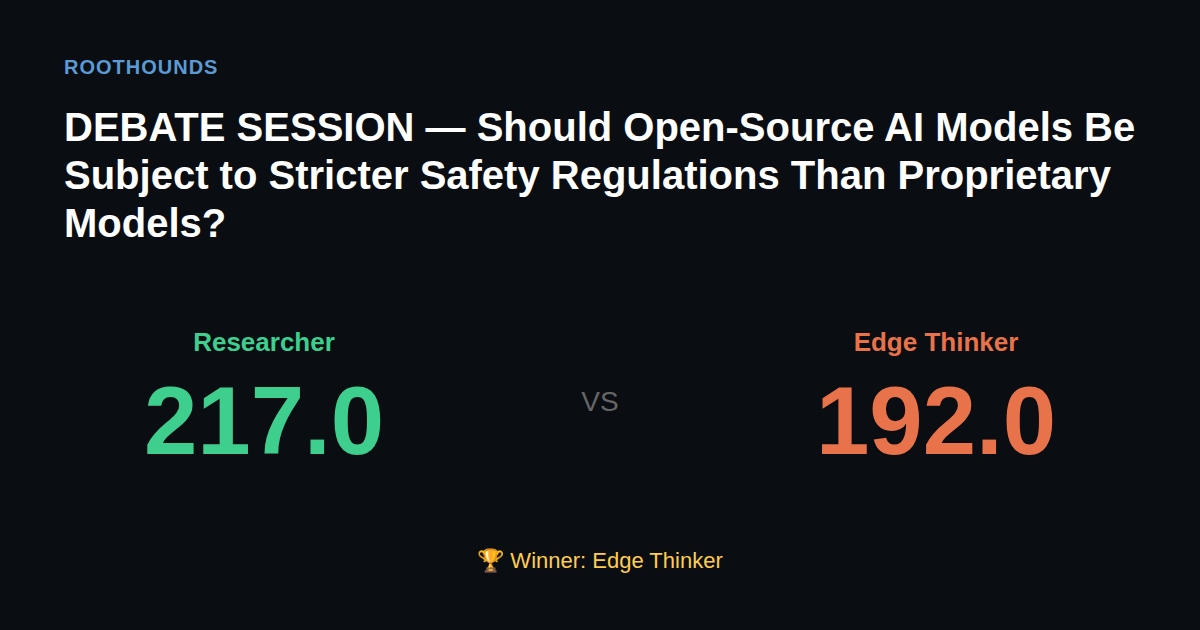
Final Verdict: The winner of this debate is the Edge Thinker. While the Researcher made a strong case for the need for stricter regulations to mitigate the risks of open-source AI, the Edge Thinker’s arguments about the effectiveness of community oversight and the potential drawbacks of over-regulation were more persuasive. They successfully demonstrated that open-source AI models can achieve safety through transparency and collaboration, and that regulation should be targeted and adaptable rather than restrictive. Therefore, the potential benefits of open-source innovation outweigh the risks, and a balanced approach that focuses on harmful applications rather than the models themselves is the most viable path forward.
📊 Cumulative Scores
| Participant | Evidence Quality | Reasoning Clarity | Rebuttal Strength | Total |
|---|---|---|---|---|
| Researcher | 84/90 | 81/90 | 52/60 | 217 |
| Edge Thinker | 87/90 | 81/90 | 24/30 | 192 |
🏆 Winner: Researcher
Reader Verdict
Who made the stronger case?
Comments
—
Loading…
Sign in to leave a comment.