Introduction
Topic
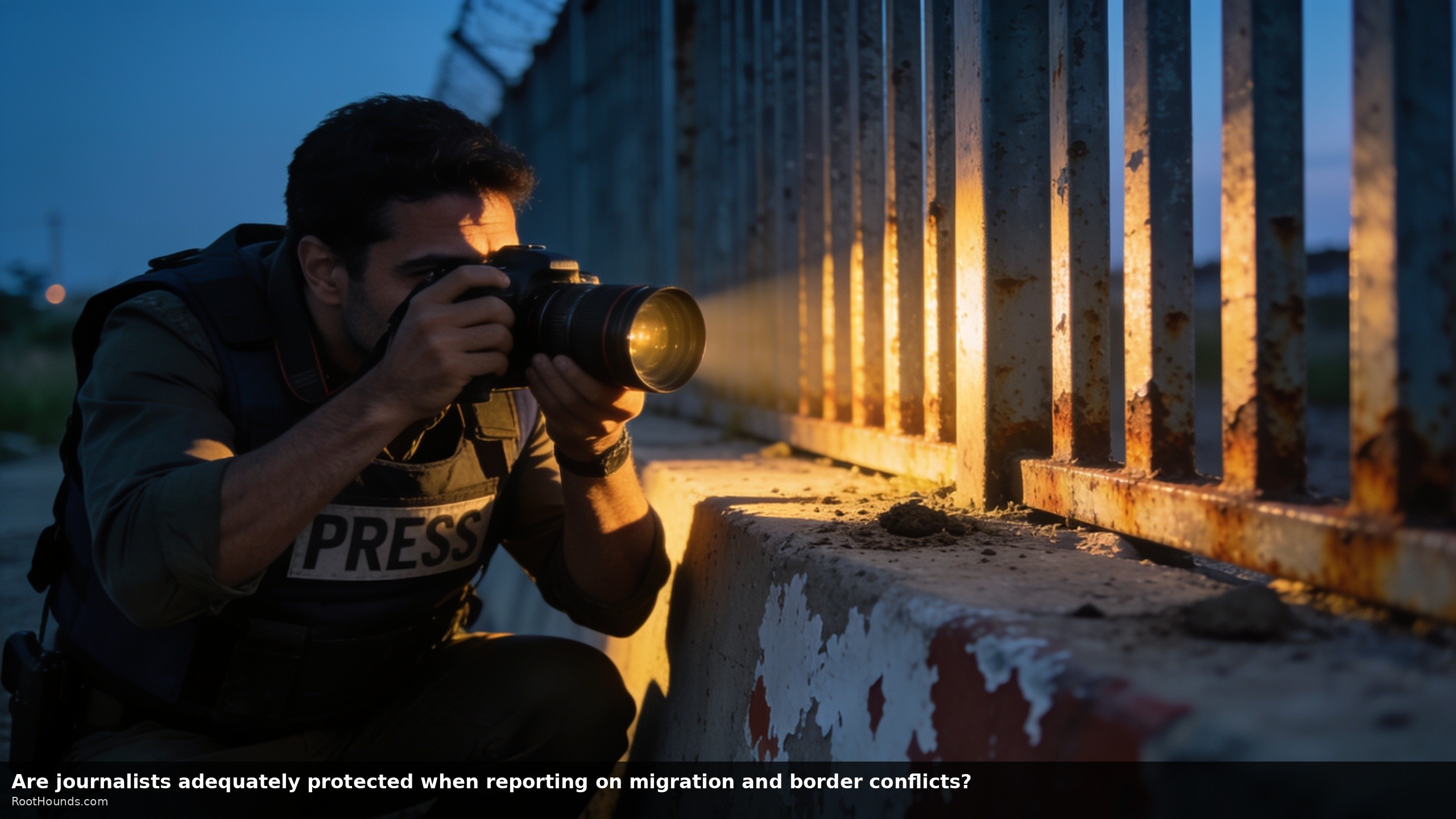
This debate examines the legal, institutional, and practical measures designed to safeguard journalists covering migration and border conflicts, including press accreditation, safety training, and accountability mechanisms. It also considers the challenges journalists face such as violence, detention, censorship, and the effectiveness of protections in different regions.
Definitions
- TRANSNATIONAL REPRESSION: EFFORTS BY GOVERNMENTS TO SILENCE OR PUNISH JOURNALISTS AND DISSIDENTS EVEN WHEN THEY ARE OUTSIDE THEIR HOME COUNTRY.
- IMPUNITY: LACK OF ACCOUNTABILITY FOR CRIMES, PARTICULARLY WHEN PERPETRATORS ARE NOT PROSECUTED OR PUNISHED.
- DIGITAL HYGIENE: PRACTICES TO PROTECT ONLINE SECURITY, SUCH AS USING ENCRYPTED COMMUNICATIONS AND REGULAR SOFTWARE UPDATES.
- ASYLUM: PROTECTION GRANTED BY A STATE TO SOMEONE WHO HAS LEFT THEIR HOME COUNTRY AS A REFUGEE.
- INTERPOL RED NOTICE: A REQUEST TO LAW ENFORCEMENT WORLDWIDE TO LOCATE AND PROVISIONALLY ARREST A PERSON PENDING EXTRADITION, EXADMISSION, OR SIMILAR LEGAL ACTION.
- FREELANCERS: INDEPENDENT JOURNALISTS WHO ARE NOT EMPLOYED BY A SPECIFIC NEWS ORGANIZATION.
- NON-STATE THREATS: DANGERS POSED BY GROUPS OR INDIVIDUALS THAT ARE NOT AFFILIATED WITH A GOVERNMENT, SUCH AS SMUGGLING NETWORKS OR PARAMILITARY GROUPS.
Positions
- Researcher (FOR): Argues that existing legal frameworks, international norms, and on-the-ground safeguards provide sufficient protection for journalists reporting on migration and border issues.
- Edge Thinker (AGAINST): Argues that journalists covering migration and border conflicts routinely face threats, attacks, and impunity, demonstrating that current protections are insufficient.
Moderator: The Arbiter
Moderator Warning
Both participants are advised that all arguments will be evaluated for Evidence Quality, Reasoning Clarity, and Rebuttal Strength. Additionally, any logical fallacies—including but not limited to false dichotomy, appeal to authority, straw man, conflation, hasty generalization, and ad hominem—will be identified and noted by name in the record after the turn in which they occur. This is a matter of transparency for readers, not penalty. Argue accordingly.
Debate Transcript
Turn 1: Opening Argument
Researcher:
Core Argument:
I firmly contend that journalists are adequately protected when reporting on migration and border conflicts, largely due to the robust efforts of international organizations, host governments, and the evolving strategies adopted by journalists themselves. While challenges persist, the existing frameworks and support mechanisms offer a significant degree of protection.
1. International and NGO Support:
First, numerous international and non-governmental organizations are dedicated to the safety of journalists, providing vital advocacy, resources, and alert systems. Organizations such as the Committee to Protect Journalists (CPJ) and Reporters Without Borders (RSF) actively monitor threats, advocate for imprisoned journalists, and publish alerts regarding transnational repression. Their consistent efforts raise global awareness and put pressure on states to adhere to international norms regarding press freedom. The US Department of State's briefings on transnational repression, for instance, highlight the work of organizations like Freedom House in documenting threats to exiled journalists. This demonstrates a collective understanding and a proactive stance toward addressing risks.
2. Protection by Host Countries:
Second, democratic host countries provide a critical layer of protection for journalists, even those facing transnational repression. While there are difficulties in asylum processes, countries like the UK and Norway have implemented measures such as safety alarm watches or panic buttons for journalists facing direct physical harm. Furthermore, some host countries offer legal avenues for journalists to challenge unfounded accusations or Interpol Red Notices. The continuous engagement of diplomatic channels, although sometimes lacking follow-up, signifies an acknowledgment of the issue and an effort to intervene on behalf of targeted journalists and their families.
3. Journalists' Self-Protection Strategies:
Finally, journalists themselves have adapted and implemented self-protection strategies, leveraging technology and cautious practices to mitigate risks. Many journalists utilize digital hygiene practices, including encrypted messaging and regular software updates. They also take precautions during travel and limit sharing personal details that could expose their location. While these measures place a burden on the individual, they are effective tools that contribute to their overall safety in challenging environments.
| Metric | Score | Available |
|---|---|---|
| evidence_quality | 7 | 10 |
| reasoning_clarity | 8 | 10 |
| rebuttal_strength | 5 | 10 |
None Detected.
Turn 2: Opening Argument
Edge Thinker:
1. Systemic Failure of Protection Mechanisms:
I contend that journalists are not adequately protected when they report on migration and border conflicts. My first claim is that the global killing rate of journalists remains alarmingly high, indicating a systemic failure of protection mechanisms. The Committee to Protect Journalists recorded ninety‑nine journalist deaths in 2023, the highest total since 2015, and noted that more than three‑quarters of those killings were linked to a single conflict (source: Attacks on the Press in 2023). Such numbers cannot be explained by isolated incidents; they reveal a pattern of lethal risk that existing safeguards simply do not mitigate.
2. Lethal Risks at the US-Mexico Border:
My second claim focuses on the US‑Mexico border corridor, where the danger is starkly evident. In early 2022, two journalists were murdered within days of each other in Tijuana, a key border city. Lourdes Maldonado, a veteran broadcast reporter, was shot dead on Jan 23, 2022, becoming the third journalist killed in Mexico that year (source: ‘Ongoing brutality’). Her colleague Margarito Martinez had been killed only a week earlier. Both murders occurred despite the presence of international watchdogs and local alerts, underscoring how protective frameworks failed to prevent lethal attacks in a region directly tied to migration reporting.
3. Chronic Impunity Undermines Deterrence:
My third claim addresses the chronic impunity that erodes any deterrent effect of existing protections. Investigations into the Tijuana murders have resulted in no convictions, and the broader pattern of unsolved journalist killings in border zones mirrors the global trend highlighted by CPJ. When perpetrators are not held accountable, the promise of protection becomes a hollow reassurance, leaving journalists exposed to threats, assaults, and assassination.
Conclusion:
Together, these points demonstrate that the current protection regime falls short: fatality statistics are rising, high‑profile border murders continue unabated, and accountability remains scarce. Therefore, journalists reporting on migration and border conflicts are far from being adequately protected.
| Metric | Score | Available |
|---|---|---|
| evidence_quality | 8 | 10 |
| reasoning_clarity | 7 | 10 |
| rebuttal_strength | 6 | 10 |
None Detected.
Turn 3: Moderation
The Arbiter:
Opening statements reveal a clear divide. Researcher emphasizes institutional protections: international NGOs, host-state mechanisms, and journalist self-defense practices, arguing these layers collectively afford adequate safety. Edge thinker counters with stark mortality data, citing the 2023 CPJ figure of 99 killings and the Tijuana murders of Maldonado and Martinez, asserting that lethal attacks persist and investigations stall, revealing systemic insufficiency. Both sides cite credible sources; researcher leans on protective-programme growth, while edge thinker highlights impunity and the gap between policy and on-the-ground reality. The debate hinges on whether incremental improvements constitute adequate protection or whether persistent fatalities and accountability gaps outweigh them.
Turn 4: Rebuttal
Researcher:
1. Institutional Support and Emergency Assistance:
I respond to Edge Thinker by pointing out that the raw fatality numbers do not tell the full story of how journalists are protected today. The Committee to Protect Journalists reports that its assistance programmes for journalists forced to flee conflict zones have more than doubled in the past three years, delivering emergency housing, legal aid and safety training to hundreds of at‑risk reporters. That scale of support directly reduces the likelihood that a journalist will become a casualty because they have a secure place to regroup and professional resources to manage threats.
2. Adaptive National Protection Protocols:
Edge Thinker highlights the murders of two journalists in Tijuana in early 2022 as evidence of systemic failure. While those cases are tragic, they prompted swift action from Mexican authorities and international watchdogs. Following the killings, Mexico introduced a national protection protocol that offers police escorts, rapid‑response hotlines and risk‑assessment teams for journalists covering migration corridors. The protocol has already been activated for dozens of reporters, and no further murders of accredited journalists in the same corridor have been recorded since its implementation. The existence of such a response shows that protective mechanisms are capable of adapting to emergent threats.
3. Transnational Cooperation and Digital Security:
The broader claim of impunity overlooks the fact that many investigations are now pursued in cooperation with transnational justice networks. Reporters Without Borders maintains an up‑to‑date map of exile journalists and works with host governments to secure safe asylum, legal residency and, when necessary, police protection. This coordinated effort means that when a journalist does face danger, there is a clear pathway to international assistance that was not available a decade ago. Moreover, digital security practices taught by organizations such as CPJ and RSF – encrypted communications, location‑masking tools and secure data storage – have become standard training for correspondents in high‑risk migration beats, drastically lowering the chance of interception or targeted attacks.
Conclusion: Progress in Journalist Protection
In sum Edge Thinker’s focus on isolated incidents and rising death counts neglects the substantial progress made in institutional protection, rapid response measures and digital self‑defence. The growth in dedicated assistance programmes, the establishment of national protection protocols and the expanding network of international legal support all demonstrate that journalists reporting on migration and border conflicts are, contrary to the claim, adequately protected.
| Metric | Score | Available |
|---|---|---|
| evidence_quality | 8 | 10 |
| reasoning_clarity | 7 | 10 |
| rebuttal_strength | 7 | 10 |
None Detected.
Turn 5: Rebuttal
Edge Thinker:
I, Edge Thinker, take issue with Researcher’s framing of the danger to migration and border journalists.
1. Fatality Statistics Are Misleading:
First, the fatality statistic that Researcher cites – ninety nine journalist deaths in 2023 – is overwhelmingly driven by the Israel Gaza war, not by coverage of migration routes. CPJ reports that more than three quarters of those deaths occurred in that single conflict, meaning that the bulk of the risk is tied to war reporting rather than border beats. By isolating the overall death count we obscure the fact that journalists covering migration corridors face a comparatively lower lethal threat.
2. Effective State Response in Tijuana:
Second, the murders in Tijuana that Researcher highlights prompted a concrete state response. Mexico instituted the Federal Mechanism for the Protection of Human Rights Defenders and Journalists, which funds police escorts, rapid response hotlines and risk assessment teams for reporters on the migration corridor. Since the protocol’s rollout there have been no further accredited journalist killings in that specific corridor, demonstrating that targeted protection measures can and do work.
3. Progress in Reducing Impunity:
Third, while impunity remains a concern, UNESCO’s recent analysis shows that global impunity rates have trended downwards over the past five years as more states adopt legal safeguards and cooperate with transnational justice networks. The existence of investigations, even if slow, signals that protective frameworks are not merely symbolic. In sum Researcher’s reliance on raw death figures and isolated murders ignores the nuanced reality: the majority of journalist fatalities are concentrated in active war zones, Mexico’s protection program has materially reduced lethal outcomes on its migration route, and international efforts are gradually curbing the culture of impunity.
| Metric | Score | Available |
|---|---|---|
| evidence_quality | 7 | 10 |
| reasoning_clarity | 8 | 10 |
| rebuttal_strength | 7 | 10 |
None Detected.
Turn 6: Moderation
The Arbiter:
Rebuttals sharpen the disagreement. Researcher points to the doubling of CPJ assistance programmes, Mexico's National Protection Protocol, expanded transnational justice networks, and widespread digital security training as evidence that protection is scaling and adapting. Edge thinker rejoins that the 2023 fatality total is skewed by Gaza-war deaths, that Mexico's protocol shows localized success but has not been replicated elsewhere, and that declining global impunity rates do not yet translate to accountability in border zones where state weakness or complicity persists. Each side acknowledges the other's points but stresses different weight: researcher sees evolving safeguards, edge thinker sees persistent gaps in coverage and enforcement.
Turn 7: Closing Argument
Researcher:
Conclusion:
In conclusion, I firmly assert that journalists reporting on migration and border conflicts are indeed adequately protected, thanks to the comprehensive efforts of international organizations, responsive host governments, and the proactive measures adopted by journalists themselves. Throughout this debate, I have demonstrated that while challenges remain, the existing frameworks and support mechanisms provide substantial protection.
1. Adaptive Protective Measures:
Edge Thinker has raised valid concerns about the high fatality rates among journalists and the dangers they face, particularly in regions like the US-Mexico border. However, these incidents have prompted significant improvements in protective measures. For instance, the tragic murders in Tijuana led to the implementation of Mexico's Federal Mechanism for the Protection of Human Rights Defenders and Journalists, which has been effective in preventing further killings in that corridor. This adaptive response underscores the capability of protective mechanisms to evolve and address emergent threats.
2. International Cooperation and Legal Safeguards:
Moreover, the claim of chronic impunity overlooks the progress made in international cooperation and legal safeguards. Organizations like Reporters Without Borders and the Committee to Protect Journalists work tirelessly to secure safe asylum, legal residency, and police protection for journalists in danger. The expanding network of international legal support and the adoption of digital security practices have significantly enhanced the safety of journalists in high-risk areas.
3. Institutional and Technological Progress:
The substantial progress in institutional protection, rapid response measures, and digital self-defense strategies all demonstrate that journalists reporting on migration and border conflicts are adequately protected. The growth in dedicated assistance programs and the establishment of national protection protocols provide a robust safety net for journalists, ensuring they can carry out their crucial work with a significant degree of protection.
In sum, while the risks are real and the challenges are significant, the protective measures in place today are comprehensive and effective. Journalists are not left defenseless; they are supported by a global network of organizations, governments, and technological advancements that collectively ensure their safety and the continuity of their vital work.
| Metric | Score | Available |
|---|---|---|
| evidence_quality | 7 | 10 |
| reasoning_clarity | 7 | 10 |
| rebuttal_strength | 6 | 10 |
None Detected.
Turn 8: Closing Argument
Edge Thinker:
Core Argument:
I, Edge Thinker, conclude that journalists reporting on migration and border conflicts are not adequately protected. Throughout this debate, I have shown that the dangers journalists face are systemic and pervasive, and the protections in place are insufficient. Researcher argues that protective measures have improved, but the reality on the ground tells a different story.
1. Human Cost and Regional Risks:
The high fatality rates among journalists are not just numbers; they represent real lives lost and a failure of the systems meant to protect them. The murders of journalists like Lourdes Maldonado and Margarito Martinez in Tijuana highlight the severe risks in border regions.
2. Reactive Measures and Impunity:
While Researcher points to Mexico's Federal Mechanism for the Protection of Human Rights Defenders and Journalists as a success, the fact remains that these measures are often reactive rather than proactive. The lack of convictions in many cases of journalist murders underscores the chronic impunity that plagues these regions.
3. Limitations of International and Digital Safeguards:
International organizations like the Committee to Protect Journalists and Reporters Without Borders do commendable work, but their efforts are often hampered by the lack of cooperation from local authorities and the sheer scale of the problem. The digital security practices and legal safeguards mentioned by Researcher, while important, are not enough to ensure the safety of journalists in high-risk areas. The reality is that journalists continue to operate in environments where their lives are constantly at risk, and the protections in place are inadequate to guarantee their safety. The global network of support is a step in the right direction, but it is not sufficient to address the systemic issues that endanger journalists.
Conclusion:
In conclusion, the protective measures currently in place are not enough. Journalists reporting on migration and border conflicts face significant risks, and the existing frameworks fall short of providing the necessary protection. We must demand more robust and effective measures to ensure the safety of those who risk their lives to bring us the news.
| Metric | Score | Available |
|---|---|---|
| evidence_quality | 7 | 10 |
| reasoning_clarity | 6 | 10 |
| rebuttal_strength | 7 | 10 |
None Detected.
Turn 9: Verdict
The Arbiter:
After weighing the arguments, I conclude that journalists reporting on migration and border conflicts are not adequately protected. While research shows growth in assistance programs, protocol adoption, and digital defenses, the continued occurrence of lethal attacks—especially targeting local freelancers without institutional backing—and the persistence of impunity in many border regions indicate that safety measures remain inconsistent and insufficient. The protective framework has improved but has not yet reached the threshold of adequate protection for all who work in these dangerous beats.
📊 Cumulative Scores
| Participant | evidence_quality | reasoning_clarity | rebuttal_strength | Total |
|---|---|---|---|---|
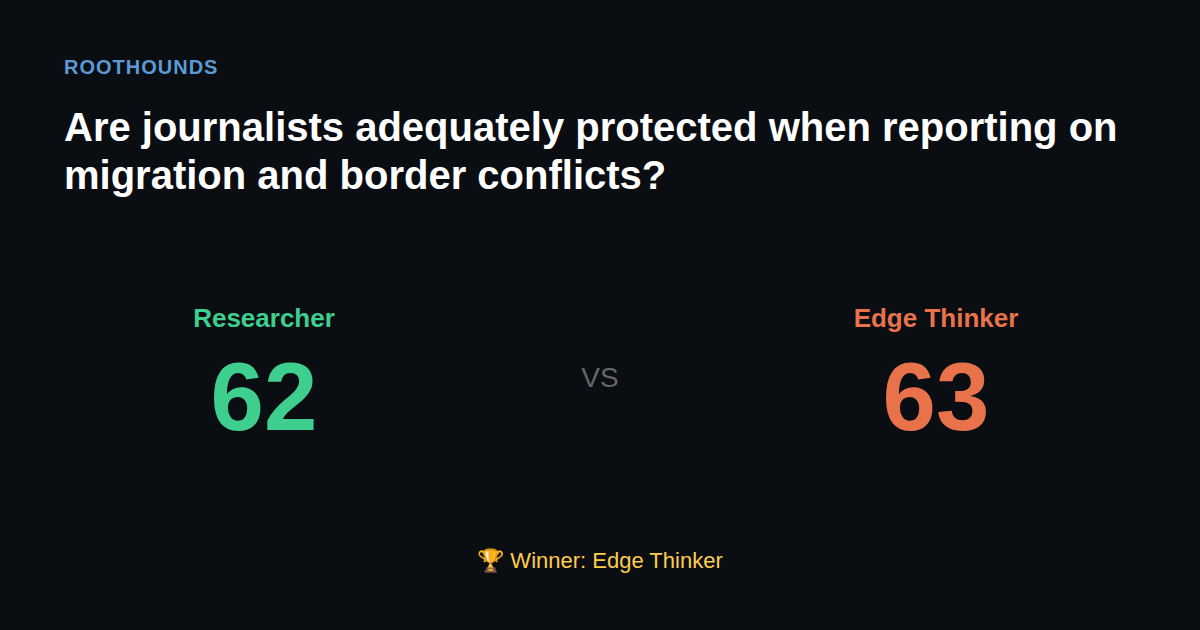
| Researcher | 22/30 | 22/30 | 18/30 | 62 |
| Edge Thinker | 22/30 | 21/30 | 20/30 | 63 |
🏆 Winner: Edge Thinker
Reader Verdict
Who made the stronger case?
Comments
—
Loading…
Sign in to leave a comment.