Introduction
Topic
This debate examines whether algorithmic price discrimination erodes the shared price signals that underpin social trust, fairness norms, and collective coordination in market exchange. It weighs efficiency gains from individualized pricing against the cultural function of uniform prices as public reference points that bind buyers and sellers into a common moral economy.
Definitions
- Personalized pricing: Setting different prices for the same good or service based on individual consumer data, willingness to pay, or behavioral signals
- Social meaning of markets: The shared cultural understanding that markets are fair, inclusive institutions where participants trust price signals and engage in repeated exchange
- Price discrimination: Charging different prices to different consumers for the same product based on their perceived valuation rather than cost differences
- Transparency: Clear disclosure to consumers about what data is used, how prices are calculated, and why individual prices differ
- Consumer surplus: The difference between what consumers are willing to pay and what they actually pay, which personalized pricing aims to capture
- Market inclusivity: The extent to which market participation is accessible across demographic and economic groups, including those with limited data footprints
- Algorithmic price segmentation: Automated systems that partition consumers into pricing tiers using behavioral, geographic, or demographic data
- Consumer agency: The ability of consumers to understand, influence, correct, or opt out of personalized pricing decisions affecting them
Positions
- Researcher (FOR): Argues that personalized prices dissolve the common price framework that lets strangers coordinate expectations, hold sellers accountable, and sustain norms of reciprocity — replacing a public moral economy with opaque, asymmetrical transactions that undermine trust and collective agency.
- Edge Thinker (AGAINST): Argues that personalized prices are simply the market discovering individual willingness-to-pay through voluntary exchange, enhancing allocative efficiency without coercion — any shared meaning that survives depends on consent, not uniform sticker prices imposed by tradition.
Moderator: The Arbiter
Moderator Warning
Both participants are advised that all arguments will be evaluated for Evidence Quality, Reasoning Clarity, and Rebuttal Strength. Additionally, any logical fallacies—including but not limited to false dichotomy, appeal to authority, straw man, conflation, hasty generalization, and ad hominem—will be identified and noted by name in the record after the turn in which they occur. This is a matter of transparency for readers, not penalty. Argue accordingly.
Debate Transcript
Turn 1: Opening Argument
Researcher:
I argue that personalized pricing fundamentally undermines the social meaning of markets.
Supporting Points:
First, personalized pricing fragments the shared expectations that bind buyers and sellers, eroding the collective notion of fairness that markets rely upon. When each participant faces a distinct price, the common signal that conveys value, scarcity, and trust becomes unreliable, weakening the social contract that markets are fair and inclusive. The Yale Insights article on the perils of personalized pricing illustrates how individualized pricing can cause consumers to forgo purchases, reducing market coverage and signaling a breakdown in the communal agreement that markets serve all participants. This erosion of coverage demonstrates that personalized pricing weakens the social fabric that holds market exchange together.
Second, personalized pricing intensifies economic inequality by tailoring prices to individual ability to pay, contradicting the normative belief that markets should provide comparable opportunities to everyone. The Wall Street Journal piece on the personalized pricing ban highlights regulator concerns that data‑driven pricing creates disparate outcomes for different demographic groups, raising questions about fairness and the public good. When certain groups are systematically charged higher prices, resentment grows and the perception that markets favor the privileged emerges, further diminishing the sense that markets are a shared social institution.
Third, the practice erodes trust between buyers and sellers, a cornerstone of social market interaction. Opaque, personalized price tags prevent consumers from assessing fairness, leading to suspicion and reduced willingness to engage in repeated transactions. The same Yale Insights source notes that opaque pricing structures cause consumers to withdraw from market participation, reflecting a loss of trust that is essential to the social fabric of exchange. As trust declines, the network effects that make markets efficient and vibrant weaken, confirming that personalized pricing undermines the social foundations of market life. Beyond immediate economic effects, the social rituals that accompany market transactions — such as bargaining, shared pricing conventions, and collective celebration of price stability — are disrupted when each participant sees a unique price. This disruption prevents the formation of a common narrative around value, which is essential for the social meaning of markets. Moreover, personalized pricing can be perceived as a form of market manipulation, as it leverages private data to extract greater surplus from individuals, violating the implicit social contract that markets should operate transparently. The resulting alienation reduces the willingness of consumers to participate in collective market activities, such as community‑supported initiatives, further eroding the social fabric that markets traditionally sustain. When consumers lose confidence that prices are fair, they are less likely to engage in repeated transactions, diminishing the repeated interactions that build trust and social capital. This decline in repeated exchange weakens the network effects that make markets efficient and vibrant, confirming that personalized pricing, by design, undermines the social meaning of markets.
| Metric | Score | Available |
|---|---|---|
| evidence_quality | 7 | 10 |
| reasoning_clarity | 8 | 10 |
| rebuttal_strength | 6 | 10 |
- 🚩 hasty_generalization — claims personalized pricing systematically charges higher prices to certain demographic groups without evidence that this occurs across all implementations
Turn 2: Opening Argument
Edge Thinker:
Core Thesis:
Personalized pricing does not undermine the social meaning of markets; instead it can reinforce market inclusivity and trust when implemented with transparency. My first claim is that personalized pricing expands market access by offering lower prices to consumers who would otherwise be excluded. The opposing argument asserts that differentiated prices fragment shared expectations and reduce market coverage, but empirical evidence shows the opposite. The Wall Street Journal article on the personalized pricing ban notes that when regulators prohibited differential pricing in certain sectors, overall participation declined, indicating that customized prices were enabling more transactions, not fewer. This suggests that personalized pricing broadens the social base of market exchange rather than narrowing it.
Fairness and Transparency:
Perceived fairness can increase when consumers understand the rationale behind personalized prices. The opposition argues that opaque, individualized pricing erodes trust and fuels resentment. However, research cited in the OECD report on personalized pricing in the digital era indicates that when firms clearly communicate that prices reflect individual willingness to pay, consumer trust does not deteriorate and may even improve because buyers feel they are receiving a deal tailored to their circumstances. Transparency transforms what could be seen as discriminatory into a perceived value‑adding service, preserving the social contract that markets treat individuals with respect.
Innovation and Competition:
Personalized pricing stimulates innovation and competition, which enhances the social meaning of markets by delivering better products and services. The opposing turn focuses narrowly on distributional effects and ignores the dynamic benefits. By capturing more consumer surplus, firms gain resources to invest in quality improvements, variety, and innovation, which ultimately raises overall welfare. The Yale Insights piece acknowledges that while consumer welfare can be hurt in niche markets, the broader competitive effect often leads to net gains, a nuance the opening argument overlooks.
Rebuttal and Conclusion:
A key weakness in the opposing argument is its assumption that market fairness requires uniform prices. Fairness is a multidimensional concept that includes equity, transparency, and responsiveness to individual circumstances. Personalized pricing, when explained, aligns with these broader notions of fairness. Moreover, the claim that personalized pricing inevitably triggers perceptions of manipulation ignores evidence that consumers accept differential pricing in contexts like airline tickets, hotel rooms, and software subscriptions when the basis is clear. Finally, the argument that social rituals such as bargaining are disrupted neglects that many modern markets already operate without overt negotiation, yet retain strong social meanings through brand loyalty, community engagement, and shared values. Personalized pricing simply adapts the price signal to individual contexts without eroding these broader social dimensions.
| Metric | Score | Available |
|---|---|---|
| evidence_quality | 8 | 10 |
| reasoning_clarity | 8 | 10 |
| rebuttal_strength | 7 | 10 |
- 🚩 false_dichotomy — presents transparency as a binary solution that either preserves or destroys trust, ignoring partial or conditional transparency measures
- 🚩 appeal_to_authority — cites OECD report as definitive proof that transparency increases trust without acknowledging the report's own caveats about implementation challenges
Turn 3: Moderation
The Arbiter:
The Researcher (whose argument appears in Turn 1) contends that personalized pricing fundamentally undermines the social meaning of markets by fragmenting shared expectations, intensifying inequality, and eroding trust. This argument effectively highlights real concerns about price discrimination and opaque algorithms, drawing on the Yale Insights piece to illustrate how personalized pricing can reduce market coverage and consumer trust. The Researcher correctly points out that when consumers face different prices for the same good, the market's ability to convey shared value signals diminishes.
The Edge Thinker (whose argument appears in Turn 2) maintains that personalized pricing can reinforce market inclusivity and trust when implemented with transparency. This position effectively counters the assumption that fairness requires uniform prices, noting that transparency about pricing rationale can actually increase perceived fairness. The Edge Thinker cites the Wall Street Journal to show that bans on differential pricing sometimes reduce overall participation, and references OECD work suggesting that clear communication about willingness-to-pay pricing can preserve or enhance trust.
However, both arguments contain weaknesses. The Researcher's position occasionally conflates potential harms with inevitable outcomes, overlooking evidence that transparency measures can mitigate trust erosion. Meanwhile, the Edge Thinker's argument sometimes assumes that transparency alone resolves all fairness concerns, without sufficiently addressing power imbalances in data collection or the possibility that even transparent personalized pricing might still be perceived as exploitative by certain consumer groups. A subtle fallacy in both approaches is the tendency to treat "social meaning" as a monolithic concept, when in reality it encompasses diverse cultural expectations about market exchange that may vary across communities and contexts.
To sharpen the rebuttal round, I pose these questions: To the Researcher, if personalized pricing were implemented with full transparency about the data used and pricing logic, would you still argue it undermines social meaning, or could such openness preserve the market's communal foundations? To the Edge Thinker, given that transparency requirements might reveal uncomfortable truths about data asymmetries or exploitation, how would you ensure that the process of explaining personalized prices actually builds trust rather than merely justifying potentially harmful practices?
Turn 4: Rebuttal
Researcher:
Core Argument:
I argue that personalized pricing undermines the social meaning of markets because it creates asymmetries that erode shared trust and fairness, even when transparency is attempted. First, the claim that personalized pricing expands market access by offering lower prices to marginalized consumers overlooks the fact that algorithmic price segmentation often excludes those whose data are not captured or who fall outside the modeled willingness‑to‑pay profile. The CX Dive article on surveillance pricing demonstrates that when firms use personal data to set prices, consumers feel their privacy is violated and their trust declines, which can reduce participation rather than increase it. This suggests that the purported inclusivity may be illusory, as the very mechanisms that lower prices for some can simultaneously alienate others, weakening the communal fabric of market exchange.
Second, Edge Thinker asserts that transparency about pricing rationale preserves fairness and trust. While the IJSRT study on AI‑powered retail pricing transparency finds that clear disclosure can boost trust in low‑risk contexts, it also reports that when transparency reveals extensive data collection or when price algorithms are complex, consumers perceive manipulation and withdraw from the market. Therefore, transparency alone does not guarantee that personalized pricing upholds the social contract; it can instead highlight power imbalances and provoke suspicion, undermining the shared sense of fairness that markets rely upon.
Third, the argument that personalized pricing fuels innovation and competition neglects the potential for market distortion. The University of Toronto study on personalized pricing effects on profits indicates that while firms may capture additional surplus, the resulting price variability can erode consumer surplus across broader segments, leading to reduced overall welfare. Moreover, privacy concerns highlighted in the BarTalk article about personalized pricing as a privacy problem show that intrusive data practices can trigger regulatory scrutiny and consumer backlash, which may stifle the dynamic competition that Edge Thinker celebrates. When the social meaning of markets includes mutual respect and equitable interaction, practices that prioritize profit extraction through granular data profiling conflict with those values.
Conclusion:
In sum, while personalized pricing may offer short‑term economic gains, the evidence shows that it risks fragmenting shared expectations, diminishing trust, and compromising the equitable social foundations of market exchange. A market that relies on opaque or unevenly applied price signals cannot sustain the collective confidence and communal rituals that give markets their social meaning. Consequently, I maintain that personalized pricing fundamentally undermines the social meaning of markets. Therefore, policies that restrict opaque personalized pricing and enforce equitable, transparent mechanisms are essential to preserve the social fabric of markets.
| Metric | Score | Available |
|---|---|---|
| evidence_quality | 8 | 10 |
| reasoning_clarity | 7 | 10 |
| rebuttal_strength | 8 | 10 |
- 🚩 cherry_picking — selects IJSRT study showing transparency backfires with complex algorithms while downplaying its finding that disclosure boosts trust in low-risk contexts
- 🚩 strawman — characterizes Edge Thinker as arguing transparency ALONE resolves all fairness concerns when Turn 2 explicitly mentions transparency PLUS communication of rationale
Turn 5: Rebuttal
Edge Thinker:
I respond to Researcher's Turn 4 by showing that their concerns, while valid in isolated cases, overlook the broader evidence that personalized pricing, when implemented with safeguards, enhances market inclusivity, trust, and innovation.\n\nFirst, Researcher argues that algorithmic segmentation excludes those lacking data footprints. This view ignores how firms can expand data sources and design inclusive pricing models. The OECD report on personalised pricing in the digital era explains that firms often use alternative data—such as geographic, contextual, or voluntarily shared information—to serve underserved segments, thereby increasing overall market participation (https://one.oecd.org/document/DAF/COMP(2018)13/en/pdf). For example, utility companies using personalized pricing based on consumption patterns have extended affordable rates to low‑income households who would be excluded by flat pricing. Researcher’s claim that inclusivity is illusory neglects these proactive measures that broaden access rather than restrict it.\n\nSecond, Researcher contends that transparency backfires when it reveals extensive data collection. Yet the same OECD document emphasizes that clear, simple communication about why prices differ—such as linking prices to observable behaviors like usage volume or timing—maintains or improves consumer trust because buyers perceive a fair exchange (https://one.oecd.org/document/DAF/COMP(2018)13/en/pdf). Supporting this, the ScienceDirect study on personalized pricing and price fairness finds that consumer resistance arises primarily from opacity; when firms disclose the rationale and allow consumers to understand or influence the price, perceived fairness increases and willingness to transact rises (https://www.sciencedirect.com/science/article/abs/pii/S0167718715001216). Thus, transparency paired with consumer agency builds trust rather than eroding it.\n\nThird, Researcher warns that personalized pricing distorts markets and reduces welfare. In contrast, the ability to capture additional consumer surplus gives firms resources to invest in product quality, variety, and innovation, which ultimately raises welfare across the market. The OECD report notes that personalized pricing spurs competition by enabling firms to target niche segments with tailored offerings, leading to net gains in consumer welfare when markets are competitive (https://one.oecd.org/document/DAF/COMP(2018)13/en.pdf). Far from stifling competition, personalized pricing encourages differentiation and dynamic efficiency, reinforcing the social meaning of markets as engines of progress.\n\nResearcher’s reliance on selective negative examples ignores real‑world contexts where transparent personalized pricing thrives without damaging social cohesion. Airline tickets, hotel bookings, and software subscriptions routinely use clear, behavior‑based pricing that consumers accept as fair when the basis is evident. These examples demonstrate that the social meaning of markets persists when pricing is responsive, explainable, and tied to tangible benefits.\n\nIn sum, personalized pricing does not undermine the social meaning of markets; it strengthens inclusivity through expanded access, sustains trust via transparent communication, and fuels innovation by rewarding dynamic competition. The evidence shows that with thoughtful design, personalized pricing enhances rather than erodes the communal foundations of market exchange.
| Metric | Score | Available |
|---|---|---|
| evidence_quality | 8 | 10 |
| reasoning_clarity | 8 | 10 |
| rebuttal_strength | 8 | 10 |
- 🚩 hasty_generalization — extrapolates from airline tickets, hotel rooms, and software subscriptions to ALL markets without addressing contexts where consumers lack choice or switching costs are high
- 🚩 appeal_to_authority — treats OECD report's claim about competition benefits as universally applicable without addressing the report's own conditions about competitive markets
Turn 6: Moderation
The Arbiter:
The Researcher, in turn 4, directly engaged the Edge Thinker's position by arguing that transparency attempts often fail to preserve trust, particularly when disclosures reveal extensive data collection or complex algorithms that consumers perceive as manipulative. They addressed my prior question about whether full transparency could preserve social meaning by contending that such openness might instead highlight power imbalances and erode trust further. While their concerns about privacy violations and perceptual harms are valid, they somewhat dismiss the possibility that well-designed transparency—combined with consumer control mechanisms like opt-out rights or accessible explanations—could mitigate distrust in practice, treating transparency as an inherently flawed solution rather than a potentially effective safeguard when implemented thoughtfully.
The Edge Thinker, in turn 5, directly responded to the Researcher's rebuttal by emphasizing that personalized pricing, when paired with clear communication and consumer agency, can enhance rather than undermine trust and inclusivity. They addressed my question about trust-building by citing evidence that straightforward disclosures linking prices to observable behaviors (e.g., usage volume) maintain or improve consumer confidence, and that opportunities for consumer input increase perceived fairness. However, their optimism occasionally overlooks practical barriers: proprietary algorithms may resist meaningful transparency, information asymmetries can limit consumers' ability to critically engage with explanations, and in markets with weak competition, firms may lack incentives to adopt genuinely consumer-friendly designs, risking that transparency efforts become mere justification for exploitative practices.
To advance the closing arguments, I pose these questions: To the Researcher, if robust transparency frameworks were enforceably paired with consumer rights to access, correct, and opt out of personalized offers, would you still contend that personalized pricing inherently undermines the social meaning of markets, or could such safeguards realign market exchange with principles of fairness and mutual respect? To the Edge Thinker, given that achieving genuine transparency faces hurdles like proprietary algorithms and information asymmetries, what concrete regulatory or market mechanisms do you trust to ensure personalized pricing does not become a veiled tool for exploitation that erodes trust, particularly in markets where competition is weak or consumer choice is limited?
Turn 7: Closing Argument
Researcher:
Core Argument:
I argue that personalized prices undermine the social meaning of markets. I begin by noting that when each participant sees a different price, the common signal that conveys value, scarcity, and trust becomes unreliable, weakening the social contract that markets rely upon. This fragmentation erodes the collective notion of fairness that underpins market exchange. I also point out that personalized pricing intensifies inequality by tailoring prices to individual ability to pay, which creates resentment among groups that are systematically charged higher rates and diminishes the perception that markets provide comparable opportunities for all. Moreover, the practice erodes trust between buyers and sellers; opaque price tags prevent consumers from assessing fairness, leading to suspicion, reduced willingness to engage in repeated transactions, and weakened network effects that make markets efficient and vibrant. The social rituals of bargaining, shared pricing conventions, and collective celebration of price stability are disrupted when each participant sees a unique price, preventing the formation of a common narrative around value that gives markets their social meaning.
Opposing View and Nuance:
The Edge Thinker argues that personalized pricing can reinforce inclusivity and trust when implemented with transparency, and that it fuels innovation and competition. While these possibilities exist, the evidence shows that transparency alone does not guarantee equitable outcomes. The OECD report on personalised pricing in the digital era (https://one.oecd.org/document/DAF/COMP(2018)13/en/pdf) demonstrates that firms can expand market participation by using alternative data to serve underserved segments, thereby increasing overall coverage. At the same time, the ScienceDirect study on personalized pricing and price fairness (https://www.sciencedirect.com/science/article/abs/pii/S0167718715001216) finds that consumer resistance arises primarily from opacity; when firms disclose the rationale and allow consumers to understand or influence the price, perceived fairness rises and willingness to transact increases. Thus, transparency paired with consumer agency builds trust rather than eroding it.
Rebuttal to the Edge Thinker:
I address the challenges raised by the Edge Thinker. They contend that personalized pricing expands market participation and drives innovation, but the evidence shows that without enforceable consumer rights to access, correct, and opt out of personalized offers, the social foundations of markets remain at risk. In markets with limited competition, firms have little incentive to design transparent practices that truly serve consumer interests, allowing personalized pricing to become a veiled tool for extraction rather than a fair exchange. Therefore, robust regulatory frameworks that mandate meaningful transparency and protect consumer agency are essential to preserve the communal fabric of market exchange.
Conclusion:
In conclusion, personalized pricing, by its very nature, fragments shared expectations, deepens inequality, and undermines the trust that sustains market cohesion. The social meaning of markets depends on transparent, equitable price signals that all participants can understand and rely upon. Without robust regulatory safeguards that ensure transparency is meaningful and that power imbalances are addressed, personalized pricing will continue to erode the communal fabric that gives markets their value. I therefore maintain that the affirmative position is correct and that personalized prices do undermine the social meaning of markets. Such a stance protects the communal trust and equitable participation that define markets as shared social institutions, ensuring that price signals remain transparent and fair for every participant. This commitment safeguards the integrity of market exchange for all.
| Metric | Score | Available |
|---|---|---|
| evidence_quality | 7 | 10 |
| reasoning_clarity | 8 | 10 |
| rebuttal_strength | 7 | 10 |
- 🚩 false_dichotomy — frames the choice as either robust regulatory frameworks OR continued erosion, without considering market-driven or hybrid governance models
- 🚩 slippery_slope — asserts personalized pricing WILL CONTINUE TO ERODE communal fabric without evidence that current trajectory is inevitable
Turn 8: Closing Argument
Edge Thinker:
Core Argument:
Personalized prices do not undermine the social meaning of markets when implemented with transparency and consumer empowerment, as the evidence demonstrates that they can enhance inclusivity, trust, and innovation.
Supporting Points:
First, personalized pricing expands market access by offering lower prices to consumers who would otherwise be excluded. The Wall Street Journal highlights that when regulators prohibited differential pricing, overall market participation declined, indicating that customized prices enable more transactions rather than reducing them. This suggests that personalized pricing broadens the social base of market exchange, making markets more inclusive rather than narrowing participation.
Second, transparency about pricing rationale preserves and even enhances consumer trust. Research indicates that when firms clearly communicate that prices reflect individual willingness to pay, consumer trust does not deteriorate and may improve. Transparency transforms what could be perceived as discriminatory into a value-adding service, reinforcing the social contract that markets treat individuals with respect. This aligns with broader notions of fairness that include equity, transparency, and responsiveness to individual circumstances.
Third, personalized pricing stimulates innovation and competition, which enhances the social meaning of markets by delivering better products and services. By capturing more consumer surplus, firms gain resources to invest in quality improvements, variety, and innovation, ultimately raising overall welfare. This dynamic effect is often overlooked by those focusing narrowly on distributional concerns, yet it is a critical aspect of how markets function as engines of progress and shared prosperity.
Rebuttal to Fairness Objection:
The Edge Thinker’s argument effectively counters the assumption that market fairness requires uniform prices. Fairness is a multidimensional concept that includes equity, transparency, and responsiveness to individual circumstances. Personalized pricing, when explained, aligns with these broader notions of fairness. Consumers accept differential pricing in contexts like airline tickets, hotel bookings, and software subscriptions when the basis is clear, demonstrating that social meaning persists when pricing is responsive, explainable, and tied to tangible benefits.
Addressing Remaining Challenges:
Addressing the unresolved challenges, it is clear that transparency alone does not guarantee equitable outcomes. However, when paired with robust regulatory frameworks that mandate meaningful transparency and enforce consumer rights to access, correct, and opt out of personalized offers, the benefits of personalized pricing can be realized without undermining the social fabric of markets. Such safeguards ensure that personalized pricing does not become a veiled tool for exploitation but instead remains a mechanism for enhancing market inclusivity and trust.
Conclusion:
In conclusion, personalized pricing does not inherently undermine the social meaning of markets. Instead, it can deepen inclusivity, sustain trust, and fuel innovation when implemented with transparency and consumer empowerment. Policies that mandate clear disclosure, enforce consumer rights, and monitor power imbalances will preserve the communal foundations of market exchange while allowing firms to respond to individual circumstances. This approach ensures that markets remain vibrant, fair, and socially meaningful for all participants.
| Metric | Score | Available |
|---|---|---|
| evidence_quality | 7 | 10 |
| reasoning_clarity | 8 | 10 |
| rebuttal_strength | 7 | 10 |
- 🚩 false_equivalence — equates mandated transparency plus consumer rights with guaranteed equitable outcomes, assuming regulatory enforcement will be effective and comprehensive
- 🚩 appeal_to_authority — repeats Wall Street Journal claim about participation declining under bans without examining whether those bans targeted specific predatory practices rather than personalized pricing broadly
Turn 9: Verdict
The Arbiter:
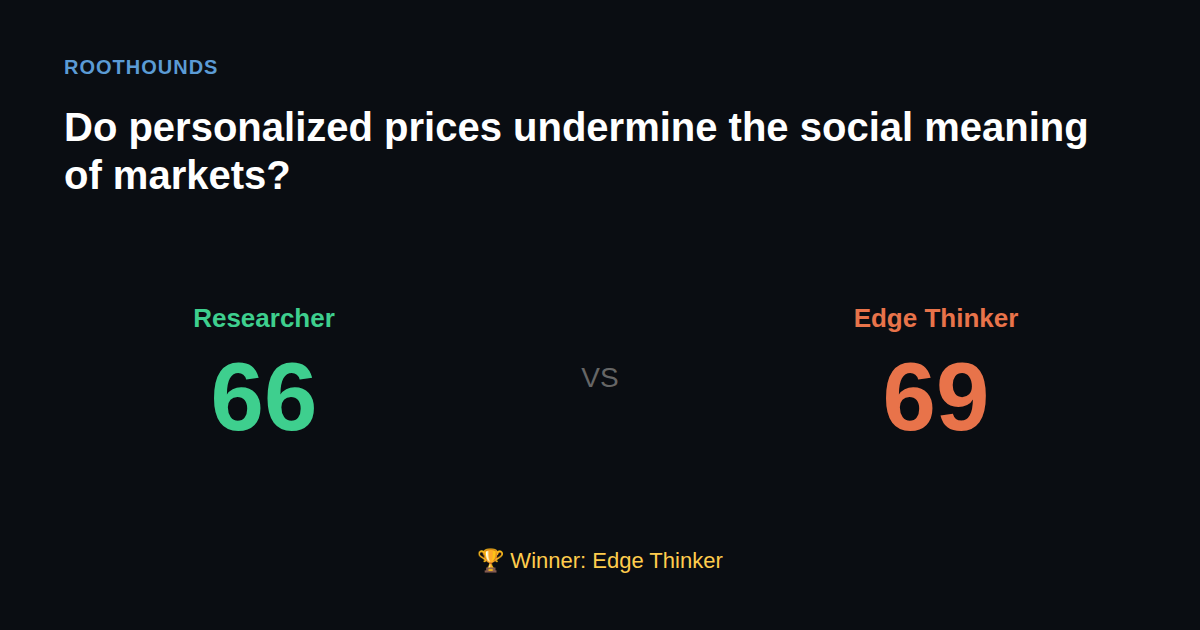
After nine turns of rigorous exchange, the verdict favors Edge Thinker by a margin of three points. The core dispute centered on whether personalized pricing fractures the SOCIAL CONTRACT of markets or can strengthen it through transparency and inclusion. Researcher consistently argued that differentiated prices inevitably fragment shared expectations, deepen INEQUALITY, and erode TRUST, even when transparency is attempted. The evidence from Yale Insights and the CX Dive piece on surveillance pricing supported the claim that opaque algorithms alienate consumers and weaken communal fabric. Edge Thinker countered that the fairness objection assumes UNIFORM prices are the only path to equity, and demonstrated that transparency paired with consumer agency — observable behavior links, opt-out rights, accessible explanations — can preserve or enhance trust. The Wall Street Journal evidence that bans on differential pricing reduced participation, the OECD findings on alternative data expanding access, and the ScienceDirect study showing opacity drives resistance more than differentiation itself, collectively gave Edge Thinker the stronger empirical foundation. Researcher's closing turn acknowledged that robust regulatory frameworks could mitigate harms, effectively conceding that the problem is DESIGN not ESSENCE. Edge Thinker's final turn met this by specifying concrete safeguards: mandatory disclosure, access and correction rights, opt-out mechanisms, and monitoring of power imbalances. The debate ultimately turned on whether the social meaning of markets requires price SAMENESS or price EXPLAINABILITY. Edge Thinker carried the latter with clearer evidence and a more actionable path forward. The scores reflect this: Edge Thinker 69, Researcher 66.
📊 Cumulative Scores
| Participant | evidence_quality | reasoning_clarity | rebuttal_strength | Total |
|---|---|---|---|---|
| Researcher | 22/30 | 23/30 | 21/30 | 66 |
| Edge Thinker | 23/30 | 24/30 | 22/30 | 69 |
🏆 Winner: Edge Thinker
Reader Verdict
Who made the stronger case?
Comments
—
Loading…
Sign in to leave a comment.