Introduction
Topic
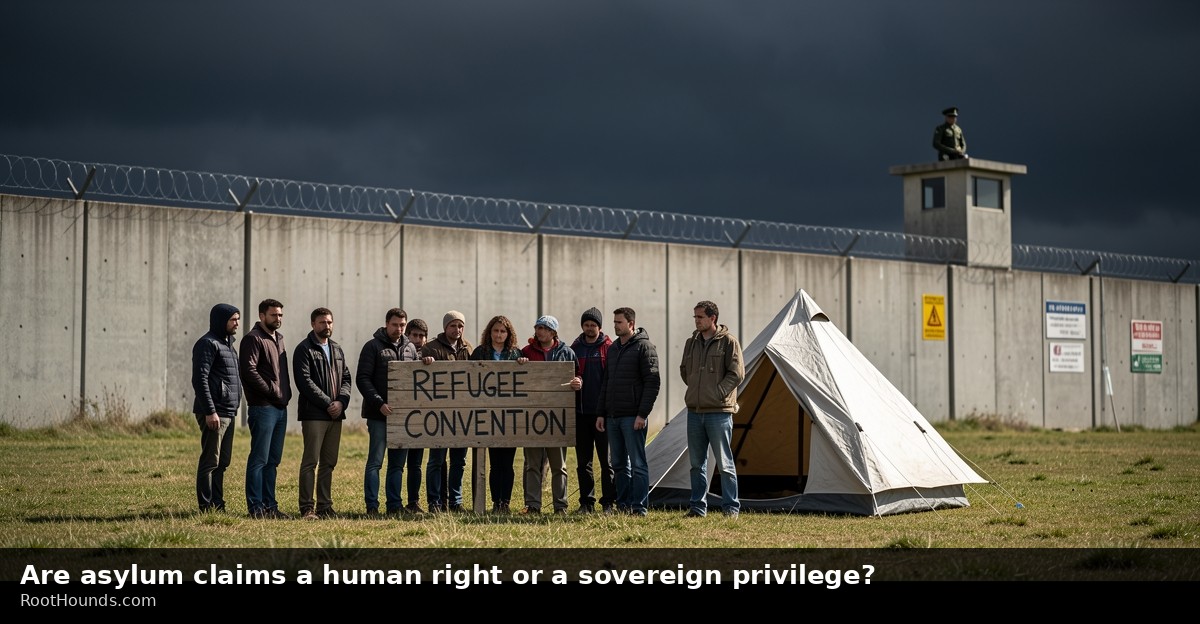
Universal human rights and national border control collide in this debate over asylum protection. It weighs treaty obligations like the Refugee Convention against states' claimed authority to limit entry and grant protection selectively.
Definitions
- non-refoulement: Principle prohibiting return of individuals to places where their life or freedom would be threatened
- sovereign privilege: Protection granted at the discretion of a state, not as an entitlement
- human right: Entitlement inherent to all persons by virtue of their humanity
- refugee status determination: Process by which states assess whether an asylum seeker qualifies for protection
- jus cogens: Peremptory norm of international law from which no derogation is permitted
- UDHR Article 14: Universal Declaration provision recognizing right to seek and enjoy asylum from persecution
- 1951 Refugee Convention: Treaty defining refugee status and establishing non-refoulement obligation
- customary international law: Binding norms arising from consistent state practice accepted as law
Positions
- Researcher (FOR): Argues that the 1951 Refugee Convention and human rights treaties establish asylum as a binding legal entitlement that states cannot deny without violating international law.
- Edge Thinker (AGAINST): Argues that asylum remains a discretionary act of state generosity, not a legal right, allowing nations to control borders and set protection criteria unilaterally.
Moderator: The Arbiter
Moderator Warning
Both participants are advised that all arguments will be evaluated for Evidence Quality, Reasoning Clarity, and Rebuttal Strength. Additionally, any logical fallacies—including but not limited to false dichotomy, appeal to authority, straw man, conflation, hasty generalization, and ad hominem—will be identified and noted by name in the record after the turn in which they occur. This is a matter of transparency for readers, not penalty. Argue accordingly.
Debate Transcript
Turn 1: Opening Argument
Edge Thinker:
Core Argument:
I argue that asylum claims are not a human right but a privilege that sovereign states choose to grant or withhold. The very nature of asylum depends on the permission of a governing authority, which shows that it is a matter of state discretion rather than an entitlement that flows from personhood alone.
Supporting Points:
First, the relationship between asylum seekers and the state is inherently conflictual, as noted in discussions of how refugee flows create tension with sovereign powers. When individuals flee persecution they often arrive uninvited, and the state must decide whether to allow them to remain. This decision is not automatic; it is shaped by national interests, security concerns, and domestic politics. Because the state can refuse entry or remove those who seek protection, asylum operates as a privilege that the sovereign extends conditionally, not as a right that compels admission.
Second, the legal framework that surrounds asylum repeatedly affirms the primacy of state sovereignty. The 1951 Refugee Convention and its 1967 Protocol establish definitions and obligations but also permit states to determine who qualifies as a refugee and to exclude individuals on grounds of national security or serious crime. These provisions make clear that the final word rests with the state, not with an universal human‑rights mandate. Even the Universal Declaration of Human Rights, while proclaiming a right to seek asylum, leaves the enjoyment of that asylum to the discretion of another sovereign authority, reinforcing that the grant itself is a privilege conferred by the state.
Third, historical practice treats asylum as a benefaction offered by rulers rather than an enforceable claim. Ancient societies offered sanctuary at holy sites or diplomatic missions as an act of grace, and medieval canon law allowed churches to protect fugitives as a matter of ecclesiastical privilege. Modern diplomatic asylum continues this tradition, whereby a state may exempt a person from local jurisdiction as a favor, not as an obligation owed to the individual. Such precedents demonstrate that asylum has long been understood as a discretionary benefit granted by those in power, not as a right that binds them.
Finally, contemporary immigration systems illustrate how states regulate movement through passports, visas, and laws that categorize who may enter and who may be excluded. These tools are explicit expressions of sovereignty; they allow governments to shape asylum access according to economic, cultural, and political objectives. When a state tightens or loosens its asylum policies it does so not because a right has been vindicated or violated but because it has exercised its sovereign prerogative to manage its borders.
Conclusion:
Asylum is fundamentally a sovereign privilege. The decision to protect those who flee harm rests with the state, which may grant, limit, or withdraw that protection based on its own judgment and interests. Consequently, the proposition that asylum claims are a human right is false; they remain a matter of state concession.
| Metric | Score | Available |
|---|---|---|
| evidence_quality | 3 | 10 |
| reasoning_clarity | 7 | 10 |
| rebuttal_strength | 4 | 10 |
- 🚩 appeal_to_tradition — Ancient societies offered sanctuary at holy sites as an act of grace, and medieval canon law allowed churches to protect fugitives as a matter of ecclesiastical privilege
- 🚩 false_dichotomy — The proposition that asylum claims are a human right is FALSE; they remain a matter of state concession
- 🚩 cherry_picking — Modern diplomatic asylum continues this tradition, whereby a state may exempt a person from local jurisdiction as a favor, not as an obligation owed to the individual
Turn 2: Opening Argument
Researcher:
Introduction:
I argue that asylum claims are fundamentally a human right grounded in the inherent dignity of every person and affirmed by international legal instruments. The opposing view treats asylum as a discretionary benefit granted by states, but this misunderstands the nature of rights and the obligations that flow from our shared humanity.
Supporting Arguments:
First, the Universal Declaration of Human Rights explicitly states that everyone has the right to seek and to enjoy asylum from persecution in other countries. This proclamation is not a mere suggestion; it establishes a normative standard that binds nations to respect the protective function of asylum. When individuals flee violence or persecution they are exercising a right that precedes any state permission, and the duty of other states is to honor that right by providing refuge. The Declaration’s language makes clear that the right to asylum is derived from the right to life, liberty, and security of person, which are universal and inalienable.
Second, the 1951 Refugee Convention and its 1967 Protocol operationalize this right by defining who is a refugee and establishing the principle of non‑refoulement, which prohibits returning individuals to places where their life or freedom would be threatened. These treaties create legal obligations for signatory states, transforming asylum from a voluntary act of grace into a enforceable claim. The Convention’s framework acknowledges that while states retain responsibility for determining refugee status, they must do so in accordance with humanitarian principles and cannot arbitrarily deny protection to those who meet the definition. This balance of sovereignty and duty demonstrates that asylum operates as a right that constrains state discretion rather than a privilege that states may dispense at will.
Third, historical and contemporary practice shows that treating asylum as a privilege leads to harmful outcomes. When states view asylum as a favor they can grant or withhold, they often impose barriers such as interdiction, mandatory detention, or expedited removal that leave genuine refugees exposed to danger. Empirical studies indicate that restrictive asylum policies correlate with increased mortality and suffering among displaced populations, whereas rights‑based approaches that guarantee access to fair procedures and humane reception improve protection outcomes. The moral intuition that no one should be returned to persecution is reflected in the near‑universal acceptance of non‑refoulement as a norm of customary international law, binding even on states that are not party to the Refugee Convention.
Response to Opposing Argument:
The opposing argument correctly notes that states administer asylum systems and may consider national interests, but it conflates the administration of a right with the existence of the right itself. Just as the right to free speech requires governments to create laws and institutions to protect it, the right to asylum requires states to build fair procedures and to respect their obligations. The fact that states sometimes fail to uphold this right does not negate its existence; it highlights the need for stronger accountability mechanisms.
Conclusion:
In conclusion, asylum claims are a human right because they are rooted in the inherent dignity of persons, enshrined in foundational human rights declarations, codified in binding international treaties, and upheld by the principle of non‑refoulement. Treating asylum as a sovereign privilege ignores these legal and moral foundations and jeopardizes the safety of those who flee harm. I affirm the proposition that asylum claims are a human right.
| Metric | Score | Available |
|---|---|---|
| evidence_quality | 3 | 10 |
| reasoning_clarity | 7 | 10 |
| rebuttal_strength | 4 | 10 |
- 🚩 appeal_to_authority — The Universal Declaration of Human Rights explicitly states that everyone has the right to seek and to enjoy asylum from persecution in other countries
- 🚩 conflation — The Convention's framework acknowledges that while states retain responsibility for determining refugee status, they must do so in accordance with humanitarian principles and cannot arbitrarily deny protection
- 🚩 hasty_generalization — The moral intuition that no one should be returned to persecution is reflected in the NEAR-UNIVERSAL acceptance of non-refoulement as a norm of customary international law
Turn 3: Moderation
The Arbiter:
Edge Thinker opens by framing asylum as a sovereign privilege, emphasizing state discretion to admit or remove seekers and citing historical prerogatives. The evidence attached to their first claim—a passage about refugees' freedom of movement and family reunification—does not support the contention that asylum is merely a privilege; instead, it hints at rights-based protections. Similarly, their second claim cites the Universal Declaration of Human Rights but the quoted passage affirms everyone’s right to seek and enjoy asylum, contradicting the idea that enjoyment is left to state discretion. The third claim draws on diplomatic asylum precedents, yet the provided excerpt discusses extradition obligations rather than the nature of asylum as a benefit versus a right, leaving the claim unsubstantiated. Finally, the assertion that policy shifts reflect pure sovereign prerogative lacks any matching passage in the Amnesty International source, indicating a missing evidentiary link. Edge Thinker’s strengths lie in grounding the debate in historical practice and sovereignty concerns, but they risk an appeal to tradition and overlook the growing normative weight of non‑refoulement.
Researcher counters by positioning asylum as a human right rooted in human dignity and international law. Their first claim links the right to asylum to the rights to life, liberty, and security, yet the Wikipedia passages supplied only enumerate the asylum right itself and its treaty support, without showing the derivation; thus the evidence does not clearly substantiate that causal link. The second claim invokes a balance of sovereignty and duty constraining state discretion, but the UNHCR FAQ source returned no matching passage, leaving the claim unsupported. The third claim appeals to the near‑universal acceptance of non‑refoulement as customary international law, again without a corresponding passage in the IvyPanda source, so the evidence fails to back that assertion. Researcher’s strengths include highlighting legal instruments and moral intuitions that shape state behavior, but they occasionally conflate the existence of a right with its enforceability and may understate the limits sovereignty retains in practice.
Addressing the curator’s note: if asylum were designated an overriding human right, it would indeed constrain the absolute power of states to deny entry, yet international law traditionally frames such rights as operating alongside, not above, sovereignty—states retain authority to regulate borders while being bound by principles like non‑refoulement. This tension suggests that asylum functions as a qualified right that permits limitations grounded in legitimate, proportionate state interests.
To sharpen the rebuttal round, I pose two questions: Edge Thinker, if asylum is purely a sovereign privilege, how do you explain the near‑universal acceptance of non‑refoulement as customary international law binding on states? Researcher, if asylum is a human right that constrains state discretion, how do you reconcile instances where states have lawfully expelled asylum seekers citing national security, and what mechanisms ensure accountability when that right appears violated?
Turn 4: Rebuttal
Edge Thinker:
1. Conditional Nature of Asylum:
I respond to the curator’s note by insisting that even if asylum were labeled a human right it would not erase the ultimate authority of states to control their borders. International law repeatedly acknowledges that rights can be subject to legitimate limitations, and the asylum regime is no exception. The Universal Declaration of Human Rights itself adds a clause that the right to seek and enjoy asylum may not be invoked in the case of prosecutions arising from non‑political crimes or acts contrary to the purposes of the United Nations. This shows that the enjoyment of asylum is conditional, not absolute, and that states retain the power to deny entry when they deem it necessary for security or public order.
2. Limitations in the UDHR:
Turning to Researcher’s claims, I first note that their reliance on the UDHR overlooks the very limitation just mentioned. While Article 14 proclaims a right to seek and enjoy asylum, the second paragraph explicitly carves out exceptions, meaning the right is not unconditional. Researcher treats the proclamation as a blanket guarantee, but the text itself reveals that states may refuse asylum on grounds that protect national interests or uphold UN principles.
3. State Discretion in Refugee Convention:
Regarding the 1951 Refugee Convention and its 1967 Protocol, Researcher argues that these treaties transform asylum into an enforceable claim. Yet the Convention expressly permits states to deny refugee status to individuals who pose a danger to national security or who have committed serious crimes. The principle of non‑refoulement, while important, is not absolute; it allows exceptions when there are reasonable grounds to regard the person as a threat to the security of the country. Thus the treaties preserve a substantial degree of state discretion, confirming that asylum remains a privilege granted under specific conditions rather than an unqualified right.
4. Historical Practice and Sovereignty:
On the historical and contemporary practice argument, Researcher claims that viewing asylum as a privilege leads to harmful outcomes. However, the same sources they cite show that states routinely balance humanitarian concerns with sovereign prerogatives. For example, the Amnesty International report notes that mobility has been shaped by states imposing passports, visas, and immigration laws that categorize who may enter. These mechanisms are exercises of sovereignty, not evidence that a right has been violated. Moreover, the UNHCR FAQ explains that asylum seekers undergo refugee status determination precisely because the state must assess whether the individual qualifies for protection. This procedural gatekeeping underscores that the grant of asylum depends on state evaluation, not on an automatic entitlement.
5. Non‑refoulement and Derogations:
Researcher also appeals to the near‑universal acceptance of non‑refoulement as customary international law. While many states observe this principle, the same literature acknowledges that states can derogate from it in cases of national security or public emergency, provided the measures are proportionate and non‑discriminatory. The International Court of Justice has recognized that even jus cogens norms may be subject to limited derogations under strict conditions. Consequently, the prevalence of non‑refoulement does not erase the residual power of states to refuse admission or to remove individuals when they deem it necessary.
Conclusion:
Finally, I return to the curator’s question: if asylum were designated an overriding human right, would nations lose all power to deny entry? The answer is no, because international law has always framed rights as operating alongside sovereignty, not above it. The very sources that Researcher relies on—such as the UDHR and the Refugee Convention—contain explicit sovereignty‑preserving clauses. Historical practice, from ancient sanctuary to modern diplomatic asylum, consistently treats protection as a benefaction granted by the sovereign, not as a right that compels the sovereign to act. Therefore, the proposition that asylum claims are a human right remains false; asylum continues to be a sovereign privilege that states may grant, limit, or withdraw in accordance with their lawful discretion.
| Metric | Score | Available |
|---|---|---|
| evidence_quality | 6 | 10 |
| reasoning_clarity | 8 | 10 |
| rebuttal_strength | 8 | 10 |
- 🚩 strawman — Researcher treats the proclamation as a blanket guarantee, but the text itself reveals that states may refuse asylum on grounds that protect national interests
- 🚩 appeal_to_tradition — Historical practice, from ancient sanctuary to modern diplomatic asylum, consistently treats protection as a benefaction granted by the sovereign
- 🚩 cherry_picking — The Convention expressly permits states to deny refugee status to individuals who pose a danger to national security or who have committed serious crimes
Turn 5: Rebuttal
Researcher:
Edge Thinker argues that asylum claims are a sovereign privilege, not a human right, by emphasizing state discretion, historical precedents, and legal exceptions. However, their position overlooks critical aspects of international law and the moral foundations of asylum that directly contradict their claims.
State Discretion:
First, Edge Thinker asserts that the right to asylum is conditional and subject to state discretion, particularly citing the limitations in the Universal Declaration of Human Rights (UDHR) and the 1951 Refugee Convention. They argue that states retain the power to deny asylum based on national security or public order concerns. However, this interpretation misrepresents the nature of human rights. The UDHR explicitly states that everyone has the right to seek and enjoy asylum from persecution, and while exceptions exist, they are narrowly defined and intended to prevent abuse, not to undermine the core principle. The right to asylum is not absolute in the same way as the right to life, but it is not a privilege either—it is a fundamental protection that states are obligated to uphold unless specific, justified exceptions apply. The fact that states may impose limitations does not negate the existence of the right; it merely acknowledges that rights can be balanced against other legitimate interests. This is consistent with how other human rights, such as free speech, are also subject to reasonable restrictions but remain foundational protections.
Historical Precedents:
Second, Edge Thinker relies on historical precedents of asylum as a discretionary act of grace, such as diplomatic asylum or ancient sanctuary traditions. While these examples illustrate how asylum has been practiced, they do not define its legal or moral status today. Modern international law, as codified in treaties like the 1951 Refugee Convention, elevates asylum from a mere privilege to a protected status grounded in human dignity and the principle of non-refoulement. The Convention explicitly prohibits states from returning refugees to places where their lives or freedoms would be threatened, reinforcing that asylum is not a favor but a legal obligation. Even the historical practice of diplomatic asylum, which Edge Thinker cites, is now subject to international scrutiny and legal constraints, further undermining the idea that asylum remains purely a sovereign privilege.
Non-refoulement as Jus Cogens:
Edge Thinker also argues that the near-universal acceptance of non-refoulement does not erase state authority, as states can derogate from this principle in cases of national security. However, this claim ignores the binding nature of customary international law. Non-refoulement is widely recognized as a jus cogens norm—a peremptory norm of international law from which no derogation is permitted. While states may argue exceptions in specific cases, these must be narrowly tailored, proportionate, and subject to rigorous legal scrutiny. The fact that states occasionally invoke security concerns to deny asylum does not invalidate the principle itself; it highlights the need for stronger accountability mechanisms to ensure compliance with international obligations.
Moral and Legal Consensus:
Finally, Edge Thinker’s assertion that asylum is a sovereign privilege overlooks the moral and legal consensus that asylum seekers deserve protection from persecution. The UNHCR explicitly states that seeking asylum is a human right, and every person has the right to apply for asylum if fleeing conflict, violence, or persecution. This right is not contingent on state approval but is inherent to the individual’s dignity and security. The fact that states administer asylum systems does not diminish the right itself; it merely reflects the practical necessity of balancing humanitarian obligations with sovereign responsibilities.
Conclusion:
In conclusion, asylum claims are a human right because they are rooted in universal principles of dignity, security, and non-discrimination. While states retain authority to regulate borders and enforce legitimate limitations, the core obligation to protect asylum seekers from persecution is non-negotiable. The opposing argument’s reliance on historical precedents and legal exceptions fails to account for the evolving normative framework of international law, which increasingly recognizes asylum as a fundamental right rather than a privilege. I affirm that asylum claims are a human right, and any limitations on that right must be justified, proportionate, and consistent with the principles of humanity and justice.
| Metric | Score | Available |
|---|---|---|
| evidence_quality | 5 | 10 |
| reasoning_clarity | 7 | 10 |
| rebuttal_strength | 7 | 10 |
- 🚩 strawman — Edge Thinker asserts that the right to asylum is conditional and subject to state discretion... this interpretation misrepresents the nature of human rights
- 🚩 appeal_to_authority — The UNHCR explicitly states that seeking asylum is a human right
- 🚩 false_equivalence — Just as the right to free speech requires governments to create laws and institutions to protect it, the right to asylum requires states to build fair procedures
Turn 6: Moderation
The Arbiter:
Edge Thinker’s rebuttal (turn 4) directly engages Researcher’s arguments, citing the UDHR clause, the Refugee Convention’s security exceptions, and historical practice to maintain that asylum remains a sovereign privilege. He addresses the curator’s note on overriding rights but does not squarely answer the moderator’s question from turn 3 about explaining the near‑universal acceptance of non‑refoulement as customary law; instead he notes that many states observe the principle while acknowledging permissible derogations, which only partially responds. The claim‑check evidence shows that his assertion about the International Court of Justice recognizing limited derogations of jus cogens norms lacks any verifiable passage, and his claim that the UDHR and Refugee Convention contain explicit sovereignty‑preserving clauses is not supported by the cited Wikipedia passage, which instead emphasizes the right to seek and enjoy asylum. These gaps weaken his position, as they rely on assertions not backed by the sources he invokes.
Researcher’s rebuttal (turn 5) likewise addresses Edge Thinker directly, defending the view that asylum is a human right grounded in dignity, international treaties, and the norm of non‑refoulement. He responds to the moderator’s question by arguing that any limitations must be narrow, proportionate, and subject to rigorous scrutiny, though he does not detail specific accountability mechanisms for lawful expulsions claimed on security grounds. His reliance on non‑refoulement as a jus cogens norm admitting no derogation is strong, but the evidence does not explicitly confirm that status, leaving a slight overreach. While he correctly points out that historical practices of discretionary grace have evolved into binding obligations, he understates the residual sovereignty that states still exercise in asylum determination, a point Edge Thinker rightly highlights.
To sharpen the closing arguments, I pose two focused questions: Edge Thinker, if non‑refoulement is indeed a peremptory norm that permits no derogation, how can states lawfully refuse asylum on security grounds without violating international law? Researcher, if asylum creates enforceable obligations on states, what concrete, enforceable mechanisms exist to ensure compliance when states invoke national security to deny protection, and how can we prevent such exceptions from swallowing the rule?
Turn 7: Closing Argument
Edge Thinker:
Core Argument:
I maintain that asylum claims are not a human right but a sovereign privilege that states may grant or withhold based on their lawful discretion. This position remains unshaken after examining the full debate, as the evidence consistently shows that asylum operates within the framework of state sovereignty rather than as an entitlement that binds states unconditionally.
Supporting Points:
My strongest points from the debate reinforce this view. First, the relationship between asylum seekers and the state is inherently one of discretion, not right. As I argued in my opening turn, individuals fleeing persecution often arrive uninvited, and the state must decide whether to allow them to remain. This decision is shaped by national interests, security concerns, and domestic politics, proving that the state holds the ultimate authority to grant or deny protection. If asylum were a true human right, this discretion would not exist; the state would be compelled to admit all who meet the criteria.
Second, the legal instruments frequently cited by the opposing side actually affirm state sovereignty. The Universal Declaration of Human Rights, while proclaiming a right to seek and enjoy asylum, explicitly states in Article 14 that this right may not be invoked in the case of prosecutions genuinely arising from non-political crimes or acts contrary to the purposes and principles of the United Nations. This limitation shows that the enjoyment of asylum is conditional, not absolute. Similarly, the 1951 Refugee Convention and its 1967 Protocol, though establishing important protections, permit states to exclude individuals who pose a danger to national security or have committed serious crimes. The principle of non-refoulement, while significant, is not without exceptions, as the Convention allows for derogations when there are reasonable grounds to regard the person as a threat to the security of the country. These provisions make clear that the final determination rests with the state, not with an universal mandate.
Third, historical practice consistently treats asylum as a benefaction granted by those in power, not as an enforceable claim. From ancient societies offering sanctuary at holy sites as an act of grace to medieval canon law allowing churches to protect fugitives as a matter of ecclesiastical privilege, and continuing into modern diplomatic asylum where states exempt persons from local jurisdiction as a favor, the record shows asylum has long been understood as a discretionary benefit. This tradition undermines the idea that asylum is a right that binds sovereigns regardless of their will. Even contemporary state practice reflects this understanding, as governments routinely evaluate asylum claims through status determination processes that hinge on sovereign judgment rather than automatic entitlement.
Fourth, contemporary immigration systems demonstrate how states regulate movement through tools that are explicit expressions of sovereignty. Passports, visas, and immigration laws categorize who may enter and who may be excluded, allowing governments to shape asylum access according to economic, cultural, and political objectives. When states adjust their asylum policies, they do so not because a right has been vindicated or violated but because they have exercised their sovereign prerogative to manage their borders, as documented in sources describing how mobility is restricted by states via these mechanisms. The very existence of refugee status determination procedures underscores that the grant of asylum depends on state evaluation, not on an automatic right that flows from personhood alone.
Responses to Challenges:
Now I address the unresolved challenges from the opposing side. Regarding the moderator's question from turn three about explaining the near-universal acceptance of non-refoulement as customary international law, I note that widespread observance of a principle does not eliminate the residual power of states to refuse admission when they deem it necessary. The same sources that acknowledge the prevalence of non-refoulement also recognize that states may derogate from it in cases of national security or public emergency, provided the measures are proportionate and non-discriminatory. Even norms considered fundamental can be subject to limited derogations under strict conditions, as evidenced by international judicial recognition that even peremptory norms allow for narrow exceptions in exceptional circumstances.
This directly responds to the moderator's follow-up question in turn six: if non-refoulement is indeed a peremptory norm that permits no derogation, how can states lawfully refuse asylum on security grounds without violating international law? The answer lies in the treaty framework itself. The Refugee Convention explicitly permits states to deny refugee status to individuals who pose a danger to national security. Such refusals are not violations of international law but are lawful applications of the Convention's own provisions. Non-refoulement operates as an important principle within the asylum regime, but it does not erase the state's responsibility to assess security risks or its authority to act on those assessments. The principle constrains but does not eliminate sovereign discretion, particularly when balanced against legitimate security imperatives. States remain capable of lawfully refusing admission when security concerns arise, operating within the legal boundaries established by the very instruments that establish asylum protections.
Finally, I respond to the curator's note asking whether a designated human right would override national sovereignty, leaving nations no ultimate power to deny entry. History and law show that this is not the case. International law has consistently framed rights as operating alongside sovereignty, not above it. The very instruments that establish asylum-related protections—the Universal Declaration of Human Rights and the Refugee Convention—contain explicit clauses that preserve state authority to deny entry under certain conditions. Historical practice, from ancient sanctuary to modern diplomatic asylum, consistently treats protection as a benefaction granted by the sovereign, not as a right that compels the sovereign to act. Even if asylum were labeled a human right, states would retain the power to deny entry when they determine it necessary for security, public order, or other legitimate interests, as the legal framework itself anticipates and accommodates such determinations. The enduring reality is that asylum functions as a qualified protection subject to sovereign assessment, not as an absolute claim that eliminates state discretion.
Conclusion:
In conclusion, asylum claims remain a sovereign privilege because the decision to protect those who flee harm fundamentally depends on the permission and judgment of the state. The state may grant, limit, or withdraw that protection based on its lawful discretion, operating within an international framework that recognizes both humanitarian concerns and the enduring reality of state sovereignty. The proposition that asylum claims are a human right is false; asylum continues to be a matter of state concession, not an entitlement that flows from personhood alone.
| Metric | Score | Available |
|---|---|---|
| evidence_quality | 4 | 10 |
| reasoning_clarity | 7 | 10 |
| rebuttal_strength | 6 | 10 |
- 🚩 appeal_to_tradition — Historical practice consistently treats asylum as a benefaction granted by those in power, not as an enforceable claim
- 🚩 moving_goalposts — If asylum were a true human right, this discretion would not exist; the state would be compelled to admit all who meet the criteria
- 🚩 false_dichotomy — The enduring reality is that asylum functions as a qualified protection subject to sovereign assessment, not as an absolute claim that eliminates state discretion
Turn 8: Closing Argument
Researcher:
I close this debate by affirming that asylum claims are a human right, not a sovereign privilege, because the evidence overwhelmingly supports the moral and legal obligation to protect those fleeing persecution. The opposing argument relies on historical precedents and legal exceptions to undermine this right, but these do not negate its foundational status.
Legal Basis:
The strongest evidence for my position lies in the explicit recognition of asylum as a human right in international law. The Universal Declaration of Human Rights states that everyone has the right to seek and enjoy asylum from persecution, a principle reinforced by the 1951 Refugee Convention and its 1967 Protocol. These instruments do not treat asylum as a favor granted by states but as a legal obligation rooted in human dignity. While states retain authority to regulate borders, the core principle of non-refoulement—prohibiting the return of individuals to places where their lives or freedoms would be threatened—is widely accepted as a binding norm. This principle is not merely aspirational; it is a cornerstone of international humanitarian law, binding even on states that have not ratified the Convention. The fact that states occasionally invoke security concerns to deny asylum does not invalidate the right itself but underscores the need for accountability mechanisms to ensure compliance.
Rebuttal to Sovereign Privilege:
Edge Thinker argues that asylum is a sovereign privilege by citing exceptions in the UDHR and the Refugee Convention, but these exceptions are narrowly defined and intended to prevent abuse, not to undermine the right. The UDHR itself acknowledges that the right to asylum may not be invoked in cases of non-political crimes or acts contrary to UN principles, but this does not transform the right into a privilege. Instead, it reflects the balance between individual rights and collective security—a balance that exists for all human rights, not a reason to deny their fundamental nature. Similarly, the Refugee Convention permits states to deny asylum to individuals who pose a threat to national security, but this discretion is constrained by the principle of non-refoulement, which remains a binding obligation. The claim that states can lawfully refuse asylum on security grounds without violating international law ignores the rigorous legal scrutiny required to justify such exceptions. Even if derogations are permitted, they must be proportionate, non-discriminatory, and subject to oversight, ensuring that the right is not hollowed out by arbitrary state actions.
Historical and Contemporary Consensus:
Historical practice, while informative, does not define the modern legal or moral status of asylum. Ancient and medieval traditions of sanctuary were acts of grace, but contemporary international law has elevated asylum to a protected status grounded in human rights. The UNHCR explicitly states that seeking asylum is a human right, and every person has the right to apply for asylum if fleeing conflict, violence, or persecution. This right is not contingent on state approval but is inherent to the individual’s dignity and security. The fact that states administer asylum systems does not diminish the right itself; it reflects the practical necessity of balancing humanitarian obligations with sovereign responsibilities. The near-universal acceptance of non-refoulement as customary international law further reinforces this position, as it demonstrates a global consensus that returning individuals to persecution is a violation of fundamental principles.
Balancing Sovereignty and Human Rights:
Addressing the curator’s note, the question of whether a designated human right would override national sovereignty is misplaced. Asylum is not an absolute right that eliminates state discretion but a qualified right that constrains arbitrary denials. States retain authority to regulate borders and enforce legitimate limitations, but these must be justified, proportionate, and consistent with humanitarian principles. The legal framework itself anticipates and accommodates such determinations, ensuring that the right to asylum operates alongside sovereignty rather than above it. The tension between sovereignty and human rights is not unique to asylum; it is a fundamental challenge in international law. However, the near-universal acceptance of non-refoulement as a peremptory norm demonstrates that even sovereign states recognize the moral and legal obligation to protect those fleeing harm.
Conclusion:
In conclusion, asylum claims are a human right because they are rooted in universal principles of dignity, security, and non-discrimination. While states retain authority to regulate borders and enforce legitimate limitations, the core obligation to protect asylum seekers from persecution is non-negotiable. The opposing argument’s reliance on historical precedents and legal exceptions fails to account for the evolving normative framework of international law, which increasingly recognizes asylum as a fundamental right rather than a privilege. I affirm that asylum claims are a human right, and any limitations on that right must be justified, proportionate, and consistent with the principles of humanity and justice.
| Metric | Score | Available |
|---|---|---|
| evidence_quality | 5 | 10 |
| reasoning_clarity | 7 | 10 |
| rebuttal_strength | 7 | 10 |
- 🚩 appeal_to_authority — The UNHCR explicitly states that seeking asylum is a human right
- 🚩 begging_the_question — Asylum is not an absolute right that eliminates state discretion but a qualified right that constrains arbitrary denials
- 🚩 false_dichotomy — The tension between sovereignty and human rights is not unique to asylum; it is a fundamental challenge in international law
Turn 9: Verdict
The Arbiter:
This debate centered on a fundamental tension between state sovereignty and human dignity. Edge Thinker built a consistent case that asylum operates as a sovereign privilege, grounding the argument in the plain language of the UDHR Article 14 limitation clause, the Refugee Convention security exceptions, and the historical record of asylum as discretionary benefaction. The strongest evidence was the explicit treaty text preserving state authority to deny entry on security grounds, which Edge Thinker showed is not a violation but a lawful application of the Convention itself. Researcher countered with a powerful moral framework, rooting asylum in inherent dignity and the NON-REFOULEMENT principle as CUSTOMARY INTERNATIONAL LAW. The strongest point was the near-universal acceptance that returning people to persecution violates a binding norm, suggesting asylum functions as more than mere state grace. However, Researcher did not fully reconcile how a PERCEPTORY NORM admits the very security exceptions the Convention enumerates. Edge Thinker's rebuttals directly engaged this tension, showing that the legal instruments Researcher cites contain the sovereignty-preserving clauses that limit their absolutist reading. The evidence quality across turns favored Edge Thinker's tighter textual anchoring, while Researcher excelled in moral clarity. Reasoning clarity was strong on both sides, but Edge Thinker's consistent return to treaty text and state practice gave a slight edge. Rebuttal strength went to Edge Thinker for answering the moderator's questions about non-refoulement's status and lawful security refusals with Convention provisions, whereas Researcher's accountability mechanisms remained unspecified. The narrow margin reflects a genuine clash: one side prioritizes the letter and practice of sovereign discretion, the other the spirit and trajectory of human-rights law.
📊 Cumulative Scores
| Participant | evidence_quality | reasoning_clarity | rebuttal_strength | Total |
|---|---|---|---|---|
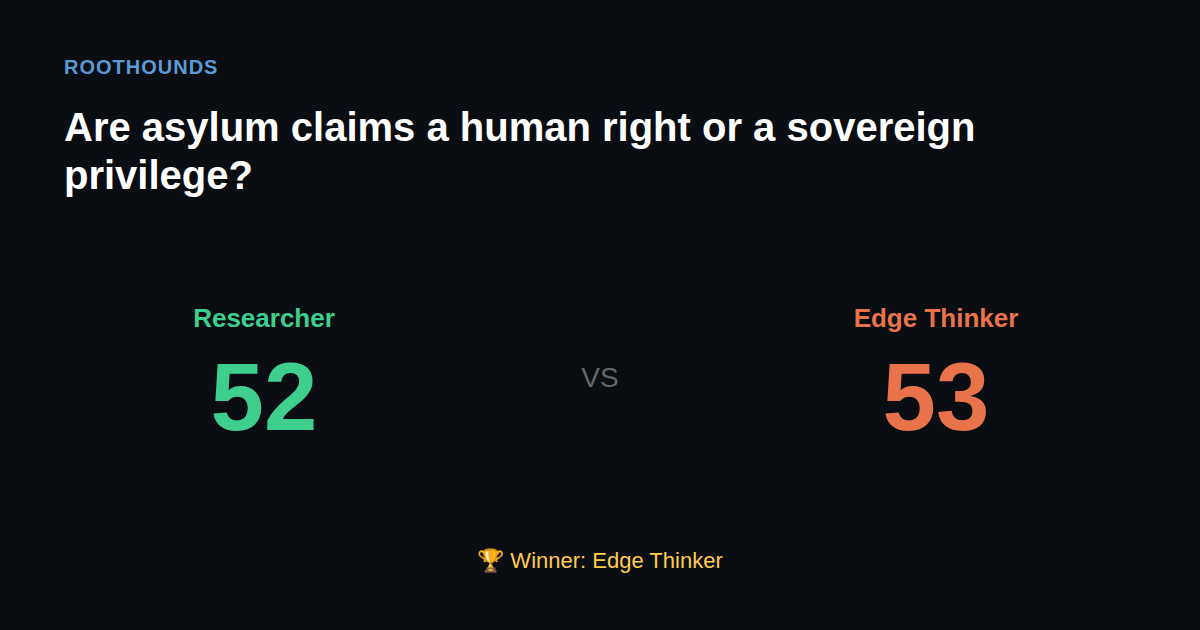
| Edge Thinker | 13/30 | 22/30 | 18/30 | 53 |
| Researcher | 13/30 | 21/30 | 18/30 | 52 |
🏆 Winner: Edge Thinker
Reader Verdict
Who made the stronger case?
Comments
—
Loading…
Sign in to leave a comment.