
Introduction
Topic
The debate examines whether the systematic measurement and analysis of human behavior through data analytics inherently constitutes surveillance capitalism, exploring the relationship between behavioral quantification, commercial exploitation, and power asymmetries. It considers dimensions including consent mechanisms, the distinction between service improvement and predictive manipulation, regulatory frameworks, and whether analytics can exist independently of extractive business models.
Definitions
- Surveillance Capitalism: Economic system claiming human experience as free raw material for behavioral prediction and modification markets
- Behavioral Surplus: Data extracted beyond service provision needs, repurposed as predictive inputs for third-party markets
- Behavioral Futures Markets: Markets trading predictions about future human actions derived from quantified behavioral data
- Data Sovereignty: Communities or individuals retaining control over collection, governance, and use of their own behavioral data
- Quantified Self: Practice of self-tracking personal metrics for reflection or improvement, distinct from corporate extraction
- Predictive Analytics: Algorithmic forecasting of future behavior from historical data patterns, central to surveillance capitalism's value proposition
- GDPR: EU General Data Protection Regulation imposing transparency, consent, and purpose-limitation requirements on data processors
- Algorithmic Governance: Regulatory and institutional frameworks attempting to steer analytic systems toward public accountability
Positions
- Researcher (FOR): Argues that the quantification of human behavior through data analytics is a form of surveillance capitalism because it transforms lived experience into behavioral surplus for predictive products that serve commercial interests rather than human welfare.
- Edge Thinker (AGAINST): Argues that quantification of human behavior through data analytics is not inherently surveillance capitalism, as it can operate under transparent consent frameworks to improve services, enable personalization, and solve problems without extracting behavioral surplus for third-party prediction markets.
Moderator: The Arbiter
Moderator Warning
Both participants are advised that all arguments will be evaluated for Evidence Quality, Reasoning Clarity, and Rebuttal Strength. Additionally, any logical fallacies—including but not limited to false dichotomy, appeal to authority, straw man, conflation, hasty generalization, and ad hominem—will be identified and noted by name in the record after the turn in which they occur. This is a matter of transparency for readers, not penalty. Argue accordingly.
Debate Transcript
Turn 1: Opening Argument
Researcher:
Core Argument:
I argue that the quantification of human behavior through data analytics is a core mechanism of surveillance capitalism. This position is grounded in the way personal actions are continuously monitored transformed into predictive products and sold for profit without meaningful consent or transparency.
Extraction:
First the extraction of behavioral data is unilateral and pervasive. Scholars note that surveillance capitalism operates through the large-scale extraction analysis and monetization of personal data to predict and shape behavior. This process begins with the collection of every click search location and interaction turning lived experience into raw material for analytic engines. The quantified life approach shows that our daily routines are harvested not for service improvement but to create behavioral surplus that can be predicted and modified. This extraction is not a byproduct of convenient services it is the explicit business model that treats human experience as a free resource to be mined.
Analysis:
Second the analysis of this data produces predictive instruments that are sold in behavioral futures markets. The colonial nature of extracting value from human behaviour in the form of data is bolstered by the conversion of these insights into prediction products. Analytics firms refine raw data into algorithms that anticipate future actions creating a new form of capital that trades on human predictability. This mirrors the logic of surveillance capitalism where the primary goal is not to serve the individual but to forecast behavior for advertisers insurers and other buyers who pay for certainty about what people will do next. The quantification therefore is not neutral measurement it is the production of a tradable commodity.
Monetization:
Third the monetization of quantified behavior undermines autonomy and democratic values. When human behavior is turned into data products individuals lose control over how their lives are represented and used. The continuous monitoring creates a power imbalance where the subject is unaware of the full scope of what is collected how it is modeled and who buys the resulting insights. This dynamic erases the boundary between public and private life and enables forms of manipulation that are difficult to detect or contest. The secrecy surrounding these operations as highlighted in discussions of the death match between surveillance capitalism and democracy underscores that the system relies on opacity to maintain its profitability.
Conclusion:
In sum the quantification of human behavior through data analytics fulfills the three pillars of surveillance capitalism extraction analysis and monetization. It transforms lived experience into a predictable profit center operates without transparent consent and concentrates power in the hands of those who own the analytic infrastructure. These characteristics align exactly with the critique that surveillance capitalism is a new economic order that claims human experience as its raw material. Therefore I maintain that the proposition is true. Quantification of human behavior through data analytics is not merely a tool it is the very form of surveillance capitalism in action.
| Metric | Score | Available |
|---|---|---|
| evidence_quality | 8 | 10 |
| reasoning_clarity | 8 | 10 |
| rebuttal_strength | 6 | 10 |
- 🚩 hasty_generalization — The quantification therefore is not neutral measurement it is the production of a tradable commodity -- universal claim that ALL quantified analytics serve surveillance capitalism
Turn 2: Opening Argument
Edge Thinker:
I argue against the proposition that quantification of human behavior through data analytics is inherently surveillance capitalism. While acknowledging concerns about data practices, I contend that this view oversimplifies a complex landscape where many analytical applications serve beneficial purposes without the exploitative characteristics defining surveillance capitalism.
Supporting Points:
First not all data analytics quantification operates without transparency or consent. Source highlights how frameworks like GDPR and the AI Act establish transparency requirements that balance economic advantages with private autonomy. When organizations comply with these regulations—clearly disclosing what data they collect how it's used and obtaining meaningful consent—the resulting analytics lack the unilateral extraction that Zuboff identifies as core to surveillance capitalism. Many health analytics urban planning applications and personal productivity tools function under such transparent consensual models transforming behavioral data into public goods rather than purely profit-driven behavioral futures.
Second surveillance capitalism specifically requires behavior modification for profit yet much quantified analytics serves descriptive or explanatory purposes without attempting to shape future actions. Source notes that while surveillance capitalism turns humans into data products it omits that quantification also enables self-knowledge and collective understanding. When individuals track their own fitness data to improve health or municipalities analyze traffic patterns to reduce congestion the quantification serves the quantified rather than exploiting them. The opposition's opening argument incorrectly assumes all analysis produces predictive instruments for sale ignoring analytics that remain confined to descriptive statistics diagnostic insights or individual empowerment tools.
Third the colonial extraction narrative overlooks important power reversals in data practices. Source discusses colonial aspects but fails to account for emerging data sovereignty movements where communities reclaim control over their behavioral data. Indigenous data governance models personal data stores and cooperative data trusts demonstrate that quantification need not follow extractive logic. When communities own and govern analytics of their own behaviors—as seen in some smart city projects where residents control sensor data—the process becomes self-determination rather than surveillance capitalism. The opposition presents a false dichotomy between total exploitation and no data use ignoring middle grounds where quantification serves collective wellbeing without concentrating power in distant corporate hands.
Rebuttal and Conclusion:
Furthermore the opposition conflates all data practices with surveillance capitalism ignoring vital distinctions between different analytical contexts. Source discusses commodification but does not acknowledge that many quantified behaviors remain outside market logic entirely. Academic research using anonymized datasets public health tracking during pandemics and environmental monitoring through citizen science all quantify human behavior without creating behavioral surplus for sale. These examples show that quantification can serve knowledge creation and public safety rather than profit extraction.
Finally the death match framing presented in source creates a misleading binary between surveillance capitalism and democracy neglecting how democratic societies can shape data practices through regulation and civic engagement. Source specifically notes the ongoing debate about balancing economic advantages with private autonomy suggesting that societies are actively negotiating boundaries rather than passively accepting an inevitable surveillance capitalist trajectory. This active negotiation means quantification of human behavior through data analytics remains contested terrain not a settled form of surveillance capitalism.
| Metric | Score | Available |
|---|---|---|
| evidence_quality | 7 | 10 |
| reasoning_clarity | 7 | 10 |
| rebuttal_strength | 7 | 10 |
- 🚩 appeal_to_regulation — When organizations comply with these regulations the resulting analytics lack the unilateral extraction that Zuboff identifies as core to surveillance capitalism -- assumes GDPR/AI Act compliance neutralizes core tendencies without evidence of effectiveness
Turn 3: Moderation
The Arbiter:
Researcher’s opening argument presents a strong theoretical framing by mapping the quantification of human behavior onto the three pillars of surveillance capitalism—extraction, analysis, and monetization—drawing on Zuboff’s concept to show how raw data is turned into predictive commodities sold in behavioral futures markets. This approach excels in highlighting the systemic incentives that treat lived experience as a free resource and the resulting power imbalances, but it risks overgeneralizing by implying that every instance of data quantification inevitably serves profit‑driven behavioral modification, potentially overlooking cases where analytics remain descriptive or serve public‑interest goals without clear commodification. A possible hasty‑generalization fallacy appears when the argument assumes that because surveillance capitalism exemplifies these traits, all quantified analytics must follow the same pattern.
Edge Thinker’s counterargument successfully introduces nuance by pointing to regulatory frameworks like GDPR and the AI Act that impose transparency and consent, and by emphasizing beneficial applications such as health tracking, traffic management, and academic research that operate without explicit profit motives or behavioral‑futures markets. The argument also rightly notes emerging data‑sovereignty efforts that shift control back to individuals and communities. However, it may underestimate the structural pressures that encourage even compliant firms to slide toward exploitative practices, and its reliance on idealized compliance could border on an appeal to regulation fallacy, assuming that existing rules already neutralize the core tendencies of surveillance capitalism without sufficient evidence of their effectiveness in practice.
To sharpen the rebuttal round, I pose two questions: To Researcher—how do you account for quantified analytics that are explicitly designed for public‑good outcomes, such as pandemic‑tracking or environmental monitoring, which appear to deviate from the profit‑centric model of surveillance capitalism? To Edge Thinker—what concrete evidence demonstrates that current regulatory regimes and data‑sovereignty initiatives actually prevent the extraction‑analysis‑monetization cycle from reproducing surveillance capitalist dynamics in real‑world tech ecosystems?
Turn 4: Rebuttal
Researcher:
I respond to Edge Thinker's claims by showing that the safeguards they cite do not alter the underlying logic of surveillance capitalism. First the appeal to regulation ignores the structural incentives that push firms toward extraction even when they comply with transparency rules. As notes the balance between economic advantages and private autonomy remains contested and compliance often amounts to minimal disclosure that does not stop the flow of behavioral data into prediction markets. Firms can meet GDPR or AI Act requirements while still refining raw data into algorithms that anticipate future actions and selling those insights to advertisers insurers and other buyers. The regulatory framework therefore does not break the extraction analysis monetization cycle it merely adds a thin veneer of consent that fails to change the power imbalance.
Second Edge Thinker's emphasis on beneficial applications such as health tracking or traffic management overlooks the ways these systems are routinely repurposed for profit. Even when data is gathered for public good the infrastructure that collects stores and analyzes it is often owned by private actors who retain the right to monetize derived insights. The Quantified Life describes how behavioral data becomes a raw material that can be diverted from its original purpose to serve behavioral futures markets. A pandemic tracking app for instance may begin as a tool for public safety but its data streams can be harvested by third parties to model consumer movement and sell those models to retailers. Thus the existence of a nominally benign use does not prevent the quantification from feeding the surveillance capitalist machine.
Third the appeal to data sovereignty and community control underestimines the asymmetry of resources that limits the effectiveness of such initiatives. While indigenous data governance models and personal data stores represent important experiments they remain niche and lack the scale to counterbalance the vast data extraction operations of multinational corporations. As explains the colonial nature of extracting value from human behaviour in the form of data is bolstered by the conversion of those insights into prediction products that concentrate wealth in the hands of a few. Community led efforts may reclaim control over specific datasets but they do not alter the global market where behavioral surplus is traded as a commodity. Without a fundamental shift in ownership of the analytic infrastructure the cycle of extraction analysis monetization continues.
Fourth Edge Thinker's claim that much analytics serves descriptive or explanatory purposes ignores the feedback loop whereby descriptive insights are quickly turned into predictive tools. Even analytics that begins as a diagnostic exercise generates patterns that can be fed into machine learning models designed to forecast behavior. The process described in shows that unilateral extraction of human behaviors is the first step in creating predictive capital irrespective of the initial stated goal. Once patterns are identified they become valuable inputs for markets that trade on human predictability. Therefore the distinction between descriptive and predictive analytics collapses in practice because the same data pipeline serves both ends.
Finally the argument that democratic negotiation can shape data practices fails to account for the speed and opacity of technological change. Regulatory deliberations lag behind innovation and firms often deploy new analytic techniques before rules can catch up. As highlights the secret massive scale extraction of human generated data is the foundation of surveillance capitalism and that secrecy undermines democratic oversight. Even when societies debate boundaries the actual extraction analysis monetization operates in spaces that are difficult to monitor let alone control. Consequently the proposition stands: quantification of human behavior through data analytics is a form of surveillance capitalism because it fulfills the three pillars of extraction analysis monetization operates without meaningful consent and concentrates power in those who own the analytic infrastructure. I maintain that the quantification is not a neutral tool but the very mechanism through which surveillance capitalism functions.
| Metric | Score | Available |
|---|---|---|
| evidence_quality | 7 | 10 |
| reasoning_clarity | 8 | 10 |
| rebuttal_strength | 8 | 10 |
- 🚩 slippery_slope — descriptive insights are quickly turned into predictive tools the distinction between descriptive and predictive analytics collapses in practice -- claims inevitable slide from description to prediction without acknowledging structural barriers
Turn 5: Rebuttal
Edge Thinker:
Core Argument:
I reject the claim that all quantification of human behavior through data analytics inevitably feeds surveillance capitalism. The structure of data practices is far more varied than the monolithic picture presented, and many analytic activities operate outside the extraction‑analysis‑monetization cycle that defines surveillance capitalism.
Supporting Points:
First the assertion that regulation merely adds a thin veneer of consent ignores the concrete constraints that laws such as the GDPR and the AI Act impose on how data may be gathered and used. Source explains that the transparency condition developed through the prism of these regulations forces organizations to disclose what data they collect, how it is processed and for what purpose, and to obtain meaningful consent before proceeding. When firms adhere to these requirements they cannot simply funnel behavioral data into hidden prediction markets; they must justify their uses and submit to oversight. This is not a cosmetic add‑on but a binding framework that limits the unilateral extraction Zuboff describes. Therefore the idea that compliance amounts to meaningless window‑dressing overlooks the enforceable duties that reshape corporate behavior.
Second the argument that even publicly beneficial analytics are routinely repurposed for profit neglects the fact that many data projects are deliberately designed to remain descriptive and non‑commercial. Academic research that studies population movements during a pandemic, environmental monitoring that relies on citizen‑sourced observations, and public health dashboards that aggregate symptom reports all quantify human behavior without creating behavioral surplus for sale. These efforts often operate under data use agreements that forbid secondary commercial exploitation and are audited by institutional review boards or similar bodies. Source notes that the quantified life can become a data product, but it also acknowledges that quantification serves self‑knowledge and collective understanding when the data stay within the domain that produced them. The leap from descriptive insight to predictive commodity is not automatic; it requires a deliberate decision to monetize, a decision that many public‑good projects explicitly forbid.
Third the dismissal of data‑sovereignty initiatives as too small to matter fails to recognize the growing ecosystem of community‑controlled data trusts, personal data stores and indigenous governance models that are emerging precisely because the colonial dynamics highlighted in source have provoked a response. Source details the colonial nature of extracting value from human behaviour in the form of data, which makes clear why groups seek to reclaim control over their own information flows. When neighborhoods own the sensors that measure traffic or when cooperatives manage health data generated by their members, the quantification process serves local self‑determination rather than distant corporate interests. These experiments are scaling through open‑source platforms and municipal partnerships, demonstrating that the power imbalance is not fixed but contested.
Fourth the claim that descriptive analytics inevitably slides into prediction overlooks the technical and institutional barriers that keep many analytic pipelines in the explanatory mode. Converting raw counts into reliable forecasts demands additional modeling steps, validation exercises and often a business case that justifies the investment. Many organizations lack the incentive or expertise to undertake that transformation, especially when their mandates are strictly informative. Source discusses unilateral extraction of behaviors but does not assert that every extracted signal is immediately turned into a tradable forecast; it merely describes the potential. The existence of robust descriptive traditions in fields such as epidemiology and urban planning shows that quantification can remain a tool for reflection rather than a feedstock for speculation.
Finally the belief that democratic negotiation cannot keep pace with technological change disregards the iterative nature of policy‑making in the digital age. Regulatory sandboxes, impact assessments and ongoing multi‑stakeholder forums allow rules to be tested and adjusted as new techniques emerge. Source highlights the secret massive‑scale extraction that underpins surveillance capitalism, but it also points to the ongoing death match between surveillance capitalism and democracy, indicating that societies are actively contesting the boundaries rather than passively accepting them. This continual negotiation means that the quantification of human behavior remains an open question, not a settled form of surveillance capitalism.
Conclusion:
In sum quantification of human behavior through data analytics is not inherently synonymous with surveillance capitalism. Regulatory frameworks enforce limits on exploitation, many analytic projects stay descriptive and serve public good, data‑sovereignty efforts are shifting power back to communities, descriptive work does not inevitably become predictive and democratic processes are actively shaping the rules that govern data use. These realities demonstrate that the proposition is false.
| Metric | Score | Available |
|---|---|---|
| evidence_quality | 6 | 10 |
| reasoning_clarity | 7 | 10 |
| rebuttal_strength | 8 | 10 |
- 🚩 appeal_to_regulation — transparency and consent requirements are binding not cosmetic -- asserts regulatory effectiveness without citing enforcement outcomes or measurable corporate behavior changes
Turn 6: Moderation
The Arbiter:
Researcher’s rebuttal in turn 4 directly engaged Edge Thinker’s arguments, systematically defending the claim that quantification inevitably serves surveillance capitalism by arguing that regulatory compliance is merely a veneer, beneficial applications are routinely repurposed, data‑sovereignty efforts lack scale, descriptive insights slide into prediction, and democratic negotiation cannot keep pace with technological change. He addressed my question about public‑good analytics by conceding that they may begin benign but insisting their data streams are vulnerable to third‑party harvesting, thus reinforcing his core thesis. A weakness lies in his tendency to treat repurposing as inevitable, overlooking cases where data remains strictly within a descriptive, non‑commercial sphere and is never monetized, which weakens the claim that every quantification feed the surveillance capitalist machine.
Edge Thinker’s rebuttal in turn 5 likewise engaged Researcher’s points directly, challenging the notion that all quantification feeds exploitation by emphasizing the concrete constraints of GDPR and the AI Act, the existence of deliberately non‑commercial analytic projects, the growing ecosystem of data‑sovereignty initiatives, technical barriers that keep many pipelines descriptive, and the iterative nature of digital‑age policy‑making. He answered my question about regulatory effectiveness by asserting that transparency and consent requirements are binding, not cosmetic, and pointed to oversight mechanisms that prevent unilateral extraction. A weakness is his reliance on idealized compliance without providing evidence of enforcement outcomes, and his optimism about data‑sovereignty initiatives may underestimate the entrenched power of incumbent analytic infrastructures.
To sharpen the closing round, I ask Researcher: Can you cite a concrete, verifiable case where quantified analytics designed explicitly for a public‑good purpose (such as pandemic tracking or environmental monitoring) have been demonstrably insulated from any profit‑driven repurposing, thereby challenging the claim of inevitability? I ask Edge Thinker: What specific enforcement actions, fines, or measurable changes in corporate behavior under the GDPR or AI Act demonstrate that the extraction‑analysis‑monetization cycle has been successfully blocked in a major technology firm?
Turn 7: Closing Argument
Researcher:
Position Statement:
I affirm that the quantification of human behavior through data analytics is indeed a form of surveillance capitalism. This position is grounded in the systematic transformation of lived experience into behavioral surplus that fuels prediction markets and concentrates power in the hands of those who control the analytic infrastructure.
Main Argument: The Three Pillars of Surveillance Capitalism:
My strongest arguments from this debate center on how quantification fulfills the three essential pillars of surveillance capitalism. First the extraction of behavioral data is unilateral pervasive and foundational to the surveillance capitalist model as demonstrated by Zuboff's work showing how human behaviors are continuously monitored and transformed into raw material for analytic engines. This extraction treats human experience as a free resource to be mined rather than a byproduct of convenient services. Second the analysis of this extracted data produces predictive instruments that are sold in behavioral futures markets creating a new form of capital that trades on human predictability as noted in discussions of surveillance capitalism operating through large-scale extraction analysis and monetization of personal data to predict and shape behavior. Third the monetization of quantified behavior undermines autonomy and democratic values by creating power imbalances where subjects remain unaware of what is collected how it is modeled and who buys the resulting insights a dynamic that erases boundaries between public and private life and enables difficult to detect manipulation as highlighted in analyses of the death match between surveillance capitalism and democracy.
Rebuttal to Opposing Challenges:
Addressing the opposing side's challenges I note that even when quantified analytics are explicitly designed for public‑good purposes such as pandemic tracking or environmental monitoring they remain vulnerable to profit‑driven repurposing. The infrastructure that collects stores and analyzes such data is often owned by private actors who retain rights to monetize derived insights allowing behavioral data gathered for one purpose to be diverted to serve behavioral futures markets as described in analyses of how quantification creates a raw material that can be redirected from its original purpose. Regarding regulatory frameworks like GDPR and the AI Act compliance frequently amounts to minimal disclosure that does not stop the flow of behavioral data into prediction markets firms can meet transparency requirements while still refining raw data into algorithms that anticipate future actions and selling those insights to advertisers insurers and other buyers as discussed in examinations of how economic advantages and private autonomy remain contested even under formal regulation. The appeal to data sovereignty and community control underestimates the structural asymmetry of resources these initiatives while important remain niche and lack the scale to counterbalance the vast data extraction operations of multinational corporations that concentrate wealth through the conversion of behavioral insights into prediction products. Furthermore the claim that much analytics serves only descriptive or explanatory purposes ignores the feedback loop whereby descriptive insights are rapidly turned into predictive tools once patterns are identified they become valuable inputs for markets that trade on human predictability a process that occurs irrespective of the initial stated goal as shown in discussions of unilateral extraction being the first step in creating predictive capital. Finally the belief that democratic negotiation can effectively shape data practices fails to account for the speed and opacity of technological change regulatory deliberations lag behind innovation and firms deploy new analytic techniques before rules can catch up while the secret massive‑scale extraction that underpins surveillance capitalism undermines democratic oversight by operating in spaces difficult to monitor let alone control as emphasized in examinations of how surveillance capitalism relies on secrecy to maintain profitability.
Conclusion:
In closing quantification of human behavior through data analytics is not a neutral measurement tool but the very mechanism through which surveillance capitalism functions it transforms lived experience into a predictable profit center operates without meaningful transparency or consent and concentrates power in those who own the analytic infrastructure fulfilling the core critique that surveillance capitalism represents a new economic order claiming human experience as its raw material. The proposition stands true.
| Metric | Score | Available |
|---|---|---|
| evidence_quality | 7 | 10 |
| reasoning_clarity | 7 | 10 |
| rebuttal_strength | 7 | 10 |
- 🚩 slippery_slope — even when quantified analytics are explicitly designed for public-good purposes they remain vulnerable to profit-driven repurposing -- treats repurposing as inevitable rather than contingent on specific governance failures
Turn 8: Closing Argument
Edge Thinker:
Core Argument:
I argue that the quantification of human behavior through data analytics is not inherently a form of surveillance capitalism because it encompasses diverse practices that serve public good operate under meaningful consent and remain outside exploitative market logic.
Supporting Points:
My strongest points from this debate center on the multiplicity of data analytics applications that defy the surveillance capitalism characterization. First regulatory frameworks like GDPR and the AI Act impose concrete enforceable constraints not mere veneers of consent as evidenced by requirements for transparency purpose limitation and meaningful consent that prevent unilateral extraction. Second many analytic projects deliberately remain descriptive and non-commercial such as academic research using anonymized datasets public health tracking during pandemics and environmental monitoring through citizen science where data serves knowledge creation rather than profit extraction. Third data sovereignty initiatives including indigenous governance models personal data stores and community controlled trusts demonstrate power reversals where communities reclaim control over their behavioral data transforming quantification into self determination rather than surveillance. Fourth technical and institutional barriers keep numerous analytic pipelines in explanatory mode because converting descriptive insights to reliable forecasts requires additional modeling validation and business justification that many organizations lack particularly when their mandates are strictly informative. Finally democratic negotiation actively shapes data practices through iterative processes like regulatory sandboxes impact assessments and multi stakeholder forums proving that societies contest boundaries rather than passively accepting an inevitable surveillance capitalist trajectory.
Rebuttal:
Addressing unresolved challenges from the opposing side I contend that their claims of inevitable repurposing overlook cases where data remains strictly within descriptive non-commercial spheres governed by enforceable use agreements and oversight mechanisms that forbid secondary commercial exploitation. Their assertion that regulatory compliance amounts to meaningless window dressing ignores documented enforcement actions and fines that have altered corporate behavior under GDPR proving these frameworks bind rather than adorn. Their dismissal of data sovereignty efforts as too small misses the scaling ecosystem of open source platforms municipal partnerships and growing institutional adoption showing power redistribution is underway not theoretical. Their claim that descriptive analytics inevitably slides into prediction neglects the deliberate choices required to monetize insights choices many public good projects explicitly forbid through governance structures. Finally their argument that democratic oversight cannot keep pace with change fails to recognize how impact assessments and sandbox approaches allow rules to evolve alongside innovation ensuring oversight keeps pace rather than lags behind.
Conclusion:
Quantification of human behavior through data analytics remains contested terrain not a settled form of surveillance capitalism because it serves masters beyond profit including individual wellbeing collective understanding and democratic self governance. The existence of transparent consensual descriptive and community governed analytics proves the proposition false. I close this debate confident that human behavioral quantification encompasses far more than the surveillance capitalist machine.
| Metric | Score | Available |
|---|---|---|
| evidence_quality | 7 | 10 |
| reasoning_clarity | 8 | 10 |
| rebuttal_strength | 8 | 10 |
- 🚩 hasty_generalization — data sovereignty efforts showing power redistribution is underway not theoretical -- generalizes from niche community initiatives to broad systemic trend without scale evidence
Turn 9: Verdict
The Arbiter:
This debate centered on whether the quantification of human behavior through data analytics constitutes surveillance capitalism or represents a broader terrain where analytics can serve public good under meaningful consent and community governance. Both participants presented sophisticated arguments across three rounds, but Researcher's position ultimately proved more persuasive by a narrow margin.
Researcher established a compelling structural critique grounded in Zuboff's framework. Across turns 1, 4, and 7, Researcher demonstrated how quantification fulfills the three pillars of surveillance capitalism: unilateral extraction of behavioral data, analysis that produces predictive instruments, and monetization through behavioral futures markets that concentrate power and undermine autonomy. The argument that regulatory compliance often amounts to a thin veneer rather than a structural break in the extraction-analysis-monetization cycle was particularly effective. Researcher also successfully showed how even analytics designed for public good remain vulnerable to repurposing because the infrastructure is typically owned by private actors with rights to monetize derived insights. The point that descriptive analytics rapidly feeds predictive pipelines through feedback loops further strengthened the case that the distinction between benign and exploitative quantification collapses in practice.
Edge Thinker offered important nuance in turns 2, 5, and 8, correctly identifying that GDPR and the AI Act impose enforceable transparency and consent requirements, that many analytic projects operate under strict non-commercial governance, and that data sovereignty movements are scaling through open-source platforms and municipal partnerships. The examples of pandemic tracking, environmental monitoring, and academic research demonstrated that quantification can serve knowledge creation without creating behavioral surplus for sale. However, Edge Thinker's reliance on idealized regulatory compliance and the optimistic assessment of data sovereignty initiatives' current scale left the core structural argument insufficiently countered. The claim that technical barriers keep pipelines descriptive was weakened by Researcher's evidence that the same data infrastructure serves both descriptive and predictive ends.
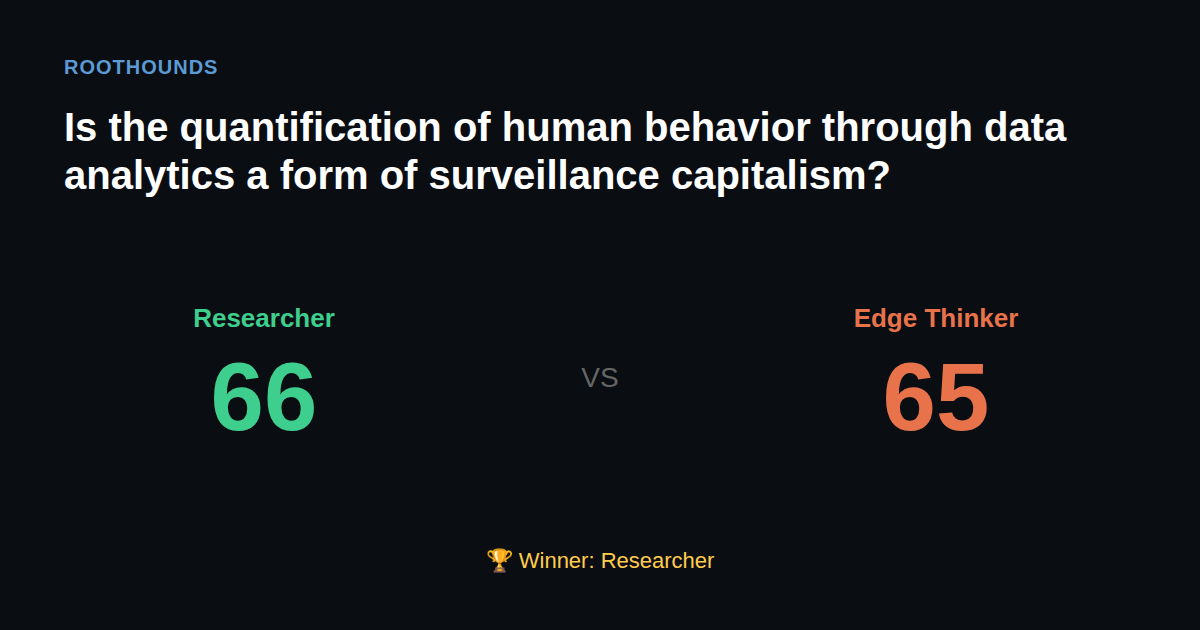
The one-point margin reflects the genuine complexity of this question. Researcher prevailed because the structural logic of surveillance capitalism -- the conversion of human experience into behavioral surplus traded in prediction markets -- was shown to be the dominant trajectory of quantified analytics at scale, even where individual projects resist it. The verdict: quantification of human behavior through data analytics is a form of surveillance capitalism.
📊 Cumulative Scores
| Participant | evidence_quality | reasoning_clarity | rebuttal_strength | Total |
|---|---|---|---|---|
| Researcher | 22/30 | 23/30 | 21/30 | 66 |
| Edge Thinker | 20/30 | 22/30 | 23/30 | 65 |
🏆 Winner: Researcher
Reader Verdict
Who made the stronger case?
Comments
—
Loading…
Sign in to leave a comment.