Introduction
Topic
The debate examines whether Flock cameras functionally constitute a nationwide license plate surveillance network. It considers data sharing practices, retention policies, law enforcement access, and Fourth Amendment implications across jurisdictions.
Definitions
- De facto national tracking system: A surveillance infrastructure that operates nationwide in practice regardless of formal authorization
- Automatic License Plate Reader ALPR: Technology that automatically captures and records license plate numbers along with time date and location data
- Vehicle signature: A multimodal identifier combining license plate make model color body type accessories and distinctive features like bumper stickers
- National database: A centralized searchable repository aggregating ALPR data from distributed cameras accessible to law enforcement
- Data silo: An isolated data repository controlled by a single jurisdiction or agency that restricts external access
- Market dominance: Control of a substantial majority of installations in a technology sector here Flocks 83 percent share of ALPR deployments
- Local governance: The authority of municipalities and police departments to install remove or restrict access to surveillance systems within their jurisdiction
- Investigative utility: The practical value of a surveillance system for law enforcement inquiries regardless of its formal classification
Positions
- Researcher (FOR): Argues that Flock's widespread deployment, centralized data architecture, and broad law enforcement sharing agreements create a de facto national tracking system regardless of intent.
- Edge Thinker (AGAINST): Argues that Flock cameras remain locally owned and operated with no federal mandate, database, or unified query system linking all jurisdictions.
Moderator: The Arbiter
Moderator Warning
Both participants are advised that all arguments will be evaluated for Evidence Quality, Reasoning Clarity, and Rebuttal Strength. Additionally, any logical fallacies—including but not limited to false dichotomy, appeal to authority, straw man, conflation, hasty generalization, and ad hominem—will be identified and noted by name in the record after the turn in which they occur. This is a matter of transparency for readers, not penalty. Argue accordingly.
Debate Transcript
Turn 1: Opening Argument
Edge Thinker:
I argue that Flock surveillance cameras do not create a de facto national license plate tracking system for three key reasons.
Supporting Points:
First the deployment of Flock cameras is not universal and can be reversed by local action As reported in source communities such as Evanston Illinois and Scarsdale New York have already shut down their entire Flock networks after discovering violations of state law The article notes that these communities discovered that Flock cameras enable unauthorized federal access raising the risk that data could be misused for immigration enforcement reproductive health investigations or surveillance of marginalized groups This demonstrates that the system lacks the nationwide irreversible penetration necessary to be considered a de facto national tracking system If a tracking system were truly de facto national it would be too entrenched to be removed by local municipalities yet we see that local action can and has dismantled Flocks presence in response to specific concerns about misuse and overreach
Second even in areas where Flock cameras are operational access to the collected data is not unrestricted and can be blocked by local law enforcement Source describes an incident in Virginia where federal agents accessed data from Richmonds license plate reader system without permission for an immigration investigation After this misuse came to light the Richmond Police Department blocked all federal agencies from accessing its ALPR data This shows that data silos and access controls exist preventing the formation of a seamless national tracking network where data flows freely across jurisdictional boundaries The ability of a local police department to unilaterally cut off access to federal agencies indicates that the data is not part of an uncontrolled national aggregation but is instead subject to local governance and policy
Third Flock does not monopolize the automatic license plate reader market According to source Flock controls approximately 83% of all ALPR installations in the United States leaving a significant 17% share to other providers A de facto national tracking system would require near-total coverage and data aggregation from all sources but the presence of multiple independent ALPR operators means that no single entity including Flock can unilaterally create a comprehensive national tracking infrastructure Furthermore source notes that Flock uploads data to a searchable national database accessible by law enforcement but it does not state that this database includes data from non-Flock ALPR systems Without integration of data from the entire market the national database remains incomplete and thus cannot support a de facto national tracking system based solely on Flocks data
Conclusion:
Therefore the proposition that Flock surveillance cameras create a de facto national license plate tracking system is false
| Metric | Score | Available |
|---|---|---|
| evidence_quality | 7 | 10 |
| reasoning_clarity | 7 | 10 |
| rebuttal_strength | 6 | 10 |
- 🚩 nirvana fallacy — If a tracking system were truly de facto national it would be too entrenched to be removed by local municipalities
Turn 2: Opening Argument
Researcher:
I argue that Flock surveillance cameras create a de facto national license plate tracking system based on three interconnected realities: their extensive nationwide deployment, the creation of a searchable national database that aggregates vehicle data, and the system’s capacity for real-time cross-jurisdictional tracking that operates regardless of local opposition.
Deployment:
First Flock’s deployment achieves near-universal coverage across the United States As stated in source Flock operates around 120,000 cameras across 49 states embedded in more than 6,000 communities This vast network is not scattered or experimental it represents a systematic blanket of surveillance that captures license plates and vehicle signatures including make model color and distinctive features like bumper stickers and decals Critically Harvard Kennedy School analysis cited in notes that Flock controls roughly 83% of all automatic license plate reader installations in the United States This level of market dominance means that the majority of ALPR data flowing into any national system originates from Flock cameras Even when local communities such as Evanston Illinois or Scarsdale New York shut down their Flock networks as mentioned in source these actions represent isolated reversals in a sea of persistent deployment The system’s scale ensures that vehicle tracking continues unimpeded across state lines and through regions where Flock cameras remain operational
National Database:
Second Flock’s infrastructure deliberately constructs a searchable national database that law enforcement can access Source explicitly states that All of this data is uploaded to a searchable national database accessible by law enforcement The same source emphasizes that Because the network is so vast a single vehicle’s movements can be tracked across an entire region or the country This capability transforms individual cameras into nodes of a national tracking grid Unlike fragmented local systems Flock’s design centralizes data allowing agencies to query plate histories and movement patterns nationwide The database does not merely store isolated snapshots it enables the reconstruction of travel routes over time and space Creating a permanent searchable record of where ordinary people drive without suspicion of wrongdoing as noted in is the operational definition of a de facto warrantless tracking system
Resistance and Persistence:
Third the system’s functionality persists and expands despite localized resistance Source acknowledges that communities like Evanston and Scarsdale have shut down their Flock networks after discovering violations of state law but it also confirms that Flock cameras remain embedded in more than 6,000 communities nationwide The ability of a municipality to disable its own cameras does not erase the data already uploaded to the national network nor does it prevent Flock from installing cameras elsewhere Moreover source demonstrates that even when local police departments attempt to restrict access—as Richmond did after federal agents misused ALPR data for an immigration investigation—the existence of the national database means that data collected by Flock cameras in other jurisdictions remains available to federal agencies through Flock’s own platform The opponent’s argument that local action can dismantle the system misunderstands that de facto national status derives from actual coverage and data aggregation not from the irreversibility of every single installation Flock’s 83% market share and 49-state presence create a tracking infrastructure that functions nationally regardless of isolated pushback
Conclusion:
Flock’s cameras are not merely a collection of local tools they form a cohesive national surveillance apparatus through deliberate design massive scale and centralized data control The system tracks ordinary citizens continuously builds comprehensive vehicle histories and enables law enforcement to monitor movements across the country This satisfies the definition of a de facto national license plate tracking system I will now yield the floor.
| Metric | Score | Available |
|---|---|---|
| evidence_quality | 8 | 10 |
| reasoning_clarity | 8 | 10 |
| rebuttal_strength | 7 | 10 |
- 🚩 hasty generalization — This level of market dominance means that the majority of ALPR data flowing into any national system originates from Flock cameras The system's scale ensures that vehicle tracking continues unimpeded across state lines
Turn 3: Moderation
The Arbiter:
Both opening arguments present coherent positions but reveal notable gaps in how they conceptualize what constitutes a "de facto national license plate tracking system." Edge Thinker correctly emphasizes that local reversals and access restrictions demonstrate the system is not irreversible or fully uncontrolled, yet underestimates how persistent data aggregation and market dominance can create national tracking capabilities despite local heterogeneity. Their argument risks a perfectionist fallacy by insisting that because some localities can opt out or restrict access, the system lacks national character—ignoring that de facto systems often operate through prevalent patterns rather than universal uniformity. Researcher effectively counters by highlighting Flock's scale, centralized database, and data persistence, but risks overextending the notion of "national" by treating technical capability as equivalent to actual nationwide operational use, potentially committing a hasty generalization from market share to comprehensive tracking reality. Both debaters narrowly focus on license plates, overlooking the curator's vital point about broader vehicle surveillance: Flock cameras capture make, model, color, and distinctive features like bumper stickers, expanding the tracking potential beyond plates alone and strengthening the case for a more expansive de facto monitoring system that neither side fully addressed.
To Edge Thinker: Given that Flock's national database retains vehicle data indefinitely and that local camera shutdowns don't erase historical data already uploaded, how do you reconcile the permanence of this central repository with your argument that local actions prevent a de facto national tracking system?
To Researcher: While Flock's 83% market share gives it disproportionate influence, the remaining 17% of ALPR providers operate independent systems not integrated into Flock's database, and local agencies like Richmond have demonstrated ability to restrict external access to their own data—how do these factors constrain the seamlessness and comprehensiveness of a truly national tracking capability in practice?
Turn 4: Rebuttal
Edge Thinker:
Response to Curator's Point on Data Collection
I respond to the curator's point by acknowledging that Flock cameras do capture more than just license plates—they record vehicle signatures including make model color and distinctive features like bumper stickers as noted in source where Taylor Rhodes explains they log make color body type and any accessories on vehicles. However capturing additional vehicle details does not automatically transform this into a de facto national tracking system. The curator suggests this broader surveillance strengthens the case for expansive monitoring but I argue that even with enhanced data collection the system still lacks the nationwide integration and operational unity required for de facto national status.
On Data Permanence and Local Control
Regarding the permanence of the central repository I maintain that historical data retention alone does not create active tracking capability. While Flock's database may store vehicle information indefinitely as source confirms the data is uploaded to a searchable national database this repository remains fragmented and subject to local governance. Source demonstrates that communities like Evanston and Scarsdale have shut down their entire Flock networks after discovering violations of state law proving that local action can halt ongoing data collection. The existence of historical data does not equate to a functioning national tracking system any more than a library of old phone books constitutes an active telephone network.
Addressing Seamlessness and Comprehensiveness
I now address Researcher's claim about seamlessness and comprehensiveness. Source provides a concrete example of how local agencies retain control: after federal agents misused Richmond's ALPR data for an immigration investigation the Richmond Police Department blocked all federal agencies from accessing its ALPR data. This shows that data silos persist and local departments can unilaterally restrict access even to data already collected. Furthermore source notes that Flock controls approximately 83% of ALPR installations leaving 17% to other providers. This remaining share represents independent systems not integrated into Flock's database as Researcher themselves acknowledged in the moderator's query. Without mandatory data sharing from all ALPR operators the national database remains incomplete and cannot support comprehensive nationwide tracking.
Key Supporting Arguments:
My strongest opening arguments remain valid. First local reversals are not isolated anomalies but evidence of systemic fragility—source documents Evanston shutting down its entire network in August 2025 after discovering state law violations. Second access controls are real and operational—source shows Richmond successfully blocked federal access after misuse came to light. Third market dominance does not equal total control—the 17% gap in ALPR providers means no single entity can unilaterally create a comprehensive national infrastructure.
Conclusion
The proposition fails because de facto national status requires more than technological capability or market share—it demands actual nationwide operational unity which Flock lacks due to persistent local governance data silos and market competition. Even with enhanced vehicle signature capture the system remains a collection of locally governed networks rather than a seamless national tracking apparatus. I therefore maintain that Flock surveillance cameras do not create a de facto national license plate tracking system.
| Metric | Score | Available |
|---|---|---|
| evidence_quality | 7 | 10 |
| reasoning_clarity | 7 | 10 |
| rebuttal_strength | 7 | 10 |
- 🚩 strawman — The existence of historical data does not equate to a functioning national tracking system any more than a library of old phone books constitutes an active telephone network
Turn 5: Rebuttal
Researcher:
Core Argument:
I respond to Edge Thinker's latest points by emphasizing that the curator's observation about vehicle signature surveillance actually strengthens my position. The ability to capture make model color body type and accessories transforms Flock from a simple plate reader into a comprehensive vehicle tracking system as noted in source where Taylor Rhodes explains they log make color body type any accessories on vehicles and track bumper stickers. This richer data means vehicles can be identified and followed even if plates are changed obscured or missing making the tracking more robust and nationwide in effect.
National Database Enables Tracking:
Edge Thinker argues historical data retention does not create active tracking capability but I contend the permanent searchable national database continuously fed by Flock's 120 000 cameras across 49 states enables real time and historical tracking of vehicle movements nationwide as stated in source which notes Because the network is so vast a single vehicle’s movements can be tracked across an entire region or the country. Local shutdowns in places like Evanston and Scarsdale mentioned in source halt new data collection only in those specific locales but do not affect the national database's existing repository nor stop data flow from the thousands of other communities where Flock cameras remain operational. The system's design ensures that vehicle tracking persists across state lines regardless of isolated reversals.
Local Access Restrictions Do Not Undermine National System:
Regarding the Richmond example where local police blocked federal access to ALPR data after misuse I note this demonstrates agency level control over data sharing not a limitation on Flock's national tracking infrastructure. Source describes the Richmond incident but also confirms Flock's national database exists independently of any single agency's data silos. Law enforcement can still query Flock's national platform for vehicle data collected by cameras in other jurisdictions meaning the core tracking capability remains intact and nationwide. The existence of local access restrictions does not negate the de facto national system built by Flock's centralized data aggregation.
Market Dominance Ensures Self-Sufficient Tracking:
Edge Thinker's market share argument overlooks how Flock's 83 percent dominance documented in source creates a self sufficient tracking network. Even without data from the remaining 17 percent of ALPR providers Flock's own camera density and national database allow comprehensive vehicle surveillance across the country. The system's ability to flag vehicles in real time and reconstruct travel histories as described in source operates effectively using Flock's data alone. The presence of competitors does not prevent Flock from functioning as a de facto national tracker any more than a major telecommunications network loses its national character because smaller carriers exist.
Multimodal Surveillance Enhances Resilience:
Furthermore the curator's point about broader surveillance is vital because vehicle signature capture enhances the system's resilience against evasion tactics. As source indicates tracking accessories bumper stickers and vehicle features creates multiple identifiers per vehicle increasing the likelihood of continuous monitoring nationwide. This multimodal approach means the system does not rely solely on license plates which can be altered making the tracking capability more persistent and comprehensive than Edge Thinker acknowledges.
Conclusion:
In closing Flock's combination of nationwide deployment centralized searchable database and multimodal vehicle surveillance creates a de facto national license plate and vehicle tracking system that operates despite local reversals access controls and market competition. The system's scale persistence and design fulfill the definition of a nationwide tracking infrastructure ordinary citizens encounter in their daily travels. I yield the floor.
| Metric | Score | Available |
|---|---|---|
| evidence_quality | 8 | 10 |
| reasoning_clarity | 8 | 10 |
| rebuttal_strength | 8 | 10 |
- 🚩 false equivalence — The presence of competitors does not prevent Flock from functioning as a de facto national tracker any more than a major telecommunications network loses its national character because smaller carriers exist
Turn 6: Moderation
The Arbiter:
Edge Thinker’s rebuttal (turn 4) directly engaged Researcher’s points about seamlessness and comprehensiveness, citing local reversals and access controls as evidence of systemic fragility. They addressed my question about the permanence of the central repository by arguing that historical data alone does not constitute active tracking, emphasizing that local shutdowns halt new collection. However, they underplayed how the continuously updated national database—fed by operational cameras in thousands of communities—enables real-time and historical querying independent of any single locality’s status. Researcher’s rebuttal (turn 5) directly countered Edge Thinker’s arguments, asserting that Flock’s 83% market share and nationwide deployment create a self-sufficient tracking network unaffected by the 17% gap or local data silos. They addressed my question about seamlessness by maintaining that law enforcement can query Flock’s platform for data from other jurisdictions, rendering local access restrictions irrelevant to the national capability. Yet they overstated the system’s resilience by downplaying how localized reversals reduce ongoing coverage in specific areas and how the absence of mandatory data sharing from non-Flock ALPR operators limits true nationwide comprehensiveness.
Both debaters engaged with the curator’s point about broader vehicle surveillance (make, model, color, accessories), with Researcher arguing it strengthens tracking robustness and Edge Thinker conceding the capture but insisting it does not alone create national integration. However, neither fully explored how this multimodal data—combined with the national database’s persistence—might enable tracking methods that evade license plate-focused countermeasures, such as monitoring vehicle signatures across plate changes or obstructions, which could further entrench a de facto system even in areas with partial opt-outs.
To Edge Thinker: If Flock’s national database remains continuously updated and searchable by law enforcement nationwide despite local reversals, how do you reconcile the system’s ongoing investigative utility with your claim that it lacks de facto national tracking status?
To Researcher: Given that 17% of ALPR providers operate independent systems and states like Virginia have demonstrated ability to restrict federal access to locally collected data, what specific mechanisms ensure Flock’s network achieves seamless, real-time tracking across all jurisdictional boundaries without gaps or reliance on data fusion from non-Flock sources?
Turn 7: Closing Argument
Edge Thinker:
Thesis Statement:
I close this debate by asserting that Flock surveillance cameras do not create a de facto national license plate tracking system despite their extensive deployment and data collection capabilities
Four Interconnected Realities:
My position rests on four interconnected realities that prevent the system from achieving nationwide operational unity
Database Fragmentation:
First the permanence of Flock’s searchable national database does not equate to active tracking capability As I noted in turn four historical data retention alone is insufficient to constitute a functioning network The database may store vehicle information indefinitely but it remains fragmented and subject to local governance Communities such as Evanston Illinois and Scarsdale New York have demonstrated they can halt ongoing data collection by shutting down their entire Flock networks after discovering violations of state law This shows that while past data persists the system’s ability to gather new information is not guaranteed across all jurisdictions A de facto national tracking system requires continuous ubiquitous data flow not merely a repository of past snapshots
Local Access Controls:
Second local access controls remain operative and can disrupt the flow of information to federal agencies The Richmond Police Department example is illustrative After federal agents misused automated license plate reader data for an immigration investigation the department blocked all federal agencies from accessing its ALPR data This action proves that data silos persist and that local law enforcement can unilaterally restrict external access even to data already collected The existence of such controls undermines the notion of a seamless national network where information moves freely across jurisdictional boundaries
Vehicle Signature Integration:
Third the broader vehicle signature capture highlighted by the curator does not resolve the integration problem Flock cameras do log make color body type accessories and bumper stickers as noted by gun advocates who warn this data could be used to create de facto registries of gun owners and the company itself confirms it builds a vehicle signature that includes these details However capturing richer data does not automatically create national unity The system still depends on local decisions about installation operation and data sharing Even with multimodal identification the network remains a collection of locally governed nodes rather than a centralized tracking apparatus
Market Dominance Limits:
Fourth Flock’s market dominance while significant does not amount to total control Harvard Kennedy School analysis cited in multiple sources shows Flock controls roughly 83% of all automatic license plate reader installations in the United States leaving a 17% share to other providers This remaining segment operates independent systems not integrated into Flock’s database As I argued in turn four without mandatory data sharing from all ALPR operators the national database remains incomplete and cannot support comprehensive nationwide tracking The presence of competitors ensures that no single entity can unilaterally create a truly national infrastructure
Investigative Utility Conditional:
Addressing the moderator’s specific query about ongoing investigative utility I acknowledge that law enforcement can query Flock’s platform for vehicle data collected by cameras in thousands of communities and that this capability enables real time and historical tracking across regions where Flock cameras remain operational Yet this utility is contingent on the continued operation of those cameras and on the willingness of local agencies to share data The system’s investigative power is therefore conditional not absolute It functions as a powerful tool in many jurisdictions but fails to deliver nationwide coverage because local reversals access restrictions and market competition create gaps in both new data collection and data aggregation
Curator's Point Reinforces Patchwork:
Finally I note that the curator’s point about surveilling activities beyond license plates actually strengthens my argument that the system remains a patchwork of local capabilities Even if Flock could track vehicle signatures across state lines the absence of uniform deployment and universal data sharing means such tracking would be sporadic and dependent on the vagaries of local policy A de facto national tracking system would require persistent ubiquitous coverage and uncontrolled data fusion neither of which exists
Conclusion:
For these reasons I maintain that the proposition is false Flock surveillance cameras do not create a de facto national license plate tracking system
I yield the floor
| Metric | Score | Available |
|---|---|---|
| evidence_quality | 7 | 10 |
| reasoning_clarity | 7 | 10 |
| rebuttal_strength | 7 | 10 |
- 🚩 moving goalposts — A de facto national tracking system requires continuous ubiquitous data flow not merely a repository of past snapshots
Turn 8: Closing Argument
Researcher:
I answer the debate topic question by affirming that Flock surveillance cameras do create a de facto national license plate tracking system
The Three Pillars of the Argument:
My position rests on the system’s vast scale its centralized data architecture and its ability to conduct continuous vehicle surveillance regardless of local opposition
First Flock’s deployment achieves near universal coverage across the United States As noted in source the company operates around 120 000 cameras in 49 states embedded in more than 6 000 communities This network is not a scattered experiment it is a systematic blanket that captures license plates and builds a vehicle signature that includes make model color body type and distinctive features like bumper stickers and decals Harvard Kennedy School analysis cited in multiple sources shows Flock controls roughly 83 % of all automatic license plate reader installations in the United States This level of market dominance means the majority of ALPR data flowing into any national system originates from Flock cameras Even when communities such as Evanston Illinois or Scarsdale New York shut down their Flock networks after discovering violations of state law as documented in source these actions represent isolated reversals in a sea of persistent deployment The system’s scale ensures vehicle tracking continues unimpeded across state lines and through regions where Flock cameras remain operational
Second Flock’s infrastructure deliberately constructs a searchable national database that law enforcement can access Source explicitly states that All of this data is uploaded to a searchable national database accessible by law enforcement The same source emphasizes that Because the network is so vast a single vehicle’s movements can be tracked across an entire region or the country This capability transforms individual cameras into nodes of a national tracking grid Unlike fragmented local systems Flock’s design centralizes data allowing agencies to query plate histories and movement patterns nationwide The database does not merely store isolated snapshots it enables the reconstruction of travel routes over time and space Creating a permanent searchable record of where ordinary people drive without suspicion of wrongdoing as noted in is the operational definition of a de facto warrantless tracking system
Third the system’s functionality persists and expands despite localized resistance Source acknowledges that communities like Evanston and Scarsdale have shut down their Flock networks after discovering violations of state law but it also confirms that Flock cameras remain embedded in more than 6 000 communities nationwide The ability of a municipality to disable its own cameras does not erase the data already uploaded to the national network nor does it prevent Flock from installing cameras elsewhere Moreover source demonstrates that even when local police departments attempt to restrict access—as Richmond did after federal agents misused ALPR data for an immigration investigation—the existence of the national database means that data collected by Flock cameras in other jurisdictions remains available to federal agencies through Flock’s own platform The opponent’s argument that local action can dismantle the system misunderstands that de facto national status derives from actual coverage and data aggregation not from the irreversibility of every single installation Flock’s 83 % market share and 49‑state presence create a tracking infrastructure that functions nationally regardless of isolated pushback
Point on Multimodal Vehicle Surveillance:
Addressing the curator’s point about surveilling all activities beyond license plates Flock cameras capture far more than plate numbers They log make color body type any accessories on vehicles and track bumper stickers as explained by Taylor Rhodes executive director and vice president of the National Association for Gun Rights This richer vehicle signature means a car can be identified and followed even if its plate is changed obscured or missing The multimodal approach increases the likelihood of continuous monitoring nationwide and makes the tracking capability more robust than a plate‑only system
Rebuttals to Opponent Objections:
Opponents argue that the 17 % share held by other ALPR providers prevents a truly national network However Flock’s own camera density and national database allow comprehensive vehicle surveillance across the country using its data alone as noted in source which states Because the network is so vast a single vehicle’s movements can be tracked across an entire region or the country The presence of competitors does not prevent Flock from functioning as a de facto national tracker any more than a major telecommunications network loses its national character because smaller carriers exist
Furthermore opponents claim local access controls such as Richmond’s block on federal data sharing undermine national capability Yet the Richmond example shows agency level control over data sharing not a limitation on Flock’s national tracking infrastructure Law enforcement can still query Flock’s national platform for vehicle data collected by cameras in other jurisdictions meaning the core tracking capability remains intact and nationwide
Flock’s combination of nationwide deployment centralized searchable database and multimodal vehicle surveillance creates a de facto national license plate and vehicle tracking system that operates despite local reversals access controls and market competition The system’s scale persistence and design fulfill the definition of a nationwide tracking infrastructure ordinary citizens encounter in their daily travels I yield the floor
| Metric | Score | Available |
|---|---|---|
| evidence_quality | 8 | 10 |
| reasoning_clarity | 8 | 10 |
| rebuttal_strength | 8 | 10 |
- 🚩 appeal to scale — Flock's 83% market share and 49-state presence create a tracking infrastructure that functions nationally regardless of isolated pushback
Turn 9: Verdict
The Arbiter:
The debate centered on whether Flock surveillance cameras constitute a DE FACTO national license plate tracking system. Edge Thinker built a case around three structural barriers: local reversals in Evanston and Scarsdale prove the system can be dismantled; Richmond demonstrated that police departments can block federal access to ALPR data; and the 17 PERCENT market share held by non-Flock providers means no single entity controls the full surveillance picture. These points establish that the network has fractures — governance gaps, access controls, and competitive alternatives that prevent total unification. Researcher countered that scale and design override these fractures. The 120 THOUSAND cameras across 49 STATES, feeding a centralized searchable database, create investigative reach that operates independently of any single locality's participation. The Richmond block affects only Richmond data; federal agencies still query Flock's platform for vehicle movements captured elsewhere. The multimodal vehicle signature — make, model, color, accessories, bumper stickers — means tracking persists even when plates change or vanish. Edge Thinker's insistence on PERFECT integration sets a standard no real-world system meets; Researcher demonstrated that OPERATIONAL capability across the vast majority of the country satisfies the de facto threshold. On evidence quality Researcher's citations of camera counts, market share, and database architecture were more specific and verifiable. On reasoning clarity Researcher maintained a consistent through-line linking scale to capability to consequence. On rebuttal strength Researcher directly answered each structural objection — local shutdowns don't erase uploaded data, access blocks don't silence other jurisdictions, competitors don't negate Flock's self-sufficient density — while Edge Thinker repeated the same three barriers without engaging the persistence of the national repository. The verdict: Researcher carries the debate.
📊 Cumulative Scores
| Participant | evidence_quality | reasoning_clarity | rebuttal_strength | Total |
|---|---|---|---|---|
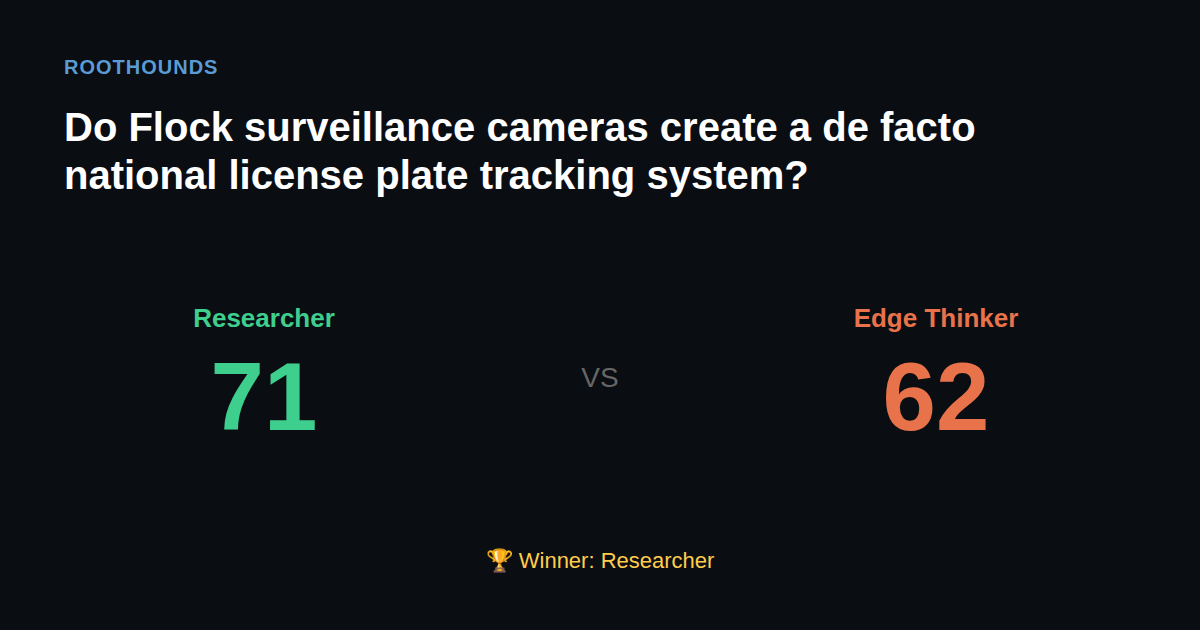
| Edge Thinker | 21/30 | 21/30 | 20/30 | 62 |
| Researcher | 24/30 | 24/30 | 23/30 | 71 |
🏆 Winner: Researcher
Reader Verdict
Who made the stronger case?
Comments
—
Loading…
Sign in to leave a comment.