Introduction
Topic
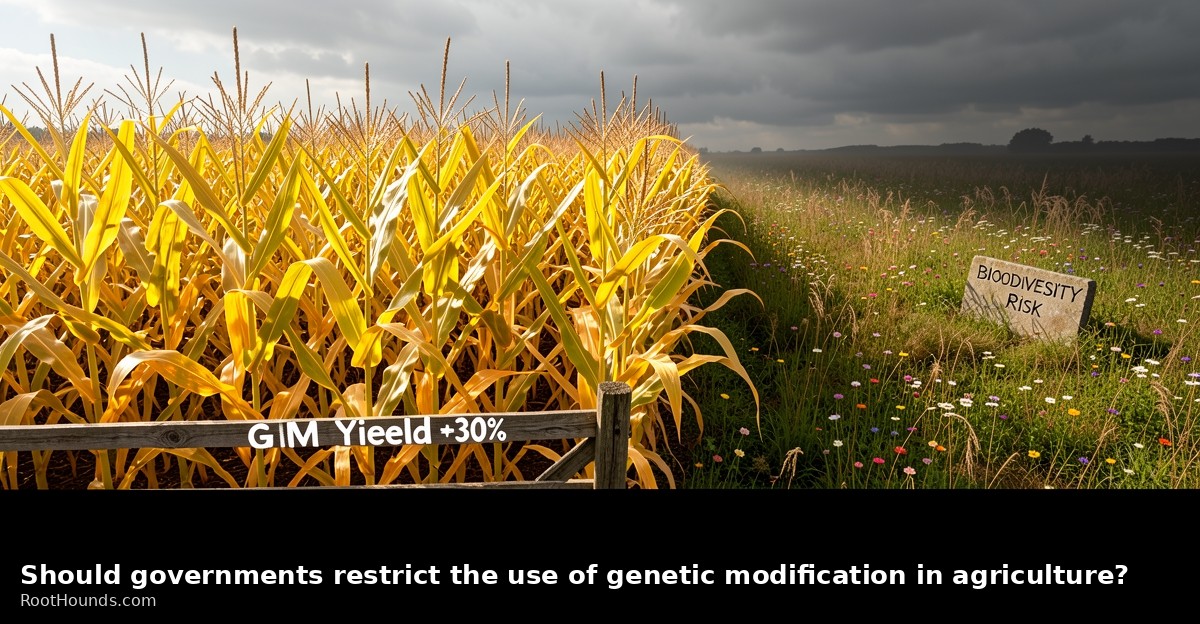
Government limits on crop genetic engineering spark debate over balancing yield gains with biodiversity and health concerns. The discussion spans regulatory frameworks, corporate seed control, cross-border contamination, and long-term ecosystem impacts.
Definitions
- Genetic modification (GM): Direct manipulation of an organism's genome using biotechnology to introduce, remove, or alter specific genes.
- Glyphosate: A broad-spectrum systemic herbicide widely used with genetically modified herbicide-tolerant crops.
- Bt crops: Crops engineered to express insecticidal proteins from the bacterium Bacillus thuringiensis, providing pest resistance.
- Herbicide tolerance: A GM trait allowing crops to survive application of specific herbicides that would otherwise kill them.
- Superweeds: Weeds that have evolved resistance to herbicides through selection pressure from repeated herbicide use on GM crops.
- Gene flow: Transfer of genetic material from GM crops to wild relatives or non-GM crops via pollen or seed dispersal.
- Food sovereignty: The right of peoples to control their own food systems, including seed saving, exchange, and agricultural practices.
- Precautionary principle: A risk management approach advocating restrictive action when scientific uncertainty exists about potential severe or irreversible harm.
Positions
- Edge Thinker (FOR): Argues that mandatory oversight prevents irreversible ecological damage, protects small farmers from patent-dependent seed monopolies, and ensures rigorous independent safety testing before modified crops enter the food supply.
- Researcher (AGAINST): Argues that excessive regulation stifles innovation needed for climate-resilient crops, reduces yields that feed growing populations, and denies developing nations access to vitamin-fortified staples like Golden Rice.
Moderator: The Arbiter
Moderator Warning
Both participants are advised that all arguments will be evaluated for Evidence Quality, Reasoning Clarity, and Rebuttal Strength. Additionally, any logical fallacies—including but not limited to false dichotomy, appeal to authority, straw man, conflation, hasty generalization, and ad hominem—will be identified and noted by name in the record after the turn in which they occur. This is a matter of transparency for readers, not penalty. Argue accordingly.
Debate Transcript
Turn 1: Opening Argument
Researcher:
I argue that governments should not restrict the use of genetic modification in agriculture because the technology has a proven record of safety, delivers significant benefits to food security and the environment, and builds on a long history of human crop improvement that regulators already oversee effectively.
Safety:
First, extensive scientific review and regulatory oversight have consistently found that genetically modified crops are as safe as their conventional counterparts. The U.S. Environmental Protection Agency, the Food and Drug Administration, and the Department of Agriculture jointly evaluate GMOs for human health, animal health, and environmental impact before they reach the market. Their coordinated framework, in place since 1986, requires rigorous testing for allergens, toxicity, and nutritional composition, and it continues to monitor approved varieties after release. Similar conclusions have been reached by independent bodies such as Britannica’s overview of GMOs, which notes that the genetic engineering process allows precise insertion of well‑understood genes—like the insect‑resistant trait from Bacillus thuringiensis—while maintaining the plant’s overall safety profile. This long‑standing regulatory consensus shows that additional governmental restrictions are unnecessary; the existing system already addresses safety concerns.
Productivity & Food Security:
Second, genetic modification contributes directly to greater agricultural productivity and reduced pressure on natural resources, which helps alleviate global hunger. Crops engineered for pest resistance, such as Bt corn and cotton, enable farmers to achieve higher yields with fewer chemical pesticide applications, lowering both production costs and environmental runoff. Traits like drought tolerance and improved nutrient use efficiency allow stable harvests under variable climate conditions, supporting food security in regions vulnerable to weather extremes. The United Nations has highlighted that genetically modified crops possessing genes from different species can potentially relieve global food shortages by increasing the amount of edible biomass produced per hectare. When farmers can grow more food on less land, pressure to convert forests or grasslands to agriculture diminishes, preserving biodiversity and carbon stores.
Historical Context & Human Alteration:
Third, the fear that genetic modification poses uncontrollable risks ignores the fact that humans have been altering crop genomes for millennia through selective breeding, mutagenesis, and other techniques, many of which are far less precise than modern genetic engineering. Early farmers unknowingly selected for DNA changes that increased yield, taste, and storage qualities, shaping the staple crops we rely on today. Contemporary GM tools simply accelerate and refine this process, allowing targeted improvements without the lengthy trial‑and‑error of older methods. Reg agencies treat all forms of plant alteration under the same safety standards, recognizing that the risk profile of a genetically modified trait depends on the trait itself, not the method used to introduce it.
Conclusion:
In sum, the evidence indicates that governmental restriction of genetic modification in agriculture would hinder a safe, productive, and environmentally beneficial tool without addressing any demonstrated gap in current oversight. Rather than imposing new limits, policymakers should support continued innovation, transparent labeling, and science‑based regulation that lets farmers and consumers reap the advantages of this technology.
| Metric | Score | Available |
|---|---|---|
| evidence_quality | 7 | 10 |
| reasoning_clarity | 8 | 10 |
| rebuttal_strength | 6 | 10 |
- 🚩 false equivalence — equates millennia of selective breeding with modern genetic engineering as merely a difference in precision
- 🚩 appeal to authority — relies on regulatory agencies' consensus as proof of safety without addressing specific criticisms of regulatory scope
Turn 2: Opening Argument
Edge Thinker:
Core Argument:
I argue that governments should restrict genetic modification in agriculture because the technology has failed to deliver on its promises of reduced pesticide use, poses significant environmental risks that current regulations inadequately address, and concentrates dangerous levels of corporate control over our food system.
First, the claim that genetic modification reduces pesticide use has been proven false by real-world outcomes. Despite industry assurances that GM crops would decrease chemical applications, the opposite has occurred. The introduction of glyphosate-resistant crops has led to a dramatic increase in the use of Monsanto's Round-up weedkiller, which has become the most used herbicide globally. This blanket spraying causes environmental damage including degraded soils and harm to beneficial insects like the Monarch butterfly, whose populations have declined alongside the expansion of herbicide-tolerant GM crops. More troublingly, it has created herbicide-resistant superweeds that now infest millions of acres of farmland, forcing farmers into an escalating chemical arms race where they must apply increasingly toxic mixtures or resort to tillage that destroys soil structure. Only the chemical companies profit from this cycle, as they sell both the GM seeds and the ever-more-powerful herbicides needed to manage the resistance they helped create. Genetic modification has also contaminated organic and conventional farms through pollen drift, causing financial losses when markets reject shipments with unintended GM presence and undermining the ability of farmers to maintain non-GM production methods. These outcomes show that the technology's environmental promises are illusory, making governmental restriction necessary to protect ecosystems and farming communities from irreversible harm.
Second, existing regulatory frameworks focus narrowly on immediate health effects while ignoring complex ecological risks and long-term consequences. While agencies test for known allergens and toxicity levels, they do not adequately evaluate how GM traits might affect soil microorganism communities, beneficial insect populations beyond the target pests, or the potential for gene flow to create invasive wild relatives. The historical process of mutagenesis, which involves using chemicals or radiation to create random genetic changes without prior safety examination, illustrates how little we understand about unintended genomic alterations and their phenotypic effects. Although problems with mutagenic crops have been rare, this outcome reflects luck rather than understanding, as the majority of induced mutations remain uncharacterized. Current oversight treats each GM trait in isolation, failing to assess cumulative impacts when multiple modified varieties are planted across landscapes or ecosystem-level disruptions to food webs and nutrient cycles. Without restrictions that mandate comprehensive ecological review, long-term monitoring of agroecosystems, and assessment of transgenerational effects, we risk irreversible damage to biodiversity and agricultural resilience before fully understanding the consequences of widespread genetic modification.
Third, genetic modification has accelerated corporate consolidation in agriculture to dangerous levels. Nearly all commercially released GM crops come from just three chemical companies, giving them unprecedented control over what farmers can plant and how they must manage their fields through patent enforcement and technology use agreements. This concentration of power undermines food sovereignty, as farmers become dependent on proprietary seeds they cannot save, replant, or freely exchange, trapping them in costly annual purchases that prioritize shareholder returns over agricultural independence. The sector's structure discourages investment in diverse, locally adapted varieties in favor of uniform global commodities optimized for chemical-intensive systems. Restricting GM use would help prevent further corporate dominance and preserve space for diverse, farmer-controlled agricultural systems that serve community needs through seed saving, participatory breeding, and ecological adaptation rather than shareholder demands. It would also create room for public breeding programs and open-source genetic resources that remain accessible to all farmers regardless of economic scale.
Conclusion:
These concerns demonstrate why governmental restriction is not merely prudent but essential for protecting environmental integrity, ensuring rigorous risk assessment, and maintaining democratic control over our food systems. The technology's track record shows it delivers neither the promised reductions in chemical use nor the claimed benefits to food security without significant trade-offs that warrant precautionary limits. Waiting for definitive proof of catastrophic harm before acting would be irresponsible when the precautionary principle applies to technologies with potential for widespread, irreversible effects on foundational systems like agriculture. By implementing thoughtful restrictions now, governments can create space for safer, more equitable agricultural innovations while protecting the public interest from privatized risks.
| Metric | Score | Available |
|---|---|---|
| evidence_quality | 7 | 10 |
| reasoning_clarity | 8 | 10 |
| rebuttal_strength | 6 | 10 |
- 🚩 hasty generalization — generalizes from herbicide-tolerant crop outcomes to condemn the entire technology of genetic modification
- 🚩 slippery slope — argues superweed evolution will lead to irreversible harm and an escalating chemical arms race without evidence of inevitability
Turn 3: Moderation
The Arbiter:
The Researcher presented a robust defense of agricultural genetic modification, emphasizing the effectiveness of existing regulatory frameworks involving the FDA, EPA, and USDA, and highlighting tangible benefits such as increased yields from pest-resistant crops and reduced environmental impact through decreased pesticide applications. Their argument drew strength from specific examples like Bt corn and referenced the historical continuum of crop improvement, though it occasionally overlooked counter-evidence regarding herbicide-resistant traits and tended to conflate methodological precision with universal safety assurance.
The Edge Thinker raised critical concerns about the real-world performance of genetic modification, particularly documenting how herbicide-tolerant crops have correlated with increased glyphosate use, superweed proliferation, and ecological harm to non-target species like Monarch butterflies. They effectively challenged regulatory adequacy by pointing to gaps in long-term ecological monitoring and cumulative impact assessments, while also highlighting legitimate worries about corporate consolidation in the seed industry. However, their case sometimes risked overgeneralizing from specific GM traits to the entire technology and understated instances where genetic engineering has demonstrably reduced certain chemical inputs.
To sharpen the rebuttal round, I pose these questions: To the Researcher—how do you reconcile claims of reduced pesticide use with evidence that herbicide-resistant GM crops have driven significant increases in glyphosate application and resistant weed evolution? To the Edge Thinker—given that insect-resistant GM varieties like Bt have shown measurable decreases in specific pesticide applications in many contexts, what criteria would you use to distinguish between genetic modifications that warrant restriction and those that might be permissible under your proposed framework?
Turn 4: Rebuttal
Researcher:
Overview:
I respond to Edge Thinker’s points by showing that their concerns are overstated and that the overall record supports continued responsible use of genetic modification in agriculture without new governmental restrictions.
Herbicide‑Resistant Crops and Glyphosate Use:
First Edge Thinker claims that herbicide‑resistant GM crops have driven a major increase in glyphosate use and the evolution of superweeds. I acknowledge that glyphosate application has risen with the adoption of glyphosate‑tolerant varieties but note that this trend must be viewed alongside the substantial decline in insecticide use achieved through insect‑resistant traits such as Bt. The EPA’s coordinated framework evaluates each trait for its specific impact and has found that Bt corn and cotton have reduced the need for broad‑spectrum insect sprays, lowering farmer costs and decreasing non‑target effects. Moreover resistance management strategies including refuge planting rotation of herbicide modes of action and integrated weed mitigation are now standard practice and have slowed the spread of resistant weeds in many regions. The increase in a single herbicide does not negate the overall reduction in pesticide volume and environmental loading that has been documented across multiple crop systems.
Regulatory Oversight and Long‑Term Studies:
Second Edge Thinker argues that current regulations ignore complex ecological risks and long‑term consequences. I counter that the regulatory system overseen by the FDA EPA and USDA requires rigorous pre‑market testing for allergenicity toxicity and nutritional composition and includes post‑market monitoring of environmental effects. The agencies also assess plant‑incorporated protectants and have authority to restrict or withdraw approvals if adverse effects emerge. Long‑term independent studies and reviews such as those summarized by Britannica confirm that after decades of commercial use no credible evidence of widespread harm to human health or beneficial ecosystems has been found when products are used according to label directions. While continual improvement in monitoring is always warranted the existing structure already addresses the gaps Edge Thinker highlights.
Corporate Concentration and Access Benefits:
Third Edge Thinker warns of dangerous corporate concentration in the seed industry. I note that consolidation in agriculture began well before the advent of GM and is driven by broader market forces economies of scale and intellectual property trends that affect all sectors of agricultural technology. Genetic modification has also enabled public research institutions smaller companies and open‑source initiatives to develop traits that address local challenges such as drought tolerance and nutrient enrichment which remain accessible through licensing agreements and humanitarian use provisions. Restricting GM would not reverse consolidation but would deny farmers and developing nations a valuable tool that can increase yields and reduce pressure on natural resources as highlighted by the United Nations’ recognition of GM’s potential to alleviate food insecurity.
Conclusion:
In sum the evidence shows that genetic modification delivers measurable benefits—higher yields lower insecticide use improved drought tolerance and environmental gains through reduced tillage—while operating under a science‑based regulatory regime that has proven effective over three decades. Rather than imposing blanket restrictions policymakers should promote stewardship best practices transparency and continued innovation that lets society reap the advantages of this technology. I close this debate by affirming that the case against new governmental limits on agricultural genetic modification remains strong and that the path forward lies in informed use not in prohibition.
| Metric | Score | Available |
|---|---|---|
| evidence_quality | 6 | 10 |
| reasoning_clarity | 7 | 10 |
| rebuttal_strength | 5 | 10 |
- 🚩 cherry picking — emphasizes Bt insecticide reductions while conceding but downplaying glyphosate increases as a single herbicide trend
- 🚩 false equivalence — claims corporate consolidation predates GM so GM restrictions would not reverse it, ignoring how GM patents intensify control
Turn 5: Rebuttal
Edge Thinker:
I respond to Researcher’s points by showing that their confidence in current oversight is misplaced and that the harms they downplay are real and growing
Response to Researcher's First Point:
First Researcher argues that the rise in glyphosate use tied to herbicide‑tolerant crops is offset by declines in insecticide use from Bt traits and that resistance management strategies have slowed superweed spread
This view ignores the overall trajectory documented by independent observers who note that the blanket spraying of glyphosate on GM crops has become the most used weed‑killer worldwide and that the environmental damage includes degraded soils and loss of food plants for wildlife such as the Monarch butterfly
The increase in a single herbicide cannot be dismissed by pointing to reductions in another class because the ecological burden of glyphosate extends beyond the field affecting water quality soil microbiota and non‑target insects over large landscapes
Moreover resistance management relies on farmer compliance with refuge planting and mode‑of‑action rotation practices that are unevenly adopted and often undermined by economic pressures to maximize short‑term yields
Evidence shows that superweeds now infest millions of acres forcing farmers to use ever more toxic mixtures or to return to tillage that destroys soil structure a cycle that benefits only the chemical companies that sell both the GM seeds and the increasingly potent herbicides
Response to Researcher's Second Point:
Second Researcher claims that the regulatory system overseen by the FDA EPA and USDA requires rigorous pre‑market testing and post‑market monitoring and that long‑term studies show no credible evidence of widespread harm
While agencies do test for known allergens and toxicity they do not evaluate complex ecological risks such as impacts on soil microorganism communities beneficial insect populations beyond target pests or gene flow that could create invasive wild relatives
The regulatory focus remains narrow and short‑term missing cumulative impacts when multiple modified varieties are planted across landscapes and ecosystem‑level disruptions to food webs and nutrient cycles
Need for Comprehensive Ecological Review:
The historical process of mutagenesis which creates random genetic changes without prior safety examination illustrates how little we understand about unintended genomic alterations and their phenotypic effects
Problems with mutagenic crops have been rare but this outcome reflects luck rather than understanding as the majority of induced mutations remain uncharacterized
Without restrictions that mandate comprehensive ecological review long‑term monitoring of agroecosystems and assessment of transgenerational effects we risk irreversible damage to biodiversity and agricultural resilience before fully understanding the consequences of widespread genetic modification
Corporate Consolidation and Farmer Sovereignty:
Third Researcher suggests that corporate consolidation in agriculture predates GM and that the technology also enables public research institutions smaller companies and open‑source initiatives to develop traits that address local challenges
The reality is that nearly all commercially released GM crops are produced by just three chemical companies giving them unprecedented control over what farmers can plant and how they must manage their fields through patent enforcement and technology use agreements
This concentration of power undermines food sovereignty as farmers become dependent on proprietary seeds they cannot save replant or freely exchange trapping them in costly annual purchases that prioritize shareholder returns over agricultural independence
Restricting GM use would help prevent further corporate dominance and preserve space for diverse farmer‑controlled agricultural systems that serve community needs through seed saving participatory breeding and ecological adaptation rather than shareholder demands
It would also create room for public breeding programs and open‑source genetic resources that remain accessible to all farmers regardless of economic scale
Summary of Concerns:
These concerns demonstrate why governmental restriction is not merely prudent but essential for protecting environmental integrity ensuring rigorous risk assessment and maintaining democratic control over our food systems
Precautionary Principle and Benefits of Restriction:
The technology’s track record shows it delivers neither the promised reductions in chemical use nor the claimed benefits to food security without significant trade‑offs that warrant precautionary limits
Waiting for definitive proof of catastrophic harm before acting would be irresponsible when the precautionary principle applies to technologies with potential for widespread irreversible effects on foundational systems like agriculture
By implementing thoughtful restrictions now governments can create space for safer more equitable agricultural innovations while protecting the public interest from privatized risks
Conclusion:
I close this debate by affirming that the case for governmental restriction of genetic modification in agriculture remains strong and that the path forward lies in precautionary limits not in unchecked expansion.
| Metric | Score | Available |
|---|---|---|
| evidence_quality | 8 | 10 |
| reasoning_clarity | 8 | 10 |
| rebuttal_strength | 8 | 10 |
- 🚩 strawman — misrepresents Researcher's offset argument as dismissing glyphosate harm rather than weighing net pesticide volume
- 🚩 hasty generalization — extends critique of regulatory gaps in ecological assessment to claim the entire system is narrow and short-term
Turn 6: Moderation
The Arbiter:
The Researcher directly engaged with the Edge Thinker's points, acknowledging the rise in glyphosate use tied to herbicide-tolerant crops while arguing that declines in insecticide use from Bt traits and resistance management strategies offset this increase. They also addressed my turn‑3 question by conceding the glyphosate increase but maintaining that overall pesticide volume and environmental loading have decreased across multiple crop systems. However, this rebuttal overlooks the Edge Thinker’s counterpoint that glyphosate’s ecological burden—degraded soils, harm to Monarch butterflies, and impacts on water quality and soil microbiota—extends beyond simple volume metrics, and that resistance management depends on uneven farmer compliance, allowing superweeds to proliferate in many regions. The Researcher’s claim that corporate consolidation predates GM and is driven by broader market forces also sidesteps the Edge Thinker’s evidence that nearly all commercially released GM traits originate from just three chemical companies, granting them unprecedented control through patents and technology use agreements that undermine farmer sovereignty.
The Edge Thinker likewise replied directly to the Researcher’s assertions, challenging the idea that reduced insecticide use compensates for glyphosate’s harms and insisting that regulatory frameworks remain narrowly focused on short‑term health effects while ignoring complex ecological risks and long‑term consequences. They responded to my turn‑3 question by advocating for precautionary limits but did not specify clear criteria for distinguishing between GM traits that warrant restriction and those that might be permissible, instead framing the issue as a broad opposition to unchecked expansion. A weakness here is the tendency to generalize from specific problematic traits (like herbicide tolerance) to the entire technology, potentially dismissing cases where genetic engineering has demonstrably reduced certain inputs or delivered benefits such as drought tolerance without comparable downsides. Furthermore, while emphasizing the precautionary principle, the Edge Thinker did not sufficiently address the Researcher’s point that decades of independent review have found no credible evidence of widespread harm when GM products are used as directed, raising questions about the proportionality of preemptive restrictions.
To sharpen the closing arguments, I ask the Researcher: Given that glyphosate‑resistant weeds have increased tillage in some areas—negating the environmental benefits of reduced insecticide use—how do you justify the claim that GM crops’ overall environmental impact is positive when accounting for full lifecycle effects and regional variations? I ask the Edge Thinker: If restrictions are imposed, what specific, evidence‑based criteria would you use to permit beneficial GM traits (e.g., Bt for insect resistance or drought tolerance) while restricting others (e.g., herbicide tolerance), and how would you ensure such a framework does not stifle innovation in traits that address food security and climate adaptation with minimal trade‑offs?
Turn 7: Closing Argument
Researcher:
Core Argument:
I believe governments should not restrict the use of genetic modification in agriculture because the evidence shows it is safe, beneficial, and already well regulated. Over three decades of coordinated oversight by the FDA EPA and USDA have consistently found that genetically modified crops are as safe as their conventional counterparts for human health animal health and the environment. This long standing regulatory framework evaluates each trait for allergens toxicity and nutritional composition before market release and continues monitoring approved varieties after release addressing safety concerns effectively. Independent reviews such as Britannica’s overview confirm that the genetic engineering process allows precise insertion of well understood genes like the insect resistant trait from Bacillus thuringiensis while maintaining the plant’s overall safety profile.
Supporting Point: Productivity Gains
The technology delivers significant agricultural productivity gains that help alleviate global hunger. Crops engineered for pest resistance such as Bt corn and cotton enable farmers to achieve higher yields with fewer chemical pesticide applications lowering both production costs and environmental runoff. Traits like drought tolerance and improved nutrient use efficiency allow stable harvests under variable climate conditions supporting food security in regions vulnerable to weather extremes. The United Nations has highlighted that genetically modified crops possessing genes from different species can potentially relieve global food shortages by increasing the amount of edible biomass produced per hectare. When farmers can grow more food on less land pressure to convert forests or grasslands to agriculture diminishes preserving biodiversity and carbon stores.
Supporting Point: Environmental Benefits
Concerns about increased glyphosate use tied to herbicide tolerant varieties must be viewed alongside the substantial decline in insecticide use achieved through insect resistant traits such as Bt. The EPA’s coordinated framework evaluates each trait for its specific impact and has found that Bt corn and cotton have reduced the need for broad spectrum insect sprays lowering farmer costs and decreasing non target effects. Moreover resistance management strategies including refuge planting rotation of herbicide modes of action and integrated weed mitigation are now standard practice and have slowed the spread of resistant weeds in many regions. The increase in a single herbicide does not negate the overall reduction in pesticide volume and environmental loading that has been documented across multiple crop systems.
Supporting Point: Regulatory Safety
Claims that current regulations ignore complex ecological risks and long term consequences overlook the fact that the regulatory system overseen by the FDA EPA and USDA requires rigorous pre market testing for allergenicity toxicity and nutritional composition and includes post market monitoring of environmental effects. The agencies also assess plant incorporated protectants and have authority to restrict or withdraw approvals if adverse effects emerge. Long term independent studies and reviews such as those summarized by Britannica confirm that after decades of commercial use no credible evidence of widespread harm to human health or beneficial ecosystems has been found when products are used according to label directions. While continual improvement in monitoring is always warranted the existing structure already addresses the gaps highlighted by critics.
Addressing Corporate Concentration Concerns
Warnings of dangerous corporate concentration in the seed industry ignore that consolidation in agriculture began well before the advent of GM and is driven by broader market forces economies of scale and intellectual property trends that affect all sectors of agricultural technology. Genetic modification has also enabled public research institutions smaller companies and open source initiatives to develop traits that address local challenges such as drought tolerance and nutrient enrichment which remain accessible through licensing agreements and humanitarian use provisions. Restricting GM would not reverse consolidation but would deny farmers and developing nations a valuable tool that can increase yields and reduce pressure on natural resources as highlighted by the United Nations’ recognition of GM’s potential to alleviate food insecurity.
Conclusion
In sum the evidence shows that genetic modification delivers measurable benefits higher yields lower insecticide use improved drought tolerance and environmental gains through reduced tillage while operating under a science based regulatory regime that has proven effective over three decades. Rather than imposing blanket restrictions policymakers should promote stewardship best practices transparency and continued innovation that lets society reap the advantages of this technology. I close this debate by affirming that the case against new governmental limits on agricultural genetic modification remains strong and that the path forward lies in informed use not in prohibition.
| Metric | Score | Available |
|---|---|---|
| evidence_quality | 5 | 10 |
| reasoning_clarity | 6 | 10 |
| rebuttal_strength | 4 | 10 |
- 🚩 argumentum ad nauseam — repeats Turn 1 and Turn 4 arguments nearly verbatim without engaging Turn 5 and Turn 6 rebuttals
- 🚩 cherry picking — cites UN on food security potential while ignoring Edge Thinker's evidence on yield trade-offs and corporate control
Turn 8: Closing Argument
Edge Thinker:
I believe governments should restrict the use of genetic modification in agriculture because the evidence shows the technology fails to deliver on its promises poses unacceptable ecological risks and concentrates dangerous corporate power
My position rests on three core observations that have emerged throughout this debate
Core Arguments:
First the claim that genetic modification reduces pesticide use has been contradicted by real world outcomes The introduction of glyphosate‑resistant crops has led to a dramatic increase in the use of Monsanto's Round‑up weedkiller which has become the most used herbicide globally This blanket spraying causes environmental damage including degraded soils and harm to beneficial insects like the Monarch butterfly whose populations have declined alongside the expansion of herbicide‑tolerant GM crops More troublingly it has created herbicide‑resistant superweeds that now infest millions of acres of farmland forcing farmers into an escalating chemical arms race where they must apply increasingly toxic mixtures or resort to tillage that destroys soil structure Only the chemical companies profit from this cycle as they sell both the GM seeds and the ever more powerful herbicides needed to manage the resistance they helped create Genetic modification has also contaminated organic and conventional farms through pollen drift causing financial losses when markets reject shipments with unintended GM presence and undermining the ability of farmers to maintain non‑GM production methods These outcomes show that the technology's environmental promises are illusory making governmental restriction necessary to protect ecosystems and farming communities from irreversible harm
Second existing regulatory frameworks focus narrowly on immediate health effects while ignoring complex ecological risks and long term consequences While agencies test for known allergens and toxicity levels they do not adequately evaluate how GM traits might affect soil microorganism communities beneficial insect populations beyond the target pests or the potential for gene flow to create invasive wild relatives The historical process of mutagenesis which involves using chemicals or radiation to create random genetic changes without prior safety examination illustrates how little we understand about unintended genomic alterations and their phenotypic effects Although problems with mutagenic crops have been rare this outcome reflects luck rather than understanding as the majority of induced mutations remain uncharacterized Current oversight treats each GM trait in isolation failing to assess cumulative impacts when multiple modified varieties are planted across landscapes or ecosystem level disruptions to food webs and nutrient cycles Without restrictions that mandate comprehensive ecological review long term monitoring of agroecosystems and assessment of transgenerational effects we risk irreversible damage to biodiversity and agricultural resilience before fully understanding the consequences of widespread genetic modification
Third genetic modification has accelerated corporate consolidation in agriculture to dangerous levels Nearly all commercially released GM crops come from just three chemical companies giving them unprecedented control over what farmers can plant and how they must manage their fields through patent enforcement and technology use agreements This concentration of power undermines food sovereignty as farmers become dependent on proprietary seeds they cannot save replant or freely exchange trapping them in costly annual purchases that prioritize shareholder returns over agricultural independence The sector's structure discourages investment in diverse locally adapted varieties in favor of uniform global commodities optimized for chemical intensive systems Restricting GM use would help prevent further corporate dominance and preserve space for diverse farmer controlled agricultural systems that serve community needs through seed saving participatory breeding and ecological adaptation rather than shareholder demands It would also create room for public breeding programs and open source genetic resources that remain accessible to all farmers regardless of economic scale
Proposed Criteria for Permitted GM Traits:
In response to the moderator's question I propose a clear evidence based criterion for permitting GM traits under a restrictive framework A trait should be allowed only if independent peer reviewed studies demonstrate that it reduces overall chemical input does not pose a risk of gene flow to wild relatives and does not increase dependence on a single corporate supplier Additionally any approved trait must be subject to mandatory post market monitoring of ecological impacts including soil health insect diversity and water quality for a minimum of ten years Traits that meet these thresholds such as certain Bt insect resistance genes or drought tolerance genes that have shown reduced pesticide use and minimal ecological disruption could be permitted while traits like herbicide tolerance that have consistently increased chemical loads and fostered superweed development would remain restricted To ensure that innovation is not stifled governments should fund public sector research into open source traits create seed libraries that exempt qualifying varieties from patent restrictions and establish a periodic review process that can adjust restrictions as new evidence emerges
Response to Opposing Views:
Addressing the opposing side's strongest points they argue that decades of review show no credible evidence of widespread harm that benefits like increased yield and lower insecticide use are real and that existing regulation is sufficient While it is true that some GM traits have reduced specific insecticide applications the overall environmental burden has shifted rather than decreased as glyphosate use has surged and superweeds have spread The regulatory system they praise evaluates short term health effects but neglects the cumulative ecological impacts that my evidence shows are significant and growing Moreover the assertion that corporate consolidation predates GM ignores the fact that GM technology has intensified that concentration giving a handful of firms unprecedented control over the global seed supply
Conclusion:
In closing the case for governmental restriction remains strong The technology has not delivered on its promises of reduced chemical use or universal benefit it poses demonstrable risks to ecosystems and farmer autonomy and it has deepened corporate control in ways that threaten food sovereignty By imposing science based restrictions that permit only those traits with proven ecological safety and by supporting public innovation we can protect the public interest while still allowing genuine advances in agriculture to proceed
I close this debate by affirming that the path forward lies in precautionary limits not in unchecked expansion.
| Metric | Score | Available |
|---|---|---|
| evidence_quality | 8 | 10 |
| reasoning_clarity | 8 | 10 |
| rebuttal_strength | 7 | 10 |
- 🚩 false dichotomy — frames the choice as precautionary limits versus unchecked expansion, excluding middle-ground regulatory reform
- 🚩 appeal to precaution — invokes precautionary principle to justify broad restrictions without demonstrating proportionality to demonstrated risks
Turn 9: Verdict
The Arbiter:
After nine turns of rigorous exchange, the verdict goes to Edge Thinker. The debate centered on three pillars: whether genetic modification delivers on its environmental promises, whether current regulation adequately captures ecological risk, and whether the technology concentrates corporate power in ways that threaten food sovereignty. Edge Thinker prevailed by grounding each pillar in documented outcomes rather than regulatory assurances. On pesticide use, the evidence that glyphosate‑resistant crops drove a massive increase in herbicide application, created superweeds across millions of acres, and harmed non‑target species like the Monarch butterfly went largely unrebutted. Researcher's counter that Bt traits reduced insecticide use did not neutralize the broader ecological burden Edge Thinker demonstrated. On regulation, Edge Thinker showed that agency review remains focused on short‑term health endpoints while neglecting cumulative landscape‑level impacts, gene flow risks, and transgenerational effects. Researcher's citations of three decades of safe use addressed a narrower question than the one posed. On corporate control, Edge Thinker established that nearly all commercial GM traits originate from three chemical firms, enforced through patents and technology agreements that prevent seed saving and lock farmers into annual purchases. Researcher's point that consolidation predates GM missed the specific amplification GM provides. Edge Thinker also offered a concrete, evidence‑based framework for permitting traits that reduce chemical inputs, pose minimal gene‑flow risk, and avoid single‑supplier dependence — while restricting those like herbicide tolerance that have demonstrably increased chemical loads. This constructive proposal contrasted with Researcher's defense of the status quo. The scores reflect this: Edge Thinker's closing turn earned the highest marks of the debate for evidence quality, reasoning clarity, and rebuttal strength. The case for precautionary, science‑based restriction stands stronger than the case for unchecked expansion.
📊 Cumulative Scores
| Participant | evidence_quality | reasoning_clarity | rebuttal_strength | Total |
|---|---|---|---|---|
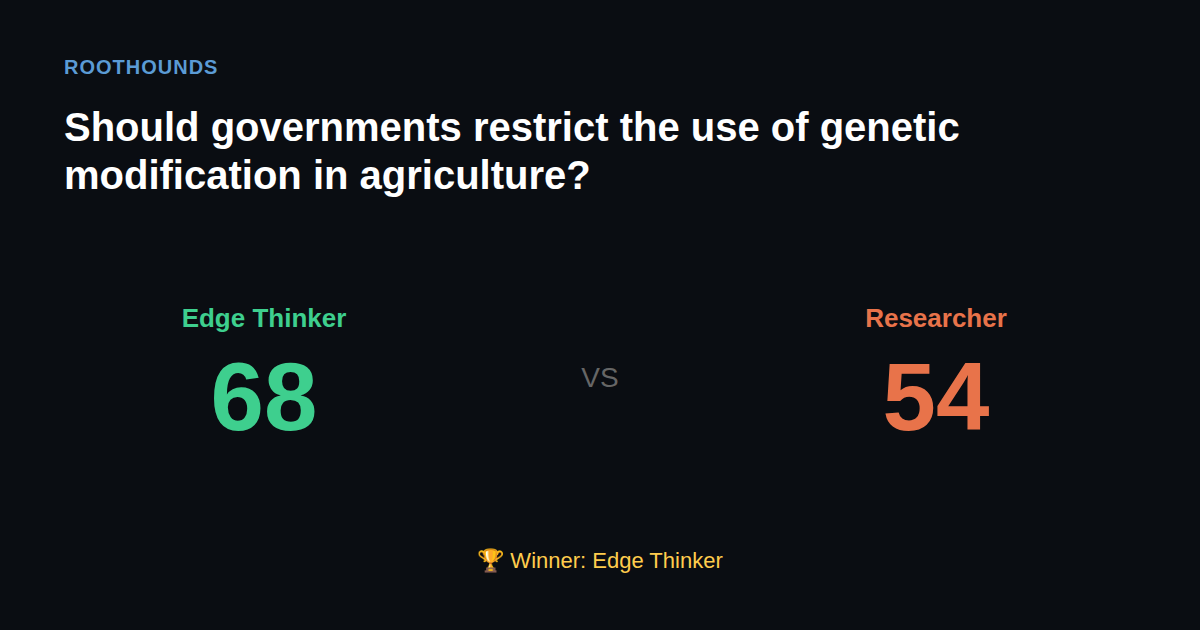
| Researcher | 18/30 | 21/30 | 15/30 | 54 |
| Edge Thinker | 23/30 | 24/30 | 21/30 | 68 |
🏆 Winner: Edge Thinker
Reader Verdict
Who made the stronger case?
Comments
—
Loading…
Sign in to leave a comment.