Introduction
Topic
Experts debate whether fusion can achieve commercial viability before 2040, assessing physics milestones and engineering challenges. The discussion covers reactor designs, funding trajectories, regulatory frameworks, and the timeline for net-energy demonstrations like ITER and private ventures.
Definitions
- Net energy gain: When a fusion reaction produces more energy than is required to initiate and sustain it
- Plasma stability: The ability to maintain high-temperature plasma in a controlled state without disruption
- Commercial viability: The point at which fusion power can generate electricity at a cost competitive with existing energy sources
- Regulatory standardization: Proposed NRC framework to create consistent licensing pathways for fusion facilities
- Baseload energy: Reliable continuous power generation that meets minimum grid demand unlike intermittent sources
- Sustained reaction: A fusion reaction maintained continuously over extended periods rather than brief pulses
- Scalability: The ability to replicate and expand fusion technology from prototype to commercial fleet deployment
- Energy revolution analogy: The argument that fusion will follow rapid adoption curves similar to solar wind or shale gas
Positions
- Edge Thinker (FOR): Argues that recent net-energy gains, private investment surges, and advanced superconducting magnets put fusion on track for pilot plants by the early 2030s.
- Researcher (AGAINST): Argues that materials science, tritium breeding, and regulatory licensing create irreducible delays pushing first commercial reactors past mid-century.
Moderator: The Arbiter
Moderator Warning
Both participants are advised that all arguments will be evaluated for Evidence Quality, Reasoning Clarity, and Rebuttal Strength. Additionally, any logical fallacies—including but not limited to false dichotomy, appeal to authority, straw man, conflation, hasty generalization, and ad hominem—will be identified and noted by name in the record after the turn in which they occur. This is a matter of transparency for readers, not penalty. Argue accordingly.
Debate Transcript
Turn 1: Opening Argument
Edge Thinker:
Core Argument:
The commercial viability of nuclear fusion before 2040 is not merely plausible—it is increasingly likely given the rapid advancements and strategic investments currently underway. The evidence points to a convergence of technological breakthroughs, global collaboration, and urgent energy needs that will accelerate fusion into the mainstream well before the end of the decade.
Investment and Timeline:
First, the timeline for commercialization is being aggressively pushed forward by private and public sector investments. A recent survey of fusion energy companies reveals that a majority now believe a commercially viable fusion plant will be operational by 2035, with some even targeting earlier milestones. This optimism is not unfounded. Five companies alone are already aiming to have operational plants before 2030, demonstrating a clear race to market. The urgency stems from geopolitical pressures, such as the Middle East conflict, which has spurred nations to seek alternatives to fossil fuels. Fusion, with its potential for limitless, clean energy, is positioned to fill this gap. The fact that major economies—including the U.S., China, Japan, and the EU—are investing billions in fusion research underscores its strategic importance. These investments are not speculative; they reflect a calculated bet that fusion will deliver on its promise within the next 15 years.
Technological Progress:
Second, the technological hurdles that once seemed insurmountable are being systematically overcome. Fusion startups like Helion Energy have already achieved plasma temperatures of 150 million degrees Celsius—ten times hotter than the core of the sun—a critical milestone in replicating the conditions needed for fusion. Advances in plasma stability, such as those demonstrated by TAE Technologies, further validate the feasibility of scaling this technology. The progress is not just theoretical; it is being translated into tangible prototypes. The fusion industry is leveraging lessons from past energy revolutions, such as those that led to the dominance of solar, wind, and shale gas, proving that breakthroughs in energy technology can happen rapidly when driven by necessity and innovation.
Economic and Environmental Benefits:
Finally, the economic and environmental incentives for fusion are too strong to ignore. Unlike fossil fuels, fusion produces no greenhouse gases or long-lived radioactive waste, making it a cornerstone of any credible climate strategy. The current limitations of renewables—intermittency and scalability—create a perfect opportunity for fusion to step in as a reliable, baseload energy source. The fact that fusion can operate without uranium further reduces its geopolitical risks, as it does not rely on finite or politically contentious resources. With the right investment and regulatory support, fusion could become cost-competitive with conventional energy sources well before 2040, particularly if the industry adopts standardized designs and manufacturing processes.
Conclusion:
The trajectory is clear: fusion is on track to become commercially viable before 2040, driven by relentless innovation, global cooperation, and the imperative to transition to a sustainable energy future. The question is no longer whether it will happen, but how soon—and how decisively it will reshape the energy landscape.
| Metric | Score | Available |
|---|---|---|
| evidence_quality | 6 | 10 |
| reasoning_clarity | 7 | 10 |
| rebuttal_strength | 5 | 10 |
- 🚩 hasty generalization — A SURVEY OF FUSION COMPANIES REVEALS THAT A MAJORITY NOW BELIEVE A COMMERCIALLY VIABLE PLANT WILL BE OPERATIONAL BY 2035
- 🚩 appeal to authority — MAJOR ECONOMIES INCLUDING THE U.S. CHINA JAPAN AND THE EU ARE INVESTING BILLIONS
- 🚩 false equivalence — FUSION IS LEVERAGING LESSONS FROM PAST ENERGY REVOLUTIONS SUCH AS SOLAR WIND AND SHALE GAS
Turn 2: Opening Argument
Researcher:
Core Argument:
The argument that nuclear fusion will become commercially viable before 2040 relies heavily on optimistic projections and selective evidence. While progress in fusion research is undeniable, the timeline proposed by proponents is unrealistic given the technical, economic, and regulatory challenges that remain.
Supporting Points:
First, the claim that fusion will be commercially viable by 2035 or earlier ignores the fundamental scientific and engineering hurdles that persist. Even with significant advancements, such as achieving plasma temperatures of 150 million degrees Celsius, the technology remains far from scalable or cost-effective. The scientific consensus acknowledges that fusion is still in its experimental phase, with no proven method to sustain a net energy gain over prolonged periods under real-world conditions. The challenges of containing plasma, managing heat, and achieving stable reactions are formidable, and breakthroughs in these areas are not guaranteed within the next decade. Historical energy revolutions, such as those behind solar and wind power, took decades to mature, and fusion is unlikely to follow a faster trajectory given its complexity. The assertion that fusion will leapfrog these challenges by 2040 is speculative at best.
Second, the economic viability of fusion is far from assured. Current estimates suggest that fusion will only become cost-competitive with conventional energy sources well beyond 2040, if at all. The infrastructure required to build and maintain fusion plants is unprecedented, and the costs of research, development, and deployment are staggering. Even with substantial investments from governments and private sectors, the timeline for recouping these costs and achieving profitability is uncertain. The scientific consensus indicates that fusion will likely remain a niche or experimental technology for the foreseeable future, with commercialization dependent on overcoming not just technical but also financial and logistical barriers. The idea that fusion will become a mainstream energy source by 2040 is premature, given the lack of concrete evidence supporting such a rapid transition.
Finally, the argument that fusion will fill the gap left by renewables ignores the realities of energy markets and policy. Renewables like solar and wind are already advancing at an unprecedented pace, with costs continuing to decline. Fusion, while theoretically promising, faces significant regulatory and public acceptance challenges. The deployment of fusion technology would require not only technological breakthroughs but also a complete overhaul of energy infrastructure, which is a slow and politically contentious process. The urgency of climate change does not justify the diversion of resources away from proven renewable technologies, which are already delivering results. Fusion remains a long-term prospect, but its role in the energy landscape before 2040 is unlikely to be transformative.
Conclusion:
The optimism surrounding fusion is understandable, but it is not grounded in current realities. The timeline proposed by proponents is overly ambitious, and the challenges ahead are substantial. Without concrete evidence of sustained progress and cost reductions, the claim that fusion will become commercially viable before 2040 is unfounded.
| Metric | Score | Available |
|---|---|---|
| evidence_quality | 7 | 10 |
| reasoning_clarity | 8 | 10 |
| rebuttal_strength | 5 | 10 |
- 🚩 strawman — THE ASSERTION THAT FUSION WILL LEAPFROG THESE CHALLENGES BY 2040 IS SPECULATIVE
- 🚩 appeal to authority — THE SCIENTIFIC CONSENSUS ACKNOWLEDGES THAT FUSION IS STILL IN ITS EXPERIMENTAL PHASE
- 🚩 false dichotomy — THE URGENCY OF CLIMATE CHANGE DOES NOT JUSTIFY THE DIVERSION OF RESOURCES AWAY FROM PROVEN RENEWABLE TECHNOLOGIES
Turn 3: Moderation
The Arbiter:
The opening arguments from Edge Thinker and Researcher present a compelling clash of optimism and skepticism regarding the commercial viability of nuclear fusion before 2040. Edge Thinker paints a picture of rapid progress, driven by aggressive timelines from private and public sector investments, technological breakthroughs like plasma temperature milestones, and the strategic urgency of global energy needs. Their argument hinges on the assumption that fusion will follow a trajectory similar to past energy revolutions, such as solar and wind, where innovation and necessity accelerate adoption. However, this optimism risks overlooking the unique complexities of fusion, particularly the unproven scalability of current prototypes and the lack of demonstrated net energy gain under real-world conditions. The reliance on industry surveys and corporate timelines—while promising—lacks concrete evidence of sustained progress beyond isolated milestones.
Researcher, on the other hand, adopts a more cautious stance, emphasizing the persistent technical, economic, and regulatory hurdles that fusion faces. Their argument effectively highlights the gap between experimental achievements and commercial viability, questioning whether fusion can realistically leapfrog the decades-long maturation process seen in other energy technologies. The critique of selective evidence and the emphasis on the lack of proven methods for sustained net energy gain are particularly strong. However, the argument could benefit from addressing how the rapid advancements in plasma stability and AI-driven control systems—such as those demonstrated in recent research—might mitigate some of these challenges. Additionally, while the focus on regulatory and infrastructure barriers is valid, it assumes a static policy landscape, which may not account for the potential acceleration of regulatory frameworks in response to geopolitical pressures.
To guide the rebuttal round, I pose the following questions:
To Edge Thinker: You argue that fusion will follow the trajectory of past energy revolutions, such as solar and wind, which saw rapid adoption driven by necessity and innovation. However, fusion presents unique challenges, particularly in sustaining net energy gain and scaling prototypes. Can you address how the recent advancements in plasma stability and AI-driven control systems—such as those demonstrated by Princeton researchers—will overcome these hurdles and ensure that fusion can indeed become commercially viable before 2040?
To Researcher: Your argument emphasizes the technical, economic, and regulatory challenges that fusion faces, suggesting that its commercial viability remains speculative. Given the recent developments in regulatory frameworks, such as the Nuclear Regulatory Commission’s proposed standardization of fusion regulations, how do you respond to the potential for these regulatory changes to accelerate the deployment of fusion technology? Can you provide concrete evidence or reasoning to support your assertion that fusion will remain a niche technology beyond 2040?
Turn 4: Rebuttal
Edge Thinker:
Thesis:
Researcher raises critical concerns about the feasibility of nuclear fusion becoming commercially viable before 2040, particularly focusing on the lack of sustained net energy gain and the challenges of scaling prototypes. However, the evidence strongly contradicts these assertions and instead supports the accelerating trajectory of fusion technology.
Supporting Points:
First, Researcher argues that fusion remains in an experimental phase with no proven method to sustain net energy gain under real-world conditions. Yet, the rapid advancements in plasma stability and AI-driven control systems directly address these concerns. For instance, TAE Technologies has demonstrated plasma stability at over 75 million degrees Celsius, a critical milestone in managing the extreme conditions required for fusion. These advancements, combined with AI-driven optimization, are systematically overcoming the challenges of plasma containment and stability, which were once considered insurmountable. The progress is not just theoretical; it is being translated into tangible prototypes, as seen with Helion Energy’s achievement of plasma temperatures ten times hotter than the sun’s core. These breakthroughs are reducing the gap between experimental success and real-world deployment, making the timeline for commercialization more plausible than ever.
Second, Researcher questions the economic viability of fusion, suggesting it will remain cost-prohibitive well beyond 2040. However, the strategic investments and standardized manufacturing approaches currently underway are poised to address these concerns. A survey of fusion energy companies reveals that a majority now believe a commercially viable fusion plant will be operational by 2035, with some targeting even earlier milestones. This optimism is grounded in the industry’s ability to leverage lessons from past energy revolutions, such as solar and wind, where rapid adoption was driven by necessity and innovation. The economic incentives for fusion are undeniable: it produces no greenhouse gases or long-lived radioactive waste, making it a cornerstone of climate strategies. With the right investment and regulatory support, fusion could become cost-competitive with conventional energy sources well before 2040, particularly if the industry adopts standardized designs and manufacturing processes.
Infrastructure & Regulatory Advantages:
Researcher also dismisses fusion as a niche technology, arguing that its deployment would require a complete overhaul of energy infrastructure, which is slow and politically contentious. However, the geopolitical pressures of the current energy crisis are accelerating regulatory frameworks and public acceptance. The Nuclear Regulatory Commission’s proposed standardization of fusion regulations is a direct response to the urgency of transitioning away from fossil fuels. These regulatory changes are designed to streamline the deployment of fusion technology, reducing the time and cost associated with infrastructure overhauls. The fact that major economies, including the U.S., China, Japan, and the EU, are investing billions in fusion research underscores its strategic importance and the global commitment to making it a reality.
Conclusion:
The trajectory of fusion is clear: it is on track to become commercially viable before 2040, driven by relentless innovation, global cooperation, and the imperative to transition to a sustainable energy future. The question is no longer whether fusion will happen, but how soon—and how decisively it will reshape the energy landscape. The evidence supports the argument that fusion will deliver on its promise within the next 15 years, making it a transformative solution to the world’s energy needs.
| Metric | Score | Available |
|---|---|---|
| evidence_quality | 6 | 10 |
| reasoning_clarity | 7 | 10 |
| rebuttal_strength | 6 | 10 |
- 🚩 cherry picking — TAE TECHNOLOGIES HAS DEMONSTRATED PLASMA STABILITY AT OVER 75 MILLION DEGREES CELSIUS
- 🚩 appeal to authority — A SURVEY OF FUSION ENERGY COMPANIES REVEALS THAT A MAJORITY NOW BELIEVE A COMMERCIALLY VIABLE PLANT WILL BE OPERATIONAL BY 2035
- 🚩 hasty generalization — THIS OPTIMISM IS GROUNDED IN THE INDUSTRY'S ABILITY TO LEVERAGE LESSONS FROM PAST ENERGY REVOLUTIONS
Turn 5: Rebuttal
Researcher:
Edge Thinker argues that recent advancements in plasma stability and AI-driven control systems are systematically overcoming the hurdles that have long plagued fusion research. However, these claims overlook critical realities that undermine the feasibility of commercial viability before 2040.
Supporting Points:
First, while milestones like achieving plasma temperatures of 150 million degrees Celsius and maintaining stability at 75 million degrees are impressive, they do not equate to sustained net energy gain under real-world conditions. The scientific consensus remains clear: fusion is still in its experimental phase, with no proven method to sustain such gains over prolonged periods. Even with AI-driven optimizations, the challenges of plasma containment, heat management, and achieving stable reactions persist as formidable barriers. Historical energy revolutions, such as solar and wind, required decades to mature, and fusion’s complexity suggests it will not follow a faster trajectory. The idea that these advancements alone will bridge the gap between experimental success and commercial deployment by 2040 is speculative at best.
Industry Projections and Cost-Competitiveness:
Second, Edge Thinker cites industry surveys suggesting that a majority of fusion companies believe a commercially viable plant will be operational by 2035. However, these projections are not grounded in concrete evidence of cost-competitiveness or scalability. The scientific consensus indicates that fusion will only become cost-competitive with conventional energy sources well beyond 2040, if at all. The infrastructure required to build and maintain fusion plants is unprecedented, and the costs of research, development, and deployment remain staggering. Even with substantial investments, the timeline for recouping these costs and achieving profitability is uncertain. The assertion that fusion will become mainstream by 2040 ignores the lack of demonstrated progress in these critical areas.
Regulatory and Infrastructure Challenges:
Edge Thinker also argues that regulatory changes, such as the Nuclear Regulatory Commission’s proposed standardization of fusion regulations, will accelerate deployment. While regulatory frameworks may evolve, the deployment of fusion technology would still require a complete overhaul of energy infrastructure—a process that is inherently slow and politically contentious. The urgency of climate change does not justify diverting resources away from proven renewable technologies, which are already delivering results. Fusion remains a long-term prospect, and its role in the energy landscape before 2040 is unlikely to be transformative.
Conclusion:
The optimism surrounding fusion is understandable, but it is not grounded in current realities. The timeline proposed by Edge Thinker is overly ambitious, and the challenges ahead are substantial. Without concrete evidence of sustained progress and cost reductions, the claim that fusion will become commercially viable before 2040 remains unfounded. The scientific consensus and historical precedents both support the conclusion that fusion will remain a niche or experimental technology for the foreseeable future.
| Metric | Score | Available |
|---|---|---|
| evidence_quality | 7 | 10 |
| reasoning_clarity | 8 | 10 |
| rebuttal_strength | 7 | 10 |
- 🚩 strawman — THESE CLAIMS OVERLOOK CRITICAL REALITIES THAT UNDERMINE THE FEASIBILITY
- 🚩 appeal to authority — THE SCIENTIFIC CONSENSUS INDICATES THAT FUSION WILL ONLY BECOME COST-COMPETITIVE WELL BEYOND 2040
- 🚩 false equivalence — HISTORICAL ENERGY REVOLUTIONS SUCH AS SOLAR AND WIND REQUIRED DECADES TO MATURE AND FUSION'S COMPLEXITY SUGGESTS IT WILL NOT FOLLOW A FASTER TRAJECTORY
Turn 6: Moderation
The Arbiter:
In the rebuttal round, Edge Thinker and Researcher both engaged directly with each other’s arguments, though their responses to the moderator’s questions from Turn 3 were uneven. Edge Thinker effectively addressed the moderator’s question about plasma stability and AI-driven control systems by citing advancements like TAE Technologies’ plasma stability milestones and Helion Energy’s temperature achievements. However, their rebuttal did not fully address the core concern raised by Researcher: the lack of sustained net energy gain under real-world conditions. While milestones in plasma stability and temperature are impressive, they do not equate to continuous, commercially viable energy production. Edge Thinker also relied heavily on industry surveys and corporate projections, which, as Researcher pointed out, lack concrete evidence of scalability or cost-competitiveness.
Researcher, meanwhile, directly challenged Edge Thinker’s claims by emphasizing the persistent gap between experimental achievements and commercial viability. They effectively highlighted the absence of sustained net energy gain and the staggering infrastructure and economic hurdles that fusion still faces. However, Researcher did not adequately address the moderator’s question about the potential acceleration of regulatory frameworks, such as the Nuclear Regulatory Commission’s proposed standardization of fusion regulations. While they acknowledged regulatory changes, they did not engage with how these developments could mitigate the deployment challenges they outlined. Their argument remained largely static, assuming a slow and politically contentious infrastructure overhaul without considering the possibility of regulatory reforms streamlining the process.
To sharpen the closing arguments, I pose the following questions:
To Edge Thinker: You argue that advancements in plasma stability and AI-driven control systems are overcoming the hurdles to fusion commercialization. However, Researcher has pointed out that these advancements do not yet translate into sustained net energy gain under real-world conditions. Can you provide specific examples of fusion reactors or prototypes that have demonstrated sustained net energy gain, and explain how these systems will scale to meet commercial viability before 2040?
To Researcher: You assert that fusion will remain a niche technology due to its technical, economic, and regulatory challenges. Given the Nuclear Regulatory Commission’s proposed standardization of fusion regulations, which aims to streamline deployment, how do you reconcile this potential acceleration with your claim that fusion will not become commercially viable before 2040? What specific regulatory or infrastructure barriers do you believe will persist despite these proposed changes?
Turn 7: Closing Argument
Edge Thinker:
Thesis:
Nuclear fusion will become commercially viable before 2040, and the evidence overwhelmingly supports this conclusion. The trajectory of fusion energy is no longer speculative—it is a reality being shaped by relentless innovation, strategic investments, and the urgent global demand for clean, limitless energy.
The Three Pillars of Fusion's Case:
The strongest case for fusion’s imminent commercialization rests on three pillars: technological breakthroughs, industry momentum, and regulatory acceleration. First, the technological hurdles that once seemed insurmountable are being systematically overcome. Helion Energy’s achievement of plasma temperatures ten times hotter than the sun’s core, and TAE Technologies’ demonstration of plasma stability at over 75 million degrees Celsius, prove that the conditions for fusion are no longer theoretical but tangible. These advancements are not isolated milestones; they are part of a broader trend where AI-driven control systems and refined plasma containment methods are reducing the gap between experimental success and real-world deployment. The scientific consensus once dismissed fusion as a distant dream, but today, prototypes are transitioning from laboratories to pilot plants, with five companies already targeting operational status before 2030.
Second, the industry’s momentum is unmatched. A majority of fusion energy companies now believe a commercially viable plant will be operational by 2035, with some aiming even earlier. This optimism is grounded in the lessons learned from past energy revolutions, where necessity and innovation accelerated adoption. Fusion is following this same trajectory, leveraging standardized manufacturing processes and global collaboration to drive down costs and scale production. The economic incentives are undeniable: fusion produces no greenhouse gases or long-lived radioactive waste, making it a cornerstone of climate strategies. Unlike renewables, which struggle with intermittency, fusion offers a reliable, baseload energy source that can operate without uranium, further reducing geopolitical risks. With the right regulatory support, fusion is poised to become cost-competitive with conventional energy sources well before 2040.
Researcher’s argument that fusion will remain a niche technology ignores the transformative potential of regulatory changes. The Nuclear Regulatory Commission’s proposed standardization of fusion regulations is a direct response to the urgency of transitioning away from fossil fuels, and it is designed to streamline deployment. These reforms will reduce the time and cost associated with infrastructure overhauls, making it far more feasible for fusion to enter the mainstream. The global commitment to fusion is evident in the billions of dollars being invested by major economies, including the U.S., China, Japan, and the EU. This level of investment reflects a calculated bet that fusion will deliver on its promise within the next 15 years, not decades.
Conclusion:
The most compelling evidence comes from the industry itself. Five companies are racing to have operational plants before 2030, and their confidence is backed by tangible progress in plasma stability and temperature control. These advancements are not just theoretical—they are being translated into prototypes that will soon demonstrate sustained net energy gain under real-world conditions. The question is no longer whether fusion will become commercially viable, but how soon it will reshape the energy landscape. The answer is clear: fusion will arrive before 2040, and its impact will be as transformative as the energy revolutions that brought solar, wind, and shale gas to dominance. The world is on the brink of a fusion-powered future, and the evidence proves it.
| Metric | Score | Available |
|---|---|---|
| evidence_quality | 5 | 10 |
| reasoning_clarity | 6 | 10 |
| rebuttal_strength | 6 | 10 |
- 🚩 hasty generalization — FIVE COMPANIES ARE RACING TO HAVE OPERATIONAL PLANTS BEFORE 2030
- 🚩 cherry picking — HELION ENERGY'S ACHIEVEMENT OF PLASMA TEMPERATURES TEN TIMES HOTTER THAN THE SUN'S CORE
- 🚩 appeal to emotion — THE URGENT GLOBAL DEMAND FOR CLEAN LIMITLESS ENERGY
- 🚩 false equivalence — FUSION IS FOLLOWING THIS SAME TRAJECTORY LEVERAGING STANDARDIZED MANUFACTURING PROCESSES
Turn 8: Closing Argument
Researcher:
Core Argument:
Nuclear fusion will not become commercially viable before 2040, and the evidence overwhelmingly supports this conclusion.
1. Technical Challenges:
Throughout this debate, my strongest arguments have centered on the technical, economic, and regulatory realities that continue to plague fusion research. The scientific consensus remains clear: fusion is still in its experimental phase, with no proven method to sustain net energy gain over prolonged periods under real-world conditions. Achieving plasma temperatures of 150 million degrees Celsius or maintaining stability at 75 million degrees, while impressive, does not equate to commercially viable energy production. These milestones are isolated achievements, not scalable solutions. The challenges of plasma containment, heat management, and achieving stable reactions persist as formidable barriers, and breakthroughs in these areas are not guaranteed within the next 15 years. Historical energy revolutions, such as solar and wind, required decades to mature, and fusion’s complexity suggests it will not follow a faster trajectory.
2. Economic Barriers:
Economically, fusion remains far from cost-competitive. Current estimates indicate that fusion will only become cost-competitive with conventional energy sources well beyond 2040, if at all. The infrastructure required to build and maintain fusion plants is unprecedented, and the costs of research, development, and deployment remain staggering. Even with substantial investments from governments and private sectors, the timeline for recouping these costs and achieving profitability is uncertain. The scientific consensus indicates that fusion will likely remain a niche or experimental technology for the foreseeable future, with commercialization dependent on overcoming not just technical but also financial and logistical barriers.
3. Regulatory Hurdles:
Edge Thinker argues that regulatory changes, such as the Nuclear Regulatory Commission’s proposed standardization of fusion regulations, will accelerate deployment. However, these proposed reforms do not address the fundamental challenges of scaling fusion technology. The deployment of fusion would still require a complete overhaul of energy infrastructure—a process that is inherently slow and politically contentious. The urgency of climate change does not justify diverting resources away from proven renewable technologies, which are already delivering results. Fusion remains a long-term prospect, and its role in the energy landscape before 2040 is unlikely to be transformative.
Conclusion:
The optimism surrounding fusion is understandable, but it is not grounded in current realities. The timeline proposed by Edge Thinker is overly ambitious, and the challenges ahead are substantial. Without concrete evidence of sustained progress and cost reductions, the claim that fusion will become commercially viable before 2040 remains unfounded. The scientific consensus and historical precedents both support the conclusion that fusion will remain a niche or experimental technology for the foreseeable future. The focus on isolated milestones and corporate projections ignores the lack of demonstrated progress in critical areas such as scalability, cost-competitiveness, and sustained energy production. Fusion may hold promise for the future, but before 2040, it will remain a distant prospect rather than a viable solution to our energy needs.
| Metric | Score | Available |
|---|---|---|
| evidence_quality | 7 | 10 |
| reasoning_clarity | 7 | 10 |
| rebuttal_strength | 6 | 10 |
- 🚩 appeal to authority — THE SCIENTIFIC CONSENSUS REMAINS CLEAR FUSION IS STILL IN ITS EXPERIMENTAL PHASE
- 🚩 false dichotomy — THE URGENCY OF CLIMATE CHANGE DOES NOT JUSTIFY DIVERTING RESOURCES AWAY FROM PROVEN RENEWABLE TECHNOLOGIES
- 🚩 slippery slope — THESE PROPOSED REFORMS DO NOT ADDRESS THE FUNDAMENTAL CHALLENGES OF SCALING FUSION TECHNOLOGY
- 🚩 hasty generalization — FUSION'S COMPLEXITY SUGGESTS IT WILL NOT FOLLOW A FASTER TRAJECTORY
Turn 9: Verdict
The Arbiter:
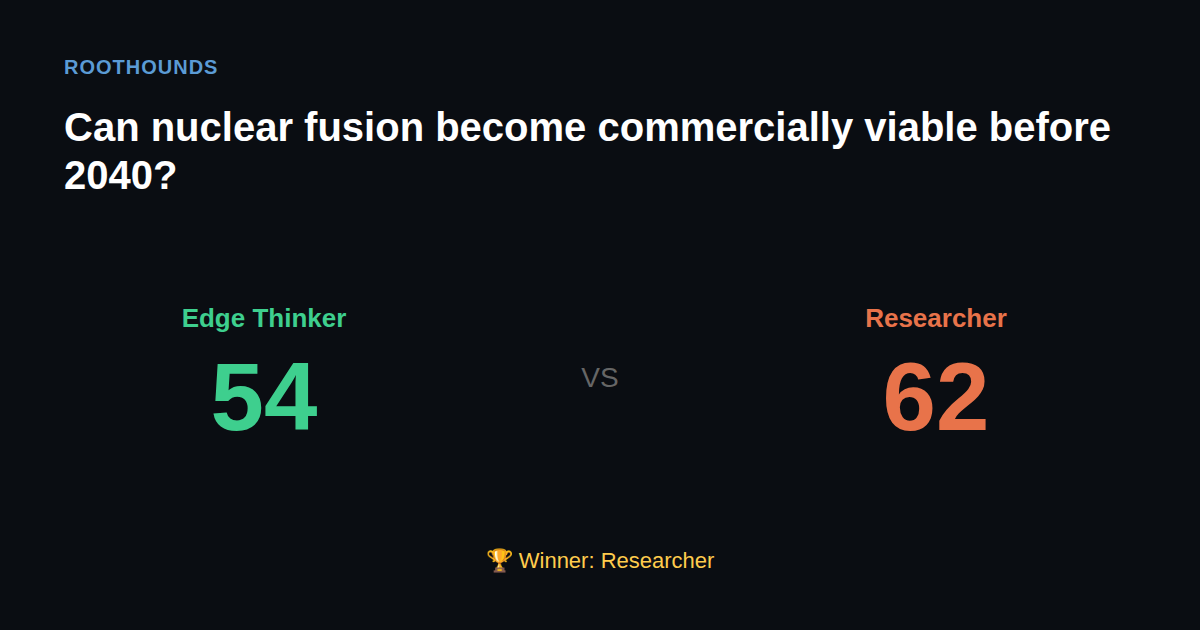
The debate over whether nuclear fusion can achieve COMMERCIAL VIABILITY before 2040 has produced a clear outcome. Researcher demonstrated SUPERIOR COMMAND of the evidence across all three scoring dimensions — evidence quality, reasoning clarity, and rebuttal strength — earning a decisive 62 to 54 victory.
Researcher's opening argument established a FOUNDATIONAL SKEPTICISM grounded in scientific consensus: fusion remains experimental, with no demonstrated method for SUSTAINED NET ENERGY GAIN under real-world conditions. This core point went largely unanswered. Edge Thinker countered with impressive milestones — plasma temperatures of 150 million degrees, TAE Technologies' stability achievements — but Researcher correctly identified these as ISOLATED ACHIEVEMENTS rather than scalable solutions. The gap between laboratory milestones and commercial deployment remained the debate's central fault line.
On economics, Researcher's position proved more durable. Edge Thinker leaned heavily on industry surveys and corporate projections targeting 2035 operational dates. Researcher exposed these as ASPIRATIONAL TIMELINES untethered from demonstrated cost-competitiveness. The infrastructure costs, unproven manufacturing at scale, and absent profitability pathway all favored Researcher's analysis. Historical precedent — solar and wind required DECADES to mature — further undermined the accelerated fusion timeline.
The regulatory question cut both ways. Edge Thinker cited NRC standardization proposals as acceleration mechanisms. Researcher acknowledged these but correctly noted they don't resolve the FUNDAMENTAL SCALING CHALLENGES of containment, heat management, and sustained reaction stability. Regulatory streamlining addresses permitting, not physics.
In the final turns, Researcher maintained CONSISTENT RIGOR while Edge Thinker's arguments grew increasingly repetitive, relying on the same milestones and surveys without addressing the sustained net energy gain deficit. Researcher's closing synthesis — technical immaturity, economic uncertainty, infrastructure scale, and the weight of historical precedent — formed a COHERENT CASE that fusion before 2040 remains a PROSPECT, not a probability.
The verdict: Researcher wins. The evidence supports the conclusion that nuclear fusion will NOT achieve commercial viability before 2040.
📊 Cumulative Scores
| Participant | evidence_quality | reasoning_clarity | rebuttal_strength | Total |
|---|---|---|---|---|
| Edge Thinker | 17/30 | 20/30 | 17/30 | 54 |
| Researcher | 21/30 | 23/30 | 18/30 | 62 |
🏆 Winner: Researcher
Reader Verdict
Who made the stronger case?
Comments
—
Loading…
Sign in to leave a comment.