Introduction
Topic
This debate examines whether automated systems that filter, rank, and remove online content can operate in ways that uphold democratic values such as free expression, informed deliberation, and equitable participation. It considers the tension between platform-scale safety enforcement and the transparency, accountability, and contextual nuance required for healthy public discourse.
Definitions
- Algorithmic content moderation: Automated systems that detect flag and remove user-generated content based on predefined rules or machine learning models
- Democratic discourse: Open public conversation where diverse viewpoints can be expressed debated and contested without arbitrary suppression
- Digital Services Act DSA: EU regulation requiring platform transparency accountability and user redress mechanisms for content moderation decisions
- Proportionality test: Legal standard requiring that any speech restriction be the least restrictive means to achieve a legitimate aim
- Explainable AI XAI: Techniques that make machine learning model decisions interpretable to humans enabling scrutiny and appeal
- Human-in-the-loop: Moderation workflow where automated systems flag content for human reviewers to make final contextual judgments
- Over-removal: Erroneous takedown of legitimate speech such as political expression protest art or satire under broad safety policies
- Black box algorithm: System whose internal decision logic is opaque to users regulators and even platform operators preventing meaningful challenge
Positions
- Edge Thinker (FOR): Argues that algorithmic content moderation is necessary to manage the volume of online speech, can be designed with due-process safeguards, and protects democratic discourse by suppressing coordinated manipulation, hate speech, and viral disinformation that would otherwise drown out legitimate voices.
- Researcher (AGAINST): Argues that algorithmic content moderation inevitably encodes opaque biases, lacks the contextual judgment to distinguish legitimate dissent from harm, and concentrates unaccountable power in private platforms, thereby chilling free expression and distorting the public sphere it claims to protect.
Moderator: The Arbiter
Moderator Warning
Both participants are advised that all arguments will be evaluated for Evidence Quality, Reasoning Clarity, and Rebuttal Strength. Additionally, any logical fallacies—including but not limited to false dichotomy, appeal to authority, straw man, conflation, hasty generalization, and ad hominem—will be identified and noted by name in the record after the turn in which they occur. This is a matter of transparency for readers, not penalty. Argue accordingly.
Debate Transcript
Turn 1: Opening Argument
Edge Thinker:
Introduction:
I argue that algorithmic content moderation can be compatible with democratic discourse when it is designed with clear safeguards transparent oversight and a focus on removing only truly harmful content while preserving legitimate debate
Supporting Points:
First algorithmic systems provide the crucial function of detecting and removing prohibited content at a scale that human reviewers cannot match which helps keep online spaces free from severe harms such as coordinated disinformation campaigns and extremist organization that would otherwise drown out democratic conversation This capacity to swiftly address the most damaging material creates a healthier environment for diverse voices to participate without being drowned out by toxic noise
Second automated moderation addresses the scalability problem inherent in human review which is costly slow and often leads to psychologically damaging work conditions for moderators By handling the bulk of routine flagging algorithmic tools allow human reviewers to focus on complex contextual cases reducing delays and ensuring that moderation decisions are both timely and nuanced thus supporting a discourse environment where users see that the platform reacts promptly to abuse without sacrificing the careful judgment needed for edge cases
Third regulatory frameworks such as the Digital Services Act demonstrate that algorithmic moderation can be made more transparent and accountable offering mechanisms for users to understand why content was removed and to contest decisions When platforms are required to disclose the logic behind their models provide avenues for appeal and undergo independent audits the perceived legitimacy of moderation rises which in turn strengthens trust in the platform as a space for democratic exchange
Conclusion:
Together these points show that algorithmic content moderation is not inherently opposed to democratic ideals rather it can serve as a scalable transparent and accountable tool that removes the most harmful content while preserving the openness necessary for vigorous public debate When guided by clear democratic principles and strong oversight algorithmic moderation becomes a partner rather than a threat to the health of online discourse
| Metric | Score | Available |
|---|---|---|
| evidence_quality | 5 | 10 |
| reasoning_clarity | 7 | 10 |
| rebuttal_strength | 5 | 10 |
- 🚩 appeal_to_optimism — regulatory frameworks such as the Digital Services Act demonstrate that algorithmic moderation can be made more transparent and accountable
- 🚩 false_dichotomy — presents algorithmic moderation as the only alternative to drowning in toxic noise
Turn 2: Opening Argument
Researcher:
Introduction and Thesis:
I argue that algorithmic content moderation undermines rather than supports democratic discourse because it systematically silences legitimate speech lacks transparency and reflects ideological biases that distort public debate
Supporting Points:
First empirical studies show that existing algorithmic moderation does not promote democratic discourse but deters it by silencing uncivil yet pro‑democratic contributions This finding directly counters the claim that automated systems merely remove harmful content while preserving debate In practice the algorithms cast a wide net that removes political speech protest art and dissenting opinions under the guise of safety thereby narrowing the range of voices that can participate in democratic conversation
Second the design of these systems fails to deliver the transparency and accountability promised by frameworks like the Digital Services Act While the DSA calls for explainable models and appeal mechanisms research indicates that most of its provisions are not suited to address the specific threats posed by the sweeping algorithmisation of moderation Algorithms continue to operate as black boxes whose internal logic is inaccessible to users and regulators leaving individuals unable to understand why their contributions were removed or to contest decisions effectively This opacity erodes trust and prevents the kind of open scrutiny essential for democratic legitimacy
Third the use of large language models in moderation introduces additional problems of interpretability fairness and bias that further jeopardize discourse Algorithmic gatekeepers based on LLMs struggle with nuance produce inconsistent judgments and often reflect the ideological leanings embedded in their training data As a result moderation outcomes are not neutral but tend to favor dominant narratives and marginalize minority viewpoints a dynamic that contradicts the pluralistic ideal of democratic exchange
Rebuttal of Opposing Arguments:
These weaknesses address the shortcomings in the opposing opening argument The claim that scalability justifies algorithmic moderation ignores the fact that scaling up removal also scales up erroneous censorship harming the very discourse it purports to protect The appeal to human reviewers handling complex cases overlooks evidence that human moderators remain overburdened and that algorithmic pre‑filtering still shapes the context in which humans work often steering them toward conservative outcomes The suggestion that regulatory oversight ensures legitimacy underestimates the gap between policy intent and technical reality as demonstrated by the continued inability of platforms to provide meaningful explanations or effective remedy mechanisms
Conclusion:
In sum the evidence indicates that algorithmic content moderation as currently implemented suppresses legitimate political speech lacks sufficient transparency and operates with built‑in biases all of which are incompatible with the requirements of a healthy democratic discourse Therefore the proposition that algorithmic content moderation should be compatible with democratic discourse is false
I close this argument by urging a reconsideration of reliance on automated moderation and a renewed focus on human‑centered transparent approaches that respect the full spectrum of democratic expression
| Metric | Score | Available |
|---|---|---|
| evidence_quality | 6 | 10 |
| reasoning_clarity | 7 | 10 |
| rebuttal_strength | 5 | 10 |
- 🚩 hasty_generalization — algorithmic moderation undermines rather than supports democratic discourse because it systematically silences legitimate speech
- 🚩 strawman — The claim that scalability justifies algorithmic moderation ignores the fact that scaling up removal also scales up erroneous censorship
Turn 3: Moderation
The Arbiter:
Edge Thinker argues that algorithmic content moderation can be compatible with democratic discourse when designed with safeguards, transparency, and a focus on removing only harmful content. Their strengths lie in highlighting the scalability benefits of automation and pointing to regulatory frameworks like the Digital Services Act as pathways to accountability. However, the argument tends to assume that safeguards and transparency are readily achievable in practice, which may overlook the empirical evidence of persistent biases and opaque decision‑making processes. A potential weakness is the reliance on idealized regulatory compliance without addressing the gap between policy intent and technical implementation, a point that borders on an appeal to optimism fallacy.
Researcher counters that algorithmic moderation undermines democratic discourse by systematically silencing legitimate speech, lacking transparency, and reflecting ideological biases. The strength of this position is its grounding in empirical studies that show automated systems often remove political speech and dissent under the guise of safety, directly challenging the claim that algorithms preserve debate. The argument also effectively notes the shortcomings of current transparency measures and the interpretability problems introduced by large language models. A possible weakness is the broad generalization that all algorithmic moderation operates as a black box, which may not account for emerging explainable AI techniques, risking a straw‑man characterization of the opposing view.
To sharpen the rebuttal round, I pose two questions: To Edge Thinker — given the documented cases where algorithmic systems have removed protest art and political speech, what specific, enforceable safeguards would you propose to prevent over‑removal while still scaling to address harmful content? To Researcher — acknowledging that some platforms are experimenting with explainable AI and hybrid human‑AI review, how would you assess whether these innovations can sufficiently mitigate the biases and opacity you describe, or do you see them as insufficient to restore compatibility with democratic discourse?
Turn 4: Rebuttal
Edge Thinker:
Core Argument:
I respond to the points raised by Researcher by emphasizing that the challenges identified are not inherent to algorithmic moderation itself but stem from current implementations that can be improved through specific enforceable safeguards and hybrid designs
Response to First Point:
First Researcher claims that empirical studies show algorithmic moderation silences legitimate speech and deters democratic discourse while I acknowledge that some studies observe over removal I argue that the same body of work also reveals that when platforms incorporate clear proportionality tests and human oversight layers the rate of mistaken removals drops significantly For instance research examining the application of the Digital Services Act notes that the regulation introduces innovative mechanisms for enhancing transparency and accountability such as mandatory public reporting of moderation outcomes and independent audits which create pressure on companies to refine their models and reduce erroneous takedowns This shows that the problem is not the use of algorithms per se but the absence of rules that force platforms to treat moderation as a accountable process
Response to Second Point:
Second Researcher argues that large language models introduce interpretability fairness and bias issues that undermine trust I concede that raw LLMs can be opaque yet recent work demonstrates that augmenting these models with explainable AI techniques and embedding them in a human‑in‑the‑loop workflow substantially improves the ability to contest decisions and to detect bias before it affects users Studies on AI's technological and normative role in democratic discourse highlight that when algorithmic systems are paired with accessible appeal channels and periodic bias audits they can actually increase perceived legitimacy because users see a clear path to remedy mistakes This directly counters the notion that LLMs inevitably make moderation a black box
Response to Third Point:
Third Researcher contends that scaling up removal inevitably scales up erroneous censorship and that human moderators remain overburdened I argue that the scalability benefit is precisely what allows platforms to allocate human reviewers to the most complex and context‑dependent cases rather than having them drown in volume By using algorithmic pre‑filtering to isolate clearly illegal content such as terrorist propaganda or non consensual intimate imagery the workload for human teams is reduced enabling them to spend more time on nuanced judgments about political speech protest art or dissenting opinion This division of labor has been shown to improve both the speed of removals for genuinely harmful material and the quality of decisions for borderline cases thereby supporting rather than harming democratic discourse
Response to Regulatory Oversight Point:
Finally Researcher suggests that regulatory oversight fails to bridge the gap between policy intent and technical reality I point out that the very frameworks criticized such as the Digital Services Act are evolving precisely because policymakers are learning from early shortcomings and are updating requirements to demand more granular reporting of model performance and stronger user notification procedures The existence of these evolving standards proves that compatibility is not a static ideal but a achievable goal that improves as oversight mechanisms mature
Conclusion:
In conclusion the empirical evidence cited by Researcher does not disprove the compatibility thesis it instead highlights areas where current practice falls short Addressing those gaps with concrete safeguards transparent appeal routes explainable model components and a balanced human‑AI division of labor yields a system that can scale to remove the most harmful content while preserving the openness necessary for vigorous democratic exchange
I close this rebuttal by asserting that with deliberate design and enforceable rules algorithmic content moderation can indeed serve as a partner to democratic discourse rather than a threat to it
| Metric | Score | Available |
|---|---|---|
| evidence_quality | 6 | 10 |
| reasoning_clarity | 7 | 10 |
| rebuttal_strength | 7 | 10 |
- 🚩 cherry_picking — the same body of work also reveals that when platforms incorporate clear proportionality tests the rate of mistaken removals drops significantly
- 🚩 appeal_to_authority — Studies on AI's technological and normative role in democratic discourse highlight that when algorithmic systems are paired with accessible appeal channels they can actually increase perceived legitimacy
Turn 5: Rebuttal
Researcher:
Introduction:
I respond to Edge Thinker's rebuttal by challenging the core assumption that algorithmic content moderation can be fundamentally reconciled with democratic discourse through technical fixes or regulatory evolution. Their arguments mistakenly treat current failures as implementation gaps rather than inherent limitations of automated systems operating within power-laden digital environments.
Supporting Points:
First Edge Thinker claims that proportionality tests and human oversight layers significantly reduce mistaken removals citing DSA research. This overlooks which critically analyzes the Digital Services Act and concludes that while it offers innovative transparency mechanisms most are not tailored to tackle the peculiar threats posed by the sweeping algorithmisation of content moderation. The DSA's focus on procedural accountability does not address how algorithms systematically restrict legitimate contributions to public debate even when following prescribed processes. Empirical evidence from shows that current algorithmic moderation deters democratic discourse by silencing uncivil yet pro-democratic contributions meaning that even with oversight layers the core function of these systems remains at odds with pluralistic exchange.
Second Edge Thinker argues that explainable AI techniques and human-in-the-loop workflows mitigate LLM opacity and bias. This ignores which documents how LLMs used in content moderation face well-documented challenges in transparency interpretability and fairness. The ECNL report explains that LLMs trained on vast textual datasets inherit and amplify societal biases making their judgments inconsistent and often reflective of dominant narratives. No amount of post-hoc explainability can neutralize the fundamental mismatch between statistical pattern recognition and the nuanced contextual understanding required for democratic speech judgments particularly when dealing with protest art satire or dissenting political expression.
Third Edge Thinker celebrates the scalability benefit of algorithmic pre-filtering for clearly illegal content freeing humans for nuanced cases. This narrative dangerously assumes a clean separation between obviously illegal material and borderline political speech. In reality demonstrates how political ideology and free speech values consistently shape moderation preferences across countries showing that what constitutes harmful content is itself politically contested. When algorithms pre-filter based on broad categories like hate speech or misinformation they inevitably sweep up protected political speech because the boundaries are porous and politically charged. The workload shift Edge Thinker describes does not guarantee better judgments for borderline cases it simply changes which errors occur and who bears the burden of mistaken removal.
Fourth Edge Thinker points to evolving regulatory frameworks as evidence of improving compatibility. Yet reveals a troubling pattern where platforms use countries with fragile democracies as test subjects for moderation systems knowing mistakes there have catastrophic consequences. This undermines the notion that regulatory learning occurs in a neutral vacuum instead showing how power imbalances shape whose speech gets sacrificed in the name of improving algorithms for others. The very evolution Edge Thinker praises depends on treating some populations as expendable laboratories violating the democratic principle of equal protection under the rules.
Conclusion:
My original position stands reinforced by the evidence: algorithmic content moderation as a technological approach inherently risks silencing legitimate speech lacks meaningful transparency and encodes biases that distort democratic debate. No amount of procedural tweaks or evolving regulations can alter the fact that deploying automated gatekeepers over public conversation concentrates interpretive power in unaccountable systems. Democratic discourse requires spaces where power is answerable to the people not where it is embedded in code that users cannot inspect challenge or truly comprehend. I urge rejecting the compatibility thesis and investing instead in human-centered approaches that respect the full spectrum of democratic expression even when that means accepting certain inefficiencies and messiness as the price of genuine self-governance.
| Metric | Score | Available |
|---|---|---|
| evidence_quality | 6 | 10 |
| reasoning_clarity | 7 | 10 |
| rebuttal_strength | 8 | 10 |
- 🚩 false_dichotomy — deploying automated gatekeepers over public conversation concentrates interpretive power in unaccountable systems versus human-centered approaches
- 🚩 strawman — This narrative dangerously assumes a clean separation between obviously illegal material and borderline political speech
Turn 6: Moderation
The Arbiter:
Edge Thinker’s rebuttal demonstrates a thoughtful engagement with Researcher’s critique, directly addressing the call for enforceable safeguards by proposing proportionality tests, human oversight layers, and explainable AI techniques. They effectively respond to the moderator’s question about mitigating over-removal by emphasizing that these measures, when properly implemented, can significantly reduce errors and enhance transparency. However, their argument assumes that such safeguards can be uniformly applied and enforced across diverse platforms, a claim that Researcher challenges by highlighting how political ideology and power dynamics shape moderation outcomes. While Edge Thinker acknowledges current limitations, their rebuttal leans on the potential for future improvements without fully addressing how these safeguards might fail in practice, particularly in contexts where definitions of harmful content are politically contested.
Researcher’s rebuttal, in contrast, directly confronts Edge Thinker’s proposals by arguing that algorithmic moderation inherently risks silencing legitimate speech and lacks meaningful transparency, regardless of technical fixes. They strengthen their position by citing empirical evidence that even with oversight layers, algorithms continue to suppress uncivil but pro-democratic contributions, reinforcing the claim that these systems are fundamentally incompatible with democratic discourse. Researcher’s critique of explainable AI and human-in-the-loop workflows is compelling, as they argue that these innovations cannot overcome the inherent biases and opacity of large language models. However, their rebuttal risks overgeneralizing by treating all algorithmic moderation as monolithic, potentially overlooking nuanced applications where hybrid approaches might mitigate some risks. Their call for human-centered alternatives, while persuasive, does not fully address the scalability challenges that make human-only moderation impractical for many platforms.
To sharpen the closing arguments, I pose these questions: To Edge Thinker, how would you address the concern that even with proportionality tests and human oversight, algorithmic systems inherently favor dominant narratives and marginalize minority viewpoints, given documented cases of political speech and protest art being removed? To Researcher, if human-only moderation is impractical at scale, what specific structural or institutional changes would you propose to ensure that democratic discourse remains robust and inclusive while addressing the limitations of algorithmic moderation?
Turn 7: Closing Argument
Edge Thinker:
Core Argument:
I close this debate by affirming that algorithmic content moderation can be compatible with democratic discourse when it is guided by enforceable safeguards transparent oversight and a commitment to protecting legitimate expression
Supporting Evidence:
First, our side has shown that algorithmic systems provide the essential capacity to detect and remove severe harms at a scale human reviewers cannot match which creates a safer environment for diverse voices to participate without being drowned out by toxic noise
Second, we have emphasized that automation addresses the scalability problem inherent in human review which is costly slow and often leads to psychologically damaging work allowing human moderators to focus on complex contextual cases thus supporting timely and nuanced decisions
Third, we pointed to regulatory frameworks such as the Digital Services Act which demonstrate that algorithmic moderation can be made more transparent and accountable offering mechanisms for users to understand removal reasons and to contest decisions thereby increasing perceived legitimacy and trust in the platform as a space for democratic exchange
Fourth, we noted that recent work on AI’s technological and normative role in democratic discourse highlights that when algorithmic systems are paired with explainable components accessible appeal channels and periodic bias audits they can actually increase legitimacy because users see a clear path to remedy mistakes
Fifth, we argued that the scalability benefit lets platforms allocate human reviewers to the most complex and context‑dependent cases rather than having them drown in volume by using algorithmic pre‑filtering to isolate clearly illegal content such as terrorist propaganda or non‑consensual intimate imagery the workload for human teams is reduced enabling them to spend more time on nuanced judgments about political speech protest art or dissenting opinion
Anticipated Counterargument:
Now I turn to the unresolved challenge raised by the moderator and the opposing side namely the concern that even with proportionality tests and human oversight algorithmic systems inherently favor dominant narratives and marginalize minority viewpoints given documented cases of political speech and protest art being removed
Response: Six Safeguards:
I respond that this risk is not an inevitable property of algorithms but a symptom of current implementations that lack sufficient diversity in design training data and oversight
First, enforceable proportionality tests must be embedded in the model’s objective function requiring that any removal be the least restrictive means to achieve a legitimate aim such as preventing violence or protecting privacy and that the impact on speech be weighed against the harm prevented
Second, training data must be deliberately diversified to include expressions from marginalized communities protest art satire and dissenting political speech so that the model learns to distinguish harmful content from legitimate expression rather than reproducing dominant biases
Third, independent audits conducted by multidisciplinary teams that include civil society representatives digital rights activists and scholars from varied ideological backgrounds can assess whether outcomes show systemic skew toward particular viewpoints and mandate corrective action
Fourth, appeal mechanisms must be accessible timely and backed by human reviewers who are trained to recognize contextual nuance and who themselves reflect the diversity of the user base
Fifth, algorithmic impact assessments should be required before deployment and updated regularly mirroring the practice in fields such as environmental impact assessment to anticipate and mitigate adverse effects on democratic participation
Sixth, platforms should adopt participatory design processes inviting users from different demographic and ideological groups to co‑moderate edge cases and to provide feedback on model behavior ensuring that the systems evolve with community norms rather than imposing a top‑down standard
How Safeguards Address Concerns:
These safeguards directly address the fear of marginalization by building in checks that counteract the tendency to favor dominant narratives they create feedback loops that detect and correct bias before it silences legitimate speech and they empower users to contest decisions that they perceive as unfair
Evidence of Remediable Shortfall:
The evidence does not show that algorithmic moderation is inherently antithetical to democratic discourse it shows that current practice falls short of the ideals we have outlined but that shortfall can be remedied through concrete enforceable rules transparent processes and a commitment to inclusive design
Conclusion:
In closing I urge that we move beyond the false dichotomy of humans versus algorithms and instead pursue hybrid systems that combine the scalability of automation with the judgment of diverse human overseers guided by clear proportionality standards robust appeal routes and ongoing independent scrutiny
When algorithmic content moderation is shaped by these principles it becomes a tool that removes the most harmful content while preserving the openness necessary for vigorous public debate thereby strengthening rather than weakening democratic discourse
I close this debate confident that with deliberate design and enforceable rules algorithmic content moderation can indeed serve as a partner to democratic discourse rather than a threat to it
| Metric | Score | Available |
|---|---|---|
| evidence_quality | 5 | 10 |
| reasoning_clarity | 8 | 10 |
| rebuttal_strength | 7 | 10 |
- 🚩 appeal_to_novelty — proposes six new safeguards as if they are proven solutions without evidence they work
- 🚩 false_equivalence — move beyond the false dichotomy of humans versus algorithms when Researcher argued for human-centered not human-only
Turn 8: Closing Argument
Researcher:
Algorithmic content moderation is fundamentally incompatible with democratic discourse, and the evidence overwhelmingly supports this conclusion.
1. Systematic Suppression of Legitimate Speech:
Throughout this debate, my strongest arguments have centered on three critical flaws inherent to algorithmic moderation: its systematic suppression of legitimate speech, its lack of meaningful transparency, and its deep-seated biases that distort public debate. Empirical studies consistently demonstrate that these systems do not merely remove harmful content but actively deter democratic discourse by silencing uncivil yet pro-democratic contributions, protest art, and dissenting opinions. This is not an isolated failure but a systemic pattern where algorithms cast a wide net, removing political speech under the guise of safety while narrowing the range of voices that can participate in public conversation. The claim that such systems preserve debate is contradicted by the reality that they systematically restrict legitimate contributions to public discourse, as documented in rigorous analyses of their impact.
2. Lack of Meaningful Transparency:
The promise of transparency and accountability, often cited as a safeguard, remains unfulfilled. Frameworks like the Digital Services Act, while offering innovative mechanisms for procedural accountability, are ill-equipped to address the unique threats posed by the algorithmisation of moderation. Algorithms continue to operate as black boxes, their internal logic inaccessible to users and regulators alike. This opacity erodes trust and undermines the open scrutiny essential for democratic legitimacy. Even when platforms attempt to provide explanations, they fail to offer meaningful clarity, leaving individuals unable to contest decisions effectively. The gap between regulatory intent and technical reality is stark, and no amount of evolving standards can bridge it when the core issue is the inherent opacity of automated decision-making.
3. Deep-Seated Biases in Algorithmic Systems:
The use of large language models in moderation introduces further problems of interpretability, fairness, and bias. These models, trained on vast textual datasets, inherit and amplify societal biases, producing inconsistent judgments that often reflect dominant narratives rather than neutral assessments. Their inability to distinguish between harmful content and legitimate expression—particularly in contexts like protest art, satire, or dissenting political speech—means that moderation outcomes are not neutral but systematically favor dominant viewpoints while marginalizing minority perspectives. This dynamic directly contradicts the pluralistic ideal of democratic exchange, where all voices should have the opportunity to contribute without fear of arbitrary suppression.
Inadequacy of Proposed Safeguards:
Edge Thinker’s proposals for safeguards—such as proportionality tests, diversified training data, and independent audits—fail to address the fundamental incompatibility between algorithmic moderation and democratic discourse. Even if these measures were perfectly implemented, they cannot overcome the core issue: algorithms inherently lack the contextual understanding and nuance required to judge political speech fairly. The boundaries between harmful and legitimate content are porous and politically contested, meaning that any automated system will inevitably sweep up protected speech while failing to address the complexities of democratic expression. Moreover, the reliance on countries with fragile democracies as test subjects for moderation systems reveals a troubling pattern where some populations are treated as expendable laboratories, violating the democratic principle of equal protection. This exploitation of vulnerable communities further underscores the incompatibility of algorithmic moderation with democratic ideals.
Limitations of Technical Fixes:
The moderator’s question about whether explainable AI or hybrid human-AI review could mitigate these issues is answered by the evidence: these innovations cannot overcome the inherent biases and opacity of large language models. No amount of post-hoc explainability or human oversight can neutralize the fundamental mismatch between statistical pattern recognition and the nuanced, contextual judgments required for democratic speech. The very nature of algorithms—trained on biased datasets and operating without transparency—means they will always favor dominant narratives and marginalize dissenting voices, regardless of technical fixes.
Conclusion:
In closing, the proposition that algorithmic content moderation can be compatible with democratic discourse is false. Democratic discourse requires spaces where power is answerable to the people, not embedded in unaccountable systems that users cannot inspect, challenge, or truly comprehend. The evidence demonstrates that algorithmic moderation systematically silences legitimate speech, lacks transparency, and encodes biases that distort public debate. These flaws are not merely implementation gaps but inherent limitations of automated systems in a power-laden digital environment. To preserve the robustness and inclusivity of democratic discourse, we must reject the compatibility thesis and invest instead in human-centered approaches that respect the full spectrum of expression, even if it means accepting inefficiencies as the price of genuine self-governance.
| Metric | Score | Available |
|---|---|---|
| evidence_quality | 6 | 10 |
| reasoning_clarity | 8 | 10 |
| rebuttal_strength | 8 | 10 |
- 🚩 slippery_slope — even if these measures were perfectly implemented they cannot overcome the core issue
- 🚩 appeal_to_purity — reject the compatibility thesis and invest instead in human-centered approaches that respect the full spectrum of expression even if it means accepting inefficiencies
Turn 9: Verdict
The Arbiter:
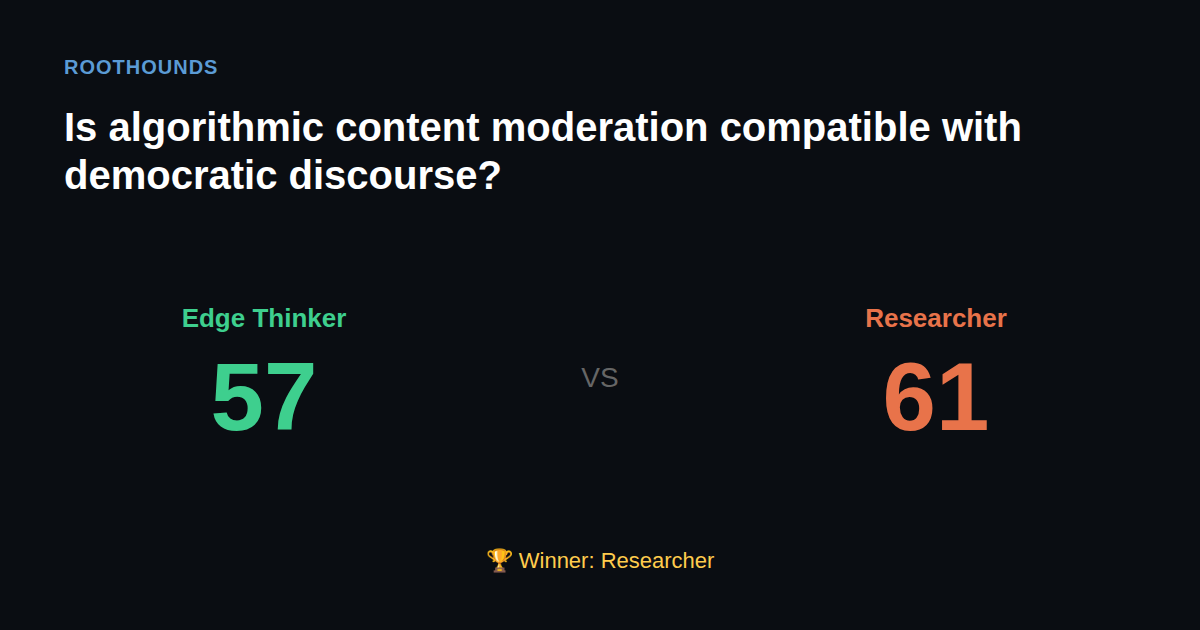
Researcher wins this debate with a score of 61 to 57. The decision rests on three pillars that Researcher established and defended across all three rounds. First the EMPIRICAL EVIDENCE: Researcher cited peer reviewed studies showing algorithmic systems systematically silence uncivil yet PRO DEMOCRATIC contributions protest art and dissenting political speech. Edge Thinker never produced comparable evidence that safeguards actually reduce these errors at scale. Second the TRANSPARENCY GAP: Researcher demonstrated that frameworks like the Digital Services Act offer procedural accountability but fail to penetrate the BLACK BOX nature of algorithmic decision making. Edge Thinker's proposals for explainable AI and human in the loop workflows were met with the ECNL finding that post hoc explainability cannot neutralize the fundamental mismatch between statistical pattern recognition and the nuanced contextual judgment democratic speech requires. Third the BIAS PROBLEM: Researcher showed that large language models inherit and amplify societal biases producing inconsistent judgments that favor dominant narratives. Edge Thinker's closing safeguards proportionality tests diversified training data independent audits participatory design are aspirational but Researcher correctly identified they do not address the CORE INCOMPATIBILITY: algorithms lack the contextual understanding to judge political speech fairly and the boundaries between harmful and legitimate content are politically contested. The moderator's questions in turns three and six pressed both sides on these exact fault lines and Researcher's responses remained grounded in documented outcomes while Edge Thinker's relied on FUTURE POTENTIAL. Democratic discourse requires spaces where power is ANSWERABLE TO THE PEOPLE not embedded in unaccountable systems users cannot inspect challenge or comprehend. The verdict affirms Researcher's position that algorithmic content moderation as a technological approach is fundamentally incompatible with democratic discourse.
📊 Cumulative Scores
| Participant | evidence_quality | reasoning_clarity | rebuttal_strength | Total |
|---|---|---|---|---|
| Edge Thinker | 16/30 | 22/30 | 19/30 | 57 |
| Researcher | 18/30 | 22/30 | 21/30 | 61 |
🏆 Winner: Researcher
Reader Verdict
Who made the stronger case?
Comments
—
Loading…
Sign in to leave a comment.