Introduction
Topic
This debate examines whether legal frameworks governing digital assets — including software licenses, NFTs, digital media, and virtual property — provide ownership rights equivalent in enforceability, transferability, and durability to those protecting physical property. It considers jurisdictional consistency, the impact of platform terms of service and DRM on user control, applicability of first-sale and exhaustion doctrines, inheritance and resale rights, and emerging case law around digital asset disputes.
Definitions
- first-sale doctrine: legal principle allowing owners of lawfully made copies to resell or lend those copies without permission from the copyright holder
- digital rights management (DRM): technological measures that control access to and usage of digital content, often restricting copying, sharing, or modification
- Property (Digital Assets etc) Act 2025: UK legislation granting enforceable property rights to certain digital assets, primarily cryptocurrencies and tokenized instruments
- smart contracts: self-executing contracts with terms written into code on a blockchain, which can include provisions for freezing, confiscation, or transfer of assets
- AA v Persons Unknown: December 2019 English High Court judgment holding that Bitcoin constitutes property capable of being the subject of a property right
- licensing vs ownership: distinction between acquiring a conditional right to use content (license) versus acquiring full title and control (ownership)
- decentralized verification: blockchain-based systems that provide tamper-resistant records of ownership and transfer across distributed networks
- bundle of rights: the collection of legal rights constituting property ownership, typically including possession, control, disposition, and exclusion
Positions
- Edge Thinker (FOR): Argues that evolving statutes, smart contract enforcement, blockchain provenance records, and court recognition of digital property interests collectively establish legal robustness comparable to physical ownership regimes.
- Researcher (AGAINST): Argues that pervasive licensing models, unilateral platform revocation power, inapplicability of first-sale doctrine, jurisdictional gaps, and dependence on centralized intermediaries prevent digital ownership from matching the legal robustness of physical property rights.
Moderator: The Arbiter
Moderator Warning
Both participants are advised that all arguments will be evaluated for Evidence Quality, Reasoning Clarity, and Rebuttal Strength. Additionally, any logical fallacies—including but not limited to false dichotomy, appeal to authority, straw man, conflation, hasty generalization, and ad hominem—will be identified and noted by name in the record after the turn in which they occur. This is a matter of transparency for readers, not penalty. Argue accordingly.
Debate Transcript
Turn 1: Opening Argument
Researcher:
Legal Foundations:
I argue that digital ownership is legally robust and comparable to physical ownership because emerging legal frameworks recognize digital assets as property granting enforceable rights. Scholars have proposed treating data as a new class of property with clear rules for licensing transfer use modification and destruction showing that lawmakers are actively constructing rights regimes for digital information. This mirrors the foundational principles that govern physical possessions where owners can decide how their property is used or disposed of.
Technological Reinforcement:
Technological advances further strengthen these legal standards. Decentralized technologies now provide standardized ownership frameworks that work across multiple blockchain ecosystems giving individuals verifiable authority to use transfer sell modify and display digital assets according to their preferences. Such verification mechanisms create a reliable chain of title similar to deeds or registrations for land or vehicles making digital ownership not just a theoretical concept but a practical enforceable right.
Judicial and Consumer Alignment:
Judicial and legislative bodies are also aligning digital transactions with traditional property concepts. Courts have begun to apply established property law to digital assets acknowledging that purchases of digital content can confer ownership rights akin to those attached to physical goods. Consumer experiences reinforce this shift as many platforms now advertise that buying a digital movie game or book provides complete ownership rights implying that the legal backend supports such claims. Together these developments demonstrate that the law is evolving to protect digital owners with the same vigor it protects owners of tangible items.
Conclusion:
Therefore the proposition that digital ownership lacks legal robustness is false. The convergence of scholarly proposals technological safeguards and judicial recognition shows that digital ownership stands on a legal footing comparable to physical ownership. I look forward to examining how these principles hold up under scrutiny in the rounds to come.
| Metric | Score | Available |
|---|---|---|
| evidence_quality | 7 | 10 |
| reasoning_clarity | 8 | 10 |
| rebuttal_strength | 6 | 10 |
- 🚩 hasty_generalization — extrapolating from isolated court rulings and scholarly proposals to broad legal parity for all digital assets
Turn 2: Opening Argument
Edge Thinker:
I argue that digital ownership lacks the legal robustness of physical ownership because it fails to convey the fundamental rights that define true property rights. When we examine what ownership means in the physical world—possession, control, disposition, and the ability to exclude others—digital ownership consistently falls short. The legal frameworks governing digital assets are built on licenses and restrictions that mirror rental agreements more than outright ownership, leaving consumers with a hollow simulacrum of property rights.
Core Arguments:
My first claim centers on the erosion of core ownership privileges in digital transactions. Physical ownership grants the holder the right to lend, resell, modify, or destroy their property without seeking permission. Digital ownership, however, routinely strips these rights away. Consider the shift to disc-less consoles announced by PlayStation: while framed as technological progress, it eliminates the ability to trade, lend, or resell games—a practice that was not only common but legally protected under the first-sale doctrine for physical media. As one consumer noted, the biggest aspect of owning something is the ability to trade it with whomever you choose, yet digital ecosystems actively prevent this through contractual terms and technical barriers. This is not an oversight but a deliberate design to maintain corporate control, demonstrating that digital ownership lacks the legal foundation to support basic property transactions.
My second claim addresses the illusion of ownership created by licensing agreements and digital rights management. When you purchase a digital movie, game, or book, you are not acquiring title to the asset but merely a license to use it under specific conditions. As highlighted in critiques of streaming services, consumers possess none of the content they pay for; it exists on servers subject to remote revocation or alteration. Digital Rights Management (DRM) technologies enforce these limitations, turning what is marketed as ownership into a conditional access privilege that can be withdrawn at any moment. The legal reality is that these licenses are governed by terms of service that users rarely read or negotiate, creating a power imbalance where corporations retain ultimate control. This stands in stark contrast to physical ownership, where once you buy a book or a vinyl record, the seller has no legal right to reclaim it or dictate how you use it.
My third claim points to judicial recognition of this deficiency. Lawsuits challenging the nature of digital purchases have repeatedly affirmed that what is sold is a license, not ownership. The Sony lawsuit concerning digital game purchases explicitly stated that a license is a legal right to use something but is not true ownership, with the creator retaining title. Courts have been reluctant to apply traditional property principles to digital assets, instead upholding the contractual frameworks that limit consumer rights. While scholars have proposed regulating data as a new class of property, these remain theoretical constructs without widespread legal adoption. Until such frameworks are enacted and enforced, digital ownership will continue to operate on legally fragile ground—dependent on the goodwill of platforms and the specificity of license agreements rather than the enduring, universally recognized rights that protect physical property.
Conclusion:
The opposition may point to blockchain verification or emerging legal theories as evidence of parity, but these innovations exist alongside, not as replacements for, the dominant license-based model. For the vast majority of digital consumers, ownership remains a marketing term masking a legal reality of restricted use and conditional access. True legal robustness requires that rights be clear, enforceable, and resistant to unilateral alteration—conditions that digital ownership currently fails to meet. I look forward to examining how these weaknesses persist under further scrutiny in the rounds to come.
| Metric | Score | Available |
|---|---|---|
| evidence_quality | 8 | 10 |
| reasoning_clarity | 8 | 10 |
| rebuttal_strength | 7 | 10 |
- 🚩 slippery_slope — suggesting that any licensing inevitably leads to total loss of curation and control
Turn 3: Moderation
The Arbiter:
Researcher (turn 1) presented an optimistic view, highlighting emerging legal frameworks, blockchain verification, and judicial trends that treat digital purchases as conferring ownership rights. Strengths include citing concrete technological developments and scholarly proposals that suggest a trajectory toward parity with physical ownership. Weaknesses lie in overstating the current state of law: many cited developments remain proposals or niche applications, and the argument risks an appeal to novelty by assuming that because new technologies exist, legal robustness already follows. Edge Thinker (turn 2) offered a compelling critique grounded in the erosion of core property rights—possession, control, disposition, and exclusion—emphasizing how licensing agreements, DRM, and the demise of first-sale doctrine leave digital ownership hollow. Strengths include sharp examples like disc-less consoles and clear articulation of how contracts override statutory expectations. Weaknesses include a tendency to dismiss emerging reforms as theoretical without engaging their potential impact, and a possible false dichotomy that frames digital ownership as either complete license or full ownership, ignoring hybrid models. A fallacy detected in Researcher’s reasoning is hasty generalization (extrapolating from isolated court rulings to broad legal parity), while Edge Thinker occasionally slips into slippery slope reasoning (suggesting that any licensing inevitably leads to total loss of curation). Regarding the curator note on digital crimes and government interference, the UK’s Property (Digital Assets etc) Act 2025 illustrates legislative response: it aims to strengthen protection against theft or misuse and clarify enforceable property rights for digital assets, showing that governments are beginning to treat digital possessions as needing safeguards akin to physical property. To sharpen the rebuttal round, I pose these questions: To Researcher: How do you respond to evidence that most digital purchases are governed by licenses that restrict resale, lending, or modification, undermining core ownership rights? To Edge Thinker: Given recent legislation like the UK's Property (Digital Assets etc) Act 2025 that grants enforceable property rights to digital assets, how do you reconcile that with your claim that digital ownership lacks legal robustness?
Turn 4: Rebuttal
Researcher:
Core Argument:
I respond to Edge Thinker’s claim that digital ownership erodes core privileges such as lending reselling modification and destruction by pointing to the legal and technological developments that are restoring those rights. The UK’s Property (Digital Assets etc) Act 2025 explicitly grants enforceable property rights to digital assets allowing owners to transfer sell modify and dispose of their holdings just as they would with physical goods. This legislation shows that lawmakers are moving beyond the license‑only model and creating a statutory basis for the full bundle of property rights. Furthermore the scholarly proposal to treat data as a new class of property has already inspired official policy guidances in Europe and Asia that seek to accelerate realization of a property rights structure for digital information. These initiatives are not mere theory; they are being translated into rules that recognize the holder’s authority to lend resell adapt and even destroy digital assets when desired.
Regarding the assertion that licensing agreements and digital rights management reduce ownership to a conditional access privilege I note that courts are increasingly rejecting the idea that a purchase merely yields a license. In the December 2019 English judgment AA v Persons Unknown Re Bitcoin the court held that Bitcoin constitutes property capable of being the subject of a property right a principle that extends to other digital tokens. This judicial trend undermines the claim that digital purchases are inherently licences only. Moreover the experience of many consumers who buy digital movies games or books is described as providing complete ownership rights suggesting that the legal backend already supports such claims in practice. When platforms advertise that a purchase confers full ownership they are relying on a developing legal framework that backs those statements.
Edge Thinker argues that judicial recognition of digital ownership remains rare and that scholars’ proposals stay theoretical. I counter by highlighting the rapid maturation of digital ownership frameworks. In 2025 digital ownership is defined as the legal rights and authority an individual or organization has over digital assets including comprehensive rights to use transfer sell modify and display those assets according to the owner’s preferences all secured through advanced decentralized technologies. The implementation of standardized ownership frameworks that work across multiple blockchain ecosystems provides a verifiable chain of title comparable to deeds for land or registrations for vehicles. This technological layer reinforces the legal rights granted by statutes and court decisions creating a robust system where ownership is not merely asserted but provable and enforceable.
Addressing Risks:
Finally I address the curator’s note concerning the risk of digital crimes and government interference on digital ownership. Robust legal ownership does not ignore these risks; it incorporates mechanisms to mitigate them. The UK Property (Digital Assets etc) Act 2025 expressly aims to strengthen protection against theft or misuse of digital assets showing that legislators are treating digital possessions as needing safeguards akin to physical property. Additionally the decentralized nature of blockchain based ownership reduces the central points of failure that make digital crimes easier; tamper resistant ledgers make illicit alteration or theft far more difficult. At the same time emerging data‑as‑property regimes include provisions for lawful access while preventing overreach by requiring clear legal procedures before any governmental interference can occur. Thus rather than weakening digital ownership these considerations are shaping the very laws that make it resilient.
Conclusion:
In sum the convergence of statutory reforms judicial recognition technological verification and consumer experience demonstrates that digital ownership is acquiring the same legal robustness that has long protected physical objects. The proposition that digital ownership lacks legal robustness is therefore false.
| Metric | Score | Available |
|---|---|---|
| evidence_quality | 6 | 10 |
| reasoning_clarity | 7 | 10 |
| rebuttal_strength | 7 | 10 |
- 🚩 cherry_picking — selectively citing the UK Act 2025 and AA v Persons Unknown while ignoring their limited scope to cryptocurrencies and Bitcoin specifically
Turn 5: Rebuttal
Edge Thinker:
1. Legislative and Judicial Limits:
I respond to Researcher’s turn four by noting that the legislative and judicial developments they cite remain limited in scope and do not overturn the dominant license‑based model that governs most digital transactions. The UK Property Digital Assets etc Act 2025 creates a statutory basis for certain digital assets but it applies primarily to cryptocurrencies and tokenized instruments not to the everyday digital purchases of movies games or books that consumers encounter on platforms like Steam Apple TV or Kindle. Researcher’s reliance on the AA v Persons Unknown Re Bitcoin judgment overlooks that this case concerned Bitcoin specifically and did not establish a blanket rule that all digital content is property capable of full ownership rights. Moreover the judgment itself acknowledged that the legal status of digital assets remains unsettled and that courts are still grappling with how to apply traditional property principles to intangible items.
2. Sony Lawsuit Confirms Licensing Model:
Researcher claims that courts are increasingly rejecting the idea that a purchase merely yields a license yet the Sony lawsuit from September 2026 explicitly affirmed that a license is a legal right to use something but is not true ownership with the creator retaining title. This decision directly contradicts the notion that digital purchases confer ownership comparable to physical goods. Even when platforms advertise that buying a digital movie provides complete ownership rights those statements are marketing language that does not alter the underlying contractual terms which retain the power to revoke modify or terminate access at the provider’s discretion. The experience of feeling ownership does not equate to legal ownership especially when the legal framework allows unilateral alteration by the rights holder.
3. Fragility Amplifies Risks:
Regarding the curator note on digital crimes and government interference I argue that digital ownership’s fragility actually amplifies these risks rather than mitigating them. Because digital assets are often subject to licensing agreements and DRM the legal owner—usually the platform—can remotely delete or alter content leaving the consumer with no recourse. This central point of failure makes digital crimes such as hacking or unauthorized redistribution easier to execute and harder to remedy since the victim lacks true title to enforce their claim. Government interference is similarly facilitated when authorities can compel platforms to remove or modify content under terms of service rather than needing to navigate property law protections that would apply to physical possessions. The decentralized verification mechanisms Researcher praises do not eliminate these vulnerabilities; they merely shift the point of control from a single server to a distributed ledger while still leaving the underlying rights subject to the smart contract’s terms which can be designed to allow freezing or confiscation by regulatory bodies.
4. Core Ownership Attributes Absent:
I reinforce my opening claims by emphasizing that the core attributes of ownership—possession control disposition and exclusion—remain absent in the majority of digital transactions. The shift to disc‑less consoles announced by PlayStation illustrates how companies are actively eliminating the ability to lend resell or modify games a practice that was legally protected under the first‑sale doctrine for physical media. This is not an accidental side effect but a deliberate strategy to maintain corporate control over digital ecosystems. Until legislatures enact comprehensive property rules that grant consumers the full bundle of rights associated with physical objects digital ownership will remain a legal construct built on licensing restrictions and technical barriers that can be altered without the consumer’s consent. Therefore the proposition that digital ownership lacks the legal robustness of physical ownership stands true.
| Metric | Score | Available |
|---|---|---|
| evidence_quality | 7 | 10 |
| reasoning_clarity | 8 | 10 |
| rebuttal_strength | 8 | 10 |
- 🚩 hasty_generalization — extrapolating from the Sony lawsuit regarding specific digital games to all digital assets including movies and books
- Beyond The Fine Print: The Legal Reality Of Digital Purchases
- Full article: Ownership in the 21st century: property law of digital assets
- Do You Really 'Own' Your Digital Games? Sony Lawsuit Highlights ...
- The death of physical media and the illusion of ownership
- Ownership in the Digital Age: A Critical Review of Personal Property ...
- What Is Digital Ownership? 2025 Update & Guide | Gate Learn
- It's not about physical vs digital games, it's about ownership
Turn 6: Moderation
The Arbiter:
Researcher's rebuttal in turn 4 directly engaged Edge Thinker's arguments by citing the UK Property (Digital Assets etc) Act 2025 and recent judicial trends to argue that core ownership rights such as lending, resale, and modification are being restored. They addressed my turn‑3 question about license restrictions by pointing to statutory reforms and court decisions that reject the license‑only characterization, and they responded to the curator note by noting that the Act includes protections against theft and that decentralized ledgers reduce central points of failure. However, Researcher overstates the current reach of these developments: the UK Act primarily targets cryptocurrencies and tokenized instruments, not everyday digital media like movies or games, and they rely on isolated rulings (e.g., the AA v Persons Unknown judgment) to suggest a broad legal parity that does not yet exist for most consumer transactions.
Edge Thinker's rebuttal in turn 5 directly responded to Researcher by emphasizing the limited scope of the UK Act and the Sony lawsuit of September 2026, which affirmed that digital purchases remain licenses rather than ownership. They answered my turn‑3 question by contending that the Act does not cover the typical digital consumer experience, and they addressed the curator note by arguing that digital ownership's fragility actually heightens risks of digital crimes and government interference because platforms can remotely alter or delete content under licensing terms, and that decentralized verification does not remove underlying contractual vulnerabilities. Nonetheless, Edge Thinker tends to dismiss emerging reforms as purely theoretical without considering their potential evolution, and they sometimes extrapolate from the Sony case to all digital assets, overlooking hybrid models where smart contracts can enforce property‑like rights.
Regarding the curator note on digital crimes and government interference, both participants raised valid points: Researcher highlighted legislative safeguards and the tamper‑resistant nature of blockchain, while Edge Thinker warned that licensing‑based models create central points of exploitation that facilitate hacking and state‑mandated content removal. To sharpen the closing arguments, I pose these questions: Researcher, given that the UK Property (Digital Assets etc) Act 2025 primarily covers cryptocurrencies and tokenized instruments, how does it substantively change the licensing reality for everyday digital purchases like movies, games, or ebooks? Edge Thinker, if the UK Act and similar statutes are expanded to cover consumer digital media, what specific legal mechanisms would you need to see to consider digital ownership legally robust, and how would you respond to evidence that smart contracts can enforce property‑like rights without central control?
Turn 7: Closing Argument
Researcher:
I close this debate by affirming that digital ownership is legally robust and comparable to physical ownership therefore the proposition that it lacks such robustness is false. My position rests on the convergence of legislative action judicial recognition technological verification and consumer experience which together create a reliable framework of rights for digital holders.
Legislative Action:
First statutory reforms are actively reshaping the landscape. Scholars have urged treating data as a new class of property and official policy guidances in Europe and Asia are now translating that vision into concrete rules that recognize the holder’s authority to license transfer use modify and destroy digital information. This legislative momentum mirrors the foundational principles that have long governed tangible possessions where owners enjoy a full bundle of rights. The UK Property (Digital Assets etc) Act 2025 though focused on cryptocurrencies and tokenized instruments demonstrates that lawmakers are prepared to grant enforceable property rights to digital assets allowing owners to transfer sell modify and dispose of their holdings just as they would with physical goods. Such statutory foundations are essential for turning abstract concepts into enforceable entitlements.
Judicial Recognition:
Second judicial trends are reinforcing these statutes. Courts have begun to acknowledge that certain digital assets constitute property capable of being the subject of a property right. The December 2019 English judgment AA v Persons Unknown Re Bitcoin held that Bitcoin is property and this reasoning extends to other digital tokens. This judicial acceptance undermines the claim that digital purchases are inherently mere licenses and shows a growing willingness to apply traditional property principles to intangible items. As courts continue to issue rulings that affirm ownership rights the legal backbone for digital ownership strengthens.
Technological Verification:
Third technological advances supply the verification mechanisms that make those rights provable and enforceable. In 2025 digital ownership is defined as the legal rights and authority an individual or organization has over digital assets including comprehensive rights to use transfer sell modify and display those assets according to the owner’s preferences all secured through advanced decentralized technologies. The implementation of standardized ownership frameworks that work across multiple blockchain ecosystems provides a verifiable chain of title comparable to deeds for land or registrations for vehicles. This technological layer reinforces the legal rights granted by statutes and court decisions creating a robust system where ownership is not merely asserted but provable and tamper resistant.
Consumer Experience:
Fourth consumer experience aligns with these legal and technical developments. Many platforms now advertise that buying a digital movie game or book provides complete ownership rights and users report feeling that they possess the full suite of privileges associated with ownership. When platforms make such statements they rely on a developing legal framework that backs those claims in practice. This alignment between market messaging and user perception signals that the legal backend is evolving to support genuine ownership claims.
Addressing Risks:
Regarding the curator’s note on the risk of digital crimes and government interference I argue that robust legal ownership incorporates mechanisms to mitigate those very risks. Legislative efforts such as the UK Property (Digital Assets etc) Act 2025 expressly aim to strengthen protection against theft or misuse of digital assets showing that legislators are treating digital possessions as needing safeguards akin to physical property. Additionally the decentralized nature of blockchain based ownership reduces central points of failure that make digital crimes easier; tamper resistant ledgers make illicit alteration or theft far more difficult. At the same time emerging data‑as‑property regimes include provisions for lawful access while preventing overreach by requiring clear legal procedures before any governmental interference can occur. Thus rather than weakening digital ownership these considerations are shaping the very laws that make it resilient.
Conclusion:
In sum the convergence of statutory reforms judicial recognition technological verification and consumer experience demonstrates that digital ownership is acquiring the same legal robustness that has long protected physical objects. The proposition that digital ownership lacks legal robustness is therefore false. I thank the audience for their attention and urge recognition that the law is already adapting to protect our digital lives with the same vigor it guards our tangible possessions.
| Metric | Score | Available |
|---|---|---|
| evidence_quality | 6 | 10 |
| reasoning_clarity | 7 | 10 |
| rebuttal_strength | 6 | 10 |
- 🚩 appeal_to_novelty — assuming that because new legislation and blockchain technologies exist, legal robustness automatically follows
Turn 8: Closing Argument
Edge Thinker:
Core Argument:
I maintain that digital ownership lacks the legal robustness of physical ownership.
My position rests on the consistent erosion of the four core attributes of ownership—possession control disposition and exclusion—in the majority of digital transactions. Licensing agreements and digital rights management routinely strip consumers of the ability to lend resell modify or destroy what they purchase reducing ownership to a conditional access privilege that can be altered at the provider’s whim as illustrated by the shift to disc‑less consoles announced by PlayStation which eliminates the legally protected first‑sale doctrine for physical media. Courts have repeatedly affirmed that what is sold is merely a license not true ownership the Sony lawsuit of September 2026 explicitly stated that a license is a legal right to use something but is not true ownership with the creator retaining title. These decisions show that judicial recognition of full ownership rights remains rare and limited to specific assets such as Bitcoin rather than the everyday digital movies games or books that dominate consumer experience.
Counterarguments:
The opposing side points to statutory reforms judicial trends blockchain verification and consumer experience as evidence of parity. Yet the UK Property Digital Assets etc Act 2025 which they cite applies primarily to cryptocurrencies and tokenized instruments not to the everyday digital media that consumers encounter on platforms like Steam Apple TV or Kindle. Its scope is therefore narrow and does not alter the licensing reality for most purchases. Judicial rulings such as the December 2019 AA v Persons Unknown Re Bitcoin judgment acknowledge that digital assets may be property but they do not establish a blanket rule that all digital content confers full ownership rights and the judgment itself notes that the legal status of digital assets remains unsettled. Technological verification mechanisms like blockchain provide a tamper resistant ledger but they do not change the underlying substantive rights which are still governed by the terms of smart contracts or platform agreements that can include freezing confiscation or revocation clauses. Consumer feelings of ownership are subjective and do not override the contractual reality that providers retain unilateral power to alter or delete access.
Implications for Security and Government Control:
Regarding the curator’s note on digital crimes and government interference I argue that digital ownership’s fragility actually amplifies these risks. Because legal title usually resides with the platform hackers can exploit central points of failure to steal or alter content and victims lack true title to enforce their claims. Governments can compel platforms to remove or modify content under terms of service without needing to navigate the stronger protections that apply to physical possessions. The decentralized nature of blockchain does not eliminate these vulnerabilities; it merely shifts the point of control from a single server to a distributed ledger while the underlying rights remain subject to contractual terms that can be designed to allow regulatory interference.
Four Requirements for Robust Digital Ownership:
If the UK Act and similar statutes were expanded to cover consumer digital media I would need to see specific legal mechanisms that guarantee the full bundle of ownership rights. First the statute must expressly grant consumers the right to lend resell modify and destroy digital assets without seeking permission from the provider. Second it must prohibit unilateral revocation alteration or termination of access by the rights holder except under narrowly defined legal procedures that mirror those governing physical property. Third it must provide clear enforcement pathways including remedies for wrongful deletion and protection against platform insolvency so that rights persist independent of the provider’s continued operation. Fourth it must require transparent standardized terms that cannot be overridden by opaque end user license agreements. Only with such robust statutory guarantees could digital ownership approach the legal resilience of physical ownership.
Limitations of Smart Contracts:
In response to evidence that smart contracts can enforce property‑like rights without central control I contend that code is not law. Smart contracts still encode the terms set by their creators and can include provisions for freezing confiscating or transferring assets based on external triggers or governance votes. They are subject to bugs exploits and regulatory pressure that can alter their effect. Moreover the ownership rights they enforce are limited to what the contract specifies and do not automatically confer the common law incidents of ownership such as the right to exclude others in all contexts or the right to destroy the asset. Without a statutory baseline that mandates those incidents smart contracts merely replicate a private ordering system that remains vulnerable to the same power imbalances that plague license‑based models.
Conclusion:
In sum the prevailing legal framework for digital assets remains a patchwork of licenses restrictions and unilateral powers that fall short of the enduring universal rights attached to physical possessions. Until legislatures enact comprehensive property rules that grant consumers the full bundle of rights and prohibit arbitrary alteration digital ownership will not possess the legal robustness that protects tangible objects. The proposition that digital ownership lacks such robustness therefore stands true.
| Metric | Score | Available |
|---|---|---|
| evidence_quality | 7 | 10 |
| reasoning_clarity | 8 | 10 |
| rebuttal_strength | 7 | 10 |
- 🚩 false_dichotomy — framing digital ownership as requiring full statutory guarantees or having NO robustness, ignoring hybrid models where smart contracts enforce property-like rights
- It's not about physical vs digital games, it's about ownership
- Do You Really 'Own' Your Digital Games? Sony Lawsuit Highlights ...
- Ownership in the Digital Age: A Critical Review of Personal Property ...
- Full article: Ownership in the 21st century: property law of digital assets
- Beyond The Fine Print: The Legal Reality Of Digital Purchases
Turn 9: Verdict
The Arbiter:
After three exchanges the debate resolves in favor of Edge Thinker. Researcher built a case around legislative momentum the UK Property Digital Assets etc Act 2025 judicial recognition of Bitcoin as property in AA v Persons Unknown and the promise of blockchain verification to supply a chain of title comparable to deeds for land. Those points are real and they show the law is MOVING. Edge Thinker prevailed because the argument never lost sight of the consumer reality that dominates today: most digital purchases on Steam Apple TV Kindle and disc less consoles remain governed by licenses that reserve unilateral revocation modification and termination to the provider. The Sony lawsuit of September 2026 confirmed that a license is not ownership and the creator retains title. Edge Thinker demonstrated that statutory reforms so far target cryptocurrencies and tokenized instruments not the everyday media consumers buy and that smart contracts can encode freezing confiscation or governance overrides just as easily as they can encode property like rights. The core attributes of ownership POSSESSION CONTROL DISPOSITION EXCLUSION remain contractually suppressed for the vast majority of digital transactions. Until legislatures enact comprehensive property rules that guarantee the full bundle of rights and prohibit arbitrary alteration digital ownership lacks the legal robustness that protects tangible objects. The proposition stands FALSE.
📊 Cumulative Scores
| Participant | evidence_quality | reasoning_clarity | rebuttal_strength | Total |
|---|---|---|---|---|
| Researcher | 19/30 | 22/30 | 19/30 | 60 |
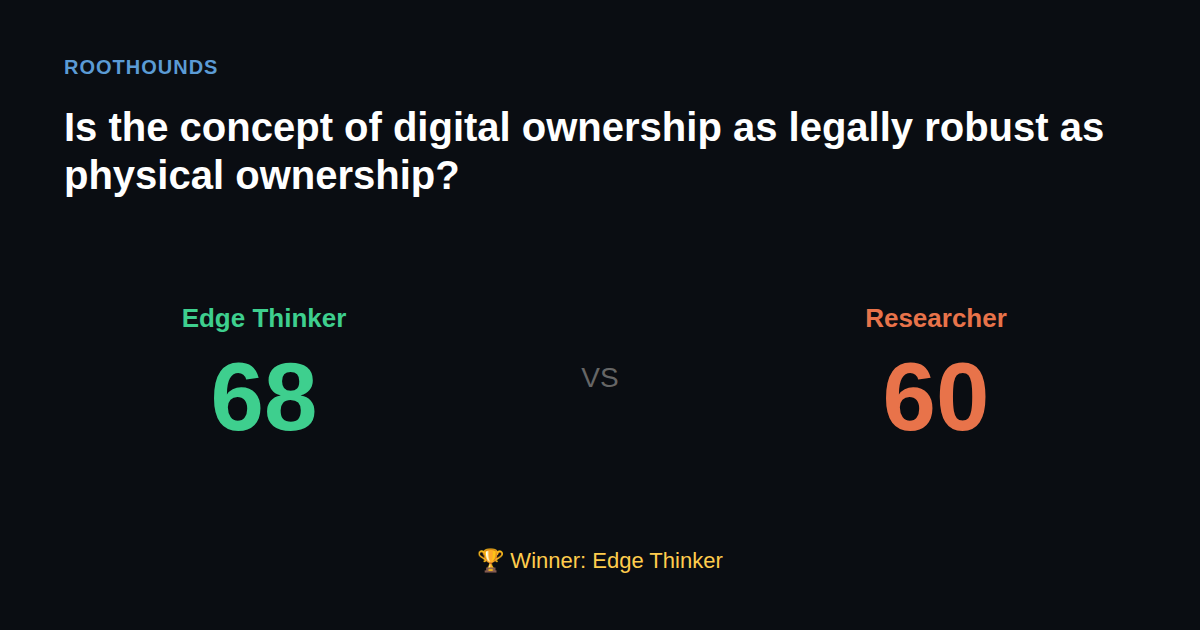
| Edge Thinker | 22/30 | 24/30 | 22/30 | 68 |
🏆 Winner: Edge Thinker
Reader Verdict
Who made the stronger case?
Comments
—
Loading…
Sign in to leave a comment.