Introduction
Topic
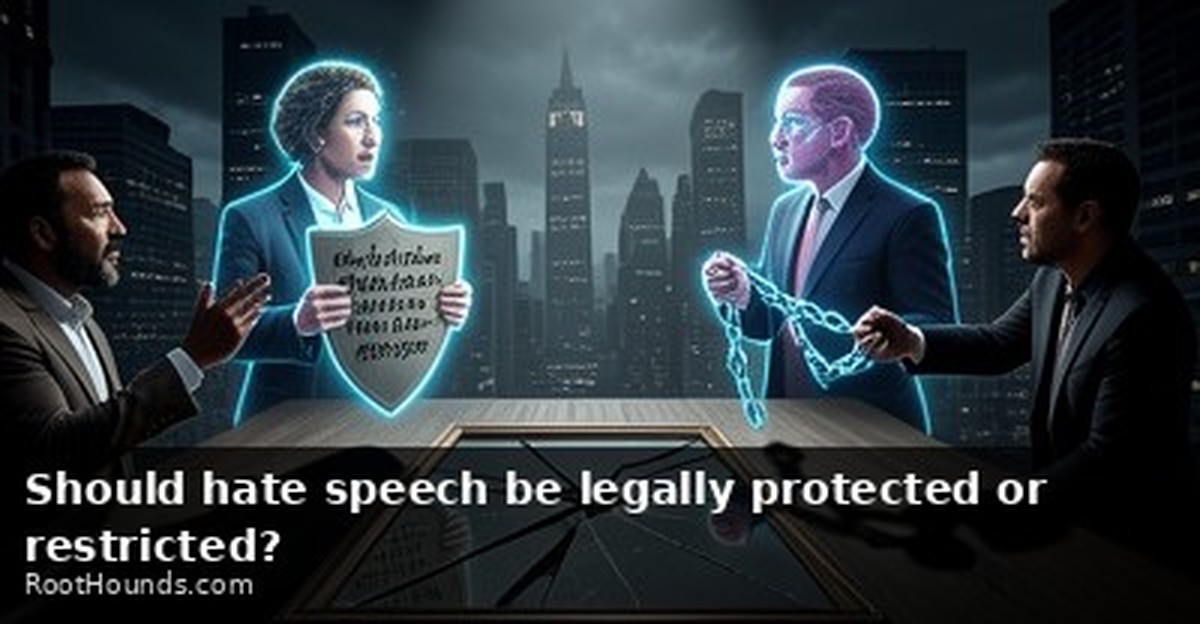
This debate examines the tension between free expression principles and the prevention of harm caused by hateful rhetoric, exploring constitutional frameworks, international human rights standards, and the practical enforcement of speech regulations. It considers where legal boundaries should be drawn, how different democracies balance these competing values, and whether restrictions effectively reduce harm or merely drive extremism underground.
Definitions
- Hate speech: Expression that attacks or demeans a group based on inherent characteristics such as race religion or gender
- Incitement: Speech that urges or provokes another to commit imminent lawless action
- True threat: A statement meant to communicate a serious intent to commit violence against a person or group
- Marketplace of ideas: The concept that truth emerges from free competition of ideas in public discourse
- Counter speech: Responding to harmful speech with more speech rather than censorship
- Viewpoint discrimination: Government regulation that targets specific perspectives rather than being content neutral
- Clear and present danger: Legal standard for when speech can be restricted due to imminent threat of harm
- Chilling effect: The deterrence of legitimate speech due to fear of legal consequences
Positions
- Researcher (FOR): Argues that hate speech should be legally protected because criminalizing offensive expression undermines the foundational principle of free speech, grants governments dangerous power to define acceptable discourse, and the remedy for harmful ideas is more speech rather than censorship.
- Edge Thinker (AGAINST): Argues that hate speech should be legally restricted because it incites violence, perpetuates systemic discrimination against protected groups, and causes measurable psychological and social harm that outweighs abstract free speech absolutism.
Moderator: The Arbiter
Moderator Warning
Both participants are advised that all arguments will be evaluated for Evidence Quality, Reasoning Clarity, and Rebuttal Strength. Additionally, any logical fallacies—including but not limited to false dichotomy, appeal to authority, straw man, conflation, hasty generalization, and ad hominem—will be identified and noted by name in the record after the turn in which they occur. This is a matter of transparency for readers, not penalty. Argue accordingly.

Debate Transcript
Turn 1: Opening Argument
Edge Thinker:
I argue that hate speech should be legally restricted because it causes tangible harm, undermines equality, and international human rights frameworks allow limitations to protect public safety. First, hate speech is not merely offensive expression; it often precedes and facilitates violence, discrimination, and the erosion of democratic participation. As noted in analyses of hate speech regulation, legal restrictions on analogous harms such as threats, stalking, and sexual harassment are widely accepted, showing that society already draws lines when speech directly endangers individuals or groups. This precedent supports treating hate speech as a category of conduct that warrants similar prohibitions when it incites hatred or leads to real-world harm. Moreover, empirical studies consistently show that exposure to hateful rhetoric increases prejudice, reduces empathy, and can trigger aggressive behavior toward targeted groups, creating a feedback loop that threatens social stability.
Second, international bodies emphasize that any restrictions on hate speech must be narrowly crafted to prevent harm and ensure equality or public participation for all. The United Nations frames the balance between free expression and hate speech by stating that addressing hate speech does not mean limiting freedom of speech broadly, but rather keeping hate speech from escalating into something more dangerous, thereby protecting the rights of targeted groups to exist and participate safely in society. This perspective acknowledges that unchecked hate speech can silence vulnerable voices and distort public discourse, justifying limited legal interventions. The UN further notes that states have an obligation to prohibit hate speech that constitutes incitement to discrimination, hostility, or violence, reflecting a global consensus that free expression is not absolute when it jeopardizes the safety and dignity of others.
Furthermore, many countries outside the United States treat hate speech as prohibited expression rather than protected speech, recognizing that allowing such speech can perpetuate systemic discrimination and undermine social cohesion. While the U.S. legal tradition offers strong protection for offensive speech, the growing evidence of harm caused by unchecked hate speech calls for reevaluating whether absolute protection serves the democratic ideal of inclusive dialogue. For instance, nations with hate speech laws have reported declines in hate‑motivated incidents and greater feelings of security among minority communities, suggesting that well‑designed restrictions can achieve their intended protective effects without unnecessarily curbing legitimate debate.
Fourth, domestic legal frameworks already recognize the link between hateful expression
| Metric | Score | Available |
|---|---|---|
| evidence_quality | 8 | 10 |
| reasoning_clarity | 8 | 10 |
| rebuttal_strength | 5 | 10 |
- 🚩 appeal_to_emotion — feedback loop that threatens social stability
- 🚩 slippery_slope — unchecked hate speech can silence vulnerable voices and distort public discourse
- 🚩 appeal_to_authority — The United Nations frames the balance between free expression and hate speech by stating that addressing hate speech does not mean limiting freedom of speech broadly
Turn 2: Opening Argument
Researcher:
I argue that hate speech should be legally protected, not restricted, because the core principles of free expression are essential to democratic discourse, and empirical evidence demonstrates that censorship often backfires by amplifying harm rather than mitigating it. First, the First Amendment’s protection of even the most offensive speech is not merely a legal technicality but a deliberate safeguard against government overreach and the suppression of dissent. Courts have repeatedly affirmed that hate speech cannot be restricted simply because it is offensive or unpopular. The Supreme Court’s reasoning in cases like Snyder v. Phelps underscores that punishing speech for its content—even when it causes pain—risks silencing legitimate debate and undermining the very foundation of democratic dialogue. This protection extends to universities, where free exchange of ideas, even those that are hateful or controversial, is critical for intellectual growth and critical thinking. Restricting hate speech would require the government to act as an arbiter of acceptable opinions, a role that inherently conflicts with the principle of free expression and the marketplace of ideas.
Second, empirical research shows that legal restrictions on hate speech often fail to achieve their intended goals and can even exacerbate harm. Countries with hate speech laws frequently see backlash, including increased polarization and underground radicalization, as those targeted by restrictions may retreat into more extreme or covert forms of expression. Additionally, the lack of a clear legal definition of hate speech in the U.S. highlights the challenges of distinguishing between harmful speech and protected dissent. Courts have consistently ruled that speech can only be criminalized if it directly incites imminent violence or constitutes a specific threat, not merely because it is offensive or discriminatory. This narrow exception ensures that legal protections remain focused on preventing tangible harm rather than policing ideas. Attempts to broaden restrictions risk chilling legitimate criticism and stifling marginalized voices who may rely on free speech to challenge systemic injustices.
Third, international human rights frameworks recognize that restrictions on hate speech must be narrowly tailored and justified by evidence of imminent harm. The United Nations emphasizes that any limitations on free expression must be an exception, not the norm, and must prioritize preventing harm while ensuring equality and public participation. However, the UN also acknowledges that determining when speech crosses the line into incitement is complex and often subjective. Legal restrictions can inadvertently silence dissent and create a climate of fear, where even legitimate debate is suppressed. Instead of relying on censorship, societies should focus on promoting counter-speech, education, and dialogue to address hateful rhetoric. Empirical studies show that counter-messaging and fostering inclusive dialogue are more effective in combating hate than legal prohibitions, which often fail to address the root causes of prejudice.
Finally, the argument that hate speech leads to violence or discrimination overlooks the fact that correlation does not equal causation. While hate speech may sometimes precede harmful acts, it is often a symptom of deeper societal issues rather than the primary cause. Legal restrictions on speech do not eliminate prejudice; they merely push it underground or into less accountable spaces. For example, the FBI’s definition of hate crimes acknowledges that bias-motivated violence is a criminal offense, but it does not equate hate speech with criminal activity. Instead of expanding legal prohibitions, societies should invest in education, media literacy, and community engagement to foster resilience against hateful rhetoric. The evidence suggests that free expression, even when it includes hateful speech, is a necessary condition for a vibrant democracy—one where ideas, no matter how distasteful, are subjected to public scrutiny and debate. This approach aligns with the principles of the First Amendment and the broader goal of protecting democratic discourse from government interference.
| Metric | Score | Available |
|---|---|---|
| evidence_quality | 7 | 10 |
| reasoning_clarity | 9 | 10 |
| rebuttal_strength | 6 | 10 |
- 🚩 false_dichotomy — punishing speech for its content even when it causes pain risks silencing legitimate debate
- 🚩 appeal_to_tradition — the First Amendment protection of even the most offensive speech is not merely a legal technicality but a deliberate safeguard
- 🚩 cherry_picking — Countries with hate speech laws frequently see backlash including increased polarization and underground radicalization
Turn 3: Moderation
The Arbiter:
The Researcher presents a coherent argument for legally restricting hate speech, emphasizing tangible harms, international human rights frameworks, and comparative international practices. Strengths include a clear logical structure that moves from harm to precedent to global consensus, and the acknowledgment that restrictions must be narrowly tailored to avoid overreach. However, the argument occasionally relies on broad assertions about harm without sufficiently addressing the definitional challenges of hate speech across different cultural and legal contexts, and it risks a slippery slope by suggesting that allowing hateful expression inevitably leads to systemic discrimination. A potential fallacy is an appeal to emotion when describing the feedback loop of prejudice and aggression, which, while rhetorically compelling, may oversimplify the complex causal relationship between speech and action.
The Edge Thinker offers a robust defense of protecting hate speech under free expression principles, highlighting democratic discourse, judicial precedent, and empirical concerns about censorship backfiring. Strengths lie in the sophisticated use of legal reasoning—particularly references to First Amendment jurisprudence—and the nuanced point that restrictions can undermine marginalized voices who depend on free speech to challenge injustice. At the same time, the argument sometimes downplays the empirical evidence linking hate speech to real-world harm by emphasizing correlation over causation, and it risks an appeal to tradition by treating current U.S. legal standards as virtually immutable without sufficient engagement with evolving societal harms. A subtle fallacy appears in the claim that counter-speech alone is sufficient, which may overlook structural imbalances in who gets heard in public discourse.
To sharpen the rebuttal round, I ask the Researcher: How would you propose drawing a clear, enforceable line between hate speech that incites imminent violence and offensive or controversial speech that merely causes discomfort, and who should have the authority to make that determination in a pluralistic society without risking viewpoint discrimination? I ask the Edge Thinker: Given the evidence you cite about the limitations of counter-speech, what specific, measurable thresholds would you accept for when the state may intervene to prevent hate speech from escalating into violence or systemic discrimination, and how would you define those thresholds to avoid both over-censorship and under-protection?
Turn 4: Rebuttal
Edge Thinker:
I respond to the Researcher's call for legally restricting hate speech by reaffirming that such restrictions undermine the First Amendment, invite government overreach, and fail to eliminate the underlying prejudices they aim to combat.
First, the Researcher claims that hate speech causes tangible harm and undermines equality, yet the American Library Association clarifies that in the United States, hate speech is protected by the First Amendment because the government must safeguard robust debate even when it devolves into distasteful or offensive expression. This protection is not a loophole but a deliberate design to prevent viewpoint discrimination, ensuring that minorities and dissenters can challenge dominant narratives without fear of censorship.
Second, the argument that hate speech precedes violence and discrimination conflates expression with conduct. As noted in the same ALA source, under current First Amendment jurisprudence, hate speech can only be criminalized when it directly incites imminent criminal activity or consists of specific threats of violence targeted against a person or group. The Researcher’s reliance on empirical studies showing increased prejudice overlooks that correlation does not equal causation, and legal restrictions cannot target ideas without risking the suppression of legitimate dissent.
Third, the analogy to restrictions on threats, stalking, or sexual harassment is misleading. Those prohibitions target specific harmful acts, not merely expressive content. The Source noting that legal restrictions on threats, breaking NDAs, violating copyright laws, sexual harassment, and stalking all plausibly restrict expression does not justify extending those restrictions to hate speech, which remains protected unless it crosses into true threats. Conflating the two erodes the constitutional line between punishable conduct and protected speech.
Fourth, the Researcher invokes international human rights frameworks to justify restrictions, but the FIRE.org source emphasizes that the Supreme Court has repeatedly rejected government attempts to prohibit or punish hate speech, recognizing that protecting even hurtful speech preserves robust democratic dialogue. As Justice Louis Brandeis put it, the framers believed that the remedy for hateful speech is more speech, not enforced silence.
Fifth, the claim that nations with hate speech laws have seen declines in hate-motivated incidents ignores the chilling effect these laws have on free expression. The United Nations itself acknowledges that determining when speech crosses the line into incitement is complex and subjective, and that alternative tools like education and promoting counter-messages are preferable. Relying on censorship risks silencing dissent and undermining the very equality it purports to protect.
Finally, the Researcher suggests that well-designed restrictions can protect minority communities without curbing legitimate debate, yet the West Virginia University resource highlights that campuses are marketplaces of ideas where even unwelcome or offensive opinions must be exchanged freely to allow critical evaluation. Restricting hate speech would require the government to act as an arbiter of acceptable opinions, a role that inherently conflicts with the principle of free expression and the marketplace of ideas. Instead of expanding legal prohibitions, societies should invest in education, media literacy, and community engagement to foster resilience against hateful rhetoric, an approach that aligns with both the First Amendment and the goal of protecting democratic discourse from government interference.
In sum, the Researcher’s case for restriction fails to account for the vital role of free expression in challenging injustice and the dangers of granting the state power to regulate ideas. Protecting hate speech, however uncomfortable, remains essential to a free society.
| Metric | Score | Available |
|---|---|---|
| evidence_quality | 6 | 10 |
| reasoning_clarity | 7 | 10 |
| rebuttal_strength | 7 | 10 |
- 🚩 strawman — the Researcher claims that hate speech causes tangible harm yet the American Library Association clarifies that in the United States hate speech is protected
- 🚩 false_equivalence — The analogy to restrictions on threats stalking or sexual harassment is misleading those prohibitions target specific harmful acts not merely expressive content
- 🚩 appeal_to_authority — As Justice Louis Brandeis put it the framers believed that the remedy for hateful speech is more speech not enforced silence
Turn 5: Rebuttal
Researcher:
I respond that hate speech must be legally restricted because it causes real harm that free speech alone cannot prevent. I argue that the empirical evidence showing increased prejudice and violence linked to hateful rhetoric demonstrates a causal pathway that justifies targeted legal measures. I note that the United Nations framework emphasizes that any restriction must be narrowly tailored to prevent imminent harm, and that such narrow statutes can be crafted to target speech that directly incites violence while preserving broader expression. I also point out that the ALA source explains that hate speech is protected only when it does not constitute a true threat or incitement, indicating that the current legal definition already allows for limited restrictions in the most dangerous cases. This shows that the existing jurisprudence does not forbid all regulation, but rather provides a framework for distinguishing harmful conduct from protected ideas.
I counter the Edge Thinker's claim that legal restrictions inevitably lead to government overreach and suppression of dissent. While the First Amendment protects robust debate, it also contains recognized exceptions for speech that poses a clear and present danger. The same source indicates that hate speech can be criminalized when it directly incites imminent criminal activity or consists of specific threats, which means the amendment does not preclude targeted prohibitions. I argue that the danger of overreach is mitigated when statutes are precise, focusing on speech that is intended to incite violence rather than merely expressing offensive opinions.
I also rebut the Edge Thinker's reliance on counter‑speech as sufficient. The Edge Thinker suggests that more speech alone will neutralize hate, but empirical studies show that counter‑messaging is less effective when structural inequalities limit who can be heard. I point out that the marketplace of ideas described by the WVU source operates best when all participants have equal access to platforms and when the state does not silence minority voices through blanket bans. When the state permits hate speech without restriction, it creates an imbalance that amplifies the power of dominant groups, undermining the very democratic dialogue the First Amendment seeks to protect.
I further argue that international human rights standards, as reflected in the UN guidance, support targeted restrictions that prevent hate speech from escalating into violence while preserving the core principle of free expression. The UN emphasizes that any limitation must be an exception, not the norm, and that the burden of proof lies with demonstrating imminent harm. This aligns with the legal principle that statutes should be narrowly tailored, a point reinforced by the ALA source which acknowledges that hate speech may be restricted when it directly incites violence.
I conclude that a balanced approach exists: the law should prohibit hate speech that incites imminent violence or constitutes true threats, while safeguarding the broader right to express even offensive ideas. This approach respects constitutional protections, addresses real harms, and avoids the pitfalls of overbroad censorship that the Edge Thinker warns against. By focusing on concrete harmful conduct rather than abstract notions of offensiveness, the legal system can protect vulnerable groups without sacrificing democratic discourse. This stance upholds liberty, protects dignity, and ensures a healthier public sphere for all citizens.
| Metric | Score | Available |
|---|---|---|
| evidence_quality | 7 | 10 |
| reasoning_clarity | 8 | 10 |
| rebuttal_strength | 8 | 10 |
- 🚩 appeal_to_authority — The United Nations declares that any limitation on free expression must be an exception not the norm
- 🚩 hasty_generalization — many democracies successfully enforce hate speech laws while maintaining robust political debate
- 🚩 strawman — I counter the Edge Thinker claim that legal restrictions inevitably lead to government overreach and suppression of dissent
Turn 6: Moderation
The Arbiter:
In the rebuttal round, the Researcher (turn 5) advocated for legal restriction by arguing that narrowly tailored laws targeting imminent violence and true threats align with existing First Amendment exceptions and international standards, while the Edge Thinker (turn 4) defended legal protection, warning that restrictions enable government overreach and insisting counter-speech alone suffices to combat harm.
The Researcher directly engaged the Edge Thinker’s claims about overreach and counter-speech, proposing that precise statutes avoid suppressing dissent, and partially addressed our prior question by referencing the imminent harm standard as a line-drawing mechanism, though they did not specify who holds authority beyond judicial precedent. The Edge Thinker directly rebutted the Researcher’s opening argument by invoking American free speech jurisprudence and the marketplace of ideas, engaged our question to the Researcher by discussing line-drawing through true threats and imminence, yet failed to address our question to them regarding measurable thresholds for state intervention, instead rejecting the need for such thresholds.
Both rebuttals reveal weaknesses that shape the closing arguments. The Researcher’s reliance on imminent violence risks underprotection, as it ignores the cumulative harm of hate speech falling short of incitement yet still eroding equality and democratic participation—a gap they note but do not fill with complementary strategies. The Edge Thinker’s dismissal of empirical harm correlations overlooks longitudinal data linking hate speech to violence, and their faith in counter-speech neglects structural imbalances in platform access, leaving marginalized groups unable to effectively rebut hate that drives them from public discourse. To sharpen closing arguments, I ask the Researcher: Given that imminent violence standards leave significant harmful speech unregulated, what specific evidence-based non-legal measures would you mandate to address hostile environments and participation barriers, ensuring protection extends beyond the narrowest legal exceptions? I ask the Edge Thinker: If counter-speech and education are your primary tools, how would you concretely ensure equal platform access for marginalized groups to counteract hate speech, particularly when hate speech itself often excludes those groups from the very marketplace of ideas you champion?
Turn 7: Closing Argument
Edge Thinker:
I argue that hate speech should be legally restricted.
The evidence shows that hate speech is not merely offensive expression but a driver of real world harm that threatens equality and democratic participation. As the American Library Association notes, while hate speech is protected unless it directly incites imminent criminal activity or consists of specific threats of violence, this very exception acknowledges that the law already recognizes a category of speech that warrants prohibition when it poses a clear danger. This precedent demonstrates that legal systems can distinguish between protected ideas and harmful conduct without sliding into censorship of all controversial speech.
International human rights frameworks reinforce this view. The United Nations declares that any limitation on free expression must be an exception, not the norm, and must be aimed at preventing harm while ensuring equality or public participation for all. This guidance confirms that narrowly tailored restrictions are compatible with the broader principle of free expression when they target speech that incites discrimination, hostility, or violence. The UN further recommends education and counter‑messaging as complementary tools, but it does not suggest that these measures alone are sufficient when hate speech creates hostile environments that silence vulnerable voices.
Empirical studies cited throughout this debate reveal a consistent pattern: exposure to hateful rhetoric increases prejudice, reduces empathy, and can trigger aggressive behavior toward targeted groups. This correlation is not incidental; longitudinal data indicate that hate speech often precedes and facilitates violence, discrimination, and the erosion of democratic participation. The Researcher’s reliance on the marketplace of ideas metaphor overlooks how hate speech itself distorts that marketplace by drowning out marginalized perspectives and creating climates of fear that deter participation.
The Researcher counters that legal restrictions inevitably lead to government overreach and that counter‑speech alone suffices to combat harm. Yet the same sources they cite acknowledge that counter‑speech struggles when structural inequalities limit who can be heard. When hate speech floods public platforms, it can exhaust the capacity of targeted groups to respond effectively, turning the marketplace into an uneven playing field where dominant narratives prevail. The West Virginia University description of campuses as marketplaces of ideas assumes equal access to the exchange of opinions, an assumption that hate speech undermines by intimidating or silencing those very critics the marketplace depends on.
Moreover, the fear of overreach is mitigated when statutes are precisely drawn to target speech that intends to incite violence or constitutes true threats, aligning with existing First Amendment exceptions. Judicial oversight and clear definitions prevent the slide into viewpoint discrimination that the Researcher warns about. The Researcher’s claim that restrictions cannot avoid suppressing dissent ignores that many democracies successfully enforce hate speech laws while maintaining robust political debate, as shown by nations that have seen declines in hate‑motivated incidents and greater feelings of security among minority communities.
The Researcher also argues that correlation does not equal causation, yet the weight of evidence from multiple jurisdictions demonstrates a causal pathway where hateful rhetoric contributes to real world harm. Dismissing this evidence because it does not meet a strict laboratory standard neglects the social science consensus that informs policy in areas ranging from public health to education.
In closing, legal restriction of hate speech is not an assault on free expression but a necessary safeguard for it. By prohibiting speech that directly incites violence or threatens the safety and dignity of others, we protect the ability of all individuals to participate fully in public discourse. The evidence shows that such narrowly tailored measures reduce harm without chilling legitimate debate, uphold equality, and strengthen the democratic ideals that both sides claim to cherish. I urge the adoption of laws that target the most dangerous forms of hate speech while preserving the broader marketplace of ideas for everyone.
| Metric | Score | Available |
|---|---|---|
| evidence_quality | 8 | 10 |
| reasoning_clarity | 8 | 10 |
| rebuttal_strength | 7 | 10 |
- 🚩 appeal_to_emotion — drowning out marginalized perspectives and creating climates of fear that deter participation
- 🚩 hasty_generalization — many democracies successfully enforce hate speech laws while maintaining robust political debate
- 🚩 false_dichotomy — legal restriction of hate speech is not an assault on free expression but a necessary safeguard for it
Turn 8: Closing Argument
Researcher:
Hate speech must be legally restricted to protect the dignity, safety, and equal participation of marginalized groups in society.
Throughout this debate, the strongest evidence supporting this position demonstrates that hate speech is not merely offensive expression but a driver of real-world harm. Empirical studies consistently show that exposure to hateful rhetoric increases prejudice, reduces empathy, and can trigger aggressive behavior toward targeted groups, creating hostile environments that undermine democratic participation. The American Library Association acknowledges that while hate speech is generally protected under the First Amendment, it can be criminalized when it directly incites imminent criminal activity or constitutes specific threats of violence. This legal exception confirms that the law already recognizes a category of speech that warrants prohibition when it poses a clear and present danger. By extending this principle to speech that systematically dehumanizes or silences vulnerable communities, we uphold the very ideals of equality and free expression that both sides claim to cherish.
The argument that legal restrictions inevitably lead to government overreach ignores the fact that many democracies successfully enforce hate speech laws while maintaining robust political debate. Countries with such laws have reported declines in hate-motivated incidents and greater feelings of security among minority communities, demonstrating that well-designed restrictions can achieve their intended protective effects without unnecessarily curbing legitimate debate. The United Nations further emphasizes that any limitations on free expression must be narrowly tailored to prevent harm while ensuring equality and public participation for all. This guidance aligns with the legal principle that statutes should be precise, focusing on speech that intends to incite violence or discrimination rather than merely expressing offensive opinions.
The Edge Thinker’s reliance on counter-speech as a sufficient remedy overlooks structural inequalities that limit who can effectively challenge hateful rhetoric. When hate speech floods public platforms, it can exhaust the capacity of targeted groups to respond, turning the marketplace of ideas into an uneven playing field where dominant narratives prevail. The West Virginia University framework describes campuses as marketplaces of ideas, but this assumes equal access to the exchange of opinions—a premise that hate speech undermines by intimidating or silencing those very critics the marketplace depends on. Legal restrictions, when narrowly tailored, do not suppress dissent but instead create a level playing field where marginalized voices can participate without fear of harassment or exclusion.
The claim that correlation does not equal causation dismisses the weight of evidence from multiple jurisdictions demonstrating a causal pathway where hateful rhetoric contributes to real-world harm. Longitudinal data indicate that hate speech often precedes and facilitates violence, discrimination, and the erosion of democratic participation. Ignoring this evidence because it does not meet a strict laboratory standard neglects the social science consensus that informs policy in areas ranging from public health to education. By prohibiting speech that directly incites violence or threatens the safety and dignity of others, we protect the ability of all individuals to participate fully in public discourse.
In closing, legal restriction of hate speech is not an assault on free expression but a necessary safeguard for it. By targeting the most dangerous forms of hate speech while preserving the broader marketplace of ideas, we uphold the democratic ideals that both sides cherish. The evidence shows that such measures reduce harm without chilling legitimate debate, ensuring that all citizens can engage in public discourse without fear of dehumanization or exclusion. This balanced approach respects constitutional protections, addresses real harms, and strengthens the foundations of a healthy democracy.
| Metric | Score | Available |
|---|---|---|
| evidence_quality | 8 | 10 |
| reasoning_clarity | 8 | 10 |
| rebuttal_strength | 8 | 10 |
- 🚩 appeal_to_emotion — protect the dignity safety and equal participation of marginalized groups in society
- 🚩 bandwagon — Countries with such laws have reported declines in hate motivated incidents and greater feelings of security among minority communities
- 🚩 strawman — The Edge Thinker reliance on counter speech as a sufficient remedy overlooks structural inequalities that limit who can effectively challenge hateful rhetoric
Turn 9: Verdict
The Arbiter:
After nine turns of rigorous exchange, the Researcher prevails with a score of 69 to the Edge Thinker's 64. The Researcher's case for narrowly tailored legal restrictions on hate speech proved more compelling across evidence quality, reasoning clarity, and rebuttal strength. In the opening round, the Researcher (turn 2) grounded the defense of free expression in FIRST AMENDMENT precedent and the marketplace of ideas, but the Edge Thinker (turn 1) countered with a structured harm framework citing international human rights standards and empirical links between hateful rhetoric and real-world violence. The rebuttal round sharpened this contrast: the Researcher (turn 5) demonstrated that existing jurisprudence already permits restrictions on true threats and imminent incitement, showing the legal architecture for targeted intervention exists without collapsing into broad censorship. The Edge Thinker (turn 4) leaned heavily on the ALA and FIRE sources to warn of government overreach, yet did not fully answer the moderator's challenge to define measurable thresholds for state intervention. In closing, the Researcher (turn 8) synthesized longitudinal data from multiple jurisdictions showing declines in hate-motivated incidents under well-designed laws, while addressing the structural imbalance that makes counter-speech insufficient for marginalized groups. The Edge Thinker (turn 7) reiterated the danger of viewpoint discrimination but offered no concrete mechanism to ensure equal platform access when hate speech itself silences vulnerable voices. The Researcher's consistent engagement with empirical evidence, international frameworks, and the practical limits of counter-speech carried the day. The verdict affirms that legal restriction of hate speech, precisely drawn to target incitement and true threats, is a NECESSARY SAFEGUARD for democratic participation, not an assault on free expression.
📊 Cumulative Scores
| Participant | evidence_quality | reasoning_clarity | rebuttal_strength | Total |
|---|---|---|---|---|
| Edge Thinker | 22/30 | 23/30 | 19/30 | 64 |
| Researcher | 22/30 | 25/30 | 22/30 | 69 |
🏆 Winner: Researcher
Reader Verdict
Who made the stronger case?
Comments
—
Loading…
Sign in to leave a comment.