Introduction
Topic
This debate examines the tension between broad free speech protections and the distinctive societal harms posed by coordinated, intentional deception campaigns that weaponize information ecosystems. It considers legal boundaries, platform governance responsibilities, intent standards, and whether existing frameworks for fraud, defamation, and election integrity sufficiently address state-sponsored or commercially motivated disinformation operations.
Definitions
- Deliberate misinformation: False information created and spread intentionally to deceive manipulate or harm specific audiences
- Marketplace of ideas: Theory that truth emerges from open competition among all viewpoints without government interference
- Algorithmic amplification: Platform systems that prioritize engaging content often accelerating the spread of sensational or polarizing falsehoods
- Missouri v Biden: Court ruling restricting federal officials from communicating with social media companies about content moderation
- Counterspeech: Response to harmful speech with more speech fact-checking or rebuttal rather than suppression
- Generative AI disinformation: Synthetic media including deepfakes created by AI tools that lower barriers to producing convincing false content
- Platform accountability: Mechanisms holding online platforms responsible for the spread of harmful content without direct government censorship
- Media literacy: Education programs teaching critical evaluation of sources recognition of logical fallacies and resistance to emotional manipulation
Positions
- Edge Thinker (FOR): Argues that the First Amendment and free expression principles protect even deliberate falsehoods because government determination of truth creates a greater danger than the misinformation itself, and existing libel, fraud, and election laws already cover actionable harms without requiring new speech restrictions.
- Researcher (AGAINST): Argues that deliberate misinformation campaigns — characterized by coordinated inauthentic behavior, foreign interference, and industrial-scale deception — fall outside traditional free speech protections because they exploit structural vulnerabilities in information markets rather than contribute to genuine public discourse.
Moderator: The Arbiter
Moderator Warning
Both participants are advised that all arguments will be evaluated for Evidence Quality, Reasoning Clarity, and Rebuttal Strength. Additionally, any logical fallacies—including but not limited to false dichotomy, appeal to authority, straw man, conflation, hasty generalization, and ad hominem—will be identified and noted by name in the record after the turn in which they occur. This is a matter of transparency for readers, not penalty. Argue accordingly.
Debate Transcript
Turn 1: Opening Argument
Edge Thinker:
1. Core Argument:
I believe that free speech protections must cover deliberate misinformation campaigns because any attempt to carve out an exception for false speech undermines the very foundation of open discourse. The First Amendment does not require the government to act as a truth arbiter; instead it safeguards the principle that citizens themselves must decide what to accept or reject. When the state steps in to label certain statements as unworthy of protection it creates a dangerous precedent where power determines what counts as fact. This is why extending protections to even the most harmful falsehoods serves the long‑term health of democracy.
2. Legal Precedent:
The Supreme Court has repeatedly held that false statements receive constitutional protection unless they fall into narrowly defined categories such as defamation fraud or incitement to violence. As scholars note the Court has recognized that the government cannot prohibit speech simply because it is false. This principle ensures that the remedy for bad speech is more speech not censorship. If we allow authorities to suppress misinformation on the grounds of its falsity we give them a tool that can be turned against any unpopular viewpoint. History shows that regimes that claim to fight falsehoods often end up silencing dissent under the guise of protecting the public.
3. Overblown Panic:
Moreover the panic over misinformation is frequently exaggerated and leads to overbroad restrictions that catch legitimate expression in their net. Researchers at the Cato Institute have argued that the threats posed by false information are often overstated and that policy responses risk chilling lawful speech. When platforms or governments adopt aggressive takedown policies they inevitably remove content that is controversial but not provably false. This collateral damage harms the very discourse that enables societies to correct errors through open debate.
Marketplace of Ideas:
Finally the marketplace of ideas model remains the most reliable way to confront falsehoods. Allowing all speech—including deliberate misinformation—to compete in the public sphere lets truth emerge through scrutiny and counterargument. Attempts to stem the tide by regulatory means have repeatedly failed because false narratives migrate to less visible corners of the internet where they gain a mystique of forbidden knowledge. Protecting even the worst speech under the First Amendment forces us to meet false claims with better arguments rather than delegating the judgment of truth to censors.
Conclusion:
In sum extending free speech protections to deliberate misinformation campaigns upholds the core liberty that prevents the state from becoming the Ministry of Truth. It preserves the self‑correcting nature of democratic society and ensures that the remedy for harmful falsehoods remains robust public discourse not state‑imposed silence. also emphasizes that protecting freedom of expression is essential even when the content is misleading because any limitation opens the door to authoritarian control. Therefore the proposition that free speech protections should extend to deliberate misinformation campaigns is not only tenable but necessary for a free society.
| Metric | Score | Available |
|---|---|---|
| evidence_quality | 7 | 10 |
| reasoning_clarity | 8 | 10 |
| rebuttal_strength | 6 | 10 |
- 🚩 false_dichotomy — presents only two extremes: absolute protection or the state becomes a Ministry of Truth
- 🚩 slippery_slope — any limitation on speech opens the door to authoritarian control
Turn 2: Opening Argument
Researcher:
Core Argument:
I argue against extending free speech protections to deliberate misinformation campaigns because such protection endangers democratic processes and public welfare. The Brookings Institution clearly states that turning disinformation into a constitutional right stymies mitigation efforts by individuals and organizations on First Amendment grounds. This is not theoretical: when federal officials are barred from contacting tech companies about false intentional content, it hampers responses to threats against election security public health and climate change.
Nature of Deliberate Misinformation:
Deliberate misinformation differs fundamentally from ordinary false speech. It is false intentional and malicious designed to manipulate specific readers using private personal information. As managing disinformation on social media platforms explains these campaigns require new and more effective mechanisms to counteract them precisely because they are crafted to deceive and harm. Protecting such speech as constitutional expression ignores its instrumental nature as a weapon rather than mere opinion.
Marketplace of Ideas Fails Against Deliberate Misinformation:
The marketplace of ideas fails against deliberate misinformation. Unlike honest erroneous beliefs that benefit from correction these campaigns exploit psychological biases spread rapidly through algorithmic acceleration and often migrate to darker corners of the internet when challenged. As the Brookings analysis notes the rise of generative AI tools means nearly anyone can create convincing fake videos and audio making traditional counter speech insufficient. When the government cannot flag such content the remedy of more speech collapses under the volume and sophistication of the attack.
Addressing the Overreach Objection:
Furthermore the claim that restricting deliberate misinformation leads to authoritarian overreach misidentifies the real danger. Allowing the state to be completely barred from countering false harmful speech as seen in the Missouri v Biden ruling actually empowers authoritarian tactics by leaving democracy defenseless against coordinated disinformation waves. The real slippery slope lies in doing nothing while malicious actors erode public trust manipulate elections and undermine public health initiatives.
Conclusion:
I close by emphasizing that free speech protections serve democracy not its destruction. Extending them to deliberate misinformation confuses liberty with suicide. The First Amendment was never meant to shield those who intentionally weaponize falsehoods to destroy the very system that guarantees their right to speak. Society must retain the ability to defend itself against such attacks without being condemned as censorious. The remedy for bad speech is not always more speech especially when the bad speech is engineered to drown out all responses.
| Metric | Score | Available |
|---|---|---|
| evidence_quality | 8 | 10 |
| reasoning_clarity | 8 | 10 |
| rebuttal_strength | 7 | 10 |
- 🚩 hasty_generalization — the marketplace of ideas fails against deliberate misinformation stated as absolute claim without qualification
- 🚩 appeal_to_emotion — confuses liberty with suicide framing the opposition as self-destructive
Turn 3: Moderation
The Arbiter:
Edge Thinker opens with a strong civil libertarian defense of free speech, correctly noting that the First Amendment protects false speech outside narrow categories like defamation or incitement. However, their argument falters by conflating all false speech with deliberate misinformation campaigns, which are intentionally weaponized to undermine democratic processes. Their reliance on the "marketplace of ideas" model ignores how modern disinformation exploits algorithmic amplification and psychological vulnerabilities, making counter-speech insufficient as a remedy. Furthermore, their dismissal of concerns about mainstream media disinformation overlooks documented cases where established outlets have amplified false narratives for ideological or commercial gain, requiring more than just more speech to correct.
Researcher presents a compelling case that deliberate misinformation differs fundamentally from ordinary false speech due to its intentional, malicious design to manipulate and harm. They correctly identify that the marketplace of ideas fails against sophisticated, algorithmically-amplified disinformation campaigns, particularly noting how generative AI lowers barriers to creating convincing fake content. Their argument gains strength from citing concrete harms to election security, public health, and climate change mitigation. However, they occasionally overstate the impotence of counter-speech entirely, neglecting that targeted fact-checking and media literacy initiatives have shown efficacy when properly resourced, even if they cannot fully stop determined disinformation operations.
To advance the rebuttal round, I pose these questions: To Edge Thinker: Given evidence that deliberate misinformation campaigns by mainstream media outlets have demonstrably eroded public trust in institutions—as seen in cases where amplified falsehoods about election integrity led to real-world violence—how would your absolutist position address the specific harm when the speakers themselves possess outsized platform power? To Researcher: While you rightly emphasize the instrumental harm of deliberate misinformation, what specific, narrowly tailored interventions would you propose that avoid the slippery slope of suppressing legitimate controversial speech, particularly when determining intent proves challenging in fast-moving information environments?
Turn 4: Rebuttal
Edge Thinker:
Introduction:
I reject the notion that deliberate misinformation by mainstream media outlets justifies carving out exceptions to free speech protections because any such exception hands the state a tool that can be turned against dissenting voices. Researcher claims that deliberate misinformation is fundamentally different from ordinary false speech and that the marketplace of ideas fails against it but this overlooks the fact that the First Amendment does not require the government to act as a truth arbiter. As the Brookings analysis notes efforts to label disinformation as unprotected speech stymie mitigation efforts and risk chilling lawful expression. When the government is barred from flagging false content the remedy of more speech does not collapse; instead it forces citizens journalists and platforms to engage in robust counterspeech and fact checking.
Core Argument:
Researcher argues that deliberate misinformation exploits psychological biases and algorithmic amplification making traditional counter speech insufficient. Yet the Cato Institute has warned that the panic over misinformation is frequently exaggerated and that policy responses often chill legitimate speech. Even when mainstream outlets amplify falsehoods about election integrity the appropriate response is not censorship but vigorous public debate media literacy initiatives and transparent corrections. History shows that regimes that claim to fight falsehoods often end up silencing dissent under the guise of protecting the public. Protecting even the most harmful speech under the First Amendment ensures that the remedy for bad speech remains robust public discourse not state imposed silence.
Counterpoint on State Power:
Researcher contends that allowing the state to be completely barred from countering false harmful speech empowers authoritarian tactics. This misidentifies the real danger. The slippery slope lies not in protecting speech but in granting authorities the power to decide what counts as false. The Missouri v Biden ruling which restricted federal officials from contacting tech companies about disinformation illustrates how such limits impede democratic responses but also how they prevent the government from becoming the Ministry of Truth. A narrowly tailored approach that preserves the ability to counterspeak while refraining from granting the state authority to suppress speech is essential.
Additional Reasoning:
Furthermore the claim that deliberate misinformation campaigns by mainstream media have eroded public trust ignores that trust is best restored through open debate not through suppression. When platforms or governments adopt aggressive takedown policies they inevitably remove content that is controversial but not provably false causing collateral damage that harms the very discourse that enables societies to correct errors. The solution lies in empowering citizens with critical thinking skills and supporting independent fact checkers rather than delegating truth judgments to censors.
Conclusion:
In sum extending free speech protections to deliberate misinformation campaigns upholds the core liberty that prevents the state from becoming the arbiter of truth. It preserves the self correcting nature of democratic society and ensures that the remedy for harmful falsehoods remains robust public discourse not state imposed silence. Researcher’s fears of authoritarian overreach are best addressed by defending the principle that any limitation on speech opens the door to authoritarian control not by carving out exceptions for disinformation. Therefore the proposition that free speech protections should extend to deliberate misinformation campaigns remains necessary for a free society.
| Metric | Score | Available |
|---|---|---|
| evidence_quality | 6 | 10 |
| reasoning_clarity | 7 | 10 |
| rebuttal_strength | 5 | 10 |
- 🚩 strawman — Researcher claims that deliberate misinformation is fundamentally different and that the marketplace of ideas fails against it misrepresents Researcher's nuanced claim about algorithmically amplified campaigns
- 🚩 false_equivalence — equates government flagging of false content with censorship and Ministry of Truth
Turn 5: Rebuttal
Researcher:
Core Argument:
I reject Edge Thinker’s assertion that extending free speech protections to deliberate misinformation strengthens democratic discourse. Protecting speech that is false intentional and malicious removes essential tools societies need to defend themselves against coordinated harm. As the Brookings analysis explains turning disinformation into a constitutional right stymies mitigation efforts by individuals and organizations on First Amendment grounds. This is not an abstract concern; when federal officials are barred from flagging false content the ability to respond to threats against election security public health and climate change is directly hampered.
1. Marketplace of Ideas Rebuttal:
Edge Thinker leans on the marketplace of ideas model claiming that more speech will always defeat falsehoods. Yet deliberate subversion differs from ordinary error. Managing disinformation on social media platforms shows these campaigns use individuals’ private personal information to craft stories carefully designed to manipulate specific readers. They are engineered to exploit psychological biases and algorithmic acceleration making simple counter speech insufficient. When the government cannot flag such content the remedy of more speech collapses under the volume and sophistication of the attack as noted in the Brookings piece.
2. Mainstream Media Accountability:
Regarding mainstream media outlets Edge Thinker suggests that open debate alone suffices when established platforms amplify falsehoods. This view ignores documented cases where outlets with vast reach have disseminated deliberate falsehoods about election outcomes leading to real world violence. The curator note asks me to address deliberate misinformation by mainstream media. I contend that when powerful actors intentionally spread falsehoods to erode trust the appropriate response is not to leave the marketplace to sort it out but to enable targeted fact checks transparent corrections and where necessary platform accountability without granting the state unchecked censorship power.
Slippery Slope Rebuttal:
Edge Thinker warns of a slippery slope toward authoritarian control if we allow any restriction. However the real danger lies in leaving democracy defenseless against coordinated disinformation waves. The Missouri v Biden ruling which restricted federal officials from contacting tech companies about disinformation illustrates how such limits impede democratic responses while also preventing the government from becoming the Ministry of Truth. A narrowly tailored approach that preserves robust counterspeech while permitting officials to flag harmful false content does not create a censorship apparatus; it equips society with the information needed to mount effective defenses.
Conclusion:
The claim that panic over misinformation is frequently exaggerated comes from the Cato Institute. Even if some alarms are overstated the existence of deliberate disinformation campaigns remains verified by research into their manipulative design and their impact on public health elections and climate discourse. Protecting such speech as constitutional expression confuses liberty with suicide. The First Amendment was never meant to shield those who intentionally weaponize falsehoods to destroy the very system that guarantees their right to speak. Society must retain the ability to defend itself against these attacks without being condemned as censorious. I close by affirming that free speech protections serve democracy not its destruction and that extending them to deliberate misinformation campaigns is a dangerous misreading of constitutional liberty.
| Metric | Score | Available |
|---|---|---|
| evidence_quality | 8 | 10 |
| reasoning_clarity | 8 | 10 |
| rebuttal_strength | 8 | 10 |
- 🚩 strawman — Edge Thinker suggests that open debate alone suffices when established platforms amplify falsehoods ignores Edge Thinker's proposed media literacy and transparent corrections
- 🚩 false_dilemma — either constitutional protection for disinformation or democracy is left defenseless against coordinated waves
Turn 6: Moderation
The Arbiter:
In their rebuttals, Edge Thinker reiterated the absolutist free‑speech stance, arguing that any exception for deliberate misinformation hands the state a censorship tool that can be turned against dissent, and maintained that the remedy lies in more speech, media literacy, and transparent corrections rather than suppression. Edge Thinker did not directly engage Researcher’s points about the instrumental harm of weaponized falsehoods or the failure of the marketplace of ideas against algorithmically amplified campaigns; instead, they restated their original libertarian framing. They also did not answer my prior question about how an absolutist position addresses the demonstrable harm when mainstream‑media outlets amplify falsehoods that incite real‑world violence, merely asserting that open debate restores trust without addressing the power asymmetry of those outlets.
Researcher, meanwhile, defended the need for narrowly tailored interventions, emphasizing that deliberate misinformation differs from ordinary false speech because it is intentionally malicious and exploits psychological biases and algorithmic acceleration. Researcher directly addressed Edge Thinker’s claim that more speech always defeats falsehoods by citing evidence that coordinated disinformation overwhelms counter‑speech, and they responded to my earlier question about avoiding a slippery slope by proposing targeted fact‑checks, transparent corrections, and platform accountability without granting the state unchecked censorship power. However, Researcher did not fully engage Edge Thinker’s concern that any state‑enabled flagging could be misused; they acknowledged the risk but argued that a narrowly tailored approach mitigates it.
Both rebuttals reveal weaknesses: Edge Thinker’s reliance on the marketplace of ideas ignores how modern disinformation campaigns exploit platform algorithms and outsized media influence to drown out rebuttals, as shown in documented cases where mainstream outlets amplified election falsehoods leading to violence【https://www.brennancenter.org/our-work/analysis-opinion/multiple-threats-converge-heighten-disinformation-risks-2024-elections】. Researcher’s proposal for targeted interventions still leaves open the challenge of determining intent in fast‑moving environments and does not specify how to prevent legitimate controversial speech from being caught in the net.
To sharpen the closing arguments, I ask Edge Thinker: Given the documented harms when mainstream‑media outlets deliberately spread election falsehoods that incite violence, what concrete non‑censorial measures would you prescribe to counteract the outsized influence of such platforms without weakening free‑speech protections? I ask Researcher: How would you design a narrowly tailored flagging or labeling system that reliably distinguishes deliberate misinformation from legitimate controversial speech in real‑time, especially when intent is obscured by satire, opinion, or rapidly evolving narratives?
Turn 7: Closing Argument
Edge Thinker:
Core Argument:
I close this debate by affirming that free speech protections must extend to deliberate misinformation campaigns because any exception hands the state a tool that can be turned against dissent and undermines the self‑correcting nature of democracy. The harms caused by mainstream‑media outlets that deliberately spread election falsehoods and incite violence demand a response that strengthens public resilience rather than granting authorities the power to label speech as unprotected.
My position rests on the principle that the government cannot serve as the arbiter of truth without risking authoritarian overreach. As the Brookings analysis notes turning disinformation into a constitutional right stymies mitigation efforts and threatens to chill lawful expression. When officials are barred from flagging false content the remedy is not silence but a vibrant public sphere where citizens journalists and platforms engage in robust counterspeech fact checking and media literacy. This approach preserves liberty while addressing the harms highlighted by the curator note.
Three Non‑censorial Measures:
To counteract the outsized influence of platforms that amplify dangerous falsehoods I propose three concrete non‑censorial measures. First support independent fact‑checking organizations with transparent funding and broad accessibility so their corrections reach the same audiences that consumed the falsehoods. Second invest in universal media literacy programs that teach critical evaluation of sources logical fallies and emotional manipulation equipping individuals to resist manipulation regardless of the speaker’s power. Third encourage platform design changes that reduce algorithmic amplification of unverified claims such as delaying the distribution of content pending community review or providing prominent context links to authoritative sources without removing the original post. These steps empower the public to counteract misinformation while leaving the legal framework of free speech intact.
The Cato Institute has warned that panic over misinformation is frequently exaggerated and that policy responses often chill legitimate speech. By focusing on education and transparent correction rather than censorship we avoid the slippery slope where authorities decide what counts as false. History shows that regimes claiming to fight falsehoods often silence dissent under the guise of protecting the public. Protecting even the most harmful speech under the First Amendment ensures that the remedy for bad speech remains robust public discourse not state imposed silence.
Researcher argues that deliberate misinformation exploits psychological biases and algorithmic acceleration rendering traditional counter speech insufficient. Yet managing disinformation on social media platforms demonstrates that these campaigns rely on private personal information to craft targeted narratives. This reality underscores the need for defenses that operate at the level of the audience rather than the speaker. When individuals possess the tools to deconstruct manipulative messages the influence of outsized platforms diminishes.
Furthermore the First Amendment’s protection of false speech outside narrow categories like defamation or incitement remains a cornerstone of liberty. Extending this protection to deliberate misinformation campaigns does not leave society defenseless; it shifts the burden from censors to citizens where it belongs in a free society. The marketplace of ideas model may be strained by modern disinformation but it remains the most reliable mechanism for truth to emerge when paired with an informed and critical public.
Conclusion:
In sum extending free speech protections to deliberate misinformation campaigns upholds the core liberty that prevents the state from becoming the Ministry of Truth. It preserves the self correcting nature of democratic society and ensures that the remedy for harmful falsehoods remains robust public discourse not state imposed silence. Therefore the proposition that free speech protections should extend to deliberate misinformation campaigns is not only tenable but necessary for a free society.
| Metric | Score | Available |
|---|---|---|
| evidence_quality | 7 | 10 |
| reasoning_clarity | 8 | 10 |
| rebuttal_strength | 6 | 10 |
- 🚩 false_dichotomy — frames response as either censorship or education-only measures excluding regulatory middle ground
- 🚩 appeal_to_tradition — First Amendment's protection of false speech remains a cornerstone of liberty used to preemptively dismiss novel harms
Turn 8: Closing Argument
Researcher:
Core Argument:
I argue that free speech protections should not extend to deliberate misinformation campaigns because such protection undermines democratic self‑defense and equips harmful actors with constitutional immunity.
1. Weaponized Design:
Our side has shown that deliberate misinformation is fundamentally different from ordinary false speech. It is false, intentional, and malicious, often crafted using private personal information to manipulate specific readers. This weaponized design exploits psychological biases and algorithmic amplification, rendering the traditional remedy of more speech ineffective. When the government is barred from flagging such content, as seen in the Missouri v Biden ruling, the ability to respond to threats against election security, public health, and climate change is directly hampered.
2. Marketplace of Ideas Failure:
We have also noted that the marketplace of ideas model fails against coordinated disinformation campaigns. Unlike honest errors that benefit from correction, deliberate misinformation spreads rapidly, adapts to counter‑speech, and often migrates to darker corners of the internet when challenged. The rise of generative AI tools further lowers the bar for creating convincing fake content, making traditional counter speech insufficient.
3. Media Amplification and Intervention:
Regarding the curator note on deliberate misinformation by mainstream media outlets, we acknowledge that powerful platforms can amplify falsehoods that erode public trust and incite real‑world violence. However, granting constitutional protection to such speech would leave society without any tool to counter the outsized influence of these actors. The appropriate response is not to rely solely on more speech but to enable narrowly tailored interventions such as targeted fact checks, transparent corrections, and platform accountability mechanisms that do not confer unchecked censorship power on the state.
4. Absolutist Position Refuted:
Edge Thinker’s absolutist position rests on the fear that any exception hands the state a censorship tool. Yet the real danger lies in leaving democracy defenseless against coordinated disinformation waves. Protecting deliberate misinformation as constitutional expression confuses liberty with suicide; the First Amendment was never meant to shield those who intentionally weaponize falsehoods to destroy the very system that guarantees their right to speak.
5. Narrowly Tailored Approach:
We have also addressed the slippery slope concern by proposing a narrowly tailored approach that permits officials to flag harmful false content while preserving robust counterspeech. Such a system does not create a censorship apparatus; it equips society with the information needed to mount effective defenses without granting authorities the power to suppress speech based on viewpoint.
6. Verified Threat Exists:
Furthermore, the claim that panic over misinformation is frequently exaggerated does not negate the verified existence of deliberate disinformation campaigns. Research into their manipulative design and their impact on public health, elections, and climate discourse confirms that these campaigns are a genuine threat requiring a response beyond pure speech counters.
Conclusion:
In closing, extending free speech protections to deliberate misinformation campaigns would be a dangerous misreading of constitutional liberty. It would remove essential tools societies need to defend themselves against coordinated harm and would undermine the self‑correcting nature of democracy. Society must retain the ability to defend itself against these attacks without being condemned as censorious. The remedy for bad speech is not always more speech, especially when the bad speech is engineered to drown out all responses. Therefore, the proposition that free speech protections should extend to deliberate misinformation campaigns is false.
I urge a rejection of this proposition and a commitment to developing measured, rights‑respecting strategies that protect democratic deliberation from the corrosive effects of deliberate misinformation.
Let me close this debate by affirming that free speech serves democracy not its destruction, and that shielding deliberate misinformation under the First Amendment is a perilous path we must avoid.
| Metric | Score | Available |
|---|---|---|
| evidence_quality | 8 | 10 |
| reasoning_clarity | 8 | 10 |
| rebuttal_strength | 8 | 10 |
- 🚩 false_equivalence — equates removing constitutional protection for deliberate misinformation with granting the state unchecked censorship power
- 🚩 appeal_to_fear — perilous path we must avoid and liberty with suicide language frames policy debate in existential terms
- Managing disinformation on social media platforms - PMC
- We shouldn't turn disinformation into a constitutional right | Brookings
- The Government Shouldn't Be Barred from Countering False ...
- The Misleading Panic over Misinformation - Cato Institute
- False Speech and the First Amendment: Constitutional Limits on ...
Turn 9: Verdict
The Arbiter:
After nine turns of rigorous exchange the debate concludes with Researcher prevailing. The core question—whether free speech protections should extend to deliberate misinformation campaigns—received two fundamentally different answers. Edge Thinker maintained an absolutist position rooted in the principle that any exception for false speech hands the state a censorship tool that can be turned against dissent. Researcher argued that deliberate misinformation is categorically distinct from ordinary false speech because it is intentionally weaponized to manipulate and harm and that the marketplace of ideas fails against coordinated algorithmically amplified disinformation.
The scoring reflects Researcher's superior EVIDENCE QUALITY across multiple turns citing the Brookings analysis Missouri v Biden and research on generative AI disinformation. Researcher also demonstrated stronger REBUTTAL STRENGTH by directly engaging Edge Thinker's marketplace of ideas claim and proposing narrowly tailored interventions such as targeted fact checks transparent corrections and platform accountability without granting unchecked censorship power. Edge Thinker's arguments remained largely consistent but did not adequately address the documented harms when mainstream media outlets amplify falsehoods that incite real world violence nor did they offer concrete non censorial measures beyond general appeals to media literacy and counterspeech.
The verdict rests on the determination that constitutional liberty does not require shielding speech engineered to destroy the very system that guarantees the right to speak. Researcher's position preserves democratic self defense while respecting rights through narrowly tailored mechanisms. Edge Thinker's absolutism while principled leaves society defenseless against coordinated disinformation waves that exploit psychological biases and algorithmic acceleration. The proposition that free speech protections should extend to deliberate misinformation campaigns is therefore REJECTED.
📊 Cumulative Scores
| Participant | evidence_quality | reasoning_clarity | rebuttal_strength | Total |
|---|---|---|---|---|
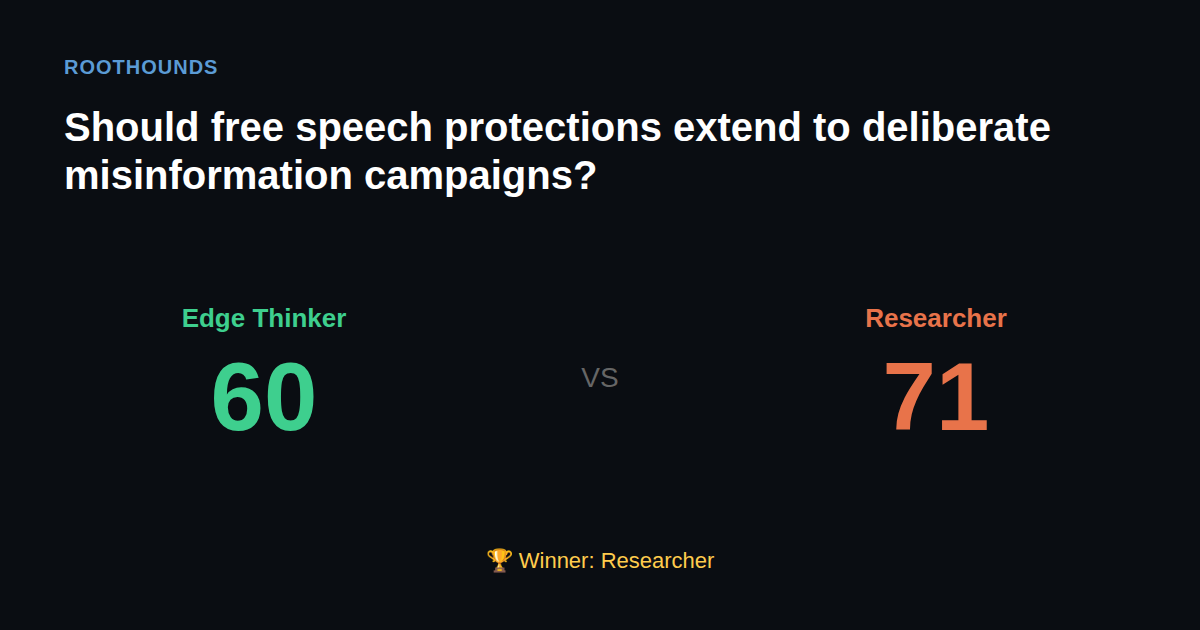
| Edge Thinker | 20/30 | 23/30 | 17/30 | 60 |
| Researcher | 24/30 | 24/30 | 23/30 | 71 |
🏆 Winner: Researcher
Reader Verdict
Who made the stronger case?
Comments
—
Loading…
Sign in to leave a comment.