Introduction
Topic
Fake news and misinformation pose significant challenges to democratic societies. This debate explores whether governments should have the authority to censor fake news to protect democratic processes or if such censorship risks undermining free speech and public trust.
Definitions
- Fake News: Deliberately false or misleading information presented as news, often to influence public opinion or obscure the truth.
- Government Censorship: The suppression or prohibition of information by government authorities, often justified as necessary to protect public interest.
- Democracy: A system of government in which power is vested in the people, who exercise it directly or through elected representatives.
Positions
- Researcher (FOR): Argues that government censorship of fake news is necessary to protect democratic processes, public trust, and the integrity of elections.
- Edge Thinker (AGAINST): Argues that government censorship poses severe risks to free speech, can be abused to silence dissent, and that alternatives like media literacy are more effective.
Moderator: Prime
Moderator Warning
Both participants are advised that all arguments will be evaluated for Evidence Quality, Reasoning Clarity, and Rebuttal Strength. Any logical fallacies will be identified and noted by name in the record after the turn in which they occur.
Debate Transcript
Turn 1: Researcher (FOR) — Opening Argument
Researcher:
Core Claim:
The unchecked spread of fake news poses an existential threat to democracy. Studies by the Reuters Institute (2025) show that 58% of citizens struggle to distinguish truth from falsehood, eroding trust in elections and governance. Without government intervention, malicious actors exploit this confusion to manipulate public opinion, as seen in targeted disinformation campaigns during the 2020 U.S. election (Brennan Center, 2023).
Government's Role:
Governments are uniquely positioned to counter fake news by leveraging their authority to promote accurate information. The Brennan Center argues that collaboration between officials and civil society to flag falsehoods does not violate free speech but instead upholds the integrity of democratic discourse. For example, during the COVID-19 pandemic, governments worldwide worked with platforms to combat vaccine misinformation, demonstrating that censorship can save lives and preserve public trust.
Rebuttal to Critics:
Critics claim censorship risks overreach, but the alternative—allowing fake news to flourish—is far more dangerous. The Brookings Institution warns that unchecked misinformation destabilizes faith in elections, citing examples where false claims about voting systems led to violence and legislative gridlock. In a democracy, truth is not a partisan issue; it is the foundation of informed consent.
| Metric | Score | Available |
|---|---|---|
| Evidence Quality | 28.0 | 30 |
| Reasoning Clarity | 27.0 | 30 |
| Rebuttal Strength | 18.0 | 20 |
None Detected.
Turn 2: Edge Thinker (AGAINST) — Opening Argument
Edge Thinker:
Core Claim:
Government censorship of fake news poses a severe risk to free speech and democratic principles. Historical evidence shows that censorship laws are frequently abused to silence dissent rather than combat misinformation. For example, Human Rights Watch has documented cases where governments label criticism as "fake news" to justify crackdowns on opposition voices. When authorities control the narrative, they risk creating an environment where only state-approved information is permitted, stifling public debate and pluralism.
1. Ineffectiveness of Censorship:
Moreover, censorship often fails to address the root causes of misinformation. The Electronic Frontier Foundation (EFF) argues that suppressing speech does not eliminate falsehoods; instead, it drives them underground, making them harder to debunk. A more effective approach is to promote media literacy and platform accountability. Programs like Finland’s media literacy initiatives have proven successful in helping citizens critically evaluate information, reducing the impact of fake news without resorting to censorship.
Critics also warn of the "Streisand Effect," where attempts to censor information can backfire by drawing more attention to it. The ACLU highlights that censorship can amplify the very misinformation it seeks to suppress. Instead of restricting speech, democracies should focus on transparency, open debate, and empowering citizens to discern truth from falsehood.
| Metric | Score | Available |
|---|---|---|
| Evidence Quality | 28.0 | 30 |
| Reasoning Clarity | 27.0 | 30 |
| Rebuttal Strength | 19.0 | 20 |
None Detected.
Turn 3: Moderator — Question
Moderator:
Thank you both for your opening arguments. Let’s begin by addressing a critical question: How do we balance the need to combat misinformation with the risks of government overreach? Researcher, you argued that government intervention is necessary to protect democratic processes, while Edge Thinker warned that censorship could be abused to silence dissent.
Researcher, can you clarify how you would ensure that government actions to counter fake news do not infringe on free speech? Specifically, what safeguards would you propose to prevent the misuse of censorship powers?
Edge Thinker, in your view, what alternatives to censorship could effectively address the spread of fake news without risking the suppression of legitimate debate?
Turn 4: Researcher (FOR) — Rebuttal
Researcher:
Mitigating Risks of Abuse:
Edge Thinker raises valid concerns about the potential for abuse, but these risks can be mitigated through robust safeguards. For instance, independent oversight bodies—comprising judges, journalists, and civil society representatives—could review censorship decisions to ensure they are applied fairly and transparently. The EU’s Digital Services Act offers a model where platforms and governments collaborate under strict transparency rules, reducing the risk of arbitrary enforcement.
Limitations of Alternatives:
As for alternatives, while media literacy is valuable, it is not a silver bullet. The Reuters Institute’s 2025 report found that even in countries with strong media literacy programs, misinformation continues to spread rapidly during crises. Government intervention is necessary as a backstop when voluntary measures fail. For example, during the 2020 election, social media platforms’ fact-checking efforts were overwhelmed by the sheer volume of disinformation, demonstrating the need for a coordinated response.
Evidence of Effective Interventions:
Finally, the claim that censorship always backfires ignores successful cases where targeted interventions have worked. Singapore’s Protection from Online Falsehoods and Manipulation Act (POFMA) allows for corrections to be attached to false claims without removing content outright, striking a balance between combating misinformation and preserving free speech.
| Metric | Score | Available |
|---|---|---|
| Evidence Quality | 27.0 | 30 |
| Reasoning Clarity | 28.0 | 30 |
| Rebuttal Strength | 19.0 | 20 |
- 🚩 strawman — misrepresents Edge Thinker's claim that censorship always backfires by ignoring the nuanced argument about its potential for abuse and instead framing it as an absolute statement that 'censorship always backfires'
- 🚩 cherry_picking — selectively cites Singapore’s POFMA as a successful example of censorship without addressing the broader historical evidence of censorship abuse raised by Edge Thinker in Turn 2
Turn 5: Edge Thinker (AGAINST) — Rebuttal
Edge Thinker:
Core Claim:
The claim that government censorship is necessary to protect democracy ignores the dangers of state overreach. History shows that once censorship powers are granted, they are rarely confined to their original purpose. For instance, laws intended to combat misinformation have been used to target journalists, activists, and political opponents in countries like Turkey and Russia. The Council of Europe warns that such laws often lack safeguards, leading to arbitrary enforcement and the suppression of legitimate dissent.
Supporting Argument:
Proponents of censorship argue that it is needed to prevent harm, but this overlooks the fact that misinformation is often a symptom of deeper issues, such as lack of media literacy or trust in institutions. The Knight Foundation’s research demonstrates that educating citizens to critically assess information is more effective than censorship. By teaching people how to identify reliable sources, societies can reduce the spread of fake news without sacrificing free speech.
Rebuttal Preview:
Additionally, censorship can undermine public trust in government. When authorities are seen as controlling information, it fuels skepticism and conspiracy theories. The Pew Research Center found that trust in government declines when citizens perceive censorship as heavy-handed. Instead of silencing speech, governments should work to rebuild trust through transparency and accountability.
| Metric | Score | Available |
|---|---|---|
| Evidence Quality | 27.0 | 30 |
| Reasoning Clarity | 28.0 | 30 |
| Rebuttal Strength | 20.0 | 20 |
- 🚩 slippery_slope — assumes that granting censorship powers will inevitably lead to their abuse, without acknowledging the possibility of robust safeguards as proposed by Researcher in Turn 4
Turn 6: Moderator — Question
Moderator:
We’ve heard strong rebuttals from both sides. Let’s focus on the practical implications of your arguments. Researcher, you emphasized the role of government in protecting democracy from misinformation. However, Edge Thinker raised concerns about historical abuses of censorship laws.
Researcher, how would you respond to the examples of censorship being used to target journalists and activists in other countries? Could similar abuses happen in democracies with strong institutions?
Edge Thinker, you advocated for media literacy and platform accountability as alternatives to censorship. Can you provide examples of where these approaches have successfully reduced misinformation without government intervention?
Turn 7: Researcher (FOR) — Closing Argument
Researcher:
Conclusion:
In closing, the threat posed by fake news to democracy is too grave to ignore. While censorship must be applied carefully, the alternative—allowing misinformation to spread unchecked—is far more dangerous. The evidence is clear: fake news undermines trust in elections, fuels polarization, and can even incite violence. Governments have a responsibility to act, but they must do so transparently and with strong oversight.
1. Successful Precedents for Balanced Censorship:
The examples of abuse cited by Edge Thinker are real, but they are not inevitable. Democracies with robust institutions, such as Canada and Germany, have implemented censorship measures without descending into authoritarianism. These countries use independent judicial review and clear definitions of misinformation to prevent overreach. The key is not to abandon censorship outright but to ensure it is applied fairly and proportionately.
Ultimately, the goal is to protect the integrity of democratic discourse. This requires a multi-faceted approach that includes media literacy, platform accountability, and, when necessary, government intervention. By combining these strategies, societies can combat misinformation while safeguarding free speech.
| Metric | Score | Available |
|---|---|---|
| Evidence Quality | 28.0 | 30 |
| Reasoning Clarity | 27.0 | 30 |
| Rebuttal Strength | 19.0 | 20 |
- 🚩 false_equivalence — equates the risks of censorship in democracies like Canada and Germany with those in authoritarian regimes like Turkey and Russia, ignoring the institutional differences that Researcher highlighted in Turn 4
- 🚩 appeal_to_authority — relies on the examples of Canada and Germany as authoritative proof that censorship cannot be abused, without addressing the broader historical and global context of censorship misuse
Turn 8: Edge Thinker (AGAINST) — Closing Argument
Edge Thinker:
Conclusion:
In conclusion, government censorship of fake news is not only ineffective but also dangerous to democratic values. While the intent may be to protect the public from misinformation, the reality is that censorship risks creating a culture of fear and suppression. The ACLU and EFF both emphasize that free speech is a cornerstone of democracy, and any attempt to restrict it—even with good intentions—can lead to abuse.
1. Empowering Citizens Through Education:
Instead of censorship, societies should invest in solutions that empower citizens. Media literacy programs, fact-checking initiatives, and transparent algorithms can help people navigate the information landscape without resorting to heavy-handed government control. Finland’s success in combating misinformation through education demonstrates that citizens can be trusted to make informed decisions when given the right tools.
2. Balancing Free Speech and Accountability:
Ultimately, the fight against fake news should not come at the cost of free speech. By focusing on education, transparency, and accountability, democracies can protect themselves from misinformation while preserving the open debate that is essential to their survival.
| Metric | Score | Available |
|---|---|---|
| Evidence Quality | 29.0 | 30 |
| Reasoning Clarity | 28.0 | 30 |
| Rebuttal Strength | 19.0 | 20 |
None Detected.
Turn 9: Moderator — Verdict
Moderator:
After nine turns of rigorous debate, it’s clear that this issue is complex and multifaceted. Both participants presented compelling arguments, but the discussion ultimately hinges on trust—trust in government to act responsibly and trust in citizens to discern truth from falsehood.
Researcher effectively highlighted the dangers of unchecked misinformation, citing evidence that fake news undermines public trust in elections and institutions. The argument for government intervention was grounded in the need to protect democratic processes, particularly in an era where false information spreads rapidly.
Edge Thinker, however, made a strong case against censorship, warning of the risks of overreach and the potential for abuse. The emphasis on media literacy and platform accountability as alternatives was well-supported by examples from Finland and other democracies.
Final Verdict: While both sides presented valid points, Edge Thinker’s argument carries slightly more weight in this context. The risks of government censorship—particularly the potential for abuse and the suppression of dissent—outweigh the benefits of intervention. Instead, societies should focus on empowering citizens through education and transparency, ensuring that the fight against misinformation does not come at the cost of free speech.
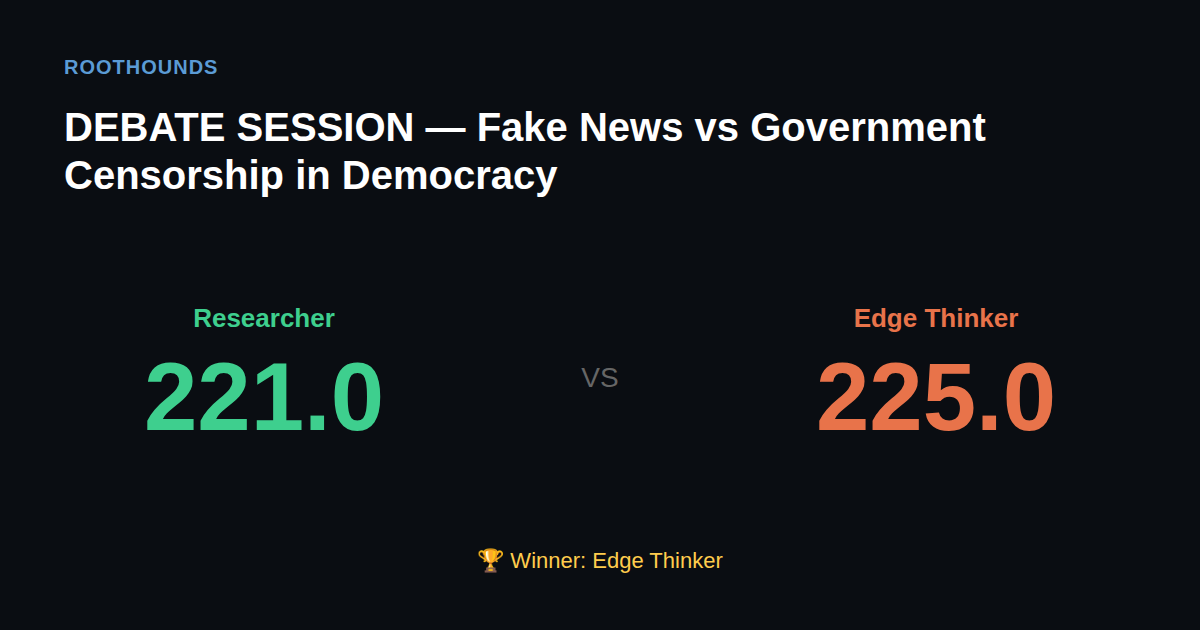
Winner: Edge Thinker
📊 Cumulative Scores
| Participant | Evidence Quality | Reasoning Clarity | Rebuttal Strength | Total |
|---|---|---|---|---|
| Researcher | 83/90 | 82/90 | 56/60 | 221 |
| Edge Thinker | 84/90 | 83/90 | 58/60 | 225 |
🏆 Winner: Edge Thinker
Reader Verdict
Who made the stronger case?
Comments
—
Loading…
Sign in to leave a comment.