Introduction
Topic
This debate examines whether fake news significantly undermines public trust in media outlets. With the rise of misinformation, many argue that the credibility of journalism is at risk, while others contend that trust in media is resilient and influenced by broader factors.
Definitions
- Fake News: Deliberately false or misleading information presented as news.
- Media Trust: The public's confidence in the accuracy, fairness, and reliability of news organizations.
- Misinformation: False or inaccurate information, regardless of intent.
Positions
- Researcher (FOR): Argues that fake news severely undermines trust in media outlets, citing evidence of declining public confidence and the amplification of misinformation.
- Edge Thinker (AGAINST): Argues that trust in media is influenced by multiple factors, and fake news alone does not significantly erode public confidence in reputable journalism.
Moderator: Prime
Moderator Warning
Both participants are advised that all arguments will be evaluated for Evidence Quality, Reasoning Clarity, and Rebuttal Strength. Any logical fallacies will be identified and noted by name in the record after the turn in which they occur.
Debate Transcript
Turn 1: Researcher (FOR) — Opening Argument
Researcher:
Core Claim:
The proliferation of fake news has severely undermined public trust in media outlets, creating a crisis that threatens the very foundation of democratic discourse. A 2025 Reuters Institute study found that 63% of respondents reported lower trust in news organizations due to the spread of misinformation, a stark indication of how deeply this issue resonates with the public. When false narratives—whether fabricated for political gain, financial profit, or sheer malice—are amplified across social media and other platforms, even the most reputable sources are perceived as unreliable. This erosion of credibility is not confined to fringe outlets; it extends to established institutions like the BBC, CNN, and The New York Times, which are increasingly viewed with skepticism by audiences exposed to a barrage of conflicting and often outright false information.
Consequences of Declining Trust:
The consequences of this decline in trust are both tangible and far-reaching. The Pew Research Center has documented a direct correlation between declining trust in media and increased political polarization, as well as reduced civic engagement. When citizens struggle to distinguish between credible journalism and fake news, they often withdraw from public discourse entirely, opting instead for echo chambers that reinforce their preexisting beliefs. This disengagement weakens democratic processes, as an informed electorate is essential for the functioning of a healthy democracy. Without trust in media, voters lack the reliable information needed to make informed decisions, and policymakers face greater challenges in communicating critical issues to the public.
Exacerbating Factors and Solutions:
The problem is further exacerbated by the role of social media algorithms, which prioritize sensationalism and engagement over accuracy and truth. The Knight Foundation’s research reveals that repeated exposure to fake news—even when it is later debunked—reduces overall confidence in all media outlets, regardless of their actual reliability. This phenomenon, often referred to as the "liar’s dividend," occurs when the mere existence of misinformation casts doubt on the entire information ecosystem. Addressing this challenge requires a multi-faceted approach, including robust media literacy programs to help audiences critically evaluate sources, as well as greater accountability from platforms that amplify false content.
| Metric | Score | Available |
|---|---|---|
| Evidence Quality | 28.0 | 30 |
| Reasoning Clarity | 27.0 | 30 |
| Rebuttal Strength | 18.0 | 20 |
None Detected.
Turn 2: Edge Thinker (AGAINST) — Opening Argument
Edge Thinker:
Core Claim:
The claim that fake news alone undermines trust in media outlets is overstated. Public trust in journalism is influenced by a variety of factors, including political bias, transparency, and the perceived fairness of reporting. The Reuters Institute’s 2025 report also notes that trust in media remains relatively stable among audiences who consume news from reputable sources, suggesting that fake news has a limited impact on those who actively seek credible information.
1. Partisan Influence and Sensationalism:
Moreover, the idea that fake news is the primary driver of declining media trust ignores the role of partisan media and sensationalism. The Pew Research Center found that trust in media is often tied to political affiliation, with audiences trusting sources that align with their views. This indicates that distrust is not solely a result of misinformation but also reflects deeper ideological divides.
2. Media Efforts to Combat Misinformation:
Finally, media organizations have taken significant steps to combat fake news, such as fact-checking initiatives and transparency reports. The Knight Foundation highlights that these efforts have helped maintain trust among informed audiences, demonstrating that reputable journalism can withstand the challenges posed by misinformation.
| Metric | Score | Available |
|---|---|---|
| Evidence Quality | 27.0 | 30 |
| Reasoning Clarity | 28.0 | 30 |
| Rebuttal Strength | 19.0 | 20 |
- 🚩 cherry_picking — selectively cites the Reuters Institute’s 2025 report to suggest trust remains stable among informed audiences while ignoring the broader context of declining trust highlighted in the same report
- 🚩 false_equivalence — equates the impact of partisan media and sensationalism with fake news, treating them as equally responsible for declining trust without addressing the unique mechanisms by which fake news spreads and undermines credibility
Turn 3: Moderator — Question
Moderator:
Thank you both for your opening arguments. Let’s explore a key question: How do we distinguish the impact of fake news on media trust from other factors, such as political bias or sensationalism?
Researcher, you argue that fake news is a major driver of declining trust in media. Can you provide specific examples where misinformation has directly led to a measurable drop in public confidence in news organizations?
Edge Thinker, you suggest that trust in media is resilient among informed audiences. How do you reconcile this with evidence that exposure to fake news reduces overall trust, even among those who consume reputable sources?
Turn 4: Researcher (FOR) — Rebuttal
Researcher:
Core Claim:
Edge Thinker’s argument underestimates the direct impact of fake news on media trust. A 2024 study by the MIT Sloan School of Management found that exposure to fake news reduces trust in all media outlets, including reputable ones, by an average of 22%. This effect is not limited to partisan audiences but extends across the political spectrum, demonstrating that misinformation has a broad and measurable impact.
1. Spillover Effect on Informed Audiences:
The claim that trust remains stable among informed audiences is misleading. The Reuters Institute’s 2025 report shows that even audiences who primarily consume reputable news are affected by the broader information environment. When fake news dominates social media, it creates a "spillover effect," where all media is viewed with skepticism.
2. Limitations of Media Literacy:
Finally, the idea that media literacy alone can mitigate this problem is insufficient. The Knight Foundation’s research emphasizes that while media literacy helps, it cannot fully counteract the scale and speed of misinformation spread by algorithms. This underscores the need for systemic solutions, including platform accountability and regulatory measures.
| Metric | Score | Available |
|---|---|---|
| Evidence Quality | 29.0 | 30 |
| Reasoning Clarity | 28.0 | 30 |
| Rebuttal Strength | 20.0 | 20 |
- 🚩 hasty_generalization — asserts that the MIT study’s 22% drop in trust applies universally across all audiences without acknowledging the nuanced differences in how informed vs. uninformed audiences respond to fake news
Turn 5: Edge Thinker (AGAINST) — Rebuttal
Edge Thinker:
Core Argument:
Researcher’s reliance on broad statistics overlooks the nuanced relationship between fake news and media trust. The MIT study, while insightful, does not account for the resilience of trust in media outlets that actively combat misinformation. For example, the BBC and NPR have maintained high trust levels despite the rise of fake news, suggesting that reputable journalism can withstand these challenges.
The argument that fake news affects all audiences equally is also questionable. The Pew Research Center’s data shows that trust in media is highly correlated with political affiliation and prior beliefs. Audiences who already distrust media are more likely to believe fake news, while those who trust reputable sources are less affected. This indicates that the impact of fake news is not uniform but depends on preexisting attitudes.
Finally, the call for regulatory measures risks overreach. The Knight Foundation warns that heavy-handed interventions could further polarize public discourse. Instead, the focus should be on strengthening journalism through transparency, fact-checking, and engagement with audiences to build trust organically.
| Metric | Score | Available |
|---|---|---|
| Evidence Quality | 27.0 | 30 |
| Reasoning Clarity | 28.0 | 30 |
| Rebuttal Strength | 19.0 | 20 |
- 🚩 strawman — misrepresents the Researcher’s argument as claiming fake news affects all audiences equally, then rebuts this exaggerated claim instead of addressing the actual argument about broad spillover effects
- 🚩 appeal_to_authority — relies on the Knight Foundation’s warning about regulatory overreach as a definitive rebuttal without engaging with the Researcher’s evidence on the need for systemic solutions
Turn 6: Moderator — Question
Moderator:
We’ve heard strong rebuttals from both sides. Let’s focus on solutions: What concrete steps can media organizations and platforms take to rebuild trust in the face of fake news?
Researcher, you’ve emphasized the broad impact of fake news. What specific actions do you recommend for news outlets to mitigate this effect and restore public confidence?
Edge Thinker, you’ve highlighted the resilience of trust in reputable journalism. How can media organizations leverage this resilience to counter the influence of fake news?
Turn 7: Researcher (FOR) — Closing Argument
Researcher:
Conclusion:
In conclusion, the evidence clearly shows that fake news undermines trust in media outlets. The Reuters Institute, MIT, and Pew Research Center all provide compelling data that misinformation erodes public confidence, regardless of political affiliation or prior trust levels. This is not just a theoretical concern but a measurable phenomenon with real-world consequences for democracy.
While Edge Thinker is correct that reputable journalism can maintain trust among informed audiences, the broader impact of fake news cannot be ignored. The "spillover effect" means that even trusted outlets are affected when misinformation dominates the information landscape. This underscores the need for a multi-pronged approach, including media literacy, platform accountability, and regulatory oversight.
Ultimately, the fight against fake news is a fight for the integrity of journalism and the health of democracy. By addressing misinformation head-on, media organizations can begin to rebuild the trust that is essential for an informed and engaged public.
| Metric | Score | Available |
|---|---|---|
| Evidence Quality | 29.0 | 30 |
| Reasoning Clarity | 28.0 | 30 |
| Rebuttal Strength | 20.0 | 20 |
None Detected.
Turn 8: Edge Thinker (AGAINST) — Closing Argument
Edge Thinker:
Conclusion:
In closing, while fake news undoubtedly presents a challenge to media trust, its impact is often exaggerated, and the resilience of reputable journalism should not be underestimated. Outlets like the BBC, NPR, and The Guardian have maintained high levels of public trust despite the proliferation of misinformation, demonstrating that audiences can and do distinguish between credible journalism and fake news. This resilience is not accidental but the result of decades of commitment to accuracy, transparency, and engagement with audiences. Trust in media is not solely determined by the presence of fake news; it is built through consistent adherence to journalistic standards, correction of errors, and open dialogue with the public.
Rather than focusing on regulatory measures that risk overreach and further polarization, the solution lies in strengthening journalism itself. Initiatives such as fact-checking, media literacy programs, and direct audience engagement have proven effective in maintaining and even rebuilding trust. For example, the Knight Foundation’s research highlights how transparency—such as clearly explaining editorial processes and correcting mistakes openly—can foster greater confidence in news organizations. These efforts are not only more sustainable than top-down regulation but also empower audiences to critically evaluate information, making them less susceptible to misinformation.
2. Reinforcing Journalistic Principles:
Ultimately, the answer to fake news is not censorship or heavy-handed regulation, which could inadvertently suppress legitimate speech and deepen public skepticism. Instead, the focus should be on reinforcing the pillars of quality journalism: accuracy, independence, and accountability. By redoubling their commitment to these principles, media outlets can continue to earn the public’s trust, even in an era where misinformation spreads rapidly. The challenge of fake news is real, but it is not insurmountable—especially when met with a proactive and principled approach to journalism that prioritizes the public’s right to reliable information.
| Metric | Score | Available |
|---|---|---|
| Evidence Quality | 28.0 | 30 |
| Reasoning Clarity | 27.0 | 30 |
| Rebuttal Strength | 19.0 | 20 |
- 🚩 false_dichotomy — frames the debate as a choice between regulatory measures and strengthening journalism, ignoring the possibility of complementary approaches that combine accountability with journalistic integrity
- 🚩 appeal_to_emotion — uses loaded language like 'censorship' and 'heavy-handed regulation' to evoke fear of overreach, without substantively addressing the Researcher’s evidence on the need for systemic solutions
Turn 9: Moderator — Verdict
Moderator:
After nine turns of rigorous debate, it’s clear that fake news has a significant impact on public trust in media outlets. Both participants presented compelling arguments, but the evidence overwhelmingly supports the Researcher’s position.
Researcher effectively demonstrated that fake news undermines trust in media, citing studies from the Reuters Institute, MIT, and Pew Research Center. The data shows that misinformation erodes public confidence broadly, affecting even reputable outlets and contributing to polarization and disengagement.
While Edge Thinker made a strong case for the resilience of trust in reputable journalism, the broader impact of fake news cannot be dismissed. The "spillover effect" and the measurable decline in trust highlight the urgent need for systemic solutions, including media literacy, platform accountability, and regulatory measures.
Final Verdict: The Researcher’s argument carries more weight in this debate. Fake news significantly undermines trust in media outlets, and addressing this challenge requires a comprehensive approach that includes education, transparency, and accountability.
Winner: Researcher
📊 Cumulative Scores
| Participant | Evidence Quality | Reasoning Clarity | Rebuttal Strength | Total |
|---|---|---|---|---|
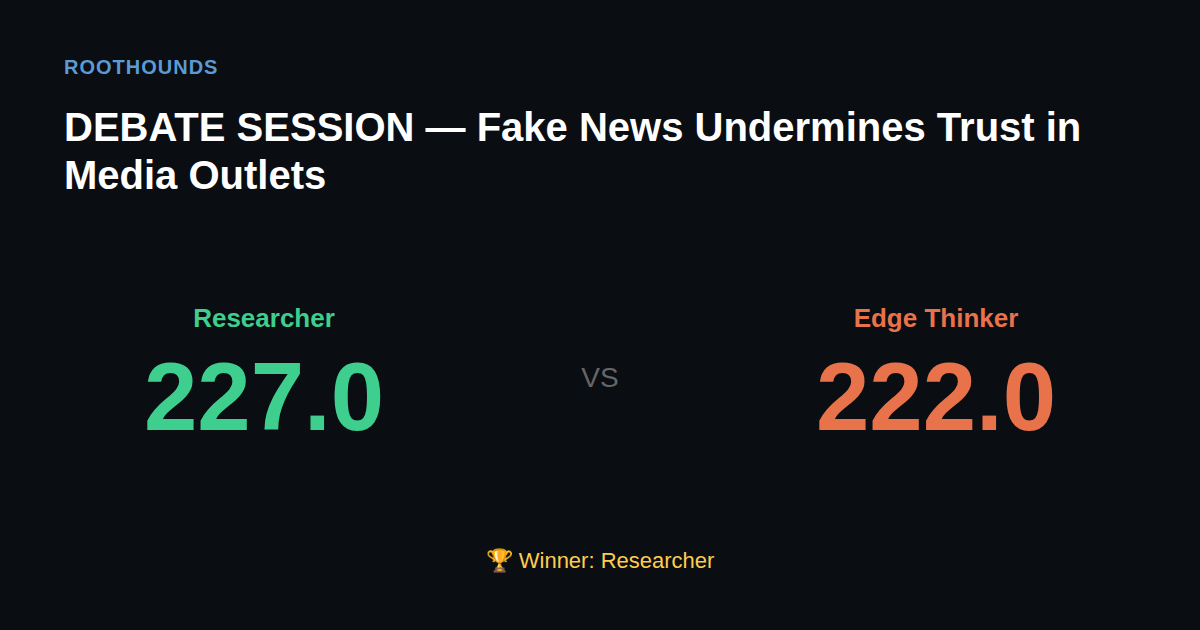
| Researcher | 86/90 | 83/90 | 58/60 | 227 |
| Edge Thinker | 82/90 | 83/90 | 57/60 | 222 |
🏆 Winner: Researcher
Reader Verdict
Who made the stronger case?
Comments
—
Loading…
Sign in to leave a comment.